

EN 17339:2024/prA1
(Amendment)Transportable gas cylinders - Hoop wrapped and fully wrapped carbon composite cylinders and tubes for hydrogen
General Information
- Abstract
This document specifies minimum requirements for the materials, design, construction, prototype testing and routine manufacturing inspections of composite gas cylinders and tubes for compressed hydrogen.
NOTE 1 Unless specified in the text, for the purposes of this document, the word “cylinder” includes tubes.
This document applies to
- fully wrapped composite cylinders (Type 3 and Type 4)
- hoop wrapped cylinders (Type 2)
with carbon fibres intended to be permanently mounted in a frame (e.g. bundle or trailer) with a test pressure of not less than 300 bar, with:
— non-metallic liners (for Type 4) or seamless metallic liners (for Type 2 and Type 3),
— a maximum water capacity of 3 000 l
— a maximum working pressure of 1 000 bar.
— the product of working pressure times water capacity (p x V) not exceeding 1 000 000 bar.l.
NOTE 2 A glass fibre protective layer is sometimes applied to the external surface of the cylinder
- Status
- Not Published
- Publication Date
- 10-Aug-2027
- Technical Committee
- CEN/TC 23 - Transportable gas cylinders
- Drafting Committee
- CEN/TC 23/WG 16 - Fully wrapped composite cylinders
- Current Stage
- 4060 - Closure of enquiry - Enquiry
- Start Date
- 27-Aug-2026
- Due Date
- 17-Jun-2026
- Completion Date
- 27-Aug-2026

Overview
EN 17339:2024/prA1 sets forth the minimum requirements for the materials, design, construction, prototype testing, and routine manufacturing inspections of carbon composite gas cylinders and tubes used for the storage and transport of compressed hydrogen. This European Standard, developed by CEN, covers hoops wrapped (Type 2) and fully wrapped (Type 3 and Type 4) composite cylinders manufactured with carbon fibre reinforcements. The standard applies to gas cylinders and tubes intended for permanent installation in frame-mounted setups such as bundles or trailers, operating at test pressures of at least 300 bar and maximum working pressures up to 1000 bar.
The document ensures uniformity and safety in manufacturing hydrogen cylinders, which is critical as hydrogen fuel becomes increasingly important in transportation, industry, and energy storage applications.
Key Topics
Types of Cylinders Covered:
- Type 2: Hoop wrapped with seamless metallic liners.
- Type 3: Fully wrapped with seamless metallic liners.
- Type 4: Fully wrapped with non-metallic liners.
Performance Criteria:
- Maximum water capacity: 3000 liters
- Maximum working pressure: 1000 bar
- Product of working pressure and water capacity (p × V): ≤ 1,000,000 bar·l
Material Requirements:
- Specifications for carbon fibres and, where applicable, glass fibre protective layers on the cylinder exterior for added durability.
Manufacturing and Testing:
- Prototype and production batch testing for tensile strength, modulus, elongation, and other material properties to ensure compliance.
- Procedures for hydraulic pressurization cycle testing at temperatures ranging from 65°C to –40°C.
- Requirements for permanent cylinder components and their role in safety and impact resistance.
Certification and Documentation:
- Provision of type test certificates and documentation of material property tests per batch, supporting traceability and regulatory compliance.
Applications
EN 17339:2024/prA1 is an essential reference for manufacturers, quality assessors, and end users of high-pressure hydrogen storage cylinders and tubes. Practical applications include:
- Hydrogen Fueling Stations: Providing safe, standardized storage solutions for compressed hydrogen, supporting the rollout of hydrogen-powered vehicles.
- Transport and Mobility: Enabling the use of lightweight, high-strength hydrogen cylinders in commercial transport fleets, buses, trucks, and emerging hydrogen rail and marine vehicles.
- Industrial Hydrogen Supply: Ensuring conformity and safety in the bulk transport and onsite storage of hydrogen for industrial processes, laboratories, and energy storage systems.
- Trailer Bundles: Standardizing the design and inspection of frames and bundles used for large-volume hydrogen transportation by road.
The standard promotes the safe, efficient, and sustainable use of hydrogen storage technology - a core component of the evolving clean energy ecosystem.
Related Standards
Those working with or implementing EN 17339:2024/prA1 may also benefit from familiarity with related standards, including:
- EN ISO 11119 Series: Cylinders for the transport of dangerous goods - Refillable composite cylinders and tubes.
- EN 12245: Transportable gas cylinders - Fully wrapped composite cylinders.
- EN 12257: Transportable gas cylinders - Seamless and composite tubes.
- ISO 19884: Gaseous hydrogen - Cylinders and tubes for stationary storage.
- ISO 11114: Gas cylinders - Compatibility of cylinder and valve materials with gas contents.
Adhering to EN 17339:2024/prA1 facilitates harmonization with international best practices for gas cylinder safety, supporting regulatory approval and market acceptance across Europe and globally.
Keywords: hydrogen cylinders, carbon composite gas cylinders, transportable hydrogen storage, safety standard, CEN, cylinder testing, high-pressure gas cylinder, Type 2 Type 3 Type 4 cylinders, prototype testing, gas cylinder manufacturing.
Relations
- Effective Date
- 21-May-2025
Get Certified
Connect with accredited certification bodies for this standard

Institut za varilstvo d.o.o. (Welding Institute)
Slovenia's leading welding institute since 1952. ISO 3834, EN 1090, pressure equipment certification, NDT personnel, welder qualification. Only IIW Au
Sponsored listings
Frequently Asked Questions
EN 17339:2024/prA1 is a draft published by the European Committee for Standardization (CEN). Its full title is "Transportable gas cylinders - Hoop wrapped and fully wrapped carbon composite cylinders and tubes for hydrogen". This standard covers: This document specifies minimum requirements for the materials, design, construction, prototype testing and routine manufacturing inspections of composite gas cylinders and tubes for compressed hydrogen. NOTE 1 Unless specified in the text, for the purposes of this document, the word “cylinder” includes tubes. This document applies to - fully wrapped composite cylinders (Type 3 and Type 4) - hoop wrapped cylinders (Type 2) with carbon fibres intended to be permanently mounted in a frame (e.g. bundle or trailer) with a test pressure of not less than 300 bar, with: — non-metallic liners (for Type 4) or seamless metallic liners (for Type 2 and Type 3), — a maximum water capacity of 3 000 l — a maximum working pressure of 1 000 bar. — the product of working pressure times water capacity (p x V) not exceeding 1 000 000 bar.l. NOTE 2 A glass fibre protective layer is sometimes applied to the external surface of the cylinder
This document specifies minimum requirements for the materials, design, construction, prototype testing and routine manufacturing inspections of composite gas cylinders and tubes for compressed hydrogen. NOTE 1 Unless specified in the text, for the purposes of this document, the word “cylinder” includes tubes. This document applies to - fully wrapped composite cylinders (Type 3 and Type 4) - hoop wrapped cylinders (Type 2) with carbon fibres intended to be permanently mounted in a frame (e.g. bundle or trailer) with a test pressure of not less than 300 bar, with: — non-metallic liners (for Type 4) or seamless metallic liners (for Type 2 and Type 3), — a maximum water capacity of 3 000 l — a maximum working pressure of 1 000 bar. — the product of working pressure times water capacity (p x V) not exceeding 1 000 000 bar.l. NOTE 2 A glass fibre protective layer is sometimes applied to the external surface of the cylinder
EN 17339:2024/prA1 is classified under the following ICS (International Classification for Standards) categories: 23.020.35 - Gas cylinders. The ICS classification helps identify the subject area and facilitates finding related standards.
EN 17339:2024/prA1 has the following relationships with other standards: It is inter standard links to EN 17339:2024. Understanding these relationships helps ensure you are using the most current and applicable version of the standard.
EN 17339:2024/prA1 is associated with the following European legislation: EU Directives/Regulations: 2008/68/EC; Standardization Mandates: M/TDG. When a standard is cited in the Official Journal of the European Union, products manufactured in conformity with it benefit from a presumption of conformity with the essential requirements of the corresponding EU directive or regulation.
EN 17339:2024/prA1 is available in PDF format for immediate download after purchase. The document can be added to your cart and obtained through the secure checkout process. Digital delivery ensures instant access to the complete standard document.
Standards Content (Sample)
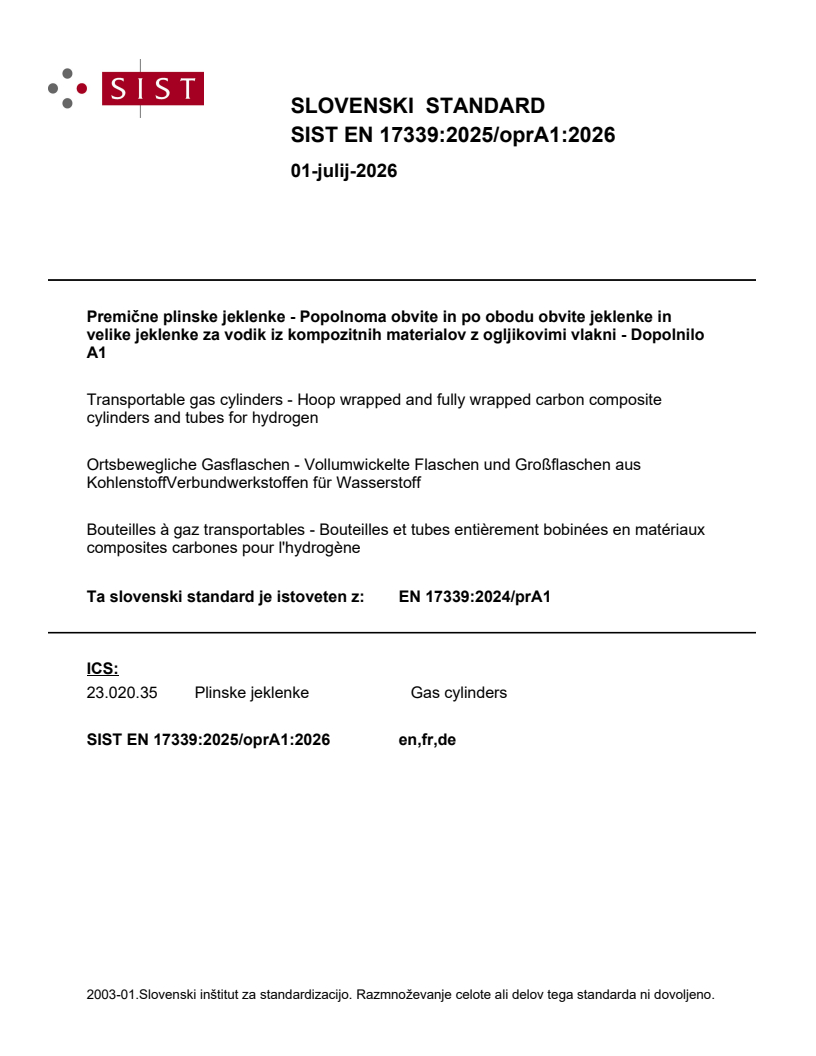
SLOVENSKI STANDARD
01-julij-2026
Premične plinske jeklenke - Popolnoma obvite in po obodu obvite jeklenke in
velike jeklenke za vodik iz kompozitnih materialov z ogljikovimi vlakni - Dopolnilo
A1
Transportable gas cylinders - Hoop wrapped and fully wrapped carbon composite
cylinders and tubes for hydrogen
Ortsbewegliche Gasflaschen - Vollumwickelte Flaschen und Großflaschen aus
KohlenstoffVerbundwerkstoffen für Wasserstoff
Bouteilles à gaz transportables - Bouteilles et tubes entièrement bobinées en matériaux
composites carbones pour l'hydrogène
Ta slovenski standard je istoveten z: EN 17339:2024/prA1
ICS:
23.020.35 Plinske jeklenke Gas cylinders
2003-01.Slovenski inštitut za standardizacijo. Razmnoževanje celote ali delov tega standarda ni dovoljeno.
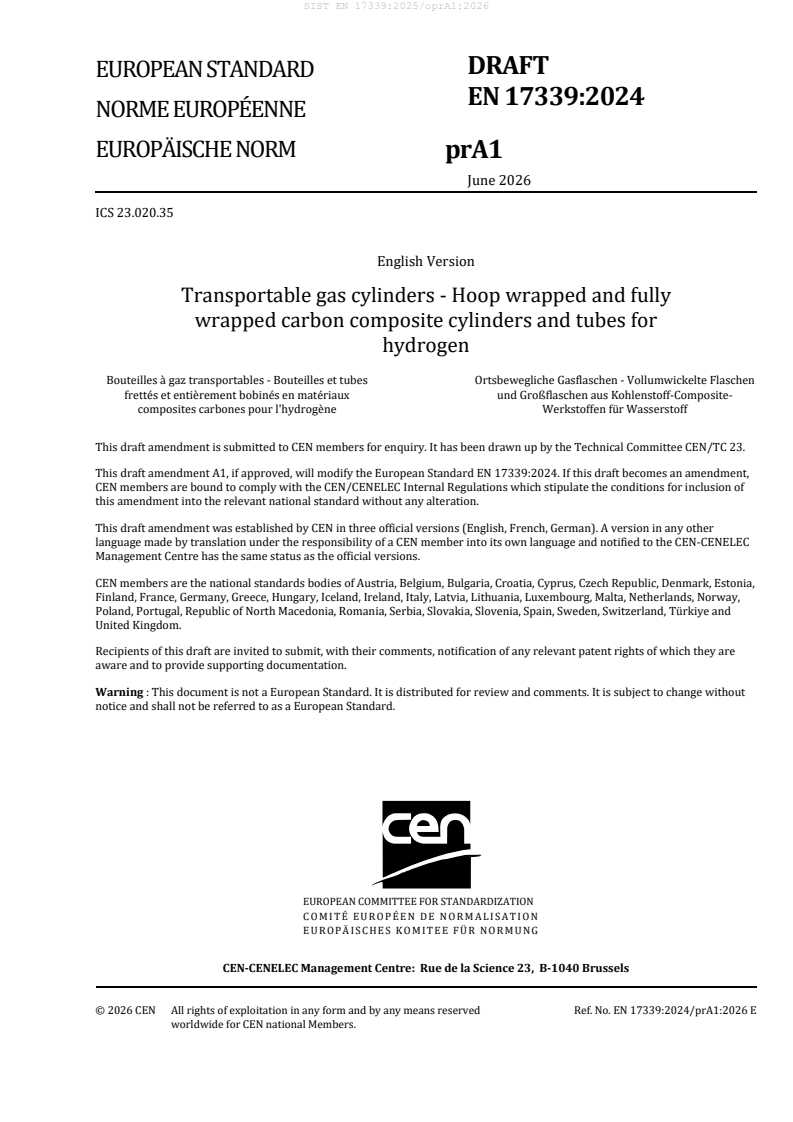
DRAFT
EUROPEAN STANDARD
EN 17339:2024
NORME EUROPÉENNE
EUROPÄISCHE NORM
prA1
June 2026
ICS 23.020.35
English Version
Transportable gas cylinders - Hoop wrapped and fully
wrapped carbon composite cylinders and tubes for
hydrogen
Bouteilles à gaz transportables - Bouteilles et tubes Ortsbewegliche Gasflaschen - Vollumwickelte Flaschen
frettés et entièrement bobinés en matériaux und Großflaschen aus Kohlenstoff-Composite-
composites carbones pour l'hydrogène Werkstoffen für Wasserstoff
This draft amendment is submitted to CEN members for enquiry. It has been drawn up by the Technical Committee CEN/TC 23.
This draft amendment A1, if approved, will modify the European Standard EN 17339:2024. If this draft becomes an amendment,
CEN members are bound to comply with the CEN/CENELEC Internal Regulations which stipulate the conditions for inclusion of
this amendment into the relevant national standard without any alteration.
This draft amendment was established by CEN in three official versions (English, French, German). A version in any other
language made by translation under the responsibility of a CEN member into its own language and notified to the CEN-CENELEC
Management Centre has the same status as the official versions.
CEN members are the national standards bodies of Austria, Belgium, Bulgaria, Croatia, Cyprus, Czech Republic, Denmark, Estonia,
Finland, France, Germany, Greece, Hungary, Iceland, Ireland, Italy, Latvia, Lithuania, Luxembourg, Malta, Netherlands, Norway,
Poland, Portugal, Republic of North Macedonia, Romania, Serbia, Slovakia, Slovenia, Spain, Sweden, Switzerland, Türkiye and
United Kingdom.
Recipients of this draft are invited to submit, with their comments, notification of any relevant patent rights of which they are
aware and to provide supporting documentation.
Warning : This document is not a European Standard. It is distributed for review and comments. It is subject to change without
notice and shall not be referred to as a European Standard.
EUROPEAN COMMITTEE FOR STANDARDIZATION
COMITÉ EUROPÉEN DE NORMALISATION
EUROPÄISCHES KOMITEE FÜR NORMUNG
CEN-CENELEC Management Centre: Rue de la Science 23, B-1040 Brussels
© 2026 CEN All rights of exploitation in any form and by any means reserved Ref. No. EN 17339:2024/prA1:2026 E
worldwide for CEN national Members.
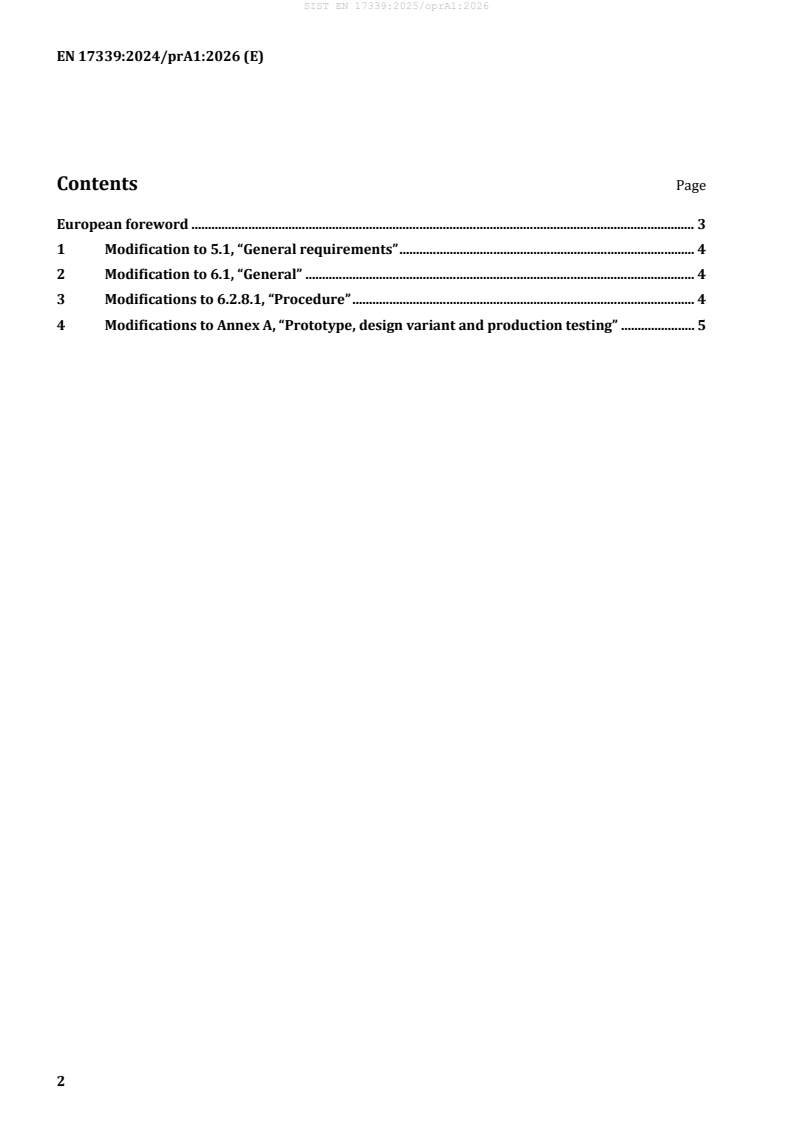
Contents Page
European foreword . 3
1 Modification to 5.1, “General requirements” . 4
2 Modification to 6.1, “General” .
...