

EN 15312:2007+A1:2010
(Main + Amendment)Free access multi-sports equipment - Requirements, including safety and test methods
- Abstract
This European Standard is applicable to free access multi-sports equipment and combinations intended for permanent installation (not temporary), which includes, but not exclusively, equipment for sports such as badminton, basketball, football, handball, hockey, table tennis, tennis, volleyball.
This European Standard specifies requirements, including safety, for the equipment itself as well as for its in-stallation, inspection and maintenance. This European Standard is applicable to multi-sports equipment intended for individual and collective public use primarily by children and teenagers.
This type of equipment is not intended for use by very young children, e.g. less than 36 months.
This European Standard is not applicable to playground equipment as defined in EN 1176-1, free access fa-cilities used for roller sports equipment (see EN 14974), fitness trails, artificial climbing structures (see
EN 12572-1, EN 12572-2 and EN 12572-3).
This European Standard does not deal with beach equipment, the ground surfaces the local environment and any feature outside the multi-sports equipment.
This European Standard does not include any specific requirements other than for access and egress for dis-abled users.
- Status
- Withdrawn
- Publication Date
- 31-Aug-2010
- Withdrawal Date
- 06-Oct-2026
- Technical Committee
- CEN/TC 136 - Sports, playground and other recreational equipment
- Drafting Committee
- CEN/TC 136/WG 22 - Gymnastic and playing field equipment
- Current Stage
- 9960 - Withdrawal effective - Withdrawal
- Start Date
- 18-Mar-2026
- Completion Date
- 07-Oct-2026

Overview
EN 15312:2007+A1:2010 is a CEN European Standard for free access multi-sports equipment intended for permanent installation in public settings. It defines safety requirements and test methods for multi-sports installations used primarily by children and teenagers (not intended for children under 36 months). The standard covers equipment for sports such as badminton, basketball, football, handball, hockey, table tennis, tennis and volleyball, and addresses the equipment itself plus installation, inspection and maintenance requirements.
Key Topics and Requirements
- Scope and applicability: Permanent, free-access multi-sports equipment for public use; excludes playground equipment, roller-sport facilities, fitness trails, artificial climbing structures and beach equipment.
- Materials and finish: Requirements for durable, weather-resistant materials and appropriate surface finishes to reduce injury risk and corrosion.
- Structural integrity and foundations: Design, calculation and testing provisions to ensure static stability and resistance to expected loads (see Annexes on loads and structural calculation).
- Protection against entrapment and movement injuries: Tests and pass/fail criteria for finger, head and neck entrapment and for moving parts.
- Connections and consumable parts: Specification for secure connections, replaceable wear components (chains, ropes), and fixation of nets and posts.
- Accessibility and user access/egress: Requirements for access including consideration of disabled users where applicable.
- Specific equipment requirements: Detailed sub-sections for basketball equipment (rings, rigidity, stability), goals, nets, multi-sports surrounds/ball stop screens and table tennis tables.
- Test methods and reporting: Annexes cover test methods for loads, structural testing, entrapment tests, impact resistance (e.g., football impact), and required test reports.
- Information/marking: Manufacturer/supplier information, installation guidance, inspection & maintenance instructions and product marking requirements.
Practical Applications
- Use EN 15312:2007+A1:2010 when specifying or procuring public multi-sports facilities to ensure safety compliance.
- Guides manufacturers in design, material selection, testing and documentation for multi-sports equipment.
- Helps installers and civil engineers confirm correct foundations, anchoring and permanent installation procedures.
- Enables testing laboratories and maintenance teams to perform standardized structural, entrapment and impact tests and to set inspection schedules.
- Supports local authorities, schools and sports facility managers in risk management and safety certification.
Who Should Use This Standard
- Manufacturers of multi-sports equipment
- Product designers and structural engineers
- Testing laboratories and certification bodies
- Municipalities, schools and sports facility operators
- Installers and maintenance personnel
Related Standards
- EN 1176 (playground equipment) - different scope (playgrounds)
- EN 14974 (roller sports facilities) - excludes roller-sport equipment
- EN 12572 series (artificial climbing structures) - excluded from this standard
Keywords: EN 15312:2007+A1:2010, free access multi-sports equipment, safety, test methods, CEN, installation, inspection, maintenance, public sports facilities.
Relations
- Effective Date
- 18-Jan-2023
- Effective Date
- 18-Jan-2023
- Replaced By
EN 15312:2026 - Free access multi-sports equipment - Safety requirements and test methods - Effective Date
- 13-Dec-2023
- Effective Date
- 25-Mar-2026
- Effective Date
- 25-Mar-2026
- Effective Date
- 28-Jan-2026
- Effective Date
- 28-Jan-2026
- Effective Date
- 28-Jan-2026
- Effective Date
- 28-Jan-2026
- Effective Date
- 28-Jan-2026
- Effective Date
- 28-Jan-2026
- Refers
EN ISO 1806:2002 - Fishing nets - Determination of mesh breaking force of netting (ISO 1806:2002) - Effective Date
- 28-Jan-2026
- Effective Date
- 28-Jan-2026
- Refers
EN 1991-1-4:2005 - Eurocode 1: Actions on structures - Part 1-4: General actions - Wind actions - Effective Date
- 28-Jan-2026
- Effective Date
- 28-Jan-2026
Frequently Asked Questions
EN 15312:2007+A1:2010 is a standard published by the European Committee for Standardization (CEN). Its full title is "Free access multi-sports equipment - Requirements, including safety and test methods". This standard covers: This European Standard is applicable to free access multi-sports equipment and combinations intended for permanent installation (not temporary), which includes, but not exclusively, equipment for sports such as badminton, basketball, football, handball, hockey, table tennis, tennis, volleyball. This European Standard specifies requirements, including safety, for the equipment itself as well as for its in-stallation, inspection and maintenance. This European Standard is applicable to multi-sports equipment intended for individual and collective public use primarily by children and teenagers. This type of equipment is not intended for use by very young children, e.g. less than 36 months. This European Standard is not applicable to playground equipment as defined in EN 1176-1, free access fa-cilities used for roller sports equipment (see EN 14974), fitness trails, artificial climbing structures (see EN 12572-1, EN 12572-2 and EN 12572-3). This European Standard does not deal with beach equipment, the ground surfaces the local environment and any feature outside the multi-sports equipment. This European Standard does not include any specific requirements other than for access and egress for dis-abled users.
This European Standard is applicable to free access multi-sports equipment and combinations intended for permanent installation (not temporary), which includes, but not exclusively, equipment for sports such as badminton, basketball, football, handball, hockey, table tennis, tennis, volleyball. This European Standard specifies requirements, including safety, for the equipment itself as well as for its in-stallation, inspection and maintenance. This European Standard is applicable to multi-sports equipment intended for individual and collective public use primarily by children and teenagers. This type of equipment is not intended for use by very young children, e.g. less than 36 months. This European Standard is not applicable to playground equipment as defined in EN 1176-1, free access fa-cilities used for roller sports equipment (see EN 14974), fitness trails, artificial climbing structures (see EN 12572-1, EN 12572-2 and EN 12572-3). This European Standard does not deal with beach equipment, the ground surfaces the local environment and any feature outside the multi-sports equipment. This European Standard does not include any specific requirements other than for access and egress for dis-abled users.
EN 15312:2007+A1:2010 is classified under the following ICS (International Classification for Standards) categories: 97.220.40 - Outdoor and water sports equipment. The ICS classification helps identify the subject area and facilitates finding related standards.
EN 15312:2007+A1:2010 has the following relationships with other standards: It is inter standard links to EN 15312:2007, EN 15312:2007/FprA1, EN 15312:2026, EN 1991-1-4:2026, ISO 8793:1986, EN 1991-1-5:2025, EN 636:2012+A1:2015, EN ISO 2062:2009, EN ISO 2307:2019, EN 1271:2014, EN 1991-1-3:2025, EN ISO 1806:2002, EN 1176-1:2008, EN 1991-1-4:2005, EN ISO 23659:2022. Understanding these relationships helps ensure you are using the most current and applicable version of the standard.
EN 15312:2007+A1:2010 is available in PDF format for immediate download after purchase. The document can be added to your cart and obtained through the secure checkout process. Digital delivery ensures instant access to the complete standard document.
Standards Content (Sample)
2003-01.Slovenski inštitut za standardizacijo. Razmnoževanje celote ali delov tega standarda ni dovoljeno.Frei zugängliche Multisportgeräte - Anforderungen, einschließlich Sicherheit und PrüfverfahrenEquipements sportifs en accès libre - Exigences, y compris de sécurité et méthodes d'essaiFree access multi-sports equipment - Requirements, including safety and test methods97.220.40Oprema za športe na prostem in vodne športeOutdoor and water sports equipmentICS:Ta slovenski standard je istoveten z:EN 15312:2007+A1:2010SIST EN 15312:2007+A1:2010en,fr,de01-december-2010SIST EN 15312:2007+A1:2010SLOVENSKI
STANDARD
EUROPEAN STANDARD NORME EUROPÉENNE EUROPÄISCHE NORM
EN 15312:2007+A1
September 2010 ICS 97.220.40 Supersedes EN 15312:2007English Version
Free access multi-sports equipment - Requirements, including safety and test methods
Equipements sportifs en accès libre - Exigences, y compris de sécurité et méthodes d'essai
Frei zugängliche Multisportgeräte – Anforderungen, einschließlich Sicherheit und Prüfverfahren This European Standard was approved by CEN on 23 December 2006 and includes Amendment 1 approved by CEN on 30 July 2010.
CEN members are bound to comply with the CEN/CENELEC Internal Regulations which stipulate the conditions for giving this European Standard the status of a national standard without any alteration. Up-to-date lists and bibliographical references concerning such national standards may be obtained on application to the CEN Management Centre or to any CEN member.
This European Standard exists in three official versions (English, French, German). A version in any other language made by translation under the responsibility of a CEN member into its own language and notified to the CEN Management Centre has the same status as the official versions.
CEN members are the national standards bodies of Austria, Belgium, Bulgaria, Croatia, Cyprus, Czech Republic, Denmark, Estonia, Finland, France, Germany, Greece, Hungary, Iceland, Ireland, Italy, Latvia, Lithuania, Luxembourg, Malta, Netherlands, Norway, Poland, Portugal, Romania, Slovakia, Slovenia, Spain, Sweden, Switzerland and United Kingdom.
EUROPEAN COMMITTEE FOR STANDARDIZATION
COMITÉ EUROPÉEN DE NORMALISATION EUROPÄISCHES KOMITEE FÜR NORMUNG
Management Centre:
Avenue Marnix 17,
B-1000 Brussels © 2010 CEN All rights of exploitation in any form and by any means reserved worldwide for CEN national Members. Ref. No. EN 15312:2007+A1:2010: ESIST EN 15312:2007+A1:2010
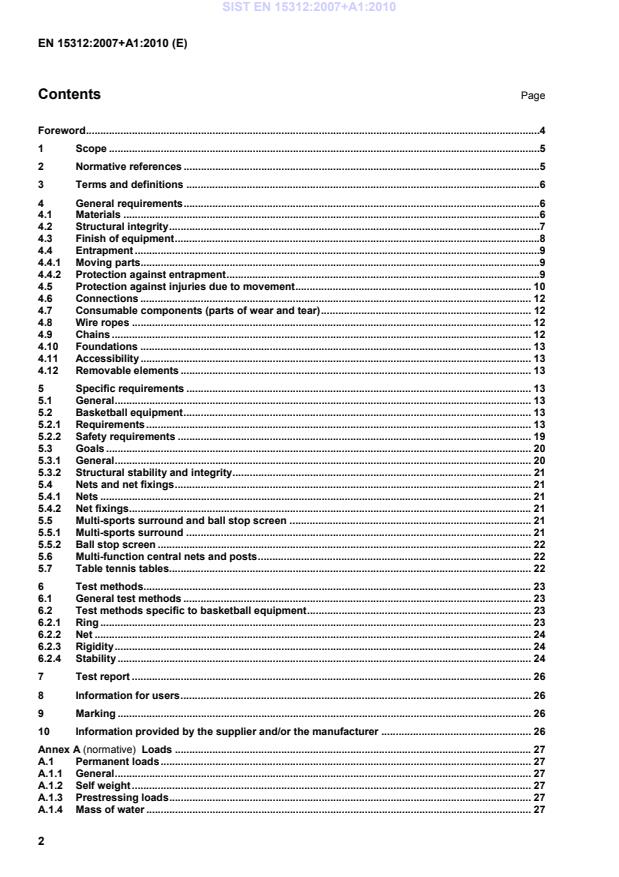
Loads . 27A.1Permanent loads . 27A.1.1General . 27A.1.2Self weight . 27A.1.3Prestressing loads . 27A.1.4Mass of water . 27SIST EN 15312:2007+A1:2010
Method of calculation of structural integrity . 33B.1General principles: Limit state . 33B.1.1Limit state . 33B.1.2Ultimate limit state . 33B.1.3Serviceability limit state. 34B.2Load combinations for static analysis . 34B.3Worked example of the calculation of user loads (without safety factors) for a surround/barrier . 34Annex C (normative)
Physical testing of structural integrity . 36C.1Pass/fail criteria . 36C.1.1Load carrying ability . 36C.1.2Failure . 36C.2Test load for equipment . 36C.2.1Load combinations for testing . 36C.2.2Safety factor for tests on identical series . 36C.2.3Safety factor for tests on a unique product . 37C.3Load application . 37C.3.1Point loads . 37C.3.2Line loads . 37C.3.3Area loads . 37Annex D (normative)
Test methods for entrapment . 38D.1!General . 38D.2Finger entrapment . 38D.2.1Apparatus . 38D.2.2Procedure . 39D.3Head and neck entrapment. 39D.3.1Completely bound openings . 39D.3.2Partially bound and V-shaped openings" . 41Annex E (normative)
Information to be provided by the supplier and/or manufacturer . 48E.1Information provided by the manufacturer of equipment . 48E.1.1General product information . 48E.1.2Pre information . 48E.1.3Installation information . 48E.1.4Inspection and maintenance information . 49Annex F (normative)
Test methods for resistance surround . 51F.1Testing repeated impact resistance to footballs and kicks . 51F.2!Impact resistance (very intense forceful kick from player)" . 52Bibliography . 53 SIST EN 15312:2007+A1:2010
!EN 12572-1, EN 12572-2 and EN 12572-3"). This European Standard does not deal with beach equipment, the ground surfaces the local environment and any feature outside the multi-sports equipment. This European Standard does not include any specific requirements other than for access and egress for dis-abled users. 2 Normative references The following referenced documents are indispensable for the application of this document. For dated refer-ences, only the edition cited applies. For undated references, the latest edition of the referenced document (including any amendments) applies. !EN 636, Plywood — Specifications" !EN 1176-1:2008", Playground equipment and surfacing — Part 1: General safety requirements and test methods EN 1271, Playing field equipment — Volleyball equipment — Functional and safety requirements, test meth-ods EN 1991-1-3, Eurocode 1 — Actions on structures — Part 1-3: General actions — Snow loads EN 1991-1-4, Eurocode 1: Actions on structures — Part 2-4: General actions — Wind actions EN 1991-1-5, Eurocode 1: Actions on structures — Part 1-5: General actions — Thermal actions !deleted text" EN ISO 1806, Fishing nets — Determination of mesh breaking force of netting (ISO 1806:2002) EN ISO 2062, Textiles — Yarns from packages — !Determination of single-end breaking force and elonga-tion at break using constant rate of extension (CRE) tester (ISO 2062:2009)" EN ISO 2307, Fibre ropes — Determination of certain physical and mechanical properties (ISO 2307:2005) ISO 8793, Steel wire ropes — Ferrule secured eye terminations SIST EN 15312:2007+A1:2010
from going in a specific direction NOTE It is important that the location of the area of play accounts for the risks of balls leaving it. If the area of play is located next to a road, a ball stop screen may minimize the risk of players having to recover the ball from the road. It is equally important that other activities (e.g. playground area, artificial climbing structure) are protected from ball impact. 4 General requirements 4.1 Materials Materials !shall" be selected and protected such that the structural integrity of the equipment manufac-tured from them is not affected before the next relevant maintenance inspection. NOTE The provisions relating to certain materials in this European Standard do not imply that other equivalent mate-rials are unsuitable in the manufacture of multi-sports equipment. The selection of materials and their use should be in accordance with the appropriate European Standards where applicable. Particular care should be taken in the choice of materials where equipment is to be used in extreme climatic or atmospheric conditions. Where very low or very high temperatures can be anticipated care should be taken with material selection to avoid possible hazards through direct skin contact. !In the choice of a material or substance for equipment, consideration should be given to the eventual dis-posal of the material or substance having regard to any possible environmental toxic hazard." SIST EN 15312:2007+A1:2010
Key 1 part of the load to be removed because of favourable effects Figure 1 — Example of removal of that part of the user load which causes a favourable effect 4.3 Finish of equipment Wooden equipment shall be made of wood with a low susceptibility to splintering. The surface finish of equip-ment made of other materials (e.g. glass fibre) shall be non-splintering. Rough surfaces should not present any risk of injury. There shall be no protruding nails, projecting wire, rope terminations or pointed or hard and sharp-edged parts within any accessible part of the equipment. Corners, edges and projecting parts within any accessible part of the equipment that project more than 8 mm, and which are not shielded by adjacent areas that are not more than 25 mm from the end of the projecting part, shall be rounded off. The minimum radius of the curve shall be 3 mm. Protruding bolt threads within any accessible part of the equipment shall be permanently covered, e.g. dome-headed nuts. Nuts and bolt heads that project less than 8 mm shall be free from burrs. All welds shall be ground smooth. NOTE Figure 2 shows examples of protection for nuts and bolts. Dimensions in millimetres
Figure 2 — Examples of protection for nuts and bolts SIST EN 15312:2007+A1:2010
Figure 3 — Examples of unexpected obstacles SIST EN 15312:2007+A1:2010
!a) Front view"
!b) Back view"
!c) Top view"
!d) Front view" Key 1 anti-cycle bar 2 multi-sports surround Figure 4 — Examples of expected obstacles SIST EN 15312:2007+A1:2010
Key 1 ferrule 2 turnbuckle Figure 5 — Examples of ferrules and turnbuckles 4.9 Chains Chains shall have a maximum opening of 8,6 mm in any one direction except where connections are made, where the maximum opening shall be greater than 18 mm or less than 8,6 mm. SIST EN 15312:2007+A1:2010
clothing/hair"." When an elevated surface abuts a multi-sports area as a spectator platform for visibility of multi-sports activi-ties, no impact attenuating surface is required within the multi-sports area if a barrier of !2 000 mm" minimum height is provided. The requirements for impact attenuating surface apply to the remaining sides of the elevated surface. NOTE The barrier is intended to prevent users gaining access to the multi-sports area either over the top or to the side of the barrier. 4.12 Removable elements If the equipment includes any elements that are designed to be removable (e.g. post, exchange of individual parts of equipment), any cavities or holes left in the surface shall be suitably covered to ensure continuity of the playing surface. 5 Specific requirements 5.1 General Equipment shall comply with general requirements of this European Standard except in so far as they are modified by this section. 5.2 Basketball equipment 5.2.1 Requirements 5.2.1.1 Classification Basketball equipment shall be classified by the design (types), the free space and typical performance crite-rion (classes) as shown in Tables 1 and 2. NOTE This classification is in line with EN 1270. Table 1 — Types Type Description Example 1 fixed wall mounted Figure 6 2 removable with sockets Figure 7 3 fixed in the ground Figure 8 4 combined basketball goal Figure 13 SIST EN 15312:2007+A1:2010
Dimensions in millimetres Class Free space
(see Figure 9) min. A 3 250 B 2 250 C 1 650 D 1 200 E 600 ≤ ≤ 1 200)
Figure 6 — Example of type 1 Figure 7 — Example of type 2 Figure 8 — Example of type 3
a) b)
!Key" !l" free space a end line of playing court 1 goal Figure 9 — Examples of free space, for simple or combined equipment SIST EN 15312:2007+A1:2010
Figure 10 — Main functional dimensions for classes h1 minus h2 shall be less than 200 mm. NOTE 1 The FIBA recommended height h1 is 3 050 mm ± 6 mm for senior players.
Figure 11 — Dimensions of backboard and marking NOTE 2 The top of the ring coincides with the top of the line of the small square. SIST EN 15312:2007+A1:2010
+ 30/– 0 1 050
+ 20/– 0 590
+ 20/– 0 450
+ 8/– 0 150
+ 0/– 2 50
any other any other — — — — — Dimensions in millimetres
Key 1 fixing plate Figure 12 — Ring 5.2.1.3 Materials The materials for the backboard shall be: synthetics or composite (for example: HPL – High Pressure Laminate); plywood in accordance !EN 636" weather approved; metal. SIST EN 15312:2007+A1:2010
1 700 N and the maximum tensile strength of the mesh, when measured according to 6.2.2 b) at least 2 040 N. 5.2.1.4.4 Framework For basketball equipment that is designed to permit height adjustment of the backboard with basket and net, locking devices shall be fitted between 3 050 mm and 2 600 mm. 5.2.1.4.5 Rigidity When tested in accordance with 6.2.3 with a force F1, the horizontal permanent deflection of the framework after removal of the test force, ready for use, from the zero position shall be not more than 10 mm. When tested in accordance with 6.2.3 with a force F3, the horizontal permanent deflection of the framework after removal of the test force, ready for use, from the zero position shall be not more than 10 mm. 5.2.1.4.6 Stability When tested in accordance with 6.2.4 with a force F2, the vertical permanent deflection of the framework after removal of the test force, ready for use, from the zero position shall be not more than 10 mm. SIST EN 15312:2007+A1:2010
Figure 13 — Example of combination SIST EN 15312:2007+A1:2010
climbing: nets with square meshes shall not have a horizontal size of more than 50 mm horizontal spacing; nets with diamond meshes shall not have a mesh size of more than 100 mm, measured from centre to centre; nets with any other type of mesh shall meet the requirements specified in 4.4.2.1.2
but restricted to the probes 1 and 2. NOTE Mesh sizes and types are defined in EN 1263-1. The upper section of the net shall be designed in such a way to prevent the user from sitting in this area." Nets shall fulfil the following load requirements: !1 080 N" minimum for mesh breaking strength (test method: EN ISO 1806); 7 000 N minimum for the rope breaking force of net head line (test method: EN ISO 2307). 5.4.2 Net fixings Net fixings shall be designed in such a way that the player cannot be hurt. NOTE This requirement may be fulfilled if e. g. external openings (i.e. on the circumference of the cross section of the uprights and the cross bar) are ≤ 8 mm or ≥ 25 mm. Net fixing shall not project into the space occupied by users during play or whilst accessing the equipment. Metal cup hooks shall not be used. If spring hooks are used as means of fixation or for the end of a rope, they shall have screw caps. 5.5 Multi-sports surround and ball stop screen 5.5.1 Multi-sports surround 5.5.1.1 General The multi-sports surround shall be at least 0,9 m in height. NOTE Given that users run into the surround during games, this is to prevent them from falling over. SIST EN 15312:2007+A1:2010
dimension of the framework of the surround (length or height) when tested in accordance with F.1 This requirement applies to the entire width of the surround and up to 2 m in height of the surround or its
entire height if the height of the surround is lower than 2 m. It is recommended that up to 3 m in height (or
entire height if the surround is lower than 3 m) of the surround²
can withstand repeated impact from balls. 5.5.1.2.2 !Very intense forceful" impact resistance to player's kicks The surround shall withstand !very intense forceful" shock from players' feet, incurring heavier impact than that from balls. NOTE This is because users are likely to run into the surround. The surround shall not show any breakage when tested in accordance with F.2. This requirement applies to the entire width of the surround and up to 1 m in height of the surround or its entire height, if the height of the surround is lower than 1 m. 5.5.1.3 Access and egress For fully enclosed facilities, there shall be at least one opening with a minimum width of 900 mm. This may be within the goal area. NOTE If access requires a change in direction the layout should not prevent a wheelchair turning to gain access. 5.5.2 Ball stop screen In the case, when a rigid ball stop screen is combined with the multi-sport surround, requirements of 4.2 apply in full up to a height of 1,5 m. In the case, when a ball stop screen is designed to yield and is combined with the surround, requirements of 4.2 apply only to the surround and to the structural supports of the ball stop-screen up to 1,5 m. In the case of a ball stop-screen, where access has not been encouraged, it is only necessary to consider self-weight and wind loading when calculating the structural integrity requirement in 4.2. 5.6 Multi-function central nets and posts !When a multi-function playing net and posts (e.g. for playing tennis, volley-ball)" are used, they shall fulfil the safety requirements of EN 1271, cla
...