

EN 15283-1:2008
(Main)Gypsum boards with fibrous reinforcement - Definitions, requirements and test methods - Part 1: Gypsum boards with mat reinforcement
- Abstract
This European Standard specifies the characteristics and performance of gypsum boards with mat reinforcement intended to be used in building construction works including those intended for secondary manufacturing operations. It includes boards designed to receive either direct surface decoration or gypsum plaster.
Gypsum boards with mat reinforcement are selected for use according to their type, size, thickness and edge profile. The boards can be used for example to provide dry lining finishes to walls, to fixed and suspended ceilings, to partitions, or as cladding to structural columns and beams. Other uses can be for floors, ventilation and smoke extraction ducts, cable trays and sheathing applications.
This European Standard covers the following product performance characteristics: reaction to fire, water vapour permeability, flexural strength, and thermal resistance.
The following performance characteristics are linked to systems assembled with gypsum boards with mat reinforcement: shear strength, fire resistance, impact resistance, direct airborne sound insulation, acoustic absorption. If required, tests should be done according to the corresponding European test methods on assembled systems simulating the end use conditions.
This European Standard also covers additional technical characteristics that are of importance for the use and acceptance of the product and the reference tests for these characteristics. It provides for the evaluation of conformity of the product to this EN.
This European Standard does not cover gypsum boards with mat reinforcement which have been subject to any secondary manufacturing operations (e.g. insulating composite panels, boards with thin lamination etc.).
Products covered by EN 520 or EN 13815 are excluded.
- Status
- Withdrawn
- Publication Date
- 19-Feb-2008
- Withdrawal Date
- 18-Aug-2009
- Technical Committee
- CEN/TC 241 - Gypsum and gypsum based products
- Drafting Committee
- CEN/TC 241/WG 3 - Board products
- Current Stage
- 9960 - Withdrawal effective - Withdrawal
- Start Date
- 19-Aug-2009
- Completion Date
- 19-Aug-2009
89/106/EEC - Construction productsOJ Ref: C, C 321 OJ Date: 16-Dec-2008

Relations
- Effective Date
- 18-Jan-2023
Get Certified
Connect with accredited certification bodies for this standard

DIBt (Deutsches Institut für Bautechnik)
German Institute for Building Technology.
DIN CERTCO
DIN Group product certification.

Aboma Certification B.V.
Specialized in construction, metal, and transport sectors.
Sponsored listings
Frequently Asked Questions
EN 15283-1:2008 is a standard published by the European Committee for Standardization (CEN). Its full title is "Gypsum boards with fibrous reinforcement - Definitions, requirements and test methods - Part 1: Gypsum boards with mat reinforcement". This standard covers: This European Standard specifies the characteristics and performance of gypsum boards with mat reinforcement intended to be used in building construction works including those intended for secondary manufacturing operations. It includes boards designed to receive either direct surface decoration or gypsum plaster. Gypsum boards with mat reinforcement are selected for use according to their type, size, thickness and edge profile. The boards can be used for example to provide dry lining finishes to walls, to fixed and suspended ceilings, to partitions, or as cladding to structural columns and beams. Other uses can be for floors, ventilation and smoke extraction ducts, cable trays and sheathing applications. This European Standard covers the following product performance characteristics: reaction to fire, water vapour permeability, flexural strength, and thermal resistance. The following performance characteristics are linked to systems assembled with gypsum boards with mat reinforcement: shear strength, fire resistance, impact resistance, direct airborne sound insulation, acoustic absorption. If required, tests should be done according to the corresponding European test methods on assembled systems simulating the end use conditions. This European Standard also covers additional technical characteristics that are of importance for the use and acceptance of the product and the reference tests for these characteristics. It provides for the evaluation of conformity of the product to this EN. This European Standard does not cover gypsum boards with mat reinforcement which have been subject to any secondary manufacturing operations (e.g. insulating composite panels, boards with thin lamination etc.). Products covered by EN 520 or EN 13815 are excluded.
This European Standard specifies the characteristics and performance of gypsum boards with mat reinforcement intended to be used in building construction works including those intended for secondary manufacturing operations. It includes boards designed to receive either direct surface decoration or gypsum plaster. Gypsum boards with mat reinforcement are selected for use according to their type, size, thickness and edge profile. The boards can be used for example to provide dry lining finishes to walls, to fixed and suspended ceilings, to partitions, or as cladding to structural columns and beams. Other uses can be for floors, ventilation and smoke extraction ducts, cable trays and sheathing applications. This European Standard covers the following product performance characteristics: reaction to fire, water vapour permeability, flexural strength, and thermal resistance. The following performance characteristics are linked to systems assembled with gypsum boards with mat reinforcement: shear strength, fire resistance, impact resistance, direct airborne sound insulation, acoustic absorption. If required, tests should be done according to the corresponding European test methods on assembled systems simulating the end use conditions. This European Standard also covers additional technical characteristics that are of importance for the use and acceptance of the product and the reference tests for these characteristics. It provides for the evaluation of conformity of the product to this EN. This European Standard does not cover gypsum boards with mat reinforcement which have been subject to any secondary manufacturing operations (e.g. insulating composite panels, boards with thin lamination etc.). Products covered by EN 520 or EN 13815 are excluded.
EN 15283-1:2008 is classified under the following ICS (International Classification for Standards) categories: 91.100.10 - Cement. Gypsum. Lime. Mortar. The ICS classification helps identify the subject area and facilitates finding related standards.
EN 15283-1:2008 has the following relationships with other standards: It is inter standard links to EN 15283-1:2008+A1:2009. Understanding these relationships helps ensure you are using the most current and applicable version of the standard.
EN 15283-1:2008 is associated with the following European legislation: EU Directives/Regulations: 305/2011, 89/106/EEC; Standardization Mandates: M/106. When a standard is cited in the Official Journal of the European Union, products manufactured in conformity with it benefit from a presumption of conformity with the essential requirements of the corresponding EU directive or regulation.
EN 15283-1:2008 is available in PDF format for immediate download after purchase. The document can be added to your cart and obtained through the secure checkout process. Digital delivery ensures instant access to the complete standard document.
Standards Content (Sample)
2003-01.Slovenski inštitut za standardizacijo. Razmnoževanje celote ali delov tega standarda ni dovoljeno.Gypsum boards with fibrous reinforcement - Definitions, requirements and test methods - Part 1: Gypsum boards with mat reinforcementPlaques de plâtre armées de fibres - Définitions, spécifications et méthodes d'essai - Partie 1: Plaque de plâtre armée d'un tissuFaserverstärkte Gipsplatten - Definitionen, Anforderungen und Prüfverfahren - Teil 1: Gipsplatten mit VliesarmierungTa slovenski standard je istoveten z:EN 15283-1:2008SIST EN 15283-1:2008en,fr,de91.100.10ICS:SLOVENSKI
STANDARDSIST EN 15283-1:200801-april-2008
EUROPEAN STANDARDNORME EUROPÉENNEEUROPÄISCHE NORMEN 15283-1February 2008ICS 91.100.10 English VersionGypsum boards with fibrous reinforcement - Definitions,requirements and test methods - Part 1: Gypsum boards withmat reinforcementPlaques de plâtre armées de fibres - Définitions,spécifications et méthodes d'essai - Partie 1: Plaques deplâtre armées d'un tissuFaserverstärkte Gipsplatten - Begriffe, Anforderungen undPrüfverfahren - Teil 1: Gipsplatten mit VliesarmierungThis European Standard was approved by CEN on 28 December 2007.CEN members are bound to comply with the CEN/CENELEC Internal Regulations which stipulate the conditions for giving this EuropeanStandard the status of a national standard without any alteration. Up-to-date lists and bibliographical references concerning such nationalstandards may be obtained on application to the CEN Management Centre or to any CEN member.This European Standard exists in three official versions (English, French, German). A version in any other language made by translationunder the responsibility of a CEN member into its own language and notified to the CEN Management Centre has the same status as theofficial versions.CEN members are the national standards bodies of Austria, Belgium, Bulgaria, Cyprus, Czech Republic, Denmark, Estonia, Finland,France, Germany, Greece, Hungary, Iceland, Ireland, Italy, Latvia, Lithuania, Luxembourg, Malta, Netherlands, Norway, Poland, Portugal,Romania, Slovakia, Slovenia, Spain, Sweden, Switzerland and United Kingdom.EUROPEAN COMMITTEE FOR STANDARDIZATIONCOMITÉ EUROPÉEN DE NORMALISATIONEUROPÄISCHES KOMITEE FÜR NORMUNGManagement Centre: rue de Stassart, 36
B-1050 Brussels© 2008 CENAll rights of exploitation in any form and by any means reservedworldwide for CEN national Members.Ref. No. EN 15283-1:2008: E
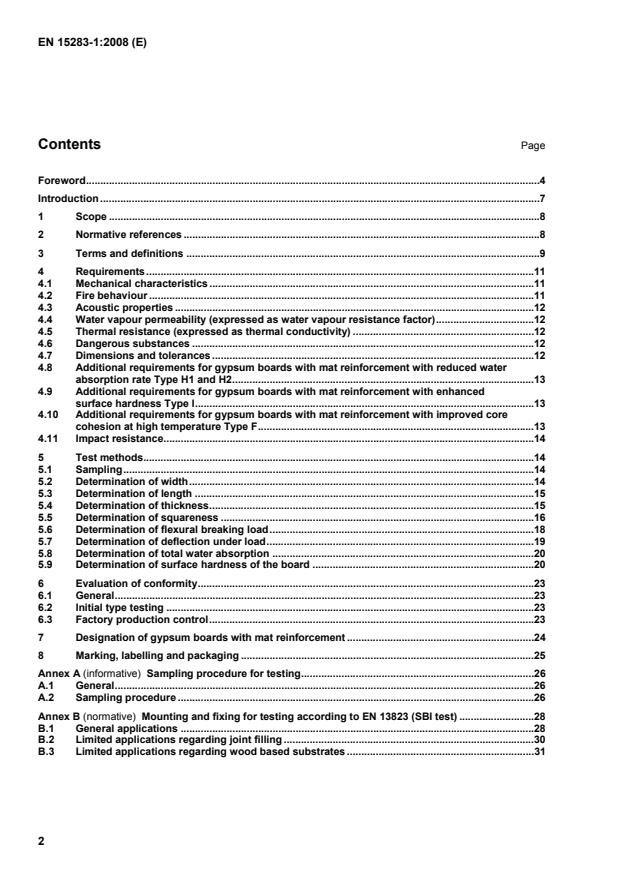
Sampling procedure for testing.26 A.1 General.26 A.2 Sampling procedure.26 Annex B (normative)
Mounting and fixing for testing according to EN 13823 (SBI test).28 B.1 General applications.28 B.2 Limited applications regarding joint filling.30 B.3 Limited applications regarding wood based substrates.31
Clauses of this European Standard addressing the provisions of EU Construction Products Directive.32 ZA.1 Scope and relevant characteristics.32 ZA.2 Procedure of attestation of conformity of gypsum boards with mat reinforcement.34 ZA.3 CE marking and labelling.37
Diagram 1 — Families of gypsum products
Diagram 2 — Family of ancillary products
Transverse direction Longitudinal direction GM, GM-H1, GM-H2, GM-I, GM-F
t 16,8 ⋅ t 43 ⋅ t GM-R t 24 ⋅ t 58 ⋅ t Additionally, no individual result shall be more than 10 % below these values. 4.1.2 Deflection under load When required and subject to regulatory requirements, the deflection under load shall be determined in accordance to the test method described in 5.7. 4.1.3 Shear strength (strength of bond/substructure connection) When the intended use of gypsum boards with mat reinforcement is stiffening building assemblies (i.e. walls, partitions, roof truss structures) the conventional shear strength of the boards shall be determined in accordance with the test method given in EN 520. NOTE This test does not measure the actual shear strength of the board but rather the strength of the board/substructure connection that is the relevant property for this application. 4.2 Fire behaviour 4.2.1 Reaction to fire When the intended use of gypsum boards with mat reinforcement is for exposed situations in building construction works, gypsum boards with mat reinforcement shall be classified in accordance with EN 13501-1. When testing the gypsum boards with mat reinforcement in the EN 13823 test according to the provisions of EN 13501-1 is required, the product shall be mounted in a manner which is representative of end use applications. The method for mounting shall be as Annex B. 4.2.2 Resistance to fire Resistance to fire is a property of an assembled system and not of a product in isolation. When required and subject to regulatory requirement, the fire resistance of a system including gypsum boards with mat reinforcement shall be classified in accordance with EN 13501-2.
When required and subject to regulatory requirement, the boards shall be tested in accordance with the method for water vapour resistance given in EN ISO 12572. 4.5 Thermal resistance (expressed as thermal conductivity) When the intended use of boards is to contribute to thermal resistance in building construction works (walls, partitions, ceilings), the tabulated values of thermal conductivity for gypsum products given in EN 12524 shall be used. When required and subject to regulatory requirement, thermal resistance shall be determined in accordance with the test method given in EN 12664. 4.6 Dangerous substances Materials used in products shall not release any dangerous substances in excess of the maximum permitted levels specified in a relevant European Standard for the material or permitted in the national regulations of the member state of destination. 4.7 Dimensions and tolerances 4.7.1 Width NOTE Common nominal widths are: 900 mm, 1 200 mm and 1 250 mm. Other widths are also possible. The width shall be measured as described in 5.2 and compared to the nominal width. The tolerance shall be +0/ - 4 mm. 4.7.2 Length The length shall be measured as described in 5.3 and compared to the nominal length.
The thickness shall be measured as described in 5.4 and compared to the nominal thickness. Tolerances for thickness below 18 mm shall be ± 0,7 mm. For boards of thickness equal to or greater than 18 mm, the tolerance shall be ± (0,04 x thickness) (in mm). The difference between individual thickness measurements on any individual board shall not exceed 0,8 mm. 4.7.4 Squareness The deviation from squareness measured as described in 5.5 shall not exceed 2,5 mm per metre of width. 4.7.5 Edge and end profiles The edge and end profiles may vary widely depending upon the jointing system and decorative and aesthetic considerations. The exception is the tapered edge and the half-rounded tapered edge profile. When measured as described in 5.6 of EN 520:2004, each individual reading shall be between the following limits: depth of taper: between 0,6 mm and 2,5 mm; width of taper: between 40 mm and 80 mm. 4.8 Additional requirements for gypsum boards with mat reinforcement with reduced water absorption rate Type H1 and H2 The total water absorption of boards, determined by the method described in 5.8, shall not be greater than 5 %. for type H1 and 10 % for type H2. 4.9 Additional requirements for gypsum boards with mat reinforcement with enhanced surface hardness Type I The surface hardness of board is characterised by the diameter of the depression produced in the surface according to the test method described in 5.9. The diameter of the depression shall not be more than 15 mm. 4.10 Additional requirements for gypsum boards with mat reinforcement with improved core cohesion at high temperature Type F When a type F board (or combined) is subjected to the test described in 5.10 of EN 520:2004, none of the six specimens shall break.
Figure 1 — Determination of width
Figure 2 — Determination of length 5.3.3 Procedure Take three measurements between the extremities of the board (see Figure 2) to the nearest millimetre, one near each edge and one near the middle. 5.3.4 Expression of results Each measured value expressed in millimetres is recorded and compared to the nominal length of the board. 5.4 Determination of thickness 5.4.1 Principle The thickness of the board is measured at six points near to one end of the board. 5.4.2 Apparatus A micrometer, dial gauge, or callipers with an anvil diameter not less than 10 mm and permitting a reading to 0,05 mm. 5.4.3 Procedure Take six measurements (see Figure 3) to the nearest 0,05 mm across one end at approximately equal intervals across the width and at least 25 mm from the end and 100 mm from the edges. For boards of nominal width not greater than 600 mm, three measurements are sufficient.
Figure 3 — Determination of thickness 5.4.4 Expression of results Record each individual measurement. Record to the nearest 0,1 mm the thickness as the average of the values obtained for each board. 5.5 Determination of squareness 5.5.1 Principle Method a: Two boards are compared with each other and the squareness measured. Method b: The two diagonals of a board are measured. 5.5.2 Apparatus A metal rule or tape with 1 mm divisions. 5.5.3 Procedure Method a: Place one board on top of another so that they coincide along one edge and at one corner (circled in Figure 4.). Measure to the nearest 1 mm the distance ∆1 (see Figure 4) between the ends of the opposite edges. Turn the top board over so that the same ends coincide as for the first measurement and ensure that the corner of the top board coincides with that corner of the lower board used in the first measurement (circled in Figure 4). Measure the new distance ∆2 between the ends of the opposite edges.
Figure 4 — Determination of squareness of ends Method b: Measure the length (l) and the width (w) of the board and the lengths of the two diagonals d1 and d2 to the nearest mm. 5.5.4 Expression of results Method a: The squareness is characterised for one of the boards by the half sum w221∆∆+ and for other by the half difference w212∆∆+ expressed in millimetres per metre. Method b: The squareness S is expressed by the result of the expression: wlddddS.4)21(.)21(−+= (1) For the calculations, the width (w) shall be expressed in metres, all other parameters in millimetres.
5.6.1 Principle The flexural strength of boards is characterised by the flexural breaking load. Specimens 400 mm x 300 mm cut off the boards are subjected to a known load which is increased at a controlled rate until failure occurs. 5.6.2 Apparatus A loading machine capable of being read to 2 % and capable of applying the necessary load with a rate of 250 N/min ± 125 N/min. 5.6.3 Procedure 5.6.3.1 Preparation of specimens Cut two specimens from each board with all edges square (as shown in Figure 5). One specimen is taken in the longitudinal direction (designated L) and the other in the transverse direction (designated T) (see Figure 5). Cut the specimens at least 100 mm from the ends and edges of the board, except in the case of boards of less than 600 mm width where the distanc
...