

CEN/TR 15276-1:2009
(Main)Fixed firefighting systems - Condensed aerosol extinguishing systems - Part 1: Requirements and test methods for components
- Abstract
This document specifies requirements, describes test methods for condensed aerosol extinguishing components and covers solely condensed aerosols.
This document is not intended to indicate approval of the extinguishants listed herein by the appropriate authorities, as other extinguishants may be equally acceptable.
This document is intended as a standard covering solely condensed aerosol.
The condensed aerosol generator typically consists of the following main components:
a) solid aerosol-forming compound;
b) cooling mechanism;
c) ignition device(s);
d) end plate discharge outlet(s);
e) housing;
f) mounting bracket.
This document does not cover dispersed aerosols.
This document requires, as a precaution, that the room is evacuated and sealed off whenever a generator is activated. Precautions include evacuation of the proximity area, criteria for re-entering and other safeguards as stated in Clause 5 of CEN/TR 15276-2:2009.
- Status
- Withdrawn
- Publication Date
- 13-Jan-2009
- Withdrawal Date
- 06-Oct-2026
- Technical Committee
- CEN/TC 191 - Fixed firefighting systems
- Drafting Committee
- CEN/TC 191/WG 6 - Gas extinguishing Systems and components
- Current Stage
- 9960 - Withdrawal effective - Withdrawal
- Start Date
- 03-Apr-2019
- Completion Date
- 07-Oct-2026

Relations
- Effective Date
- 10-Apr-2019
- Effective Date
- 25-Aug-2026
- Effective Date
- 25-Aug-2026
- Effective Date
- 09-Feb-2026
- Effective Date
- 09-Feb-2026
- Effective Date
- 28-Jan-2026
- Refers
EN 622-5:2009 - Fibreboards - Specifications - Part 5: Requirements for dry process boards (MDF) - Effective Date
- 28-Jan-2026
- Refers
EN 13262:2004/FprA2 - Railway applications - Wheelsets and bogies - Wheels - Product requirements - Effective Date
- 28-Jan-2026
- Effective Date
- 28-Jan-2026
- Effective Date
- 28-Jan-2026
- Effective Date
- 28-Jan-2026
- Effective Date
- 28-Jan-2026
- Effective Date
- 28-Jan-2026
- Effective Date
- 28-Jan-2026
Get Certified
Connect with accredited certification bodies for this standard

CIS Institut d.o.o.
Personal Protective Equipment (PPE) certification body. Notified Body NB-2890 for EU Regulation 2016/425 PPE.

Kiwa BDA Testing
Building and construction product certification.
Kmetijski inštitut Slovenije
Agricultural Institute of Slovenia. Soil testing, plant health, agricultural product analysis.
Sponsored listings
Frequently Asked Questions
CEN/TR 15276-1:2009 is a technical report published by the European Committee for Standardization (CEN). Its full title is "Fixed firefighting systems - Condensed aerosol extinguishing systems - Part 1: Requirements and test methods for components". This standard covers: This document specifies requirements, describes test methods for condensed aerosol extinguishing components and covers solely condensed aerosols. This document is not intended to indicate approval of the extinguishants listed herein by the appropriate authorities, as other extinguishants may be equally acceptable. This document is intended as a standard covering solely condensed aerosol. The condensed aerosol generator typically consists of the following main components: a) solid aerosol-forming compound; b) cooling mechanism; c) ignition device(s); d) end plate discharge outlet(s); e) housing; f) mounting bracket. This document does not cover dispersed aerosols. This document requires, as a precaution, that the room is evacuated and sealed off whenever a generator is activated. Precautions include evacuation of the proximity area, criteria for re-entering and other safeguards as stated in Clause 5 of CEN/TR 15276-2:2009.
This document specifies requirements, describes test methods for condensed aerosol extinguishing components and covers solely condensed aerosols. This document is not intended to indicate approval of the extinguishants listed herein by the appropriate authorities, as other extinguishants may be equally acceptable. This document is intended as a standard covering solely condensed aerosol. The condensed aerosol generator typically consists of the following main components: a) solid aerosol-forming compound; b) cooling mechanism; c) ignition device(s); d) end plate discharge outlet(s); e) housing; f) mounting bracket. This document does not cover dispersed aerosols. This document requires, as a precaution, that the room is evacuated and sealed off whenever a generator is activated. Precautions include evacuation of the proximity area, criteria for re-entering and other safeguards as stated in Clause 5 of CEN/TR 15276-2:2009.
CEN/TR 15276-1:2009 is classified under the following ICS (International Classification for Standards) categories: 13.220.20 - Fire protection. The ICS classification helps identify the subject area and facilitates finding related standards.
CEN/TR 15276-1:2009 has the following relationships with other standards: It is inter standard links to EN 15276-1:2019, ISO 5660-1:2002, ISO 209:2007, EN IEC 60068-2-30:2025, EN 60068-2-6:2008, EN 622-3:2004, EN 622-5:2009, EN 13262:2004/FprA2, EN 622-4:2024, EN 622-1:2003, EN 622-2:2004, EN 316:2009, EN 15154-5:2019, CEN/TR 15276-2:2009. Understanding these relationships helps ensure you are using the most current and applicable version of the standard.
CEN/TR 15276-1:2009 is available in PDF format for immediate download after purchase. The document can be added to your cart and obtained through the secure checkout process. Digital delivery ensures instant access to the complete standard document.
Standards Content (Sample)
SLOVENSKI STANDARD
01-april-2009
Vgrajeni gasilni sistemi - Sistemi za gašenje s kondenziranim aerosolom - 1. del:
Zahteve in preskusne metode za sestavne dele
Fixed firefighting systems - Condensed aerosol extinguishing systems - Part 1:
Requirements and test methods for components
Ortsfeste Brandbekämpfungsanlagen - Löschanlagen für kondensierte Aerosole - Teil 1:
Anforderungen und Prüfverfahren für Bauteile
Installations fixes de lutte contre l'incendie - Systemes d'extinction a aérosol - Partie 1 :
Exigences et méthodes d'essais pour les éléments constitutifs
Ta slovenski standard je istoveten z: CEN/TR 15276-1:2009
ICS:
13.220.10 Gašenje požara Fire-fighting
2003-01.Slovenski inštitut za standardizacijo. Razmnoževanje celote ali delov tega standarda ni dovoljeno.
TECHNICAL REPORT
CEN/TR 15276-1
RAPPORT TECHNIQUE
TECHNISCHER BERICHT
January 2009
ICS 13.220.20
English Version
Fixed firefighting systems - Condensed aerosol extinguishing
systems - Part 1: Requirements and test methods for
components
Installations fixes de lutte contre l'incendie - Systèmes Ortsfeste Brandbekämpfungsanlagen - Löschanlagen für
d'extinction à aérosol - Partie 1 : Exigences et méthodes kondensierte Aerosole - Teil 1: Anforderungen und
d'essais pour les éléments constitutifs Prüfverfahren für Bauteile
This Technical Report was approved by CEN on 9 September 2008. It has been drawn up by the Technical Committee CEN/TC 191.
CEN members are the national standards bodies of Austria, Belgium, Bulgaria, Cyprus, Czech Republic, Denmark, Estonia, Finland,
France, Germany, Greece, Hungary, Iceland, Ireland, Italy, Latvia, Lithuania, Luxembourg, Malta, Netherlands, Norway, Poland, Portugal,
Romania, Slovakia, Slovenia, Spain, Sweden, Switzerland and United Kingdom.
EUROPEAN COMMITTEE FOR STANDARDIZATION
COMITÉ EUROPÉEN DE NORMALISATION
EUROPÄISCHES KOMITEE FÜR NORMUNG
Management Centre: rue de Stassart, 36 B-1050 Brussels
© 2009 CEN All rights of exploitation in any form and by any means reserved Ref. No. CEN/TR 15276-1:2009: E
worldwide for CEN national Members.
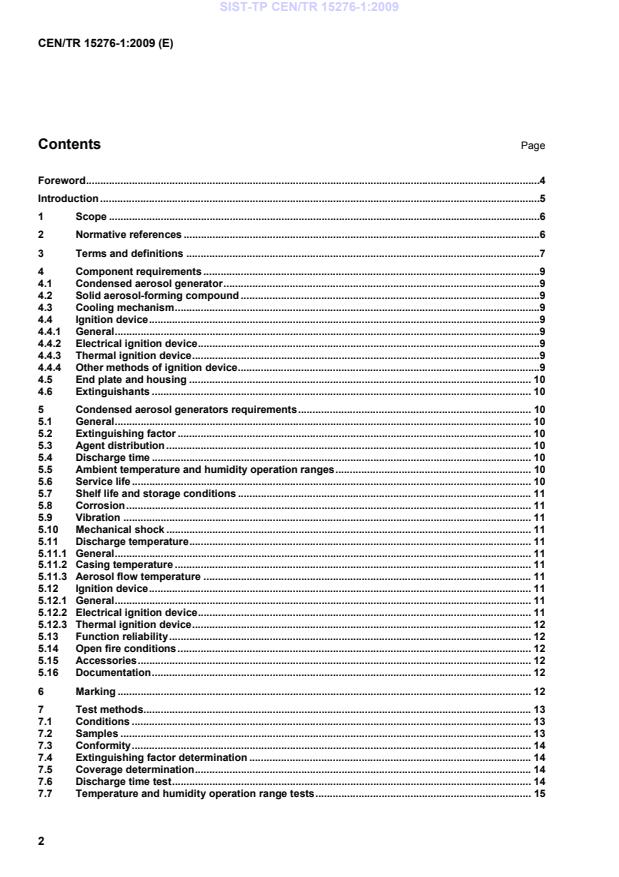
Contents Page
Foreword .4
Introduction .5
1 Scope .6
2 Normative references .6
3 Terms and definitions .7
4 Component requirements .9
4.1 Condensed aerosol generator .9
4.2 Solid aerosol-forming compound .9
4.3 Cooling mechanism .9
4.4 Ignition device .9
4.4.1 General .9
4.4.2 Electrical ignition device .9
4.4.3 Thermal ignition device .9
4.4.4 Other methods of ignition device.9
4.5 End plate and housing . 10
4.6 Extinguishants . 10
5 Condensed aerosol generators requirements . 10
5.1 General . 10
5.2 Extinguishing factor . 10
5.3 Agent distribution . 10
5.4 Discharge time . 10
5.5 Ambient temperature and humidity operation ranges . 10
5.6 Service life . 10
5.7 Shelf life and storage conditions . 11
5.8 Corrosion . 11
5.9 Vibration . 11
5.10 Mechanical shock . 11
5.11 Discharge temperature . 11
5.11.1 General . 11
5.11.2 Casing temperature . 11
5.11.3 Aerosol flow temperature . 11
5.12 Ignition device . 11
5.12.1 General . 11
5.12.2 Electrical ignition device . 11
5.12.3 Thermal ignition device . 12
5.13 Function reliability . 12
5.14 Open fire conditions . 12
5.15 Accessories . 12
5.16 Documentation . 12
6 Marking . 12
7 Test methods . 13
7.1 Conditions . 13
7.2 Samples . 13
7.3 Conformity . 14
7.4 Extinguishing factor determination . 14
7.5 Coverage determination . 14
7.6 Discharge time test . 14
7.7 Temperature and humidity operation range tests . 15
7.7.1 Object of the test . 15
7.7.2 Test procedure . 15
7.7.3 Low temperature Test . 15
7.8 Accelerated ageing test . 15
7.8.1 Test time . 15
7.8.2 Test procedure . 16
7.9 Corrosion test . 16
7.10 Stress corrosion test. 17
7.11 Vibration test . 17
7.12 Impact test . 18
7.12.1 Test procedure . 18
7.12.2 Test apparatus . 18
7.13 Drop test . 20
7.13.1 Impact surface . 20
7.13.2 Procedure . 20
7.13.3 Requirements . 20
7.14 Casing and aerosol flow temperatures test . 20
7.14.1 Casing temperature test . 20
7.14.2 Aerosol flow temperature test . 20
7.15 Ignition performance test . 20
7.16 Function test . 20
7.16.1 Discharge time . 21
7.16.2 Aerosol flow temperatures . 21
7.16.3 Test procedure . 21
7.16.4 Casing temperature test . 21
7.16.5 Discharged mass . 21
7.16.6 Explosive atmosphere actuation test . 21
7.16.7 Requirements . 22
7.17 Heat exposure test . 22
7.17.1 Object of the test . 22
7.17.2 Test procedure . 22
7.17.3 Requirements . 22
7.18 Explosive atmosphere test . 22
7.18.1 Object of the test. . 22
7.18.2 Test procedure . 23
7.18.3 Requirements . 23
Annex A (normative) Extinguishing factor/coverage test procedure . 24
Bibliography . 47
Foreword
This document (CEN/TR 15276-1:2009) has been prepared by Technical Committee CEN/TC 191 “Fixed
firefighting systems”, the secretariat of which is held by BSI.
This document has the general title Fixed fire-fighting systems – Condensed aerosol extinguishing systems
and will consist of the following parts:
Part 1: Requirements and test methods for components;
Part 2: Design, installation and maintenance.
Introduction
It has been assumed in the preparation of this document that the execution of its provisions is entrusted to
appropriately qualified and experienced people in the specification, design, installation, testing, approval,
inspection, operation and maintenance of systems and equipment, for whose guidance it has been prepared,
and who can be expected to exercise a duty of care to avoid unnecessary release of extinguishant.
Product certification: Users of this document are advised to consider the desirability of independent
certification of product conformity with this document based on testing and continuing surveillance, which may
be coupled with assessment of manufacturer quality systems against EN ISO 9001.
Fire-fighting systems covered in this document are designed to provide a supply of fixed condensed aerosol
extinguishing medium to extinguish fire.
The requirements of this document are made in the light of the best technical data known to the working group
at the time of writing but, since a wide field is covered, it has been impracticable to consider every possible
factor or circumstance that might affect implementation of the requirements.
It is important that the fire protection of a building or plant be considered as a whole. Aerosol extinguishant
systems form only a part, though an important part, of the available facilities, but it should not be assumed that
their adoption necessarily removes the need to consider supplementary measures, such as the provision of
portable fire extinguishers or other mobile appliances for first aid or emergency use, or to deal with special
hazards.
Aerosol extinguishants have been recognized as effective media for the extinction of Class A fires (solid
surface burning fires) and Class B and Class C fires according to EN 2, but it should not be forgotten, in the
planning of comprehensive schemes, that there may be hazards for which these mediums are not suitable, or
that in certain circumstances or situations there may be dangers in their use requiring special precautions.
Advice on these matters can be obtained from the appropriate manufacturer of the aerosol generators or the
extinguishing system. Information may also be sought from the appropriate fire authority, the health and safety
authorities and insurers. In addition, reference should be made as necessary to other national standards and
statutory regulations.
It is essential that fire-fighting equipment be carefully maintained to ensure instant readiness when required.
Routine maintenance is liable to be overlooked or given insufficient attention by the owner of the system. It is,
however, neglected at peril to the lives of occupants of the premises and at the risk of crippling financial loss.
The importance of maintenance cannot be too highly emphasised.
Condensed aerosol may contain traces of toxic substances like those produced by a fire, and will obscure
vision like smoke from fire.
1 Scope
This document specifies requirements, describes test methods for condensed aerosol extinguishing
components and covers solely condensed aerosols.
This document is not intended to indicate approval of the extinguishants listed herein by the appropriate
authorities, as other extinguishants may be equally acceptable.
This document is intended as a standard covering solely condensed aerosol.
The condensed aerosol generator typically consists of the following main components:
a) solid aerosol-forming compound;
b) cooling mechanism;
c) ignition device(s);
d) end plate discharge outlet(s);
e) housing;
f) mounting bracket.
This document does not cover dispersed aerosols.
This document requires, as a precaution, that the room is evacuated and sealed off whenever a generator is
activated. Precautions include evacuation of the proximity area, criteria for re-entering and other safeguards
as stated in Clause 5 of CEN/TR 15276-2:2009.
2 Normative references
The following referenced documents are indispensable for the application of this document. For dated
references, only the edition cited applies. For undated references, the latest edition of the referenced
document (including any amendments) applies.
EN 316, Wood fibreboards – Definition, classification and symbols
EN 622 (all parts), Fibreboards – Specifications
EN 60068-2-6, Environmental testing – Part 2-6: Tests – Test Fc: Vibration (sinusoidal) (IEC 60068-2-6:2007)
EN 60068-2-30, Environmental testing – Part 2-30: Tests – Test Db: Damp Heat, cyclic (12 h + 12 h cycle)
(IEC 60068-2-30:2005)
ISO 209, Aluminium and aluminium alloys – Chemical composition
ISO 5660-1, Reaction-to-fire tests – Heat release, smoke production and mass loss rate – Part 1: Heat
release rate (cone calorimeter method)
3 Terms and definitions
For the purposes of this document, the following terms and definitions apply.
3.1
authority
organisation, office or individual responsible for approving equipment, installations or procedures in
determining acceptability
NOTE The authority may base acceptance on conformity to the appropriate standards.
3.2
clearance
3.2.1
electrical clearance
unobstructed air distance between extinguishing system equipment and unenclosed or uninsulated live
electrical components not at ground potential
3.2.2
thermal clearance
air distance between a condensed aerosol generator and any structure or components sensitive to the
temperature developed by the generator
3.3
condensed aerosol
extinguishing medium consisting of finely divided solid particles and gaseous matter, these being generated
by a combustion process of a solid aerosol-forming compound
3.4
condensed aerosol generator
non-pressurised device which, when activated, generates an aerosol. It includes the mounting brackets
3.5
design factor
extinguishing factor multiplied by the safety factor, required for system design purposes
NOTE 1 The design factor is expressed in grams per cubic metre.
NOTE 2 Extinguishing factor and design factor have been introduced as an alternative to extinguishing concentration
and design concentration respectively as concentration of the actual aerosol cannot be measured or even assessed in
some cases (the discharged medium, apart from the condensed aerosol, may contain products of the thermal
decomposition of a chemical coolant).
3.6
discharge time
time from the generator activation to the end of its discharge
3.7
extinguishing application density
minimum mass of a specific aerosol-forming compound per cubic metre of enclosure volume required to
extinguish fire involving a specific fuel under defined experimental conditions, excluding any safety factors
NOTE The extinguishing factor is expressed in grams per cubic metre.
3.8
family
group of generators with same solid compound, same kind of cooling device, same kind of discharge outlet,
same ignition device, same layout and same internal/external architecture
3.9
ignition device
any device which is able to ignite the solid aerosol-forming compound
3.10
listing authority
recognized fire protection testing and approval body (notified laboratory)
3.11
maintenance
thorough check to give maximum assurance that the extinguishing system will operate as intended
NOTE It includes a thorough examination and any necessary repair or replacement of system components.
3.12
manufacturer
legal person that is responsible for the design, manufacturing, packaging and quality assurance of a device
before it is placed on the market
3.13
monitoring
supervision of the operating integrity of an electrical, mechanical, pneumatic or hydraulic control feature of a
system
3.14
protected volume
volume enclosed by the building elements around the protected enclosure, minus the volume of any
permanent impermeable building element within the enclosure
3.15
release
physical discharge or emission of an aerosol as a consequence of the generator actuation
3.16
safety factor
multiplier of the extinguishing factor to determine the design factor
3.17
solid aerosol-forming compound
mixture of oxidant, combustible component and technical admixtures producing fire extinguishing aerosol
upon ignition
3.18
supplier
legal person that is responsible for the product and is able to ensure that its quality is ensured
3.19
thermal ignition device
device which automatically operates at a rated temperature and is arranged for the ignition of the solid
aerosol-forming compound
3.20
test house
establishment having all relevant test equipment to carry out the required tests
4 Component requirements
4.1 Condensed aerosol generator
The condensed aerosol generator typically consists of the following main components:
a) solid aerosol-forming compound;
b) cooling mechanism;
c) ignition device(s);
d) end plate discharge outlet(s);
e) housing;
f) mounting bracket.
The generator is a non-pressurised canister, because aerosol is generated and distributed by the combustion
process of the solid aerosol-forming compound.
4.2 Solid aerosol-forming compound
Upon actuation of the condensed aerosol generator, the solid aerosol-forming compound shall undergo the
combustion reaction producing a fire extinguishing aerosol.
4.3 Cooling mechanism
The cooling mechanism shall provide an adequate cooling of the hot aerosol prior to its discharge into the
enclosure.
4.4 Ignition device
4.4.1 General
The ignition device is arranged to initiate the aerosol-forming compound.
If the ignition device is a complex device incorporating several components, all such components shall be
specified by the manufacturer.
4.4.2 Electrical ignition device
The electrical ignition device shall be capable of operating via an electrical input and arranged to initiate the
aerosol-forming compound.
4.4.3 Thermal ignition device
The thermal ignition device shall be capable of operating at a rated temperature and arranged to initiate the
aerosol-forming compound.
4.4.4 Other methods of ignition device
Methods capable to ignite the aerosol-forming compound, other than 4.4.2 and 4.4.3, shall be specified.
4.5 End plate and housing
The outer case and all parts inside the generator shall be made of corrosion-resistant material or shall be
suitably treated to resist corrosion. The manufacturer shall ensure that the materials of construction are also
compatible with the solid aerosol-forming compound and the cooling device so that corrosion or chemical
action does not occur.
Materials for non-metallic components that are exposed to ultraviolet light shall be UV-stabilised.
4.6 Extinguishants
The extinguishants referred to in this document are electrically non-conductive media.
5 Condensed aerosol generators requirements
5.1 General
The test samples shall conform to the technical description (drawings, parts list, description of function,
operating instructions) as stated by the manufacturer (see 5.16 and 7.3).
The manufacturer shall specify the minimum distance from the generator outlet to the first obstacle.
The manufacturer shall specify the minimum and maximum mass of aerosol compound discharged from the
generator
5.2 Extinguishing factor
The extinguishing factor for specific fuels under different classes of fires shall be determined by test using the
fire test protocol described in Annex A.
5.3 Agent distribution
The maximum area coverage and the related maximum and minimum height of the protected enclosure for
each aerosol generator unit size shall be determined by test using the fire test protocol described in 7.5.
5.4 Discharge time
The discharge time required to achieve 95 % of the minimum design application density shall be specified by
the manufacturer and shall not exceed 90 s when tested in accordance with 7.6.
5.5 Ambient temperature and humidity operation ranges
Condensed aerosol generators shall operate at ambient temperatures as specified by the manufacturer and
as a minimum requirement from – 20 °C to + 50 °C.
Condensed aerosol generators shall operate at ambient humidity up to 95 %.
These operation ranges shall be verified by the temperature and humidity operation range tests as described
in 7.7.
5.6 Service life
The service life of condensed aerosol generator under specific conditions, as described in 5.5, shall be
specified by the manufacturer and as a minimum requirement shall not be less than 5 years.
The specified service life shall be verified by test using the accelerated ageing test as described in 7.8.
5.7 Shelf life and storage conditions
The shelf life and storage conditions shall be specified by the manufacturer.
5.8 Corrosion
The aerosol generator shall operate according to 7.16 and shall show no sign of damage which could alter the
proper extinguishing action after being subjected to the corrosion test described in 7.9.
Any copper alloy part used in the component shall not crack, when tested in accordance with 7.10 (stress
corrosion test).
5.9 Vibration
The aerosol generator shall operate according to 7.16 after being subjected to a vibration test described in
7.11.
5.10 Mechanical shock
The aerosol generator shall operate according to 7.16 after being subjected to an impact test as described in
7.12.
The aerosol generator shall operate according to 7.16 after being subjected to a drop test as described in
7.13.
5.11 Discharge temperature
5.11.1 General
The requirements of 5.11.2 and 5.11.3 shall be verified by test according to the procedure described in 7.14.
5.11.2 Casing temperature
The manufacturer shall specify the maximum developed temperature for aerosol casing that shall not exceed
400 °C.
5.11.3 Aerosol flow temperature
The manufacturer shall specify the distance from the aerosol generator discharge outlet to the point where the
temperatures do not exceed 75 °C, 200 °C and 400 °C.
5.12 Ignition device
5.12.1 General
The characteristics of the ignition device shall be verified and the reliability of operation tested by using the
test method as described in 7.15.
5.12.2 Electrical ignition device
The manufacturer shall specify at least the minimum activation current and its duration, form of the signal,
maximum monitoring current, range of voltage and the type of connection for a multiple generators
arrangement.
5.12.3 Thermal ignition device
The manufacturer shall specify at least the minimum rated temperature at which the device operates.
5.13 Function reliability
When activated, the aerosol generator shall operate satisfactorily when tested in accordance with the
procedure described in 7.16 (Function test).
Any generator’s family shall be actuated inside an explosive atmosphere. The actuation of the generator shall
not initiate any explosion.
5.14 Open fire conditions
The aerosol generator, when intended for installation inside the protected enclosure, shall pass the function
test after being subjected to the heat exposure test as described in 7.17.
5.15 Accessories
The mounting bracket shall be tested together with the generator for corrosion, vibration and mechanical
shock impacts as described in 7.9, 7.11, 7.12 and 7.13.
5.16 Documentation
The manufacturer shall prepare and maintain documentation.
The manufacturer shall prepare installation and user documentation, which shall be submitted to the testing
authority together with the sample(s). This documentation shall comprise at least the following:
a) a general description of the components;
b) a technical specification including:
1) information mentioned in 5.1 and 7.16.6;
2) sufficient information to permit an assessment of the compatibility with other components of the
system (if applicable e.g. mechanical, electric or software compatibility);
c) installation instructions including mounting instructions;
d) operating instructions;
e) maintenance instructions.
The manufacturer shall prepare design documentation, which shall be submitted to the testing authority
together with the sample(s). This documentation shall include drawings, parts lists, block diagrams (if
applicable), circuit diagrams (if applicable) and a functional description to such an extent that conformity to this
document may be checked and that a general assessment of the design is possible.
6 Marking
Each generator shall be marked with the following information:
a) name of the product;
b) manufacturer's or supplier's name or trade mark;
c) some mark(s) or code(s) (e.g. serial number or batch code), by which, at least, the date or batch and
place of manufacture (if several places of manufacture) can be identified by the manufacturer;
d) mass of aerosol-forming compound;
e) date of manufacture;
f) temperature range;
g) storage humidity range;
h) service life;
i) distances as specified in 5.11.3.
The markings shall be non-detachable, non-flammable, permanent and legible.
7 Test methods
7.1 Conditions
The components shall be tested assembled as recommended for installation by the manufacturer. The tests
shall be carried at a temperature of (25 ± 10) °C, except when otherwise stated.
The tolerance for all test parameters is ± 5 %, unless otherwise stated.
7.2 Samples
The manufacturer shall submit for tests 100 samples from the same batch. From this number, 20 samples
shall be tested according to the function test in 7.16 only.
The order of tests (with the exception of the compliance test and the functional test) may be changed by the
testing authority.
The sequence of tests is shown in Table 1 and is given by the numbers 1, 2, 3 etc. in the Table. A, B etc. are
the different samples.
Table 1 — Test order for samples
Test method Test order for sample
A B C D E F G H
7.3 Conformity 1 1 1 1 1 1 1 1
7.6 Discharge time test 2
7.7.2 Temperature and humidity test 2 2
7.7.3 Low temperature test 3
7.8 Accelerated ageing test 2
7.9 Corrosion test 2
7.10 Stress corrosion test 2
7.11 Vibration test 2
7.12 Impact test 2
7.13 Drop test 2
7.14 Casing and aerosol flow 3
temperatures tests
7.16 Function test 2 4 3 3 3 3 4
7.17 Heat exposure test 2
7.3 Conformity
A visual and measurement check shall be made to determine whether the condensed aerosol generator
corresponds to the description in the technical literature (drawings, parts lists, description of functions,
operating and installation instructions).
7.4 Extinguishing factor determination
NOTE This test relates to the requirements of 5.2.
The extinguishing factor for specific fuels under different classes of fires shall be determined by specific test
using the fire test procedure described in Annex A.
Extinguishing factor tests should be conducted with generator(s) of the same family. Number of aerosol
generator units shall be sufficient to provide needed extinguishing factor in the test enclosure. Mass of
generators unit prior and after discharge shall be registered. Other generators unit sizes which belong to the
same family shall be subjected to a cold discharge. Mass prior to and after discharge shall be registered.
These data shall be compared to results from fire tests to get extinguishing factor for each generator unit type.
7.5 Coverage determination
NOTE This test relates to the requirements of 5.3.
The maximum coverage and maximum and minimum height of the protected enclosure for each aerosol
generator unit size shall be determined by test using the fire test procedures as described in Annex A.
7.6 Discharge time test
NOTE This test relates to the requirements of 5.4.
Discharge time test is integral part of the function test. See 7.16.1 for the discharge time test procedure.
7.7 Temperature and humidity operation range tests
NOTE The tests relate to the requirements of 5.5.
7.7.1 Object of the test
The object of the test is to demonstrate the ability of the equipment to function correctly at high relative
humidity (with condensation) which may occur for short periods in the anticipated service environment.
7.7.2 Test procedure
7.7.2.1 General
The test procedure as described in EN 60068-2-30, using the variant 1 test cycle and controlled recovery
conditions shall be used.
7.7.2.2 Conditioning
Apply the following severity of conditioning:
a) lower temperature: (25 ± 3) °C
b) upper temperature: (55 ± 2) °C
c) relative humidity at lower temperature: (93 ± 3) %
d) relative humidity at upper temperature: (93 ± 3) %
e) number of cycles: 2
7.7.2.3 Final measurements
After the recovery period, the sample shall be visually checked for mechanical damage externally, and shall
be subjected to the function test.
7.7.2.4 Requirements
When subjected to the function test, the sample shall respond correctly.
7.7.3 Low temperature Test
Condition the sample at – 20°C, or the service temperature recommended by the manufacturer whichever is
the lower, for (2 ± 0,5) h.
Then carry out function test immediately. When subjected to the function test, the sample shall respond
correctly.
7.8 Accelerated ageing test
NOTE This test relates to the requirements of 5.6.
7.8.1 Test time
The test time shall be calculated to fulfil requirements as follows:
t
2 ∆∆∆∆T/10
= 2 (1)
t
where
t test time, in days
t expected service life, in days
∆T = T - T
1 2
T test temperature, in degrees Kelvin
T equivalent storage temperature, in degrees Kelvin
Table 2 — Example for the calculation result of formula (1) at T = 25 °C
Test temperature T Test days for 10 years Test days for 5 years
expected service life expected service life
363,15K (90°C) 40 days 20 days
373,15K (100°C) 20 days 10 days
7.8.2 Test procedure
a) Tests are performed on three fully assembled condensed aerosol generators of the selected model
size(s).
b) The manufacturer shall specify the maximum operation temperature and expected service life.
c) The generators shall be subjected to air-oven ageing at temperature T , which shall be at least 10 °C
higher than the specified maximum operation temperature, for a period of t days as calculated by
Equation (1).
d) Following the ageing test the aerosol generators shall be subjected to and pass the function test.
7.9 Corrosion test
NOTE The tests relate to the requirements of 5.8.
The sample shall be exposed to a salt spray within a fog chamber.
The essential components and properties of the reagents and the test configuration are:
Solution consisting of NaCl in distilled water;
Concentration of the solution: (5 ± 1) %;
pH Value: 6,5 to 7,5;
Spray pressure: 0,6 bar to 1,5 bar;
Spray volume: 1 ml/h to 2 ml/h on an area of 80 cm ;
+1,0
Temperature in test cabinet: (35 ) °C;
−1,7
Position of the sample: 15° to the vertical axis;
Spray time: (240 ± 2) h;
Drying time: (168 ± 5) h at a humidity of maximum 70 %.
The sample shall be inspected for external mechanical damage and shall be subjected to a function test in
accordance with 7.16.
7.10 Stress corrosion test
The aqueous ammonia solution shall have a specific weight of (0,94 ± 0,02) kg/l. The sample shall be filled
with (10 ± 0,5) ml of the solution for each litre of container volume.
The sample shall be degreased for the test and shall be exposed for 10 days to the moist atmosphere of
ammonia and air, at a temperature of (34 ± 2) °C. The samples shall be positioned (40 ± 5) mm above the
level of the liquid.
After testing, the samples shall be cleaned and dried and subjected to careful visual examination. To make
cracking clearly visible, the liquid penetration method shall be used.
7.11 Vibration test
NOTE This test relates to the requirements of 5.9.
The drawings and the technical data shall be checked to determine whether vibration could have an adverse
effect on the performance of the non-electrical disable device.
If necessary, vibration tests shall be carried out either in the standby position, loaded position or unlocked
position.
The sample is attached to a vibration table using fixing materials provided by the manufacturer.
The test apparatus and procedure shall be as described in EN 60068-2-6, Test F :
c
Frequency range: 10 Hz to 150 Hz
Acceleration amplitude for components which are designed to be attached to machinery:
10 Hz to 50 Hz: 9,81 m/s (= 1,0 g )
n
50 Hz to 150 Hz: 29,43 m/s (= 3,0 g )
n
Acceleration amplitude for components which are designed to be attached to walls:
10 Hz to 50 Hz: 1,962 m/s (= 0,2 g
n)
50 Hz to 150 Hz: 4,905 m/s (= 0,5 g
)
n
Sweep rate: 1 octave per 30 min
Number of sweeps: 0,5 per axis
Number of axes: 3 mutually perpendicular
The sample shall not operate during the test as a result of the vibrations.
No deterioration or detachment of parts shall occur. The sample shall be inspected for external mechanical
damage and shall be subjected to a function test in accordance with 7.16.
7.12 Impact test
NOTE This test relates to the requirements of 5.10.
7.12.1 Test procedure
The test apparatus shall consist of a swinging hammer incorporating a rectangular-section aluminium alloy
head (Aluminium alloy AlCu SiMg conforming to ISO 209, solution treated and precipitation treated condition)
with the plane impact face chamfered to an angle of (60 ± 1)° to the horizontal, when in the striking position. A
suitable apparatus is described in Figure 1 – Impact test apparatus.
The specimen shall be rigidly mounted to the apparatus by its normal mounting means and shall be positioned
so that it is struck by part of the upper half of the impact face of the hammer (i.e. above the centre line), when
the hammer is in the vertical position (i.e. when the hammer-head is moving horizontally). The direction of
impact relative to the specimen shall be chosen as the most likely to impair the normal functioning of the
specimen.
A horizontal blow shall be delivered to the specimen at an impact energy level of (1,9 ± 0,1) J by a hammer
velocity of (1,5 ± 0,125) m/s.
7.12.2 Test apparatus
The tolerance for all dimensions in this test apparatus shall be 0,5 mm, unless otherwise specified.
The test apparatus (see Figure 1) shall consist essentially of a swinging hammer comprising a rectangular
section head (striker), with a chamfered impact face, mounted on a tubular steel shaft. The hammer shall be
fixed into a steel boss, which runs on ball bearings on a fixed steel shaft mounted in a rigid steel frame, so that
the hammer can rotate freely around the axis of the fixed shaft. The design of the rigid frame shall be such as
to allow complete rotation of the hammer assembly when the specimen is not present.
The striker shall be of dimensions 76 mm wide, 50 mm deep and 94 mm long (overall dimensions) and shall
be manufactured from aluminium
...