

EN 3275:2019
(Main)Aerospace series - Pipe coupling 8°30' up to 28 000 kPa Dynamic beam seal - Metric series - Technical specification
- Abstract
This European standard specifies the required characteristics, inspection and test methods, quality
assurance and procurement requirements for metric series 8°30’ dynamic beam seal pipe couplings, for
temperature ranges type II and III according to ISO 6771 and nominal pressure up to 28 000 kPa.
- Status
- Published
- Publication Date
- 30-Apr-2019
- Withdrawal Date
- 29-Nov-2019
- Technical Committee
- ASD-STAN - Aerospace
- Drafting Committee
- ASD-STAN/D 3/S 3 - Hydraulics
- Current Stage
- 9093 - Decision to confirm - Review Enquiry
- Start Date
- 21-Jan-2025
- Completion Date
- 21-Oct-2026

Overview
EN 3275:2019 - Aerospace series - Pipe coupling 8°30' up to 28 000 kPa - Dynamic beam seal - Metric series - Technical specification - is a European (CEN) standard that defines the required characteristics, inspection and test methods, quality assurance and procurement requirements for metric-series 8°30′ dynamic beam-seal pipe couplings used in aerospace fluid systems. It covers couplings designed for nominal pressures up to 28 000 kPa and for temperature ranges Type II and III as classified in ISO 6771. EN 3275:2019 supersedes EN 3275:2002 and is intended for use across aerospace design, manufacturing and procurement.
Key Topics
- Scope and definitions: Terms for pressure (nominal, proof, impulse, burst), coupling assemblies, forged/shaped parts and surface defects.
- Design and materials: Requirements for conformity with product and semi‑finished material standards; chemical certificates per EN 10204.
- Dimensions and passages: Dimensional verification and fluid‑passage checks (e.g., minimum bore checks).
- Sealing system: Specification of the dynamic beam seal geometry (8°30′ metric series) and associated installation conditions.
- Surface quality and threads: Surface roughness per EN ISO 1302; thread inspection (gauging, micro‑examination for rolled threads), limits for laps, seams and defects.
- Test methods: Mandatory qualification and production tests including proof pressure (assembly must withstand twice nominal pressure for 5 minutes at ambient without leakage or permanent deformation), burst and impulse testing; specified test fluids (MIL‑H‑5606 for Type II; MIL‑H‑8446 for Type III) and acceptable use of water for certain tests.
- Assembly and installation: Preparation, torque application (minimum/maximum installation torque for specimens) and pipe‑end joining methods.
- Quality assurance & procurement: Product qualification, sampling (ISO 2859‑1 referenced), batch identification (Annex A), records, acceptance/rejection and purchaser’s quality control rights.
- Packaging and delivery: Cleaning, preservation and marking requirements.
Applications
EN 3275:2019 is directly applicable to:
- Aerospace hydraulic and fluid system designers specifying high‑pressure couplings.
- Manufacturers and suppliers of metric 8°30′ pipe couplings and dynamic beam seals.
- Quality, inspection and test laboratories performing qualification and batch testing.
- Procurement and certification engineers who require standardized acceptance criteria for couplings up to 28 000 kPa.
- Maintenance and overhaul organizations verifying replacement parts and installation procedures.
Keywords: EN 3275:2019, pipe coupling, dynamic beam seal, aerospace, metric series, 8°30′, 28 000 kPa, quality assurance, test methods, ISO 6771.
Related Standards (if applicable)
Standards and documents referenced in EN 3275:2019 include EN 2813, EN 3120, EN 10204, ISO 6771, ISO 6772, ISO 7137, ISO 7257, ISO 9538, ISO 2859‑1 and TR 2674, plus MIL‑H‑5606 / MIL‑H‑8446 hydraulic fluids. These are commonly consulted alongside EN 3275 for material, testing and sampling details.
Relations
- Effective Date
- 08-May-2019
- Effective Date
- 12-Feb-2026
- Refers
ISO 7137:1995 - Aircraft — Environmental conditions and test procedures for airborne equipment - Effective Date
- 25-Aug-2026
- Effective Date
- 25-Aug-2026
- Refers
ISO 5855-3:1999 - Aerospace — MJ threads — Part 3: Limit dimensions for fittings for fluid systems - Effective Date
- 25-Aug-2026
- Effective Date
- 25-Aug-2026
- Effective Date
- 25-Aug-2026
- Effective Date
- 25-Aug-2026
- Effective Date
- 25-Aug-2026
- Effective Date
- 25-Aug-2026
- Refers
ISO 6771:2007 - Aerospace — Fluid systems and components — Pressure and temperature classifications - Effective Date
- 09-Feb-2026
- Effective Date
- 09-Feb-2026
- Effective Date
- 09-Feb-2026
- Effective Date
- 28-Jan-2026
- Effective Date
- 28-Jan-2026
Get Certified
Connect with accredited certification bodies for this standard

BUREAU VERITAS Certification Germany
Bureau Veritas certification in Germany.

Element Materials Technology
Materials testing and product certification.

AQMS Ltd.
AQMS provides ISO certification to SMEs across the UK.
Sponsored listings
Frequently Asked Questions
EN 3275:2019 is a standard published by the European Committee for Standardization (CEN). Its full title is "Aerospace series - Pipe coupling 8°30' up to 28 000 kPa Dynamic beam seal - Metric series - Technical specification". This standard covers: This European standard specifies the required characteristics, inspection and test methods, quality assurance and procurement requirements for metric series 8°30’ dynamic beam seal pipe couplings, for temperature ranges type II and III according to ISO 6771 and nominal pressure up to 28 000 kPa.
This European standard specifies the required characteristics, inspection and test methods, quality assurance and procurement requirements for metric series 8°30’ dynamic beam seal pipe couplings, for temperature ranges type II and III according to ISO 6771 and nominal pressure up to 28 000 kPa.
EN 3275:2019 is classified under the following ICS (International Classification for Standards) categories: 49.080 - Aerospace fluid systems and components. The ICS classification helps identify the subject area and facilitates finding related standards.
EN 3275:2019 has the following relationships with other standards: It is inter standard links to EN 3275:2002, ISO 24568:2021, ISO 7137:1995, ISO 5855-2:1999, ISO 5855-3:1999, ISO 5855-1:1999, ISO 7257:2016, ISO 8625-1:2018, ISO 2859-1:1999, ISO 2685:1998, ISO 6771:2007, ISO 6772:2012, ISO 9538:2017, EN 266:2020, EN 13848-1:2003+A1:2008. Understanding these relationships helps ensure you are using the most current and applicable version of the standard.
EN 3275:2019 is available in PDF format for immediate download after purchase. The document can be added to your cart and obtained through the secure checkout process. Digital delivery ensures instant access to the complete standard document.
Standards Content (Sample)
SLOVENSKI STANDARD
01-julij-2019
Nadomešča:
SIST EN 3275:2004
Aeronavtika - Cevni priključek 8°30' do 28 000 kPa - Dinamično tesnilo snopa -
Metrične serije - Tehnična specifikacija
Aerospace series - Pipe coupling 8°30' up to 28 000 kPa Dynamic beam seal - Metric
series - Technical specification
Luft- und Raumfahrt - Rohrverschraubung 8°30' bis 28 000 kPa Dichtlippe - Metrische
Reihe - Technische Lieferbedingungen
Série aérospatiale - Système de raccordement 8°30' jusqu'à 28 000 kPa - Joint à lèvre -
Série métrique - Spécification technique
Ta slovenski standard je istoveten z: EN 3275:2019
ICS:
49.080 Letalski in vesoljski Aerospace fluid systems and
hidravlični sistemi in deli components
2003-01.Slovenski inštitut za standardizacijo. Razmnoževanje celote ali delov tega standarda ni dovoljeno.
EN 3275
EUROPEAN STANDARD
NORME EUROPÉENNE
May 2019
EUROPÄISCHE NORM
ICS 49.080 Supersedes EN 3275:2002
English Version
Aerospace series - Pipe coupling 8°30' up to 28 000 kPa
Dynamic beam seal - Metric series - Technical specification
Série aérospatiale - Système de raccordement 8°30' Luft- und Raumfahrt - Rohrverschraubung 8°30' bis 28
jusqu'à 28 000 kPa - Joint à lèvre - Série métrique - 000 kPa Dichtlippe - Metrische Reihe - Technische
Spécification technique Lieferbedingungen
This European Standard was approved by CEN on 5 November 2018.
CEN members are bound to comply with the CEN/CENELEC Internal Regulations which stipulate the conditions for giving this
European Standard the status of a national standard without any alteration. Up-to-date lists and bibliographical references
concerning such national standards may be obtained on application to the CEN-CENELEC Management Centre or to any CEN
member.
This European Standard exists in three official versions (English, French, German). A version in any other language made by
translation under the responsibility of a CEN member into its own language and notified to the CEN-CENELEC Management
Centre has the same status as the official versions.
CEN members are the national standards bodies of Austria, Belgium, Bulgaria, Croatia, Cyprus, Czech Republic, Denmark, Estonia,
Finland, Former Yugoslav Republic of Macedonia, France, Germany, Greece, Hungary, Iceland, Ireland, Italy, Latvia, Lithuania,
Luxembourg, Malta, Netherlands, Norway, Poland, Portugal, Romania, Serbia, Slovakia, Slovenia, Spain, Sweden, Switzerland,
Turkey and United Kingdom.
EUROPEAN COMMITTEE FOR STANDARDIZATION
COMITÉ EUROPÉEN DE NORMALISATION
EUROPÄISCHES KOMITEE FÜR NORMUNG
CEN-CENELEC Management Centre: Rue de la Science 23, B-1040 Brussels
© 2019 CEN All rights of exploitation in any form and by any means reserved Ref. No. EN 3275:2019 E
worldwide for CEN national Members.
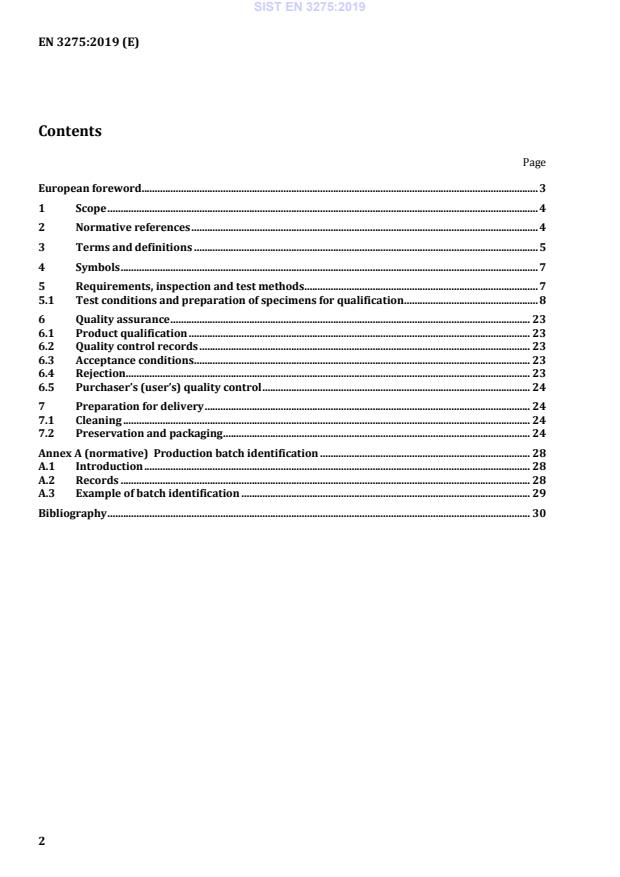
Contents
Page
European foreword . 3
1 Scope . 4
2 Normative references . 4
3 Terms and definitions . 5
4 Symbols . 7
5 Requirements, inspection and test methods . 7
5.1 Test conditions and preparation of specimens for qualification . 8
6 Quality assurance . 23
6.1 Product qualification . 23
6.2 Quality control records . 23
6.3 Acceptance conditions . 23
6.4 Rejection . 23
6.5 Purchaser’s (user’s) quality control . 24
7 Preparation for delivery . 24
7.1 Cleaning . 24
7.2 Preservation and packaging . 24
Annex A (normative) Production batch identification . 28
A.1 Introduction . 28
A.2 Records . 28
A.3 Example of batch identification . 29
Bibliography . 30
European foreword
This document (EN 3275:2019) has been prepared by the Aerospace and Defence Industries
Association of Europe - Standardization (ASD-STAN).
After enquiries and votes carried out in accordance with the rules of this Association, this Standard has
received the approval of the National Associations and the Official Services of the member countries of
ASD, prior to its presentation to CEN.
This European Standard shall be given the status of a national standard, either by publication of an
identical text or by endorsement, at the latest by November 2019, and conflicting national standards
shall be withdrawn at the latest by November 2019.
Attention is drawn to the possibility that some of the elements of this document may be the subject of
patent rights. CEN shall not be held responsible for identifying any or all such patent rights.
This document supersedes EN 3275:2002.
According to the CEN-CENELEC Internal Regulations, the national standards organizations of the
following countries are bound to implement this European Standard: Austria, Belgium, Bulgaria,
Croatia, Cyprus, Czech Republic, Denmark, Estonia, Finland, Former Yugoslav Republic of Macedonia,
France, Germany, Greece, Hungary, Iceland, Ireland, Italy, Latvia, Lithuania, Luxembourg, Malta,
Netherlands, Norway, Poland, Portugal, Romania, Serbia, Slovakia, Slovenia, Spain, Sweden, Switzerland,
Turkey and the United Kingdom.
1 Scope
This European standard specifies the required characteristics, inspection and test methods, quality
assurance and procurement requirements for metric series 8°30’ dynamic beam seal pipe couplings, for
temperature ranges type II and III according to ISO 6771 and nominal pressure up to 28 000 kPa.
2 Normative references
The following documents are referred to in the text in such a way that some or all of their content
constitutes requirements of this document. For dated references, only the edition cited applies. For
undated references, the latest edition of the referenced document (including any amendments) applies.
EN 2813, Aerospace series — Aluminium alloy AL-P-6061- — T6 — Drawn tube for pressure
applications — 0,6 mm ≤ a ≤ 12,5 mm
EN 3120, Aerospace series — Titanium alloy TI-P64003 — Cold worked and stress relieved — Seamless
tube for pressure systems — 4 mm ≤ D ≤ 51 mm, 690 MPa ≤ R ≤ 1 030 MPa
m
EN 10204, Metallic products — Types of inspection documents
EN ISO 1302, Geometrical Product Specifications (GPS) — Indication of surface texture in technical
product documentation
ISO 2685, Aircraft — Environmental test procedure for airborne equipment — Resistance to fire in
designated fire zones
ISO 2859-1, Sampling procedures for inspection by attributes — Part 1: Sampling schemes indexed by
acceptance quality limit (AQL) for lot-by-lot inspection
ISO 5855 (all parts), Aerospace — MJ threads
ISO 6771, Aerospace — Fluid systems and components — Pressure and temperature classifications
ISO 6772, Aerospace — Fluid systems — Impulse testing of hydraulic hose, tubing and fitting assemblies
ISO 7137, Aircraft — Environmental conditions and test procedures for airborne equipment
ISO 7257, Aircraft — Hydraulic tubing joints and fittings — Rotary flexure test
ISO 8625-1, Aerospace — Fluid systems — Vocabulary — Part 1: General terms and definitions related to
pressure
ISO 9538, Aerospace series — Hydraulic tubing joints and fittings — Planar flexure test
TR 2674, Design and construction of pipeline for fluids in liquid or gaseous condition — Rigid lines,
installation
1 Published as ASD-STAN Prestandard at the date of publication of this standard by AeroSpace and Defence
industries Association of Europe – Standardization (ASD-STAN) (www.asd-stan.org).
2 Published as ASD-STAN Technical Report at the date of publication of this standard by AeroSpace and Defence
industries Association of Europe – Standardization (ASD-STAN) (www.asd-stan.org).
MIL-H-5606, Hydraulic fluid, Petroleum Base, Aircraft, Missile and Ordnance
MIL-H-8446, Hydraulic fluid, Nonpetroleum Base, Aircraft
3 Terms and definitions
For the purposes of this document, the following terms and definitions apply.
ISO and IEC maintain terminological databases for use in standardization at the following addresses:
ISO Online browsing platform: available at http://www.iso.org/obp
IEC Electropedia: available at http://www.electropedia.org/
3.1
pressure
nominal pressure, proof pressure, impulse pressure, burst pressure according to ISO 8625-1
3.2
coupling
3.2.1
coupling assembly
assembled and torque-tightened nut, ferrule and pipe mating with e.g. unions, tees or elbows
Note 1 to entry: See Figure 1.
Key
1 dynamic beam seal
2 ferrule
3 nut
4 union end
Figure 1 — Example of coupling assembly
3.2.2
straight coupling
union connecting pipe to pipe
3 Published by: Department of Defense (DoD), the Pentagon, Washington, D.C. 20301.
3.2.3
forged parts
shaped parts
couplings machined out of individual forging blanks
Note 1 to entry: For crosses, tees and elbows machined out of bar or plate stock the term “shaped” may be used.
3.3
surface defects
3.3.1
surface irregularity
nonconformity with general surface appearance, possible defect
3.3.2
crack
clean (crystalline) fracture passing through or across the grain boundaries that possibly follows
inclusions of foreign elements
Note 1 to entry: Cracks are normally caused by overstressing the metal during forging or other forming
operations, or during heat treatment. Where parts are subject to significant reheating, cracks are usually
discoloured by scale.
3.3.3
fold
doubling over of metal, which can occur during the forging operation
Note 1 to entry: Folds can occur at or near the intersection of diameter changes and are especially prevalent
with non-circular necks, shoulders and heads.
3.3.4
lap
fold-like machining defect
3.3.5
seam
(1) usually a surface opening or crack resulting from a defect obtained during casting or forging
(2) extraneous material, stringer in the material, which is not homogeneous with base metal
3.3.6
pit
void or hole in the surface as caused, for example, by corrosion
3.4
quality assurance
3.4.1
production batch
definite quantity of some commodity or service produced at one time under conditions that are
presumed uniform
3.4.2
delivery batch
batch consisting of couplings with the same identity block which may come from different production
batches
3.4.3
acceptable quality level
AQL
when a continuing series of lots is considered, a quality level which for the purposes of sampling
inspection is the limit of a satisfactory process average
3.4.4
qualification
testing required to demonstrate successful performance of the coupling assembly in simulated service
(overload, destructive and fatigue tests)
3.4.5
major defect
defect other than critical, that is likely to result in a failure or to reduce materially the usability of the
considered product for its intended purpose
3.4.6
minor defect
defect that is not likely to reduce materially the usability of the considered product for its intended
purpose, or that is a departure from established specification having little bearing on the effective use
or operation of this product
4 Symbols
A Elongation, in percent [%]
D Actual outside diameter of pipe, in millimetres [mm]
D Actual inside diameter of pipe, in millimetres [mm]
DN Nominal outside diameter of pipe
P Working pressure, in megapascals [MPa]
R Tensile strength, in megapascals [MPa]
m
R 0,2 % proof stress, in megapascals [MPa]
p0,2
σ Axial stress due to pressure, in megapascals [MPa]
x
5 Requirements, inspection and test methods
See Table 1 and Table 2.
5.1 Test conditions and preparation of specimens for qualification
Tests fluids
Unless otherwise specified, tests shall be carried out using e.g. a petroleum base hydraulic fluid to
MIL-H-5606 for coupling assemblies of type II temperature range and a silicate ester base hydraulic
fluid to MIL-H-8446 for those of type III temperature range. Water may be used, whenever practical, for
proof, burst, stress corrosion and re-use capability testing. For other than hydraulic system
applications, it is preferable to use system fluid for leakage (gaseous pressure) and proof testing. When
specified in the test method, the test fluid is used as a lubricant.
Specimen preparation
Shaped parts shall be machined with the grain flow of the bar or plate in the direction of the fluid.
Specimens shall be assembled as illustrated in Table 2. Installations on the pipe end shall be in
accordance with TR 2674. Prior to testing, all couplings shall be assembled using the maximum
specified torque. Except, when specified in Table 2, the coupling shall be assembled using the minimum
installation torque for at least half of the specimens, and maximum torques for the remainder.
Pipe assembly
The method of joining the pipe to the coupling end (brazing, welding, mechanical attachment, etc.) shall
not be detrimental to the properties, strength or geometry of the pipe and the coupling end. The joint
shall be in accordance with the design instructions and shall be inspected by direct measurement, X-ray
or other non-destructive methods.
Table 1 — Requirements, inspection and test methods
a a
Clause Characteristic Requirement Inspection and test method
Q A
b
Materials Conformity with the Chemical analysis or certificate of X X
5.2
product standards compliance to EN 10204 issued by the
100 % 100 %
semi-finished product manufacturer.
b
Dimensions Conformity with the Suitable measuring instruments X X
5.3
product standards
100 % 50 %
Fluid passages Conformity with the A ball with a diameter 0,5 mm less than X X
product standards the minimum diameter specified for the
100 % 20 %
passage shall pass through the coupling.
b
Product Marking according to Visual examination X X
5.4
product standards and
identification 100 % 100 %
definition documents
including batch identifi-
cation of Annex A. It shall be
legible and shall not
adversely affect the material
or the functioning of the
products.
b
Surface Conformity with the Suitable measuring instruments or X X
5.5
roughness product standards visual-tactile samples
100 % 100 %
Interpreted in accordance
with EN ISO 1302
a a
Clause Characteristic Requirement Inspection and test method
Q A
b
Surface Conformity with the Visual examination X X
5.6
treatment product standards
The thread shall be tested using a gauge 100 % 100 %
with a tolerance class of 4h6h.
b
Surface defects Parts shall be free from Visual inspection using suitable methods X X
5.7
surface defects indicated in
100 % 100 %
3.3 liable to have an adverse
Visual examination X X
affect on their
characteristics and
100 % 100 %
endurance.
Threads Threads may be cut, rolled Thread flanks in rolled threads shall be X X
or ground, except titanium examined by micro-examination.
10 % 5 %
alloys which shall be cut or Specimens shall be taken from the
rolled. The external threads finished part by sectioning on a
of couplings should be longitudinal plane across the threaded
rolled and, if machined, area. The specimens shall be polished
shall have an arithmetical and etched to reveal the surface defects.
mean deviation, Ra, of the
profile of 3,2 μm or
smoother in accordance
with EN ISO 1302.
The grain flow in rolled
threads shall be continuous
and follow the general
thread contour with the
maximum density at the
thread root.
Laps, cracks, surface
irregularities and seams
(see 3.3) are not acceptable
on any part of the pressure
thread flank, in the thread
root or on the non-pressure
thread flank. Laps and
seams, depths of which are
within the limits of table,
are acceptable on the crest
and the non-pressure
thread flank above the pitch
diameter.
DN Depth
mm
05 0,15
06 0,18
08 0,18
10 0,20
12 0,23
14 to 32 0,25
a a
Clause Characteristic Requirement Inspection and test method
Q A
5.8 Proof pressure The coupling assembly shall The coupling assembly shall be con- X
withstand a pressure equal nected to a pressure source with one end
to twice the nominal free to move. Rate of pressure increase
pressure of the fluid system shall be (150 000 ± 37 500) kPa/min.
for 5 min at ambient
temperature without
leakage and shall not show
any evidence of permanent
deformation or other
malfunction when using the
specified torque values.
5.9 Gaseous The coupling assembly shall The coupling assembly shall be solvent X
pressure withstand a gaseous cleaned and air dried prior to testing. It
pressure equal to the shall be assembled and tightened to the
nominal pressure for 5 min, minimum torques specified in Table 3. It
at ambient temperature. shall then be pressurized with nitrogen
There shall be no visible to the nominal pressure. This pressure
formation of bubbles after shall be maintained for 5 min while the
1 min at pressure or other specimens are immersed in water or
malfunction that would suitable oil (see Figure 2).
affect assembly or
disassembly when using the
torque values specified.
5.10 Hydraulic The coupling assembly shall The coupling assembly shall be impulse X
impulse withstand 200 000 impulse tested at the temperatures and in the
resistance pressure cycles without sequence specified in ISO 6772.
leakage.
5.11 Minimum The coupling assembly shall The coupling assembly shall be X
burst pressure withstand a pressure equal connected to a pressure source with one
to four times the nominal end free to move.
pressure of the fluid system
Rate of pressure increase shall be
for 5 min, when tested at
(150 000 ± 37 500) kPa/min.
ambient temperature.
There shall be no leakage or
burst.
Pipe expansion is
permissible. The coupling
assemblies need not meet
any disassembly or
assemblies requirements
after this test.
a a
Clause Characteristic Requirement Inspection and test method
Q A
5.12 Flexure fatigue Coupling assembly welded In accordance with either ISO 7257 or X
resistance to pipes shall achieve a ISO 9538. The bending stress shall be
target minimum flexure determined prior to the application of
fatigue stress of 130 MPa internal pressure.
for 10 cycles.
In order to obtain the true bending
stress, it is always necessary to measure
For other methods of
the strain dynamically at the flexure test
joining the coupling to the
frequency. The tolerance for the specified
pipe the minimum flexure
bending stress shall be from 0 % to 10 %.
fatigue levels for each
DN size shall be as shown in
NOTE If it is desired to express the
Table 4a or Table 4b. stress in terms of combined pressure and
bending stress, the axial pressure stress is
Specimens according to
calculated by the formula:
Figure 3 shall pass this test
without leakage from the
𝐷
coupling assembly or the
𝜎 =𝑃⋅
𝑥
2 2
𝐷 −𝐷
pipe/coupling interface. 0 1
Recorded S/N curves shall
show characteristics equal
to or greater than those of
Figure 4.
Thrust wire coupling
assemblies shall achieve the
flexure fatigue stress of
130 MPa for 107 cycles,
measured at the pipe/
coupling joint.
5.13 Stress The coupling assembly shall The coupling assembly shall be installed X
corrosion withstand salt spray in a test apparatus (see Figure 5) which
resistance exposure without any of the imposes a
...