


EN 30-1-1:2021
(Main)Domestic cooking appliances burning gas - Part 1-1: Safety - General
Domestic cooking appliances burning gas - Part 1-1: Safety - General
This document specifies the requirements and methods of test for the safety and marking of freestanding and built-in domestic cooking appliances burning combustible gases given in EN 437:2021, referred to in the text as “appliances”.
The appliances covered by this document are intended to be used in a domestic dwelling.
This document covers the following types of domestic cooking appliances:
- independent freestanding hobs;
- independent built-in hobs;
- hobs and grills;
- table cookers;
- freestanding ovens;
- built-in ovens;
- freestanding or built-in grills;
- griddles;
- freestanding cookers;
- built-in cookers.
This document also applies to gas cooking appliances incorporating electrical heating elements (e.g. gas-electric cooking appliances).
For appliances intended to be used in caravans, or motorhomes/mobile homes or on board of ships or aircraft, additional requirements may be necessary.
This document does not apply to:
a) outdoor appliances;
b) appliances connected to a combustion products evacuation duct;
c) appliances having a pyrolytic gas oven;
d) appliances incorporating flame supervision devices and having an automatic ignition device for which the duration of the ignition attempt is limited by design;
e) appliances equipped with a burner that is periodically ignited and extinguished under the control of an automatic on/off device;
f) appliances equipped with an oven and/or with a grill having a fan:
1) either for the supply of combustion air or for the evacuation of the products of combustion;
2) or for the circulation of the products of combustion within the compartments;
g) appliances incorporating one or more hob or grill burners that enable the user to program the delayed start of the cooking cycle;
h) appliances of categories I2N, I2R, I3R, I2E(S), I2E(R), I2Esi, I2Er, I2R and the equivalent double and triple categories which include these indices;
i) appliances of category II2E+3B.
This document does not cover the requirements relating to third family gas cylinders, their pressure regulators and their connection.
Haushalt-Kochgeräte für gasförmige Brennstoffe - Teil 1-1: Sicherheit - Allgemeines
Dieses Dokument legt die Anforderungen und Prüfverfahren für die Sicherheit und Kennzeichnung von freistehenden und eingebauten Haushalt-Kochgeräten für gasförmige Brennstoffe nach EN 437:2021 fest, welche im Text als „Geräte“ bezeichnet sind.
Die von diesem Dokument erfassten Geräte sind für den Gebrauch in Wohngebäuden bestimmt.
Dieses Dokument behandelt die folgenden Arten von Haushaltskochgeräten:
— freistehende Kochmulden;
— eingebaute Kochmulden;
— Kochmulden und Strahlungsgrilleinrichtungen;
— Tischherde;
— freistehende Backöfen;
— Einbaubacköfen;
— Strahlungsgrilleinrichtungen, freistehend oder eingebaut;
— Kontaktgrilleinrichtungen;
— freistehende Herde;
— Einbauherde.
Dieses Dokument ist auch anzuwenden für Gaskochgeräte mit elektrischen Heizelementen (z. B. Gas- Elektro- Kochgeräte).
Für Geräte die in Wohnwagen, Wohnmobile, an Bord von Schiffen oder in Flugzeugen verwendet werden, können zusätzliche Anforderungen notwendig sein.
Dieses Dokument ist nicht anzuwenden für:
a) Geräte zum Betrieb im Freien;
b) Geräte zum Anschluss an eine Abzugseinrichtung für Verbrennungsprodukte;
c) Geräte mit pyrolytischem Gasbackofen;
d) Geräte mit Flammenüberwachungseinrichtung und mit automatischer Zündeinrichtung, wobei die Dauer des Zündversuchs durch die Konstruktion begrenzt ist;
e) Geräte mit Brennern, deren Zünd- und Löschzyklus von einer automatischen „Ein-Aus“-Einrichtung gesteuert wird;
f) Geräte, deren Gasbackofen und/oder Strahlungsgrilleinrichtung mit einem Gebläse ausgestattet ist:
1) das entweder zur Zufuhr von Verbrennungsluft bzw. zum Abzug der Verbrennungsprodukte;
2) oder zur Zirkulation der Verbrennungsprodukte innerhalb der Backräume dient;
g) Geräte mit einem oder mehreren Koch- oder Grillbrennern, die es dem Benutzer ermöglichen den verzögerten Start des Kochzyklus zu programmieren;
h) Geräte der Kategorien I2N, I2R, I3R, I2E(S), I2E(R), I2Esi, I2Er, I2R und die entsprechenden Zweifach- und Dreifach-Kategorien, die diese Indizes enthalten;
i) Geräte der Kategorie II2E+3B.
Dieses Dokument enthält keine Anforderungen an Gasflaschen der dritten Familie, die dazugehörigen Druckregler sowie ihren Anschluss.
Appareils de cuisson domestiques utilisant les combustibles gazeux - Partie 1-1 : Sécurité - Généralités
Le présent document spécifie les exigences et les méthodes d'essai relatives à la sécurité et au marquage des appareils de cuisson isolés et encastrés à usage domestique, utilisant les combustibles gazeux décrits dans l'EN 437:2021, désignés dans l'ensemble du texte par « appareils ».
Les appareils couverts par le présent document sont destinés à être utilisés dans un bâtiment d'habitation.
Le présent document concerne les types d'appareils de cuisson à usage domestique suivants :
— tables de cuisson isolées ;
— tables de cuisson encastrées ;
— tables-grilloirs ;
— réchauds-fours ;
— fours isolés ;
— fours encastrés ;
— grilloirs par rayonnement isolés ou encastrés ;
— grilloirs par contact ;
— cuisinières isolées ;
— cuisinières encastrées.
Le présent document s'applique également aux appareils de cuisson à gaz comportant des éléments chauffants électriques (par exemple : appareil de cuisson combiné gaz-électricité).
Pour les appareils destinés à une utilisation dans des caravanes ou autocaravanes/maisons mobiles, ou à bord de bateaux ou aéronefs, des exigences supplémentaires peuvent être nécessaires.
Le présent document ne s'applique pas :
a) aux appareils de plein air ;
b) aux appareils raccordés à un conduit d'évacuation des produits de combustion ;
c) aux appareils munis de four à gaz à pyrolyse ;
d) aux appareils munis de dispositifs de surveillance de flamme et comportant un dispositif d'allumage automatique pour lequel la durée de la tentative d'allumage est limitée par la conception ;
e) aux appareils équipés d'un brûleur fonctionnant par cycles d'allumage et d'extinction, commandés par un dispositif automatique marche-arrêt ;
f) aux appareils munis d'un four et/ou d'un grilloir comportant un ventilateur :
1) soit pour l'alimentation en air de combustion ou l'évacuation des produits de combustion ;
2) soit pour la circulation des produits de combustion à l'intérieur des enceintes ;
g) aux appareils munis d'un ou plusieurs brûleurs de table de cuisson ou de grilloir permettant à l'utilisateur de programmer le démarrage différé du cycle de cuisson ;
h) aux appareils de catégories I2N, I2R, I3R, I2E(S), I2E(R), I2Esi, I2Er et I2R, ainsi que des catégories doubles et triples équivalentes comprenant ces indices ;
i) aux appareils de catégorie II2E+3B.
Le présent document ne fixe pas d'exigences relatives aux bouteilles de gaz de la troisième famille, à leurs régulateurs de pression ou à leurs raccords.
Plinski kuhalni aparati za gospodinjstvo - 1-1. del: Varnost - Splošno
Ta evropski standard določa značilnosti v zvezi z izdelavo in delovanjem ter zahteve in preskusne metode za varnost oziroma označevanje prosto stoječih in vgrajenih kuhalnih aparatov za gospodinjstvo, ki uporabljajo gorljive pline, navedene v točki 4.1 skladno s kategorijami iz točke 4.2, in so v nadaljevanju imenovani »aparati«. Ta evropski standard zajema naslednje tipe kuhalnih aparatov za gospodinjstvo, ki so opredeljeni v točki 3 in spadajo v razrede iz točke 4.3 (glej preglednico 1): samostojne prostostoječe grelne plošče; samostojne vgradne grelne plošče; samostojne grelne plošče in žari; namizni kuhalniki; prostostoječe pečice; vgradne pečice; prostostoječi ali vgradni žari; žar plošče; prostostoječi kuhalniki; vgradni kuhalniki. Če v nadaljevanju ni izrecno navedeno drugače, se ta evropski standard uporablja za te aparate ali njihove sestavne dele, ne glede na to, ali so sestavni deli samostojni ali vgrajeni v aparat, tudi če drugi grelni sestavni deli aparata uporabljajo električno energijo (npr. kombinirani plinsko-električni kuhalniki). Ta evropski standard vključuje zahteve za električno varnost opreme, vgrajene v aparate, ki uporabljajo plin. Standard ne vključuje zahtev, ki obravnavajo električno varnost električno segrevanih sestavnih delov ali z njimi povezane opreme. Ta evropski standard se ne uporablja za: a) zunanje aparate; b) aparate, priključene na kanal za odvod produktov zgorevanja; c) aparate s pirolizno plinsko pečico; d) aparate s pokritimi gorilniki, ki niso v skladu s konstrukcijskimi zahtevami iz točke 5.2.8.2.2; e) aparate z vgrajenimi napravami za nadzor plamena in napravo za samodejni vžig, pri kateri je trajanje poskusa vžiga konstrukcijsko omejeno; f) aparate, opremljene z gorilnikom, ki se periodično vžiga in ugaša pod nadzorom naprave za samodejni vklop/izklop; g) aparate, opremljene s pečico in/ali žarom z ventilatorjem: 1) za dovajanje zgorevalnega zraka in/ali odvajanje produktov zgorevanja; ali 2) za kroženje produktov zgorevanja v predelkih; h) aparate, ki delujejo pri tlaku, ki presega tlak iz točke 7.1.2; i) aparate z enim ali več gorilniki, ki jih je mogoče upravljati daljinsko (tip 1 ali tip 2), razen če so zadevni gorilniki gorilniki časovno nadzorovanih pečic s termostatsko regulacijo, ki so namenjeni delovanju z zakasnitvijo brez uporabnika; j) aparate, ki so opremljeni z enim ali več gorilniki grelnih plošč ali žarov in uporabniku omogočajo programiranje cikla kuhanja, vključno z začetkom in /ali koncem cikla. Ta evropski standard ne zajema zahtev v zvezi z jeklenkami za pline tretje družine, njihovimi regulatorji in priključki. Ta evropski standard zajema le tipsko preskušanje. (...)
General Information
- Status
- Withdrawn
- Publication Date
- 21-Dec-2021
- Withdrawal Date
- 13-Apr-2025
- Technical Committee
- CEN/TC 49 - Gas cooking appliances
- Drafting Committee
- CEN/TC 49/WG 1 - Revision of EN 30
- Current Stage
- 9960 - Withdrawal effective - Withdrawal
- Start Date
- 13-Dec-2023
- Completion Date
- 14-Apr-2025
Relations
- Replaces
EN 30-1-1:2008+A3:2013 - Domestic cooking appliances burning gas - Part 1-1: Safety - General - Effective Date
- 08-Jun-2022
- Merged Into
EN 30-1-1:2021+A1:2023 - Domestic cooking appliances burning gas - Part 1-1: Safety - General - Effective Date
- 18-Oct-2023
- Amended By
EN 30-1-1:2021+A1:2023/prA2 - Domestic cooking appliances burning gas - Part 1-1: Safety - General - Effective Date
- 28-Jun-2023



Frequently Asked Questions
EN 30-1-1:2021 is a standard published by the European Committee for Standardization (CEN). Its full title is "Domestic cooking appliances burning gas - Part 1-1: Safety - General". This standard covers: This document specifies the requirements and methods of test for the safety and marking of freestanding and built-in domestic cooking appliances burning combustible gases given in EN 437:2021, referred to in the text as “appliances”. The appliances covered by this document are intended to be used in a domestic dwelling. This document covers the following types of domestic cooking appliances: - independent freestanding hobs; - independent built-in hobs; - hobs and grills; - table cookers; - freestanding ovens; - built-in ovens; - freestanding or built-in grills; - griddles; - freestanding cookers; - built-in cookers. This document also applies to gas cooking appliances incorporating electrical heating elements (e.g. gas-electric cooking appliances). For appliances intended to be used in caravans, or motorhomes/mobile homes or on board of ships or aircraft, additional requirements may be necessary. This document does not apply to: a) outdoor appliances; b) appliances connected to a combustion products evacuation duct; c) appliances having a pyrolytic gas oven; d) appliances incorporating flame supervision devices and having an automatic ignition device for which the duration of the ignition attempt is limited by design; e) appliances equipped with a burner that is periodically ignited and extinguished under the control of an automatic on/off device; f) appliances equipped with an oven and/or with a grill having a fan: 1) either for the supply of combustion air or for the evacuation of the products of combustion; 2) or for the circulation of the products of combustion within the compartments; g) appliances incorporating one or more hob or grill burners that enable the user to program the delayed start of the cooking cycle; h) appliances of categories I2N, I2R, I3R, I2E(S), I2E(R), I2Esi, I2Er, I2R and the equivalent double and triple categories which include these indices; i) appliances of category II2E+3B. This document does not cover the requirements relating to third family gas cylinders, their pressure regulators and their connection.
This document specifies the requirements and methods of test for the safety and marking of freestanding and built-in domestic cooking appliances burning combustible gases given in EN 437:2021, referred to in the text as “appliances”. The appliances covered by this document are intended to be used in a domestic dwelling. This document covers the following types of domestic cooking appliances: - independent freestanding hobs; - independent built-in hobs; - hobs and grills; - table cookers; - freestanding ovens; - built-in ovens; - freestanding or built-in grills; - griddles; - freestanding cookers; - built-in cookers. This document also applies to gas cooking appliances incorporating electrical heating elements (e.g. gas-electric cooking appliances). For appliances intended to be used in caravans, or motorhomes/mobile homes or on board of ships or aircraft, additional requirements may be necessary. This document does not apply to: a) outdoor appliances; b) appliances connected to a combustion products evacuation duct; c) appliances having a pyrolytic gas oven; d) appliances incorporating flame supervision devices and having an automatic ignition device for which the duration of the ignition attempt is limited by design; e) appliances equipped with a burner that is periodically ignited and extinguished under the control of an automatic on/off device; f) appliances equipped with an oven and/or with a grill having a fan: 1) either for the supply of combustion air or for the evacuation of the products of combustion; 2) or for the circulation of the products of combustion within the compartments; g) appliances incorporating one or more hob or grill burners that enable the user to program the delayed start of the cooking cycle; h) appliances of categories I2N, I2R, I3R, I2E(S), I2E(R), I2Esi, I2Er, I2R and the equivalent double and triple categories which include these indices; i) appliances of category II2E+3B. This document does not cover the requirements relating to third family gas cylinders, their pressure regulators and their connection.
EN 30-1-1:2021 is classified under the following ICS (International Classification for Standards) categories: 97.040.20 - Cooking ranges, working tables, ovens and similar appliances. The ICS classification helps identify the subject area and facilitates finding related standards.
EN 30-1-1:2021 has the following relationships with other standards: It is inter standard links to EN 30-1-1:2008+A3:2013, EN 30-1-1:2021+A1:2023, EN 30-1-1:2021+A1:2023/prA2. Understanding these relationships helps ensure you are using the most current and applicable version of the standard.
EN 30-1-1:2021 is associated with the following European legislation: EU Directives/Regulations: 2009/142/EC, 2016/426; Standardization Mandates: M/BC/CEN/89/6. When a standard is cited in the Official Journal of the European Union, products manufactured in conformity with it benefit from a presumption of conformity with the essential requirements of the corresponding EU directive or regulation.
You can purchase EN 30-1-1:2021 directly from iTeh Standards. The document is available in PDF format and is delivered instantly after payment. Add the standard to your cart and complete the secure checkout process. iTeh Standards is an authorized distributor of CEN standards.
Standards Content (Sample)
SLOVENSKI STANDARD
01-april-2022
Nadomešča:
SIST EN 30-1-1:2009+A3:2013
Plinski kuhalni aparati za gospodinjstvo - 1-1. del: Varnost - Splošno
Domestic cooking appliances burning gas - Part 1-1: Safety - General
Haushalt-Kochgeräte für gasförmige Brennstoffe - Teil 1-1: Sicherheit - Allgemeines
Appareils de cuisson domestiques utilisant les combustibles gazeux - Partie 1-1 :
Sécurité - Généralités
Ta slovenski standard je istoveten z: EN 30-1-1:2021
ICS:
97.040.20 Štedilniki, delovni pulti, Cooking ranges, working
pečice in podobni aparati tables, ovens and similar
appliances
2003-01.Slovenski inštitut za standardizacijo. Razmnoževanje celote ali delov tega standarda ni dovoljeno.
EN 30-1-1
EUROPEAN STANDARD
NORME EUROPÉENNE
December 2021
EUROPÄISCHE NORM
ICS 97.040.20 Supersedes EN 30-1-1:2008+A3:2013
English Version
Domestic cooking appliances burning gas - Part 1-1: Safety
- General
Appareils de cuisson domestiques utilisant les Haushalt-Kochgeräte für gasförmige Brennstoffe - Teil
combustibles gazeux - Partie 1-1 : Sécurité - 1-1: Sicherheit - Allgemeines
Généralités
This European Standard was approved by CEN on 22 November 2021.
CEN members are bound to comply with the CEN/CENELEC Internal Regulations which stipulate the conditions for giving this
European Standard the status of a national standard without any alteration. Up-to-date lists and bibliographical references
concerning such national standards may be obtained on application to the CEN-CENELEC Management Centre or to any CEN
member.
This European Standard exists in three official versions (English, French, German). A version in any other language made by
translation under the responsibility of a CEN member into its own language and notified to the CEN-CENELEC Management
Centre has the same status as the official versions.
CEN members are the national standards bodies of Austria, Belgium, Bulgaria, Croatia, Cyprus, Czech Republic, Denmark, Estonia,
Finland, France, Germany, Greece, Hungary, Iceland, Ireland, Italy, Latvia, Lithuania, Luxembourg, Malta, Netherlands, Norway,
Poland, Portugal, Republic of North Macedonia, Romania, Serbia, Slovakia, Slovenia, Spain, Sweden, Switzerland, Turkey and
United Kingdom.
EUROPEAN COMMITTEE FOR STANDARDIZATION
COMITÉ EUROPÉEN DE NORMALISATION
EUROPÄISCHES KOMITEE FÜR NORMUNG
CEN-CENELEC Management Centre: Rue de la Science 23, B-1040 Brussels
© 2021 CEN All rights of exploitation in any form and by any means reserved Ref. No. EN 30-1-1:2021 E
worldwide for CEN national Members.
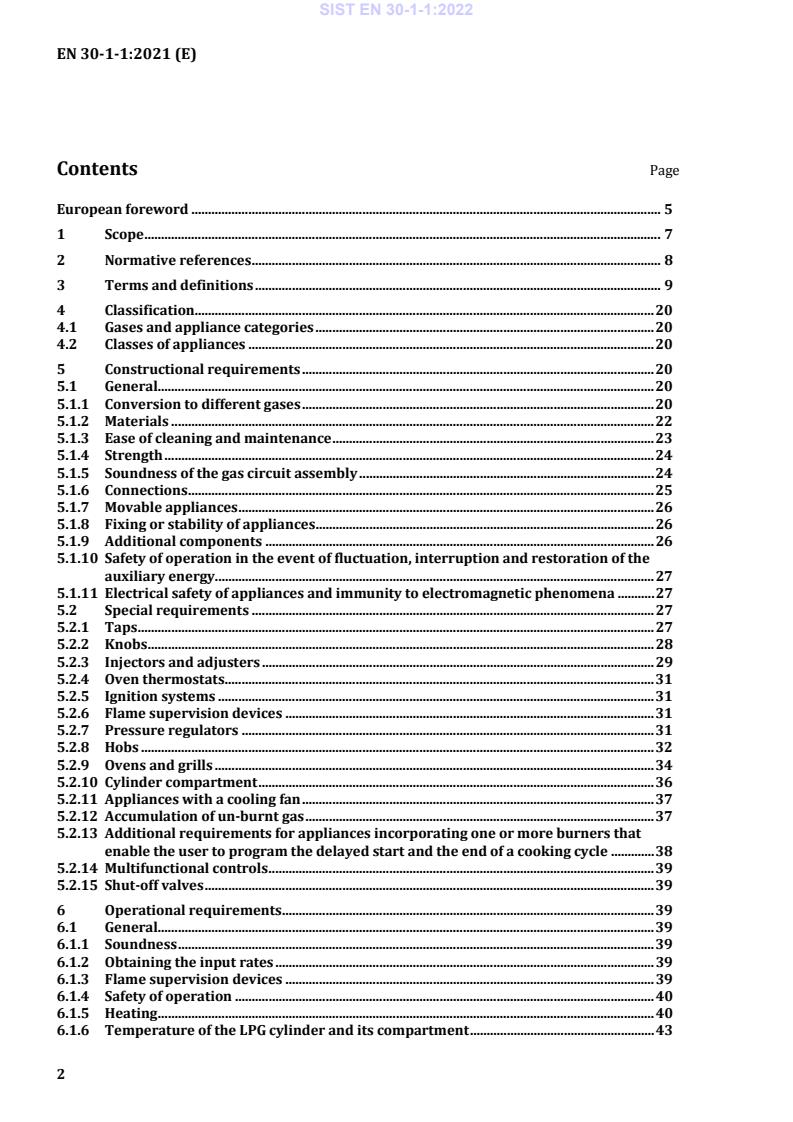
Contents Page
European foreword . 5
1 Scope . 7
2 Normative references . 8
3 Terms and definitions . 9
4 Classification. 20
4.1 Gases and appliance categories . 20
4.2 Classes of appliances . 20
5 Constructional requirements . 20
5.1 General. 20
5.1.1 Conversion to different gases . 20
5.1.2 Materials . 22
5.1.3 Ease of cleaning and maintenance . 23
5.1.4 Strength . 24
5.1.5 Soundness of the gas circuit assembly . 24
5.1.6 Connections . 25
5.1.7 Movable appliances . 26
5.1.8 Fixing or stability of appliances . 26
5.1.9 Additional components . 26
5.1.10 Safety of operation in the event of fluctuation, interruption and restoration of the
auxiliary energy. 27
5.1.11 Electrical safety of appliances and immunity to electromagnetic phenomena . 27
5.2 Special requirements . 27
5.2.1 Taps . 27
5.2.2 Knobs . 28
5.2.3 Injectors and adjusters . 29
5.2.4 Oven thermostats . 31
5.2.5 Ignition systems . 31
5.2.6 Flame supervision devices . 31
5.2.7 Pressure regulators . 31
5.2.8 Hobs . 32
5.2.9 Ovens and grills . 34
5.2.10 Cylinder compartment . 36
5.2.11 Appliances with a cooling fan . 37
5.2.12 Accumulation of un-burnt gas . 37
5.2.13 Additional requirements for appliances incorporating one or more burners that
enable the user to program the delayed start and the end of a cooking cycle . 38
5.2.14 Multifunctional controls . 39
5.2.15 Shut-off valves . 39
6 Operational requirements . 39
6.1 General. 39
6.1.1 Soundness . 39
6.1.2 Obtaining the input rates . 39
6.1.3 Flame supervision devices . 39
6.1.4 Safety of operation . 40
6.1.5 Heating . 40
6.1.6 Temperature of the LPG cylinder and its compartment . 43
6.1.7 Total input of the appliance . 44
6.1.8 Pressure regulator performance . 44
6.1.9 Blocking of the cooling fan and failure of the thermostat . 44
6.2 Special requirements for hobs . 44
6.2.1 Ignition, cross-lighting and flame stability . 44
6.2.2 Combustion . 45
6.3 Special requirements for ovens and grills . 45
6.3.1 Ignition, cross-lighting and flame stability . 45
6.3.2 Combustion . 46
7 Test methods . 47
7.1 General . 47
7.1.1 Reference and test gases . 47
7.1.2 Test pressures. 47
7.1.3 Test procedures . 47
7.1.4 Pans . 51
7.1.5 Ovens and grill temperatures . 53
7.1.6 Appliances having a mains electrical supply . 53
7.1.7 Appliances having one or more multi-ring hob burners . 53
7.2 Verification of construction characteristics . 53
7.2.1 Strength . 53
7.2.2 Strength, stability . 55
7.2.3 Appliances with a glass lid having a device for shutting off the gas to the hob
burners . 57
7.3 Verification of operational characteristics . 57
7.3.1 General tests . 57
7.3.2 Specific tests for hobs . 70
7.3.3 Specific tests for ovens and grills . 79
7.4 Accuracy of measuring instruments . 85
8 Marking and instructions . 85
8.1 Marking . 85
8.1.1 General . 85
8.1.2 Marking and warnings on the appliance . 86
8.1.3 Additional marking and warnings on the appliance . 86
8.1.4 Marking and warning on the packaging . 87
8.1.5 Additional marking on the packaging . 87
8.2 Instructions general . 87
8.3 Instructions for installation . 87
8.3.1 General . 87
8.3.2 Instructions for installation and adjustment . 87
8.3.3 Additional instructions for installation . 89
8.4 Instructions for use and maintenance . 90
Annex A (informative) National situations . 106
A.1 General . 106
A.2 Use in different countries of the categories listed in the text of the standard . 106
A.3 Supply pressures for the appliances (see 7.1.2) . 106
A.4 National or local gas categories . 106
A.4.1 National distribution . 106
A.4.2 Categories . 106
A.4.3 Permitted operations for changing gas . 106
A.5 Test gases corresponding to the particular categories given in A.4 . 106
A.6 Special conditions . 106
A.7 Connection requirements in force in various countries (see 5.1.6) . 107
Annex B (informative) Guidelines for extension to other categories . 111
B.1 General. 111
Annex C (normative) Characteristics of the pans required . 112
C.1 Pans required for testing on gas burners . 112
C.2 Characteristics of pans for testing on electric cooking plates . 114
Annex D (normative) Surface temperature probe (7.3.1.5.3.2) . 115
D.1 Design . 115
D.2 Validation test . 115
D.2.1 Principle . 115
D.2.2 Procedure . 115
D.2.3 Validation . 115
Annex E (normative) Use of symbols on the appliance and packaging . 117
E.1 Information having to appear on the appliance and packaging, in accordance with
Clause 8 . 117
E.1.1 Electricity supply . 117
E.1.2 Type of gas . 117
E.1.3 Pressure . 118
E.1.4 Country . 118
E.1.5 Category . 118
E.2 Other optional information . 118
E.2.1 General. 118
E.2.2 Nominal heat input of a burner . 118
E.2.3 Nominal heat input of all appliance burners . 118
E.3 Information that shall be on the appliance and its packaging, in accordance with 8.1
and 8.2 . 118
Annex F (normative) Fragmentation required for toughened soda-lime glass . 121
F.1 Requirement . 121
F.2 Test method . 121
Annex G (informative) Examples of types of multi-ring burners and their operating
modes . 123
Annex ZA (informative) Relationship between this European Standard and the essential
requirements of EU Regulation 2016/426/EU aimed to be covered . 124
Bibliography . 127
European foreword
This document (EN 30-1-1:2021) has been prepared by Technical Committee CEN/TC 49 “Gas cooking
appliances”, the secretariat of which is held by UNI.
This European Standard shall be given the status of a national standard, either by publication of an
identical text or by endorsement, at the latest by June 2022, and conflicting national standards shall be
withdrawn at the latest by December 2024.
Attention is drawn to the possibility that some of the elements of this document may be the subject of
patent rights. CEN shall not be held responsible for identifying any or all such patent rights.
This document supersedes EN 30-1-1:2008+A3:2013.
This document has been prepared under a Standardization Request given to CEN by the European
Commission and the European Free Trade Association, and supports essential requirements of EU
Directive(s).
For relationship with EU Directive(s), see informative Annex ZA, which is an integral part of this
document.
The main modifications in this document with respect to the previous edition (EN 30-1-1:2008+A3:2013)
are the following:
— Alignment with Regulation 2016/426/EU throughout the full text;
— Reference to the different types of gases is now given by making reference to the specific
EN 437:2021 and not by introducing its requirements in this document (various clauses and
Annex A);
— Reference to specific requirements for multifunctional controls is now given by making reference to
the specific EN 126:2012 (5.2.14);
— Addition of requirements for appliances that enable the user to program the delayed start and the
end of a cooking cycle (5.2.13);
— Removal of requirements for ovens volume calculation as reference is made to
EN 15181:2017+A1:2020;
— Removal of requirements in 7.3.1.3.2 of EN 30-1-1:2008+A3:2013 for pilot flames as these devices
are no more used on appliances;
— Introduction of requirements on accuracy of measuring instruments (7.4);
— More detailed info on types of inlets allowed for the connection of the appliances (5.1.6 and A.7).
— Introduction of a new Annex for multi-ring burners (Annex G).
EN 30 consists of the following parts:
— EN 30-1-1, Domestic cooking appliances burning gas — Part 1-1: Safety - General;
— EN 30-1-2, Domestic cooking appliances burning gas — Safety — Part 1-2: Appliances having forced-
convection ovens and/or grills;
— EN 30-1-3, Domestic cooking appliances burning gas — Part 1-3: Safety — Appliances having a glass
ceramic hotplate;
— EN 30-1-4, Domestic cooking appliances burning gas — Safety — Part 1-4: Appliances having one or
more burners with an automatic burner control system;
— EN 30-2-1, Domestic cooking appliances burning gas — Part 2-1: Rational use of energy — General;
— EN 30-2-2, Domestic cooking appliances burning gas — Part 2-2: Rational use of energy — Appliances
having forced-convection ovens and/or grills.
Requirements concerning the emission of NOx are not mentioned in this document; taking account of the
usage of the appliances and their low output, their contribution to environment pollution is negligible.
This document covers type testing.
Any feedback and questions on this document should be directed to the users’ national standards body.
A complete listing of these bodies can be found on the CEN website.
According to the CEN-CENELEC Internal Regulations, the national standards organisations of the
following countries are bound to implement this European Standard: Austria, Belgium, Bulgaria, Croatia,
Cyprus, Czech Republic, Denmark, Estonia, Finland, France, Germany, Greece, Hungary, Iceland, Ireland,
Italy, Latvia, Lithuania, Luxembourg, Malta, Netherlands, Norway, Poland, Portugal, Republic of North
Macedonia, Romania, Serbia, Slovakia, Slovenia, Spain, Sweden, Switzerland, Turkey and the United
Kingdom.
1 Scope
This document specifies the requirements and methods of test for the safety and marking of freestanding
and built-in domestic cooking appliances burning combustible gases given in EN 437:2021, referred to in
the text as “appliances”.
The appliances covered by this document are intended to be used in a domestic dwelling.
This document covers the following types of domestic cooking appliances:
— independent freestanding hobs;
— independent built-in hobs;
— hobs and grills;
— table cookers;
— freestanding ovens;
— built-in ovens;
— freestanding or built-in grills;
— griddles;
— freestanding cookers;
— built-in cookers.
This document also applies to gas cooking appliances incorporating electrical heating elements (e.g. gas-
electric cooking appliances).
For appliances intended to be used in caravans, or motorhomes/mobile homes or on board of ships or
aircraft, additional requirements may be necessary.
This document does not apply to:
a) outdoor appliances;
b) appliances connected to a combustion products evacuation duct;
c) appliances having a pyrolytic gas oven;
d) appliances incorporating flame supervision devices and having an automatic ignition device for
which the duration of the ignition attempt is limited by design;
e) appliances equipped with a burner that is periodically ignited and extinguished under the control of
an automatic on/off device;
f) appliances equipped with an oven and/or with a grill having a fan:
1) either for the supply of combustion air or for the evacuation of the products of combustion;
2) or for the circulation of the products of combustion within the compartments;
g) appliances incorporating one or more hob or grill burners that enable the user to program the
delayed start of the cooking cycle;
h) appliances of categories I , I , I , I , I , I , I , I and the equivalent double and triple
2N 2R 3R 2E(S) 2E(R) 2Esi 2Er 2R
categories which include these indices;
i) appliances of category II
2E+3B.
This document does not cover the requirements relating to third family gas cylinders, their pressure
regulators and their connection.
2 Normative references
The following documents are referred to in the text in such a way that some or all of their content
constitutes requirements of this document. For dated references, only the edition cited applies. For
undated references, the latest edition of the referenced document (including any amendments) applies.
EN 30-1-4:2012, Domestic cooking appliances burning gas - Safety - Part 1-4: Appliances having one or
more burners with an automatic burner control system
EN 88-1:2011+A1:2016, Pressure regulators and associated safety devices for gas appliances - Part 1:
Pressure regulators for inlet pressures up to and including 50 kPa
EN 125:2010+A1:2015, Flame supervision devices for gas burning appliances - Thermoelectric flame
supervision devices
EN 126:2012, Multifunctional controls for gas burning appliances
EN 161:2011+A3:2013, Automatic shut-off valves for gas burners and gas appliances
EN 257:2010, Mechanical thermostats for gas-burning appliances
EN 437:2021, Test gases - Test pressures - Appliance categories
EN 549:2019, Rubber materials for seals and diaphragms for gas appliances and gas equipment
EN 751-1:1996, Sealing materials for metallic threaded joints in contact with 1st, 2nd and 3rd family gases
and hot water - Part 1: Anaerobic jointing compounds
EN 751-2:1996, Sealing materials for metallic threaded joints in contact with 1st, 2nd and 3rd family gases
and hot water - Part 2: Non-hardening jointing compounds
EN 1106:2010, Manually operated taps for gas burning appliances
EN 1116:2018, Furniture - Kitchen furniture - Coordinating sizes for kitchen furniture and kitchen
appliances
EN 10226-1:2004, Pipe threads where pressure tight joints are made on the threads - Part 1: Taper external
threads and parallel internal threads - Dimensions, tolerances and designation
EN 10226-2:2005, Pipe threads where pressure tight joints are made on the threads - Part 2: Taper external
threads and taper internal threads - Dimensions, tolerances and designation
EN 15181:2017+A1:2020, Measuring method of the energy consumption of gas fired ovens
EN 60068-2-75:2014, Environmental testing - Part 2-75: Tests - Test Eh: Hammer tests (IEC 60068-2-
75:2014)
Household and similar electrical appliances - Safety - Part 1: General requirements
EN 60335-1:2012,
(IEC 60335-1:2010, modified)
Household and similar electrical appliances - Safety - Part 2-6: Particular
EN 60335-2-6:2015,
requirements for stationary cooking ranges, hobs, ovens and similar appliances (IEC 60335-2-6:2014,
modified)
EN 60335-2-102:2016, Household and similar electrical appliances - Safety - Part 2-102: Particular
requirements for gas, oil and solid-fuel burning appliances having electrical connections (IEC 60335-2-
102:2004, modified)
EN 60584-1:2013, Thermocouples - Part 1: EMF specifications and tolerances (IEC 60584-1:2013)
EN 60730-1:2016, Automatic electrical controls - Part 1: General requirements (IEC 60730-1:2013,
modified)
EN IEC 60730-2-7:2020, Automatic electrical controls - Part 2-7: Particular requirements for timers and
time switches (IEC 60730-2-7:2015)
EN ISO 228-1:2003, Pipe threads where pressure-tight joints are not made on the threads - Part 1:
Dimensions, tolerances and designation (ISO 228-1:2000)
3 Terms and definitions
For the purposes of this document, the following terms and definitions apply.
ISO and IEC maintain terminological databases for use in standardization at the following addresses:
• IEC Electropedia: available at https://www.electropedia.org/
• ISO Online browsing platform: available at https://www.iso.org/obp
3.1 General terms and definitions:
3.1.1
conversion
operation carried out by a professional on an appliance at the time of a change of gas
3.1.2
removable
can be removed without the aid of a tool
3.1.3
reference conditions
15 °C and 1 013,25 mbar
As impacted by EN 60335-1:2012/AC:2014, EN 60335-1:2012/A11:2014, EN 60335-1:2012/A13:2017,
EN 60335-1:2012/A1:2019, EN 60335-1:2012/A2:2019, EN 60335-1:2012/A14:2019 and EN 60335-
1:2012/A15:2021.
As impacted by EN 60335-2-6:2015/A1:2020 and EN 60335-2-6:2015/A11:2020.
As impacted by EN 60730-1:2016/A1:2019.
3.1.4
mechanically fastened
can only be removed with the aid of a tool
3.1.5
special maintenance
maintenance carried out by a professional
3.1.6
soft soldering
soldering for which the lowest temperature of the melting range, after application, is less than 450 °C
3.1.7
country of destination
intended country of destination, such that, at the time of putting the appliance on the market and/or
installation, the appliance needs to be capable of operating, without adjustment or modification, with one
of the gases distributed in the country concerned, at the appropriate supply pressure
Note 1 to entry: More than one country can be specified if the appliance, in its current state of adjustment, can be
used in each of these countries.
3.1.8
technical documentation
technical information (e.g. drawings, product specifications, etc.) required for the application of this
document
Note 1 to entry: the technical documentation is not delivered together with the appliance
3.2 Terms and definitions relating to the appliance:
3.2.1
appliance incorporating a cylinder
appliance functioning in particular with third family gases which includes a compartment for the cylinder
3.2.2
freestanding appliance
appliance not normally having direct contact with adjacent furniture or walls
3.2.3
appliance for building-in between two furniture units
appliance which can have its side panels in direct contact with adjacent furniture units
Note 1 to entry: When installed, the appliance may only be in contact with a single furniture unit.
3.2.4
appliance for building into a furniture unit
appliance intended to be installed in a kitchen cabinet or unit or in a housing located in a wall or under
similar conditions
Note 1 to entry: For this reason, the appliance may not necessarily have a casing on all sides.
3.2.5
domestic cooking appliance
appliance designed to be used by non-expert users in a domestic dwelling
3.2.6
domestic dwelling
household environment in which appliances for typical housekeeping functions (e.g. cooking) are used
by non-expert users
EXAMPLE Examples of household environment are:
— house or apartments;
— shops, offices and other similar working environments;
— farm houses;
— hotels, motels, bed and breakfast and other residential type environments where appliances are
used by non-expert users.
Note 1 to entry: This is indicated in the instructions for use and maintenance as well as in the instructions for
installation.
3.2.7
cooker
cooking appliance comprising:
— a hob;
— one or more ovens with or without a thermostat, having possibly a grill;
— possibly a grill
3.2.8
table cooker
cooking appliance intended to rest on a raised support or stand comprising:
— a hob;
— an oven;
— possibly a grill
3.2.9
hob
appliance or part of an appliance which incorporates one or more burners including a control unit and
which is heated by gas
Note 1 to entry: The hob can be free standing, built in or part of a cooker assembly.
3.2.10
hob and grill
cooking appliance consisting of a hob including a grill
3.3 Terms and definitions relating to gases and pressures:
3.3.1 Terms and definitions relating to gases:
3.3.1.1
test gases
gases intended for the verification of the operational characteristics of appliances using combustible
gases; they consist of reference gases and limit gases
Note 1 to entry: Table 7 in EN 437:2021, Clause 7 gives the characteristics of reference gases and limit gases.
3.3.1.2
reference gases
test gases with which appliances operate under nominal conditions when they are supplied at the
corresponding normal pressure
3.3.1.3
limit gases
test gases representative of the extreme variations in characteristics of the gases for which the appliances
have been designed
3.3.1.4
relative density
d
ratio of the masses of equal volumes of dry gas and dry air under the same conditions of temperature and
pressure: 15 °C or 0 °C and 1 013,25 mbar
3.3.1.5
calorific value
quantity of heat produced by complete combustion at a constant pressure of 1 013,25 mbar, of a unit
volume or mass of gas, the constituents of the combustible mixture being taken at reference
Note 1 to entry: A distinction is made between:
— the gross calorific value H : the water produced by combustion is assumed to be condensed;
s
— the net calorific value H : the water produced by combustion is assumed to be in the vapour state.
i
Note 2 to entry: The calorific value is expressed:
— either in megajoules per cubic metre (MJ/m ) of dry gas under the reference conditions;
— or in megajoules per kilogram (MJ/kg) of dry gas.
Note 3 to entry: In this document only the gross calorific value is used.
3.3.1.6
Wobbe index
gross Wobbe index W ; net Wobbe index W
s i
ratio of the calorific value of a gas per unit volume and the square root of its relative density under the
same reference conditions
Note 1 to entry: The Wobbe index is said to be gross or net according to whether the calorific value used is the
gross or net calorific value.
Note 2 to entry: The Wobbe indices are expressed:
— either in megajoules per cubic metre (MJ/m ) of dry gas under the reference conditions;
— or in megajoules per kilogram (MJ/kg) of dry gas.
3.3.1.7
theoretical air
volume of air necessary for the stoichiometric combustion of a unit volume of gas
3.3.2 Terms and definitions relating to pressures:
3.3.2.1
gas supply pressure
p
difference between the static pressure measured at the inlet connection of the appliance in operation and
the atmospheric pressure
Note 1 to entry: The gas supply pressure is expressed in millibar (mbar): 1 mbar = 10 Pa.
3.3.2.2
test pressures
gas pressures which are used to verify the operational characteristics of appliances using combustible
gases and which consist of normal and limit pressures
Note 1 to entry: The gas pressures used are expressed in millibars (mbar): 1 mbar = 10 Pa.
Note 2 to entry: The test pressures are given in Tables 5 and 6 of EN 437:2021.
3.3.2.3
normal pressure
p
n
pressure under which the appliances operate in nominal conditions, when they are supplied with the
corresponding reference gas
3.3.2.4
limit pressures
maximum pressure: p and minimum pressure: p
max min
pressures representative of the extreme variations in the supply conditions
3.3.2.5
pressure couple
combination of two distinct gas distribution pressures applied by reason of the significant difference
existing between the Wobbe indices within a single family or group in which:
— the higher pressure corresponds only to gases of low Wobbe index;
— the lower pressure corresponds to gases of high Wobbe index
3.4 Terms and definitions relating to the parts of the appliance:
3.4.1 Burners:
3.4.1.1
burners
component devices that allow the gas to burn
Note 1 to entry: They may be one of two types:
— non-aerated burners in which the air for combustion is entrained entirely at the burner outlet;
— aerated burners in which part of the air for combustion termed “primary air”, is entrained by the gas
flow and is mixed with gas before the burner outlet. The remainder of the air, called “secondary air” is
entrained after the burner outlet.
Note 2 to entry: These burners consist of:
— a gas injector;
— a body forming the mixing tube;
— a head equipped with ports for the air-gas mixture.
3.4.1.2
ignition burners
small burners, the flame of which is intended to light a principal burner
3.4.1.3
principal burners
burners intended to assure a thermal function to the appliance
Note 1 to entry: In this document they are referred to as burners.
3.4.1.4
covered burners
hob burners for which the pans being heated are screened from direct flame contact by the interposition
of a surface on which they rest
Note 1 to entry: Covered burners may be of two types:
— non enclosed covered burners;
— enclosed covered burners.
3.4.1.4.1
non enclosed covered burner
covered burner for which all products of combustion are evacuated directly to atmosphere, e.g. around
the periphery of the plate and which is designed so that partial visibility of the flames is possible in normal
operation
Note 1 to entry: A non-enclosed covered burner can be:
— permanent, i.e. designed to be used only with the plate in position;
— temporary, i.e. designed so that it may also be used as an uncovered burner after removal of the
removable plate.
3.4.1.4.2
enclosed covered burner
covered burner having a combustion circuit in which all products of combustion are evacuated to
atmosphere indirectly through a purpose-designed outlet
Note 1 to entry: The burner may be so enclosed that flames may not be visible during normal operation.
3.4.1.5
uncovered burners
hob burners for which the pans being heated are in direct contact with the flames
3.4.1.6
injector
component part that admits the gas into an aerated burner
Note 1 to entry: There are two types of injectors:
— calibrated injector in which the section of the outlet orifice is fixed;
— adjustable injector in which the section of the outlet orifice is variable.
3.4.1.7
multi-ring hob burners
hob burner assembly having two or more rings of burner ports
Note 1 to entry: The term ring includes any distribution of burner ports around the central axis of the burner.
3.4.1.7.1
multi-ring hob burner with sectional control
multi-ring hob burner that is so designed that one or more of its rings of burner ports can be utilised
independently
Note 1 to entry: They can be Type II, Type III and Type V as defined in Annex G
3.4.1.7.2
multi-ring hob burner with simple control
multi-ring hob burner that is so designed that its rings of burner ports cannot be utilised independently
Note 1 to entry: They can be Type I as defined in Annex G.
3.4.2 Auxiliary equipment, control devices
3.4.2.1
auxiliary equipment
all controls and devices that can affect the safety of operation of the gas appliance or the gas part of a
combined gas-electric appliance
EXAMPLES
— taps and cocks;
— pressure regulators;
— flame supervision devices;
— thermostats.
3.4.2.2
ignition device
device to ignite one or more burners directly or indirectly
Note 1 to entry: It may be:
— an electrical means (resistance, spark, etc.);
— a thermal means (e.g. a match or a gas lighter, etc.).
3.4.2.3
automatic re-ignition device
device, whose function is to re-ignite the gas automatically after the extinction of the flame during
operation without the gas supply being interrupted
3.4.2.4
putting an adjuster or control out of service
adjuster or control (of rate, pressure etc.) when it is put out of action and sealed in this position, in which
case the appliance then functions as if this device had been removed
3.4.2.5
means of assuring soundness
static or dynamic device intended to assure soundness, e.g.: flat face joints, O-ring joints, conical joints,
diaphragms, greases, pastes, mastics
3.4.2.6
primary air adjuster
device allowing the primary aeration of a burner to be set at a pre-determined value according to the
supply conditions
Note 1 to entry: The operation of changing the setting of this device is termed the “adjustment of primary air”.
3.4.2.7
reduced gas rate adjuster
device allowing the reduced. gas rate to a burner to be set at a pre-determined value according to the
supply conditions
Note 1 to entry: The adjustment may be continuous (adjustment screw) or discontinuous (change of calibrated
orifices, etc.).
Note 2 to entry: The operation of changing the setting of this device is termed th
...
기사 제목: EN 30-1-1:2021 - 가스를 태우는 가정용 조리기구 - Part 1-1: 안전 - 일반 기사 내용: 이 문서는 EN 437:2021에서 제시된 연소성 가스를 태우는 자유 스탠딩 및 내장형 가정용 조리기기의 안전 요구 사항과 시험 방법을 명시합니다. 이 문서에서는 "조리기구"라는 용어로 지칭됩니다. 이 문서는 주택에서 사용되는 가정용 조리기기의 다음 유형을 다룹니다: - 독립형 스탠딩 호브 - 독립형 내장 호브 - 호브와 그릴 - 탁상 인덕션 - 스탠딩 오븐 - 내장형 오븐 - 스탠딩 또는 내장형 그릴 - 그릴팬 - 스탠딩 쿠커 - 내장형 쿠커 또한이 문서는 전기 가열 요소(예: 가스-전기 조리기구)를 포함한 가스 조리기기에도 적용됩니다. 캐러밴, 모터홈/이동식 주택, 배 및 항공기에서 사용되는 기기의 경우 추가 요구 사항이 필요할 수 있습니다. 이 문서는 다음에 해당하지 않습니다: a) 야외용 기기 b) 연소생산물 배출 덕트에 연결된 기기 c) 열분해 가스 오븐이있는 기기 d) 화염 지시 장치를 포함하고 점화 시도 시간이 설계에 의해 제한된 자동 점화 장치가있는 기기 e) 자동 온/오프 장치의 제어하에 주기적으로 점화 및 소싱이있는 버너가 장착된 기기 f) 오븐 및/또는 그릴이 팬을 갖는 기기 : 1) 연소 공기 공급 또는 연소 생산물 배출에 대한 것 2) 또는 구획 내에서 연소생산물의 순환에 대해서 g) 사용자가 요리 주기를 지연시킬 수 있는 한 개 이상의 호브 또는 그릴 버너를 갖는 기기 h) I2N, I2R, I3R, I2E(S), I2E(R), I2Esi, I2Er, I2R 및 각각의 이중 및 삼중 범주를 포함하는 카테고리 I2E로 제품군 i) II2E+3B 범주의 기기 이 문서는 제3 가스 가스 실린더, 가스압 조절기 및 연결에 관련된 요구 사항을 다루지 않습니다.
この記事は、可燃性ガスを燃やす家庭用調理器具の安全要件とテスト方法について説明しています。対象となる家庭用調理器具には、独立型フリースタンディングホブ、独立型ビルトインホブ、ホブとグリル、テーブルクッカー、フリースタンディングオーブン、ビルトインオーブン、フリースタンディングまたはビルトイングリル、グリドル、フリースタンディングクッカー、ビルトインクッカーなどが含まれます。また、ガスと電気加熱要素を組み合わせたガス・エレクトリック調理器具にも適用されます。ただし、キャラバン、モーターホーム、船舶、航空機で使用する場合は、追加の要件が必要です。この記事では、屋外用の器具、燃焼生成物の排気ダクトに接続された器具、パイロリチックガスオーブンを持つ器具、フレーム監視装置と点火自動装置を持つ器具などは対象外です。また、定期的に点火と消火が行われるバーナー、特定のファンが装備されたオーブンやグリル、調理サイクルの遅延開始をプログラム可能なバーナー、特定のカテゴリの器具、ガスシリンダーの要件や圧力調整器、接続に関する要件も対象外です。
記事のタイトル:EN 30-1-1:2021 - ガスを燃やす家庭用調理機器 - 第1-1部:安全性 - 一般 記事内容:この文書は、EN 437:2021で示される可燃性ガスを燃やす自立型およびビルトイン型の家庭用調理機器の安全性の要件と試験方法を指定しています。文書では、"調理機器"という表現でこれらの機器を指します。 この文書は、住宅で使用されるさまざまな種類の家庭用調理機器に適用されます。これには、独立型のスタンド型コンロ、独立型のビルトインコンロ、コンロとグリル、テーブルコンロ、スタンド型オーブン、ビルトインオーブン、スタンド型またはビルトインのグリル、グリドル、スタンド型コンロ、ビルトインコンロなどが含まれます。 また、ガスを燃やす調理機器には電気加熱要素(例:ガス-電気の調理器具)も適用されます。ただし、キャラバン、モーターホーム/移動式住宅、船舶、航空機などで使用される機器には追加の要件が必要となる場合があります。 この文書は次の対象には適用されません: a) 屋外用機器 b) 燃焼生成物排出ダクトに接続された機器 c) 灼熱性ガスオーブンを備えた機器 d) 火炎制御装置を備えかつ点火試行時間が設計によって制限された自動点火装置を備えた機器 e) 周期的に点火と消火を繰り返すバーナーを制御装置によって持つ機器 f) 送気または燃焼生成物の排出のためのファンを備えたオーブンおよび/またはグリルを持つ機器: 1) 燃焼空気供給または燃焼生成物の循環に関する装置 2) またはコンパートメント内の燃焼生成物の循環に関する装置 g) 調理サイクルの遅延開始をプログラム可能な1つ以上のコンロまたはグリルバーナーを備えた機器 h) I2N、I2R、I3R、I2E(S)、I2E(R)、I2Esi、I2Er、I2R、およびこれらの指標を含んだ同等の二重およびトリプルカテゴリーの機器 i) II2E+3Bカテゴリーの機器 この文書では、第3家族のガスシリンダー、圧力調整器、接続に関連する要件には触れていません。
The article discusses the safety requirements and testing methods for domestic cooking appliances that burn combustible gases. These appliances include hobs, grills, ovens, and cookers, both freestanding and built-in. The document also applies to gas cooking appliances that incorporate electrical heating elements. However, additional requirements may be necessary for appliances used in caravans, motorhomes, ships, or aircraft. The article outlines the types of appliances that are not covered by the document, such as outdoor appliances, those connected to a combustion products evacuation duct, and those with specific features like pyrolytic gas ovens or automatic ignition devices. The document also excludes appliances with certain types of fans, programmable delayed start burners, and specific appliance categories. Lastly, the article states that the document does not address requirements for third family gas cylinders, pressure regulators, or connections.
이 기사는 가스를 연소시키는 가정용 조리기구의 안전 요구 사항과 시험 방법에 대해 다룬다. 이 문서는 독립형 및 내장형 가정용 조리기구를 다루며, 주택에서 사용되도록 설계되었다. 이 문서는 독립형 가스레인지, 내장형 가스레인지, 가스호브 및 그릴, 테이블 쿠커, 독립형 오븐, 내장형 오븐, 독립형 또는 내장형 그릴, 그리들, 독립형 쿠커, 내장형 쿠커 등을 다룬다. 또한 이 문서는 가스와 전기 난방 요소를 결합한 가스 전기 조리기구에도 적용된다. 반면, 캐러밴, 모터홈, 배, 항공기에서 사용되는 기구에는 추가 요구 사항이 있을 수 있다. 이 문서는 야외용 기기, 연소 생성물 배출 덕트에 연결된 장치, 가스 피로리틱 오븐을 갖춘 기기, 화염감시 장치와 자동 점화 장치를 갖춘 기기 등을 포함하지 않는다. 또한 주기적으로 점화되고 소화되는 버너, 특정 유형의 팬을 갖춘 오븐 또는 그릴, 요리 주기의 지연 시작을 프로그래밍할 수 있는 버너, 특정 카테고리의 기기, 가스 실린더, 압력 조절기, 연결에 대한 요구 사항은 다루지 않는다.
The article discusses the requirements and testing methods for the safety and marking of domestic cooking appliances that burn combustible gases. It applies to various types of appliances, such as hobs, ovens, grills, and cookers, that are intended for use in domestic dwellings. The document also includes gas cooking appliances with electrical heating elements. However, additional requirements may be necessary for appliances used in caravans, motorhomes, ships, aircraft, or similar settings. The document does not apply to outdoor appliances, appliances connected to combustion products evacuation ducts, pyrolytic gas ovens, appliances with flame supervision devices and limited ignition attempts, appliances with periodic ignition and extinguishment, appliances with fans for combustion air supply or product evacuation, appliances with delayed start programming, specific appliance categories, or requirements related to third family gas cylinders, pressure regulators, and connections.
Questions, Comments and Discussion
Ask us and Technical Secretary will try to provide an answer. You can facilitate discussion about the standard in here.
Loading comments...