


EN 20-1:2023
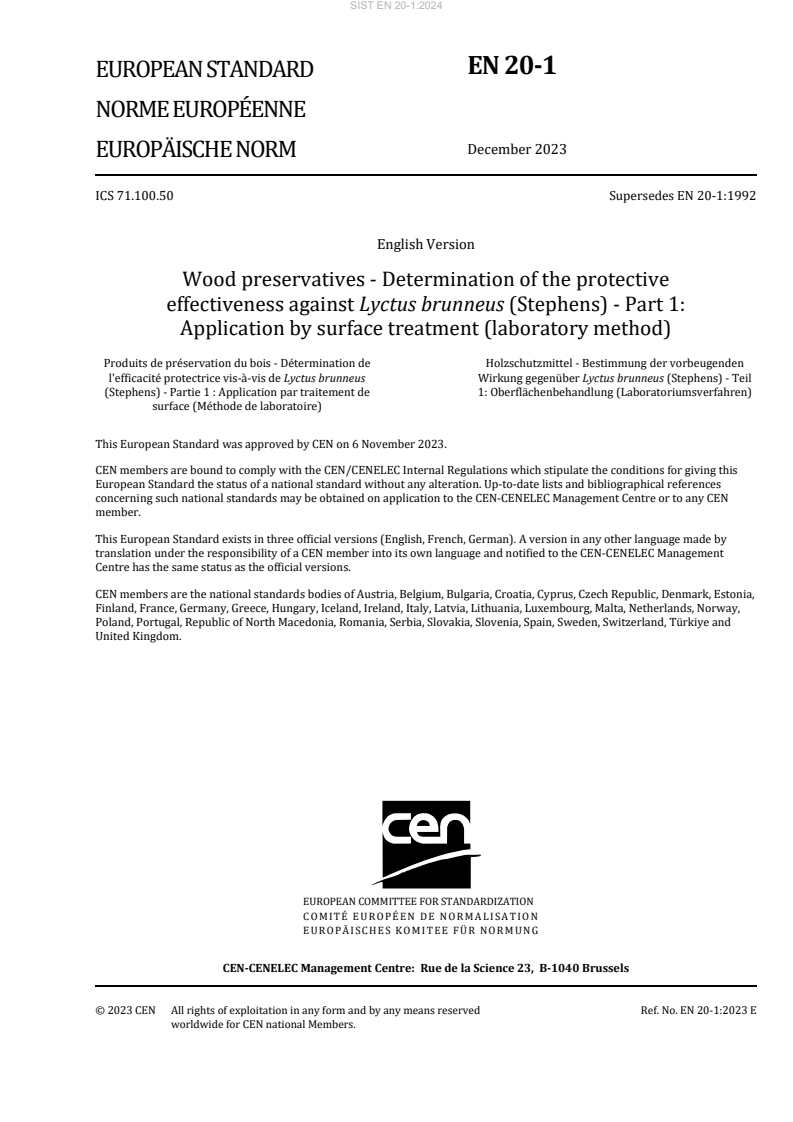
(Main)Wood preservatives - Determination of the protective effectiveness against Lyctus brunneus (Stephens) - Part 1: Application by surface treatment (laboratory method)
Wood preservatives - Determination of the protective effectiveness against Lyctus brunneus (Stephens) - Part 1: Application by surface treatment (laboratory method)
This part of the EN 20 series specifies a method for the determination of the protective effectiveness or the toxic values of a wood preservative against infection by Lyctus brunneus (Stephens) when the product is applied as a surface treatment to wood.
This method is applicable to:
- water-insoluble chemicals which are being studied as active insecticides; or
- organic formulsation, as supplied or as prepared in the laboratory by dilution of concentrates; or
- organic water-dispersible formulations as supplied or as prepared in the laboratory by dilution of concentrates; or
- water-soluble materials, for example salts.
NOTE This method can be used in conjuction with ageing procedures, which do not remove the added nutrient.
Holzschutzmittel - Bestimmung der vorbeugenden Wirkung gegenüber Lyctus brunneus (Stephens) - Teil 1: Oberflächenbehandlung (Laboratoriumsverfahren)
Dieser Teil der Normenreihe EN 20 legt ein Verfahren zur Bestimmung der vorbeugenden Wirkung oder der Grenze der Wirksamkeit eines Holzschutzmittels gegen Befall durch Lyctus brunneus (Stephens) fest, bei dem das Schutzmittel durch Behandlung seiner Oberfläche auf das Holz aufgebracht wird.
Das Verfahren ist anwendbar für
nicht wasserlösliche chemische Erzeugnisse, die als insektizide Wirkstoffe untersucht werden, oder
organische Formulierungen im Anlieferungszustand oder in der Form, wie sie im Labor durch Verdünnung von Konzentraten hergestellt werden, oder
in Wasser dispergierbare organische Formulierungen im Anlieferungszustand oder in der Form, wie sie im Labor durch Verdünnung von Konzentraten hergestellt werden, oder
wasserbasierte Schutzmittel, z. B. Salze.
ANMERKUNG Das Verfahren kann in Verbindung mit Alterungsverfahren angewendet werden, die die zugegebene Nährlösung nicht entfernen.
Produits de préservation du bois - Détermination de l'efficacité protectrice vis-à-vis de Lyctus brunneus (Stephens) - Partie 1 : Application par traitement de surface (Méthode de laboratoire)
La présente partie de la série de normes EN 20 spécifie une méthode de détermination de l'efficacité protectrice ou du seuil d'efficacité d'un produit de préservation du bois contre l'infestation par le Lyctus brunneus (Stephens) lorsque ce produit est appliqué au bois en tant que traitement de surface.
La présente méthode est applicable :
- aux produits chimiques non hydrosolubles étudiés en tant que matières actives insecticides ; ou
- aux formules organiques telles qu'elles sont livrées ou obtenues en laboratoire par dilution de concentrés ; ou
- aux formules organiques hydrodispersables telles qu'elles sont livrées ou obtenues en laboratoire par dilution de concentrés ; ou
- aux produits de préservation à base d’eau tels que les sels.
NOTE La présente méthode peut être utilisée conjointement avec des épreuves de vieillissement qui n'éliminent pas la solution nutritive ajoutée.
Zaščitna sredstva za les - Določanje učinkovitosti preventivne zaščite proti rjavemu parketarju Lyctus brunneus (Stephens) - 1. del: Površinsko nanašanje (laboratorijska metoda)
Ta del skupine standardov EN 20 določa metodo za ugotavljanje učinkovitosti preventivne zaščite ali toksičnih vrednosti zaščitnega sredstva za les proti rjavemu parketarju Lyctus brunneus (Stephens), ko je izdelek uporabljen v sklopu površinske obdelave lesa.
Ta metoda se uporablja za:
– v vodi netopne kemikalije, ki se preučujejo kot aktivni insekticidi; ali
– organske formulacije, ki so dobavljene ali pripravljene v laboratoriju z redčenjem koncentratov; ali
– organske formulacije, ki se razpršijo v vodi in so dobavljene ali pripravljene v laboratoriju z redčenjem
koncentratov; ali
– zaščitna sredstva za les na vodni osnovi, na primer sol.
OPOMBA: Ta metoda se lahko uporablja v povezavi s postopki staranja, ki ne odstranjujejo dodanega hranila.
General Information
- Status
- Published
- Publication Date
- 05-Dec-2023
- Technical Committee
- CEN/TC 38 - Durability of wood and derived materials
- Drafting Committee
- CEN/TC 38/WG 24 - Insect testing - (beetles - termites)
- Current Stage
- 6060 - Definitive text made available (DAV) - Publishing
- Start Date
- 06-Dec-2023
- Due Date
- 15-Feb-2024
- Completion Date
- 06-Dec-2023
Relations
- Effective Date
- 18-Jan-2023
Overview
EN 20-1:2023 (CEN) - Wood preservatives - Determination of the protective effectiveness against Lyctus brunneus (Stephens) - Part 1: Application by surface treatment (laboratory method) - specifies a laboratory procedure to assess the protective effectiveness or toxic values of wood preservatives when applied as a surface treatment. The method is designed to quantify the ability of a preservative to prevent infestation and development of the powderpost beetle Lyctus brunneus and is part of the EN 20 series on wood-protecting chemicals.
Key topics and technical requirements
- Scope and applicability: Applicable to water‑insoluble actives, organic formulations (as supplied or diluted), organic water‑dispersible formulations, and water‑soluble materials (e.g., salts). Can be combined with ageing procedures that do not remove the added nutrient.
- Test principle: Nutrient‑impregnated wood specimens are surface treated with the preservative (single concentration or a series for toxic values), exposed to adult Lyctus brunneus, and attack is compared to untreated or solvent controls.
- Test materials: Requires cultured Lyctus brunneus (adults ≤48 h after emergence), specified reagents (peptone, D(+)-glucose, paraffin/gelatin seals), filter paper and suitable solvents/diluents.
- Specimen preparation: Details on wood species selection, specimen dimensions, nutrient impregnation, sealing of transverse faces, application of surface treatment, drying and conditioning.
- Test environment: Defined conditioning and culturing chambers (examples in the standard: culturing at ~26 ± 2 °C, 75 ± 5 % RH; conditioning at ~20 ± 2 °C, 65 ± 5 % RH).
- Results and reporting: Assessment of protective effectiveness, calculation of toxic values, validity criteria and required test-report contents. Annexes include an example test report (A), culturing technique for Lyctus (B) and information on parasites/predators (C).
- Normative references: Includes EN ISO 835 (laboratory glassware) and ISO 3696 (water for analytical laboratory use).
Applications and who uses it
- Chemical manufacturers and formulators developing or registering wood preservatives and insecticides.
- Independent testing laboratories and quality control units performing standardized efficacy testing.
- Timber treatment plants and product development teams comparing formulations and application methods.
- Regulatory authorities and certification bodies evaluating performance claims for treated wood.
- Research institutions studying insect resistance, ageing effects, or comparative preservative performance.
Related standards
- EN 20 series (other parts for different test methods and species)
- EN ISO 835, ISO 3696 (referenced for equipment and water quality)
- National implementations of CEN standards (mandatory adoption within CEN member states)
Keywords: EN 20-1:2023, wood preservatives, Lyctus brunneus, surface treatment, laboratory method, protective effectiveness, toxic values, wood‑protecting chemicals.

Frequently Asked Questions
EN 20-1:2023 is a standard published by the European Committee for Standardization (CEN). Its full title is "Wood preservatives - Determination of the protective effectiveness against Lyctus brunneus (Stephens) - Part 1: Application by surface treatment (laboratory method)". This standard covers: This part of the EN 20 series specifies a method for the determination of the protective effectiveness or the toxic values of a wood preservative against infection by Lyctus brunneus (Stephens) when the product is applied as a surface treatment to wood. This method is applicable to: - water-insoluble chemicals which are being studied as active insecticides; or - organic formulsation, as supplied or as prepared in the laboratory by dilution of concentrates; or - organic water-dispersible formulations as supplied or as prepared in the laboratory by dilution of concentrates; or - water-soluble materials, for example salts. NOTE This method can be used in conjuction with ageing procedures, which do not remove the added nutrient.
This part of the EN 20 series specifies a method for the determination of the protective effectiveness or the toxic values of a wood preservative against infection by Lyctus brunneus (Stephens) when the product is applied as a surface treatment to wood. This method is applicable to: - water-insoluble chemicals which are being studied as active insecticides; or - organic formulsation, as supplied or as prepared in the laboratory by dilution of concentrates; or - organic water-dispersible formulations as supplied or as prepared in the laboratory by dilution of concentrates; or - water-soluble materials, for example salts. NOTE This method can be used in conjuction with ageing procedures, which do not remove the added nutrient.
EN 20-1:2023 is classified under the following ICS (International Classification for Standards) categories: 71.100.50 - Wood-protecting chemicals. The ICS classification helps identify the subject area and facilitates finding related standards.
EN 20-1:2023 has the following relationships with other standards: It is inter standard links to EN 20-1:1992. Understanding these relationships helps ensure you are using the most current and applicable version of the standard.
EN 20-1:2023 is associated with the following European legislation: EU Directives/Regulations: 305/2011. When a standard is cited in the Official Journal of the European Union, products manufactured in conformity with it benefit from a presumption of conformity with the essential requirements of the corresponding EU directive or regulation.
You can purchase EN 20-1:2023 directly from iTeh Standards. The document is available in PDF format and is delivered instantly after payment. Add the standard to your cart and complete the secure checkout process. iTeh Standards is an authorized distributor of CEN standards.
Standards Content (Sample)
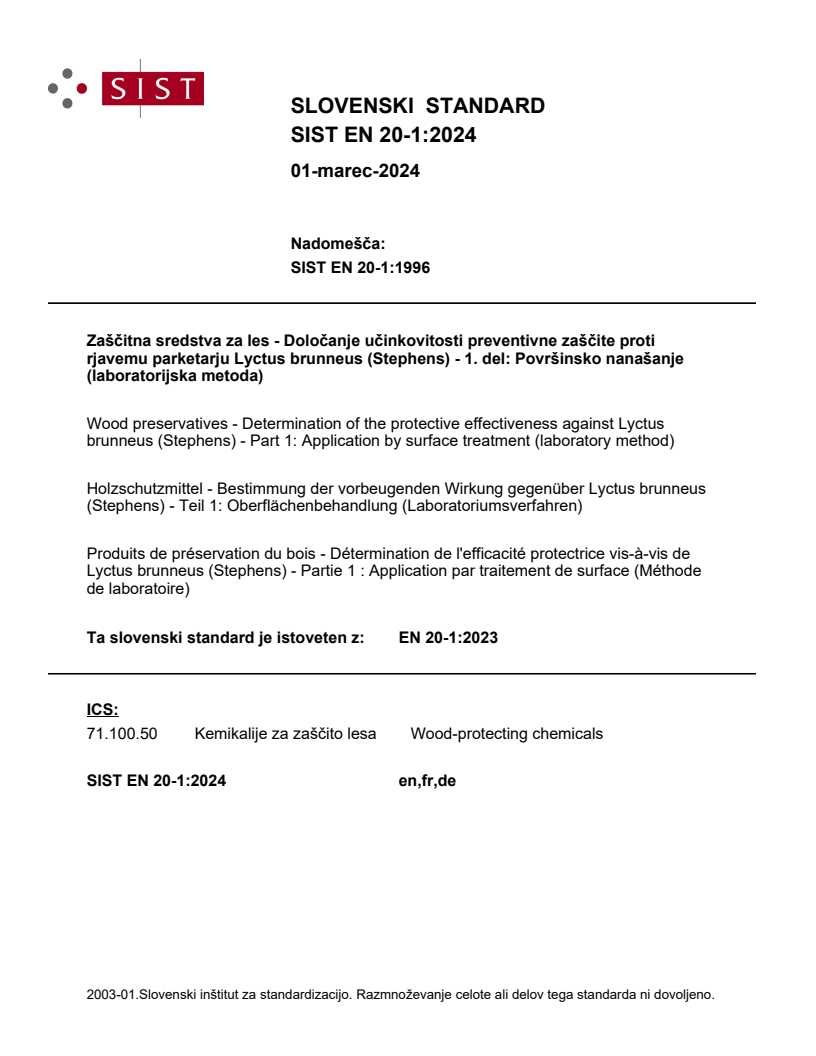
SLOVENSKI STANDARD
01-marec-2024
Nadomešča:
SIST EN 20-1:1996
Zaščitna sredstva za les - Določanje učinkovitosti preventivne zaščite proti
rjavemu parketarju Lyctus brunneus (Stephens) - 1. del: Površinsko nanašanje
(laboratorijska metoda)
Wood preservatives - Determination of the protective effectiveness against Lyctus
brunneus (Stephens) - Part 1: Application by surface treatment (laboratory method)
Holzschutzmittel - Bestimmung der vorbeugenden Wirkung gegenüber Lyctus brunneus
(Stephens) - Teil 1: Oberflächenbehandlung (Laboratoriumsverfahren)
Produits de préservation du bois - Détermination de l'efficacité protectrice vis-à-vis de
Lyctus brunneus (Stephens) - Partie 1 : Application par traitement de surface (Méthode
de laboratoire)
Ta slovenski standard je istoveten z: EN 20-1:2023
ICS:
71.100.50 Kemikalije za zaščito lesa Wood-protecting chemicals
2003-01.Slovenski inštitut za standardizacijo. Razmnoževanje celote ali delov tega standarda ni dovoljeno.
EN 20-1
EUROPEAN STANDARD
NORME EUROPÉENNE
December 2023
EUROPÄISCHE NORM
ICS 71.100.50 Supersedes EN 20-1:1992
English Version
Wood preservatives - Determination of the protective
effectiveness against Lyctus brunneus (Stephens) - Part 1:
Application by surface treatment (laboratory method)
Produits de préservation du bois - Détermination de Holzschutzmittel - Bestimmung der vorbeugenden
l'efficacité protectrice vis-à-vis de Lyctus brunneus Wirkung gegenüber Lyctus brunneus (Stephens) - Teil
(Stephens) - Partie 1 : Application par traitement de 1: Oberflächenbehandlung (Laboratoriumsverfahren)
surface (Méthode de laboratoire)
This European Standard was approved by CEN on 6 November 2023.
CEN members are bound to comply with the CEN/CENELEC Internal Regulations which stipulate the conditions for giving this
European Standard the status of a national standard without any alteration. Up-to-date lists and bibliographical references
concerning such national standards may be obtained on application to the CEN-CENELEC Management Centre or to any CEN
member.
This European Standard exists in three official versions (English, French, German). A version in any other language made by
translation under the responsibility of a CEN member into its own language and notified to the CEN-CENELEC Management
Centre has the same status as the official versions.
CEN members are the national standards bodies of Austria, Belgium, Bulgaria, Croatia, Cyprus, Czech Republic, Denmark, Estonia,
Finland, France, Germany, Greece, Hungary, Iceland, Ireland, Italy, Latvia, Lithuania, Luxembourg, Malta, Netherlands, Norway,
Poland, Portugal, Republic of North Macedonia, Romania, Serbia, Slovakia, Slovenia, Spain, Sweden, Switzerland, Türkiye and
United Kingdom.
EUROPEAN COMMITTEE FOR STANDARDIZATION
COMITÉ EUROPÉEN DE NORMALISATIO N
EUROPÄISCHES KOMITEE FÜR NORMUN G
CEN-CENELEC Management Centre: Rue de la Science 23, B-1040 Brussels
© 2023 CEN All rights of exploitation in any form and by any means reserved Ref. No. EN 20-1:2023 E
worldwide for CEN national Members.
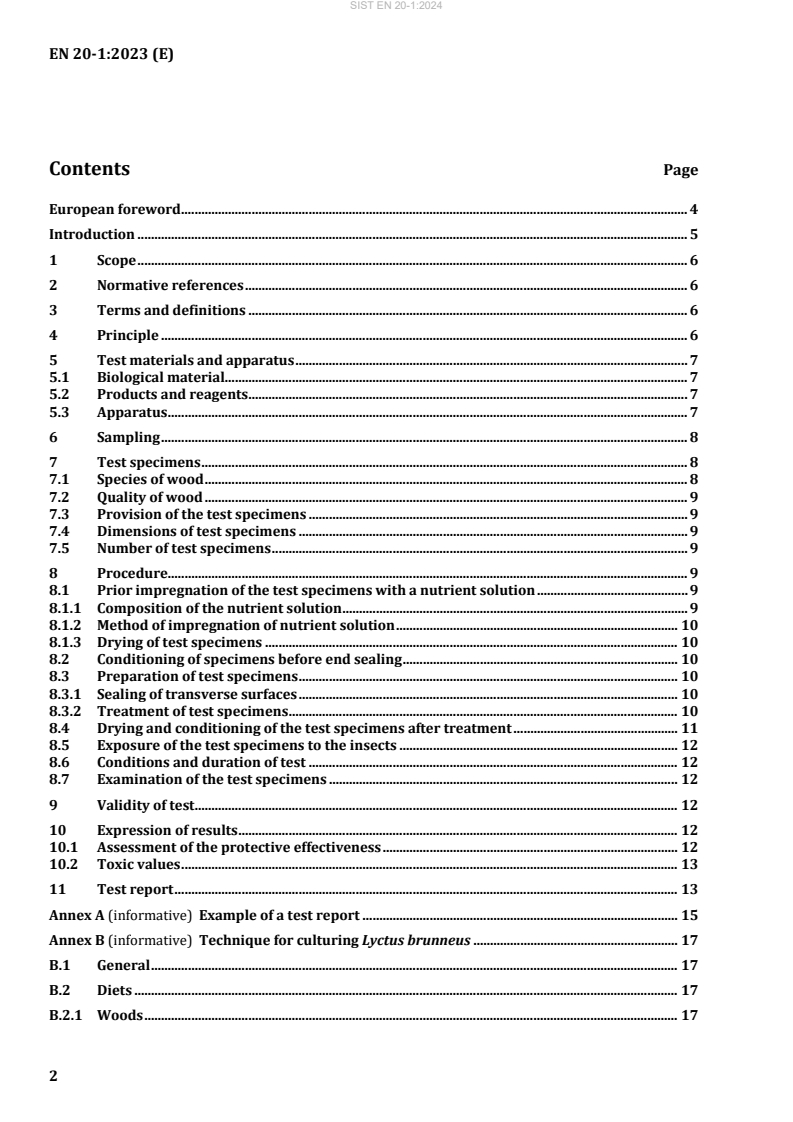
Contents Page
European foreword . 4
Introduction . 5
1 Scope . 6
2 Normative references . 6
3 Terms and definitions . 6
4 Principle . 6
5 Test materials and apparatus . 7
5.1 Biological material . 7
5.2 Products and reagents . 7
5.3 Apparatus . 7
6 Sampling . 8
7 Test specimens . 8
7.1 Species of wood . 8
7.2 Quality of wood . 9
7.3 Provision of the test specimens . 9
7.4 Dimensions of test specimens . 9
7.5 Number of test specimens . 9
8 Procedure. 9
8.1 Prior impregnation of the test specimens with a nutrient solution . 9
8.1.1 Composition of the nutrient solution . 9
8.1.2 Method of impregnation of nutrient solution . 10
8.1.3 Drying of test specimens . 10
8.2 Conditioning of specimens before end sealing . 10
8.3 Preparation of test specimens . 10
8.3.1 Sealing of transverse surfaces . 10
8.3.2 Treatment of test specimens . 10
8.4 Drying and conditioning of the test specimens after treatment . 11
8.5 Exposure of the test specimens to the insects . 12
8.6 Conditions and duration of test . 12
8.7 Examination of the test specimens . 12
9 Validity of test . 12
10 Expression of results . 12
10.1 Assessment of the protective effectiveness . 12
10.2 Toxic values . 13
11 Test report . 13
Annex A (informative) Example of a test report . 15
Annex B (informative) Technique for culturing Lyctus brunneus . 17
B.1 General . 17
B.2 Diets . 17
B.2.1 Woods . 17
B.2.2 Artificial diet . 19
B.3 Obtaining adults beetles . 19
B.4 Culturing procedure . 20
B.5 Identifiction of sex . 20
B.6 Precautions against infestation by parasites . 20
Annex C (informative) Principal parasites and predators of Lyctus . 21
C.1 Mites . 21
C.2 Insects . 21
Bibliography . 22
European foreword
This document (EN 20-1:2023) has been prepared by Technical Committee CEN/TC 38 “Durability of
wood and wood-based products”, the secretariat of which is held by SIS.
This European Standard shall be given the status of a national standard, either by publication of an
identical text or by endorsement, at the latest by June 2024, and conflicting national standards shall be
withdrawn at the latest by June 2024.
Attention is drawn to the possibility that some of the elements of this document may be the subject of
patent rights. CEN shall not be held responsible for identifying any or all such patent rights.
This document supersedes EN 20-1:1992.
The main changes compared to the previous edition EN 20-1:1992 are listed below:
a) the source of peptone is no longer specified (5.2.6);
b) other wood species than oak may be used for the test under certain circumstances (7.1);
c) tests with solvent control may be omitted, when the solvent is water (7.5);
d) new pictures were used for Figure B.1, Figure B.2 and Figure B.3.
NOTE Test results obtained according to earlier versions of this document and when the tests had started
before this version of EN 20-1 was published are considered valid.
Any feedback and questions on this document should be directed to the users’ national standards body.
A complete listing of these bodies can be found on the CEN website.
According to the CEN-CENELEC Internal Regulations, the national standards organisations of the
following countries are bound to implement this European Standard: Austria, Belgium, Bulgaria, Croatia,
Cyprus, Czech Republic, Denmark, Estonia, Finland, France, Germany, Greece, Hungary, Iceland, Ireland,
Italy, Latvia, Lithuania, Luxembourg, Malta, Netherlands, Norway, Poland, Portugal, Republic of North
Macedonia, Romania, Serbia, Slovakia, Slovenia, Spain, Sweden, Switzerland, Türkiye and the United
Kingdom.
Introduction
This Part of the EN 20 series describes a laboratory method of test which gives a basis for assessment of
the protective effectiveness of a wood preservative, when applied as a surface treatment, against Lyctus
brunneus. It allows the deternination of the concentration at which the product prevents the development
of infestation from egg-laying.
It can also be used with formulations ready for use.
The species Lyctus brunneus is chosen because of its particular practical relevance and because it can be
used easily in laboratory tests. The method can be used with other lyctid species, but the results might
not be comparable with those obtained with Lyctus brunneus.
The test specimens are enriched with a defined nutrient solution, before exposure to egg-laying, in order
to ensure uniformity of nutrient quality of test specimens between different laboratories.
This laboratory method provides one criterion by which the value of a product can be assessed. In making
this assessment, the methods by which the preservative may be applied should be taken into account. It
is further recommended that results from this test should be supplemented by those from other
appropriates tests, and above all by comparison with practical experience.
When products which are very active at low concentrations are used, it is very important to take suitable
precautions to isolate and separate, as far as possible, operations involving chemical products, other
products, treated wood, laboratory apparatus and clothing. Suitable precautions should include the use
of separate rooms, areas within rooms, extraction facilities and conditioning chambers as well as special
training for personnel.
1 Scope
This part of the EN 20 series specifies a method for the determination of the protective effectiveness or
the toxic values of a wood preservative against infection by Lyctus brunneus (Stephens) when the product
is applied as a surface treatment to wood.
This method is applicable to:
— water-insoluble chemicals which are being studied as active insecticides; or
— organic formulsation, as supplied or as prepared in the laboratory by dilution of concentrates; or
— organic water-dispersible formulations as supplied or as prepared in the laboratory by dilution of
concentrates; or
— water-based preservatives, for example salts.
NOTE This method can be used in conjuction with ageing procedures, which do not remove the added nutrient.
2 Normative references
The following documents are referred to in the text in such a way that some or all of their content
constitutes requirements of this document. For dated references, only the edition cited applies. For
undated references, the latest edition of the referenced document (including any amendments) applies.
EN ISO 835, Laboratory glassware — Graduated pipettes (ISO 835)
ISO 3696, Water for analytical laboratory use — Specification and test methods
3 Terms and definitions
For the purposes of this document, the following terms and definitions apply.
ISO and IEC maintain terminology databases for use in standardization at the following addresses:
— IEC Electropedia: available at https://www.electropedia.org/
— ISO Online browsing platform: available at https://www.iso.org/obp
3.1
representative sample
sample having its physical or chemical characteristics identical to the volumetric average characteristics
of the total volume being sampled
3.2
supplier
sponsor of the test
4 Principle
Depending on the test being carried out either:
— a set of test specimens of a susceptible wood species is impregnated with nutrient solution and then
surface treated with a solution of the preservative; or
— if toxic values are to be determined, several sets of tests specimens of a susceptible wood species are
impregnated with a nutrient solution and then surface treated with a series of solutions in which the
concentration of preservative is ranged in a given progression.
The treated test specimens are exposed to adult Lyctus brunneus and the resulting attack compared to
that in untreated controls. If the preservation has been prepared in the laboratory by dilution of a
concentrate or by dissolution of a solid, the resulting attack is also compared to that in solvent or diluent
treated controls.
5 Test materials and apparatus
5.1 Biological material
Lyctus brunneus (Stephens), insects emerged from cultures not more than 48 h before use in the test.
NOTE The culturing of Lyctus brunneus requires care in order to obtain a regular supply of adults which have
not already laid eggs. The culturing technique, which experiences has shown to be suitable, is described in Annex B.
5.2 Products and reagents
5.2.1 Paraffin wax, for sealing the relevant surfaces of test specimens to be treated with solutions in
which water is the continuous phase
NOTE Paraffiin wax with a setting point of 52 °C to 54 °C has been found to be suitable.
5.2.2 Gelatin, for sealing the relevant surfaces of specimens to be treated with solutions in which an
organic solvent is the continuous phase
5.2.3 Paste, for securing filter paper. The paste shall be starch-free, non-toxic to Lyctus and insoluble
in the product under test
NOTE Sodium carboxymethyl cellulose, food grade, has been found to be suitable.
5.2.4 Water, complying with grade 3 of ISO 3696
5.2.5 Solvent or diluent, a volatile liquid that will dissolve or dilute the preservative but does not leave
a residue in the wood at the end of the post-treatment conditioning period that has a toxic effet on the
insects
CAUTION — Do not use benzene or other solvents which pose on health risk.
5.2.6 Peptone
5.2.7 D (+)-glucose
5.2.8 Filter paper ordinary quality, medium-fast grade
5.2.9 Fine cloth of cotton of linen, with a mesh aperture of less than 0,3 mm
5.3 Apparatus
5.3.1 Culturing chamber, with air circulation, controlled at (26 ± 2) °C, and at relative humidity
(75 ± 5) %
5.3.2 Conditioning chamber, well ventilated, controlled at (20 ± 2) °C and relative humidity
(65 ± 5) %
The conditioning of specimens may be carried out in the laboratory work area (see 5.3.4) provided that
this has the conditions specified for the conditioning chamber (see 5.3.2).
5.3.3 Drying chamber, well ventilated, controlled at (30 ± 2) °C
5.3.4 Laboratory work area, well ventilated, where treatment of the test specimens is carried out
CAUTION — It is essential to follow safety procedures for handling flammable and toxic materials. Avoid
excessive exposure of operators to solvents of their vapours.
5.3.5 Testing chamber, with conditions identical to those of the culturing chamber (see 5.3.1)
5.3.6 Vacuum vessel(s), fitted with stopcocks
5.3.7 Vaccum pump, fitted with a pressure gauge and capable of maintaining a pressure of 700 Pa
5.3.8 Weights, to provide ballast for the test specimens. The weights shall not react with any materials
with which they come into contact during the test
5.3.9 Pipette, of the specified in EN ISO 835, or brush
5.3.10 Safety equipment and protective clothing, appropriate for the test product and the test solvent,
to ensure the safety of the operator
5.3.11 Test container, suitable for holding the test specimens and of material resistant to the solvents
used
NOTE Jars of approximately 60 mm diameter and 100 mm height have been found to be suitable.
5.3.12 Ordinary laboratory equipment, including a balance capable of weighing to an accuracy of
0,01 g
5.3.13 X-ray apparatus, (optional) with tungsten target and beryllium window, with voltage and
current continuously variable in the range:
— voltage: 10 kV to 50 kV;
— current: 0 mA to 15 mA
6 Sampling
The sample of preservative shall be representative of the product to be tested. Samples shall be stored
and handled in accordance with any written recommendations from the supplier.
For the sampling of preservatives from bulk supplies, the procedure given in EN 212 should be used.
7 Test specimens
7.1 Species of wood
The test shall be carried out on European oak. This shall comprise sessile oak, Quercus petraea
(Mattuschka) Lieblin, and pedunculate oak, Quercus robur Linnaeus.
100 Pa = 1 mbar.
Other wood species, with demonstrated susceptiblity to Lyctus brunneus (Stephens), like Triplochiton
scleroxylon, may be used instead of European oak.
7.2 Quality of wood
Use only sound sapwood with between 2 annual growth rings per 10 mm and 10 annual growth rings per
10 mm, straight-grainded without knots. The wood, having few tyloses, shall not have been floated or
subjected to any chemical treatment and shall be dried without delay as described in 7.3.
7.3 Provision of the test specimens
Remove the bark from the freshly cut billets and then cut them into lengths (from which strips
25 mm × 15 mm in cross-section will be cut). Immediately place the billets in the drying chamber (5.3.3)
stacked with spaces between individual billets so as to allow movement of air through the stack. Retain
the billets in the drying chamber until their moisture contents are reduced to 15 % mass fraction (see
ISO 13061-1).
NOTE Moisture meters of the two-pronged electrical conductivity type are suitable for assessing moisture
content.
Cut the sapwood of the dried billets into planted st
...
SIST EN 20-1:2024は、Lyctus brunneus(スティーブンス)に対する木材防腐剤の効果を評価するための方法を定めており、特に表面処理によって適用される場合の評価に焦点を当てています。この標準は、水不溶性化学物質やオーガニック製剤、さらに水溶性材料を含む様々な防腐剤の効果を測定するための包括的な方法論を提供しています。 この基準の強みは、その適用範囲の広さです。水不溶性化学物質、オーガニック製剤、または水溶性材料に対する効果を一貫した手法で検証でき、実験室での条件下でも正確な結果を得ることが可能です。また、加齢手順と組み合わせて使用することができ、これにより、追加栄養素を取り除かずに長期的な防腐剤の効果を検討することができます。この点は、特に実際の使用条件において重要です。 さらに、EN 20-1:2023は、ライフサイクルの異なる段階で木材が直面するリスクを考慮しており、木材防腐剤の選択と使用における情報を提供します。これにより、製造業者やユーザーは、実際の使用条件下でのパフォーマンスを予測しやすくなります。 全体として、SIST EN 20-1:2024は、木材防腐剤に関連する研究や製品開発において重要な役割を果たすための基準として、その関連性と有用性が高いことが強調されます。この標準は、木材業界における持続可能な実践と製品の安全性を促進するための基礎となります。
SIST EN 20-1:2024 표준 문서는 Lyctus brunneus (Stephens)에 대한 목재 방부제의 보호 효과를 실험실 방법을 통해 규명하는 데 중점을 두고 있습니다. 이 문서는 EN 20 시리즈의 첫 번째 부분으로, 목재에 대한 표면 처리 방식으로 적용된 방부제의 효과성을 확인하는 방법을 명시합니다. 이 표준의 주요 강점은 다양한 유형의 화학 물질에 적용 가능하다는 것입니다. 수용성이 아닌 화학 물질, 유기 배합물, 유기 수분 분산 배합물, 그리고 수용성 물질 등 다양한 형태의 방부제를 다룰 수 있으며, 이는 사용자에게 폭넓은 적용 가능성을 제공합니다. 특히, 실험실에서 농축액을 희석하여 준비한 유기 배합물이나 유기 수분 분산 배합물을 사용할 수 있는 점은 연구자들과 산업 사용자에게 큰 장점으로 작용합니다. 또한, 이 표준은 나이 든 기능을 보충하는 절차와 함께 사용할 수 있다는 점에서 현대 연구 동향에 잘 부합합니다. 즉, 추가된 영양소를 제거하지 않으면서 방부제의 장기적인 효과에 대해 평가할 수 있음을 의미합니다. 결론적으로, EN 20-1:2023은 목재 산업에 필수적인 표준으로, 방부제의 보호 효과를 실험적으로 평가하는 데 필요한 신뢰할 수 있는 방법론을 제공합니다. 이는 방부제 개발 및 품질 보증에 있어 매우 중요한 자료가 될 것입니다.
Le document SIST EN 20-1:2024 établit une norme précise pour la détermination de l'efficacité protectrice des produits de préservation du bois contre l'infestation par Lyctus brunneus (Stephens) lorsqu'ils sont appliqués par traitement de surface. Ce standard revêt une importance capitale pour les industriels et chercheurs du secteur, en permettant une évaluation fiable et reproductible de l'efficacité des insecticides sur divers types de formulations. L'étendue de cette norme est clairement définie, s'appliquant aux produits chimiques insolubles dans l'eau, aux formulations organiques, qu'elles soient fournies prêtes à l'emploi ou préparées en laboratoire, ainsi qu'aux matériaux solubles dans l'eau, comme les sels. Cette flexibilité permet d'intégrer une large gamme de produits dans les tests, ce qui en fait un outil précieux pour les développeurs de produits de préservation du bois. Une des forces majeures de la norme EN 20-1:2023 réside dans sa capacité à être utilisée conjointement avec des procédures de vieillissement, ajoutant ainsi une dimension supplémentaire d'étude qui n’affecte pas les nutriments ajoutés. Cela permet une appréciation plus réaliste et dynamique de la protection apportée face à l'infestation, prenant en compte les variables qui interviennent dans des conditions réelles. En intégrant ces méthodologies standardisées, ce document s'assure de la pertinence de ses résultats pour les applications industrielles, garantissant que les produits de préservation du bois testés répondent aux exigences de sécurité et d'efficacité. La norme SIST EN 20-1:2024 constitue donc un référentiel essentiel pour le secteur, favorisant le développement, la commercialisation et l'utilisation de traitements de bois plus efficaces et durables.
The standard EN 20-1:2023 presents a comprehensive methodology for assessing the protective effectiveness of wood preservatives against the insect Lyctus brunneus. This is particularly crucial in maintaining the integrity of wood products, as this beetle is known for its detrimental impact on wooden structures. The scope of EN 20-1:2023 is clearly defined, targeting various categories of wood preservatives. It accommodates water-insoluble chemicals considered as active insecticides, as well as organic formulations, whether supplied directly or diluted from concentrates. Furthermore, it includes guidance on organic water-dispersible formulations and water-soluble materials, such as salts. This inclusivity significantly enhances the standard's applicability across different types of wood treatment products, making it relevant for a wide range of research and implementation scenarios. A notable strength of this standard is its flexibility in method application. The inclusion of ageing procedures allows for a more nuanced understanding of a wood preservative's longevity and effectiveness over time without compromising the nutrient addition. This aspect is particularly valuable for laboratories looking to conduct thorough testing under varied conditions. The standard also plays a critical role in advancing best practices in the wood preservation industry, aligning with environmental and safety regulations. By setting a rigorous framework for testing and evaluation, EN 20-1:2023 ensures that only effective and safe wood preservatives are identified for use, ultimately contributing to sustainable forestry practices. In summary, EN 20-1:2023 stands out for its comprehensive, adaptable, and relevant methodologies in evaluating wood preservatives against Lyctus brunneus, making it an essential standard for researchers and industry professionals alike.
Die Norm EN 20-1:2023 befasst sich mit der Bestimmung der schützenden Wirksamkeit von Holzschutzmitteln gegen die Infektion durch Lyctus brunneus (Stephens), indem sie eine spezifische Prüfmethodik für die Anwendung von Oberflächenbehandlungen an Holz vorschlägt. Die Norm ist von erheblicher Bedeutung für die Holzschutzmittelindustrie, da sie sowohl die Effizienz als auch die Sicherheitsaspekte von chemischen Formulierungen bewertet. Ein herausragendes Merkmal dieser Norm ist ihre umfangreiche Anwendbarkeit. Sie ist nicht nur auf wasserunlösliche Chemikalien beschränkt, sondern umfasst auch organische Formulierungen, die sowohl als Fertigprodukte als auch durch Verdünnung von Konzentraten im Labor hergestellt werden. Dies ermöglicht eine umfassende Evaluierung verschiedener Holzschutzmittel und erleichtert die Forschung und Entwicklung neuer Produkte, die als aktive Insektizide fungieren können. Des Weiteren sind auch wasserdispersible Formulierungen und wasserlösliche Materialien, wie beispielsweise Salze, in ihrem Geltungsbereich enthalten. Ein weiterer Vorteil dieser Norm besteht darin, dass sie in Verbindung mit Alterungsverfahren eingesetzt werden kann, ohne dass die zugesetzten Nährstoffe entfernt werden. Dies bietet zusätzliche Flexibilität in der Anwendung und macht sie für verschiedene Forschungsszenarien und industrielle Anwendungen attraktiv. Die Relevanz der Norm EN 20-1:2023 wird durch die zunehmende Notwendigkeit zur Gewährleistung von Holzprodukten, die gegen Schädlinge wie Lyctus brunneus resistent sind, besonders deutlich. Durch die Bereitstellung eines standardisierten Verfahrens zur Bestimmung der Wirksamkeit von Holzschutzmitteln trägt die Norm entscheidend zur Verbesserung der Holzschutztechnologien bei und unterstützt die Branche dabei, den Forderungen nach sicheren und effektiven Lösungen gerecht zu werden. Insgesamt bietet die Norm EN 20-1:2023 eine solide Grundlage für die Bewertung der Schutzmaßnahmen gegen Lyctus brunneus und stellt sicher, dass Hersteller und Forscher über die erforderlichen Werkzeuge verfügen, um die Leistungsfähigkeit von Holzschutzmitteln zu beurteilen.
Questions, Comments and Discussion
Ask us and Technical Secretary will try to provide an answer. You can facilitate discussion about the standard in here.
Loading comments...