

EN 15119-1:2025
(Main)Biological durability of wood and wood-based products - Determination of emissions from preservative treated wood to the environment - Part 1: Wood held in the storage yard after treatment and wooden commodities exposed in Use Class 3 (not covered, not in contact with the ground) - Laboratory method
- Abstract
This document specifies a laboratory method for obtaining water samples from preservative treated wood exposed out of ground contact (wood held in the storage yard after treatment and which has been in conditions designed to simulate outdoor, out of ground contact situations), at increasing time intervals after exposure.
- Status
- Published
- Publication Date
- 01-Jul-2025
- Technical Committee
- CEN/TC 38 - Durability of wood and derived materials
- Drafting Committee
- CEN/TC 38/WG 27 - Exposure Aspects
- Current Stage
- 6060 - Definitive text made available (DAV) - Publishing
- Start Date
- 02-Jul-2025
- Due Date
- 11-Sep-2025
- Completion Date
- 02-Jul-2025
Buy Documents


Overview
EN 15119-1:2025 (CEN) specifies a laboratory method to determine emissions (leaching) from preservative‑treated wood that is stored after treatment or used in Use Class 3 (not covered, not in contact with the ground). The method produces water samples (leachate) at defined time intervals after exposure, relates emissions to wood surface area and exposure time (flux in mg·m‑2·day‑1), and supports environmental risk assessment of treated wood.
Key topics and technical requirements
- Scope: Laboratory simulation of outdoor, above‑ground exposure (storage yard and Use Class 3 commodities).
- Test principle: Short‑term immersion and drying cycles are used to simulate rainfall wetting/drying; leachate is collected for chemical analysis and/or ecotoxicity testing.
- Immersion regime example: The standard describes a recommended 3 × 1 min immersion regime (three 1‑minute dips per day with drying intervals) and time points that allow extrapolation to longer exposures (e.g., annual flux estimates).
- Results and reporting: Emissions quantified as mass per surface area per time (mg/m2/day); records and reporting formats are specified.
- Quality criteria: The standard addresses accuracy, reproducibility, specimen conditioning, and selection to ensure representative results.
- Apparatus and materials: Requirements for immersion containers, specimen assemblies, receiving vessels, balances, refrigeration, chemical analysis equipment, and safety.
- Analytical options: Chemical analysis of leachates and alternative evaluations such as ecotoxicity tests are supported.
- Compliance context: Aligned with OECD emission scenario principles and references EN ISO 5667‑3 (water sampling preservation/handling) and EN 335 (Use Classes).
Applications and who uses it
- Preservative manufacturers and wood treatment plants: to quantify emissions from treated products and demonstrate conformity with regulatory or internal requirements.
- Environmental laboratories: standardized method for leachate sampling and analysis.
- Regulatory bodies and risk assessors: input data for environmental exposure and risk assessments (BPR authorization contexts).
- Product certifiers and specifiers: evidence for labeling, sustainable procurement, and lifecycle assessments.
- R&D teams: compare treatment processes, surface treatments (paints, coatings) and species effects on emissions.
Related standards
- EN 15119-2 (Part 2: use classes 4/5 - ground or water contact)
- EN 335 (Use Classes for timber)
- EN ISO 5667‑3 (Water quality - sampling preservation and handling)
- OECD emission scenario documents referenced for exposure assumptions
EN 15119-1:2025 is essential when assessing leaching behavior of treated wood in above‑ground applications and for producing reproducible emission data for regulatory and environmental decision‑making.
Relations
- Effective Date
- 19-Jan-2023
- Effective Date
- 28-Jan-2026
- Effective Date
- 13-Feb-2026
Buy Documents
Get Certified
Connect with accredited certification bodies for this standard

BSI Group
BSI (British Standards Institution) is the business standards company that helps organizations make excellence a habit.

Bureau Veritas
Bureau Veritas is a world leader in laboratory testing, inspection and certification services.

DNV
DNV is an independent assurance and risk management provider.
Sponsored listings
Frequently Asked Questions
EN 15119-1:2025 is a standard published by the European Committee for Standardization (CEN). Its full title is "Biological durability of wood and wood-based products - Determination of emissions from preservative treated wood to the environment - Part 1: Wood held in the storage yard after treatment and wooden commodities exposed in Use Class 3 (not covered, not in contact with the ground) - Laboratory method". This standard covers: This document specifies a laboratory method for obtaining water samples from preservative treated wood exposed out of ground contact (wood held in the storage yard after treatment and which has been in conditions designed to simulate outdoor, out of ground contact situations), at increasing time intervals after exposure.
This document specifies a laboratory method for obtaining water samples from preservative treated wood exposed out of ground contact (wood held in the storage yard after treatment and which has been in conditions designed to simulate outdoor, out of ground contact situations), at increasing time intervals after exposure.
EN 15119-1:2025 is classified under the following ICS (International Classification for Standards) categories: 13.020.30 - Environmental impact assessment; 71.100.50 - Wood-protecting chemicals. The ICS classification helps identify the subject area and facilitates finding related standards.
EN 15119-1:2025 has the following relationships with other standards: It is inter standard links to CEN/TS 15119-1:2018, EN ISO 5667-3:2024, prEN 15119-1. Understanding these relationships helps ensure you are using the most current and applicable version of the standard.
EN 15119-1:2025 is available in PDF format for immediate download after purchase. The document can be added to your cart and obtained through the secure checkout process. Digital delivery ensures instant access to the complete standard document.
Standards Content (Sample)
SLOVENSKI STANDARD
01-september-2025
Odpornost lesa in lesnih izdelkov - Ugotavljanje emisij iz zaščitenega lesa v okolje
- 1. del: Sveže zaščiten les v skladiščih in leseni izdelki, izpostavljeni 3. razredu
uporabe (nepokrita uporaba, ni v stiku z zemljo) - Laboratorijska metoda
Durability of wood and wood-based products - Determination of emissions from
preservative treated wood to the environment - Part 1: Wood held in the storage yard
after treatment and wooden commodities exposed in Use Class 3 (not covered, not in
contact with the ground) - Laboratory method
Dauerhaftigkeit von Holz und Holzprodukten - Abschätzung von Emissionen von mit
Holzschutzmitteln behandeltem Holz an die Umwelt - Teil 1: Holz auf dem Lagerplatz
nach der Behandlung und Holzprodukte in Gebrauchsklasse 3 (nicht abgedeckt, ohne
Erdkontakt) - Laborverfahren
Durabilité du bois et des matériaux à base de bois - Estimation des émissions dans
l'environnement du bois traité avec des produits de préservation - Partie 1 : Bois stocké
en dépôt après traitement et articles en bois exposés en classe d'emploi 3 (non couverts,
non en contact avec le sol) - Méthode de laboratoire
Ta slovenski standard je istoveten z: EN 15119-1:2025
ICS:
13.020.30 Ocenjevanje vpliva na okolje Environmental impact
assessment
71.100.50 Kemikalije za zaščito lesa Wood-protecting chemicals
79.040 Les, hlodovina in žagan les Wood, sawlogs and sawn
timber
2003-01.Slovenski inštitut za standardizacijo. Razmnoževanje celote ali delov tega standarda ni dovoljeno.
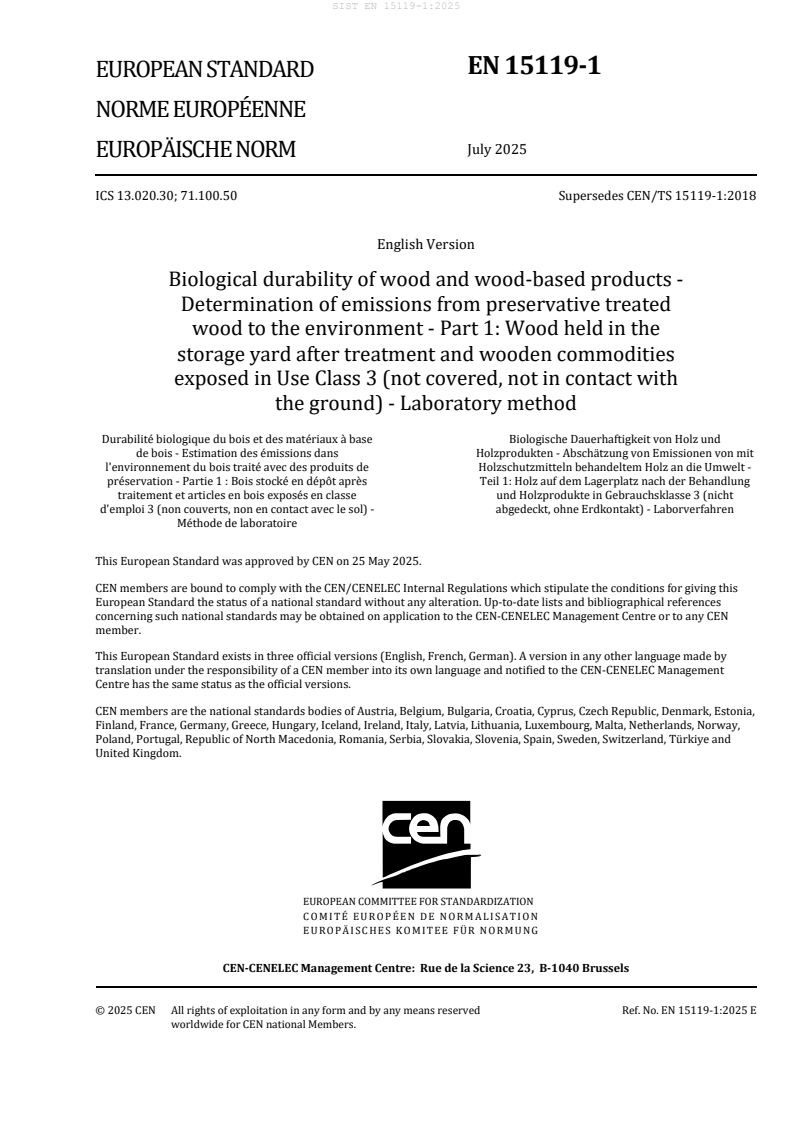
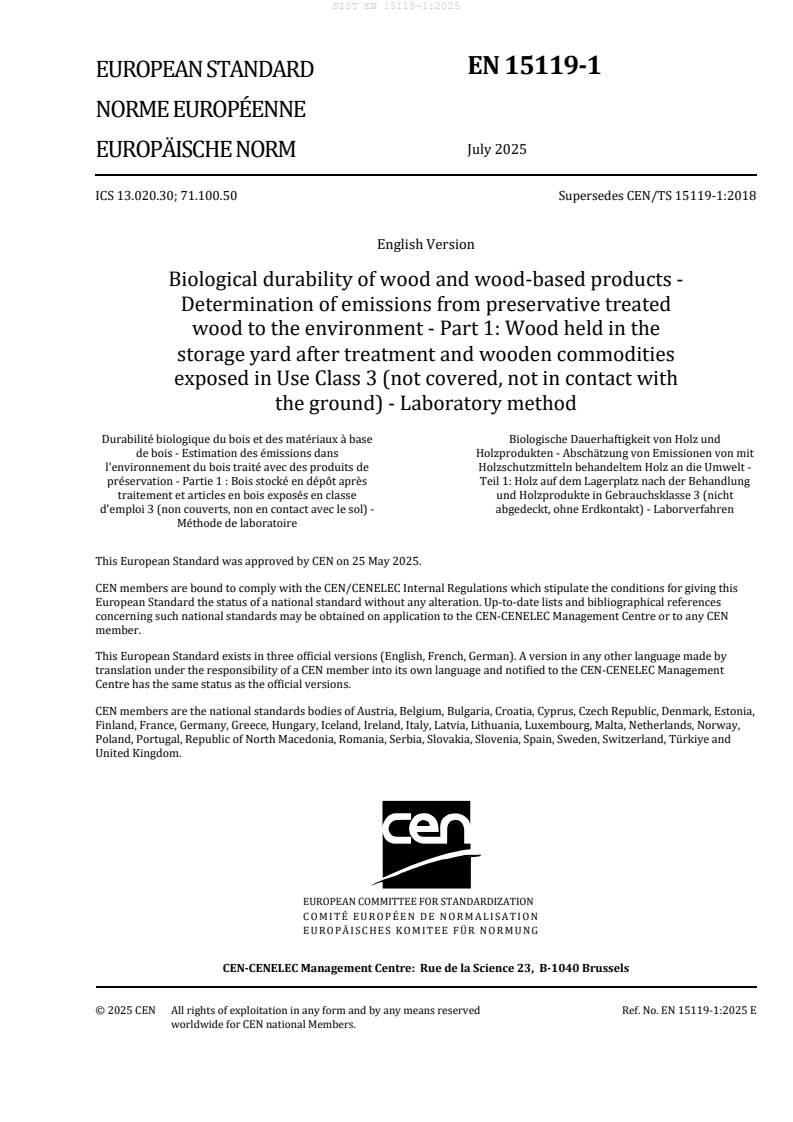
EN 15119-1
EUROPEAN STANDARD
NORME EUROPÉENNE
July 2025
EUROPÄISCHE NORM
ICS 13.020.30; 71.100.50 Supersedes CEN/TS 15119-1:2018
English Version
Biological durability of wood and wood-based products -
Determination of emissions from preservative treated
wood to the environment - Part 1: Wood held in the
storage yard after treatment and wooden commodities
exposed in Use Class 3 (not covered, not in contact with
the ground) - Laboratory method
Durabilité biologique du bois et des matériaux à base Biologische Dauerhaftigkeit von Holz und
de bois - Estimation des émissions dans Holzprodukten - Abschätzung von Emissionen von mit
l'environnement du bois traité avec des produits de Holzschutzmitteln behandeltem Holz an die Umwelt -
préservation - Partie 1 : Bois stocké en dépôt après Teil 1: Holz auf dem Lagerplatz nach der Behandlung
traitement et articles en bois exposés en classe und Holzprodukte in Gebrauchsklasse 3 (nicht
d'emploi 3 (non couverts, non en contact avec le sol) - abgedeckt, ohne Erdkontakt) - Laborverfahren
Méthode de laboratoire
This European Standard was approved by CEN on 25 May 2025.
CEN members are bound to comply with the CEN/CENELEC Internal Regulations which stipulate the conditions for giving this
European Standard the status of a national standard without any alteration. Up-to-date lists and bibliographical references
concerning such national standards may be obtained on application to the CEN-CENELEC Management Centre or to any CEN
member.
This European Standard exists in three official versions (English, French, German). A version in any other language made by
translation under the responsibility of a CEN member into its own language and notified to the CEN-CENELEC Management
Centre has the same status as the official versions.
CEN members are the national standards bodies of Austria, Belgium, Bulgaria, Croatia, Cyprus, Czech Republic, Denmark, Estonia,
Finland, France, Germany, Greece, Hungary, Iceland, Ireland, Italy, Latvia, Lithuania, Luxembourg, Malta, Netherlands, Norway,
Poland, Portugal, Republic of North Macedonia, Romania, Serbia, Slovakia, Slovenia, Spain, Sweden, Switzerland, Türkiye and
United Kingdom.
EUROPEAN COMMITTEE FOR STANDARDIZATION
COMITÉ EUROPÉEN DE NORMALISATION
EUROPÄISCHES KOMITEE FÜR NORMUNG
CEN-CENELEC Management Centre: Rue de la Science 23, B-1040 Brussels
© 2025 CEN All rights of exploitation in any form and by any means reserved Ref. No. EN 15119-1:2025 E
worldwide for CEN national Members.
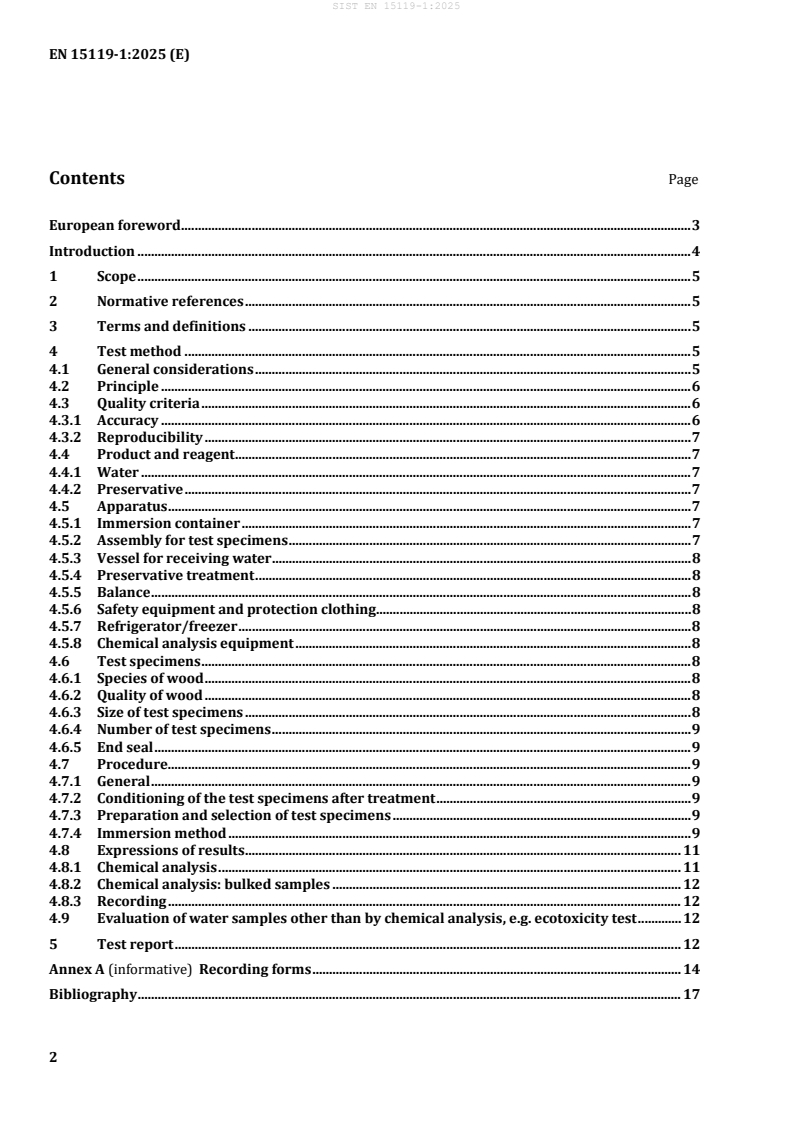
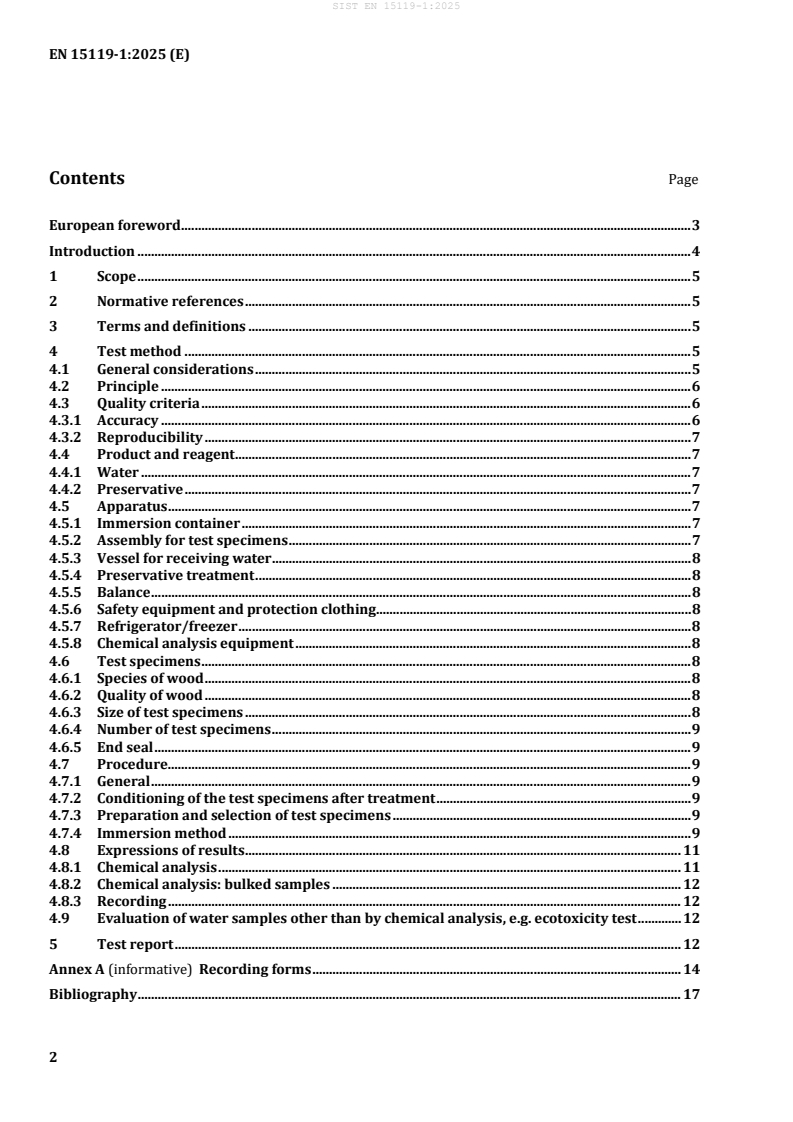
Contents Page
European foreword . 3
Introduction . 4
1 Scope . 5
2 Normative references . 5
3 Terms and definitions . 5
4 Test method . 5
4.1 General considerations . 5
4.2 Principle . 6
4.3 Quality criteria . 6
4.3.1 Accuracy . 6
4.3.2 Reproducibility . 7
4.4 Product and reagent . 7
4.4.1 Water . 7
4.4.2 Preservative . 7
4.5 Apparatus . 7
4.5.1 Immersion container . 7
4.5.2 Assembly for test specimens . 7
4.5.3 Vessel for receiving water . 8
4.5.4 Preservative treatment . 8
4.5.5 Balance . 8
4.5.6 Safety equipment and protection clothing . 8
4.5.7 Refrigerator/freezer . 8
4.5.8 Chemical analysis equipment . 8
4.6 Test specimens . 8
4.6.1 Species of wood . 8
4.6.2 Quality of wood . 8
4.6.3 Size of test specimens . 8
4.6.4 Number of test specimens . 9
4.6.5 End seal . 9
4.7 Procedure. 9
4.7.1 General . 9
4.7.2 Conditioning of the test specimens after treatment . 9
4.7.3 Preparation and selection of test specimens . 9
4.7.4 Immersion method . 9
4.8 Expressions of results . 11
4.8.1 Chemical analysis . 11
4.8.2 Chemical analysis: bulked samples . 12
4.8.3 Recording . 12
4.9 Evaluation of water samples other than by chemical analysis, e.g. ecotoxicity test . 12
5 Test report . 12
Annex A (informative) Recording forms . 14
Bibliography . 17
European foreword
This document (EN 15119-1:2025) has been prepared by Technical Committee CEN/TC 38 “Biological
durability of wood and wood-based products”, the secretariat of which is held by SIS.
This European Standard shall be given the status of a national standard, either by publication of an
identical text or by endorsement, at the latest by January 2026, and conflicting national standards shall
be withdrawn at the latest by January 2026.
Attention is drawn to the possibility that some of the elements of this document may be the subject of
patent rights. CEN shall not be held responsible for identifying any or all such patent rights.
This document supersedes CEN/TS 15119-1:2018.
This document is a revision of the Technical Specification published in 2018. The main changes from the
Technical Specification are that the document is changed into a standard because this laboratory method
is now well known. Furthermore, the basic principles of this document shall remain in line with the OECD
texts (see reference [7] of the Bibliography.)
EN 15119 is composed of the following parts:
— Part 1: Wood held in the storage yard after treatment and wooden commodities exposed in Use Class 3
(not covered, not in contact with the ground) — Laboratory method
— Part 2: Wooden commodities exposed in Use Class 4 or 5 (in contact with the ground, fresh water or sea
water) — Laboratory method
Any feedback and questions on this document should be directed to the users’ national standards body.
A complete listing of these bodies can be found on the CEN website.
According to the CEN-CENELEC Internal Regulations, the national standards organisations of the
following countries are bound to implement this European Standard: Austria, Belgium, Bulgaria, Croatia,
Cyprus, Czech Republic, Denmark, Estonia, Finland, France, Germany, Greece, Hungary, Iceland, Ireland,
Italy, Latvia, Lithuania, Luxembourg, Malta, Netherlands, Norway, Poland, Portugal, Republic of North
Macedonia, Romania, Serbia, Slovakia, Slovenia, Spain, Sweden, Switzerland, Türkiye and the United
Kingdom.
Introduction
Test results obtained with earlier versions of this method (i.e. CEN/TS 15119-1:2018) are still valid.
The emissions from preservative treated wood into the environment need to be quantified to enable an
environmental risk assessment to be made of the treated wood. This document specifies a laboratory
method for the determination of emissions by leaching from preservative treated wood where the
preservative treated wood is not covered and not in contact with the ground or the water. There are two
situations in this case where such emissions could enter the environment:
a) emissions from preservative treated wood stored outside in the storage yard of a preservative
treatment site. Rain falling on the treated wood could produce emissions that run off into surface
water and / or soil;
b) emissions from treated wood used in commodities exposed in Use Class 3. This is the situation in
which the wood or wood-based product is not covered and not in contact with the ground. It is either
continually exposed to the weather or is protected from the weather but subject to frequent wetting.
Use classes are specified in EN 335 and categorize the biological hazard to which the treated
commodity will be subjected. The Use Classes also specify the situation in which the treated
commodity is used and determine the environmental compartments (air, water, soil) which are
potentially at risk from the preservative treated wood. Rain falling on treated wood in Use Class 3
could produce emissions that run off into surface water and/ or soil.
The method is a laboratory procedure for obtaining water samples (leachate) from treated wood exposed
out of ground contact, at time intervals after exposure. The quantities of emissions in the leachate are
related to the surface area of the wood and the length of exposure, to estimate a flux in milligrams per
square metre per day. The flux after increasing periods of exposure (e.g. 1 year, 10 years) can be
estimated.
NOTE The leachate can also be tested for eco-toxicological effects.
The quantity of emissions can be used in an environmental risk assessment of the treated wood.
The test can be applied to wood treated using a penetrating process or superficial application (brush,
spray or dipping), or to treated wood which has an additional surface treatment (e.g. paint that is applied
as a requirement for commercial use).
1 Scope
This document specifies a laboratory method for obtaining water samples from preservative treated
wood exposed out of ground contact (wood held in the storage yard after treatment and which has been
in conditions designed to simulate outdoor, out of ground contact situations), at increasing time intervals
after exposure.
2 Normative references
The following documents, in whole or in part, are normatively referenced in this document and are
indispensable for its application. For dated references, only the edition cited applies. For undated
references, the latest edition of the referenced document (including any amendments) applies.
EN ISO 5667-3, Water quality — Sampling — Part 3: Preservation and handling of water samples
(ISO 5667-3)
3 Terms and definitions
No terms and definitions are listed in this document.
ISO and IEC maintain terminology databases for use in standardization at the following addresses:
— ISO Online browsing platform: available at https://www.iso.org/obp/
— IEC Electropedia: available at https://www.electropedia.org/
4 Test method
4.1 General considerations
The principal agent for causing emissions from wood during open-air storage in the yard and in
Use Class 3 is rainfall. Wood exposed in above ground situations is subjected to intermittent wetting by
rainfall and drying of the wood surface between the rainfall events. These wetting and drying cycles are
simulated by the method described in this document. It is assumed that emissions obtained by short-term
immersion in water are indicative of the emissions which will occur during exposure to rainfall.
The wood, in the case of wood treated with a wood preservative, shall be representative of commercially
treated wood. It shall be treated in accordance with the preservative manufacturer’s instructions and in
compliance with appropriate standards and specifications. The parameters for post-treatment
conditioning of the wood prior to the commencement of the test shall be stated.
The wood samples used shall be representative of the commodities used.
The composition, amount, pH value and the physical form of rainfall are important in determining the
quantity, content and nature of emissions from wood. However, simulating a realistic rainfall regime in
the laboratory is time-consuming, expensive and is likely to lack reproducibility, accuracy, precision and
reliability.
Two main immersion regimes are recommended as follows:
1. The 3 × 1 min immersion regime: A 1 min immersion in water of the treated test specimens to
simulate exposure to a rainfall event. There are three immersions or rainfall events per day, with test
specimens allowed to dry for 3 h between immersions simulating the wetting and drying cycle of
natural exposure situations. The days of rainfall are set for 1, 3, 5, 8, 10, 12, 15, 17 and 19 days.
NOTE 1 The OECD Emission Scenarios for Wood Preservatives 2013 (see bibliography) that are applied for
the authorization procedure of the European BPR are based on the assumptions, that the total amount of
rainfall per year is 700 mm. The daily regime is intended to produce the same moisture content on the surface
of the wood, and the same moisture content profile in the wood, and thus the same emission, as wood in a real
exposure situation on a day during which rain occurs. It is intended that a 3 × 1 min dip, every third day, will
give the same moisture content cycle in the wood, and the same emission from the wood, as exposure under
real conditions. If the dipping and drying regime is continued for one year, the emission quantity and rate
would be the same as the emission obtained from wood after exposure in a real situation in a region of Europe
where there is 700 mm of rain per year, with rain events occurring on 260 days of the year.
2. The 2 × 1 h immersion regime: A 1 h immersion in water of the treated test specimens to simulate
exposure to a rainfall event. There are two immersions or rainfall events per day, with test specimens
allowed to dry for 4 h between immersions simulating the wetting and drying cycle of vertical natural
exposure situations. The days of rainfall are set for 1, 3, 5, 8, 10, 12, 15, 17 and 19 days.
The applicant shall provide adequate discussion of the conditions of these regimes (e.g. purpose is to
estimate emissions from wood that is treated and then exposed vertically or horizontally) for data to be
acceptable when using these regimes.
NOTE 2 The OECD 107 (see in Bibliography) proposes a third immersion regime (1 × 2 h). It was decided not to
retain this option in this document.
4.2 Principle
To simulate the emission of wood preservatives from wood exposed to rain water, a simulated wetting
and drying process is employed. This process is used to simulate the wetting and drying of natural
exposure situations. The water (leachate) from each immersion day is collected and analysed chemically.
It is suitable for ecotoxicity testing. Emission rates in milligrams per square metre per day are calculated
from analytical results.
A system with untreated wood specimens provides background levels for leachates from wood. Tests
with untreated samples can be discontinued if there is no background detected in the first three data
points.
Recording forms are given in Annex A.
4.3 Quality criteria
4.3.1 Accuracy
The performance of the analytical method should be determined before conducting the test:
1) accuracy;
2) specificity;
3) limit of detection;
4) limit of quantification.
The testing is carried out with untreated references and with controlled water.
NOTE EN ISO 5667-3 gives guidance on the preservation and handling o
...
SLOVENSKI STANDARD
01-september-2025
Trajnost lesa in lesnih izdelkov - Ugotavljanje emisij iz zaščitenega lesa v okolje -
1. del: Sveže zaščiten les v skladiščih in leseni izdelki, izpostavljeni 3. razredu
uporabe (nepokrita uporaba, ni v stiku z zemljo) - Laboratorijska metoda
Durability of wood and wood-based products - Determination of emissions from
preservative treated wood to the environment - Part 1: Wood held in the storage yard
after treatment and wooden commodities exposed in Use Class 3 (not covered, not in
contact with the ground) - Laboratory method
Dauerhaftigkeit von Holz und Holzprodukten - Abschätzung von Emissionen von mit
Holzschutzmitteln behandeltem Holz an die Umwelt - Teil 1: Holz auf dem Lagerplatz
nach der Behandlung und Holzprodukte in Gebrauchsklasse 3 (nicht abgedeckt, ohne
Erdkontakt) - Laborverfahren
Durabilité du bois et des matériaux à base de bois - Estimation des émissions dans
l'environnement du bois traité avec des produits de préservation - Partie 1 : Bois stocké
en dépôt après traitement et articles en bois exposés en classe d'emploi 3 (non couverts,
non en contact avec le sol) - Méthode de laboratoire
Ta slovenski standard je istoveten z: EN 15119-1:2025
ICS:
13.020.30 Ocenjevanje vpliva na okolje Environmental impact
assessment
71.100.50 Kemikalije za zaščito lesa Wood-protecting chemicals
79.040 Les, hlodovina in žagan les Wood, sawlogs and sawn
timber
2003-01.Slovenski inštitut za standardizacijo. Razmnoževanje celote ali delov tega standarda ni dovoljeno.
EN 15119-1
EUROPEAN STANDARD
NORME EUROPÉENNE
July 2025
EUROPÄISCHE NORM
ICS 13.020.30; 71.100.50 Supersedes CEN/TS 15119-1:2018
English Version
Biological durability of wood and wood-based products -
Determination of emissions from preservative treated
wood to the environment - Part 1: Wood held in the
storage yard after treatment and wooden commodities
exposed in Use Class 3 (not covered, not in contact with
the ground) - Laboratory method
Durabilité biologique du bois et des matériaux à base Biologische Dauerhaftigkeit von Holz und
de bois - Estimation des émissions dans Holzprodukten - Abschätzung von Emissionen von mit
l'environnement du bois traité avec des produits de Holzschutzmitteln behandeltem Holz an die Umwelt -
préservation - Partie 1 : Bois stocké en dépôt après Teil 1: Holz auf dem Lagerplatz nach der Behandlung
traitement et articles en bois exposés en classe und Holzprodukte in Gebrauchsklasse 3 (nicht
d'emploi 3 (non couverts, non en contact avec le sol) - abgedeckt, ohne Erdkontakt) - Laborverfahren
Méthode de laboratoire
This European Standard was approved by CEN on 25 May 2025.
CEN members are bound to comply with the CEN/CENELEC Internal Regulations which stipulate the conditions for giving this
European Standard the status of a national standard without any alteration. Up-to-date lists and bibliographical references
concerning such national standards may be obtained on application to the CEN-CENELEC Management Centre or to any CEN
member.
This European Standard exists in three official versions (English, French, German). A version in any other language made by
translation under the responsibility of a CEN member into its own language and notified to the CEN-CENELEC Management
Centre has the same status as the official versions.
CEN members are the national standards bodies of Austria, Belgium, Bulgaria, Croatia, Cyprus, Czech Republic, Denmark, Estonia,
Finland, France, Germany, Greece, Hungary, Iceland, Ireland, Italy, Latvia, Lithuania, Luxembourg, Malta, Netherlands, Norway,
Poland, Portugal, Republic of North Macedonia, Romania, Serbia, Slovakia, Slovenia, Spain, Sweden, Switzerland, Türkiye and
United Kingdom.
EUROPEAN COMMITTEE FOR STANDARDIZATION
COMITÉ EUROPÉEN DE NORMALISATION
EUROPÄISCHES KOMITEE FÜR NORMUNG
CEN-CENELEC Management Centre: Rue de la Science 23, B-1040 Brussels
© 2025 CEN All rights of exploitation in any form and by any means reserved Ref. No. EN 15119-1:2025 E
worldwide for CEN national Members.
Contents Page
European foreword . 3
Introduction . 4
1 Scope . 5
2 Normative references . 5
3 Terms and definitions . 5
4 Test method . 5
4.1 General considerations . 5
4.2 Principle . 6
4.3 Quality criteria . 6
4.3.1 Accuracy . 6
4.3.2 Reproducibility . 7
4.4 Product and reagent . 7
4.4.1 Water . 7
4.4.2 Preservative . 7
4.5 Apparatus . 7
4.5.1 Immersion container . 7
4.5.2 Assembly for test specimens . 7
4.5.3 Vessel for receiving water . 8
4.5.4 Preservative treatment . 8
4.5.5 Balance . 8
4.5.6 Safety equipment and protection clothing . 8
4.5.7 Refrigerator/freezer . 8
4.5.8 Chemical analysis equipment . 8
4.6 Test specimens . 8
4.6.1 Species of wood . 8
4.6.2 Quality of wood . 8
4.6.3 Size of test specimens . 8
4.6.4 Number of test specimens . 9
4.6.5 End seal . 9
4.7 Procedure. 9
4.7.1 General . 9
4.7.2 Conditioning of the test specimens after treatment . 9
4.7.3 Preparation and selection of test specimens . 9
4.7.4 Immersion method . 9
4.8 Expressions of results . 11
4.8.1 Chemical analysis . 11
4.8.2 Chemical analysis: bulked samples . 12
4.8.3 Recording . 12
4.9 Evaluation of water samples other than by chemical analysis, e.g. ecotoxicity test . 12
5 Test report . 12
Annex A (informative) Recording forms . 14
Bibliography . 17
European foreword
This document (EN 15119-1:2025) has been prepared by Technical Committee CEN/TC 38 “Biological
durability of wood and wood-based products”, the secretariat of which is held by SIS.
This European Standard shall be given the status of a national standard, either by publication of an
identical text or by endorsement, at the latest by January 2026, and conflicting national standards shall
be withdrawn at the latest by January 2026.
Attention is drawn to the possibility that some of the elements of this document may be the subject of
patent rights. CEN shall not be held responsible for identifying any or all such patent rights.
This document supersedes CEN/TS 15119-1:2018.
This document is a revision of the Technical Specification published in 2018. The main changes from the
Technical Specification are that the document is changed into a standard because this laboratory method
is now well known. Furthermore, the basic principles of this document shall remain in line with the OECD
texts (see reference [7] of the Bibliography.)
EN 15119 is composed of the following parts:
— Part 1: Wood held in the storage yard after treatment and wooden commodities exposed in Use Class 3
(not covered, not in contact with the ground) — Laboratory method
— Part 2: Wooden commodities exposed in Use Class 4 or 5 (in contact with the ground, fresh water or sea
water) — Laboratory method
Any feedback and questions on this document should be directed to the users’ national standards body.
A complete listing of these bodies can be found on the CEN website.
According to the CEN-CENELEC Internal Regulations, the national standards organisations of the
following countries are bound to implement this European Standard: Austria, Belgium, Bulgaria, Croatia,
Cyprus, Czech Republic, Denmark, Estonia, Finland, France, Germany, Greece, Hungary, Iceland, Ireland,
Italy, Latvia, Lithuania, Luxembourg, Malta, Netherlands, Norway, Poland, Portugal, Republic of North
Macedonia, Romania, Serbia, Slovakia, Slovenia, Spain, Sweden, Switzerland, Türkiye and the United
Kingdom.
Introduction
Test results obtained with earlier versions of this method (i.e. CEN/TS 15119-1:2018) are still valid.
The emissions from preservative treated wood into the environment need to be quantified to enable an
environmental risk assessment to be made of the treated wood. This document specifies a laboratory
method for the determination of emissions by leaching from preservative treated wood where the
preservative treated wood is not covered and not in contact with the ground or the water. There are two
situations in this case where such emissions could enter the environment:
a) emissions from preservative treated wood stored outside in the storage yard of a preservative
treatment site. Rain falling on the treated wood could produce emissions that run off into surface
water and / or soil;
b) emissions from treated wood used in commodities exposed in Use Class 3. This is the situation in
which the wood or wood-based product is not covered and not in contact with the ground. It is either
continually exposed to the weather or is protected from the weather but subject to frequent wetting.
Use classes are specified in EN 335 and categorize the biological hazard to which the treated
commodity will be subjected. The Use Classes also specify the situation in which the treated
commodity is used and determine the environmental compartments (air, water, soil) which are
potentially at risk from the preservative treated wood. Rain falling on treated wood in Use Class 3
could produce emissions that run off into surface water and/ or soil.
The method is a laboratory procedure for obtaining water samples (leachate) from treated wood exposed
out of ground contact, at time intervals after exposure. The quantities of emissions in the leachate are
related to the surface area of the wood and the length of exposure, to estimate a flux in milligrams per
square metre per day. The flux after increasing periods of exposure (e.g. 1 year, 10 years) can be
estimated.
NOTE The leachate can also be tested for eco-toxicological effects.
The quantity of emissions can be used in an environmental risk assessment of the treated wood.
The test can be applied to wood treated using a penetrating process or superficial application (brush,
spray or dipping), or to treated wood which has an additional surface treatment (e.g. paint that is applied
as a requirement for commercial use).
1 Scope
This document specifies a laboratory method for obtaining water samples from preservative treated
wood exposed out of ground contact (wood held in the storage yard after treatment and which has been
in conditions designed to simulate outdoor, out of ground contact situations), at increasing time intervals
after exposure.
2 Normative references
The following documents, in whole or in part, are normatively referenced in this document and are
indispensable for its application. For dated references, only the edition cited applies. For undated
references, the latest edition of the referenced document (including any amendments) applies.
EN ISO 5667-3, Water quality — Sampling — Part 3: Preservation and handling of water samples
(ISO 5667-3)
3 Terms and definitions
No terms and definitions are listed in this document.
ISO and IEC maintain terminology databases for use in standardization at the following addresses:
— ISO Online browsing platform: available at https://www.iso.org/obp/
— IEC Electropedia: available at https://www.electropedia.org/
4 Test method
4.1 General considerations
The principal agent for causing emissions from wood during open-air storage in the yard and in
Use Class 3 is rainfall. Wood exposed in above ground situations is subjected to intermittent wetting by
rainfall and drying of the wood surface between the rainfall events. These wetting and drying cycles are
simulated by the method described in this document. It is assumed that emissions obtained by short-term
immersion in water are indicative of the emissions which will occur during exposure to rainfall.
The wood, in the case of wood treated with a wood preservative, shall be representative of commercially
treated wood. It shall be treated in accordance with the preservative manufacturer’s instructions and in
compliance with appropriate standards and specifications. The parameters for post-treatment
conditioning of the wood prior to the commencement of the test shall be stated.
The wood samples used shall be representative of the commodities used.
The composition, amount, pH value and the physical form of rainfall are important in determining the
quantity, content and nature of emissions from wood. However, simulating a realistic rainfall regime in
the laboratory is time-consuming, expensive and is likely to lack reproducibility, accuracy, precision and
reliability.
Two main immersion regimes are recommended as follows:
1. The 3 × 1 min immersion regime: A 1 min immersion in water of the treated test specimens to
simulate exposure to a rainfall event. There are three immersions or rainfall events per day, with test
specimens allowed to dry for 3 h between immersions simulating the wetting and drying cycle of
natural exposure situations. The days of rainfall are set for 1, 3, 5, 8, 10, 12, 15, 17 and 19 days.
NOTE 1 The OECD Emission Scenarios for Wood Preservatives 2013 (see bibliography) that are applied for
the authorization procedure of the European BPR are based on the assumptions, that the total amount of
rainfall per year is 700 mm. The daily regime is intended to produce the same moisture content on the surface
of the wood, and the same moisture content profile in the wood, and thus the same emission, as wood in a real
exposure situation on a day during which rain occurs. It is intended that a 3 × 1 min dip, every third day, will
give the same moisture content cycle in the wood, and the same emission from the wood, as exposure under
real conditions. If the dipping and drying regime is continued for one year, the emission quantity and rate
would be the same as the emission obtained from wood after exposure in a real situation in a region of Europe
where there is 700 mm of rain per year, with rain events occurring on 260 days of the year.
2. The 2 × 1 h immersion regime: A 1 h immersion in water of the treated test specimens to simulate
exposure to a rainfall event. There are two immersions or rainfall events per day, with test specimens
allowed to dry for 4 h between immersions simulating the wetting and drying cycle of vertical natural
exposure situations. The days of rainfall are set for 1, 3, 5, 8, 10, 12, 15, 17 and 19 days.
The applicant shall provide adequate discussion of the conditions of these regimes (e.g. purpose is to
estimate emissions from wood that is treated and then exposed vertically or horizontally) for data to be
acceptable when using these regimes.
NOTE 2 The OECD 107 (see in Bibliography) proposes a third immersion regime (1 × 2 h). It was decided not to
retain this option in this document.
4.2 Principle
To simulate the emission of wood preservatives from wood exposed to rain water, a simulated wetting
and drying process is employed. This process is used to simulate the wetting and drying of natural
exposure situations. The water (leachate) from each immersion day is collected and analysed chemically.
It is suitable for ecotoxicity testing. Emission rates in milligrams per square metre per day are calculated
from analytical results.
A system with untreated wood specimens provides background levels for leachates from wood. Tests
with untreated samples can be discontinued if there is no background detected in the first three data
points.
Recording forms are given in Annex A.
4.3 Quality criteria
4.3.1 Accuracy
The performance of the analytical method should be determined before conducting the test:
1) accuracy;
2) specificity;
3) limit of detection;
4) limit of quantification.
The testing is carried out with untreated references and with controlled water.
NOTE EN ISO 5667-3 gives guidance on the preservation and handling of
...