

EN 12757-1:2005
(Main)Mixing machinery for coating materials - Safety requirements - Part 1: Mixing machinery for use in vehicle refinishing
- Abstract
This European Standard applies to the design and construction of mixing machinery for liquid coating materials equipped with container of maximal volume £ 10 l used by vehicle refinishers and their coating materials distributors.
The pressure related parts of the machines covered are classified as no higher than category I under article 9 of the Pressure Equipment Directive 97/23/EC.
NOTE Pressure related parts of the machines referred to in this European Standard exceeding the limits of category I may lead to additional application of the Pressure Equipment Directive 97/23/EC.
This European Standard deals with all significant hazards, hazardous situations and events relevant to mixing machinery mentioned above, when they are used as intended and under the conditions foreseen by the manufacturer (see Clause 4).
Mixing machinery can operate by stirring or vibrating (shaking) and consists of the following equipment:
- cabinet;
- stirrer;
- vibrator;
- shaker;
- drive unit and related devices;
- container for coating material;
- safety, measuring and control devices;
- lighting;
- heating equipment and/or air conditioning inside the mixing cabinet.
The mixing machinery may be fixed or mobile.
1.2 The following is excluded from this European Standard:
- Mixing machinery intended for:
- pressure vessels;
- open or closed material containers larger than 10 l;
- hand-held mixing tools.
1.3 This European Standard is not applicable to mixing machinery which are manufactured before the date of publication of this European Standard by CEN.
- Status
- Withdrawn
- Publication Date
- 04-Oct-2005
- Withdrawal Date
- 08-Jun-2010
- Technical Committee
- CEN/TC 271 - Surface treatment equipment - Safety
- Drafting Committee
- CEN/TC 271/WG 2 - Machines for coating and color mixing
- Current Stage
- 9960 - Withdrawal effective - Withdrawal
- Start Date
- 09-Jun-2010
- Completion Date
- 09-Jun-2010
- Directive
- 94/9/EC - Equipment and protective systems intended for use in potentially explosive atmospheres (ATEX)OJ Ref: C, C 57 OJ Date: 09-Mar-2006

Relations
- Effective Date
- 18-Jan-2023
Frequently Asked Questions
EN 12757-1:2005 is a standard published by the European Committee for Standardization (CEN). Its full title is "Mixing machinery for coating materials - Safety requirements - Part 1: Mixing machinery for use in vehicle refinishing". This standard covers: This European Standard applies to the design and construction of mixing machinery for liquid coating materials equipped with container of maximal volume £ 10 l used by vehicle refinishers and their coating materials distributors. The pressure related parts of the machines covered are classified as no higher than category I under article 9 of the Pressure Equipment Directive 97/23/EC. NOTE Pressure related parts of the machines referred to in this European Standard exceeding the limits of category I may lead to additional application of the Pressure Equipment Directive 97/23/EC. This European Standard deals with all significant hazards, hazardous situations and events relevant to mixing machinery mentioned above, when they are used as intended and under the conditions foreseen by the manufacturer (see Clause 4). Mixing machinery can operate by stirring or vibrating (shaking) and consists of the following equipment: - cabinet; - stirrer; - vibrator; - shaker; - drive unit and related devices; - container for coating material; - safety, measuring and control devices; - lighting; - heating equipment and/or air conditioning inside the mixing cabinet. The mixing machinery may be fixed or mobile. 1.2 The following is excluded from this European Standard: - Mixing machinery intended for: - pressure vessels; - open or closed material containers larger than 10 l; - hand-held mixing tools. 1.3 This European Standard is not applicable to mixing machinery which are manufactured before the date of publication of this European Standard by CEN.
This European Standard applies to the design and construction of mixing machinery for liquid coating materials equipped with container of maximal volume £ 10 l used by vehicle refinishers and their coating materials distributors. The pressure related parts of the machines covered are classified as no higher than category I under article 9 of the Pressure Equipment Directive 97/23/EC. NOTE Pressure related parts of the machines referred to in this European Standard exceeding the limits of category I may lead to additional application of the Pressure Equipment Directive 97/23/EC. This European Standard deals with all significant hazards, hazardous situations and events relevant to mixing machinery mentioned above, when they are used as intended and under the conditions foreseen by the manufacturer (see Clause 4). Mixing machinery can operate by stirring or vibrating (shaking) and consists of the following equipment: - cabinet; - stirrer; - vibrator; - shaker; - drive unit and related devices; - container for coating material; - safety, measuring and control devices; - lighting; - heating equipment and/or air conditioning inside the mixing cabinet. The mixing machinery may be fixed or mobile. 1.2 The following is excluded from this European Standard: - Mixing machinery intended for: - pressure vessels; - open or closed material containers larger than 10 l; - hand-held mixing tools. 1.3 This European Standard is not applicable to mixing machinery which are manufactured before the date of publication of this European Standard by CEN.
EN 12757-1:2005 is classified under the following ICS (International Classification for Standards) categories: 87.100 - Paint coating equipment. The ICS classification helps identify the subject area and facilitates finding related standards.
EN 12757-1:2005 has the following relationships with other standards: It is inter standard links to EN 12757-1:2005+A1:2010. Understanding these relationships helps ensure you are using the most current and applicable version of the standard.
EN 12757-1:2005 is associated with the following European legislation: EU Directives/Regulations: 94/9/EC, 98/37/EC; Standardization Mandates: M/BC/CEN/88/13, M/BC/CEN/92/46. When a standard is cited in the Official Journal of the European Union, products manufactured in conformity with it benefit from a presumption of conformity with the essential requirements of the corresponding EU directive or regulation.
EN 12757-1:2005 is available in PDF format for immediate download after purchase. The document can be added to your cart and obtained through the secure checkout process. Digital delivery ensures instant access to the complete standard document.
Standards Content (Sample)
2003-01.Slovenski inštitut za standardizacijo. Razmnoževanje celote ali delov tega standarda ni dovoljeno.Mixing machinery for coating materials - Safety requirements - Part 1: Mixing machinery for use in vehicle refinishingMešalne naprave za premaze – Varnostne zahteve – 1. del: Mešalne naprave za uporabo v lakirnicah za popravila avtomobilovMachines a homogénéiser des produits de revetement - Prescriptions de sécurité - Partie 1 : Machines a homogénéiser destinées a etre utilisées pour la réfection des peintures d'automobilesMischgeräte für Beschichtungsstoffe - Sicherheitsanforderungen - Teil 1: Mischgeräte zur Verwendung in der Fahrzeugreparaturlackierung87.100Oprema za nanašanje premazovPaint coating equipmentICS:SIST EN 12757-1:2006enTa slovenski standard je istoveten z:EN 12757-1:200501-marec-2006SIST EN 12757-1:2006SLOVENSKI
STANDARD
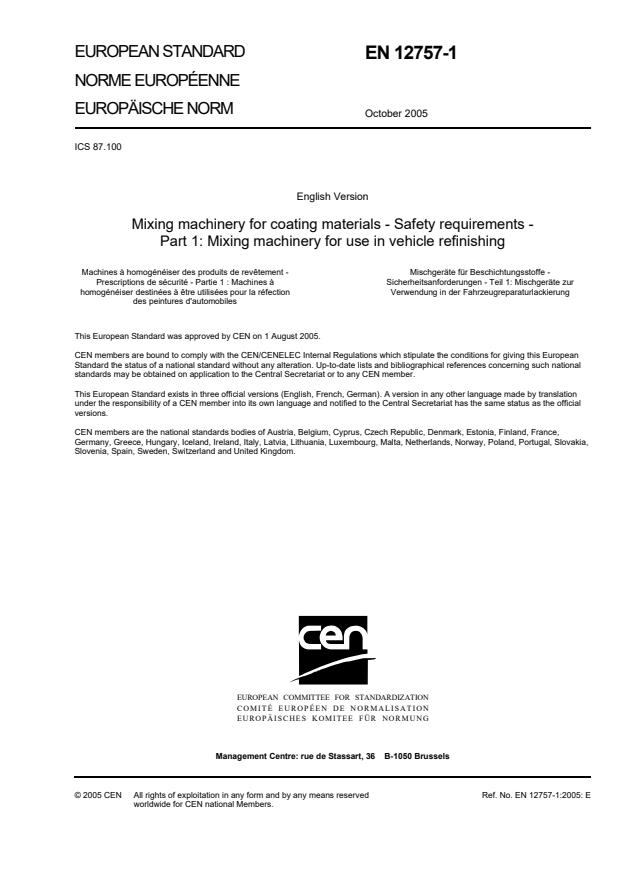
EUROPEAN STANDARDNORME EUROPÉENNEEUROPÄISCHE NORMEN 12757-1October 2005ICS 87.100 English VersionMixing machinery for coating materials - Safety requirements -Part 1: Mixing machinery for use in vehicle refinishingMachines à homogénéiser des produits de revêtement -Prescriptions de sécurité - Partie 1 : Machines àhomogénéiser destinées à être utilisées pour la réfectiondes peintures d'automobilesMischgeräte für Beschichtungsstoffe -Sicherheitsanforderungen - Teil 1: Mischgeräte zurVerwendung in der FahrzeugreparaturlackierungThis European Standard was approved by CEN on 1 August 2005.CEN members are bound to comply with the CEN/CENELEC Internal Regulations which stipulate the conditions for giving this EuropeanStandard the status of a national standard without any alteration. Up-to-date lists and bibliographical references concerning such nationalstandards may be obtained on application to the Central Secretariat or to any CEN member.This European Standard exists in three official versions (English, French, German). A version in any other language made by translationunder the responsibility of a CEN member into its own language and notified to the Central Secretariat has the same status as the officialversions.CEN members are the national standards bodies of Austria, Belgium, Cyprus, Czech Republic, Denmark, Estonia, Finland, France,Germany, Greece, Hungary, Iceland, Ireland, Italy, Latvia, Lithuania, Luxembourg, Malta, Netherlands, Norway, Poland, Portugal, Slovakia,Slovenia, Spain, Sweden, Switzerland and United Kingdom.EUROPEAN COMMITTEE FOR STANDARDIZATIONCOMITÉ EUROPÉEN DE NORMALISATIONEUROPÄISCHES KOMITEE FÜR NORMUNGManagement Centre: rue de Stassart, 36
B-1050 Brussels© 2005 CENAll rights of exploitation in any form and by any means reservedworldwide for CEN national Members.Ref. No. EN 12757-1:2005: E
Relationship between categories and zones.24 Annex B
(informative)
Explosion-prevention requirements for mixing machinery for vehicle refinishing.25 Annex C (informative)
National references to exposure limit values.26 Annex D (informative)
Classification of construction material’s reaction to fire - National standards.27 Annex ZA (informative)
Relationship between this European Standard and the Essential Requirements of EU Directive 98/37/EC.28 Annex ZB (informative)
Relationship between this European Standard and the Essential Requirements of EU Directive 94/9/EC.29 Bibliography.30
1 Scope 1.1 This European Standard applies to the design and construction of mixing machinery for liquid coating materials equipped with container of maximal volume ≤ 10 l used by vehicle refinishers and their coating materials distributors. The pressure related parts of the machines covered are classified as no higher than category I under article 9 of the Pressure Equipment Directive 97/23/EC. NOTE Pressure related parts of the machines referred to in this European Standard exceeding the limits of category I may lead to additional application of the Pressure Equipment Directive 97/23/EC. This European Standard deals with all significant hazards, hazardous situations and events relevant to mixing machinery mentioned above, when they are used as intended and under the conditions foreseen by the manufacturer (see Clause 4). Mixing machinery can operate by stirring or vibrating (shaking) and consists of the following equipment: cabinet; stirrer; vibrator; shaker; drive unit and related devices; container for coating material; safety, measuring and control devices; lighting; heating equipment and/or air conditioning inside the mixing cabinet. The mixing machinery may be fixed or mobile. 1.2 The following is excluded from this European Standard: Mixing machinery intended for: pressure vessels; open or closed material containers larger than 10 l; hand-held mixing tools. 1.3 This European Standard is not applicable to mixing machinery which are manufactured before the date of publication of this European Standard by CEN.
atmospheres - Part 15: Type of protection
"n" (IEC 60079-15:2001, modified) EN 60204-1:1997, Safety of machinery — Electrical equipment of machines — Part 1: General requirements (IEC 60204-1:1997) EN 60529, Degrees of protection provided by enclosures (IP code) (IEC 60529:1989) EN 61000-6-1, Electromagnetic compatibility (EMC) — Part 6-1: Generic standards — Immunity for residential, commercial and light-industrial environments (IEC 61000-6-1:1997, modified)
Electrical shock (by direct or indirect contact) Such hazards can occur, for instance by touching: electrically live parts that are non insulated for operational reasons; conductive parts which are not at a dangerous voltage under normal operation, but in the case of failure could be; electrically live parts when the insulation is damaged by contact with solvents or by mechanical parts. 4.3.2 External influence on electrical equipment hazard Such hazards can occur, for instance when interaction of the electromagnetic high voltage equipment with construction elements of the control and safety systems can cause dangerous malfunctions for instance, short circuits on electronic safety circuits, entrance guards, alarm units.
...