


EN 12312-2:2002
(Main)Aircraft ground support equipment - Specific requirements - Part 2: Catering vehicles
Aircraft ground support equipment - Specific requirements - Part 2: Catering vehicles
This European Standard specifies the technical requirements to minimize the hazards listed in clause 4 which can arise during the commissioning, the operation and the maintenance of catering vehicles when carried out in accordance with the specifications given by the manufacturer or his authorised representative. It also takes into account some requirements recognized as essential by authorities, aircraft and ground support equipment (GSE) manufacturers as well as airlines and handling agencies.
This standard applies to self-propelled catering vehicles, with seated driver, equipped with a liftable van body.
Examples of catering vehicles are shown in annex A. Vehicles of a similar design within the load limits of this standard used as GSE for other purposes e.g. cleaning equipment, exchange of aircraft seats, are also covered by this European Standard.
This standard does not apply to pneumatic systems.
This standard does not establish requirements for hazards caused by noise and vibration.
This Part of this European Standard is not applicable to catering vehicles which are manufactured before the date of publication of this standard by CEN.
Luftfahrt-Bodengeräte - Besondere Anforderungen - Teil 2: Catering-Hubfahrzeuge
Diese Europäische Norm legt grundlegende Anforderungen des Gesundheitsschutzes und der Arbeitssicherheit sowie Funktions- und Ausführungsanforderungen für Catering-Hubfahrzeuge fest, die mit einem anhebbaren Aufbau ausgerüstet sind zum Versorgen des Kabinenbereichs oder Be- und Entladen von Catering-Ausrüstung und -Waren von allen üblicherweise im zivilen Luftverkehr eingesetzten Flugzeugen.
Matériel au sol pour aéronefs - Exigences particulières - Partie 2 : Camions commissariat
La présente Norme européenne spécifie les exigences techniques pour réduire les phénomènes dangereux énumérés à l'Article 4 qui peuvent survenir lors des opérations de mise en �uvre, d'exploitation et de maintenance des camions commissariat lorsqu'elles sont réalisées conformément aux spécifications données par le fabricant ou son représentant légal. Elle tient également compte de certaines exigences reconnues comme essentielles par les autorités, les constructeurs d'aéronefs et de matériels au sol ainsi que les compagnies aériennes et les agents de manutention.
La présente norme s'applique aux camions commissariat autotractés, avec conducteur assis, équipés d'un fourgon élévateur.
Des exemples de camions commissariat sont donnés à l'Annexe A. Les camions de conception similaire, dans les limites de charge maximale de la présente norme, et utilisés comme matériel au sol à d'autres fins telles que le transport de matériel de nettoyage ou le remplacement de sièges d'aéronefs sont également couverts par la présente Norme européenne.
La présente norme ne s'applique pas aux systèmes pneumatiques.
La présente norme ne fixe pas d'exigences en ce qui concerne les phénomènes dangereux dus au bruit et aux vibrations.
La présente partie de l'EN 12312 ne s'applique pas aux camions commissariat fabriqués avant la date de publication de la présente norme par le CEN.
Podporna oprema na tleh za letalski promet – 2. del: Vozila za preskrbo
General Information
- Status
- Withdrawn
- Publication Date
- 27-Aug-2002
- Withdrawal Date
- 28-Apr-2009
- Technical Committee
- CEN/TC 274 - Aircraft ground support equipment
- Drafting Committee
- CEN/TC 274/SC 2/WG 1 - Catering vehicles
- Current Stage
- 9960 - Withdrawal effective - Withdrawal
- Start Date
- 29-Apr-2009
- Completion Date
- 29-Apr-2009
- Directive
- 98/37/EC - Machinery
Relations
- Effective Date
- 11-Feb-2009
- Effective Date
- 28-Jan-2026
- Effective Date
- 22-Dec-2008

Get Certified
Connect with accredited certification bodies for this standard

DEKRA North America
DEKRA certification services in North America.

Eagle Registrations Inc.
American certification body for aerospace and defense.

Element Materials Technology
Materials testing and product certification.
Sponsored listings
Frequently Asked Questions
EN 12312-2:2002 is a standard published by the European Committee for Standardization (CEN). Its full title is "Aircraft ground support equipment - Specific requirements - Part 2: Catering vehicles". This standard covers: This European Standard specifies the technical requirements to minimize the hazards listed in clause 4 which can arise during the commissioning, the operation and the maintenance of catering vehicles when carried out in accordance with the specifications given by the manufacturer or his authorised representative. It also takes into account some requirements recognized as essential by authorities, aircraft and ground support equipment (GSE) manufacturers as well as airlines and handling agencies. This standard applies to self-propelled catering vehicles, with seated driver, equipped with a liftable van body. Examples of catering vehicles are shown in annex A. Vehicles of a similar design within the load limits of this standard used as GSE for other purposes e.g. cleaning equipment, exchange of aircraft seats, are also covered by this European Standard. This standard does not apply to pneumatic systems. This standard does not establish requirements for hazards caused by noise and vibration. This Part of this European Standard is not applicable to catering vehicles which are manufactured before the date of publication of this standard by CEN.
This European Standard specifies the technical requirements to minimize the hazards listed in clause 4 which can arise during the commissioning, the operation and the maintenance of catering vehicles when carried out in accordance with the specifications given by the manufacturer or his authorised representative. It also takes into account some requirements recognized as essential by authorities, aircraft and ground support equipment (GSE) manufacturers as well as airlines and handling agencies. This standard applies to self-propelled catering vehicles, with seated driver, equipped with a liftable van body. Examples of catering vehicles are shown in annex A. Vehicles of a similar design within the load limits of this standard used as GSE for other purposes e.g. cleaning equipment, exchange of aircraft seats, are also covered by this European Standard. This standard does not apply to pneumatic systems. This standard does not establish requirements for hazards caused by noise and vibration. This Part of this European Standard is not applicable to catering vehicles which are manufactured before the date of publication of this standard by CEN.
EN 12312-2:2002 is classified under the following ICS (International Classification for Standards) categories: 49.100 - Ground service and maintenance equipment. The ICS classification helps identify the subject area and facilitates finding related standards.
EN 12312-2:2002 has the following relationships with other standards: It is inter standard links to EN 12312-2:2002+A1:2009, EN ISO 13894-1:2015, EN 12312-2:2002/prA1. Understanding these relationships helps ensure you are using the most current and applicable version of the standard.
EN 12312-2:2002 is associated with the following European legislation: EU Directives/Regulations: 98/37/EC; Standardization Mandates: M/079. When a standard is cited in the Official Journal of the European Union, products manufactured in conformity with it benefit from a presumption of conformity with the essential requirements of the corresponding EU directive or regulation.
EN 12312-2:2002 is available in PDF format for immediate download after purchase. The document can be added to your cart and obtained through the secure checkout process. Digital delivery ensures instant access to the complete standard document.
Standards Content (Sample)
SLOVENSKI STANDARD
01-november-2003
Podporna oprema na tleh za letalski promet – 2. del: Vozila za preskrbo
Aircraft ground support equipment - Specific requirements - Part 2: Catering vehicles
Luftfahrt-Bodengeräte - Besondere Anforderungen - Teil 2: Catering-Hubfahrzeuge
Matériel au sol pour aéronefs - Exigences particulieres - Partie 2 : Camions commissariat
Ta slovenski standard je istoveten z: EN 12312-2:2002
ICS:
49.100 Oprema za servis in Ground service and
vzdrževanje na tleh maintenance equipment
2003-01.Slovenski inštitut za standardizacijo. Razmnoževanje celote ali delov tega standarda ni dovoljeno.
EUROPEAN STANDARD
EN 12312-2
NORME EUROPÉENNE
EUROPÄISCHE NORM
August 2002
ICS 49.100
English version
Aircraft ground support equipment - Specific requirements - Part
2: Catering vehicles
Matériel au sol pour aéronefs - Exigences particulières - Luftfahrt-Bodengeräte - Besondere Anforderungen - Teil 2:
Partie 2: Camions commissariat Catering-Hubfahrzeuge
This European Standard was approved by CEN on 30 May 2002.
CEN members are bound to comply with the CEN/CENELEC Internal Regulations which stipulate the conditions for giving this European
Standard the status of a national standard without any alteration. Up-to-date lists and bibliographical references concerning such national
standards may be obtained on application to the Management Centre or to any CEN member.
This European Standard exists in three official versions (English, French, German). A version in any other language made by translation
under the responsibility of a CEN member into its own language and notified to the Management Centre has the same status as the official
versions.
CEN members are the national standards bodies of Austria, Belgium, Czech Republic, Denmark, Finland, France, Germany, Greece,
Iceland, Ireland, Italy, Luxembourg, Malta, Netherlands, Norway, Portugal, Spain, Sweden, Switzerland and United Kingdom.
EUROPEAN COMMITTEE FOR STANDARDIZATION
COMITÉ EUROPÉEN DE NORMALISATION
EUROPÄISCHES KOMITEE FÜR NORMUNG
Management Centre: rue de Stassart, 36 B-1050 Brussels
© 2002 CEN All rights of exploitation in any form and by any means reserved Ref. No. EN 12312-2:2002 E
worldwide for CEN national Members.
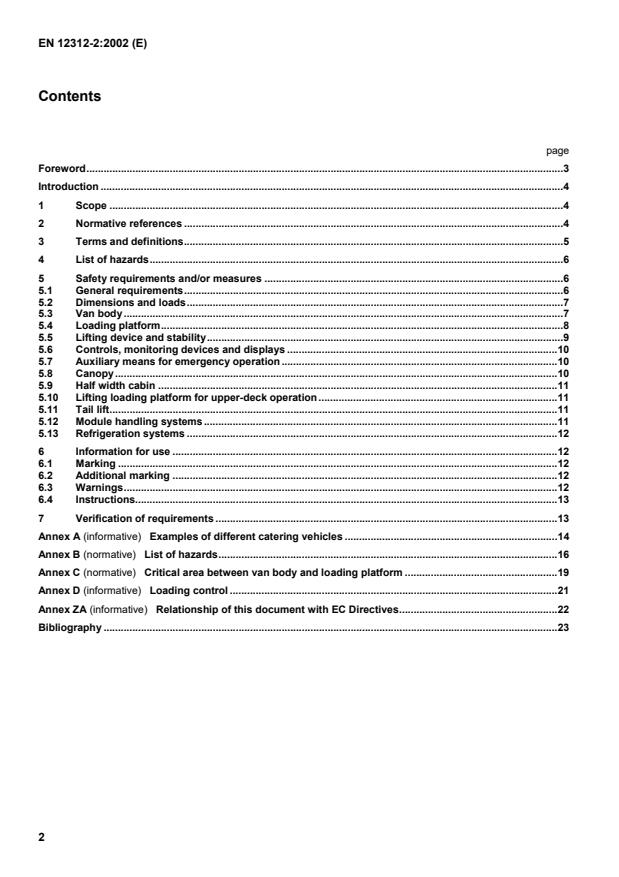
Contents
page
Foreword.3
Introduction .4
1 Scope .4
2 Normative references .4
3 Terms and definitions.5
4 List of hazards.6
5 Safety requirements and/or measures .6
5.1 General requirements.6
5.2 Dimensions and loads.7
5.3 Van body.7
5.4 Loading platform.8
5.5 Lifting device and stability.9
5.6 Controls, monitoring devices and displays .10
5.7 Auxiliary means for emergency operation.10
5.8 Canopy.10
5.9 Half width cabin .11
5.10 Lifting loading platform for upper-deck operation.11
5.11 Tail lift.11
5.12 Module handling systems.11
5.13 Refrigeration systems .12
6 Information for use .12
6.1 Marking .12
6.2 Additional marking .12
6.3 Warnings.12
6.4 Instructions.13
7 Verification of requirements .13
Annex A (informative) Examples of different catering vehicles .14
Annex B (normative) List of hazards.16
Annex C (normative) Critical area between van body and loading platform .19
Annex D (informative) Loading control .21
Annex ZA (informative) Relationship of this document with EC Directives.22
Bibliography .23
Foreword
This document EN 12312-2:2002 has been prepared by Technical Committee CEN/TC 274 "Aircraft ground sup-
port equipment", the secretariat of which is held by DIN.
This European Standard shall be given the status of a national standard, either by publication of an identical text or
by endorsement, at the latest by February 2003, and conflicting national standards shall be withdrawn at the latest
by February 2003.
This document has been prepared under a mandate given to CEN by the European Commission and the European
Free Trade Association, and supports essential requirements of EC Directive(s).
For relationship with EC Directives, see informative annex ZA, which is an integral part of this document.
The Parts of EN 12312 — Aircraft ground support equipment — Specific requirements — are:
Part 1: Passenger stairs
Part 2: Catering vehicles
Part 3: Conveyor belt vehicles
Part 4: Passenger boarding bridges
Part 5: Aircraft fuelling equipment
Part 6: Deicers and deicing/antiicing equipment
Part 7: Aircraft movement equipment.
Part 8: Maintenance stairs and platforms
Part 9: Container/Pallet loaders
Part 10: Container/Pallet transfer transporters
Part 11: Container/Pallet dollies and loose load trailers
Part 12: Potable water service equipment
Part 13: Lavatory service equipment
Part 14: Disabled/Incapacitated passenger boarding equipment
Part 15: Baggage and equipment tractors
Part 16: Air start equipment
Part 17: Air conditioning equipment
Part 18: Nitrogen or Oxygen units
Part 19: Aircraft jacks, axle jacks and hydraulic tail stanchions
Part 20: Ground power equipment
The annexes B and C are normative. The annexes A and D are informative.
According to the CEN/CENELEC Internal Regulations, the national standards organizations of the following coun-
tries are bound to implement this European Standard: Austria, Belgium, Czech Republic, Denmark, Finland,
France, Germany, Greece, Iceland, Ireland, Italy, Luxembourg, Malta, Netherlands, Norway, Portugal, Spain, Swe-
den, Switzerland and the United Kingdom.
Introduction
This European Standard specifies health and safety requirements, as well as some functional and performance
requirements, for catering vehicles intended for cabin re-supply and servicing or loading and unloading of catering
equipment and supplies on all aircraft types commonly in service in civil air transport.
The minimum essential criteria are considered to be of primary importance in providing safe, serviceable, economical,
and practical catering vehicles. Deviations from the recommended criteria should occur only after careful
consideration, extensive testing, risk assessment and thorough service evaluation have shown alternative methods or
conditions to be satisfactory.
This European Standard is a Type C standard as stated in EN 1070:1998.
1 Scope
This European Standard specifies the technical requirements to minimise the hazards listed in clause 4 which can
arise during the commissioning, the operation and the maintenance of catering vehicles when carried out in
accordance with the specifications given by the manufacturer or his authorised representative. It also takes into
account some requirements recognised as essential by authorities, aircraft and ground support equipment (GSE)
manufacturers as well as airlines and handling agencies.
This standard applies to self-propelled catering vehicles, with seated driver, equipped with a liftable van body.
Examples of catering vehicles are shown in annex A. Vehicles of a similar design within the load limits of this
standard used as GSE for other purposes e.g. cleaning equipment, exchange of aircraft seats, are also covered by
this European Standard.
This standard does not apply to pneumatic systems.
This standard does not establish requirements for hazards caused by noise and vibration.
This Part of EN 12312 is not applicable to catering vehicles which are manufactured before the date of publication
of this standard by CEN.
2 Normative references
This European Standard incorporates by dated or undated reference, provisions from other publications. These
normative references are cited at the appropriate places in the text, and the publications are listed hereafter. For
dated references, subsequent amendments to or revisions of any of these publications apply to this European
Standard only when incorporated in it by amendment or revision. For undated references the latest edition of the
publication referred to applies (including amendments).
EN 292-2:1991/A1:1995, Safety of machinery — Basic concepts, general principles for design — Part 2: Technical
principles and specifications.
EN 418:1992, Safety of machinery — Emergency stop equipment, functional aspects — Principles for design.
EN 563:1994, Safety of machinery — Temperatures of touchable surfaces — Ergonomics data to establish tem-
perature limit values for hot surfaces.
EN 1050:1996, Safety of machinery — Principles for risk assessment.
EN 1070:1998, Safety of machinery — Terminology.
EN 1386:1996, Aluminium and aluminium alloys — Tread plate – Specifications.
EN 1756-1:2001, Tail lifts — Platform lifts for mounting on wheeled vehicles — Safety requirements — Part 1: Tail
lifts for goods.
EN 1837:1999, Safety of machinery — Integral lighting of machines.
EN 1915-1:2001, Aircraft ground support equipment — General requirements — Part 1: Basic safety requirements.
EN 1915-2:2001, Aircraft ground support equipment — General requirements — Part 2: Stability and strength re-
quirements, calculations and test methods.
prEN 12195-1:2000, Load restraint assemblies on road vehicles — Safety — Part 1: Calculation of lashing forces.
ISO 4116:1986, Air cargo equipment — Ground equipment requirements for compatibility with aircraft unit load de-
vices.
ISO 7718:1984, Aircraft — Connection of passenger loading bridge or transfer vehicle — Interface requirements in
1)
the vicinity of main deck passenger doors .
)
ISO/DIS 16004:2000 , Ground equipment — Passenger boarding bridge or transfer vehicle — Interface require-
ments with aircraft doors.
3 Terms and definitions
For the purposes of this European Standard, the terms and definitions given in EN 1070:1998 and EN 1915-1:2001
together with the following apply.
3.1
van body
rear box body for carrying loads
3.2
loading platform
elevating platform for transhipment between van body and aircraft
3.3
walking area
safe areas where walking is permitted
3.4
restraint device
components for preventing movement of load inside the van body
3.5
trolley
cart for carrying food or equipment for use aboard the aircraft
3.6
canopy
cover or body fitted over loading platform to provide weather protection
3.7
tail lift (tailgate lift)
moveable platform at the rear of a vehicle used for assisting the entry into, or exit from, the vehicle of goods from
the ground level
1)
Revision in preparation at the time of publication of this standard.
)
First edition in preparation at time of publication of this standard.
3.8
supporting screen
front wall of the van body fixed to the chassis and supporting the loading platform in the lowered position
3.9
under-run guard
rigid or flexible bumper device which is designed to prevent another vehicle from becoming entrapped underneath
the rear of a vehicle when the vehicle is struck from behind
3.10
sideguard
rigid device which is designed to prevent another vehicle from becoming entrapped underneath the side of a vehi-
cle when the vehicle is struck from either side
4 List of hazards
The list of risks and hazards (see annex B) is based on EN 1050:1996 and contains the hazards and hazardous
situations, as far as they are dealt with in this European Standard, identified by risk assessment as significant for
catering vehicles and which require action to eliminate or reduce risks. Not covered are risks and hazards due to a
standard automotive chassis, the traffic, maintenance and repair and general misuse.
5 Safety requirements and/or measures
5.1 General requirements
5.1.1 Catering vehicles shall conform to the relevant requirements of EN 1915-1:2001, unless otherwise speci-
fied in this standard. They shall also conform to the specific requirements of this standard.
NOTE General functional requirements for catering vehicles for large capacity aircraft are specified in ISO 10841:1996.
5.1.2 Strength calculations shall be carried out in accordance with EN 1915-2:2001.
5.1.3 For catering vehicles to be moved on public roadways, the dimensions, laden mass and other characteris-
tics shall meet all applicable government regulations.
NOTE Applicable government regulations are dependant on the airport of use.
5.1.4 Catering vehicles shall be equipped with a fully enclosed van body and a loading platform capable of
reaching the door sill height of the aircraft.
5.1.5 The catering vehicle chassis at ground level shall be surrounded by a protective structure in order to pre-
vent any possibility of inadvertent access of persons under the van body while elevated (see also annex D of
EN 1915-1:2001).
5.1.6 The van body or loading platform shall be equipped with a means for safe access from ground level.
5.1.7 The cover material of walking areas on the loading platform shall provide the possibility of easy elimination
of water and snow, e.g. using tread plate conforming to EN 1386:1996.
5.1.8 The breadth of gaps between the different floors of van body, loading platform and tail lift in change — over
position shall be less than 10 mm. Where the difference of height is more than 5 mm in change-over position, the
change-over shall be achieved with an inclination at a maximum angle of 15°.
5.1.9 Van body and loading platform shall have illumination of a non-glare quality. A minimum illumination of
50 lx shall be provided at any point of walking areas.
5.1.10 Catering vehicles shall be equipped with driver’s cabins.
5.1.11 All seats shall be provided with 3 point type inertial reel seat belts as used on standard automotive
vehicles.
5.2 Dimensions and loads
5.2.1 The overall height of the catering vehicle, with the van body fully lowered, shall not exceed 4 m.
NOTE Depending on the airport of use, lower heights can be necessary (see clause 0 of EN 1915-1:2001 — negotiation).
5.2.2 The overall width of the catering vehicle in the driving condition shall not exceed 2,6 m.
NOTE Local road traffic regulations can require narrower widths.
5.2.3 For the strength calculation of the structure a minimum load of 200 kg/m on the areas intended by the
manufacturer for the storage of loads and/or walking areas shall be considered.
5.2.4 For the construction of the van body and the loading platform, the following local loads are to be consid-
ered:
floor plate of the van body 500 kg/m ;
floor plate of the loading platform 300 kg/m ;
minimum local single load at the leading edge of the loading platform 100 kg;
whereby the allowed maximum of sag relative to the van body or platform floor is 20 mm.
5.2.2.4 of EN 1915-2:2001 does not apply to these loads.
5.2.5 All areas to be driven on with a trolley are to be designed for a minimum floor contact pressure of
10 N/mm . No permanent deflection is allowable.
5.3 Van body
5.3.1 The minimum clear height at any point above walking areas shall be not less than 1,9 m.
Attention shall be paid when installing e.g. lights, evaporators at the ceiling.
5.3.2 The van body shall be equipped with at least one doorway with a minimum usable width of 0,8 m and a
clear height of 1,9 m which can be opened from both sides. Doors shall open to the inside of the van body.
5.3.3 Parts of the van body front wall not used for loading procedures shall be protected against falling of per-
sons and loads.
5.3.4 Sidewalls shall be equipped with protective devices to avoid deterioration by impact from trolleys or loads.
5.3.5 The van body shall be equipped with a load securing system, preventing sliding, rolling, tilting, and drop-
ping of catering equipment, i.e.:
fixed storage racks;
attachments for restraint devices.
Attachment points shall be calculated according to prEN 12195-1:2000.
5.3.6 It shall be possible to close all openings of the van body as a means for additional load security and for
hygienic reasons.
It shall be possible to store restraint devices when not in use. The storage facility shall not create risks of
5.3.7
tripping and shall protect the devices against damage and dirt.
5.3.8 The interior of the van body shall be fully lined with a smooth, non moisture absorbent, non toxic material,
hygienically approved by the authorities for use in vehicles carrying food for human consumption.
5.3.9 The lining material shall be compatible with repeated cleaning with strong detergents and disinfecting
agents, as well as suitable for repeated water pressure cleaning and steam cleaning. Joints or appurtenances in-
side the van body shall be flush, rounded, sloped or otherwise protected to prevent any accumulation of dirt or rub-
bish and facilitate comprehensive cleaning the body.
5.4 Loading platform
5.4.1 Catering vehicles shall be equipped with a loading platform enabling transhipment between van body and
aircraft.
5.4.2 The minimum usable width of the loading platform shall be 700 mm.
5.4.3 The loading platform shall be constructed so that the driver in the cabin is able to see the leading edge
throughout its operating range.
5.4.4 For the design of loading platforms the specifications found in 5.2.3 and 5.2.4 shall be considered.
5.4.5 The loading platforms and the railings adjacent to the aircraft shall have a capability to provide an adapta-
tion to the contour of the aircraft. Railings shall be of such design to leave a maximum gap of 150 mm to the aircraft
fuselage. The profile shall conform to the interface requirements given in ISO 7718:1984 and ISO/DIS 16004:2000.
5.4.6 Telescopic parts of the loading platform and railings shall have a minimum extension of 0,5 m.
5.4.7 The telescopic part of the loading platform shall be secured in any extended position.
5.4.8 The maximum extending force of telescopic parts of the loading platform and railings adjacent to the air-
craft shall not exceed 400 N. Where the maximum force caused by movement of the aircraft exceeds 400 N, these
telescopic parts shall give way.
5.4.9 The leading edge of the loading platform shall be designed so that damage of the aircraft is avoided, pref-
erably by application of a full width cylindrical bumper with a minimum diameter of 120 mm.
5.4.10 Safeguards against falling shall be provided on all open sides of the loading platform except for access to
the aircraft and van bo
...
Questions, Comments and Discussion
Ask us and Technical Secretary will try to provide an answer. You can facilitate discussion about the standard in here.
Loading comments...