

EN 13687-4:2002
(Main)Products and systems for the protection and repair of concrete structures - Test methods - Determination of thermal compatibility - Part 4: Dry thermal cycling
- Abstract
This standard is the fourth in a series of five parts to assess the thermal compatibility of repair products and systems, comprising grouts, mortars and concretes and surface protection systems, used for the repair and protection of concrete structures. The method measures the effect of dry thermal cycling without exposure to de-icing salt, upon the repair product or system. The method is suitable for repair products and systems based on CC, PCC and PC binders and for surface protection systems.
- Status
- Published
- Publication Date
- 26-Feb-2002
- Technical Committee
- CEN/TC 104 - Concrete ( performance, production, placing and compliance criteria )
- Drafting Committee
- CEN/TC 104/SC 8 - Protection and repairs of concrete structures
- Current Stage
- 9093 - Decision to confirm - Review Enquiry
- Start Date
- 01-Jul-2022
- Completion Date
- 07-Oct-2026

Overview
EN 13687-4:2002 (CEN) defines a standardized test method to determine the thermal compatibility of products and systems used for the protection and repair of concrete structures by means of dry thermal cycling. The scope covers repair grouts, mortars and concretes (CC, PCC, PC binders) and surface protection systems. The method measures effects of repeated temperature extremes in air (no de-icing salt or water exposure) and records visible defects and adhesion loss.
Key elements from the standard include: the use of reference concrete specimens prepared to EN 1766, temperature cycling between +55 °C and -25 °C, and final adhesion testing by pull-off in accordance with EN 1542.
Key Topics
Test principle: A repair material or surface protection layer is applied to a reference concrete specimen; after curing and conditioning, specimens undergo dry thermal cycles and are inspected for defects and bond performance.
Temperature range and cycle: The dry thermal cycle used in the standard cycles between +55 °C and -25 °C. The published cycle repeats over the specified number of cycles to simulate thermal stress without moisture or de-icing salts.
Specimen preparation and curing:
- Use concrete specimens per EN 1766.
- Follow curing regimes in Annex A: examples include immersion curing for CC products and standard laboratory climate curing for PCC, PC and surface protection systems.
- Condition specimens in the standard laboratory climate (21 ± 2 °C, 60 ± 10 % RH) prior to testing.
Evaluation and acceptance criteria:
- Visual inspections every ten cycles for cracking, scaling, peeling, blistering and other surface defects; cracks > 0.05 mm are recorded.
- After cycling, determine pull-off strength on both cycled specimens and an uncycled reference using EN 1542; report single values, mean and standard deviation and modes of fracture.
Applications
This standard is directly applicable to:
- Manufacturers and testing laboratories assessing durability and thermal performance of repair mortars, grouts and protective coatings.
- Specifiers and contractors who need to verify compatibility of repair systems with existing concrete under thermal stress.
- Quality control and product development to detect tendencies to cracking, delamination or loss of adhesion caused by thermal cycling.
Benefits of applying EN 13687-4:2002 include more reliable durability data for material selection, clearer specification compliance for repair systems, and improved risk assessment for thermally demanding environments.
Related Standards
- EN 1766 - Reference concretes for testing (used to prepare substrate specimens).
- EN 1542 - Measurement of bond strength by pull-off (used to quantify adhesion after cycling).
- EN 13687 (series) - Other parts cover freeze–thaw with de-icing salt, thermal shock, and related thermal compatibility tests.
- EN 1504 (parts 1–3) - Definitions, requirements and application contexts for surface protection and repair systems.
For procurement, test planning and interpretation, combine EN 13687-4:2002 results with the broader EN 13687 series and EN 1504 product requirements to ensure cohesive evaluation of thermal compatibility and long-term performance.
Relations
- Effective Date
- 28-Jan-2026
- Effective Date
- 28-Jan-2026
- Effective Date
- 28-Jan-2026
- Effective Date
- 28-Jan-2026
- Effective Date
- 28-Jan-2026
- Effective Date
- 28-Jan-2026
- Effective Date
- 28-Jan-2026
- Effective Date
- 28-Jan-2026
Get Certified
Connect with accredited certification bodies for this standard

DIBt (Deutsches Institut für Bautechnik)
German Institute for Building Technology.
DIN CERTCO
DIN Group product certification.

Aboma Certification B.V.
Specialized in construction, metal, and transport sectors.
Sponsored listings
Frequently Asked Questions
EN 13687-4:2002 is a standard published by the European Committee for Standardization (CEN). Its full title is "Products and systems for the protection and repair of concrete structures - Test methods - Determination of thermal compatibility - Part 4: Dry thermal cycling". This standard covers: This standard is the fourth in a series of five parts to assess the thermal compatibility of repair products and systems, comprising grouts, mortars and concretes and surface protection systems, used for the repair and protection of concrete structures. The method measures the effect of dry thermal cycling without exposure to de-icing salt, upon the repair product or system. The method is suitable for repair products and systems based on CC, PCC and PC binders and for surface protection systems.
This standard is the fourth in a series of five parts to assess the thermal compatibility of repair products and systems, comprising grouts, mortars and concretes and surface protection systems, used for the repair and protection of concrete structures. The method measures the effect of dry thermal cycling without exposure to de-icing salt, upon the repair product or system. The method is suitable for repair products and systems based on CC, PCC and PC binders and for surface protection systems.
EN 13687-4:2002 is classified under the following ICS (International Classification for Standards) categories: 91.080.40 - Concrete structures. The ICS classification helps identify the subject area and facilitates finding related standards.
EN 13687-4:2002 has the following relationships with other standards: It is inter standard links to prEN 1504-3, EN 1504-2:2004, EN 1542:1999, EN 1504-1:2005, EN 196-1:2016, EN 1766:2017, EN 1504-3:2005, EN 12618-3:2004. Understanding these relationships helps ensure you are using the most current and applicable version of the standard.
EN 13687-4:2002 is available in PDF format for immediate download after purchase. The document can be added to your cart and obtained through the secure checkout process. Digital delivery ensures instant access to the complete standard document.
Standards Content (Sample)
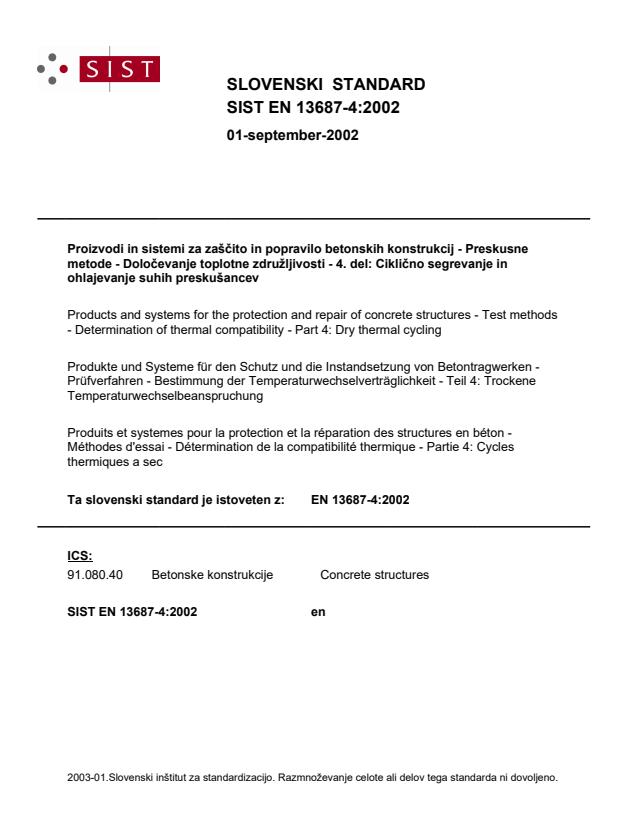
2003-01.Slovenski inštitut za standardizacijo. Razmnoževanje celote ali delov tega standarda ni dovoljeno.Produkte und Systeme für den Schutz und die Instandsetzung von Betontragwerken - Prüfverfahren - Bestimmung der Temperaturwechselverträglichkeit - Teil 4: Trockene TemperaturwechselbeanspruchungProduits et systemes pour la protection et la réparation des structures en béton - Méthodes d'essai - Détermination de la compatibilité thermique - Partie 4: Cycles thermiques a secProducts and systems for the protection and repair of concrete structures - Test methods - Determination of thermal compatibility - Part 4: Dry thermal cycling91.080.40Betonske konstrukcijeConcrete structuresICS:Ta slovenski standard je istoveten z:EN 13687-4:2002SIST EN 13687-4:2002en01-september-2002SIST EN 13687-4:2002SLOVENSKI
STANDARD
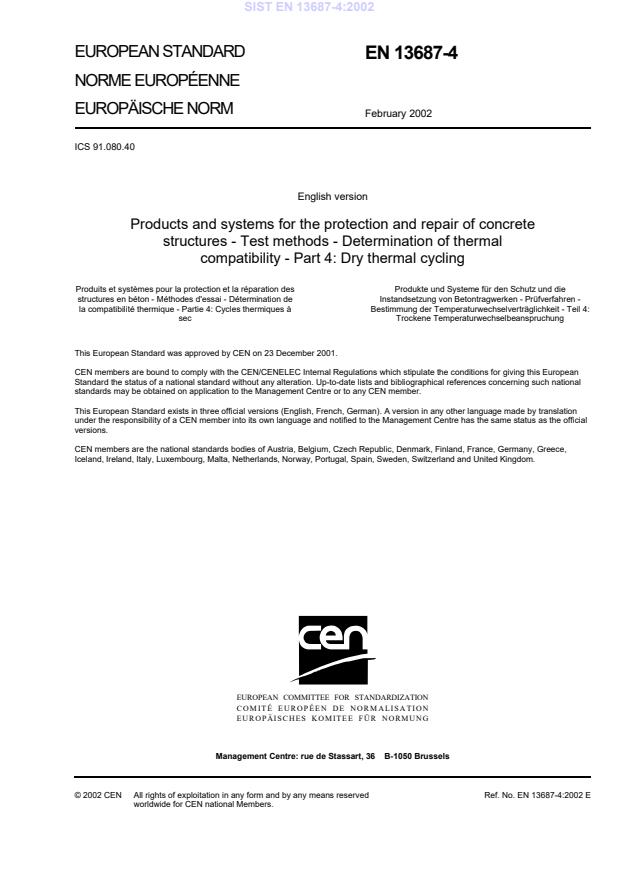
EUROPEAN STANDARDNORME EUROPÉENNEEUROPÄISCHE NORMEN 13687-4February 2002ICS 91.080.40English versionProducts and systems for the protection and repair of concretestructures - Test methods - Determination of thermalcompatibility - Part 4: Dry thermal cyclingProduits et systèmes pour la protection et la réparation desstructures en béton - Méthodes d'essai - Détermination dela compatibilité thermique - Partie 4: Cycles thermiques àsecProdukte und Systeme für den Schutz und dieInstandsetzung von Betontragwerken - Prüfverfahren -Bestimmung der Temperaturwechselverträglichkeit - Teil 4:Trockene TemperaturwechselbeanspruchungThis European Standard was approved by CEN on 23 December 2001.CEN members are bound to comply with the CEN/CENELEC Internal Regulations which stipulate the conditions for giving this EuropeanStandard the status of a national standard without any alteration. Up-to-date lists and bibliographical references concerning such nationalstandards may be obtained on application to the Management Centre or to any CEN member.This European Standard exists in three official versions (English, French, German). A version in any other language made by translationunder the responsibility of a CEN member into its own language and notified to the Management Centre has the same status as the officialversions.CEN members are the national standards bodies of Austria, Belgium, Czech Republic, Denmark, Finland, France, Germany, Greece,Iceland, Ireland, Italy, Luxembourg, Malta, Netherlands, Norway, Portugal, Spain, Sweden, Switzerland and United Kingdom.EUROPEAN COMMITTEE FOR STANDARDIZATIONCOMITÉ EUROPÉEN DE NORMALISATIONEUROPÄISCHES KOMITEE FÜR NORMUNGManagement Centre: rue de Stassart, 36
B-1050 Brussels© 2002 CENAll rights of exploitation in any form and by any means reservedworldwide for CEN national Members.Ref. No. EN 13687-4:2002 ESIST EN 13687-4:2002
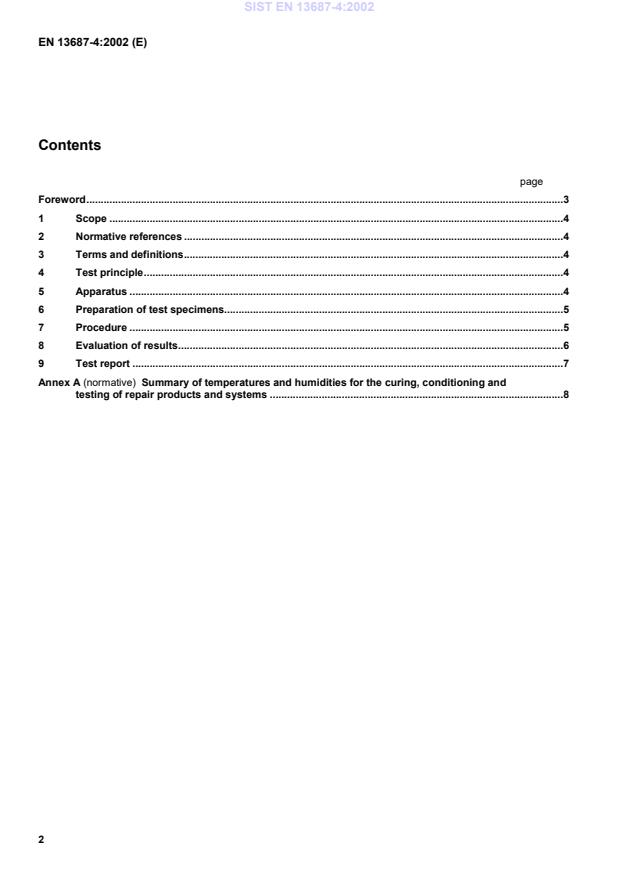
Summary of temperatures and humidities for the curing, conditioning andtesting of repair products and systems.8SIST EN 13687-4:2002
...