

EN 13258:2003
(Main)Materials and articles in contact with foodstuffs - Test methods for crazing resistance of ceramic articles
- Abstract
This European Standard specifies two test methods (methods A and B) for the determination of crazing resistance of glazed ceramic tableware articles in contact with food with water absorption higher than 0,5 % (determined according to method C of EN 1217:1997). Method A is a test for resistance to crazing due to moisture expansion. Method B is a test for resistance to crazing due to thermal shock and is similar in most respects to EN 1183: 1997.
- Status
- Published
- Publication Date
- 04-Mar-2003
- Withdrawal Date
- 29-Sep-2003
- Technical Committee
- CEN/TC 194 - Utensils in contact with food
- Drafting Committee
- CEN/TC 194/WG 3 - Non-metallic tableware
- Current Stage
- 9093 - Decision to confirm - Review Enquiry
- Start Date
- 20-Jul-2022
- Completion Date
- 07-Oct-2026



Overview
EN 13258:2003 (CEN) defines standardized test methods for assessing the crazing resistance of glazed ceramic tableware intended to be in contact with food. The standard applies to articles with water absorption greater than 0.5 % (determined according to method C of EN 1217:1997) and specifies two complementary procedures:
- Method A - resistance to crazing caused by moisture expansion using an autoclave (steam exposure), and
- Method B - resistance to crazing caused by thermal shock by alternating heating and rapid immersion in a cold water bath.
Both methods include staining techniques to aid detection of fine glaze cracks and a defined reporting format including a Crazing Resistance Index calculated in annexes A and B.
Key Topics
- Scope and applicability: glazed ceramic tableware with water absorption > 0.5 %.
- Method A (moisture expansion):
- Samples are exposed in an autoclave at controlled steam pressure (controlled around 340 ± 34 kPa).
- Cycles typically last 2 h at target pressure with cooling and inspection after each cycle; staining (eosine + washing-up liquid) is used to reveal cracks.
- Repeat cycles until failure or up to seven cycles; results expressed as cycle number and cumulative time.
- Method B (thermal shock):
- Samples heated in an oven to an upper temperature t1 then rapidly immersed into a stained cold water bath at t2.
- Start with a temperature difference t1 - t2 of about 100 ± 5 °C and increase in 20 °C increments until failure or 200 °C maximum.
- Inspection after each thermal shock identifies failed samples.
- Apparatus and materials: autoclave, test oven, cold bath with circulator and thermostat, baskets, tongs, heat-resistant gloves, and staining agents (e.g. eosine at ~5 g/l).
- Sampling: at least seven whole unused samples are tested; hollowware and flatware may be tested separately due to manufacturing differences.
- Crazing Resistance Index: calculated from failure data per annex A (method A) and annex B (method B) to produce a single index value (hours for A, °C for B) and a possible ‘PLUS’ suffix when samples survive the maximum cycles or temperature.
Applications
- Quality control for ceramic tableware manufacturers to ensure glaze stability in service.
- Product compliance testing for regulatory and trading purposes within CEN member states.
- Comparative testing during product development to evaluate glaze formulations and firing processes.
- Useful for laboratories performing food-contact material assessments where crazing can affect hygiene and durability.
Related Standards
- EN 1217:1997 - method C (water absorption measurement) used to determine applicability of EN 13258.
- EN 1183:1997 - similar thermal shock principles referenced for method B.
For reporting, EN 13258:2003 requires a clear test report referencing the method used, sample identification, failure counts per cycle or temperature increment, and the calculated Crazing Resistance Index. This ensures reproducible, comparable assessment of glaze performance for safety and durability in food-contact ceramics.
Relations
- Effective Date
- 22-Dec-2008
Get Certified
Connect with accredited certification bodies for this standard

BSI Group
BSI (British Standards Institution) is the business standards company that helps organizations make excellence a habit.

Bureau Veritas
Bureau Veritas is a world leader in laboratory testing, inspection and certification services.

DNV
DNV is an independent assurance and risk management provider.
Sponsored listings
Frequently Asked Questions
EN 13258:2003 is a standard published by the European Committee for Standardization (CEN). Its full title is "Materials and articles in contact with foodstuffs - Test methods for crazing resistance of ceramic articles". This standard covers: This European Standard specifies two test methods (methods A and B) for the determination of crazing resistance of glazed ceramic tableware articles in contact with food with water absorption higher than 0,5 % (determined according to method C of EN 1217:1997). Method A is a test for resistance to crazing due to moisture expansion. Method B is a test for resistance to crazing due to thermal shock and is similar in most respects to EN 1183: 1997.
This European Standard specifies two test methods (methods A and B) for the determination of crazing resistance of glazed ceramic tableware articles in contact with food with water absorption higher than 0,5 % (determined according to method C of EN 1217:1997). Method A is a test for resistance to crazing due to moisture expansion. Method B is a test for resistance to crazing due to thermal shock and is similar in most respects to EN 1183: 1997.
EN 13258:2003 is classified under the following ICS (International Classification for Standards) categories: 67.250 - Materials and articles in contact with foodstuffs; 97.040.60 - Cookware, cutlery and flatware. The ICS classification helps identify the subject area and facilitates finding related standards.
EN 13258:2003 has the following relationships with other standards: It is inter standard links to ENV 13258:1998. Understanding these relationships helps ensure you are using the most current and applicable version of the standard.
EN 13258:2003 is available in PDF format for immediate download after purchase. The document can be added to your cart and obtained through the secure checkout process. Digital delivery ensures instant access to the complete standard document.
Standards Content (Sample)
2003-01.Slovenski inštitut za standardizacijo. Razmnoževanje celote ali delov tega standarda ni dovoljeno.Werkstoffe und Gegenstände in Kontakt mit Lebensmitteln - Prüfverfahren für die Haarrissbeständigkeit keramischer GegenständeMatériaux et articles en contact avec les denrées alimentaires - Méthodes d'essai de la résistance au tressaillage des articles en céramiqueMaterials and articles in contact with foodstuffs - Test methods for crazing resistance of ceramic articles67.250Materiali in predmeti v stiku z živiliMaterials and articles in contact with foodstuffsICS:Ta slovenski standard je istoveten z:EN 13258:2003SIST EN 13258:2003en01-julij-2003SIST EN 13258:2003SLOVENSKI
STANDARDSIST ENV 13258:20001DGRPHãþD
EUROPEAN STANDARDNORME EUROPÉENNEEUROPÄISCHE NORMEN 13258March 2003ICS 67.250; 97.040.60English versionMaterials and articles in contact with foodstuffs - Test methodsfor crazing resistance of ceramic articlesMatériaux et articles en contact avec les denréesalimentaires - Méthodes d'essai de la résistance autressaillage des articles en céramiqueWerkstoffe und Gegenstände in Kontakt mit Lebensmitteln- Prüfverfahren für die Haarrissbeständigkeit keramischerGegenständeThis European Standard was approved by CEN on 21 November 2002.CEN members are bound to comply with the CEN/CENELEC Internal Regulations which stipulate the conditions for giving this EuropeanStandard the status of a national standard without any alteration. Up-to-date lists and bibliographical references concerning such nationalstandards may be obtained on application to the Management Centre or to any CEN member.This European Standard exists in three official versions (English, French, German). A version in any other language made by translationunder the responsibility of a CEN member into its own language and notified to the Management Centre has the same status as the officialversions.CEN members are the national standards bodies of Austria, Belgium, Czech Republic, Denmark, Finland, France, Germany, Greece,Hungary, Iceland, Ireland, Italy, Luxembourg, Malta, Netherlands, Norway, Portugal, Slovak Republic, Spain, Sweden, Switzerland andUnited Kingdom.EUROPEAN COMMITTEE FOR STANDARDIZATIONCOMITÉ EUROPÉEN DE NORMALISATIONEUROPÄISCHES KOMITEE FÜR NORMUNGManagement Centre: rue de Stassart, 36
B-1050 Brussels© 2003 CENAll rights of exploitation in any form and by any means reservedworldwide for CEN national Members.Ref. No. EN 13258:2003 ESIST EN 13258:2003
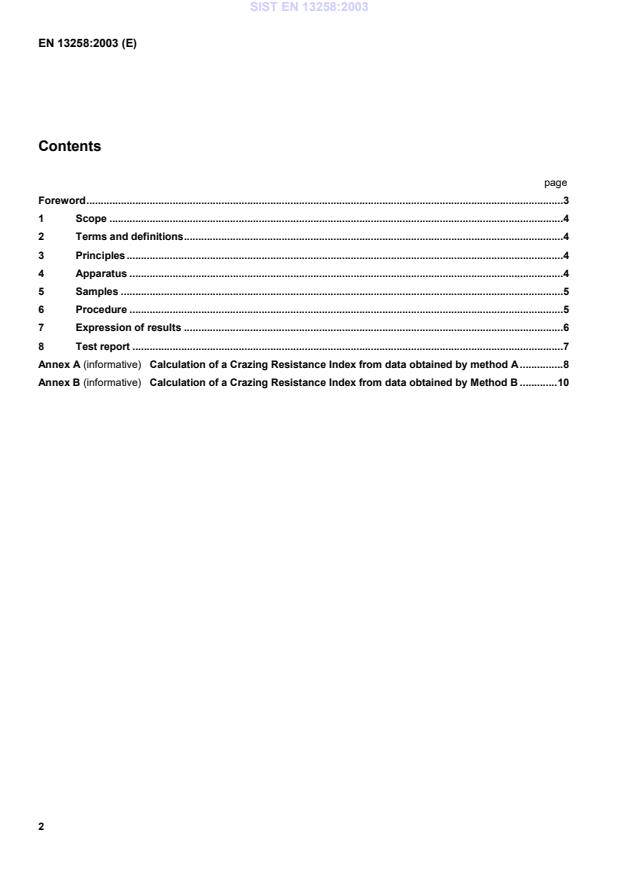
Calculation of a Crazing Resistance Index from data obtained by method A.8Annex B (informative)
Calculation of a Crazing Resistance Index from data obtained by Method B.10SIST EN 13258:2003
...