

SIST EN 13258:2003
(Main)Materials and articles in contact with foodstuffs - Test methods for crazing resistance of ceramic articles
General Information
- Abstract
This European Standard specifies two test methods (methods A and B) for the determination of crazing resistance of glazed ceramic tableware articles in contact with food with water absorption higher than 0,5 % (determined according to method C of EN 1217:1997). Method A is a test for resistance to crazing due to moisture expansion. Method B is a test for resistance to crazing due to thermal shock and is similar in most respects to EN 1183: 1997.
- Status
- Published
- Publication Date
- 30-Jun-2003
- Technical Committee
- EPO - Packaging - sales and grouped
- Current Stage
- 6060 - National Implementation/Publication (Adopted Project)
- Start Date
- 01-Jul-2003
- Due Date
- 01-Jul-2003
- Completion Date
- 01-Jul-2003



Overview
SIST EN 13258:2003 – Materials and articles in contact with foodstuffs - Test methods for crazing resistance of ceramic articles – is a European standard published by SIST (Slovenian Institute for Standardization). This standard specifies two laboratory test methods for evaluating the crazing resistance of glazed ceramic tableware and articles intended to come into contact with food. It applies specifically to ceramic products with water absorption higher than 0.5%, as determined by EN 1217:1997, ensuring these articles are safe and durable for repeated everyday use.
The standard helps manufacturers, laboratories, and quality control entities verify that ceramic food contact materials maintain both aesthetic value and hygienic safety by limiting the risk of micro-cracks (“crazing”) in glazed surfaces.
Key Topics
- Crazing: Defined as the formation of fine surface cracks in the glaze caused by moisture expansion or thermal shock.
- Test Methods:
- Method A: Tests resistance to crazing resulting from moisture expansion. Samples are subjected to repeated cycles of saturated steam under controlled pressure in an autoclave.
- Method B: Tests resistance to crazing caused by thermal shock, involving cycles of heating samples in an oven followed by rapid cooling in a water bath.
- Sampling: Requires no fewer than 7 unused samples per test to ensure representative results and accounts for variances in flatware and holloware.
- Expression of Results: Records cycles or temperature differentials at which crazing occurs; allows calculation of a Crazing Resistance Index for both methods, indicating product durability.
- Reporting: Specifies detailed content for test reports, including test method, sample identification, and summary of resistance indexes.
Applications
SIST EN 13258:2003 is essential for:
- Quality Assurance: Assists ceramic manufacturers in validating that their tableware meets required standards for food contact materials, ensuring long-term durability and consumer safety.
- Compliance Testing: Provides accredited laboratories with reliable, repeatable procedures for testing glazed ceramic products destined for the EU market, supporting regulatory conformity.
- Product Development: Utilized in research and development to select glazes and body compositions that maximize resistance to crazing, thereby improving product lifecycle and consumer confidence.
- Consumer Protection: Reduces the risk of bacterial growth and contamination associated with crazed glazes, making ceramic articles safer for repeated food contact use.
Related Standards
- EN 1217:1997 – Test method for determining water absorption of ceramic articles, referenced for identifying products covered under SIST EN 13258:2003.
- EN 1183:1997 – Test methods for thermal shock resistance, referenced for Method B procedures.
- EN 1388 (series) – Relates to the release of metals and metalloids from ceramic articles intended for food contact.
- ISO 6486 (series) – Ceramicware in contact with food – Release of lead and cadmium.
Practical Value
Adopting SIST EN 13258:2003 enhances the reliability and marketability of ceramic tableware by:
- Ensuring compliance with European food safety regulations for materials in contact with foods.
- Protecting consumer health through effective assessment of glaze integrity.
- Supporting international trade of ceramic goods by aligning with recognized testing standards.
- Providing clear guidelines for laboratory evaluation and reporting, facilitating standardization across the ceramics industry.
Keywords: crazing resistance, ceramic tableware, food contact materials, glazed ceramics, thermal shock, moisture expansion, standards compliance, quality assurance, European food safety, testing methods.
Relations
- Effective Date
- 01-Jul-2003
Get Certified
Connect with accredited certification bodies for this standard

BSI Group
BSI (British Standards Institution) is the business standards company that helps organizations make excellence a habit.

Bureau Veritas
Bureau Veritas is a world leader in laboratory testing, inspection and certification services.

DNV
DNV is an independent assurance and risk management provider.
Sponsored listings
Frequently Asked Questions
SIST EN 13258:2003 is a standard published by the Slovenian Institute for Standardization (SIST). Its full title is "Materials and articles in contact with foodstuffs - Test methods for crazing resistance of ceramic articles". This standard covers: This European Standard specifies two test methods (methods A and B) for the determination of crazing resistance of glazed ceramic tableware articles in contact with food with water absorption higher than 0,5 % (determined according to method C of EN 1217:1997). Method A is a test for resistance to crazing due to moisture expansion. Method B is a test for resistance to crazing due to thermal shock and is similar in most respects to EN 1183: 1997.
This European Standard specifies two test methods (methods A and B) for the determination of crazing resistance of glazed ceramic tableware articles in contact with food with water absorption higher than 0,5 % (determined according to method C of EN 1217:1997). Method A is a test for resistance to crazing due to moisture expansion. Method B is a test for resistance to crazing due to thermal shock and is similar in most respects to EN 1183: 1997.
SIST EN 13258:2003 is classified under the following ICS (International Classification for Standards) categories: 67.250 - Materials and articles in contact with foodstuffs. The ICS classification helps identify the subject area and facilitates finding related standards.
SIST EN 13258:2003 has the following relationships with other standards: It is inter standard links to SIST ENV 13258:2000. Understanding these relationships helps ensure you are using the most current and applicable version of the standard.
SIST EN 13258:2003 is available in PDF format for immediate download after purchase. The document can be added to your cart and obtained through the secure checkout process. Digital delivery ensures instant access to the complete standard document.
Standards Content (Sample)
2003-01.Slovenski inštitut za standardizacijo. Razmnoževanje celote ali delov tega standarda ni dovoljeno.Werkstoffe und Gegenstände in Kontakt mit Lebensmitteln - Prüfverfahren für die Haarrissbeständigkeit keramischer GegenständeMatériaux et articles en contact avec les denrées alimentaires - Méthodes d'essai de la résistance au tressaillage des articles en céramiqueMaterials and articles in contact with foodstuffs - Test methods for crazing resistance of ceramic articles67.250Materiali in predmeti v stiku z živiliMaterials and articles in contact with foodstuffsICS:Ta slovenski standard je istoveten z:EN 13258:2003SIST EN 13258:2003en01-julij-2003SIST EN 13258:2003SLOVENSKI
STANDARDSIST ENV 13258:20001DGRPHãþD
EUROPEAN STANDARDNORME EUROPÉENNEEUROPÄISCHE NORMEN 13258March 2003ICS 67.250; 97.040.60English versionMaterials and articles in contact with foodstuffs - Test methodsfor crazing resistance of ceramic articlesMatériaux et articles en contact avec les denréesalimentaires - Méthodes d'essai de la résistance autressaillage des articles en céramiqueWerkstoffe und Gegenstände in Kontakt mit Lebensmitteln- Prüfverfahren für die Haarrissbeständigkeit keramischerGegenständeThis European Standard was approved by CEN on 21 November 2002.CEN members are bound to comply with the CEN/CENELEC Internal Regulations which stipulate the conditions for giving this EuropeanStandard the status of a national standard without any alteration. Up-to-date lists and bibliographical references concerning such nationalstandards may be obtained on application to the Management Centre or to any CEN member.This European Standard exists in three official versions (English, French, German). A version in any other language made by translationunder the responsibility of a CEN member into its own language and notified to the Management Centre has the same status as the officialversions.CEN members are the national standards bodies of Austria, Belgium, Czech Republic, Denmark, Finland, France, Germany, Greece,Hungary, Iceland, Ireland, Italy, Luxembourg, Malta, Netherlands, Norway, Portugal, Slovak Republic, Spain, Sweden, Switzerland andUnited Kingdom.EUROPEAN COMMITTEE FOR STANDARDIZATIONCOMITÉ EUROPÉEN DE NORMALISATIONEUROPÄISCHES KOMITEE FÜR NORMUNGManagement Centre: rue de Stassart, 36
B-1050 Brussels© 2003 CENAll rights of exploitation in any form and by any means reservedworldwide for CEN national Members.Ref. No. EN 13258:2003 ESIST EN 13258:2003
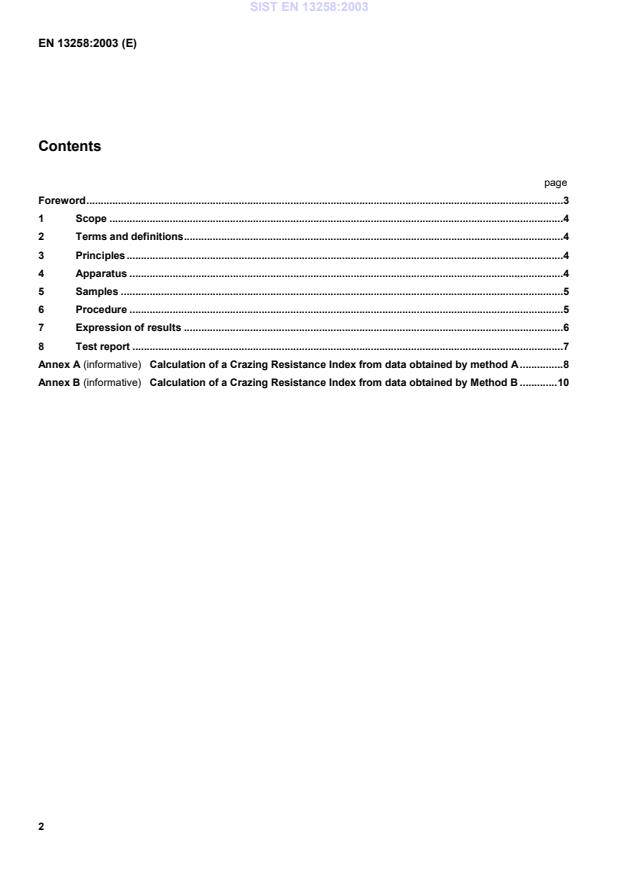
Calculation of a Crazing Resistance Index from data obtained by method A.8Annex B (informative)
Calculation of a Crazing Resistance Index from data obtained by Method B.10SIST EN 13258:2003
...