

SIST-TP CEN/TR 15356-1:2006
(Main)Validation and interpretation of analytical methods, migration testing and analytical data for materials and articles in contact with food - Part 1: General considerations
General Information
- Abstract
This Technical Report gives guidance in support of Directives adopted by the European Union in the Food Contact Materials Sector and is intended to aid Food Control Authorities and industry enforce and comply with those Directives.
- Status
- Published
- Publication Date
- 31-Aug-2006
- Technical Committee
- EPO - Packaging - sales and grouped
- Current Stage
- 6060 - National Implementation/Publication (Adopted Project)
- Start Date
- 01-Sep-2006
- Due Date
- 01-Sep-2006
- Completion Date
- 01-Sep-2006


Overview
CEN/TR 15356-1:2006 - "Validation and interpretation of analytical methods, migration testing and analytical data for materials and articles in contact with food - Part 1: General considerations" is a CEN Technical Report offering guidance to support EU Directives in the food contact materials sector. It addresses the validation of analytical methods, interpretation of migration test results, and the quality of analytical data used for enforcement, compliance and risk assessment. The document is aimed primarily at Food Control Authorities, industry and laboratories involved in migration testing and regulation of materials in contact with food.
Key topics and technical requirements
- Analytical method validation: Emphasis on single-laboratory (in-house) validation and the need for appropriate accuracy, precision and recovery data when established validated methods do not exist.
- Migration testing variability: Discussion of sources of variability in the migration contact stage (food simulants, test conditions, sampling) and implications for result interpretation.
- Analytical tolerance concept: Explanation of the EU approach to handling measurement variability through analytical tolerance applied to quantitative restrictions such as:
- Overall Migration Limit (OML) - example values and tolerances are discussed (e.g., OML in fatty simulants 60 mg/kg with a tolerance of 20 mg/kg).
- Specific Migration Limit (SML) and classifications including non-detectable substances (detection limits cited, e.g., 20 µg/kg for certain high-risk substances).
- QM / QMA limits (maximal quantity in the finished article per mass or surface area).
- Data quality for risk assessment: Guidance on producing migration data suitable for EFSA/SCF or other authorities, including recommendations for spiking tests and recovery studies.
- Laboratory competence and quality assurance: Encourages participation in proficiency testing (e.g., FAPAS), use of certified reference materials (IRMM) and accreditation to EN ISO/IEC 17025.
- Practical topics covered: Sampling, costs, enforcement considerations, and limitations of existing validation practices; annexes list current legislation, available methods and reference materials.
Practical applications
- Supports design and validation of analytical procedures for migration testing of plastics and other food-contact materials.
- Helps enforcement laboratories interpret results against OML, SML, QM/QMA and analytical tolerances.
- Guides industry when preparing dossiers or technical data for regulatory submissions and risk assessments.
- Useful for laboratories seeking accreditation and for organizations running proficiency tests or producing reference materials.
Who should use this standard
- Food Control Authorities and regulators
- Analytical and testing laboratories
- Manufacturers of food contact materials (plastics, coatings, packaging)
- Risk assessors and consultants involved in compliance with EU food contact legislation
Related standards and legislation
- Regulation (EC) No. 1935/2004 (framework for food contact materials)
- Commission Directive 2002/72/EC (consolidated plastics directives - referenced)
- EN ISO/IEC 17025 (laboratory accreditation)
- EN 13130 (CEN methods for food contact plastics)
- EFSA guidance and national enforcement directives
Keywords: CEN/TR 15356-1:2006, food contact materials, migration testing, analytical method validation, analytical tolerance, specific migration limit (SML), overall migration limit (OML), EN ISO/IEC 17025, EFSA.
Get Certified
Connect with accredited certification bodies for this standard

BSI Group
BSI (British Standards Institution) is the business standards company that helps organizations make excellence a habit.

Bureau Veritas
Bureau Veritas is a world leader in laboratory testing, inspection and certification services.

DNV
DNV is an independent assurance and risk management provider.
Sponsored listings
Frequently Asked Questions
SIST-TP CEN/TR 15356-1:2006 is a technical report published by the Slovenian Institute for Standardization (SIST). Its full title is "Validation and interpretation of analytical methods, migration testing and analytical data for materials and articles in contact with food - Part 1: General considerations". This standard covers: This Technical Report gives guidance in support of Directives adopted by the European Union in the Food Contact Materials Sector and is intended to aid Food Control Authorities and industry enforce and comply with those Directives.
This Technical Report gives guidance in support of Directives adopted by the European Union in the Food Contact Materials Sector and is intended to aid Food Control Authorities and industry enforce and comply with those Directives.
SIST-TP CEN/TR 15356-1:2006 is classified under the following ICS (International Classification for Standards) categories: 67.250 - Materials and articles in contact with foodstuffs. The ICS classification helps identify the subject area and facilitates finding related standards.
SIST-TP CEN/TR 15356-1:2006 is available in PDF format for immediate download after purchase. The document can be added to your cart and obtained through the secure checkout process. Digital delivery ensures instant access to the complete standard document.
Standards Content (Sample)
SLOVENSKI STANDARD
01-september-2006
Validacija in interpretacija analitskih metod, migracijsko preskušanje in analitski
podatki za materiale in predmete v stiku z živili – 1. del: Splošne ugotovitve
Validation and interpretation of analytical methods, migration testing and analytical data
for materials and articles in contact with food - Part 1: General considerations
Validierung und Interpretation analytischer Verfahren, Migrationsprüfung und
analytischer Daten von Werkstoffen und Bedarfsgegenständen in Kontakt mit
Lebensmitteln - Teil 1: Allgemeine Betrachtungen
Validation et interprétation des méthodes d'analyse, essais de migrations et données
analytiques des matériaux et objets en contact avec les denrées alimentaires - Partie 1 :
Considérations générales
Ta slovenski standard je istoveten z: CEN/TR 15356-1:2006
ICS:
67.250
2003-01.Slovenski inštitut za standardizacijo. Razmnoževanje celote ali delov tega standarda ni dovoljeno.
TECHNICAL REPORT
CEN/TR 15356-1
RAPPORT TECHNIQUE
TECHNISCHER BERICHT
March 2006
ICS 13.060.20; 23.060.50
English Version
Validation and interpretation of analytical methods, migration
testing and analytical data for materials and articles in contact
with food - Part 1: General considerations
Validation et interprétation des méthodes d'analyse, essais Validierung und Interpretation analytischer Verfahren,
de migrations et données analytiques des matériaux et Migrationsprüfung und analytischer Daten von Werkstoffen
objets en contact avec les denrées alimentaires - Partie 1 : und Bedarfsgegenständen in Kontakt mit Lebensmitteln -
Considérations générales Teil 1: Allgemeine Betrachtungen
This Technical Report was approved by CEN on 16 January 2006. It has been drawn up by the Technical Committee CEN/TC 194.
CEN members are the national standards bodies of Austria, Belgium, Cyprus, Czech Republic, Denmark, Estonia, Finland, France,
Germany, Greece, Hungary, Iceland, Ireland, Italy, Latvia, Lithuania, Luxembourg, Malta, Netherlands, Norway, Poland, Portugal, Romania,
Slovakia, Slovenia, Spain, Sweden, Switzerland and United Kingdom.
EUROPEAN COMMITTEE FOR STANDARDIZATION
COMITÉ EUROPÉEN DE NORMALISATION
EUROPÄISCHES KOMITEE FÜR NORMUNG
Management Centre: rue de Stassart, 36 B-1050 Brussels
© 2006 CEN All rights of exploitation in any form and by any means reserved Ref. No. CEN/TR 15356-1:2006: E
worldwide for CEN national Members.
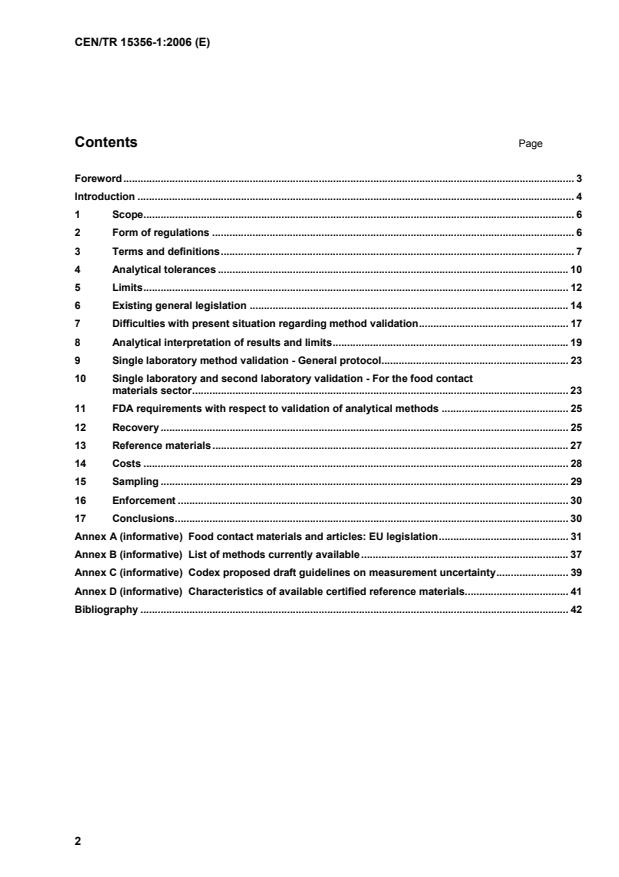
Contents Page
Foreword. 3
Introduction . 4
1 Scope. 6
2 Form of regulations . 6
3 Terms and definitions. 7
4 Analytical tolerances . 10
5 Limits. 12
6 Existing general legislation . 14
7 Difficulties with present situation regarding method validation. 17
8 Analytical interpretation of results and limits. 19
9 Single laboratory method validation - General protocol. 23
10 Single laboratory and second laboratory validation - For the food contact
materials sector. 23
11 FDA requirements with respect to validation of analytical methods . 25
12 Recovery . 25
13 Reference materials. 27
14 Costs . 28
15 Sampling . 29
16 Enforcement . 30
17 Conclusions. 30
Annex A (informative) Food contact materials and articles: EU legislation. 31
Annex B (informative) List of methods currently available. 37
Annex C (informative) Codex proposed draft guidelines on measurement uncertainty. 39
Annex D (informative) Characteristics of available certified reference materials. 41
Bibliography . 42
Foreword
This document (CEN/TR 15356-1:2006) has been prepared by CEN /TC 194, "Utensils in contact with
food", the secretariat of which is held by BSI.
Introduction
0.1 Requirement for validation of analytical methods for enforcement of Directives
[1]
Regulation (EC) No. 1935/2004 has laid down the requirements that may be included in specific
Directives to protect human health. It allows for specific Directives to set overall migration limits and
specific limits on the migration of certain constituents or groups of constituents into foodstuffs.
[2] [3]
Commission Directive 90/128/EEC and its subsequent amendments (e.g. ) introduced specific
migration limits for more than 300 substances. A consolidation of these directives has since been
[4]
issued as Commission Directive 2002/72/EC . In addition, some substances are subject to a
maximum permitted quantity of the residual substance in the material or article. Some substances are
subject to group limits. Continuously, additional substances are being evaluated and added to the
Directive.
New technical dossiers are being prepared for substances which could eventually be listed in future
amendments to Directive 2002/72/EC. Methods of control will be required for the majority of the
abovementioned substances.
[5]
The two Food Control Directives (European Council Directive 89/397/EEC and Council Directive
[6]
93/99/EEC ) require that methods used for control purposes must be correctly and fully validated. So
far only the methods developed by CEN as parts of EN 13130 have been so validated. Methods
developed in the project sponsored by DG Research (SM&T project, MAT1-CT92-0006,
"Development of Methods of Analysis for Monomers") have only been validated by two competent
laboratories. Most methods from technical dossiers have only limited validation data at best.
This Technical Report considers the background to whether or not acceptable validation of analytical
methods could be achieved faster and at less cost. The Technical Report also considers the need for
validation of the whole test procedure for enforcement purposes, for compliance purposes, and for the
creation of data for risk assessment purposes. It should be noted that the considerations apply to both
overall as well as specific migration.
The list of current legislation currently adopted by the Commission is given in Annex A.
The list of current methods adopted by CEN/TC 194/SC 1 is given in Annex B.
0.2 Variability in the migration contact stage
The determination of migration from plastics is quite unlike other measurement tasks in ensuring food
safety and quality. Reliable measurements depend upon more than simply having validated analytical
methods for measuring chemical concentrations in foods. The Directives allows that, as an alternative
to the analysis of foodstuff itself, migration testing can be carried out with food simulants applied
under conditions which simulate actual use of the plastic material or article with food. This introduces
many potential sources of variability in the final migration value. These are discussed in Clause 8.
0.3 Quality of data submitted for risk assessment purposes
Migration data is usually an important part of the petition submitted for a risk assessment carried out
by the Scientific Committee on Food (since 2003, by the European Food Safety Authority, EFSA). For
new substances it is unlikely that a fully validated method in food simulants will exist. A single
laboratory (in-house) system of validation is required as part of the demonstration that the data
submitted is of adequate quality. For example, validation of a method’s intended use, the
determination of accuracy and precision, usually involves replicate analyses of appropriate matrices
spiked with known amounts of the additive at concentrations similar to those encountered in the
migration studies and determination of the percentage recovery of the spiked additive.
Where data are supplied to other authorities, e.g. the US-FDA, the data has to be applicable and
acceptable to those authorities.
Even when a validated method exists there is still the need for the laboratory carrying out the test to
ensure the migration testing carried out within the laboratory does not suffer from excessive error. The
possibility of error may be reduced by taking part in proficiency testing schemes. Proficiency testing
schemes aim to assess the competence of laboratories to carry out migration testing. At present there
is at least one scheme which is known to operate in this area. This is the Food Analysis Performance
Assessment Scheme (FAPAS) operated by the FAPAS Secretariat, Central Science Laboratory, Sand
Hutton, York (UK).
Laboratories carrying out these methods will also be able to demonstrate their general competence by
being accredited to EN ISO/IEC 17025:2005, which is administered by the appropriate Accreditation
Agencies in the European Countries. For overall migration testing, samples of plastics with known
overall migration values are available from the IRMM, Geel, Belgium. Spectra and a table of physical
properties of the monomers and additives listed in Directives have been published to assist ensuring
[7], [8]
that substances used for calibration are of adequate and known purity .
1 Scope
This Technical Report gives guidance in support of Directives adopted by the European Union in the
Food Contact Materials Sector and is intended to aid Food Control Authorities and industry enforce
and comply with those Directives.
2 Form of regulations
2.1 General
The EU Directives on food contact plastics, provide for various types of quantitative restrictions i.e.
specific migration limits (SML, expressed as mg (of substance) /kg of food), overall migration limit
(OML, expressed as mg/kg of food or mg/dm of surface) and maximal quantity of the substance in
the finished plastic article referred either to the quantity of article (QM, expressed as mg/kg of article)
or to area of the surface in contact with the foodstuffs (QMA, expressed as mg/dm² of surface). The
determination of these quantities implies various procedural steps e.g. sampling, migration tests with
different experimental conditions (OML, SML) or extraction (QM, QMA) as well the usual multi-step
analytical determination. Each of these steps is subject to a certain variability and an overall variability
will affect the value found by one laboratory (repeatability) or by more than one laboratories
(reproducibility). In the past at the level of the Standing Committee for Foodstuffs a discussion took
place on the method of analysis for vinyl chloride. The Commission proposed then that the variability
should be expressed as "Reproducibility" but the majority of Member States were in favour of the
"Repeatability". Therefore the Commission services decided to avoid any further scientific discussion
on this issue and decided to propose a new term, "Analytical Tolerance" which shall comprise the
variability due to all the above-mentioned procedural steps. Until now no Member States objected to
this choice and no fundamental problems were raised from its application. Three options have been
chosen by the Commission services as regards the various existing quantitative restrictions:
a) restrictions affected by a specified analytical tolerance,
b) restrictions affected by an unspecified analytical tolerance, and
c) restrictions not affected by any analytical tolerance.
The three options and their background are explained in 2.2, 2.3 and 2.4.
2.2 Restriction and specified analytical tolerance
This case applies to the overall migration limit, where the value of the OML in fatty simulants
(60 mg/kg (ppm) or 10 mg/dm ) is accompanied by an analytical tolerance of 20 mg/kg (ppm)
(or 3 mg/dm ). In this case the variability should be added to the limit value and, only if the value
found is greater than 80 mg/kg (ppm) (=60+20) or 13 mg/dm (=10+3), the article is considered not in
compliance with the Directive. The choice to increase the OML by the value of the tolerance was due
to the variability of the analysis.
NOTE This approach has the disadvantage that as the variability of sampling and analytical procedures
becomes less, the overall limit becomes, effectively greater. However it is possible to change the value of the
analytical tolerance by an amendment of the Plastics Directive. For example, as practical experience was gained
and as both standardised methods and certified reference materials became available it became clear that many
laboratories struggled to meet the analytical tolerance value of 1 mg/dm set for tests using volatile simulants.
Consequently, Commission Directive 2001/62/EC was issued which, based on expert judgement rather than any
statistical evaluation of the available results, raised this tolerance figure to 2 mg/dm . The same problem would
exist if an EN rather than a Directive establishes the value of the variability. If no value is specified, this issue is
no longer harmonised and this should also be considered as disadvantage. The Member States and professional
organisations requested, at unanimity, that an analytical tolerance should be fixed.
2.3 SML restriction which includes non specified analytical tolerance
This case applies to the substances, which are classified by EFSA into EFSA list 4 (carcinogens or
high toxic substances) and, therefore, in principle should not be detectable in foodstuffs. For these
substances a detection limit value (= DL) is fixed. Because there is also a variability in determining the
detection limit, an analytical tolerance was considered also in this case. Therefore the Directive
includes a sentence "Not detectable (Detection Limit = 20 µg/kg (ppb) analytical tolerance included).
This choice, although not scientifically correct, was adopted pending the validation of the specific
methods of analysis for the substances.
NOTE this approach suffers from the same disadvantage as above, except that the variabilities have not
been quantified. However, it may also be argued that this is an advantage. For the analyst the lack of a specified
variability could be a disadvantage and considered scientifically incorrect. But for a jury, a responsible of the
production or enforcement laboratory is a great advantage, from the point of view of the juridical certainty, to
know the limit which cannot be exceeded in any situation. It has also to be considered that the level chosen is so
high that it is quite difficult to raise analytical difficulties in its enforcement and, at the same time, so low that the
protection of the health is fully ensured. In fact the limit is expressed as concentration of the migrant in the food
and not as exposure, which generally is lower, taking into account the current assumptions of the system that
1 kg of food is eaten by a person every day and this food is all in contact with a material that contains the
substance and releases the substance at a concentration is equal to its SML. Moreover a limit expressed in these
terms ("not detectability") avoids the criticism of some organisations, which are not in favour of establishing a limit
for carcinogenic substances.
2.4 SML Restriction without any reference to analytical tolerance
This case applies to the substances affected by an SML of 50 µg/kg (ppb) or greater or to the
substances affected by QM or QMA restrictions. In all three cases there is no indication of the
variability. This choice was justified by the following considerations:
a) variability at this level is not so great,
b) lack of real technical obstacles to the trade, and
c) lack of human and financial resources.
NOTE This is the normal approach for legal limits, but can lead to inconsistencies if the approaches used by
different control authorities are not standardised. In principle, any quantitative limit should be accompanied by a
validated method of analysis establishing the analytical variability. This is the reason why the Commission has
given a mandate to the CEN to validate some methods of analysis for global and specific migration. However the
reality is that this approach requires too much time and human and financial resources. Therefore it is necessary
to decide on a case by case basis if a validation is necessary or not. When the value of SML is high, the
importance of the determination of variability is questionable or, in any case, not a priority. The Commission's
proposal is to restrict the validation process only to those substances, economically very important and/or for
which the restriction is very low (e.g. not detectable or very low concentration).
3 Terms and definitions
For the purposes of this Technical Report, the following terms and definitions apply.
3.1
plastics
organic macromolecular compounds obtained by polymerisation, polycondensation, polyaddition or
any similar process from molecules with a lower molecular weight or by chemical alteration of natural
molecules
NOTE Other substances or matter may be added to such compounds.
3.2
final material and article
materials or article in its ready-for-use state or as sold
3.3
sample
material or article under investigation
3.4
test specimen
portion of the sample on which a test is performed
3.5
test piece
portion of the test specimen
3.6
conventional oven
oven where the air within the oven is heated and this heat is then transferred to the food through the
plastic as opposed to a microwave oven where the food itself is heated directly by microwave
irradiation
3.7
food simulant
medium intended to simulate (‘mimic’ or ‘model’) the essential characteristics of a foodstuff
3.8
overall migration
mass of material transferred to the food simulant or test media as determined by the relevant test
method
3.9
specific migration
mass of the substance transferred to the food/simulant as determined in the test method
3.10
residual content
mass of the substance present in the final material or article
3.11
specific migration limit (SML)
maximum permitted level of a named substance migrating from the final material or article into food or
food simulants
3.12
SML(T)
maximum permitted level of a group of named substances migrating from the final material or article
into food or food simulants, expressed as total of chemical moiety or substance(s) indicated
3.13
compositional limit (QM)
maximum permitted amount of the named substance in the material or article
3.14
QM(T)
maximum permitted amount of a group of named substances, in the material or article, expressed as
total of chemical moiety or substance(s) indicated
3.15
quantity per surface area (QMA)
maximum permitted amount of residual monomer, additive or substance in the material or article
expressed on an area-related basis as mg/6 dm
3.16
reduction factor
factors in the range 2 to 5 which may be applied to the result of the migration tests relevant to certain
types of fatty foodstuffs and which are conventionally used to take account of the greater extractive
capacity of the simulant for such foodstuffs
3.17
migration test
test for the determination of specific migration of a substance, using food simulant under conventional
test conditions
3.18
substitute fat test
test carried out which uses test media under conventional substitute test conditions when the use of a
migration test into fatty food simulant(s) is not feasible
3.19
test media
substances used in "substitute tests", isooctane, 95 % ethanol in aqueous solution and modified
polyphenylene oxide (MPPO)
3.20
alternative fat test
tests, with volatile test media, that may be used instead of migration tests with fatty food simulants
3.21
‘volatile’ test media
volatile substances used in alternative fat tests
3.22
extraction tests
tests in which media having strong extraction properties under very severe test conditions are used
3.23
dissolution test
tests in which the specimen is dissolved to liberate the substance from the plastics test specimen
3.24
pouch
receptacle of known dimensions manufactured from plastics film/sheet to be tested, which when filled
with food simulant or test medium exposes only the food contact side of the film/sheet to the food
simulant or test medium
3.25
reverse pouch
pouch which is fabricated such that the plastics surface intended to come into contact with foodstuff is
the outer surface
NOTE All of its edges are sealed to prevent the inner surfaces coming into contact with the food simulant or
test medium during the test period. The reverse pouch is intended to be totally immersed in the food simulant or
test medium, exposing only the outer and not the inner surface.
3.26
cell
device in which a plastics film to be tested can be mounted and which when assembled and filled with
food simulant or test medium, exposes only the food contact side of the film to the food simulant or
test medium
3.27
repeatability value 'r'
value below which the absolute difference between two single test results obtained under repeatability
conditions may be expected to lie with a probability of 95 %, as defined by ISO 5725
3.28
reproducibility value 'R'
value below which the absolute difference between two single test results obtained under
reproducibility conditions may be expected to lie with a probability of 95 %, as defined by ISO 5725
3.29
repeatability conditions
conditions where mutually independent test results are obtained with the same method on identical
test material in the same laboratory by the same operator using the same equipment within short
intervals of time
3.30
reproducibility conditions
conditions where test results are obtained with the same method on identical test material in different
laboratories with different operators using different equipment
4 Analytical tolerances
In the Food Contact Materials sector the present approach to variability is inconsistent. The three
situations described in Clause 2 are not self-consistent. The normal approach within the EU is that
food analysis limits are specified without any indication of analytical tolerances (i.e. the situation
described in 2.3).
In quantitative chemical analysis many important decisions are based on the results obtained by a
laboratory and so it is important that an indication of the quality of the results reported is available.
Analytical chemists are now more than ever coming under pressure to be able to demonstrate the
quality of their results by giving a measure of the confidence placed on a particular result to
demonstrate its fitness for purpose. Users of the results of chemical analysis, particularly in those
areas concerned with international trade, wish to minimise the replication of effort frequently
expended in obtaining the results. Confidence in data obtained outside the user’s own organisation is
a prerequisite to meeting this objective. In many sectors of analytical chemistry it is now a formal
(frequently legislative) requirement for laboratories to introduce quality assurance measures to ensure
that they are capable of and are providing data of the required quality. Such measures include: the
use of validated methods of analysis; the use of defined internal quality control procedures;
participation in proficiency testing schemes; accreditation based on EN ISO/IEC 17025, and
establishing traceability of the results of the measurements.
Whenever decisions are based on analytical results, it is important to have some indication of the
quality of the results, that is, the extent to which they can be relied on for the purpose in hand. In
analytical chemistry, there has been great emphasis on the precision of results obtained using a
specified method, rather than on their traceability to a defined standard or SI unit. This has led the use
of "official methods" to fulfil legislative and trading requirements. The use of official methods is not in
itself a complete answer. To demonstrate fitness for purpose, irrespective of the analytical methods
used, one useful indicator is measurement uncertainty. A number of ways are available for analysts to
estimate their measurement uncertainty. These included:
evaluation of the effect of the identified sources of uncertainty on the analytical result for a single
method implemented as a defined measurement procedure in a single laboratory;
results from defined internal quality control procedures in a single laboratory;
results from collaborative trials used to validate methods of analysis in a number of competent
laboratories;
results from proficiency test schemes used to assess the analytical competency of laboratories.
[9]
A practical solution is needed in the short term, and for this a Horwitz equation approach is often
taken. Here the Horwitz value is derived from the Horwitz trumpet and equation, which states that for
any method:
(1-0,5logC)
RSD = 2
R
and that the value is independent of matrix/analyte.
RSD is the relative standard deviation of the reproducibility (S x 100/MEAN).
R
R
The major values are:
Concentration ratio RSD
R
1 (100 %) 2
–1
10 2,8
–2
10 (1 %) 4
–3
10 5,6
–4
10 8
–5
10 11
–6
10 (ppm) 16
–7 a
10 23
–8 a
10 32
–9 a
10 (ppb) 45
a
At levels below 120 µg/kg (ppb), the more usual
[10]
value to be used is 22 % of the concentration .
Horwitz derived the equation after assessing the results from many (ca. 3 000) collaborative trials.
Although it represents the average RSD values and is an approximation of the possible precision
R
that can be achieved, the data points from "acceptable" collaborative trials are less than twice the
predicted RSD values at the concentrations of interest. This idealised smoothed curve was found to
R
be independent of the nature of the analyte or of the analytical technique that was used to make the
measurement. In general the values taken from this curve are indicative of the precision that is
achievable and acceptable of an analytical method by different laboratories. Its use provides a
satisfactory and simple means of assessing method precision acceptability.
A comparison of the RSD obtained in the method validation procedure and that predicted by the
R
Horwitz equation is increasingly being used by organisations to assess the acceptability of the
precision characteristics of their methods. If the ratio between the two is significantly greater than 2,
then many organisations would deem the method to be unacceptable (too imprecise).
5 Limits
5.1 General
The analytical difficulty, and hence the intrinsic uncertainty of measurements, will vary according to
the nature of the limitation in the Directive. A number of these instances are addressed in 5.2 to 5.6.
5.2 ‘High’ SML values
When the value for the specific migration limit is high, for example 1-octene with an SML of 15 mg/kg,
then the uncertainty of measurement is likely to be low compared to the limit.
5.3 ‘Low’ SML values
When the value for the specific migration limit is low, for example the many substances with a
migration limit of 0,05 mg/kg, then the uncertainty of measurement may become a significant problem
when establishing compliance, or otherwise, with the limit. This problem is exacerbated if the
substance is volatile or of limited stability or if interfering substances are present in the plastics.
5.4 Substances "Not to be detectable"
There are a number of substances with a limit stated as "the specific migration of this substance shall
not be detectable (when measured by a method with a limit of detection of 0,01 mg/kg)", for example
acrylamide. Also, there are substances with a limit stated as "the specific migration of this substance
shall not be detectable (when measured by a method with a limit of detection of 0,02 mg/kg, analytical
tolerance included)", for example acrylonitrile. The definition of what constitutes "not detectable" and
the low limits gives rise to significant problems when establishing the uncertainty of any method.
The relevant parts of EN 13130 give advice and instruction upon the analytical methods for
substances with these limitations and how to report the results.
5.5 Group limits
A number of substances in the Directive are subject to group limits, i.e. QM(T) or SML(T) limitations.
The imposition of group limits causes particular difficulties. Except for the epoxy moiety, there is
usually no obvious derivatisation route to determine the functional group quantitatively. This means
that each member of the group needs to be determined individually and the total amount of the moiety
migrating has to be derived by calculation, i.e. by summing the levels of each individual member of
the group multiplied by the appropriate conversion factor. Many of the group restrictions cover
substances that differ considerably from each other in molecular weight, boiling point, polarity etc. and
so they cannot all be determined by a single analytical procedure. This could lead to greater analytical
errors when summing the total amount of the individual substances present.
Determination of the total of a group of substances requires that for each member of the group a
value needs to be given which is either the level actually determined, together with the tolerance on
this determination, or the limit of detection for that member of the group. The total is then the sum of
these values. This means that if, for example a limit for a group was 0,05 mg/kg and there were more
than five substances in the group, each of which was subject to a detection limit of 0,01 mg/kg, even if
none of the substances were in fact present it would not be possible to prove that the group limit was
not exceeded. It also means that, even for a small group of two or three substances, if two were
present at, for example, the 0,02 mg/kg level but with an analytical tolerance of ± 0,01 mg/kg for the
group total, then it would not be possible to prove that a group limit of 0,05 mg/kg had not been
exceeded.
The relevant parts of EN 13130 give advice and instruction upon the analytical methods for these
groups and how to report the results.
5.6 Future Issues
5.6.1 Compositional limits
In some cases substances in the Directive are subject to residual limits, marked as QM. A QM limit is
set to avoid any problem with instability of the substance during migration, or because the
determination of the substance in food simulants or real foodstuffs is not feasible. The limit requires
the determination of the total amount of the substance in the polymer. The QM value was derived
from the available toxicity data assuming that 1 % of the substance present in 1 kg polymer may
migrate into 1 kg of food. The basis for this reasoning was derived from experiments with vinyl
chloride in polyvinylchloride.
A QM limit is difficult to enforce in case of multilayer materials. For thin multilayer materials the whole
film can be extracted and if the QM limit is not exceeded then the material is in compliance. However,
in case of thick materials (e.g. >0,17 mm) the QM limit should be determined from the layer containing
that substance. This is generally not possible.
The relevant parts of EN 13130 give advice and instruction upon the analytical methods for the
determination of the residual amount of relevant substances and how to report the results.
5.6.2 QMA limits (mg/unit area)
A new type of restriction was introduced with the fifth amendment (1999/91/EC) of Directive
90/128/EEC. This restriction called QMA is a limit for the substance expressed in mg/6 dm surface
area. There are various reasons to establish a QMA, e.g.:
no analytical method for the determination of the migration of the substance is provided;
substance is not stable under conditions of migration;
substance is very volatile.
Establishing a QMA limit is a careful consideration at the state of petitioning and is considered case
by case. The QMA limit is based on available toxicity data, while assuming 100 % migration from the
polymer into the food simulant. In other words the QMA limit is equal to the SML limit, but it represents
a worst case situation because of the assumption of 100 % migration.
The QMA limit is also applicable to multilayer materials as the expression (mg/6 dm²) is independent
from other layers. Only in case of thick materials the assumption of 100 % migration may be
unrealistically severe. In many cases the maximum thickness of a layer of 0,25 mm seems reasonable.
However in some cases this thickness may be irrelevant because of high diffusion rate through the
material. In those cases the total layer should be taken into account.
A QMA limit can be enforced in the same way as a QM limit. In most cases the polymer can be
extracted and the extracted substance can be determined by means of a suitable method.
The relevant parts of EN 13130 give advice and instruction upon the analytical methods for the
determination of the residual amount of relevant substances and how to report the results.
5.6.3 Multi-analyte methods
EU legislation for food packaging plastics is based on an extensive positive list system containing
hundreds of compounds authorised for the manufacture of food contact plastics. Only for a small
fraction of these substances do validated analytical methods exist. Consequently, proper enforcement
of European legislation is currently nearly impossible under reasonable economical circumstances.
As a logical consequence the need arises to develop and apply multi-analyte methods in connection
with innovative exploitation of the time and cost saving potential of modern powerful analytical
techniques. It appears that only the availability of standardised and validated multi-analyte methods
for chemical groups of specific plastics constituents legally authorised by EU Directive 2002/72/EC will
allow effective enforcement of European food packaging legislation.
6 Existing general legislation
6.1 General
It is essential that customers demand of providers of analytical data that their data meet established
quality requirements. Formal quality requirements have now been developed and adopted on an
international basis by both the EU and the Codex Alimentarius Commission (CAC); these are
described in 6.2 and 6.3. Customers will be appreciative of these requirements so it is advisable that a
laboratory fully complies with them to ensure that it meets its customer demands.
6.2 The European Union
For analytical laboratories in the food sector there are legislative requirements regarding analytical
data which have been adopted by the European Union. In particular, methods of analysis have been
prescribed by legislation for a number of foodstuffs since the creation of the European Union and its
precursors. However, the Union now recognises that the competency of a laboratory (i.e. how well it
can use a method) is equally as important as the "quality" of the method used to obtain results. This is
best illustrated by consideration of the Council Directive on the Official Control of Foodstuffs (OCF)
[5]
which was adopted by the Community in June, 1989 .
In Article 13 it is stated:
"In order to ensure that the application of this Directive is uniform throughout the Member States, the
Commission shall, within one year of its adoption, make a report to the European Parliament and to
the Council on the possibility of establishing Community quality standards for all laboratories involved
in inspection and sampling under this Directive"
Following that the Commission, in September 1990, produced a report which recommended
establishing Community quality standards for all laboratories involved in inspections and sampling
under the OCF Directive. Proposals on this have now been adopted by the Community in the Council
[6]
Directive on the subject of additional measures concerning the official control of foodstuffs (AMFC) .
The relevant Articles are:
Article 3, which states:
"1. Member States shall take all measures necessary to ensure that the laboratories referred to in
[5]
Article 7 of Directive 89/397/EEC comply with the general criteria for the operation of testing
[11]
laboratories laid down in European standard EN 45001 supplemented by Standard Operating
Procedures and the random audit of their compliance by quality assurance personnel, in accordance
with the OECD principles Nos. 2 and 7 of good laboratory practice as set out in Section II of Annex 2
of the Decision of the Council of the OECD of 12 Mar 1981 concerning the mutual acceptance of data
[12]
in the assessment of chemicals .
2. In assessing the laboratories referred to in Article 7 of Directive 89/397/EEC Member States
shall:
[13]
(a) apply the criteria laid down in European standard EN 45002 ; and
(b) require the use of proficiency testing schemes as far as appropriate.
Laboratories meeting the assessment criteria shall be presumed to fulfil the criteria referred to in
paragraph 1.
Laboratories which do not meet the assessment criteria shall not be considered as laboratories
referred to in Article 7 of the said Directive.
3. Member States shall designate bodies responsible for the assessment of laboratories as referred
to in Article 7 of Directive 89/397/EEC. These bodies shall comply with the general criteria for
[14]
laboratory accreditation bodies laid down in European Standard EN 45003 .
4. The accreditation and assessment of testing laboratories referred to in this article may relate to
individual tests or groups of tests. Any appropriate deviation in the way in which the standards
referred to in paragraphs 1, 2 and 3 are applied shall be adopted in accordance with the procedure
laid down in Article 8."
and Article 4, which states:
"Member States shall ensure that the validation of methods of analysis used within the context of
official control of foodstuffs by the laboratories referred to in Article 7 of Directive 89/397/EEC comply
whenever possible with the provisions of paragraphs 1 and 2 of the Annex to Council Directive
85/591/EEC of 23 December 1985 concerning the introduction of Community methods of sampling
[15]
and analysis for the monitoring of foodstuffs intended for human consumption."
As a result of the adoption of the above directives legislation is now in place to ensure that there is
confidence not only in national laboratories but also those of the other Member States - thus
facilitating the so-called "mutual recognition" aspects which were described above.
The effect of the AMFC Directive is that organisations must consider the following aspects within the
laboratory:
organisation of the laboratory,
how well the laboratory actually carries out analyses, and
methods of analysis used in the laboratory.
All these aspects are inter-related, but in simple terms may be thought of as:
becoming accredited to an Internationally recognised standard; such accreditation is aided by the
use of internal quality control procedures,
participating in proficiency schemes, and
using validated methods.
In addition it is important that there is "co-operation with customers" as this is also required by virtue
of EN ISO/IEC 17025.
Although the legislative requirements apply only to official food control laboratories, the effect of their
adoption is that other food laboratories will be advised to achieve the same standard in order for their
results to be recognised as equivalent and accepted for "due diligence" purposes.
The AMFC Directive requires that food control laboratories should be accredited to the EN 45000
series of standards as supplemented by some of the OECD GLP principles. In the UK, government
departments will nominate the United Kingdom Accreditation Service (UKAS) to carry out the
accreditation of official food control laboratories for all the aspects prescribed in the Directive.
However, as the accreditation agency will also be required to comply with EN ISO/IEC 17011 and to
carry out assessments in accordance with EN 45002, all accreditation agencies that are members of
the European Co-operation for Accreditation of Laboratories (EA) may be asked to carry out the
accreditation of a food control laboratory within the UK. Similar procedures will be followed in the
other Member States, all having or are developing equivalent organisations to UKAS.
6.3 Requirements of the Codex Alimentarius Commission: Guidelines for the
assessment of the competence of testing laboratories involved in the import and
export control of food
The requirements of the Codex Alimentarius Commission (CAC) are becoming of increasing
importance because of the acceptance of Codex Standards in the World Trade Organisation
agreements. They may be regarded as being semi-legal in status. Thus, on a world-wide level, the
establishment of the World Trade Organisation (WTO) and the formal acceptance of the Agreements
on the Application of Sanitary and Phytosanitary Measures (SPS Agreement) and Technical Barriers
to Trade (TBT Agreement) has dramatically increased the status of Codex as a body. As a result,
Codex Standards are now seen as de facto international standards and are increasingly being
adopted by reference into the food law of both developed
...