


EN 12485:2001
(Main)Chemicals used for treatment of water intended for human consumption - Calcium carbonate, high-calcium lime and half-burnt dolomite - Test methods
Chemicals used for treatment of water intended for human consumption - Calcium carbonate, high-calcium lime and half-burnt dolomite - Test methods
This European standard specifies the methods used for the chemical analyses of calcium carbonate, high-calcium lime and half-burnt dolomite used to treat water for human consumption. Of the reference methods described, the atomic spectroscopy methods are preferred to the conventional methods. If methods other than those described are used, it shall be demonstrated that the results are equivalent to those of the reference methods. In the event of disputes, the reference methods shall take precedence.
Produkte zur Aufbereitung von Wasser für den menschlichen Gebrauch - Calciumcarbonat, Weißkalk und halbgebrannter Dolomit - Analytische Verfahren
Anwendungsbereich
Diese Europäische Norm beschreibt Verfahren zur Analyse von Calciumcarbonat, Weißkalk und halb-gebranntem
Dolomit. Diese Stoffe werden zur Aufbereitung von Wasser für den menschlichen Gebrauch
eingesetzt.
ANMERKUNG Die Norm beschreibt Referenzverfahren, bei denen die atomspektroskopischen Verfahren gegenüber den
klassischen Verfahren vorgezogen werden. Werden andere als die beschriebenen Verfahren angewendet, sollte nach-gewiesen
werden, dass ihre Ergebnisse den Ergebnissen der Referenzverfahren entsprechen.
Der Analysengang ist schematisch im Anhang A dargestellt (siehe Bilder A.1 bis A.4).
Produits chimiques pour le traitement de l'eau destinée à la consommation humaine - Carbonate de calcium, chaux et dolomie semi calcinée - Méthodes d'analyse
1 Domaine d'application
La présente norme européenne décrit les méthodes utilisées pour les analyses du carbonate de calcium, de la chaux et de la dolomie semi-calcinée utilisés pour le traitement de l'eau destinée à la consommation humaine.
NOTE Parmi les méthodes de référence décrites, celles par spectroscopie atomique sont préférées aux méthodes conventionnelles. Si d'autres méthodes que celles décrites sont utilisées, il convient de faire la preuve que les résultats sont équivalents à ceux obtenus avec les méthodes de référence.
La représentation schématique de l'analyse chimique est illustrée en annexe A (Figures A.1 à A.4).
Kemikalije, ki se uporabljajo za pripravo pitne vode - Kalcijev karbonat, visoko kalcijevo apno in polžgan dolomit - Preskusne metode
General Information
- Status
- Withdrawn
- Publication Date
- 03-Apr-2001
- Withdrawal Date
- 20-Apr-2010
- Technical Committee
- CEN/TC 164 - Water supply
- Drafting Committee
- CEN/TC 164/WG 9 - Drinking water treatment
- Current Stage
- 9960 - Withdrawal effective - Withdrawal
- Start Date
- 21-Apr-2010
- Completion Date
- 21-Apr-2010
- Directive
- 89/106/EEC - Construction products
Relations
- Effective Date
- 22-Dec-2008

Get Certified
Connect with accredited certification bodies for this standard

ECOCERT
Organic and sustainability certification.

Eurofins Food Testing Global
Global leader in food, environment, and pharmaceutical product testing.

Intertek Bangladesh
Intertek certification and testing services in Bangladesh.
Sponsored listings
Frequently Asked Questions
EN 12485:2001 is a standard published by the European Committee for Standardization (CEN). Its full title is "Chemicals used for treatment of water intended for human consumption - Calcium carbonate, high-calcium lime and half-burnt dolomite - Test methods". This standard covers: This European standard specifies the methods used for the chemical analyses of calcium carbonate, high-calcium lime and half-burnt dolomite used to treat water for human consumption. Of the reference methods described, the atomic spectroscopy methods are preferred to the conventional methods. If methods other than those described are used, it shall be demonstrated that the results are equivalent to those of the reference methods. In the event of disputes, the reference methods shall take precedence.
This European standard specifies the methods used for the chemical analyses of calcium carbonate, high-calcium lime and half-burnt dolomite used to treat water for human consumption. Of the reference methods described, the atomic spectroscopy methods are preferred to the conventional methods. If methods other than those described are used, it shall be demonstrated that the results are equivalent to those of the reference methods. In the event of disputes, the reference methods shall take precedence.
EN 12485:2001 is classified under the following ICS (International Classification for Standards) categories: 71.100.80 - Chemicals for purification of water. The ICS classification helps identify the subject area and facilitates finding related standards.
EN 12485:2001 has the following relationships with other standards: It is inter standard links to EN 12485:2010. Understanding these relationships helps ensure you are using the most current and applicable version of the standard.
EN 12485:2001 is associated with the following European legislation: EU Directives/Regulations: 305/2011, 89/106/EEC. When a standard is cited in the Official Journal of the European Union, products manufactured in conformity with it benefit from a presumption of conformity with the essential requirements of the corresponding EU directive or regulation.
EN 12485:2001 is available in PDF format for immediate download after purchase. The document can be added to your cart and obtained through the secure checkout process. Digital delivery ensures instant access to the complete standard document.
Standards Content (Sample)
2003-01.Slovenski inštitut za standardizacijo. Razmnoževanje celote ali delov tega standarda ni dovoljeno.Kemikalije, ki se uporabljajo za pripravo pitne vode - Kalcijev karbonat, visoko kalcijevo apno in polžgan dolomit - Preskusne metodeProdukte zur Aufbereitung von Wasser für den menschlichen Gebrauch - Calciumcarbonat, Weißkalk und halbgebrannter Dolomit - Analytische VerfahrenProduits chimiques pour le traitement de l'eau destinée a la consommation humaine - Carbonate de calcium, chaux et dolomie semi calcinée - Méthodes d'analyseChemicals used for treatment of water intended for human consumption - Calcium carbonate, high-calcium lime and half-burnt dolomite - Test methods71.100.80Chemicals for purification of water13.060.20Pitna vodaDrinking waterICS:Ta slovenski standard je istoveten z:EN 12485:2001SIST EN 12485:2001en01-december-2001SIST EN 12485:2001SLOVENSKI
STANDARD
EUROPEAN STANDARDNORME EUROPÉENNEEUROPÄISCHE NORMEN 12485April 2001ICS 71.100.80English versionChemicals used for treatment of water intended for humanconsumption - Calcium carbonate, high-calcium lime and half-burnt dolomite - Test methodsProduits chimiques pour le traitement de l'eau destinée à laconsommation humaine - Carbonate de calcium, chaux etdolomie semi calcinée - Méthodes d'analyseProdukte zur Aufbereitung von Wasser für denmenschlichen Gebrauch - Calciumcarbonat, Weißkalk undhalbgebrannter Dolomit - Analytische VerfahrenThis European Standard was approved by CEN on 21 January 2001.CEN members are bound to comply with the CEN/CENELEC Internal Regulations which stipulate the conditions for giving this EuropeanStandard the status of a national standard without any alteration. Up-to-date lists and bibliographical references concerning such nationalstandards may be obtained on application to the Management Centre or to any CEN member.This European Standard exists in three official versions (English, French, German). A version in any other language made by translationunder the responsibility of a CEN member into its own language and notified to the Management Centre has the same status as the officialversions.CEN members are the national standards bodies of Austria, Belgium, Czech Republic, Denmark, Finland, France, Germany, Greece,Iceland, Ireland, Italy, Luxembourg, Netherlands, Norway, Portugal, Spain, Sweden, Switzerland and United Kingdom.EUROPEAN COMMITTEE FOR STANDARDIZATIONCOMITÉ EUROPÉEN DE NORMALISATIONEUROPÄISCHES KOMITEE FÜR NORMUNGManagement Centre: rue de Stassart, 36
B-1050 Brussels© 2001 CENAll rights of exploitation in any form and by any means reservedworldwide for CEN national Members.Ref. No. EN 12485:2001 ESIST EN 12485:2001
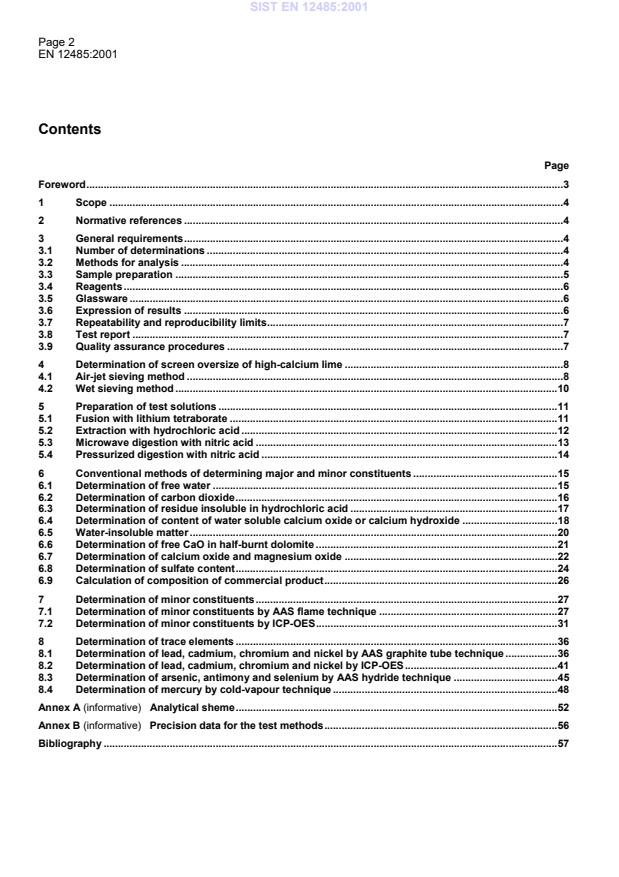
Page 2EN 12485:2001ContentsPageForeword.31Scope.42Normative references.43General requirements.43.1Number of determinations.43.2Methods for analysis.43.3Sample preparation.53.4Reagents.63.5Glassware.63.6Expression of results.63.7Repeatability and reproducibility limits.73.8Test report.73.9Quality assurance procedures.74Determination of screen oversize of high-calcium lime.84.1Air-jet sieving method.84.2Wet sieving method.105Preparation of test solutions.115.1Fusion with lithium tetraborate.115.2Extraction with hydrochloric acid.125.3Microwave digestion with nitric acid.135.4Pressurized digestion with nitric acid.146Conventional methods of determining major and minor constituents.156.1Determination of free water.156.2Determination of carbon dioxide.166.3Determination of residue insoluble in hydrochloric acid.176.4Determination of content of water soluble calcium oxide or calcium hydroxide.186.5Water-insoluble matter.206.6Determination of free CaO in half-burnt dolomite.216.7Determination of calcium oxide and magnesium oxide.226.8Determination of sulfate content.246.9Calculation of composition of commercial product.267Determination of minor constituents.277.1Determination of minor constituents by AAS flame technique.277.2Determination of minor constituents by ICP-OES.318Determination of trace elements.368.1Determination of lead, cadmium, chromium and nickel by AAS graphite tube technique.368.2Determination of lead, cadmium, chromium and nickel by ICP-OES.418.3Determination of arsenic, antimony and selenium by AAS hydride technique.458.4Determination of mercury by cold-vapour technique.48Annex A (informative)
Analytical sheme.52Annex B (informative)
Precision data for the test methods.56Bibliography.57SIST EN 12485:2001
Page 3EN 12485:2001ForewordThis European Standard has been prepared by Technical Committee CEN/TC 164 "Water Supply", the secretariatof which is held by AFNOR.This European Standard shall be given the status of a national standard, either by publication of an identical text orby endorsement, at the latest by October 2001, and conflicting national standards shall be withdrawn at the latestby October 2001.The annexes A and B are informative.According to the CEN/CENELEC Internal Regulations, the national standards organizations of the followingcountries are bound to implement this European Standard: Austria, Belgium, Czech Republic, Denmark, Finland,France, Germany, Greece, Iceland, Ireland, Italy, Luxembourg, Netherlands, Norway, Portugal, Spain, Sweden,Switzerland and the United Kingdom.SIST EN 12485:2001
Page 4EN 12485:20011 ScopeThis European standard describes methods used of the analyses of calcium carbonate, high-calcium lime and half-burnt dolomite used to treat water for human consumption.NOTEOf the reference methods described, the atomic spectroscopy methods are preferred to the conventional methods. Ifmethods other than those described are used, it should be demonstrated that the results are equivalent to those of thereference methods.The schematic diagram of the chemical analysis is given in annex A (Figures A.1 to A.4).2 Normative referencesThis European Standard incorporates by dated or undated reference, provisions from other publications. Thesenormative references are cited at the appropriate places in the text and the publications are listed hereafter. Fordated references, subsequent amendments to or revisions of any of these publications apply to this Europeanstandard only when incorporated in it by amendment or revision. For undated references the latest edition of thepublication referred to applies (including amendments).EN 459-2, Building lime – Part 2: Test methods.EN 1017, Chemicals used for treatment of water intended for human consumption - Half-burnt dolomite.EN 1018, Chemicals used for treatment of water intended for human consumption - Calcium carbonate.EN 12518, Chemicals used for treatment of water intended for human consumption - High-calcium lime.EN ISO 3696, Water for analytical laboratory use - Specification and test methods (ISO 3696:1987).ISO 3165, Sampling of chemical products for industrial use - Safety in sampling.ISO 4793, Laboratory sintered (fritted) filters - Porosity grading, classification and designation.ISO 5725-2, Accuracy (trueness and precision) of measurement methods and results - Part 2 : Basic method forthe determination of repeatability and reproducibility of a standard measurement method.3 General requirements3.1 Number of determinationsTwo analyses shall be carried out to determine the various constituents (see clause 5 to clause 8, see also 3.6).3.2 Methods for analysisThe methods to be used for analysis of half-burnt dolomite, calcium carbonate and high calcium lime and theprinciple of each method are listed in Table 1.SIST EN 12485:2001
Page 5EN 12485:2001Table 1 — Methods for analysisDeterminationMethodPrincipleStandardScreen oversize4.1Air-jet sievingEN 125184.2Wet sievingEN 12518Free water6.1GravimetryEN 12518Carbon dioxide6.2GravimetryEN 1017, EN 12518Residue insoluble inhydrochloric acid6.3Acidimetry, GravimetryEN 1018Water-soluble calcium oxideor calcium hydroxide6.4Acidimetric titrationEN 12518Water-insoluble constituents6.5GravimetryEN 12518Free calcium oxide6.6Extraction, acidimetric titrationEN 1017Calcium and magnesium6.7Complexometric titrationEN 1017, EN 1018Sulfur6.8Barium sulfate gravimetryEN 1017Magnesium,Silicium,Aluminium,Iron,Manganese7.1or7.2AAS (flame)orICP-OESEN 1017, EN 1018EN 1017, EN 12518EN 1017, EN 12518EN 1017, EN 12518EN 12518Sulfate7.2ICP-OESEN 1017Lead,Cadmium,Chromium,Nickel8.1or8.2AAS (flameless)orICP-OESEN 1017, EN 1018,EN 2518Arsenic,Antimony,Selenium8.3AAS (hydride)EN 1017, EN 1018,EN 12518Mercury8.4AAS (cold-vapour technique)EN 1017, EN 1018,EN 125183.3 Sample preparationThe general recommendations specified in ISO 3165 shall be observed when sampling. Sampling shall beperformed in accordance with EN 459-2. For products less than 6 mm grain size, the size of the sample shall be 1l.Before performing the chemical analyses, the size of the sample shall be reduced by using a sample divider and/orby dividing it into four parts in order to obtain a suitable subsample. The coarse-grain material in this sample shallbe reduced to a size of less than 0,2 mm before performing the chemical analysis.When sampling milk of lime, the material from which the sample is to be taken shall be thoroughly mixed with anelectrically driven stirrer of adequate power. The milk of lime shall be dried at (105
5) C (see 6.1) before beinganalysed chemically.Since the subsamples under examination are altered by the absorption of moisture and carbon dioxide, theirexposure to air shall be minimized. They shall therefore be transported and stored in air-tight containers and all thehandling shall be carried out as quickly as possible.SIST EN 12485:2001
Page 6EN 12485:20013.4 ReagentsAll reagents shall be of a recognized analytical grade appropriate for the method being used. The water used shallconform to grade 3 in accordance with EN ISO 3696 unless otherwise specified in the method. The concentrationof the analytes in the water and reagents shall be negligible compared with the lowest concentration to bedetermined.The concentrated liquids used for the reagents in this standard have the following densities () (in grams permillilitre at 20 C) : hydrochloric acid1,16 to 1,19 ; nitric acid1,40 to 1,42 ; ammonium hydroxide solution0,88 to 0,91 ; triethanolamine1,12.Dilutions are specified as the sum of the volumes. Thus, (1+2) dilute hydrochloric acid means 1 part by volume ofconcentrated hydrochloric acid mixed with 2 parts by volume of water.The concentrations of reference and standard volumetric solutions are specified as amount-of-substanceconcentrations, c (mol/l), while those of stock and standard solutions are specified as concentrations by mass,c (g/l or mg/l).Suitable element solutions for atomic absorption spectroscopy (AAS) and for optical emission spectroscopy byinductively coupled plasma (ICP-OES) are commercially available and can be used as stock solutions. They shallbe prepared for the purposes of analysis in accordance with the manufacturer´s instructions. The appropriateelement standard solutions shall be prepared in accordance with the instructions given in this standard.This standard makes no stipulations relating to the shelf life of stock, standard and reference solutions. In the caseof stock solutions having an element concentration of 1 g/l, the manufacturer generally specifies a shelf life of oneyear. It is advisable to check the calibration solutions regularly using a mean-value control chart (see 3.9). This isthe most reliable method of detecting errors in calibration due, for example, to: incorrect preparation of the standards and of the reagents ; dilution errors ; ageing of standards, reagents and reference material ; and increase in concentration as a result of evaporation.3.5 GlasswareGlass containers and pipettes shall be cleaned with hot dilute nitric acid immediately before use and then rinse withwater. If determining trace elements rinse with grade 2 water.3.6 Expression of resultsThe analytical results for the major and minor constituents shall be reported as per cent by mass, c (% (m/m)),while those for trace elements shall be reported, in milligrams per kilogram, as the mean of two determinations. Ingeneral, analytical values shall be reported to three significant figures.EXAMPLESc (CaO) = 91,2 % (m/m) ;c (SiO2) = 3,70 % (m/m) ;c (MnO2) = 0,15 % (m/m) ;SIST EN 12485:2001
Page 7EN 12485:2001c (Cr) = 0,32 mg/kg ;c (Hg) = 0,05 mg/kg.If the results of a duplicate determination differ from one another by more than twice the repeatability standarddeviation, the determination shall be repeated. The result shall then be deemed to be the mean of the two resultswith the lowest difference.To assess whether the analytical results meet the requirements laid down in EN 12518 for high-calcium lime, inEN 1018 for calcium carbonate products and in EN 1017 for half-burnt dolomites, the results have to be convertedto the form in which the requirements are stated in the above standards.The paragraphs of this standard are given in Table 2 and contain the relevant calculation methods.Table 2 — Methods for calculation of the resultsRequirements fromstandardParameterRequired valueforCalculation describedinEN 1017CaOfree, CaOCO2MgOCaCO3MgCO3MgOfree6.9.2.2EN 1018CaOMgOCaCO3MgCO36.9.2.1EN 12518CO2CaCO36.9.2.33.7 Repeatability and reproducibility limitsThe repeatability and reproducibility limits were determined in an interlaboratory test (see, annex B) which wascarried out in accordance with ISO 5725-2 and in which 28 laboratories took part.3.8 Test reportThe report shall refer to the standard used and contain the following information:a) a reference to the method used ;b) a complete identification of the sample ;c) expression of the results (see 3.6) ;d) sample pretreatment, e.g. method of digestion (see clause 5) ;e) any deviation from this standard and an indication of any circumstances which can have affected the results.3.9 Quality assurance proceduresThe methods of chemical analysis described in this standard shall include the quality criteria listed as productrequirements in the individual material standards in the form of analytical results. For this purpose, any test methodshall determine correct and precise values of the criteria. This will necessitate establishing suitable in-house qualityassurance procedures for every test method, particularly for the methods of determining trace elements.These procedures shall include the following: standard working instructions ;SIST EN 12485:2001
Page 8EN 12485:2001 calibration instructions ; keeping of quality control charts.Standard working instructions shall record in writing how recurring laboratory examinations are to be carried out.Calibration instructions shall include the checking of : blanks ; calibration standards ; the accuracy of recovery ; measurement variations ; the linearity of analytical functions ; and working range, sensitivity of the method, of method standard deviation and of the limit of determination.Quality control charts shall be used in the trace element analysis methods employing AAS and ICP-OES to checkthe accuracy. Blank-value, mean-value and accuracy-of-recovery control charts are suitable for this purpose. Theblank-value control chart can be used to detect: impurities in the reagents ; impurities originating from reaction vessels and instruments ; and errors in instrument parameters (e.g. base-line drift, short-term stability, long-term stability).The mean-value control chart shall be used to check the correctness: of the calibration with standard solutions ; and the control sample.The accuracy-of-recovery control chart determines the accuracy of analytical results by including matrix effectswhich are revealed by a proportional and systematic error in the calibration function.The precision of analytical results can be determined using the range control chart.4 Determination of screen oversize of high-calcium lime4.1 Air-jet sieving method4.1.1 GeneralThe method is used to determine the retention on sieving of high-calcium quicklime and hydrated lime as specifiedin EN 12518.The particle size distribution of high-calcium quicklime and hydrated lime can be determined using airjet sievingapparatus.For quicklime, the method is suitable for particles which substantially pass a 2,0 mm test sieve. For hydrated lime,the method can be used to determine the particle size distribution of the agglomerates of very fine particlesproduced by the manufacturing process. This method uses test sieves with aperture sizes of 0,60 mm and0,09 mm.SIST EN 12485:2001
Page 9EN 12485:20014.1.2 Apparatus4.1.2.1Air-jet sieving apparatus, of the general form shown in Figure 1. The apparatus shall be set to give apressure difference of 2 kPa to 2,5 kPa across the sieves.Key1Housing7Test sample2Dish8Oversize material3Sieve drum9Undersize material4Lid10Air jet5Slit-nozzle11Air discharge6Sieve12Pressure gauge socket, with dust hoodFigure 1 — Air-jet sieving apparatus4.1.2.2Test sieves, 200 mm diameter, aperture sizes 0,60 mm and 0,09 mm.NOTEThe effective operation of some makes of air-jet apparatus can require non-standard sieve frames and additionalgaskets. This is permissible, provided the sieving medium and general method of construction comply with the requirements ofthis standard.4.1.2.3Trays or other suitable containers of sufficient size to contain the test portion.4.1.2.4Balance, accurate to 0,1 mg.4.1.2.5Soft brush, for cleaning the mesh of the sieves. A camel hair brush is suitable.4.1.2.6Mallet, if there is a tendancy for material to adhere to the lid of the apparatus. A rubber or plastic tippedmallet is preferred.4.1.2.7Ventilated drying oven (optional), thermostatically controlled to maintain a temperature of (105
5) °C.SIST EN 12485:2001
Page 10EN 12485:20014.1.3 ProcedureWeigh to the nearest 1 mg (10
0,5) g of quicklime (m) or (25
0,5) g of hydrated lime (m). Fit the test sieve withthe aperture size 0,09 mm into the apparatus and transfer all of the test portion onto the sieve mesh. Take care notto lose any of the test portion.Fit the lid and switch on the apparatus. Check that the vacuum created is above the minimum value stated in themanufacturer’s instructions, and that the slit nozzle is rotating properly.If material adheres to the lid of the apparatus, gently tap the centre of the lid with the mallet.If the material agglomerates under the action of the air-jet, interrupt the sieving process, and break up theagglomerates with the soft brush.After (5
0,2) min, switch off the apparatus and carefully remove the sieve. Transfer the material retained on thesieve into a tray or other suitable container. Carefully clean the mesh of the sieve over the tray using the soft brush.Determine the mass of the residue, including the material brushed from the sieve mesh, and record the mass to thenearest 1 mg.Refit the sieve into the apparatus and transfer all of the residue back to the sieve mesh. Repeat the weighing andsieving stages until the sieving end-point has been achieved, and record the end-point mass to the nearest 1 mg.The sieving end-point is defined as being when not more than 0,2 % of the mass of the original test portion passesthrough the sieve in 1 min.Fit the 0,60 mm test sieve into the apparatus, and repeat the weighing and sieving stages until the mass of theresidue confirms that the sieving end-point has been reached. Record the end-point mass to the nearest 1 mg.4.1.4 Expression of resultsThe mass retained on each sieve expressed as a per cent by mass, m (P0,60 or 0,09), (% (m/m)), is given by thefollowing equation:mmm100
P 10,09or
0,60(1)wheremis the mass of the dry substance in the test portion, in grams ;m1is the mass of the residue retained on the test sieves, in grams.4.2 Wet sieving method4.2.1 GeneralThe method is used for the determination of the retentions on sieving of milk of lime as specified in EN 12518.4.2.2 Apparatus4.2.2.1Balance, accurate to 0,1 mg.4.2.2.2500 ml wide-mouthed bottle, or other suitable vessel which can be sealed with a stopper.4.2.2.3200 mm diameter 0,60 mm and 0,09 mm aperture size test sieves.4.2.2.45 mm bore rubber or plastics tubing.4.2.2.5Ventilated drying oven (optional), thermostatically controlled to maintain a temperature of (105
5) °C.SIST EN 12485:2001
Page 11EN 12485:20014.2.2.6Two sintered glass filter crucibles, of porosity 2 (as specified in ISO 4793) (maximum porosity diameter40 µm to 100 m) with filter flask and adapter funnel for crucibles.4.2.2.7Desiccator.4.2.2.8Wash bottle.4.2.2.9Filtration apparatus.4.2.3 ProcedureSuperimpose the 0,60 mm mesh test sieve on the 0,09 mm mesh test sieve and wet the sieves with water. Place avolume of milk of lime containing (50
0,5) g of dry substance in a 500 ml wide-mouthed bottle. Replace thestopper and shake the bottle for about 30 s. Remove the stopper immediately and pour the contents of the bottleonto the sieves. Wash any residue remaining in the bottle or on the stopper with a jet of water from the 5 mm boretubing and at a pressure equal to a head of 1,2 m (approximately 10 kPa) on to the sieves. Then use the jet towash the residue on the 0,60 mm mesh test sieve for (2
0,1) min. Do not rub the residue through the sieve andtake care not to flood the lower sieve during the operation. At the end of this period, wash the residue to one side ofthe sieve.Detach the 0,60 mm mesh test sieve and, using a wash bottle, transfer the residue from the sieve through a glassfunnel into one of the tared, sintered glass filter crucibles connected to the filtration apparatus. When all the residuehas been washed into the filter, and the water extracted, remove the filter containing the residue and dry it at(105
5) °C for 1h. Cool the dried filter in a desiccator and reweigh.Wash the residue on the 0,09 mm mesh test sieve for (5
0,2) min. Transfer the residue to a tared filter crucible,dry at (105
5) °C until constant mass is reached, cool and reweigh as described above.4.2.4 Expression of resultsThe mass retained on each sieve expressed as a per cent by mass, m (P0,60 or 0,09), (% (m/m)), is given by thefollowing equation:mmm100
P 10,09or
0,60(2)wheremis the mass of the dry substance in the test portion, in grams ;m1is the mass of the residue retained on the test sieves, in grams.5 Preparation of test solutions5.1 Fusion with lithium tetraborate5.1.1 GeneralFusion with lithium tetraborate is used to dissolve: high-calcium limes as specified in EN 12518 in order to determine silicon, aluminium, iron and manganese ; half-burnt dolomite as specified in EN 1017 in order to determine magnesium, silicon, aluminium and iron ; and calcium carbonate as specified in EN 1018 in order to determine magnesium when the per cent by mass ofMgO is less than 1 % (m/m).SIST EN 12485:2001
Page 12EN 12485:20015.1.2 PrincipleAfter fusing the sparingly soluble oxide constituents of the lime sample with lithium tetraborate, the fusion cake isdissolved in hydrochloric acid and the solution made up to 250 ml in a volumetric flask. Magnesium, silicon,aluminium, iron and manganese are determined in aliquot parts of this solution by flame-AAS (7.1) or ICP-OES(7.2).5.1.3 Reagents5.1.3.1Lithium tetraborate, Li2B4O7.5.1.3.2Hydrochloric acid,
= 1,16 g/ml.5.1.3.3Hydrochloric acid, diluted (1 + 5).5.1.4 ApparatusOrdinary laboratory apparatus and the following :5.1.4.1Platinum-gold crucible.5.1.4.2Hot plate.5.1.5 ProcedureWeigh (0,25
0,02) g to the nearest 0,1 mg of the sample into a platinum-gold crucible and add 1,5 g of lithiumtetraborate (5.1.3.1). Roast at (1000
25) °C until the melt is clear. Remove from the heat, cover the crucible witha watch glass and stand the crucible in water for a few seconds, remove and allow it to stand until it has cooledcompletely.Transfer the cold melt to a beaker using approximately 50 ml of hydrochloric acid (5.1.3.3) and dissolve whilestirring and heating at 100 °C. Then transfer the solution to a 250 ml volumetric flask with water (3.3) and, aftercooling to room temperature, add each 10 ml of the appropriate reagent solutions (7.1.4.6 and 7.1.4.7 for the AASmeasurement) or 1 ml of scandium solution (7.4.2.2, internal standard solution for the ICP measurement) and makeup to the mark with water (digestion solution (I) for AAS and (II) for ICP).5.2 Extraction with hydrochloric acid5.2.1 GeneralExtraction with hydrochloric acid is used to dissolve calcium carbonate as specified in EN 1018 in order todetermine calcium and magnesium.5.2.2 PrincipleThe sample is boiled with hydrochloric acid and the solution filtered. The pH value is adjusted to 6 to 7 toprecipitate the iron (III) and aluminium oxides. After refiltering, the filtrate is transferred to a suitable volumetricflask.5.2.3 Reagents5.2.3.1Hydrochloric acid,
= 1,16 g/ml.5.2.3.2Hydrogen peroxide solution, c (H2O2) = 30% (m/m).5.2.3.3Hydrogen peroxide solution ; diluted, 1 + 9.5.2.3.4Ammonium hydroxide solution, c (NH3) = 25% (m/m).5.2.3.5Ammonium hydroxide solution, diluted, 1 + 9.SIST EN 12485:2001
Page 13EN 12485:20015.2.3.6Ammonium chloride, NH4Cl.5.2.4 ApparatusOrdinary laboratory apparatus and the following :5.2.4.1Hot plate.5.2.4.2Magnetic stirrer and magnetic rod.5.2.4.3pH-meter with glass electrode.5.2.5 ProcedureWeigh (1
0,1) g of the sample to the nearest 1 mg, transfer it to a 250 ml beaker, moisten with 10 ml of water,then gradually add 30 ml of hydrochloric acid (5.2.3.1). Make the solution up to about 100 ml with water then boil itfor 10 min. After boiling, filter the solution immediately through a fluted filter paper (particle retention size 2,5 m)into a 400 ml beaker and wash the residue well with water.Add about 4 g of ammonium chloride (5.2.3.6) and a few drops of hydrogen peroxide (5.2.3.3) to the solution, thendilute with about 150 ml of water and heat to boiling. During boiling, add ammonium hydroxide solution (5.2.3.4) toadjust the pH value to 6 to 7 and precipitate aluminium hydroxides and iron hydroxides and the silicic acid.Continue boiling for 3 min and, after the precipitate has settled, filter the solution immediately through a fluted filterpaper (particle retention size 2,5 m) into a 500 ml volumetric flask. Wash the filter residue three times withammonium hydroxide solution (5.2.3.5) and three times with water. After the solution has cooled to roomtemperature, make the solution up to the mark with water and shake the contents of the flask thoroughly (digestionsolution III).5.3 Microwave digestion with nitric acid5.3.1 GeneralThe purpose of this method of digestion is to release trace elements from the accompanying matrix and determinethe content of the various elements. The method is applied to high-calcium limes as specified in EN 12518, tocalcium carbonate as specified in EN 1018 and to half-burnt dolomite as specified in EN 1017.5.3.2 PrincipleThe sample is weighed into a perfluoroalkoxyethylene (PFA) beaker and nitric acid is added. After the mixture hasbeen placed in a microwave apparatus, digestion is carried out. Any undissolved component is removed by filteringand the supernatant is used to determine the elements concerned.5.3.3 Reagents5.3.3.1Nitric acid,
= 1,40 g/ml.5.3.4 ApparatusOrdinary laboratory apparatus and the following:5.3.4.1Microwave digestion apparatus, equipped with PFA digestion vessels and a programmable pressureand temperature control unit. Performance
600 W.5.3.4.250 ml polypropylene vessel with screw lid.5.3.4.3Filtration apparatus.SIST EN 12485:2001
Page 14EN 12485:20015.3.5 ProcedureThe mass of the test sample depends on the test method. For AAS, the recommended mass is (0,5
0,05) g andfor ICP-OES (3
0,05) g, weighed to the nearest 0,1 mg. In the first case, moisten the sample with 4 ml of waterand carefully add 3 ml of nitric acid (5.3.3.1), in the second case moisten with 5 ml of water and add 10 ml of nitricacid (5.3.3.1).Seal the digestion vessel and place in the microwave apparatus. Before programming the apparatus, the heatingconditions shall be determined, and a temperature and pressure versus time plot shall be prepared.Subject the test sample to a pressure of 500 kPa to 700 kPa and to a temperature of 90°C for 10 min during aheating-up phase. Then subject the test sample to a pressure of 1 000 kPa and a temperature between 120 °C and150°C for 15 min to 20 min. Allow the digestion vessel to cool to room temperature. Open the digestion vessel,introduce the solution into a 100 ml volumetric flask rinse and make up to the mark with water. Filter and transferthe solution (digestion solution IV) to the polypropylene vessel in order to avoid adsorption on the glass.5.4 Pressurized digestion with nitric acid5.4.1 GeneralThe purpose of this method of digestion is to release trace elements from the accompanying matrix and determinethe content of the various elements. The method is applied to high-calcium limes as specified in EN 12518, tocalcium carbonate as specified in EN 1018 and to half-burnt dolomite as specified in EN 1017.5.4.2 PrincipleThe sample is weighed out into a polytetrafluorethylen (PTFE) beaker and nitric acid is added. After the mixturehas been placed in a pressure shell, digestion is carried out at 130 C. Any undissolved component is removed byfiltering and the supernatant is used to determine the elements concerned.5.4.3 Reagent5.4.3.1Nitric acid,
(HNO3) = 1,40 g/ml.5.4.4 ApparatusOrdinary laboratory apparatus and the following:5.4.4.1Pressure digestion system, consisting of a PTFE digestion vessel, pressure shell and a heater.5.4.4.250 ml polypropylene vessel with screw lid.5.4.4.3Filtration apparatus.5.4.5 ProcedureWeigh (0,5
0,05) g to the nearest of 0,1 mg of the sample into the digestion vessel, moisten the sample with 2 mlof water and add carefully 5 ml of nitric acid (5.4.3.1). Seal the pressure shell, place it in a cold drying oven andheat to 130 C. After about 15 min, remove the pressure vessel from the drying oven and cool it to roomtemperature. Open the pressurized digestion system, introduce the solution into a 100 ml volumetric flask, rinseand make up to the mark with water. Filter and transfer the solution (digestion solution V) to the polypropylenevessel in order to avoid adsorption on the glass.SIST EN 12485:2001
Page 15EN 12485:20016 Conventional methods of determining major and minor constituents6.1 Determination of free water6.1.1 GeneralThe method is used to determine free water in high-calcium lime as specified in EN 12518. In the case of hydratedhigh-calcium lime, free water means the moisture attached to the product, in the case of milk of lime, it refers to thewater content of the suspension. The method does not apply for high-calcium quickline. The determination of thewater content of milk of lime is required to calculate the water-soluble content of the suspended hydrated lime (see6.4).6.1.2 PrincipleWhen heating a sample to (105
5) °C in the drying oven the free water escapes. The loss of mass at thistemperature is referred to as free water in the case of hydrated high-calcium lime, and as per cent by mass of waterin the suspension for milk of lime.6.1.3 ApparatusOrdinary laboratory apparatus and the following:6.1.3.1Ventilated drying oven, thermostatically controlled to maintain a temperature of (105
5) °C.6.1.3.2Analytical balance accurate to 0,1 mg.6.1.3.3Desiccator containing drying agent.6.1.3.4Unglazed porcelain or platinum crucible.6.1.3.5Pipette.6.1.4 Procedure6.1.4.1 Hydrated high-calcium limeWeigh (5
0,1) g to a nearest 1 mg of the sample in the as-delivered state in a pre-weighed crucible. Dry thesample at (105
5) °C in the drying oven until constant mass is achieved. In the case of hydrated lime, constantmass is generally reached after 2 h. Cover the crucible after removing it from the oven to prevent carbon dioxideand water vapour in the atmosphere from being absorbed. Cool in the desiccator and reweigh.6.1.4.2 Milk of limeHomogenise the suspension by shaking before taking the sample aliquot. Use a pipette to take approximately 20 gand weigh to the nearest of 0,1 mg in a glass vessel. Dry the sample to constant mass in the drying oven at(105
5) °C. Cover the crucible after removing it from the oven to prevent carbon dioxide and water vapour in theatmosphere from being absorbed. After cooling down to ambient temperature in the dessicator, determine the lossin mass.6.1.5 Expression of resultsThe free water content of hydrated high-calcium lime or milk of lime expressed as a per cent by mass,c (H2O) (% (m/m)), is given by the following equation:001 x )(OH 12mmmc(3)SIST EN 12485:2001
Page 16EN 12485:2001wheremis the mass of the test portion before heating, in grams ;m1is the mass of the test portion after heating, in grams.6.2 Determination of carbon dioxide6.2.1 GeneralThe method is used to determine carbon dioxide in high-calcium lime as specified in EN 12518 and in half-burntdolomite as specified in EN 1017.6.2.2 PrincipleThe carbon dioxide content of the materials concerned is determined from the loss on ignition which takes place intwo stages, at 450 °C and at 1000 °C. The loss on ignition at 450 °C is basically due to free water and the water ofhydration. The difference in mass between the two stages is equal to the carbon dioxide content of the product.6.2.3 ApparatusOrdinary laboratory apparatus and the following:6.2.3.1Electric furnace capable of being maintained at (450
25) °C and at (1000
50) C, with athermoelectric temperature indicator.6.2.3.2Analytical balance accurate to 0,1 mg.6.2.3.3Desiccator containing phosphorous pentoxide, P2O5.6.2.3.4Unglazed porcelain or platinum crucible.6.2.4 Procedure6.2.4.1 High-calcium quicklime, high-calcium hydrated lime and half-burnt dolomiteWeigh (5 ± 0,1) g to the nearest of 1 mg of the sample (m1) in the as-delivered state in a pre-weighed crucible. Heatthe sample in the furnace at (450
25) °C for 2 h and then cool it in a desiccator. After determining its mass (m2),heat the sample at (1000 ± 50) °C for 3 h. Cover the crucible after removing it from the furnace to prevent carbondioxide and water vapour in the atmosphere from being absorbed. Cool in the desiccator and reweigh (m3).6.2.4.2 Milk of limeThe water content of the milk of lime shall be determined as specified in 6.1.4.2. After drying the sample this way,the determination shall be carried out as specified in 6.2.4.1.6.2.5 Expression of results6.2.5.1 Loss on ignition at 450 °CThe loss on ignition at 450 °C expressed as a per cent by mass, c (Lv) (% (m/m)), is given by the followingequation:100
)(Lv 121mmmc(4)SIST EN 12485:2001
Page 17EN 12485:2001wherem1is the mass of the sample before ignition at (450 ± 25) °C, in grams ;m2is the mass of the sample after ignition at (450 ± 25) °C, in grams.6.2.5.2 Loss on ignition at 1000 °CThe carbon dioxide content expressed as a percentage by mass, c (CO2) (% (m/m)), is given by the followingequation:100
)(CO 1322mmmc(5)wherem1is the mass of the sample before ignition at (450 ± 25) °C, in grams ;m2is the mass of the sample before ignition at (1000 ± 50) °C, in grams ;m3is the mass of the sample after ignition at (1000 ± 50) °C, in grams.6.3 Determination of residue insoluble in hydrochloric acid6.3.1 GeneralThe method is used to determine the residue in calcium carbonates as specified in EN 1018 which is insoluble inhydrochloric acid.6.3.2 PrincipleAfter the sample has been dissolved in hydrochloric acid and filtered, the filtration residue is washed, dried andincinerated to constant mass to determine the insoluble component gravimetrically.6.3.3 Reagents6.3.3.1Hydrochloric acid,
= 1,16 g/ml.6.3.3.2Hydrochloric acid, diluted, 1 + 1.6.3.3.3Hydrochloric acid, diluted, 1 + 3.6.3.4 ApparatusOrdinary laboratory apparatus and the following:6.3.4.1Magnetic stirrer with hot plate.6.3.4.2Platinum crucible.6.3.4.3Electric furnace capable of being maintained at (1 000 ± 50) °C with a thermoelectric temperatureindicator.SIST EN 12485:2001
Page 18EN 12485:20016.3.5 ProcedureWeigh (1
0,1) g to the nearest of 1 mg of the sample into a 250 ml beaker. Suspend the sample in 5 ml to 10 mlof water and dissolve it by adding 25 ml of hydrochloric acid (6.3.3.2). After boiling this solution for 2 min, dilute itwith 50 ml of water as soon as the dissolution is complete and immediately filter it through a filter (particle retentionsize 2,5 m, ash < 0,01%) into a 250 ml beaker. Use a rubber-tipped glass rod to ensure that all the insolubleresidue is transferred to the filter. Wash the filtration residue twice with 10 ml of hot dilute hydrochloric acid (6.3.3.3)and then several times with small portions of hot water.Reduce the washed filter to ash in a roasted and pre-weighed platinum crucible. After incinerating to constant massat (1000 ± 50) C, cool in a desiccator and weigh. An incineration time of 15 min will generally be sufficient toachieve constant mass.6.3.6 Expression of resultsThe content of residue insoluble in hydrochloric acid expressed as per cent by mass, c (HClinsol) (% (m/m)), is givenby the following equation:mmc100
HCl 1insol(6)wherem1is the incineration residue, in grams ;mis the mass of the sample, in grams.6.4 Determination of content of water soluble calcium oxide or calcium hydroxide6.4.1 GeneralThe method is used to determine the water-soluble lime content (calcium oxide and calcium hydroxide) inhigh-calcium lime products as specified in EN 12518. It is also used to determine the water-soluble calciumhydroxide in milk of lime.This method designates those constitutents which enter into the reaction under the conditions of this specifiedmethod. The interpretation of results obtained by the following method shall be determined in consideration of thislimiting definition.6.4.2 PrincipleThe amount of water-soluble lime which can be titrated with hydrochloric acid after digesting the lime sample inwater is determined. To avoid agglomeration of calcium oxide on slaking which can lead to incomplete suspensionof a high-calcium lime sample such limes shall be heated. The indicator used and the low rate of titration ensurethat the titration proceeds in the alkaline range.6.4.3 Reagents6.4.3.1Hydrochloric acid, standard volumetric solution, c (HCl) = 1 mol/l.6.4.3.2Phenolphthalein indicator solution : dissolve 0,5 g of phenolphthalein in 50 ml of ethanol and dilute to100 ml with water.6.4.3.3Ethanol,
= 0,79 g/ml.6.4.3.4Water grade 3 freshly boiled to remove CO2 and cooled.SIST EN 12485:2001
Page 19EN 12485:20016.4.4 ApparatusOrdinary laboratory apparatus and the following :6.4.4.1Analytical balance, accurate to 0,1 mg.6.4.4.2pH-meter with glass electrode.6.4.4.3Heatable magnetic stirrer with magnetic rod.6.4.4.4Pipette.6.4.5 Procedure6.4.5.1 High-calcium limeWeigh (1
0,05) g of pulverized high-calcium lime (m1) to the nearest of 0,1 mg and transfer it immediately to aconical flask containing about 200 ml of water (6.4.3.4).Cover the conical flask containing the pulverized high-calcium lime sample with a watch glass and bring thecontents to the boil while stirring on the heatable magnetic stirrer. After boiling for 4 min, spray the wall of theconical flask with approximately 50 ml of water (6.4.3.4). Allow the contents to cool to room temperature.6.4.5.2 Hydrated high-calcium limeWeigh (1,3
0,05) g of hydrated high-calcium lime (m2) to a nearest of 0,1 mg and transfer it immediately to aconical flask containing about 200 ml of water (6.4.3.4). The sample of hydrated high-calcium lime shall beanalysed immediately after preparation of the suspension at room temperature.6.4.5.3 Milk of limeBefore starting measuring, the water content of the milk of lime shall be determined as specified in 6.1.Homogenise the suspension by shaking before taking the sample aliquot. Use a pipette to take a volumecorresponding to a solid matter content of approximately 1,3 g, weigh to the nearest of 0,1 mg (m3) and, whilestirring, put into a conical flask containing enough water (6.4.3.4) to reach a volume of 200 ml after addition of thesuspension.6.4.5.4 DeterminationAdd a few drops of phenolphthalein indicator solution (6.4.3.2). Then slowly add hydrochloric acid (6.4.3.1)dropwise (at a rate of 12 ml/min) until the solution just becomes decoloured (pH value 9,5). Now stir for 60 s withoutadding further hydrochloric acid and then titrate dropwise (at a rate of 4 ml/min) to final decolouration, ignoring anyred colouration of the solution which returns after a few seconds.Keep the titrated solution for the determination of water insoluble matter (6.5).6.4.6 Expression of resultsThe water-soluble CaO or Ca(OH)2 content of the products, c (CaO) or c (Ca(OH)2) expressed as a per cent bymass (% (m/m)), is given by one of the fo
...
Questions, Comments and Discussion
Ask us and Technical Secretary will try to provide an answer. You can facilitate discussion about the standard in here.
Loading comments...