

EN 13480-5:2012/A1:2013
(Amendment)Metallic industrial piping - Part 5: Inspection and testing
- Abstract
This part of EN 13480 describes the requirements for inspection and testing to be performed on individual spools or piping systems, including supports, designed in accordance with EN 13480-3 and fabricated and installed in accordance with EN 13480-4.
- Status
- Withdrawn
- Publication Date
- 27-Aug-2013
- Withdrawal Date
- 06-Oct-2026
- Technical Committee
- CEN/TC 267 - Industrial piping and pipelines
- Drafting Committee
- CEN/TC 267/WG 5 - Inspection and testing
- Current Stage
- 9960 - Withdrawal effective - Withdrawal
- Start Date
- 28-Jun-2017
- Completion Date
- 07-Oct-2026
- Directive
- 2014/68/EU - Directive 2014/68/EU of the European Parliament and of the Council of 15 May 2014 on the harmonisation of the laws of the Member States relating to the making available on the market of pressure equipmentOJ Ref: C 293/01 OJ Date: 12-Aug-2016
97/23/EC - Pressure equipmentOJ Ref: C, C 22 OJ Date: 24-Jan-2014

Relations
- Effective Date
- 08-Jun-2022
- Effective Date
- 08-Jun-2022
Get Certified
Connect with accredited certification bodies for this standard

Institut za varilstvo d.o.o. (Welding Institute)
Slovenia's leading welding institute since 1952. ISO 3834, EN 1090, pressure equipment certification, NDT personnel, welder qualification. Only IIW Au
Sponsored listings
Frequently Asked Questions
EN 13480-5:2012/A1:2013 is a amendment published by the European Committee for Standardization (CEN). Its full title is "Metallic industrial piping - Part 5: Inspection and testing". This standard covers: This part of EN 13480 describes the requirements for inspection and testing to be performed on individual spools or piping systems, including supports, designed in accordance with EN 13480-3 and fabricated and installed in accordance with EN 13480-4.
This part of EN 13480 describes the requirements for inspection and testing to be performed on individual spools or piping systems, including supports, designed in accordance with EN 13480-3 and fabricated and installed in accordance with EN 13480-4.
EN 13480-5:2012/A1:2013 is classified under the following ICS (International Classification for Standards) categories: 23.040.01 - Pipeline components and pipelines in general. The ICS classification helps identify the subject area and facilitates finding related standards.
EN 13480-5:2012/A1:2013 has the following relationships with other standards: It is inter standard links to EN 13480-5:2017, EN 13480-5:2012. Understanding these relationships helps ensure you are using the most current and applicable version of the standard.
EN 13480-5:2012/A1:2013 is associated with the following European legislation: EU Directives/Regulations: 2014/68/EU, 97/23/EC; Standardization Mandates: M/071. When a standard is cited in the Official Journal of the European Union, products manufactured in conformity with it benefit from a presumption of conformity with the essential requirements of the corresponding EU directive or regulation.
EN 13480-5:2012/A1:2013 is available in PDF format for immediate download after purchase. The document can be added to your cart and obtained through the secure checkout process. Digital delivery ensures instant access to the complete standard document.
Standards Content (Sample)
SLOVENSKI STANDARD
01-december-2013
Kovinski industrijski cevovodi - 5. del: Pregled in preskušanje - Dopolnilo A1
Metallic industrial piping - Part 5: Inspection and testing
Metallische industrielle Rohrleitungen - Teil 5: Prüfung
Tuyauteries industrielles métalliques - Partie 5: Inspection et contrôle
Ta slovenski standard je istoveten z: EN 13480-5:2012/A1:2013
ICS:
77.140.75 Jeklene cevi in cevni profili Steel pipes and tubes for
za posebne namene specific use
2003-01.Slovenski inštitut za standardizacijo. Razmnoževanje celote ali delov tega standarda ni dovoljeno.
EUROPEAN STANDARD
EN 13480-5:2012/A1
NORME EUROPÉENNE
EUROPÄISCHE NORM
August 2013
ICS 23.040.01
English Version
Metallic industrial piping - Part 5: Inspection and testing
Tuyauteries industrielles métalliques - Partie 5: Inspection Metallische industrielle Rohrleitungen - Teil 5: Prüfung
et contrôle
This amendment A1 modifies the European Standard EN 13480-5:2012; it was approved by CEN on 26 July 2013.
CEN members are bound to comply with the CEN/CENELEC Internal Regulations which stipulate the conditions for inclusion of this
amendment into the relevant national standard without any alteration. Up-to-date lists and bibliographical references concerning such
national standards may be obtained on application to the CEN-CENELEC Management Centre or to any CEN member.
This amendment exists in three official versions (English, French, German). A version in any other language made by translation under the
responsibility of a CEN member into its own language and notified to the CEN-CENELEC Management Centre has the same status as the
official versions.
CEN members are the national standards bodies of Austria, Belgium, Bulgaria, Croatia, Cyprus, Czech Republic, Denmark, Estonia,
Finland, Former Yugoslav Republic of Macedonia, France, Germany, Greece, Hungary, Iceland, Ireland, Italy, Latvia, Lithuania,
Luxembourg, Malta, Netherlands, Norway, Poland, Portugal, Romania, Slovakia, Slovenia, Spain, Sweden, Switzerland, Turkey and United
Kingdom.
EUROPEAN COMMITTEE FOR STANDARDIZATION
COMITÉ EUROPÉEN DE NORMALISATION
EUROPÄISCHES KOMITEE FÜR NORMUNG
Management Centre: Avenue Marnix 17, B-1000 Brussels
© 2013 CEN All rights of exploitation in any form and by any means reserved Ref. No. EN 13480-5:2012/A1:2013: E
worldwide for CEN national Members.
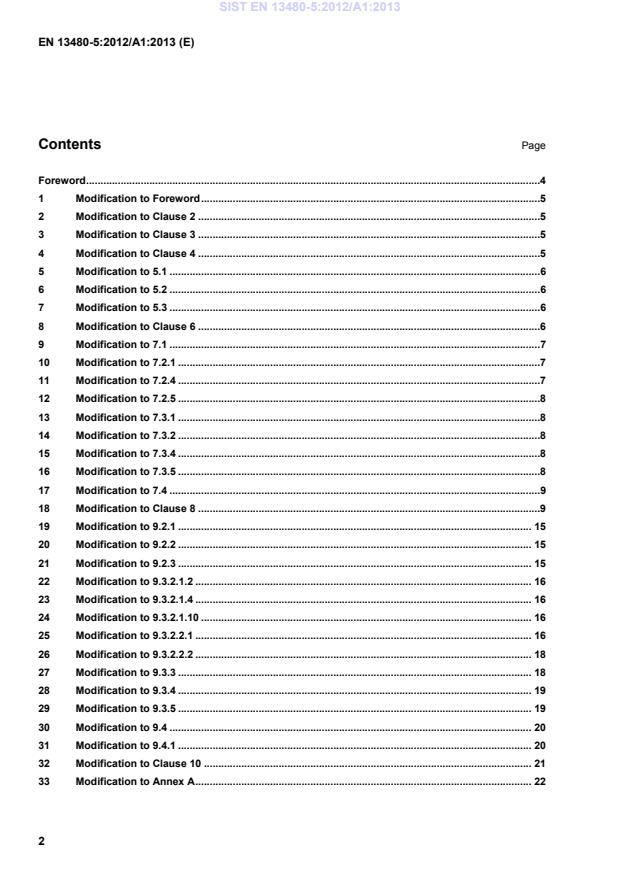
Contents Page
Foreword .4
1 Modification to Foreword .5
2 Modification to Clause 2 .5
3 Modification to Clause 3 .5
4 Modification to Clause 4 .5
5 Modification to 5.1 .6
6 Modification to 5.2 .6
7 Modification to 5.3 .6
8 Modification to Clause 6 .6
9 Modification to 7.1 .7
10 Modification to 7.2.1 .7
11 Modification to 7.2.4 .7
12 Modification to 7.2.5 .8
13 Modification to 7.3.1 .8
14 Modification to 7.3.2 .8
15 Modification to 7.3.4 .8
16 Modification to 7.3.5 .8
17 Modification to 7.4 .9
18 Modification to Clause 8 .9
19 Modification to 9.2.1 . 15
20 Modification to 9.2.2 . 15
21 Modification to 9.2.3 . 15
22 Modification to 9.3.2.1.2 . 16
23 Modification to 9.3.2.1.4 . 16
24 Modification to 9.3.2.1.10 . 16
25 Modification to 9.3.2.2.1 . 16
26 Modification to 9.3.2.2.2 . 18
27 Modification to 9.3.3 . 18
28 Modification to 9.3.4 . 19
29 Modification to 9.3.5 . 19
30 Modification to 9.4 . 20
31 Modification to 9.4.1 . 20
32 Modification to Clause 10 . 21
33 Modification to Annex A . 22
34 Modification to Clause Y.1 . 25
35 Modification to Annex ZA . 26
36 Modification to Bibliography . 27
Foreword
This document (EN 13480-5:2012/A1:2013) has been prepared by Technical Committee CEN/TC 267
“Industrial piping and pipelines”, the secretariat of which is held by AFNOR.
This Amendment to the European Standard EN 13480-5:2012 shall be given the status of a national standard,
either by publication of an identical text or by endorsement, at the latest by February 2014, and conflicting
national standards shall be withdrawn at the latest by February 2014.
Attention is drawn to the possibility that some of the elements of this document may be the subject of patent
rights. CEN [and/or CENELEC] shall not be held responsible for identifying any or all such patent rights.
This document has been prepared under a mandate given to CEN by the European Commission and the
European Free Trade Association, and supports essential requirements of EU Directive(s).
For relationship with EU Directive(s), see informative Annex ZA, which is an integral part of this document.
This document includes the text of the amendment itself. The amended/corrected pages of EN 13480-5:2012
will be published in August 2013 as Issue 2 of the European Standard.
According to the CEN-CENELEC Internal Regulations, the national standards organizations of the following
countries are bound to implement this European Standard: Austria, Belgium, Bulgaria, Croatia, Cyprus, Czech
Republic, Denmark, Estonia, Finland, Former Yugoslav Republic of Macedonia, France, Germany, Greece,
Hungary, Iceland, Ireland, Italy, Latvia, Lithuania, Luxembourg, Malta, Netherlands, Norway, Poland, Portugal,
Romania, Slovakia, Slovenia, Spain, Sweden, Switzerland, Turkey and the United Kingdom.
1 Modification to Foreword
th
The first sentence of the 9 paragraph of the Foreword shall read as follows:
The contact to submit queries can be found at http://www.unm.fr (en13480@unm.fr).
2 Modification to Clause 2
Replace the existing Clause 2 with the following:
The following referenced documents are indispensable for the application of this document. For dated
references, only the edition cited applies. For undated references, the latest edition of the referenced
document (including any amendments) applies.
EN 13480-1:2012, Metallic industrial piping — Part 1: General
EN 13480-2:2012, Metallic industrial piping — Part 2: Materials
EN 13480-3:2012, Metallic industrial piping — Part 3: Design and calculation
EN 13480-4:2012, Metallic industrial piping — Part 4: Fabrication and installation
EN 13480-6:2012, Metallic industrial piping — Part 6: Additional requirements for buried piping
EN 14917:2009+A1:2012, Metal bellows expansion joints for pressure applications
EN ISO 5817:2007, Welding — Fusion-welded joints in steel, nickel, titanium and their alloys (beam welding
excluded) — Quality levels for imperfections (ISO 5817:2003, corrected version:2005, including Technical
Corrigendum 1:2006)
EN ISO 9712:2012, Non-destructive testing — Qualification and certification of NDT personnel
(ISO 9712:2012)
EN ISO 17635:2010, Non-destructive testing of welds — General rules for metallic materials
(ISO 17635:2010)
EN ISO 17640:2010, Non-destructive testing of welds — Ultrasonic testing — Techniques, testing levels, and
assessment (ISO 17640:2010)
3 Modification to Clause 3
Replace the existing Clause 3 with the following:
For the purposes of this document, the terms and definitions given in EN 13480-1 shall apply.
4 Modification to Clause 4
Replace the existing Clause 4 with the following:
For the purposes of this Part of this European Standard, the symbols given in EN 13480-1 apply together with
the following abbreviations:
NDT Non-destructive testing
MT Magnetic particle testing
PT Penetrant testing
RT Radiographic testing
UT Ultrasonic testing
VT Visual testing
PWHT Post-weld heat treatment
— PED Pressure Equipment Directive
5 Modification to 5.1
The revised sub-clause 5.1 shall read as follows:
The manufacturer shall be responsible for the fabrication and the installation, even if this work will be sub-
contracted to other fabricators and/or installers.
The fabricator and/or installer shall be responsible for carrying out the inspection and testing including
subcontracted NDT (if any) specified in this European Standard, for all piping.
NOTE For guidance on the use of conformity assessment procedures see CEN/TR 13480-7.
6 Modification to 5.2
The revised sub-clause 5.2 shall read as follows:
Industrial piping shall be classified in accordance with EN 13480-1:2012, Table 5.1-1.
NOTE Categories I to III are identical to categories I to III of the Pressure Equipment Directive.
7 Modification to 5.3
The existing sub-clause 5.3 “Testing and inspection procedures” shall be deleted.
8 Modification to Clause 6
Replace the existing Clause 6 with the following:
6 Design review
Before fabrication/installation commences, a review of the piping design and its supports shall be performed.
Where design and fabrication are carried out by separate organisations, the piping designer shall prepare a
confirmation for the manufacturer that the design is in compliance with the requirements of this European
Standard.
A list of the relevant drawings shall be attached to the confirmation.
Where the design of parts has already been reviewed in accordance with this European Standard, and where
an appropriate confirmation is available, a further design review shall not be required.
NOTE For guidance on the use of conformity assessment procedures see CEN/TR 13480-7.
9 Modification to 7.1
The revised sub-clause 7.1 shall read as follows:
Testing and inspection shall be carried out by personnel qualified for the method used. European Standards,
specifications or written procedures (if necessary) shall be available to all testing personnel and inspectors
prior to the testing/inspection.
Reports on NDT specified in 7.2.4 and Clause 8 and reports on destructive testing specified in 7.2.5 shall be
prepared to demonstrate that all required testing has been carried out and that the results are acceptable.
10 Modification to 7.2.1
Following the first existing paragraph, add a second paragraph as follows:
Formed parts shall be subject to appropriate testing in accordance with the fabricators/installers test
programme.
11 Modification to 7.2.4
The revised sub-clause 7.2.4 shall read as follows:
Depending on material, dimensions and type of forming process testing may include:
a) visual testing;
b) wall thickness measurements;
c) dimensional checks (ovality, angle of bend etc.);
d) hardness tests;
e) ultrasonic testing for volumetric (internal) imperfections in longitudinal and transversal direction;
f) testing for surface imperfections (magnetic particle or penetrant testing);
g) replicas of the surface structure in the tension zone (in case life monitoring is required for creep range
applications)
on each component or batch of identical components.
Material, heat treatment conditions, heat treatment lot, degree of deformation shall be considered in the
definition of the batch.
NOTE A customary interpretation of a heat treatment lot is the entire content of a furnace of a single heat treatment.
12 Modification to 7.2.5
The revised sub-clause 7.2.5 shall read as follows:
Testing performed to verify the heat treatment of the formed parts shall include as appropriate:
a) tensile test at room temperature;
b) tensile test at elevated temperature (where items are being used in the creep range);
c) impact test;
d) microscopic examinations (e.g. 9 % or 12 % Cr steels);
e) other tests specified in European Standards for base materials.
The tests shall be performed on test pieces from the end of the component itself, or from test pieces placed
together with the components in the heat treatment furnaces.
13 Modification to 7.3.1
The revised heading and the revised sub-clause 7.3.1 shall read as follows:
7.3.1 Review of welding documents
Prior to carrying out any welding activity, the fabricator shall verify that the welding procedures and the
welding personnel are qualified for the relevant work. This shall be reviewed by the manufacturer.
14 Modification to 7.3.2
The revised heading of the sub-clause 7.3.2 shall read as follows:
7.3.2 Inspection before welding
The revised first sentence shall read as follows:
Prior to carrying out any welding, each joint preparation shall be visually inspected.
In the list, replace the indents “ — “ by the indents “a”, “b”, “c”, “d” and “e”.
15 Modification to 7.3.4
The first indent “a” shall read as follows:
a) verification for compliance with drawings;
16 Modification to 7.3.5
Add a new sub-clause 7.3.5 as follows:
7.3.5 Inspection of built up pipe ends
All built up pipe ends shall be subject to 100 % non-destructive testing of internal and surface imperfections.
17 Modification to 7.4
The revised sub-clause 7.4 shall read as follows:
For post-forming and post-weld heat treatment (PWHT), where applicable, it shall be verified by a review of
the heat treatment reports that the heat treatment carried out complies with the heat treatment procedure.
If additional examinations (e.g. replica, hardness) after post-forming and post-weld heat treatment are
required, this testing shall be reported and the reports shall be reviewed.
18 Modification to Clause 8
Replace the existing Clause 8 with the following:
8 Non-destructive testing of welds
8.1 Application of NDT
8.1.1 General
8.1.1.1 The following shall be applicable to all welded joints:
a) welded joints shall be visually examined before any other NDT is performed;
b) the area to be examined shall include the weld metal and the heat affected zones;
c) surface examination stipulated in Table 8.2-1 shall be performed on the outer surface;
d) where a welded joint is to be subsequently formed or heat treated, the required NDT shall be carried out
on the weld in the final condition. If a weld will not be accessible for examination after heat treatment or
forming, a suitable alternative shall be agreed;
e) NDT-methods used and acceptance criteria for all NDT shall be in accordance with 8.4.5;
f) weld imperfections, which have been assessed as weld defects, shall be repaired in accordance with
EN 13480-4 and inspected again after repair.
8.1.1.2 Arc strikes and contact points with fused material shall be ground smooth and subjected to
surface examination appropriate to the material used.
8.1.2 Examination of weld quality by sample inspection
Where the required extent of non-destructive testing is less than 100 %, the specified NDT techniques shall be
employed at the earliest stage practicable in the fabrication process to ensure that sound welds are achieved.
The timing shall be agreed. Sample welds to be examined shall be:
a) randomly selected;
b) representative of a batch of welds.
At least one complete sample weld shall be examined over the whole length.
Where the number of sample welds required is small, combinations of thicker sections and smaller diameters
or thinner sections and greater diameters shall be given preference. All welders and welding operators shall
be covered.
A batch of welds is a quantity of welds, welded by one welder or welding operator, in accordance with a
specific welding procedure specification.
8.1.3 Imperfections revealed by sample inspection
When sample inspection reveals imperfections in one weld which are not acceptable to this European Standard,
the following shall apply for each defective weld:
a) Two additional welds of the same batch shall be examined by the same method(s);
b) If these additional welds are acceptable, the initial weld shall be repaired or replaced and re-examined by
the original method(s);
c) If any one of these additional welds required by a) reveal an unacceptable imperfection, two further
additional welds of the same batch shall be examined by the same method(s).
d) If the two additional welds required by c) are acceptable, the initial weld and the weld(s) examined under
c) with unacceptable imperfections shall be repaired or replaced and re-examined by the original
method(s).
e) If any one of the two additional welds required by c) reveal an unacceptable imperfection, all welds in that
batch shall be examined and, as necessary, repaired or replaced and re-examined.
8.2 Circumferential butt, branch, fillet and seal welds
8.2.1 Extent of testing
The type of NDT required and its extent shall be determined in accordance with Table 8.2-1, taking into
account the category the piping is classified to and also wall thicknesses and material grouping.
For piping where creep or fatigue is the controlling factor in design:
a) additional extent of NDT is required by Table 8.2-1, Note f, critical areas shall be included in the test;
b) the quality level given in Table 8.4.2-1 for these service conditions shall be met.
For piping of pipe category 0 and piping operating at or below 0,5 bar the amount of NDT shall be suitable to
assure weld quality. For volumetric testing a minimum amount of 2% is recommended. When pneumatic testing
is used, the extent of testing according to Table 9.3.3-1 applies. When agreed in the purchase order, for piping of
category I made of material of material group 1.1, 1.2 and 8.1 an amount of 2% volumetric testing may be
sufficient, if satisfactory experience exists.
Table 8.2-1 — Extent of testing for circumferential, branch, fillet and seal welds
Material Category All Circumferential welds Branch welds Socket/fillet Seal welds
a
group welds welds
Volumetric
b,k
Surface testing Surface testing Volumetric testing Surface testing Surface testing
b
testing
h h
c c RT/UT MT/PT MT/PT
e e
e e
VT e MT/PT RT/UT Branch MT/PT Branch
n n
n n
n
i
% % % diameter % diameter mm mm
mm mm mm
% % %
I
5 0
All 0 All 0 0
1.1,
g f,g
(10) (5)
1.2, II 100 All All
f,g
(5)
8.1
III 10 10 > DN 100 > 15 10 10 10
≤ 30 5 10
1.3, 1.4, 1.5,
I
> 30 10 10
2.1, 2.2, e e e
All All 0 All 10 All 5
≤ 30 5 10
4.1, 4.2,
II
g
100 10 (25)
> 30 10 10
5.1, 5.2,
8.2, 8.3,
≤ 30 5 10
9.1, 9.2, 9.3,
III > DN 100 > 15 10 All 25 All 25
All
> 30 10
10.1, 10.2 d f,g
(25 )
≤ 30 10 25
I
> 30 25 25
3.1, 3.2, 3.3, ≤ 30 25 25 25 25 25 10
5.3, 5.4, II 25
> 30 25
d f,g
6.1, 6.2, 100 All > DN 100 > 15 All All
(25 )
6.3, 6.4,
≤ 30 100
f,g
7.1, 7.2
(100)
III 100 100 100 100
> 30 100 25
d f,g
(100 )
(continued)
Table 8.2-1 (continued)
a
Material group, see CEN ISO/TR 15608.
b
For the selection of the appropriate NDT-method for volumetric testing, see 8.4.4.3.
c
See 8.4.4.2.
d
Additional testing for transverse defects from weld surface (see EN ISO 17640:2010, testing level C).
e
Only if PWHT has been carried out.
f
Value in brackets applies to piping where creep or fatigue is the controlling factor in design.
g
Value in brackets applies to piping with pneumatic pressure test with 1,1 times the maximum allowable pressure.
h
e is the nominal thickness of the branch pipe at the weld (see W3, W3.1 and W6 in EN 13480-4:2012, Figure 9.14.4-1 and Figure 9.14.4-2).
n
i
For parts without DN designation d > 120 mm may be used instead of DN > 100.
i
k
Volumetric testing is required if both criteria (branch diameter and nominal thickness) are satisfied.
8.2.2 Dissimilar metal welds
The test methods and extent of testing for welds between different materials (e.g. austenitic, nickel-based alloys)
shall be according to the material group with the higher extent of testing which is applicable to the base
materials.
8.2.3 Transverse cracks
For material groups 5.3, 5.4 and 6 with wall thicknesses above 30 mm testing for transverse defects from weld
surface (see EN ISO 17640:2010, testing level C) is required. For extent of testing see Table 8.2-1.
8.3 Longitudinal welds
Longitudinal welds, except thos
...