

EN 1186-4:2002
(Main)Materials and articles in contact with foodstuffs - Plastics - Part 4: Test methods for overall migration into olive oil by cell
- Abstract
This part of this European Prestandard describes test methods for the determination of the overall migration from one surface only of plastics in the form of sheet and film, which are intended to come into contact with fatty foodstuffs by exposure to olive oil in a standard cell or equivalent cell for 10 days, 24 h or 2 h at 40 °C or for 2 h at 70 °C. This method is most suitable for plastics in the form of films and sheets, but is particularly applicable to those materials consisting of more than one layer or of surfaces that differ in their migration characteristics,...
- Status
- Withdrawn
- Publication Date
- 16-Apr-2002
- Withdrawal Date
- 06-Oct-2026
- Technical Committee
- CEN/TC 194 - Utensils in contact with food
- Drafting Committee
- CEN/TC 194/SC 1/WG 1 - Overall migration
- Current Stage
- 9960 - Withdrawal effective - Withdrawal
- Start Date
- 27-Jul-2022
- Completion Date
- 07-Oct-2026

Relations
- Effective Date
- 22-Dec-2008
- Effective Date
- 23-Oct-2019
- Effective Date
- 25-Aug-2026
- Effective Date
- 25-Aug-2026
- Effective Date
- 28-Jan-2026
- Effective Date
- 28-Jan-2026
- Effective Date
- 28-Jan-2026
- Effective Date
- 24-Jan-2018
Get Certified
Connect with accredited certification bodies for this standard

BSI Group
BSI (British Standards Institution) is the business standards company that helps organizations make excellence a habit.

Bureau Veritas
Bureau Veritas is a world leader in laboratory testing, inspection and certification services.

DNV
DNV is an independent assurance and risk management provider.
Sponsored listings
Frequently Asked Questions
EN 1186-4:2002 is a standard published by the European Committee for Standardization (CEN). Its full title is "Materials and articles in contact with foodstuffs - Plastics - Part 4: Test methods for overall migration into olive oil by cell". This standard covers: This part of this European Prestandard describes test methods for the determination of the overall migration from one surface only of plastics in the form of sheet and film, which are intended to come into contact with fatty foodstuffs by exposure to olive oil in a standard cell or equivalent cell for 10 days, 24 h or 2 h at 40 °C or for 2 h at 70 °C. This method is most suitable for plastics in the form of films and sheets, but is particularly applicable to those materials consisting of more than one layer or of surfaces that differ in their migration characteristics,...
This part of this European Prestandard describes test methods for the determination of the overall migration from one surface only of plastics in the form of sheet and film, which are intended to come into contact with fatty foodstuffs by exposure to olive oil in a standard cell or equivalent cell for 10 days, 24 h or 2 h at 40 °C or for 2 h at 70 °C. This method is most suitable for plastics in the form of films and sheets, but is particularly applicable to those materials consisting of more than one layer or of surfaces that differ in their migration characteristics,...
EN 1186-4:2002 is classified under the following ICS (International Classification for Standards) categories: 67.250 - Materials and articles in contact with foodstuffs. The ICS classification helps identify the subject area and facilitates finding related standards.
EN 1186-4:2002 has the following relationships with other standards: It is inter standard links to ENV 1186-4:1994, EN 1186-2:2022, ISO 648:1977, ISO 4788:1980, EN ISO 9934-1:2001, EN 1186-1:2002, EN 1186-12:2002, EN 1186-3:2022. Understanding these relationships helps ensure you are using the most current and applicable version of the standard.
EN 1186-4:2002 is associated with the following European legislation: EU Directives/Regulations: 89/109/EEC; Standardization Mandates: M/052. When a standard is cited in the Official Journal of the European Union, products manufactured in conformity with it benefit from a presumption of conformity with the essential requirements of the corresponding EU directive or regulation.
EN 1186-4:2002 is available in PDF format for immediate download after purchase. The document can be added to your cart and obtained through the secure checkout process. Digital delivery ensures instant access to the complete standard document.
Standards Content (Sample)
2003-01.Slovenski inštitut za standardizacijo. Razmnoževanje celote ali delov tega standarda ni dovoljeno.Materiali in predmeti v stiku z živili - Polimerni materiali - 4. del: Preskusne metode za celotno migracijo v olivno olje z migracijsko celicoWerkstoffe und Gegenstände in Kontakt mit Lebensmitteln - Kunststoffe - Teil 4: Prüfverfahren für die Gesamtmigration in Olivenöl mittels ZelleMatériaux et objets en contact avec les denrées alimentaires - Matiere plastique - Partie 4: Méthodes d'essai pour la migration globale dans l'huile d'olive en celluleMaterials and articles in contact with foodstuffs - Plastics - Part 4: Test methods for overall migration into olive oil by cell67.250Materiali in predmeti v stiku z živiliMaterials and articles in contact with foodstuffsICS:Ta slovenski standard je istoveten z:EN 1186-4:2002SIST EN 1186-4:2002en01-september-2002SIST EN 1186-4:2002SLOVENSKI
STANDARDSIST ENV 1186-4:19971DGRPHãþD
EUROPEAN STANDARDNORME EUROPÉENNEEUROPÄISCHE NORMEN 1186-4April 2002ICS 67.250Supercedes ENV 1186-4:1994English versionMaterials and articles in contact with foodstuffs - Plastics - Part4: Test methods for overall migration into olive oil by cellMatériaux et objets en contact avec les denréesalimentaires - Matière plastique - Partie 4: Méthodesd'essai pour la migration globale dans l'huile d'olive encelluleWerkstoffe und Gegenstände in Kontakt mit Lebensmitteln- Kunststoffe - Teil 4: Prüfverfahren für dieGesamtmigration in Olivenöl mittels ZelleThis European Standard was approved by CEN on 4 January 2002.CEN members are bound to comply with the CEN/CENELEC Internal Regulations which stipulate the conditions for giving this EuropeanStandard the status of a national standard without any alteration. Up-to-date lists and bibliographical references concerning such nationalstandards may be obtained on application to the Management Centre or to any CEN member.This European Standard exists in three official versions (English, French, German). A version in any other language made by translationunder the responsibility of a CEN member into its own language and notified to the Management Centre has the same status as the officialversions.CEN members are the national standards bodies of Austria, Belgium, Czech Republic, Denmark, Finland, France, Germany, Greece,Iceland, Ireland, Italy, Luxembourg, Malta, Netherlands, Norway, Portugal, Spain, Sweden, Switzerland and United Kingdom.EUROPEAN COMMITTEE FOR STANDARDIZATIONCOMITÉ EUROPÉEN DE NORMALISATIONEUROPÄISCHES KOMITEE FÜR NORMUNGManagement Centre: rue de Stassart, 36
B-1050 Brussels© 2002 CENAll rights of exploitation in any form and by any means reservedworldwide for CEN national Members.Ref. No. EN 1186-4:2002 ESIST EN 1186-4:2002
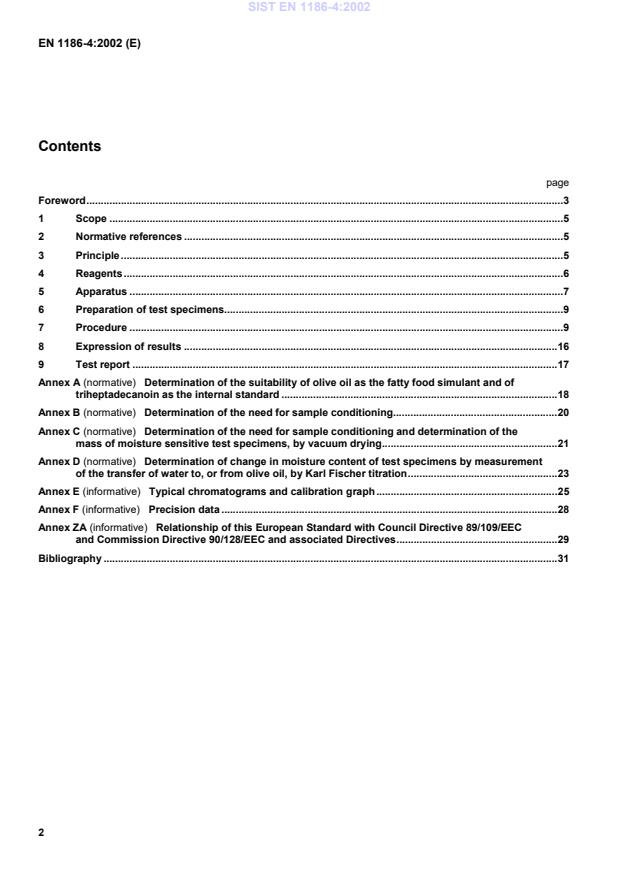
Determination of the suitability of olive oil as the fatty food simulant and oftriheptadecanoin as the internal standard.18Annex B (normative)
Determination of the need for sample conditioning.20Annex C (normative)
Determination of the need for sample conditioning and determination of themass of moisture sensitive test specimens, by vacuum drying.21Annex D (normative)
Determination of change in moisture content of test specimens by measurementof the transfer of water to, or from olive oil, by Karl Fischer titration.23Annex E (informative)
Typical chromatograms and calibration graph.25Annex F (informative)
Precision data.28Annex ZA (informative)
Relationship of this European Standard with Council Directive 89/109/EECand Commission Directive 90/128/EEC and associated Directives.29Bibliography.31SIST EN 1186-4:2002
Further Directives andamendments to existing Directives are expected which could change the legislative requirements which thisstandard supports.
It is therefore strongly recommended that users of this standard refer to the latest relevantpublished Directive(s) before commencement of any of the test or tests described in this standard.EN 1186-4 should be read in conjunction with EN 1186-1.Further Parts of this standard have been prepared concerned with the determination of overall migration fromplastics materials into food simulants.
Their titles are as follows:EN 1186 Materials and articles in contact with foodstuffs- Plastics-Part 1Guide to the selection of conditions and test methods for overall migrationPart 2Test methods for overall migration into olive oil by total immersionPart 3Test methods for overall migration into aqueous food simulants by total immersionPart 5Test methods for overall migration into aqueous food simulants by cellPart 6Test methods for overall migration into olive oil using a pouchPart 7Test methods for overall migration into aqueous food simulants using a pouchPart 8Test methods for overall migration into olive oil by article fillingPart 9Test methods for overall migration into aqueous food simulants by article fillingPart 10Test methods for overall migration into olive oil (modified method for use in cases whereincomplete extraction of olive oil occurs)Part 11Test methods for overall migration into mixtures of
14C-labelled synthetic triglyceridePart 12Test methods for overall migration at low temperaturesSIST EN 1186-4:2002
The test method can also be usedwith appropriate modifications with 'other fatty food simulants ' called simulant D - a synthetic mixture of triglycerides, sunfloweroil and corn oil.
These other fatty food simulants will produce different chromatograms for the simulant methyl esters to those ofthe methyl esters of olive oil.
Select suitable chromatogram peaks of the methyl esters of the other fatty food simulants for thequantitative determination of the simulant extracted from the test specimens.The test method described is applicable to most types of plastics, although there are some plastics for which it isknown not to be applicable.2 Normative referencesThis European Standard incorporates by dated and undated reference, provisions from other publications.
Thesenormative references are cited at the appropriate places in the text, and the publications are listed hereafter. Fordated references, subsequent amendments to and revisions of any of these publications apply to this EuropeanStandard only when incorporated in it by amendment or revision.
For undated references the latest edition of thepublication referred to applies (including amendments).EN 1186-1:2002, Materials and articles in contact with foodstuffs – Plastics – Part 1: Guide to the selection ofconditions and test methods for overall migration.ISO 648, Laboratory glassware - One mark pipettes.ISO 4788, Laboratory glassware – Graduated measuring cylinders.3 PrincipleThe overall migration from a sample of the plastics is determined as the loss in mass per unit of surface areaintended to come into contact with foodstuffs.The selection of the conditions of test will be determined by the conditions of use, see clauses 4, 5 and 6 ofEN 1186-1:2002.Test specimens of known mass are exposed in a cell to olive oil for the exposure time, at temperatures above20 °C and below 100 °C, then taken from the cell, blotted to remove oil adhering to the surface, and reweighed.The specimens will usually retain absorbed olive oil that extracted and determined quantitatively by means of gaschromatography after conversion to methyl esters.
Methylation is carried out by reacting a borontrifluoride/methanol complex with fatty acids formed by hydrolysing the oil with potassium hydroxide.
An internalstandard, triheptadecanoin, is added prior to the extraction of the absorbed olive oil from the test specimens.
Thisensures that any active or extractable components of the plastics react with the internal standard, as well as withthe extracted olive oil. The internal standard is also subjected to the hydrolysis and methylation reactions, providingcompensation for any inefficiencies in the hydrolysis and methylation processes.Migration into the olive oil is calculated by subtracting the mass of olive oil retained by the test specimen from theSIST EN 1186-4:2002
If an unacceptable amount of interference is present thensuitability of one of the 'other fatty food simulants' should be examined, see annex A and 9.3 and 9.5 of EN 1186-1:2002.
If aninterference is present which would interfere with the triheptadecanoin internal standard an alternative internal standard shouldbe used, see annex A, and 9.3 of EN 1186-1:2002.4 ReagentsNOTEAll reagents should be of recognized analytical quality, unless otherwise specified.4.1Olive oil, reference simulant D, as specified in 5.2 of EN 1186-1:2002.4.2Extraction solvent (see 10.1 of EN 1186-1:2002).4.2.1For non-polar plastics, such as polyethylene and polypropylene:- Pentane 98 % boiling point 36 °C.For polar plastics, such as polyamide and polyacetal:- 95/5 by volume azeotropic mixture of pentane 98 % and ethanol 99 %.NOTE 1Pentane is a very volatile and highly flammable solvent.
Care should therefore be taken when handling this solventto prevent contact with sources of ignition.
Ethanol is also a flammable solvent.
It is not recommended that extractions witheither pentane or the pentane/ethanol mixture be left unattended, particularly overnight.NOTE 2Due to the low boiling points of these solvents, cooled condenser water can be required to prevent undue loss of thesolvent from the condenser.or4.2.2Other suitable solvent.NOTE 1In previous methods for determining overall migration into olive oil the extraction solvent used has been 1,1,2-trichloro-trifluoroethane.
For environmental reasons the use of this solvent should be avoided where possible, see 9.1 of EN1186-1:2002.
Experience has shown that this solvent, although effective for most plastics requires longer periods of extraction.NOTE 2Some solvents can contain non-volatile substances which, after hydrolysis and methylation processes, produce gaschromatography peaks with retention times similar to the retention times of olive oil methyl esters and methyl heptadecanoatefrom the internal standard.
Solvents found to contain such substances should be redistilled before use.4.3Internal standard, triheptadecanoin (glyceryl trimargarate) CAS No. 2438-40-61) of a quality such that theproducts from hydrolysis and methylation processes do not contain substances giving detectable gas
1) The source of this is the Chemical Abstracts published by the American Chemical Society.SIST EN 1186-4:2002
Therefore the containers should be placed in athermostatically controlled room or oven, at a temperature of approximately 20 °C, the set temperature should not vary by morethan ± 1 °C.5.8Glass tubes, ground neck and stoppers, for retaining the olive oil.
Tubes with an internal diameter ofapproximately 35 mm and length in the range of 100 mm to 200 mm, excluding the ground neck, see 7.2 ofEN 1186-1:2002, have been found to be satisfactory.5.9Thermostatically controlled oven or incubator capable of maintaining the set temperature, within thetolerances specified in Table B.2 of EN 1186-1:2002.5.10Filter paper, lint-free.5.11Anti-bumping beads.SIST EN 1186-4:2002
A 10 ml graduated syringe may be used in place of the 10 ml measuring cylinder.5.18Pipettes, complying with the minimum requirements of ISO 648, 5 ml and 10 ml.5.19Glass beads, 2 mm to 3 mm in diameter or glass rods, 2 mm to 3 mm in diameter and approximately100 mm long (see 7.2 of EN 1186-1:2002).5.20Gas chromatograph, with flame ionisation detector equipped with an appropriate column.
When using apolar column, the major peaks of olive oil, such as C16:0, methyl hexadecanoate (methyl palmitate), C16:1, methyl9-hexadecenoate (methyl palmitoate), C18:0, methyl octadecanoate (methyl stearate), C18:1, methyl 9-octadecenoate (methyl oleate), C18:2, methyl 9,12-octadecadienoate (methyl linoleate) and the internal standardC17:0, methyl heptadecanoate (methyl margarate) shall demonstrate baseline separation. Optionally, a non-polarcolumn can be used which shall give baseline separation of the methyl esters with 16 and 18 carbon numbers andthe internal standard with 17 carbon number.NOTEThe following columns have been found to be suitable:- Column 1, polar column, WCOT fused silica column, length 50 m, internal diameter 0,25 mm, coated with a 0,21micrometre film of cyanopropyl silicone;- Column 2, non polar column, BP1, length 25 m, internal diameter 0,32 mm, with a 1 micron film thickness;- Column 3, polar column, stainless steel column 2 mm to 3 mm internal diameter and 2 m to 3 m length with a packingof 10 % to 20 % by mass of polyestersuccinate on a stationary phase of diatomaceous earth 80 mesh to 100 mesh.5.21Glass tubes with ground glass necks and stoppers, of a volume of approximately 10 ml, for storing theheptane layer if necessary.5.22Vacuum oven or vacuum desiccator, capable of maintaining a temperature of 60 °C ± 2 °C.
The vacuumoven or vacuum desiccator shall be equipped with or connected to a vacuum pump capable of achieving a vacuumof 1,3 kPa or less.
The vacuum pump shall be provided with a time controller to switch on the vacuum pump everyhour for 15 min.NOTEIf a vacuum oven is not available, a vacuum desiccator placed in an oven at 60 °C can be used.5.23Desiccator containing self indicating silica gel or anhydrous calcium chloride.5.24Balance, capable of determining a change of mass of 10 mg.5.25Disposable plastic syringes with luer fitting. 1 ml or 10 ml size.5.26Wide gauge luer needles (80 mm ´ 1,2 mm).SIST EN 1186-4:2002
TheKarl Fischer titrator shall be capable of measuring the water content of the simulant with a precision
(standarddeviation) of 10 mg/kg or less (equivalent to 1 mg/dm2 plastic).
An automated volumetric or coulometric instrumentshall be used.
Manual titration procedures do not give the required accuracy or precision.6 Preparation of test specimens6.1 GeneralIt is essential that test specimens are clean and free from surface contamination (many plastics can readily attractdust due to static charges). Before preparing test specimens, remove any surface contamination from the sampleby gently wiping it with a lint-free cloth, or by brushing with a soft brush. Under no circumstances wash the samplewith water or solvent. If it is specified in the instructions for use of the article that it should be washed or cleanedbefore use see 8.1 of EN 1186-1:2002.
Minimise handling of the samples and, where necessary, wear cottongloves.When preparing test specimens measure the surface area according to 8.3 of EN 1186-1:2002.6.2 Number of test specimensSeven test specimens are required for samples, in the form of thin films, sheets and flat sections cut fromcontainers or similar articles.These test specimens are utilized as follows:a) four test specimens for the migration test;b) two test specimens to check for possible loss of volatiles;c) one test specimen to determine the suitability of olive oil as the fatty food simulant and triheptadecanoinas the internal standard (see annex A);If the conditioning test in annex C is used, one additional test specimen is required.NOTEThe two test specimens, b), are used to check whether the sample losses mass from the evaporation of volatiles,such as solvents, during the test period.
If the vacuum drying procedure in annex C is used these test specimens are notrequired as during the vacuum drying any volatiles will have been removed from the test specimens.If previous testing has established that interference in the gas chromatography procedure is unlikely and annex A isomitted, one fewer test specimen will be required.A minimum of three valid test results is required to calculate the mean.
Testing in triplicate is allowed but in thiscase if one test result is invalid repeat the entire procedure.6.3 Cutting test specimensLay the sample on the cutting slab (5.1) with the surface to be in contact with the olive oil uppermost.
Take the ringfrom the cell type A (5.6) and place on the test sample.
Cut out the test specimen by cutting round the outer edgeof the ring, using the cutting implement (5.3)7 Procedure7.1 GeneralDetermine the applicability of the method by carrying out the procedure described in annex A.
If prior tests haveestablished that the method is applicable then annex A may be omitted.SIST EN 1186-4:2002
If prior tests have established that sample conditioning is not required then annex B andannex C may be omitted.
If prior tests have established that the procedure described in annex D is applicable tothe sample, then annex B or annex C may be omitted.7.2.2If the tests described in annex B or annex C show that conditioning is not necessary, determine and recordthe mass of each test specimen.7.2.3If the tests described in annex B or annex C show that conditioning is necessary, follow the directions inthe relevant annex to determine the initial mass of the sample.7.2.4If the tests described in annex B show that conditioning is necessary, but constant mass cannot beachieved within 5 days then carry out the conditioning procedure described in C.3.1 or annex D.NOTE 1Long conditioning periods are not satisfactory due to oxidation of the olive oil which can occur upon prolongedconditioning.NOTE 2The conditioning procedures described in annex C and annex D can be used if it has been established that theseprocedures are more suited to the polymer type under test.7.3 Exposure to food simulantTake four type A cells (5.6), mark them for identification purposes.
Place in the thermostatically controlled oven orincubator (5.9), which is set at the test temperature and leave until the test temperature has been attained.Take five glass tubes (5.8), measure 125 ml ± 5 ml of olive oil (4.1) into each tube by measuring cylinder andstopper the tubes.NOTE 1If the procedure described in annex D is used, it can be necessary to dry all of the olive oil used for the migrationtest, see D.3.2.Alternatively mark the tubes for a volume of 125 ml and fill with olive oil to the mark.
Place into one of the tubes athermometer or thermocouple and stopper the tubes.
Two extra tubes with a minimum of 50 ml of olive oil arerequired as blank simulant, if the procedure in annex D is used.
Place the five or seven tubes, and two emptytubes, in the thermostatically controlled oven or incubator (5.9) set at the test temperature.
Leave until the olive oilhas attained the test temperature, using the thermometer or thermocouple to monitor the temperature.Remove the cells from the thermostatically controlled oven or incubator, dismantle the cells and place on the baseof each cell one of the test specimens.
Reassemble the cells, ensuring that the clamping screw wheel is welltightened down.Remove four tubes containing 125 ml of olive oil from the thermostatically controlled oven or incubator orrefrigerator and transfer the olive oil from each tube to each of the cells through the filler hole.
Remove thethermometer or thermocouple from the tube and insert, if applicable see NOTE 5, in one of the cells and replacethe filler plugs.NOTE 2The olive oil in the fifth tube is used as a reference standard in constructing the calibration graph (see 7.6.2.2) and ifthe procedure in annex D is used, as the third blank sample for Karl Fischer titrations.
The olive oil in the sixth tube is used tocheck the temperature of the oil.
If glass beads or glass rods have been used to raise the level of the olive oil to achieve totalimmersion, then similar glass beads or glass rods should be added to the sixth tube.Remove the two empty tubes from the thermostatically controlled oven or incubator or refrigerator and place ineach tube one of the remaining two test specimens and stopper.SIST EN 1186-4:2002
If the vacuum drying procedure in annex C is applicable these testspecimens are not required as during the vacuum drying volatiles will have been removed from the test specimens.Replace the four cells and the two tubes in the thermostatically controlled oven or incubator set at the testtemperature. This part of the operation should be carried out in the minimum time to prevent undue heat loss fromthe cells and olive oil.
Observe the temperature of the thermostatically controlled oven or incubator or the olive oil(see NOTE 5) in the one of the cells and leave the cells and tubes for the selected test period, taking into accountthe tolerances specified in Table B.1 of EN 1186-1:2002, after the olive oil in the cell has reached a temperaturewithin the tolerance specified in Table B.2 of EN 1186-1:2002.NOTE 4Annex B of EN 1186-1:2002 includes tolerances on a wide range of contact times and contact temperatures.
All ofthese contact times and contact temperatures are not necessarily relevant to this Part of the standard.NOTE 5For exposure times of 24 h or more it is acceptable to monitor the temperature of the airbath of the thermostaticallycontrolled oven or incubator or refrigerator, instead of the temperature of the simulant.Take the cells and tubes from the oven or incubator and immediately remove the test specimens from the cells.For those specimens that have been in olive oil, allow the oil to drain.
Remove any adhering olive oil by gentlypressing between filter papers (5.10).
Repeat the pressing procedure until the filter paper shows no spots of oliveoil.NOTE 6If the procedure in annex D is followed, retain the tubes containing the oil.
Cap the tubes to prevent further changein the moisture content of the oil and carry out the Karl Fischer determination of water content as soon as possible.7.4 Final weighing of test specimens7.4.1For those specimens which did not require conditioning to obtain their initial masses (see 7.2.2), weigh allsix test specimens i.e. the four that have been in olive oil and the two that were in the empty tubes and record themass of each test specimen.7.4.2If conditioning of the test specimens was carried out using the procedure in annex B (see 7.2.3) thenrepeat the procedure.7.4.3If conditioning was carried out before the initial weighing using the procedure described in annex C (see7.2.4) then carry out the procedure described in C.4.7.4.4If it was decided that the procedure described in annex D (see 7.2.4) was applicable to the test sample,then carry out that procedure.7.4.5If the final mass of each of the test specimens which have been in empty tubes is less than their initialmass by more than 2,0 mg, then volatile substances have been lost and adjustment may be made, see 9.4 ofEN 1186-1:2002, to the final mass for each test specimen such that the values obtained are a measure of themigration of non-volatile substances only.7.5 Extraction of absorbed olive oilTake four flasks, 250 ml or 500 ml as appropriate to the size of the soxhlet type extractor (5.12) to be used for theextraction, and place in each flask 10,0 ml of the internal standard cyclohexane solution of triheptadecanoin (4.3),using a pipette (5.18), or an alternative higher quantity if more than 100 mg of olive oil is present.NOTE 1If the test specimens have retained more than 100 mg of olive oil, 10,0 ml of the internal standard solution is notsufficient for optimum precision in the gas chromatography determination after extraction.
Before commencing the operations inthis clause an estimation of the quantity of olive oil retained in the test specimens should be obtained by comparing the finalmasses of the test specimens with their initial masses.
If considered necessary the quantity of internal standard solution can beincreased from 10 ml although it is essential that the same quantity is used for each test specimen, and that this quantity is alsoused with the olive oil standards for the calibration graph (see 7.6.2.2).
As a guide, approximately 0,5 mg of the internalstandard is required for every mg of extracted olive oil.Add sufficient extraction solvent (4.2) to allow cycling of the soxhlet type extractor (approximately 200 ml or400 ml, according to the size of the flask) with anti-bumping beads (5.11) to control boiling.SIST EN 1186-4:2002
Couple eachsoxhlet to a flask containing the internal standard prepared as above.
Using either a water bath or steam bath(5.13), extract for a period of 7 10+ h, with a minimum of six cycles per hour, ensuring that the test pieces are totallysubmerged in the solvent during each soxhlet cycle, and that they remain separated from each other.Drain all of the solvent from the soxhlet type extractors, remove the flasks from the soxhlet type extractors andevaporate the solvent to approximately 10 ml using a rotary evaporator, or simple distillation apparatus (5.14).Transfer the solutions containing the extracted olive oil and internal standard to separate 50 ml flasks (5.16), andwash each flask with three portions of 5 ml of solvent.
Add the three washings to the respective individual 50 mlflasks.
Evaporate to dryness using a rotary evaporator or a waterbath (5.14 or 5.15).NOTE 2Oxidation of the olive oil should be avoided where possible.
Therefore evaporation of the solvent to dryness shouldbe carried out under mild conditions of temperature.
In addition exposure of the olive oil to oxygen should be limited.NOTE 3Some types of plastics are known to retain some of the absorbed olive oil.
In these cases extraction of the olive oilis incomplete and a second extraction with a more polar solvent is required, see also 9.2 of EN 1186-1:2002.Repeat the extraction of the test specimens for an additional 710+ h, with diethyl ether (4.8), adding a furtherquantity of the internal standard solution.NOTE 4The same quantity of internal standard solution is used as for the first 7 h extraction.
This quantity might not be theoptimum if the quantity of olive oil in the first 7 h extraction is high. Good precision is not required for the second 7 hdeterminations since they are intended primarily as a check on the efficiency of the first 7 h extraction and using the samequantity of internal standard enables one calibration graph to be used.If previous testing has established that all of the olive oil will be extracted from the test specimens during the first7 h extraction then the second 7 h extraction may be omitted.Isolate the residues in 50 ml flasks, using the procedure described above.Determine the extracted olive oil in both the first 7 h and the second 7 h extraction by the procedure described in7.6, but retain the test specimens in the soxhlet type extractors until the extracted olive oil has been determined forthe second extraction.7.6 Determination of extracted olive oil7.6.1 Preparation of fatty acid methyl estersAdd 10 ml ± 0,2 ml of n-heptane to each of the 50 ml flasks containing the first 7 h extraction residue, by measuringcylinder (5.17), ensuring that the residues of olive oil and plastics extractables dissolve or are well dispersed byshaking, warming or by ultrasonic treatment.NOTE 1Unless the residues in the flasks are dissolved or well dispersed in the n-heptane, quantitative hydrolysis ormethylation of the olive oil and of the internal standard might not be obtained under the conditions described particularly whenthese residues contain extractables from plastics in excess of 50 mg.
The internal standard might not react with the plasticsextractables to the same degree as does the olive oil and correct results for olive oil may not be obtained.Add by measuring cylinder or graduated syringe (5.17), 10 ml ± 0,2 ml of the potassium hydroxide solution (4.4)and a few anti-bumping beads (5.11).
Connect a condenser to the flask and boil the mixture under reflux for10 min ± 1,0 min.Add through the condenser by measuring cylinder, or graduated syringe (5.25), 5,0 ml ± 0,2 ml of the methanolsolution of boron trifluoride (4.5) and boil the mixture under reflux for 2 min ± 0,25 min.Cool to room temperature and add, by measuring cylinder (5.17), 15 ml to 20 ml of saturated sodium sulfatesolution (4.7.2) and shake well.
Then add further sodium sulfate solution until the liquid level reaches the neck ofthe flask.
Allow to stand until the phases have separated.NOTE 2The methyl esters for the subsequent gas chromatographic determination are in the upper, n-heptane, layer.SIST EN 1186-4:2002
5 °C to 190 °C and maintained at190 °C for 8 min.injector temperature220 °Cdetector temperature240 °CFor column 2 described in the note to 5.20 the following operating conditions have been found to be suitablecarrier gasheliumoven temperature250 °C isothermalinjector temperature320 °Cdetector temperature320 °CFor column 3 described in the note to 5.20 the following operating conditions have been found to be suitablecarrier gasnitrogen at 25 ml/minoven temperature185 °C to 195 °Cinjector temperature190 °C to 200 °Cdetector temperature190 °C to 200 °CUse an integrator to measure the area of each of the olive oil peaks and the internal standard.
Optionally a chartrecorder may be used to record the chromatogram and the height of the various peaks is measured.
In this caseonly the height of the internal standard and the major peak of olive oil (C18 or C18:1) shall be used forquantification of the amount of olive oil.NOTE 2The use of an integrator and measurement of the peak area is the preferred method.7.6.2.2 Calibration graphWeigh a range of quantities of the blank reference olive oil that has been subjected to the same test conditions asthe test specimens into 50 ml flasks (5.16).
Weigh a range of olive oil quantities spanning the quantities of olive oilSIST EN 1186-4:2002
Remove the cyclohexaneusing a rotary evaporator or water bath (5.13 or 5.14). Subject the olive oil quantities, with the added internalstandard, to the methyl ester preparation procedure described in 7.6.1.Inject each of the n-heptane methyl ester solutions in duplicate, as a minimum, into the gas chromatographiccolumn.NOTE 1Typical chromatograms generated using columns 1 and 2 are shown respectively in Figures E.1 and E.2.Construct a calibration graph, plotting the ratios of olive oil methyl esters to the internal standard peak on the y-axisand against the weighed quantities of olive oil on the x-axis.Various methods for the construction of a calibration graph are suitable and the choice of method depends on theequipment and chromatographic column used.
The following methods are acceptable:Method 1
Peak height methodMeasure the peak height of the internal standard peak and of the methyl oleate (C18:1) peak, when a polar columnhas been employed.
In the case where a non-polar column has been used for the separation of the methyl ester,then measure the internal standard peak and the C18 peak of the olive oil.
Calculate the ratio of the measuredC18 peaks to the internal standard peak and plot the ratios versus the weighed quantities of olive oil.Method 2
Peak area methodMeasure the peak area of the internal standard peak and of each of the methyl esters originating from the olive oil.Add together the peak areas of the C16 and C18 peaks if a non-polar column was employed.
If a polar columnwas used, sum the areas of all the peaks (C16:0, C16:1, C18:0, C18:1 and C18:2) originating from the olive oil.Calculate the ratio of the combined areas of the measured peaks to the area of the internal standard peak and plotthe ratio versus the weighed quantities of olive oil.Method 3
Peak area method in the case of interference from the test sampleIn the event that the analysis of a blank test sample, see annex A, has revealed an interference with one or more ofthe olive oil methyl esters, but not all of the peaks, then this peak or peaks shall be excluded from the calculation ofthe total area of the olive oil methyl esters.
Calculate the ratio of the total area of the methyl esters originating fromolive oil and which are free from interference and the area of the internal standard and plot the ratios versus theweighed quantities of oil.NOTE 2A typical calibration graph is shown in Figure E.3.Calculate from each calibration standard chromatogram the C18:1/C16:0 ratio if a polar column was used orC18/C16 ratio in the case of a non polar column.
Determine the mean ratio value from the duplicate or multipleinjections for comparison with the same ratio obtained from the test specimen extracts, see 7.6.2.3.7.6.2.3 Determination of olive oil absorbed by test specimensInject into the gas chromatograph (5.20) a suitable quantity from each of the n-heptane methyl ester solutionsprepared from the residues containing the extracted olive oil (see 7.6.1).
Inject in duplicate, as a minimum.For each chromatogram, measure the height or area of the olive oil methyl ester peak or peaks and the internalstandard peak using the same peaks and method as used in the construction of the calibration graph, see 7.6.2.2.Calculate the ratio of the relevant peaks to the internal standard peak for each chromatogram and for each solutiondetermine the mean ratio value from the duplicate or multiple injections.Calculate the amount of olive oil extracted from the test specimen as follows:SIST EN 1186-4:2002
=
a x + b(1)then:moo =ab)-
(y(2)wheremoois the mass of olive oil extracted from the sample, in milligrams;ais the slope of the calibration graph;bis the intercept of the calibration graph;xis the mass of olive oil in the standard, in milligrams;yis the ratio of olive oil methyl esters to internal standard.Both procedures yield directly the amount of olive oil extracted from the test specimen, in milligrams.NOTE 1The method applying calculation from the regression parameters is the preferred method.If olive oil is found in the second extract from more than one of the test specimens and the amount is less than10 mg, but measurable, add this to the amount determined from the first 7 h extraction and record the total mass ofextracted olive oil for each test specimen in grams.If more than 10 mg of olive oil is found in the second extract or the ratio C18 to the C16 peaks has changed, see9.2 and 9.6 of EN 1186-1:2002.For each chromatogram from the first 7 h extractions, calculate the ratio of the height or area of the C18 peak to theheight or area of the C16 peak.
Determine the mean value of these ratios and compare to the similar ratiodetermined in 7.6.2.2 from the olive oil calibration chromatograms.
Establish whether the difference between thetwo ratios values is acceptable, see 9.6 of EN 1186-1:2002.NOTE 2A change in the C18/C16 ratio for extracted olive oil samples compared with the same ratio for olive oil used for thecalibration graph indicates that some reaction or fractionation of the olive oil has occurred, either during the test period or dur
...