EN 1277:2003
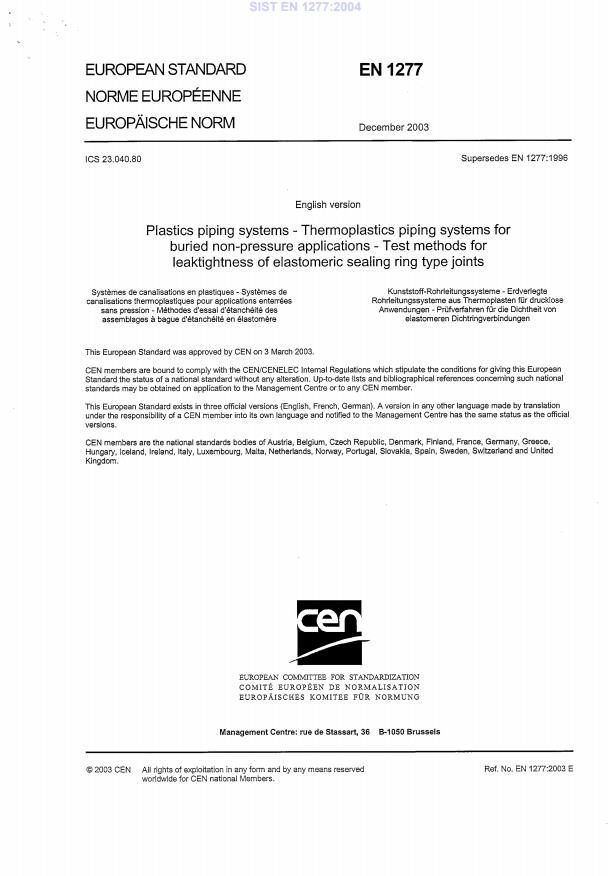
(Main)Plastics piping systems - Thermoplastics piping systems for buried non-pressure applications - Test methods for leaktightness of elastomeric sealing ring type joints
Plastics piping systems - Thermoplastics piping systems for buried non-pressure applications - Test methods for leaktightness of elastomeric sealing ring type joints
This European standard specifies three basic test pressures for determining the leaktightness of elastomeric sealing ring type joints for buried thermoplastics non-pressure piping systems.
Unless otherwise specified in the referring standard, the methods pressures used are the following:
- p1: internal negative air pressure (partial vacuum);
- p2: a low internal hydrostatic pressure;
- p3: a higher internal hydrostatic pressure.
It also describes four test conditions under which the test can be executed, as follows:
A: without any additional diametric or angular deflection;
B: with diametric deflection;
C: with angular deflection;
D: with simultaneous angular and diametric deflection.
These conditions can be applied individually or in combination. The applicable selection of the method(s) and the condition(s) should be specified in the referring standard.
Kunststoff-Rohrleitungssysteme - Erdverlegte Rohrleitungssysteme aus Thermoplasten für drucklose Anwendungen - Prüfverfahren für die Dichtheit von elastomeren Dichtringverbindungen
Diese Norm legt drei grundlegende Prüfdruckarten für die Bestimmung der Dichtheit elastomerer Dichtring-verbindungen für erdverlegte drucklose Rohrleitungssysteme aus Thermoplasten fest.
Falls in der bezugnehmenden Norm nicht anders festgelegt, sind die angewandten Druckarten für das Verfahren folgende:
¾ p1: negativer Luftdruck (partielles Vakuum);
¾ p2: ein niedriger hydrostatischer Innendruck;
¾ p3: ein höherer hydrostatischer Innendruck.
Sie beschreibt außerdem vier Prüfbedingungen, unter denen die Prüfung wie folgt ausgeführt werden kann:
A: ohne zusätzliche Rohrdurchbiegung oder Abwinkelung;
B: mit Rohrdurchbiegung;
C: mit Abwinkelung;
D: mit gleichzeitiger Rohrdurchbiegung oder Abwinkelung.
Diese Bedingungen können einzeln oder in Kombination angewendet werden. Die passende Anzahl des/der Verfahren(s) und der Bedingung(en) sollten in der bezugnehmenden Norm festgelegt sein.
Systèmes de canalisations en plastiques - Systèmes de canalisations thermoplastiques pour applications enterrées sans pression - Méthodes d'essai d'étanchéité des assemblages à bague d'étanchéité en élastomère
Cevni sistemi iz polimernih materialov - Plastomerni cevovodi, položeni v zemljo, ki delujejo po težnostnem principu - Metode za preskus tesnjenja spojev z elastomernimi tesnilnimi obroči
General Information
- Status
- Withdrawn
- Publication Date
- 09-Dec-2003
- Withdrawal Date
- 13-Apr-2025
- Technical Committee
- CEN/TC 155 - Plastics piping systems and ducting systems
- Drafting Committee
- CEN/TC 155 - Plastics piping systems and ducting systems
- Current Stage
- 9960 - Withdrawal effective - Withdrawal
- Start Date
- 06-Jun-2018
- Completion Date
- 14-Apr-2025
- Directive
- 89/106/EEC - Construction products
Relations
- Effective Date
- 22-Dec-2008
- Effective Date
- 19-Oct-2016
Frequently Asked Questions
EN 1277:2003 is a standard published by the European Committee for Standardization (CEN). Its full title is "Plastics piping systems - Thermoplastics piping systems for buried non-pressure applications - Test methods for leaktightness of elastomeric sealing ring type joints". This standard covers: This European standard specifies three basic test pressures for determining the leaktightness of elastomeric sealing ring type joints for buried thermoplastics non-pressure piping systems. Unless otherwise specified in the referring standard, the methods pressures used are the following: - p1: internal negative air pressure (partial vacuum); - p2: a low internal hydrostatic pressure; - p3: a higher internal hydrostatic pressure. It also describes four test conditions under which the test can be executed, as follows: A: without any additional diametric or angular deflection; B: with diametric deflection; C: with angular deflection; D: with simultaneous angular and diametric deflection. These conditions can be applied individually or in combination. The applicable selection of the method(s) and the condition(s) should be specified in the referring standard.
This European standard specifies three basic test pressures for determining the leaktightness of elastomeric sealing ring type joints for buried thermoplastics non-pressure piping systems. Unless otherwise specified in the referring standard, the methods pressures used are the following: - p1: internal negative air pressure (partial vacuum); - p2: a low internal hydrostatic pressure; - p3: a higher internal hydrostatic pressure. It also describes four test conditions under which the test can be executed, as follows: A: without any additional diametric or angular deflection; B: with diametric deflection; C: with angular deflection; D: with simultaneous angular and diametric deflection. These conditions can be applied individually or in combination. The applicable selection of the method(s) and the condition(s) should be specified in the referring standard.
EN 1277:2003 is classified under the following ICS (International Classification for Standards) categories: 23.040.80 - Seals for pipe and hose assemblies. The ICS classification helps identify the subject area and facilitates finding related standards.
EN 1277:2003 has the following relationships with other standards: It is inter standard links to EN 1277:1996, EN ISO 13259:2018. Understanding these relationships helps ensure you are using the most current and applicable version of the standard.
EN 1277:2003 is associated with the following European legislation: EU Directives/Regulations: 305/2011, 89/106/EEC, 93/38/EEC; Standardization Mandates: M/BC/CEN/88/15. When a standard is cited in the Official Journal of the European Union, products manufactured in conformity with it benefit from a presumption of conformity with the essential requirements of the corresponding EU directive or regulation.
You can purchase EN 1277:2003 directly from iTeh Standards. The document is available in PDF format and is delivered instantly after payment. Add the standard to your cart and complete the secure checkout process. iTeh Standards is an authorized distributor of CEN standards.
Standards Content (Sample)
2003-01.Slovenski inštitut za standardizacijo. Razmnoževanje celote ali delov tega standarda ni dovoljeno.Kunststoff-Rohrleitungssysteme - Erdverlegte Rohrleitungssysteme aus Thermoplasten für drucklose Anwendungen - Prüfverfahren für die Dichtheit von elastomeren DichtringverbindungenSystemes de canalisations en plastiques - Systemes de canalisations thermoplastiques pour applications enterrées sans pression - Méthodes d'essai d'étanchéité des assemblages a bague d'étanchéité en élastomerePlastics piping systems - Thermoplastics piping system
...
The standard EN 1277:2003 provides a comprehensive framework for assessing the leaktightness of elastomeric sealing ring type joints in buried thermoplastics piping systems designated for non-pressure applications. It specifically outlines three fundamental test pressures: internal negative air pressure (partial vacuum), low internal hydrostatic pressure, and higher internal hydrostatic pressure. This multi-pressure approach allows for a thorough evaluation of joint integrity under varying conditions that may be encountered in practical applications. One of the significant strengths of this standard is its detailed specification of four test conditions, which enhances the versatility of the testing process. These conditions include scenarios with no additional deflection, diametric deflection, angular deflection, and a combination of both angular and diametric deflections. This breadth of testing conditions ensures that the leaktightness assessment is robust and reflective of real-world situations where these joints may face different forms of stress. Moreover, the clarity in specifying that the selection of test methods and conditions should be defined in the referring standard adds to the standard’s relevance. It allows stakeholders in the industry to tailor their testing protocols to meet specific operational needs while still adhering to a recognized framework. This adaptable approach is particularly valuable for manufacturers and engineers focused on ensuring the reliability and safety of their piping systems. In conclusion, EN 1277:2003 is a crucial standard that effectively addresses the topic of leaktightness in elastomeric sealing ring type joints, emphasizing testing versatility and practical applicability. Its clear guidelines and structured testing methodologies make it an essential reference for professionals involved in the design and assessment of thermoplastics piping systems for buried non-pressure applications.
EN 1277:2003 표준은 엘라스토머 씰링 링 타입 조인트에 대한 누수 안전성을 평가하는 방법을 규정하고 있으며, 매립된 비압력 열가소성 파이프 시스템의 테스트를 위한 중요한 기초를 제공합니다. 이 표준은 세 가지 기본 테스트 압력을 정의하여, 다양한 조건에서의 조인트의 누수 안전성을 종합적으로 평가할 수 있도록 구성되어 있습니다. 첫째, p1은 내부 음압(부분 진공)을 제공하여, 일반적인 환경에서 조인트의 누수 여부를 측정합니다. 둘째, p2는 낮은 내부 정수압을 활용하여 비교적 안전한 압력 상태에서의 성능을 평가합니다. 셋째, p3은 높은 내부 정수압을 통해 최대 스트레스를 받는 상황에서의 조 joint의 신뢰성을 검사합니다. 이러한 다양한 압력 조건은 열가소성 파이프 시스템이 일반 환경과 극한 조건 모두에서 잘 작동할 수 있도록 보장합니다. 또한, 이 표준은 네 가지 테스트 조건을 제공하며, 이는 테스트가 다양한 환경에서 실행될 수 있게 합니다. A 조건은 추가적인 지름 방향 또는 각도 방향 변위를 추가하지 않고 테스트를 진행하고, B 조건은 지름 방향 변위를 추가하며, C 조건은 각도 방향 변위를 추가합니다. D 조건은 지름과 각도 방향 변위를 동시에 적용함으로써 더욱 복잡하고 실제적인 상황을 시뮬레이션할 수 있도록 합니다. 이러한 조건들을 개별적으로 또는 조합하여 적용할 수 있어, 특정 사용 환경에 적합한 평가를 수행할 수 있도록 합니다. EN 1277:2003 표준의 강점은 그 포괄적인 테스트 접근 방식에 있으며, 다양한 압력과 조건을 통해 실제 환경에 대한 적합성을 판단할 수 있다는 점입니다. 이 표준은 열가소성 파이프 시스템의 설계자, 제조자 및 테스트 담당자에게 필수적인 지침을 제공하여 제품의 안전성과 신뢰성을 높이는 데 기여합니다. 따라서 이 표준은 비압력 매립 파이프 시스템의 품질 보증 및 안전성 향상에 있어 매우 중요한 역할을 하고 있습니다.
Die Norm EN 1277:2003 befasst sich mit Thermoplastik-Rohrleitungssystemen für begrabene, drucklose Anwendungen und legt die Prüfmethoden zur Dichtheit von elastomeren Dichtungsringverbindungen fest. Diese europäische Norm ist von großer Relevanz für die Installation und Wartung von Rohrleitungssystemen, da sie klare Richtlinien für die Leckageprüfung bereitstellt. Ein zentraler Stärke dieser Norm ist die Definition von drei grundlegenden Prüfdrücken: p1, p2 und p3. Diese Variationen, bestehend aus internem negative Luftdruck (Teilvakuum), niedrigem internem hydrostatischen Druck und höherem hydrostatischen Druck, ermöglichen eine umfassende Analyse der Dichtheit der Verbindungen unter verschiedenen Bedingungen. Diese Differenzierung sorgt dafür, dass Anwender die Prüfmethoden an die spezifischen Bedingungen ihrer Projekte anpassen können. Darüber hinaus beschreibt die EN 1277:2003 vier Prüfbedingungen, die es ermöglichen, die Tests unter unterschiedlichen mechanischen Einflüssen durchzuführen. Die Flexibilität, die Tests unter Zuständen ohne zusätzliche Durchbiegung oder mit diametrischer und/oder angularer Durchbiegung durchzuführen, macht die Norm besonders wertvoll für Ingenieure und Techniker, die an der Planung und Implementierung von Rohrleitungssystemen beteiligt sind. Die Möglichkeit, die Prüfmethoden und Bedingungen auszuwählen und zu kombinieren, fördert eine maßgeschneiderte Herangehensweise an die Dichtheitsprüfung und stellt sicher, dass die spezifischen Anforderungen jedes Projekts erfüllt werden. Dies unterstreicht die Relevanz der Norm in der Praxis, da sie dazu beiträgt, die Integrität der Rohrleitungssysteme zu gewährleisten und potenzielle Leckagen zu identifizieren, bevor sie zu größeren Problemen führen. Insgesamt bietet die EN 1277:2003 eine solide Grundlage für die Prüfung der Dichtheit von elastomeren Dichtungsringverbindungen in thermoplastischen Rohrsystems, was sie zu einem unverzichtbaren Instrument für Fachleute im Bereich der Rohrleitungstechnik macht. Die umfassende und flexible Natur dieser Norm stärkt ihre Position als bedeutendes Referenzdokument in der Branche.
標準EN 1277:2003は、埋設された非圧力用熱可塑性配管システムのエラストマーチールリング型継手の漏れのない状態を確認するための試験方法を定めています。この標準は、具体的には以下の三つの基本的な試験圧力を使用して、エラストマーチールリング型継手の漏れのない状態を測定する際の指針を提供します。 1. p1: 内部負圧(部分真空) 2. p2: 低内部静水圧 3. p3: 高内部静水圧 これらの試験圧力は、参照する標準で特に指定されない限り使用することが求められます。 また、本標準は、試験を実施するための四つの試験条件も明記しており、これには以下が含まれます: A: 追加の直径方向または角度方向の偏差なし B: 直径方向の偏差あり C: 角度方向の偏差あり D: 同時に角度方向および直径方向の偏差あり これらの条件は、個別または組み合わせで適用可能です。使用する方法や条件の適切な選択は、参照標準で指定される必要があります。 この標準の強みは、その明確な指示があることにより、埋設熱可塑性配管システムにおけるエラストマーチールリング型継手の性能評価が一貫して行える点です。さらに、試験条件のバリエーションが豊富であるため、現場の実際の状況をより正確に反映した試験を実施できる点も評価されます。そのため、EN 1277:2003は、業界内での信頼性の高い試験基準となっており、漏れ防止設計の重要性が高まる中で、その関連性も非常に重要です。
La norme EN 1277:2003 constitue un document essentiel dans le domaine des systèmes de tuyauterie en plastiques, en particulier pour les applications non sous pression. Elle se concentre spécifiquement sur les méthodes d'essai pour la détermination de l'étanchéité des joints à anneau d'étanchéité en élastomère, ce qui est crucial pour garantir l'intégrité et la durabilité des systèmes de tuyauterie enfouis. Le champ d'application de cette norme est clairement défini, stipulant trois pressions de test fondamentales : la pression d'air interne négative (p1), la pression hydrostatique interne faible (p2) et la pression hydrostatique interne élevée (p3). Cette diversité dans les niveaux de pression permet d'évaluer de manière exhaustive l'étanchéité des joints, répondant ainsi à différents scénarios pratiques rencontrés dans des contextes réels. Les conditions de test bien articulées, qui incluent des tests sans déformation supplémentaire ainsi que ceux avec déformation diamétrique, angulaire, ou les deux simultanément, renforcent la robustesse de la norme. Cela permet aux fabricants et aux ingénieurs de tester les joints dans divers états d'union, assurant ainsi une évaluation complète de leur performance dans des situations susceptibles de se produire dans des applications réelles. L'utilisation de différentes conditions de test, individuellement ou en combinaison, témoigne également de la flexibilité et de l’adaptabilité de la norme aux besoins spécifiques de l'industrialisation. En résumé, la norme EN 1277:2003 se révèle être un outil de référence de grande valeur pour tous les professionnels travaillant avec des systèmes de tuyauterie en plastiques. Sa structuration claire et ses méthodes rigoureuses lui confèrent une pertinence indéniable dans le domaine, garantissant que les produits fabriqués et installés respectent des critères de performance et de sécurité élevés.


Questions, Comments and Discussion
Ask us and Technical Secretary will try to provide an answer. You can facilitate discussion about the standard in here.
Loading comments...