


EN 1484:1997
(Main)Water analysis - Guidelines for the determination of total organic carbon (TOC) and dissolved organic carbon (DOC)
Water analysis - Guidelines for the determination of total organic carbon (TOC) and dissolved organic carbon (DOC)
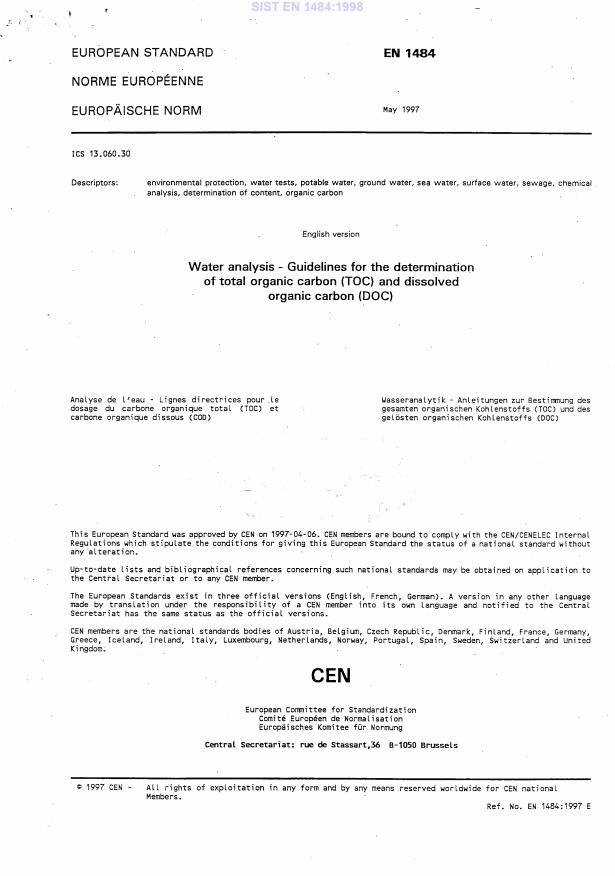
This European Standard gives guidance for the determination of organic carbon indrinking water, ground water, surface water, sea water and waste water. It dealswith definitions, interferences, reagents, and the sample pretreatment of water samples with a content of organic carbon ranging from 0,3 mg/l to 1000 mg/l while the lower value is only applicable in special cases, for example drinking water, measured with instruments capable of measuring these low levels.
Wasseranalytik - Anleitungen zur Bestimmung des gesamten organischen Kohlenstoffs (TOC) und des gelösten organischen Kohlenstoffs (DOC)
Diese Europäische Norm beschreibt eine Richtlinie zur Bestimmung von organischem Kohlenstoff in Trinkwasser, Grundwasser, Oberflächenwasser, Seewasser und Abwasser. Sie behandelt Festlegungen, Störungen, Reagenzien und die Probenvorbehandlung von Wasserproben mit einem Gehalt von 0,3 mg/l bis 1000 mg/l, wobei der untere Wert nur in besonderen Fällen, z.B. bei Trinkwasser erreicht werden kann, wenn mit Geräten gemessen wird, die eine Messung in derart niedrigen Bereichen erlauben.
Analyse de l'eau - Lignes directrices pour le dosage du carbone organique total (TOC) et carbone organique dissous (COD)
La présente Norme européenne est un guide pour la détermination de carbone organique dans l'eau potable, l'eau phréatique, l'eau de surface, l'eau de lacs et les eaux usées. Elle comprend les définitions, les interférences, les réactifs et le traitement préalable des échantillons d'eau dont la teneur en carbone organique s'élève de 0,3 à 1000 mg/l: la valeur inférieure ne pouvant être atteinte que dans les cas particuliers, par exemple, pour l'eau potable, lorsque l'on mesure à l'aide d'appareils permettant le dosage à faibles teneurs.
Kakovost vode - Navodila za določevanje celotnega organskega ogljika (TOC) in raztopljenega organskega ogljika (DOC)
General Information
- Status
- Published
- Publication Date
- 20-May-1997
- Technical Committee
- CEN/TC 230 - Water analysis
- Drafting Committee
- CEN/TC 230 - Water analysis
- Current Stage
- 9093 - Decision to confirm - Review Enquiry
- Start Date
- 09-Feb-2022
- Completion Date
- 14-Apr-2025
Overview
EN 1484:1997 (CEN) provides practical guidance for the determination of total organic carbon (TOC) and dissolved organic carbon (DOC) in a wide range of water matrices. The standard addresses drinking water, ground water, surface water, sea water and waste water. It focuses on definitions, potential interferences, recommended reagents and sample pretreatment for samples containing organic carbon between 0.3 mg/L and 1000 mg/L. The lower limit (0.3 mg/L) applies primarily in special cases such as drinking water and requires instruments capable of measuring low TOC/DOC levels.
Key Topics
- Scope and applicability: Guidance for TOC and DOC determination across multiple water types.
- Definitions: Clarifies terms used in TOC/DOC analysis to ensure consistent interpretation.
- Interferences: Describes sources of analytical interference and considerations to minimise their impact.
- Reagents: Outlines reagent use and handling principles relevant to organic carbon analysis.
- Sample pretreatment: Guidance on preparing water samples to obtain representative and reliable measurements.
- Measurement range: Practical considerations for analyzing concentrations from 0.3 mg/L up to 1000 mg/L, noting instrument requirements for low-level detection.
Applications
EN 1484:1997 is designed to support laboratories, water utilities and environmental monitoring bodies by promoting consistent TOC/DOC measurements and improving data comparability. Typical applications include:
- Drinking water quality monitoring: Ensuring low-level organic carbon is reliably detected in treated water.
- Environmental monitoring: Assessing organic carbon in rivers, lakes and marine environments.
- Groundwater assessment: Supporting investigations of organic pollution and natural organic matter.
- Waste water treatment monitoring: Tracking organic load and treatment performance.
Benefits of following the standard:
- Improved reproducibility and comparability of TOC/DOC data across laboratories
- Clear guidance on sample handling to reduce artefacts and interferences
- Better selection and use of reagents and pretreatment steps for diverse water matrices
Related Standards
EN 1484:1997 should be used in conjunction with other water analysis and sampling standards and good laboratory practice documents. Related guidance typically covers:
- Water sampling procedures and sample preservation
- Instrument calibration and method validation for low-level organic carbon
- National and international standards on water quality testing (EN, ISO and regional standards)
For laboratories and practitioners, EN 1484:1997 is a practical reference to harmonise TOC and DOC determinations and to support robust water quality programs across drinking, environmental and wastewater monitoring contexts.


Frequently Asked Questions
EN 1484:1997 is a standard published by the European Committee for Standardization (CEN). Its full title is "Water analysis - Guidelines for the determination of total organic carbon (TOC) and dissolved organic carbon (DOC)". This standard covers: This European Standard gives guidance for the determination of organic carbon indrinking water, ground water, surface water, sea water and waste water. It dealswith definitions, interferences, reagents, and the sample pretreatment of water samples with a content of organic carbon ranging from 0,3 mg/l to 1000 mg/l while the lower value is only applicable in special cases, for example drinking water, measured with instruments capable of measuring these low levels.
This European Standard gives guidance for the determination of organic carbon indrinking water, ground water, surface water, sea water and waste water. It dealswith definitions, interferences, reagents, and the sample pretreatment of water samples with a content of organic carbon ranging from 0,3 mg/l to 1000 mg/l while the lower value is only applicable in special cases, for example drinking water, measured with instruments capable of measuring these low levels.
EN 1484:1997 is classified under the following ICS (International Classification for Standards) categories: 13.060.30 - Sewage water. The ICS classification helps identify the subject area and facilitates finding related standards.
You can purchase EN 1484:1997 directly from iTeh Standards. The document is available in PDF format and is delivered instantly after payment. Add the standard to your cart and complete the secure checkout process. iTeh Standards is an authorized distributor of CEN standards.
Standards Content (Sample)
2003-01.Slovenski inštitut za standardizacijo. Razmnoževanje celote ali delov tega standarda ni dovoljeno.Wasseranalytik - Anleitungen zur Bestimmung des gesamten organischen Kohlenstoffs (TOC) und des gelösten organischen Kohlenstoffs (DOC)Analyse de l'eau - Lignes directrices pour le dosage du carbone organique total (TOC) et carbone organique dissous (COD)Water analysis - Guidelines for the determination of total organic carbon (TOC) and dissolved organi
...
제목: EN 1484:1997 - 물 분석 - 총 유기 탄소(TOC) 및 용해 유기 탄소(DOC) 결정 지침 내용: 이 유럽 표준은 음용수, 지하수, 표면수, 해수 및 폐수의 유기 탄소 결정에 대한 지침을 제공합니다. 정의, 간섭, 시약 및 유기 탄소 함유량이 0.3 mg/l에서 1000 mg/l 범위에 있는 물 샘플의 전처리에 대해 다룹니다. 낮은 값은 특정 경우에만 적용되며, 예를 들어 음용수에서 낮은 수준을 측정할 수 있는 기기로 측정됩니다.
記事のタイトル:EN 1484:1997 - 水分析 - 全有機炭素(TOC)および溶解有機炭素(DOC)の決定のためのガイドライン 記事内容:この欧州規格は、飲料水、地下水、地表水、海水、および廃水の有機炭素の決定に関する指針を提供しています。定義、干渉要因、試薬、および有機炭素濃度が0.3 mg/lから1000 mg/lの範囲にある水サンプルの前処理について取り扱っています。ただし、低い値は特定の場合にのみ適用され、例えば低レベルを検出することができる器具を使用して飲料水中の有機炭素濃度を測定する際にのみ適用されます。
The article discusses EN 1484:1997, a European standard that provides guidelines for determining the amount of organic carbon in various types of water. This includes drinking water, ground water, surface water, sea water, and waste water. The standard covers definitions, interferences, reagents, and the treatment of water samples containing organic carbon levels ranging from 0.3 mg/l to 1000 mg/l. However, the lower value is only relevant in specific cases, such as measuring organic carbon levels in drinking water using instruments capable of detecting low levels.
Questions, Comments and Discussion
Ask us and Technical Secretary will try to provide an answer. You can facilitate discussion about the standard in here.
Loading comments...