

EN 40000-1-1:2026
(Main)Cybersecurity requirements for products with digital elements - Part 1-1: Vocabulary
- Abstract
This document provides the terms and definitions and abbreviations commonly used in the cybersecurity requirements for products with digital elements family of standards.
- Status
- Not Published
- Publication Date
- 17-Nov-2026
- Technical Committee
- CEN/CLC/JTC 13 - Cybersecurity and Data Protection
- Current Stage
- 6060 - Definitive text made available (DAV) - Publishing
- Start Date
- 18-Nov-2026
- Due Date
- 07-Dec-2026
- Completion Date
- 07-Dec-2026

EN 40000-1-1:2026 is the CEN vocabulary standard for the cybersecurity requirements for products with digital elements family. It defines the common terms and definitions used across that family, so engineers, quality managers, buyers, and other users can read the related standards with the same meaning. It is a terminology document, not a product test or performance standard.
What does EN 40000-1-1:2026 specify?
EN 40000-1-1:2026 specifies the shared vocabulary for the cybersecurity requirements for products with digital elements family of standards. Its purpose is to align language across the family, so later documents can use the same terms consistently.
The document is organized as a short terminology standard:
- European foreword - explains the drafting body and approval context.
- Introduction - explains why a common language is needed.
- 1 Scope - states the family-wide vocabulary purpose.
- 2 Normative references - no normative references are given.
- 3 Terms and definitions - the main vocabulary list.
- Bibliography - lists the source standards used for several definitions.
What are the key requirements of EN 40000-1-1:2026?
The key content of EN 40000-1-1:2026 is Clause 3, which fixes the meaning of the vocabulary used throughout the family. Clause 3 says the terms and definitions given in Regulation (EU) 2024/2847 apply, and then adds the definitions needed for this standard.
The most important defined concepts
- acceptable risk (3.1) ties risk acceptance to intended and reasonably foreseeable use, the state of the art, user health and safety, and other security objectives. In practice, teams need a shared basis for deciding when remaining risk is acceptable.
- advisory (3.3) is a document or message that provides vulnerability information intended to reduce risk. This is the basis for communicating vulnerability notices and remediation guidance.
- remediation (3.12) is a change made to a product or service to remove or mitigate a vulnerability. In practice, this covers fixes such as patches, configuration changes, or source code changes.
- reporter (3.13) is the person or organization that notifies a vendor or coordinator of a potential vulnerability. This supports vulnerability disclosure processes that accept reports from many kinds of sources.
- residual cybersecurity risk (3.14) is the cybersecurity risk remaining after risk treatment. This is the risk that still has to be accepted, monitored, or further reduced.
- security objective / cybersecurity objective (3.15) is the result to be achieved concerning protection from cyber threats. It gives teams a way to state what the controls are meant to achieve.
- product control (3.11) is a measure on a product that modifies risk. In practice, this is the product-side security control that reduces exposure.
- authenticity, availability, confidentiality, and integrity (3.5 to 3.8) are the core security properties used throughout the family. They matter because later requirements often depend on which of these properties must be protected.
Other useful terms in the vocabulary
Clause 3 also defines asset, likelihood, online hosting location, and software package. These terms support risk assessment, hosted services, and software supply discussions across the family.
What terms does EN 40000-1-1:2026 define?
- acceptable risk - risk judged acceptable for the intended and reasonably foreseeable use of a product with digital elements.
- advisory - a notice or message used to share vulnerability information and reduce risk.
- asset - anything that has value to an individual, an organization, or a government.
- authenticity - the property that an entity is what it claims to be.
- residual cybersecurity risk - the cybersecurity risk left after risk treatment.
- security objective / cybersecurity objective - the protection result that the standard seeks to achieve against cyber threats.
- remediation - a change that removes or mitigates a vulnerability.
Who uses EN 40000-1-1:2026?
EN 40000-1-1:2026 is used by anyone who writes, reads, reviews, or implements the other standards in the cybersecurity requirements for products with digital elements family. That includes standards developers, product security engineers, vulnerability management teams, quality and compliance staff, manufacturers, suppliers, and buyers.
It is especially useful in IT security and product assurance work where people need to discuss advisories, remediation, residual risk, and security objectives without ambiguity.
Which standards are used with EN 40000-1-1:2026?
Clause 2 gives no normative references. The bibliography names these standards as sources for several definitions:
- ISO/IEC/IEEE 12207:2017 - source for the term activity.
- ISO/IEC 29147:2018 - source for advisory, remediation, and reporter.
- ISO/IEC 27035-3:2020 - source for asset.
- ISO/IEC 27000:2018 - source for authenticity, availability, confidentiality, integrity, and residual cybersecurity risk.
- ISO 28001:2007 - source for likelihood.
What does the EN 40000-1-1:2026 document contain?
EN 40000-1-1:2026 is a compact vocabulary document. Its main body is Clause 3, which contains 16 defined terms, several with source notes that identify where the wording comes from or where it was adapted.
The document also includes a foreword, an introduction that explains why a common language matters, a scope clause, a normative references clause, and a bibliography of five source standards. Its content is meant to support drafting, interpretation, review, and consistent use of the wider family of cybersecurity requirements.
Get Certified
Connect with accredited certification bodies for this standard

BSI Group
BSI (British Standards Institution) is the business standards company that helps organizations make excellence a habit.

Bureau Veritas
Bureau Veritas is a world leader in laboratory testing, inspection and certification services.

DNV
DNV is an independent assurance and risk management provider.
Sponsored listings
Frequently Asked Questions
EN 40000-1-1:2026 is a draft published by the European Committee for Standardization (CEN). Its full title is "Cybersecurity requirements for products with digital elements - Part 1-1: Vocabulary". This standard covers: This document provides the terms and definitions and abbreviations commonly used in the cybersecurity requirements for products with digital elements family of standards.
This document provides the terms and definitions and abbreviations commonly used in the cybersecurity requirements for products with digital elements family of standards.
EN 40000-1-1:2026 is classified under the following ICS (International Classification for Standards) categories: 01.040.35 - Information technology (Vocabularies); 35.030 - IT Security. The ICS classification helps identify the subject area and facilitates finding related standards.
EN 40000-1-1:2026 is associated with the following European legislation: EU Directives/Regulations: 2024/2847; Standardization Mandates: M/606. When a standard is cited in the Official Journal of the European Union, products manufactured in conformity with it benefit from a presumption of conformity with the essential requirements of the corresponding EU directive or regulation.
EN 40000-1-1:2026 is available in PDF format for immediate download after purchase. The document can be added to your cart and obtained through the secure checkout process. Digital delivery ensures instant access to the complete standard document.
Standards Content (Sample)
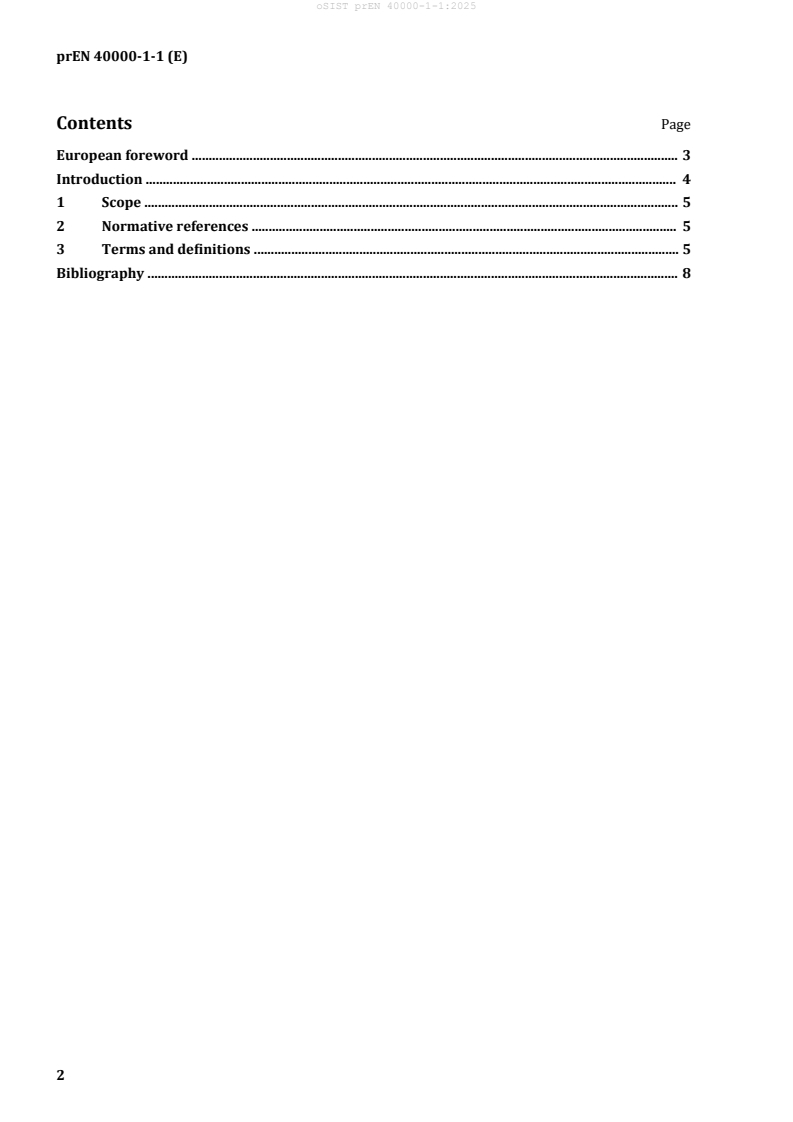
Contents
- Introduction
- 1 Scope
- 2 Normative references
- 3 Terms and definitions
- 3.1 acceptable risk
- 3.2 activity
- 3.3 advisory
- 3.4 asset
- 3.5 authenticity
- 3.6 availability
- 3.7 confidentiality
- 3.8 integrity
- 3.9 likelihood
- 3.10 online hosting location
- 3.11 product control
- 3.12 remediation
- 3.13 reporter
- 3.14 residual cybersecurity risk
- 3.15 security objective
- 3.16 software package
- Bibliography
Introduction
The effective implementation of cybersecurity requirements for products with digital elements relies on a clear and unified understanding of key concepts. This document provides the common language necessary to ensure alignment and consistency across the corresponding family of European standards.
oSIST prEN 40000-1-1:2025 prEN 40000-1-1 (E)
1 Scope
This document provides the terms and definitions commonly used in the cybersecurity requirements for products with digital elements family of standards.
2 Normative references
There are no normative references in this document.
3 Terms and definitions
For the purposes of this document, the terms and definitions given in the relevant Regulation (EU) 2024/2847 and the following apply.
ISO and IEC maintain terminology databases for use in standardization at the following addresses:
- ISO Online browsing platform: available at http://www.iso.org/obp
- IEC Electropedia: available at http://www.electropedia.org/
3.1 acceptable risk
risk that for the intended and reasonably foreseeable use of the product with digital elements is acceptable from the perspective of the risk acceptance criteria, accounting for the generally acknowledged state of the art, health and safety of the user and other security objectives (3.15)
3.2 activity
set of cohesive tasks [SOURCE: ISO/IEC/IEEE 12207:2017 [1], 3.1.3, modified – "of a process" has been removed]
...