

FprEN 868-5
(Main)Packaging for terminally sterilized medical devices - Part 5: Sealable pouches and reels constructed of porous materials and plastic film - Requirements and test methods
- Abstract
This document specifies test methods and values for single-use sealable pouches and reels constructed of a porous material as specified in EN 868 part 2, 3, 6, 7, 9 or 10 and a plastic film. These sealable pouches and reels are intended to be used as sterile barrier systems and/or packaging systems for terminally sterilized medical devices. Other than the general requirements as specified in EN ISO 11607-1 and EN ISO 11607-2, this part of EN 868 series specifies materials, test methods and values that are specific to the products covered by this document.
- Status
- Not Published
- Publication Date
- 09-Feb-2027
- Technical Committee
- CEN/TC 102 - Sterilizers and associated equipment for processing of medical devices
- Drafting Committee
- CEN/TC 102/WG 4 - Packaging
- Current Stage
- 5060 - Closure of Vote - Formal Approval
- Start Date
- 19-Nov-2026
- Due Date
- 28-Dec-2026
- Completion Date
- 28-Dec-2026

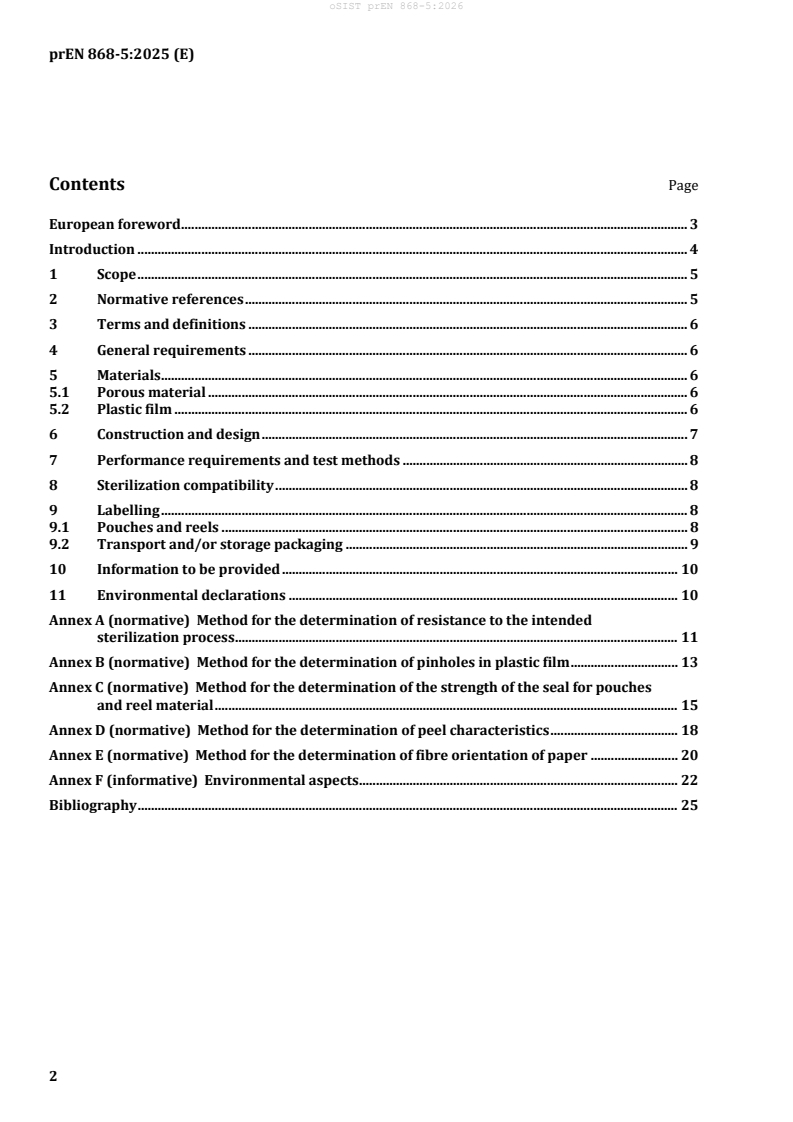
FprEN 868-5 is a CEN draft European Standard for single-use sealable pouches and reels made from porous materials and plastic film. It specifies product-specific materials, construction, test methods and performance values for packaging intended to function as sterile barrier systems and/or packaging systems for terminally sterilized medical devices. In practice, it tells manufacturers, testers and healthcare facilities how to check whether these pouches and reels are suitable for their intended sterilization use.
What does FprEN 868-5 specify?
FprEN 868-5 specifies the extra requirements that apply to sealable pouches and reels made from a porous material and a plastic film. The standard is organized into clauses on scope, references, terms, general requirements, materials, construction and design, performance, sterilization compatibility, labelling, information to be provided and environmental declarations, plus Annexes A to F.
The annexes give the test methods used to prove the product-specific requirements. Annexes A to E are normative test methods, while Annex F gives informative guidance on environmental aspects.
| Annex | What it covers |
|---|---|
| Annex A | Resistance to the intended sterilization process |
| Annex B | Pinholes in plastic film |
| Annex C | Strength of the seal for pouches and reel material |
| Annex D | Peel characteristics |
| Annex E | Fibre orientation of paper |
| Annex F | Environmental aspects |
FprEN 868-5 applies to porous materials already specified in EN 868 Part 2, 3, 6, 7, 9 or 10 combined with plastic film. It is written for single-use products used as sterile barrier systems and/or packaging systems for terminally sterilized medical devices.
What are the key requirements of FprEN 868-5?
FprEN 868-5 builds on EN ISO 11607-1 and EN ISO 11607-2 and then adds product-specific requirements for this pouch and reel construction. In practice, that means a supplier still has to meet the general sterile barrier system requirements, and then show the additional material, seal and labelling performance required here.
Materials and film quality
Clause 5 requires the porous material to meet Clause 4 of the relevant EN 868 material standard, and the plastic film to meet several checks. The film must be manufactured so it is free from pinholes, remain stable after the intended sterilization process, be visually free from defects that affect performance, be sealable to the porous material, and have a breaking factor of at least 20 N per 15 mm in each direction when tested to ASTM D882:2018.
In practice, this means the film has to survive sterilization and handling without losing integrity. A buyer or quality team would use these requirements to verify that the film and porous side are suitable together, not just individually.
Construction and seal geometry
Clause 6 sets how reels and pouches are built. Reels are made from one web of porous material and one web of plastic film sealed along parallel sides, while pouches are made from one web of each material sealed on three sides.
The overall seal width must be at least 6 mm, or the summed rib widths must reach that value for ribbed seals. Pouches also need a thumb notch or a lipped opening arrangement so the webs can be peeled apart cleanly. In practice, these rules affect opening behavior, seal consistency and user handling at point of use.
Seal strength and peel performance
Clause 7 requires seal strength to be adequate before and after sterilization, with testing in Annex C. For healthcare facility use, the minimum seal strength is 1.5 N per 15 mm for steam sterilization and 1.2 N per 15 mm for other sterilization processes.
Clause 7 also requires the seal to be continuous over the intended width and to open without damaging the porous material adjacent to the seal area. Annex D checks peel characteristics, and Annex E checks fibre orientation so the marked peel direction matches the direction that causes the least fibre disturbance. In practice, these checks help prevent seal failure, fibre tear and difficult opening.
Sterilization compatibility
Clause 8 requires the sterilization processes applicable to the product to be defined, and the compatibility to be evaluated according to EN ISO 11607-1 with the intended process or processes. The note makes clear that sterilization can change material properties, so the assessment needs to consider the actual process and the packaging function.
That matters because a pouch that looks acceptable before sterilization may behave differently after exposure. The standard therefore links product approval to the sterilization cycle that will actually be used.
Labelling and traceability
Clause 9 requires clear marking on pouches and reels with EN ISO 11607-1 information and additional product information, including a warning, lot number, manufacturer name or trade name, process indicator identification if used, peel direction for reels, and nominal dimensions or an identification code. Printing must not be on any surface intended for direct contact with the packaged items.
For deliveries to healthcare facilities, transport and/or storage packaging needs durable labelling with content description, quantity, manufacturer or representative details, manufacture date in ISO 8601-1 format, lot number, storage conditions if relevant, traceability reference, compatible sterilization process or processes, and the CE mark. In practice, this supports traceability, correct use and inventory control.
Information and environmental declarations
Clause 10 requires instructions for sealing, including recommended process parameters. Clause 11 requires environmental labels and declarations, when used, to follow EN ISO 14021 or EN ISO 14025, and it asks for end-of-life treatment recommendations. If recyclability is assessed, the standard also expects the assessment method, product reference, standards and regulations used, and the overall results to be stated.
What terms does FprEN 868-5 define?
FprEN 868-5 uses the terms and definitions from EN ISO 11607-1, and several key terms are central to the document.
- Sterile barrier system (SBS) - the packaging system that maintains sterility until point of use.
- Preformed sterile barrier system - a ready-made sterile barrier system, as opposed to one formed during use or packing.
- Process indicator / Type I indicator - a printed indicator used to show exposure to a sterilization process.
- Machine direction - the main direction of the paper or web material, used in fibre orientation testing.
- Cross direction - the direction across the web, used when checking film strength.
- Peel direction - the direction that gives the least fibre disturbance when a pouch or reel is opened.
- Lot number - the traceability identifier for a production batch.
- CE mark - the conformity marking required on the transport and/or storage packaging for deliveries to healthcare facilities.
Who uses FprEN 868-5?
FprEN 868-5 is used by manufacturers and suppliers of sterile packaging materials, by test laboratories, and by quality and regulatory teams that verify product performance. It is also used by healthcare facilities that sterilize reusable medical devices and need packaging that can be sealed, sterilized, stored and opened reliably.
In practice, packaging engineers use it to design pouches and reels, validation teams use the annex methods to prove seal and material performance, and buyers or technical evaluators use it to compare products against a defined technical basis.
What changed in FprEN 868-5 from the previous edition?
FprEN 868-5 supersedes EN 868-5:2018. The foreword states that the revision clarifies Clause 4, adds environmental declarations, moves the summary of major changes into the foreword, adds environmental aspects text to each test method in Annexes A to E, and introduces Annex F on environmental aspects.
Which standards are used with FprEN 868-5?
FprEN 868-5 refers to a series of companion standards and test methods that supply the material bases, validation rules and measurement methods used with this part.
- EN 868-2, EN 868-3, EN 868-6, EN 868-7, EN 868-9 and EN 868-10 - define the porous materials that may be used in the pouch or reel construction.
- EN ISO 11607-1 - provides the general requirements for materials, sterile barrier systems and packaging systems.
- EN ISO 11607-2 - gives the validation requirements for forming, sealing and assembly processes.
- EN ISO 11140-1 - defines the requirements for Type I process indicators.
- EN ISO 14021 and EN ISO 14025 - provide the basis for environmental labels and declarations.
- ISO 8601-1 - provides the date format used for labelling.
- ASTM D882:2018 - is used for plastic film tensile/breaking factor testing.
- ASTM F88/F88M:2023 - is used for seal strength testing.
- EN ISO 15223-1:2021 - supplies the symbol for “Do not use if the sterile barrier system is damaged”.
What does the FprEN 868-5 document contain?
FprEN 868-5 contains general requirements, product material rules, construction details, performance checks and labelling rules for sealable pouches and reels. It also contains five normative test methods in Annexes A to E, covering sterilization resistance, pinholes, seal strength, peel behavior and fibre orientation.
The annexes include practical test setups and apparatus, specimen preparation, conditioning, procedure steps and test-report content. Annex F then gives environmental guidance across the lifecycle, including material selection, production, transport, use and end-of-life handling.
Relations
- Referred By
EN 1366-3:2021+A1:2024 - Fire resistance tests for service installations - Part 3: Penetration seals - Effective Date
- 28-Jan-2026
- Referred By
EN 1366-3:2021 - Fire resistance tests for service installations - Part 3: Penetration seals - Effective Date
- 28-Jan-2026
- Effective Date
- 13-Nov-2024
Get Certified
Connect with accredited certification bodies for this standard

BSI Group
BSI (British Standards Institution) is the business standards company that helps organizations make excellence a habit.

TÜV Rheinland
TÜV Rheinland is a leading international provider of technical services.

TÜV SÜD
TÜV SÜD is a trusted partner of choice for safety, security and sustainability solutions.
Sponsored listings
Frequently Asked Questions
FprEN 868-5 is a draft published by the European Committee for Standardization (CEN). Its full title is "Packaging for terminally sterilized medical devices - Part 5: Sealable pouches and reels constructed of porous materials and plastic film - Requirements and test methods". This standard covers: This document specifies test methods and values for single-use sealable pouches and reels constructed of a porous material as specified in EN 868 part 2, 3, 6, 7, 9 or 10 and a plastic film. These sealable pouches and reels are intended to be used as sterile barrier systems and/or packaging systems for terminally sterilized medical devices. Other than the general requirements as specified in EN ISO 11607-1 and EN ISO 11607-2, this part of EN 868 series specifies materials, test methods and values that are specific to the products covered by this document.
This document specifies test methods and values for single-use sealable pouches and reels constructed of a porous material as specified in EN 868 part 2, 3, 6, 7, 9 or 10 and a plastic film. These sealable pouches and reels are intended to be used as sterile barrier systems and/or packaging systems for terminally sterilized medical devices. Other than the general requirements as specified in EN ISO 11607-1 and EN ISO 11607-2, this part of EN 868 series specifies materials, test methods and values that are specific to the products covered by this document.
FprEN 868-5 is classified under the following ICS (International Classification for Standards) categories: 11.080.30 - Sterilized packaging. The ICS classification helps identify the subject area and facilitates finding related standards.
FprEN 868-5 has the following relationships with other standards: It is inter standard links to EN 1366-3:2021+A1:2024, EN 1366-3:2021, EN 868-5:2018. Understanding these relationships helps ensure you are using the most current and applicable version of the standard.
FprEN 868-5 is available in PDF format for immediate download after purchase. The document can be added to your cart and obtained through the secure checkout process. Digital delivery ensures instant access to the complete standard document.
Standards Content (Sample)
Contents
- Introduction
- 1 Scope
- 2 Normative references
- 3 Terms and definitions
- 4 General requirements
- 4.5 A confirmation of compliance to this document shall contain a statement of whether
- 5 Materials
- 5.1 Porous material
- 5.2 Plastic film
- 6 Construction and design
- 7 Performance requirements and test methods
- 8 Sterilization compatibility
- 9 Labelling
- 9.1 Pouches and reels
- 9.2 Transport and/or storage packaging
- 10 Information to be provided
- 11 Environmental declarations
- 11.1 Environmental labels and declarations, as applicable, shall be made in accordance with
- Annex A
- Annex B
- Annex C
- Annex D
- Annex E
- Annex F
- Bibliography
Introduction
The EN ISO 11607 series of standards consists of two parts under the general title “Packaging for terminally sterilized medical devices”. EN ISO 11607-1 specifies general requirements and test methods for materials, preformed sterile barrier systems, sterile barrier systems and packaging systems that are intended to maintain sterility of terminally sterilized medical devices to the point of use. EN ISO 11607-2 [6] specifies validation requirements for forming, sealing and assembly processes. General requirements for all types of sterile barrier systems are provided by EN ISO 11607-1 and EN ISO 11607-2.
The EN 868 series of standards have been developed mainly for materials and sterile barrier systems used in health care facilities. This part of EN 868 series has been developed for pouches and reels used in typical sterilization processes for reprocessing of reusable medical devices for healthcare facilities. The EN 868 series of standards can be used to demonstrate compliance with one or more of the requirements specified in EN ISO 11607-1.
Considering CEN guide 4 [9] and the CEN environmental checklists, this revision has been complemented with a new annex with guidance to encourage users to also include environmental aspects when applying the EN 868 series of standards with the objective to minimize the environmental impact. Environmental aspects have also been included into the description of test methods with the same objective.
oSIST prEN 868-5:2026 prEN 868-5:2025 (E)
1 Scope
This document specifies test methods and values for single-use sealable pouches and reels constructed of a porous material as specified in EN 868 part 2, 3, 6, 7, 9 or 10 and a plastic film. These sealable pouches and reels are intended to be used as sterile barrier systems and/or packaging systems for terminally sterilized medical devices. Other than the general requirements as specified in EN ISO 11607-1 and EN ISO 11607-2, this part of EN 868 series specifies materials, test methods and values that are specific to the products covered by this document.
2 Normative references
The following documents are referred to in the text in such a way that some or all of their content constitutes requirements of this document. For dated references, only the edition cited applies. For undated references, the latest edition of the referenced document (including any amendments) applies. EN 868-2:2025, Packaging for terminally sterilized medical devices - Part 2: Sterilization wrap - Requirements and test methods EN 868-3:2025, Packaging for terminally sterilized medical devices - Part 3: Paper for use in the manufacture of paper bags (specified in EN 868-4) and in the manufacture of pouches and reels (specified in EN 868-5) - Requirements and test methods EN 868-6:2025, Packaging for terminally sterilized medical devices - Part 6: Paper for low temperature sterilization processes - Requirements and test methods EN 868-7:2025, Packaging for terminally sterilized medical devices - Part 7: Adhesive coated paper for low temperature sterilization processes - Requirements and test methods
EN 868-9:—, Packaging for terminally sterilized medical devices — Part 9: Uncoated nonwoven materials of polyolefines — Requirements and test methods
EN 868-10:—, Packaging for terminally sterilized medical devices — Part 10: Adhesive coated nonwoven materials of polyolefines — Requirements and test methods EN ISO 11140-1, Sterilization of health care products - Chemical indicators - Part 1: General requirements (ISO 11140-1) EN ISO 11607-1, Packaging for terminally sterilized medical devices - Part 1: Requirements for materials, sterile barrier systems and packaging systems (ISO 11607-1) EN ISO 14021, Environmental labels and declarations - Self-declared environmental claims (Type II environmental labelling) (ISO 14021) EN ISO 14025, Environmental labels and declarations - Type III environmental declarations - Principles and procedures (ISO 14025) ISO 8601-1, Date and time — Representations for information interchange — Part 1: Basic rules
Under preparation. Stage at the time of publication: prEN 868-9:2025.
Under preparation. Stage at the time of publication: prEN 868-10:2025.
oSIST prEN 868-5:2026 prEN 868-5:2025 (E) ASTM D882:2018, Test Methods for Tensile Properties of the Thin Plastic Sheeting ASTM F88/F88M:2023, Standard Test Method for Seal Strength of Flexible Barrier Materials
3 Terms and definitions
For the purposes of this document, the terms and definitions given in EN ISO 11607-1 apply. ISO and IEC maintain terminology databases for use in standardization at the following addresses:
- ISO Online browsing platform: available at https://www.iso.org/obp/
- IEC Electropedia: available at https://www.electropedia.org/
4 General requirements
4.1 For any material, preformed sterile barrier system or sterile barrier system, the requirements of EN ISO 11607-1 shall apply.
NOTE When additional materials are used inside the sterile barrier system in order to ease the organization, drying or aseptic presentation (e.g. inner wrap, indicators, packing lists, mats, instrument organizer sets, tray liners or an additional envelope around the medical device) then other requirements, including the determination of the acceptability of these materials during validation activities, can apply. 4.2 This part of EN 868 series only introduces performance requirements and test methods that are specific to the products covered by this part of EN 868 series but does not add or modify the general requirements specified in EN ISO 11607-1.
NOTE This document introduces test methods in Annex A, Annex B, Annex C, Annex D and Annex E. 4.3 As such, the requirements in Clause 5 can be used to demonstrate compliance with one or more but not all of the requirements of EN ISO 11607-1.
NOTE Conformity with this document does not automatically mean conformity with EN ISO 11607-1. 4.4 All acceptance criteria in Clause 4 and Clause 5 shall be applied for testing materials before sterilization unless it is specified otherwise.
4.5 A confirmation of compliance to this document shall contain a statement of whether
EN ISO 11607-1 is covered.
5 Materials
5.1 Porous material
The porous material shall comply with the requirements of Clause 4 of either EN 868-2:2025, EN 868- 3:2025, EN 868-6:2025, EN 868-7:2025, EN 868-9: — or EN 868-10: —.
5.2 Plastic film
5.2.1 The plastic film shall be manufactured using technology that ensures it is free from pinholes. Absence of pinholes shall be tested in accordance with Annex B. NOTE Such technology can include, but is not limited to, lamination, co-extrusion or any technology that ensures a pinhole-free product.
oSIST prEN 868-5:2026 prEN 868-5:2025 (E) 5.2.2 When tested after the intended sterilization process in accordance with Annex A the internal structure of the plastic film shall not separate nor become cloudy.
5.2.3 When examined by unaided normal or corrected vision in transmitted light (daylight or good
artificial light with a minimum of 540 lm/m of white light on the specimens) the plastic film shall be free from foreign matter and/or other imperfections that would adversely affect compliance with the requirements of 7.
NOTE Slight continuous surface irregularities arising from the extrusion of the plastic film is not regarded as a defect.
5.2.4 The plastic film shall be sealable to the porous material under the conditions specified. 5.2.5 The breaking factor of the plastics film, machine direction and cross direction, shall be not less than 20 N per 15 mm width when tested in accordance with ASTM D882:2018 (Method A).
6 Construction and design
6.1 Reel material shall be constructed from one web of porous material and one web of plastic film, sealed together along parallel sides.
6.2 Pouches shall be constructed from one web of porous material and one web of plastic film by sealing three sides and may include an area to effect closure of the pouch. 6.3 The overall width of the seal(s) shall be not less than 6 mm. For ribbed seals, the sum of the widths of the ribs shall be not less than 6 mm.
NOTE Requirements for seal width set forth in this document are valid for pouches and reels delivered as preformed sterile barrier systems to healthcare facilities and for healthcare facilities to create a sterile barrier system. For applications in industry, different values can be established based on the specific applications and on the validation requirements of EN ISO 11607–1.
6.4 The distance between the end of a pouch and the nearest edge of the width wise seal shall be sufficient to enable the two webs to be separated and peeled apart. NOTE The side seals can extend beyond the width wise seal to the end of the pouch provided that this does not impair peelability.
6.5 One of the materials of a pouch shall be:
a) provided with a thumb notch not more than 12 mm deep at either the top or bottom of the pouch or at both ends; the bottom of the notch shall be at least 1 mm from the seal; or b) lipped such that the length of one web is greater than the length of the other web by not less than 1,0 mm.
NOTE The requirements of 4.3.4 do not apply to a reel that is sealed at the third side. 6.6 The pouch and/or reel shall be closed according to the manufacturer's instructions. NOTE 1 For validation requirements for forming, sealing and assembly processes, see EN ISO 11607-2. NOTE 2 The closure and or sealing system can give the possibility to indicate whether or not the seal has been opened.
oSIST prEN 868-5:2026 prEN 868-5:2025 (E) 6.7 Process indicator:
If one or more Type I indicator(s) [process indicator(s)] are printed on the pouches and reels, the indicator’s performance shall comply with the requirements of EN ISO 11140-1. Each individual indicator
shall be not less than 100 mm in area. Indicators shall not be affected by the sealing procedure.
7 Performance requirements and test methods
7.1 When tested in accordance with the method described in Annex C, the strength of the seal shall be not less than required for the intended purpose, both before and after being subjected to the sterilization process.
NOTE The specification for seal strength before and after exposure to sterilization processes can differ. 7.2 For use for sterilization in healthcare facilities, the minimum value for seal strength shall be 1,5 N per 15 mm for steam sterilization and 1,2 N per 15 mm for other sterilization processes. NOTE 1 Requirements for seal strength set forth in this document are valid for pouches and reels delivered as preformed sterile barrier systems to healthcare facilities and for healthcare facilities to create a sterile barrier system. For applications in industry, different values can be established based on the specific applications and on the validation requirements of EN ISO 11607–1.
NOTE 2 Healthcare facilities are locations where patients are medically treated and/or medical devices are terminally sterilized (e.g. hospital, dentist office, practitioner). 7.3 The seal shall be continuous and cover the specified width. There shall be no disruption of the surface of the porous material adjacent to the seal area upon opening. Compliance shall be tested in accordance with Annex D.
7.4 If applicable, for porous materials, the direction of the peel marked on the product shall correspond to that direction which ensures least fibre disturbance. Compliance shall be tested in accordance with Annex E.
8 Sterilization compatibility
8.1 The sterilization processes applicable to the products under the scope of this document shall be defined.
8.2 The sterilization compatibility of the products shall be evaluated following the requirements of EN ISO 11607-1. The effects shall be evaluated considering the intended sterilization process(es). NOTE Sterilization processes generally have an effect on material properties, therefore evaluation of sterilization compatibility involves a risk-based assessment considering the characteristics of the material and its application to define the properties to be evaluated, which typically include material strength properties relevant for maintenance of sterility after sterilization.
9 Labelling
9.1 Pouches and reels
9.1.1 Pouches and reel material shall be clearly marked with information required by EN ISO 11607-1. Additionally, the following information shall be provided unless agreed otherwise between the supplier and the customer:
oSIST prEN 868-5:2026 prEN 868-5:2025 (E) a) the words “Do not use if the sterile barrier system is damaged”, or symbol (see EN ISO 15223-1:2021, Table 1, symbol 5.2.8 [8]);
b) lot number ; c) the manufacturers name or trade name; d) process indicator(s), if applicable; e) the direction of peel which will ensure the least fibre tear for reels; f) nominal dimensions and/or identification code.
9.1.2 The product shall not be printed on any surface which is designed to come into direct contact with the items to be packaged.
9.1.3 For lot number, process indicator, peel direction, and nominal dimensions or identification code [see 4.6.1.1 b), d), e) and f)], the print repeat interval on reel material shall be not greater than 155 mm. For other information mentioned in 4.6.1.1 a) and c), the print repeat interval shall be not greater than 310 mm.
9.1.4 Preformed sterile barrier systems placed on the market for delivery to healthcare facilities shall not be supplied individually labelled with a CE logo and/or with the symbol “sterile”. NOTE 1 This is to avoid confusion in terms of legal responsibility with the CE mark for the final product. NOTE 2 For CE marking of transport and/or storage packaging, see 4.6.2 h).
9.2 Transport and/or storage packaging
9.2.1 Each unit of the transport and/or storage packaging shall be legibly and durably labelled. 9.2.2 For industrial applications, the customer and the supplier should agree on the required label information.
9.2.3 For deliveries to health care facilities, the label shall include at least following information:
a) description of contents including the size, or/and an identification code, for the pouch or reel and reference to this document; b) quantity; c) the manufacturer's or supplier's or authorized representative's name or trade name, and address; d) date of manufacture in accordance with ISO 8601-1; e) lot number; f) any specific storage conditions, if applicable;
A reference number in order to trace the manufacturing history of the product.
oSIST prEN 868-5:2026 prEN 868-5:2025 (E) g) compatible sterilization process(es); h) CE mark.
...