

EN 12021:2014
(Main)Respiratory equipment - Compressed gases for breathing apparatus
- Abstract
This European Standard specifies requirements for the quality of compressed gas supplied for mixing or use in respiratory protective devices and hyper- and hypobaric operations. Account is taken of the use of compressed gases for normal atmospheric pressure as well as for hyper- and hypobaric pressures.
This European Standard does not apply to compressed gases used for medical purposes or for aerospace applications.
- Status
- Published
- Publication Date
- 08-Apr-2014
- Withdrawal Date
- 30-Oct-2014
- Technical Committee
- CEN/TC 79 - Respiratory protective devices
- Drafting Committee
- CEN/TC 79/SC 7 - Diving apparatus
- Current Stage
- 9060 - Closure of 2 Year Review Enquiry - Review Enquiry
- Start Date
- 02-Dec-2019
- Completion Date
- 02-Dec-2019
- Directive
- 2016/425 - Regulation (EU) 2016/425 of the European Parliament and of the Council of 9 March 2016 on personal protective equipment and repealing Council Directive 89/686/EECOJ Ref: C, C 113 OJ Date: 27-Mar-2018
89/686/EEC - Personal protective equipment (PPE)OJ Ref: C, C 445 OJ Date: 12-Dec-2014

Overview
EN 12021:2014 - Respiratory equipment: Compressed gases for breathing apparatus (CEN) - specifies quality requirements for compressed gases used in respiratory protective devices and in hyper- and hypobaric operations. The standard covers normal atmospheric use as well as hyperbaric and hypobaric pressures, and replaces EN 12021:1998. It explicitly excludes compressed gases used for medical purposes and aerospace applications. EN 12021:2014 is intended to ensure the safety and fitness-for-use of breathing air, oxygen, heliox, trimix and other breathing gas mixtures.
Key topics and technical requirements
- Gas quality and composition: Prescribed concentration limits for breathing air, breathing oxygen (>99.5% O2), oxygen-enriched air, oxygen-compatible air, heliox, trimix and synthetic air.
- Permitted impurities: Maximum allowable levels for carbon dioxide, carbon monoxide, oil, hydrocarbons, chlorofluorocarbons, hydrogen and other non-toxic gases (given as ppm or mg/m3 at 1013 mbar and 20 °C).
- Water content and dew point: Maximum water content values by nominal supply pressure and required pressure dew points to avoid condensation/freezing (e.g., pressure dew point ≤ −11 °C when storage/usage conditions are unknown).
- Mixing and verification: When gases are mixed, the final gas must be tested for oxygen content - and for helium where applicable. The standard focuses on post-mix verification of oxygen (and helium) concentrations rather than repeating full contaminant analysis if constituent gases already meet requirements.
- Contaminant control and exposure: Contaminants must be kept as low as possible and generally below one tenth of national 8‑hour exposure limits (with specific provisions for breathing air).
- Sampling and testing: Methods must have detection limits below required limits and sufficient accuracy; appropriate analytical standards should be used.
- Safety notes: Helium is an asphyxiant and must never be used alone as a breathing gas.
Applications and users
EN 12021:2014 is used by:
- Gas cylinder suppliers and gas-blending facilities producing breathing gases (air, nitrox, heliox, trimix).
- Diving operations, commercial and recreational diving service providers, and hyperbaric medicine facilities needing certified breathing gas quality.
- Manufacturers of respiratory protective devices, SCBA and breathing apparatus that rely on specified gas quality.
- Testing and certification laboratories performing gas analysis and compliance verification.
- Regulators and procurement teams specifying safety and quality requirements for breathing gas supplies.
Keywords: EN 12021:2014, respiratory equipment, compressed gases, breathing apparatus, breathing air quality, oxygen-compatible air, heliox, trimix, hyperbaric breathing gas, gas mixing, CEN.
Related standards
- EN 132:1998 (terms and definitions for respiratory protective devices)
- ISO 13301 and EN 13725 (odour measurement guidance)
- ISO 7504 (gas analysis standards)
Relations
- Effective Date
- 12-Jun-2010
- Effective Date
- 28-Jan-2026
- Effective Date
- 17-Jun-2026
- Effective Date
- 28-Jan-2026
- Effective Date
- 28-Jan-2026
- Effective Date
- 28-Jan-2026
- Effective Date
- 28-Jan-2026
- Effective Date
- 28-Jan-2026
- Effective Date
- 28-Jan-2026
- Effective Date
- 28-Jan-2026
- Effective Date
- 28-Jan-2026
- Referred By
EN 4856:2018 - Rotorcraft - Emergency Breathing Systems (EBS) - Requirements, testing and marking - Effective Date
- 28-Jan-2026
- Effective Date
- 28-Jan-2026
- Referred By
EN 1012-1:2010 - Compressors and vacuum pumps - Safety requirements - Part 1: Air compressors - Effective Date
- 28-Jan-2026
- Effective Date
- 28-Jan-2026
Get Certified
Connect with accredited certification bodies for this standard

CIS Institut d.o.o.
Personal Protective Equipment (PPE) certification body. Notified Body NB-2890 for EU Regulation 2016/425 PPE.

Kiwa BDA Testing
Building and construction product certification.
Kmetijski inštitut Slovenije
Agricultural Institute of Slovenia. Soil testing, plant health, agricultural product analysis.
Sponsored listings
Frequently Asked Questions
EN 12021:2014 is a standard published by the European Committee for Standardization (CEN). Its full title is "Respiratory equipment - Compressed gases for breathing apparatus". This standard covers: This European Standard specifies requirements for the quality of compressed gas supplied for mixing or use in respiratory protective devices and hyper- and hypobaric operations. Account is taken of the use of compressed gases for normal atmospheric pressure as well as for hyper- and hypobaric pressures. This European Standard does not apply to compressed gases used for medical purposes or for aerospace applications.
This European Standard specifies requirements for the quality of compressed gas supplied for mixing or use in respiratory protective devices and hyper- and hypobaric operations. Account is taken of the use of compressed gases for normal atmospheric pressure as well as for hyper- and hypobaric pressures. This European Standard does not apply to compressed gases used for medical purposes or for aerospace applications.
EN 12021:2014 is classified under the following ICS (International Classification for Standards) categories: 13.340.30 - Respiratory protective devices. The ICS classification helps identify the subject area and facilitates finding related standards.
EN 12021:2014 has the following relationships with other standards: It is inter standard links to EN 12021:1998, EN 132:1998, EN 17969:2026, EN 137:2006, EN 133:2001, EN 15333-1:2008, EN 15333-2:2009, EN 1073-1:2016+A1:2018, EN 14593-2:2005, EN 14594:2005, EN 14931:2006, EN 4856:2018, EN 402:2003, EN 1012-1:2010, EN 943-1:2002. Understanding these relationships helps ensure you are using the most current and applicable version of the standard.
EN 12021:2014 is associated with the following European legislation: EU Directives/Regulations: 2016/425, 89/686/EEC; Standardization Mandates: M/031. When a standard is cited in the Official Journal of the European Union, products manufactured in conformity with it benefit from a presumption of conformity with the essential requirements of the corresponding EU directive or regulation.
EN 12021:2014 is available in PDF format for immediate download after purchase. The document can be added to your cart and obtained through the secure checkout process. Digital delivery ensures instant access to the complete standard document.
Standards Content (Sample)
2003-01.Slovenski inštitut za standardizacijo. Razmnoževanje celote ali delov tega standarda ni dovoljeno.Oprema za varovanje dihal - Stisnjeni plini za dihalne aparateAtemschutzgeräte - Druckgase für AtemschutzgeräteAppareils de protection respiratoire - Gaz comprimés pour appareil de protection respiratoire isolantRespiratory protective devices - Compressed gases for breathing apparatus13.340.30Varovalne dihalne napraveRespiratory protective devicesICS:Ta slovenski standard je istoveten z:EN 12021:2014SIST EN 12021:2014en,fr,de01-september-2014SIST EN 12021:2014SLOVENSKI
STANDARDSIST EN 12021:19991DGRPHãþD
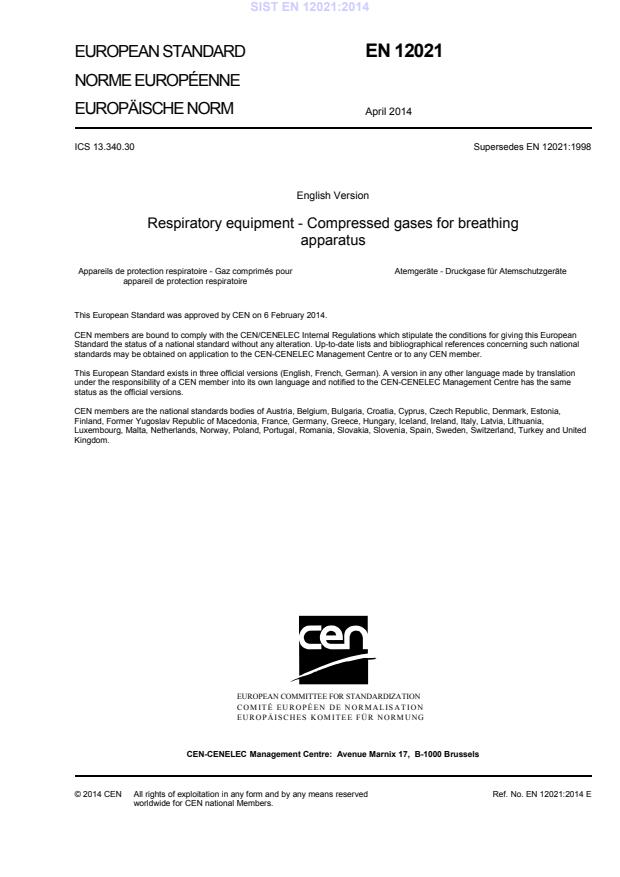
EUROPEAN STANDARD NORME EUROPÉENNE EUROPÄISCHE NORM
EN 12021
April 2014 ICS 13.340.30 Supersedes EN 12021:1998English Version
Respiratory equipment - Compressed gases for breathing apparatus
Appareils de protection respiratoire - Gaz comprimés pour appareil de protection respiratoire
Atemgeräte - Druckgase für Atemschutzgeräte This European Standard was approved by CEN on 6 February 2014.
CEN members are bound to comply with the CEN/CENELEC Internal Regulations which stipulate the conditions for giving this European Standard the status of a national standard without any alteration. Up-to-date lists and bibliographical references concerning such national standards may be obtained on application to the CEN-CENELEC Management Centre or to any CEN member.
This European Standard exists in three official versions (English, French, German). A version in any other language made by translation under the responsibility of a CEN member into its own language and notified to the CEN-CENELEC Management Centre has the same status as the official versions.
CEN members are the national standards bodies of Austria, Belgium, Bulgaria, Croatia, Cyprus, Czech Republic, Denmark, Estonia, Finland, Former Yugoslav Republic of Macedonia, France, Germany, Greece, Hungary, Iceland, Ireland, Italy, Latvia, Lithuania, Luxembourg, Malta, Netherlands, Norway, Poland, Portugal, Romania, Slovakia, Slovenia, Spain, Sweden, Switzerland, Turkey and United Kingdom.
EUROPEAN COMMITTEE FOR STANDARDIZATION
COMITÉ EUROPÉEN DE NORMALISATION EUROPÄISCHES KOMITEE FÜR NORMUNG
CEN-CENELEC Management Centre:
Avenue Marnix 17,
B-1000 Brussels © 2014 CEN All rights of exploitation in any form and by any means reserved worldwide for CEN national Members. Ref. No. EN 12021:2014 ESIST EN 12021:2014
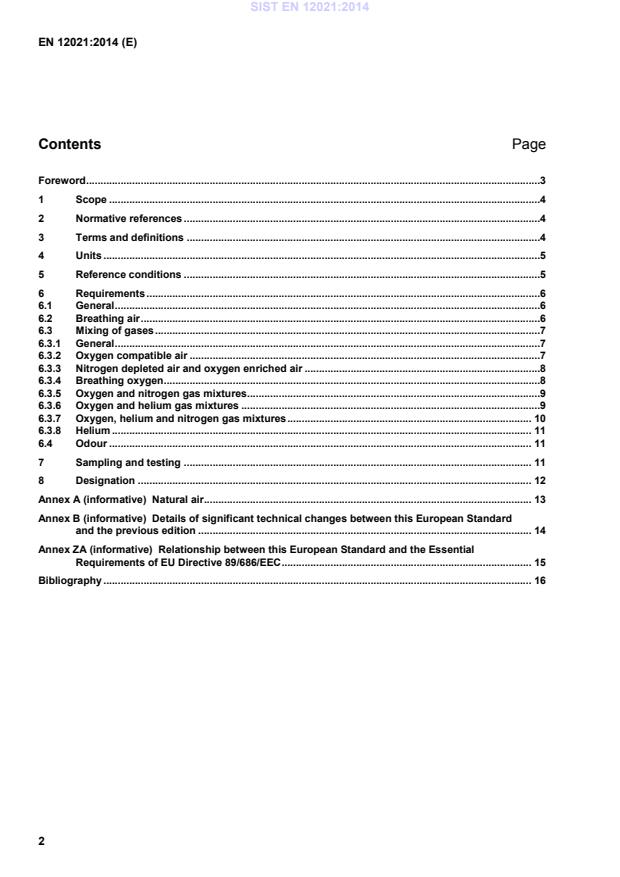
Natural air . 13 Annex B (informative)
Details of significant technical changes between this European Standard and the previous edition . 14 Annex ZA (informative)
Relationship between this European Standard and the Essential Requirements of EU Directive 89/686/EEC . 15 Bibliography . 16
...