

EN 14897:2006
(Main)Water conditioning equipment inside buildings - Devices using mercury low-pressure ultraviolet radiators - Requirements for performance, safety and testing
- Abstract
This document specifies definitions, principles of construction, requirements and methods for testing the performance of UV devices for drinking water installations inside buildings which are permanently connected to the mains supply at the point of entry into a building or within the water distribution system inside the building.
UV devices in the sense of this standard are UV bactericidal treatment devices or UV disinfection devices.
- Status
- Withdrawn
- Publication Date
- 13-Jun-2006
- Withdrawal Date
- 12-Jun-2007
- Technical Committee
- CEN/TC 164 - Water supply
- Drafting Committee
- CEN/TC 164 - Water supply
- Current Stage
- 9960 - Withdrawal effective - Withdrawal
- Start Date
- 13-Jun-2007
- Completion Date
- 13-Jun-2007

Relations
- Effective Date
- 22-Dec-2008
- Effective Date
- 28-Jan-2026
- Referred By
EN ISO 1181:2004 - Fibre ropes - Manila and sisal - 3-, 4- and 8-strand ropes (ISO 1181:2004) - Effective Date
- 28-Jan-2026
Get Certified
Connect with accredited certification bodies for this standard

DIBt (Deutsches Institut für Bautechnik)
German Institute for Building Technology.
DIN CERTCO
DIN Group product certification.

Aboma Certification B.V.
Specialized in construction, metal, and transport sectors.
Sponsored listings
Frequently Asked Questions
EN 14897:2006 is a standard published by the European Committee for Standardization (CEN). Its full title is "Water conditioning equipment inside buildings - Devices using mercury low-pressure ultraviolet radiators - Requirements for performance, safety and testing". This standard covers: This document specifies definitions, principles of construction, requirements and methods for testing the performance of UV devices for drinking water installations inside buildings which are permanently connected to the mains supply at the point of entry into a building or within the water distribution system inside the building. UV devices in the sense of this standard are UV bactericidal treatment devices or UV disinfection devices.
This document specifies definitions, principles of construction, requirements and methods for testing the performance of UV devices for drinking water installations inside buildings which are permanently connected to the mains supply at the point of entry into a building or within the water distribution system inside the building. UV devices in the sense of this standard are UV bactericidal treatment devices or UV disinfection devices.
EN 14897:2006 is classified under the following ICS (International Classification for Standards) categories: 91.140.60 - Water supply systems. The ICS classification helps identify the subject area and facilitates finding related standards.
EN 14897:2006 has the following relationships with other standards: It is inter standard links to EN 14897:2006+A1:2007, EN ISO 1969:2004, EN ISO 1181:2004. Understanding these relationships helps ensure you are using the most current and applicable version of the standard.
EN 14897:2006 is available in PDF format for immediate download after purchase. The document can be added to your cart and obtained through the secure checkout process. Digital delivery ensures instant access to the complete standard document.
Standards Content (Sample)
2003-01.Slovenski inštitut za standardizacijo. Razmnoževanje celote ali delov tega standarda ni dovoljeno.Anlagen zur Behandlung von Trinkwasser innerhalb von Gebäuden - Geräte mit Quecksilberdampf-Niederdruckstrahlern - Anforderungen an Ausführung, Sicherheit und PrüfungÉquipements de traitement de l'eau a l'intérieur des bâtiments - Lampes a rayonnement UV a mercure et basse pression - Exigences relatives aux performances, a la sécurité et aux essaisWater conditioning equipment inside buildings - Devices using mercury low-pressure ultraviolet radiators - Requirements for performance, safety and testing91.140.60Sistemi za oskrbo z vodoWater supply systems13.060.20Pitna vodaDrinking waterICS:Ta slovenski standard je istoveten z:EN 14897:2006SIST EN 14897:2006en01-oktober-2006SIST EN 14897:2006SLOVENSKI
STANDARD
EUROPEAN STANDARDNORME EUROPÉENNEEUROPÄISCHE NORMEN 14897June 2006ICS 91.140.60 English VersionWater conditioning equipment inside buildings - Devices usingmercury low-pressure ultraviolet radiators - Requirements forperformance, safety and testingÉquipements de conditionnement de l'eau à l'intérieur desbâtiments - Dispositifs utilisant des radiateurs à mercure etbasse pression de rayonnement UV - Exigences relativesaux performances, à la sécurité et aux essaisAnlagen zur Behandlung von Trinkwasser innerhalb vonGebäuden - Geräte mit Quecksilberdampf-Niederdruckstrahlern - Anforderungen an Ausführung,Sicherheit und PrüfungThis European Standard was approved by CEN on 10 May 2006.CEN members are bound to comply with the CEN/CENELEC Internal Regulations which stipulate the conditions for giving this EuropeanStandard the status of a national standard without any alteration. Up-to-date lists and bibliographical references concerning such nationalstandards may be obtained on application to the Central Secretariat or to any CEN member.This European Standard exists in three official versions (English, French, German). A version in any other language made by translationunder the responsibility of a CEN member into its own language and notified to the Central Secretariat has the same status as the officialversions.CEN members are the national standards bodies of Austria, Belgium, Cyprus, Czech Republic, Denmark, Estonia, Finland, France,Germany, Greece, Hungary, Iceland, Ireland, Italy, Latvia, Lithuania, Luxembourg, Malta, Netherlands, Norway, Poland, Portugal, Romania,Slovakia, Slovenia, Spain, Sweden, Switzerland and United Kingdom.EUROPEAN COMMITTEE FOR STANDARDIZATIONCOMITÉ EUROPÉEN DE NORMALISATIONEUROPÄISCHES KOMITEE FÜR NORMUNGManagement Centre: rue de Stassart, 36
B-1050 Brussels© 2006 CENAll rights of exploitation in any form and by any means reservedworldwide for CEN national Members.Ref. No. EN 14897:2006: ESIST EN 14897:2006
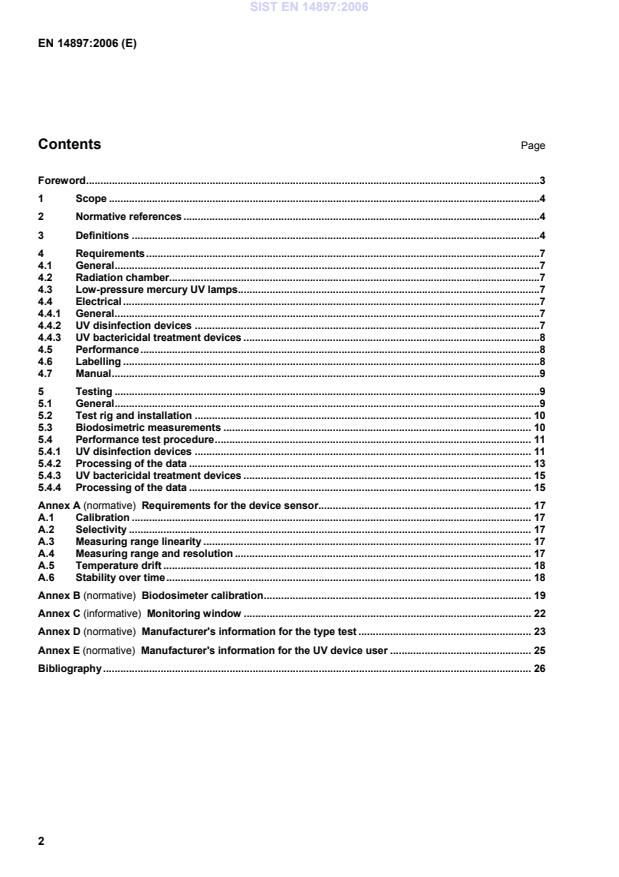
Requirements for the device sensor.17 A.1 Calibration.17 A.2 Selectivity.17 A.3 Measuring range linearity.17 A.4 Measuring range and resolution.17 A.5 Temperature drift.18 A.6 Stability over time.18 Annex B (normative)
Biodosimeter calibration.19 Annex C (informative)
Monitoring window.22 Annex D (normative)
Manufacturer's information for the type test.23 Annex E (normative)
Manufacturer's information for the UV device user.25 Bibliography.26
According to the CEN/CENELEC Internal Regulations, the national standards organizations of the following countries are bound to implement this European Standard: Austria, Belgium, Cyprus, Czech Republic, Denmark, Estonia, Finland, France, Germany, Greece, Hungary, Iceland, Ireland, Italy, Latvia, Lithuania, Luxembourg, Malta, Netherlands, Norway, Poland, Portugal, Romania, Slovakia, Slovenia, Spain, Sweden, Switzerland and United Kingdom. SIST EN 14897:2006
UV devices in the sense of this standard are UV bactericidal treatment devices or UV disinfection devices. 2 Normative references The following referenced documents are indispensable for the application of this document. For dated references, only the edition cited applies. For undated references, the latest edition of the referenced document (including any amendments) applies. EN 1717, Protection against pollution of potable water in water installations and general requirements of devices to prevent pollution by backflow 3 Definitions For the purposes of this document, the following terms and definitions apply. 3.1 absorption decrease of the incident irradiance of a light beam including transformation into other forms suffered by radiant energy passing through a material substance (e. g. heat) 3.2 irradiance measure of the UV light flux divided by the area that intercepts the radiation, in W/m2
NOTE The irradiance measured in UV disinfection devices by the UV device sensor
is mainly influenced by the lamp output, the transmittance of the water, and scaling/fouling of the protective quartz sleeves and the position of the lamps in the radiation chamber. 3.3 disinfection action of killing or inactivating all types of pathogenic bacteria to a specified degree of at least 99,999 % and all types of pathogenic viruses to a degree of at least 99,99 % using a UV disinfection device 3.4 bactericidal treatment action of inactivating or killing bacteria present in water to an unspecified degree using a UV bactericidal treatment device 3.5 fluence dose product of irradiance in W/m2 and exposure time in s, in J/m2 NOTE Fluence is the correct term from a strictly scientific point of view.
3.6 germicidal fluence
fluence weighted with the germicidal UV sensitivity, in J/m2 SIST EN 14897:2006
3.19 UV lamp radiator which produces UV light 3.20 UV device general expression for products using UV light to irradiate water flow through, with the purpose of inactivating microrganisms being present in the water 3.21 UV disinfection device device designed to disinfect water 3.22 UV bactericidal treatment device device designed for bactericidal water treatment 3.23 turbidity reduction of optical transmittance of a liquid caused by the presence of undissolved matter 3.24 UV transmittance (% T100) spectral transmission rate at a wavelength of 254 nm at an optical path length in the medium of 100 mm, in % NOTE In general, the UV transmittance includes the influence of attenuation and absorption of the through passing medium. The UV transmittance is measured in the unfiltered sample in quartz cuvettes of at least 40 mm at a wavelength of 254 nm in a spectrophotometer and is given in %. 3.25 UV radiation (UV) electromagnetic radiation according to Table 1 Table 1 — UV radiation Type Wavelength nm UV-C > 100 ≤
280 UV-B > 280 ≤
315 UV-A > 315 ≤
400 NOTE
For bactericidal and disinfection purposes, part of the UV-C range is used.
4.1 General The treatment of water with the UV device shall yield a reduction equivalent fluence of at least 400 J/m2 (40 mJ/cm2), at a wavelength of 254 nm in the defined operational range. 4.2 Radiation chamber The radiation chamber is made of corrosion resistant and UV resistant materials. Materials and substances used shall be suitable for contact with drinking water.
NOTE Product intended for use in water supply systems should comply, when existing, with national regulations and testing arrangements that ensure fitness for contact with drinking water. The Member states, relevant regulators and the EC Commission agreed on the principles of a future unique European Acceptance Scheme (EAS), which would provide a common testing and approval arrangement at European level. If and when the EAS is adopted, European Product Standards will be amended by the addition of an Annex Z/EAS under Mandate M/136, which will contain formal references to the testing, certification and product marking requirements of the EAS. The mechanical design and the construction shall comply with the relevant requirements for the pressure present. Direct or indirect leaking of radiation from the radiation chamber to the environment with a wavelength below 400 nm shall be avoided. Radiation chambers shall be constructed in a way that they are easily serviceable. For UV disinfection devices, the radiation chamber shall be provided with a sensor for a representative
irradiation measurement. The location of the sensor shall be designed so that the irradiation measurement is not disturbed by gas bubbles or sediment deposits. 4.3 Low-pressure mercury UV lamps In order not to produce ozone, only lamps with a radiation range above 240 nm shall be used. At the line of 254 nm shall be 85 % of the total radiation intensity in the UV C range at the mercury resonance. Lamp(s) shall be marked with a designation of type. Only those lamps used for the type test shall be used in the UV device. The UV lamp(s) shall be approved for the device by the manufacturer or be equivalent to the approved type used at the type test. 4.4 Electrical 4.4.1 General For the electrotechnical design of UV devices, the relevant EC Directives and CE marking requirements shall be accomodated. Compliance with these EC Directives is a requirement of this standard.(see [3]) 4.4.2 UV disinfection devices 4.4.2.1 Controller The UV disinfection device shall be equipped with a controller, which provides the following functions: when switching on the device, the signal for the waterflow shall be delayed until the minimum irradiance is reached; operation and failure of the electrical function of each lamp shall be indicated; operation beyond the permissible limits of operation shall be indicated and a signal shall be provided which allows the waterflow to be stopped; SIST EN 14897:2006
flow-related alarm point(s). 4.4.2.2 Sensor For the measurement of the irradiation, a sensor shall be provided to ensure disinfection under consideration of possible changes in water UV transmittance and lamp performance. Requirements for the device sensor are given in Annex A. Where national regulations apply, a sensor and monitoring window may have to fulfil certain requirements. NOTE An example for a monitoring window is shown in Annex C. 4.4.3 UV bactericidal treatment devices The UV bactericidal treatment devices shall be equipped with a controller, which provides the following functions: operation and failure of the electrical function of the lamp(s) shall be indicated; general malfunction signal shall be provided. The following functions shall be displayed: device in function; service time of the UV lamps. 4.5 Performance The UV device shall apply a reduction equivalent fluence of at least 400 J/m2 at the end of the lamp service life for the specified flow rates and UV transmittance values. The performance is evaluated with a type test for which the manufacturer shall provide information in accordance with Annex D. 4.6 Labelling The information to be given on a nameplate, which shall be permanently fixed to the UV device and be legible when installed, shall be in accordance with Annex E.
operating diagram: transmittance vs. maximum admissible flow; water resulting from sampling (rinsing) shall be adequately disposed of to the provisions of EN 1717; replacement intervals for UV lamp(s), sensor (only for UV disinfection devices). 5 Testing 5.1 General The manufacturer shall provide the details and documentation described in Annex D. The device to be tested is checked for conformity to the documentation. The purpose of the type test is to verify that the UV fluence delivered by the device under test meets a reduction equivalent fluence of 400 J/m2 at the end of the lamp life, at the specified flow rates and transmittance values.
Parameters to be changed during the test are the flow rate of the water and the UV transmittance of the water for the test of UV bactericidal treatment devices and the flow rate, the transmittance and the lamp-output, for the test of UV disinfection devices.
For the type test of UV disinfection devices the UV device shall be equipped with a sensor or
...