

EN 14349:2004
(Main)Chemical disinfectants and antiseptics - Quantitative surface test for the evaluation of bacterial activity of chemical disinfectants and antiseptics used in veterinary field on non-porous surfaces without mechanical action - Test method and requirements (phase 2, step 2)
- Abstract
This document specifies a test method and the minimum requirements for bactericidal activity of chemical disinfectant and antiseptic products that form a homogeneous physically stable preparation in hard water or - in the case of ready-to-use - with water.
This document is applicable to products for use in the veterinary field i.e. in the breeding, husbandry, production, transport and disposal of all animals except when in the food chain following death and entry to the processing industry.
NOTE 1 Mycobacteria are the subject of a separate standard.
NOTE 2 This method corresponds to a Phase 2 Step 2 test (Annex E).
- Status
- Withdrawn
- Publication Date
- 10-Aug-2004
- Withdrawal Date
- 23-Oct-2007
- Technical Committee
- CEN/TC 216 - Chemical disinfectants and antiseptics
- Drafting Committee
- CEN/TC 216/WG 2 - Veterinary use
- Current Stage
- 9960 - Withdrawal effective - Withdrawal
- Start Date
- 24-Oct-2007
- Completion Date
- 24-Oct-2007

Relations
- Effective Date
- 22-Dec-2008
Get Certified
Connect with accredited certification bodies for this standard

BSI Group
BSI (British Standards Institution) is the business standards company that helps organizations make excellence a habit.

TÜV Rheinland
TÜV Rheinland is a leading international provider of technical services.

TÜV SÜD
TÜV SÜD is a trusted partner of choice for safety, security and sustainability solutions.
Sponsored listings
Frequently Asked Questions
EN 14349:2004 is a standard published by the European Committee for Standardization (CEN). Its full title is "Chemical disinfectants and antiseptics - Quantitative surface test for the evaluation of bacterial activity of chemical disinfectants and antiseptics used in veterinary field on non-porous surfaces without mechanical action - Test method and requirements (phase 2, step 2)". This standard covers: This document specifies a test method and the minimum requirements for bactericidal activity of chemical disinfectant and antiseptic products that form a homogeneous physically stable preparation in hard water or - in the case of ready-to-use - with water. This document is applicable to products for use in the veterinary field i.e. in the breeding, husbandry, production, transport and disposal of all animals except when in the food chain following death and entry to the processing industry. NOTE 1 Mycobacteria are the subject of a separate standard. NOTE 2 This method corresponds to a Phase 2 Step 2 test (Annex E).
This document specifies a test method and the minimum requirements for bactericidal activity of chemical disinfectant and antiseptic products that form a homogeneous physically stable preparation in hard water or - in the case of ready-to-use - with water. This document is applicable to products for use in the veterinary field i.e. in the breeding, husbandry, production, transport and disposal of all animals except when in the food chain following death and entry to the processing industry. NOTE 1 Mycobacteria are the subject of a separate standard. NOTE 2 This method corresponds to a Phase 2 Step 2 test (Annex E).
EN 14349:2004 is classified under the following ICS (International Classification for Standards) categories: 11.080.20 - Disinfectants and antiseptics. The ICS classification helps identify the subject area and facilitates finding related standards.
EN 14349:2004 has the following relationships with other standards: It is inter standard links to EN 14349:2007. Understanding these relationships helps ensure you are using the most current and applicable version of the standard.
EN 14349:2004 is available in PDF format for immediate download after purchase. The document can be added to your cart and obtained through the secure checkout process. Digital delivery ensures instant access to the complete standard document.
Standards Content (Sample)
2003-01.Slovenski inštitut za standardizacijo. Razmnoževanje celote ali delov tega standarda ni dovoljeno.Chemische Desinfektionsmittel und Antiseptika Quantitativer Oberflächenversuch zur Bestimmung der bakteriziden Wirkung chemischer Desinfektionsmittel und Antiseptika für den Veterinärbereich auf nicht-porösen Oberflächen ohne mechanische Wirkung
Prüfverfahren und Anforderungen (Phase 2/Stufe 2)Antiseptiques et désinfectants chimiques - Essai quantitatif de surface pour l'évaluation de l'activité bactéricide des antiseptiques et des désinfectants chimiques utilisés dans le domaine vétérinaire - Méthode d'essai et exigences (phase 2, étape 2)Chemical disinfectants and antiseptics - Quantitative surface test for the evaluation of bacterial activity of chemical disinfectants and antiseptics used in veterinary field on non-porous surfaces without mechanical action - Test method and requirements (phase 2, step 2)11.220VeterinarstvoVeterinary medicine11.080.20Dezinfektanti in antiseptikiDisinfectants and antisepticsICS:Ta slovenski standard je istoveten z:EN 14349:2004SIST EN 14349:2004en,fr,de01-december-2004SIST EN 14349:2004SLOVENSKI
STANDARD
EUROPEAN STANDARDNORME EUROPÉENNEEUROPÄISCHE NORMEN 14349August 2004ICS 11.080.20English versionChemical disinfectants and antiseptics - Quantitative surfacetest for the evaluation of bacterial activity of chemicaldisinfectants and antiseptics used in veterinary field on non-porous surfaces without mechanical action - Test method andrequirements (phase 2, step 2)Antiseptiques et désinfectants chimiques - Essai quantitatifde surface pour l'évaluation de l'activité bactéricide desantiseptiques et des désinfectants chimiques utilisés dansle domaine vétérinaire sur des surfaces non poreuses sansaction mécanique - Méthode d'essai et prescriptions (phase2, étape 2)Chemische Desinfektionsmittel und Antiseptika -Quantitativer Oberflächenversuch zur Bestimmung derbakteriziden Wirkung chemischer Desinfektionsmittel undAntiseptika für den Veterinärbereich auf nicht-porösenOberflächen ohne mechanische Wirkung - Prüfverfahrenund Anforderungen (Phase 2/Stufe 2)This European Standard was approved by CEN on 16 January 2004.CEN members are bound to comply with the CEN/CENELEC Internal Regulations which stipulate the conditions for giving this EuropeanStandard the status of a national standard without any alteration. Up-to-date lists and bibliographical references concerning such nationalstandards may be obtained on application to the Central Secretariat or to any CEN member.This European Standard exists in three official versions (English, French, German). A version in any other language made by translationunder the responsibility of a CEN member into its own language and notified to the Central Secretariat has the same status as the officialversions.CEN members are the national standards bodies of Austria, Belgium, Cyprus, Czech Republic, Denmark, Estonia, Finland, France,Germany, Greece, Hungary, Iceland, Ireland, Italy, Latvia, Lithuania, Luxembourg, Malta, Netherlands, Norway, Poland, Portugal, Slovakia,Slovenia, Spain, Sweden, Switzerland and United Kingdom.EUROPEAN COMMITTEE FOR STANDARDIZATIONCOMITÉ EUROPÉEN DE NORMALISATIONEUROPÄISCHES KOMITEE FÜR NORMUNGManagement Centre: rue de Stassart, 36
B-1050 Brussels© 2004 CENAll rights of exploitation in any form and by any means reservedworldwide for CEN national Members.Ref. No. EN 14349:2004: ESIST EN 14349:2004
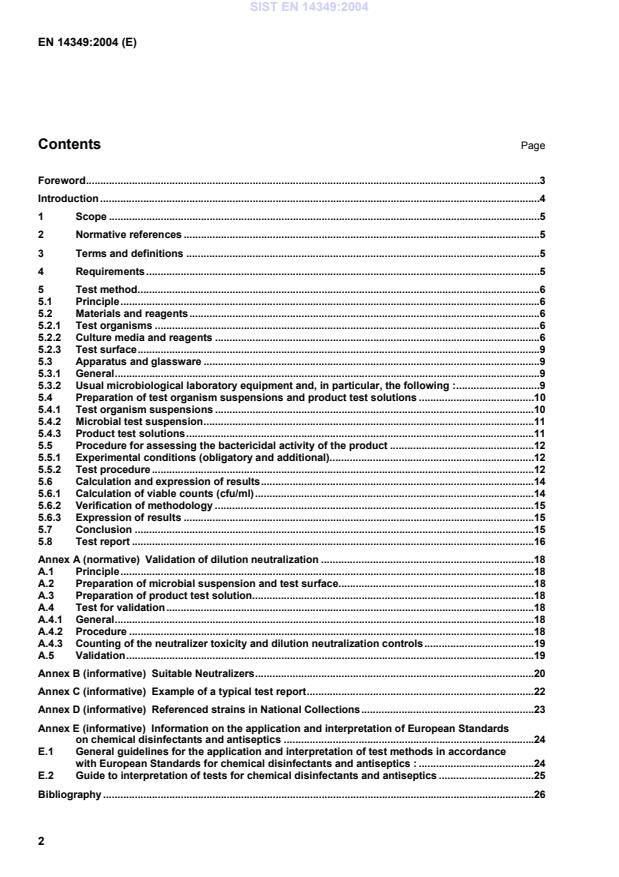
Validation of dilution neutralization.18 A.1 Principle.18 A.2 Preparation of microbial suspension and test surface.18 A.3 Preparation of product test solution.18 A.4 Test for validation.18 A.4.1 General.18 A.4.2 Procedure.18 A.4.3 Counting of the neutralizer toxicity and dilution neutralization controls.19 A.5 Validation.19 Annex B (informative)
Suitable Neutralizers.20 Annex C (informative)
Example of a typical test report.22 Annex D (informative)
Referenced strains in National Collections.23 Annex E (informative)
Information on the application and interpretation of European Standards on chemical disinfectants and antiseptics.24 E.1 General guidelines for the application and interpretation of test methods in accordance with European Standards for chemical disinfectants and antiseptics :.24 E.2 Guide to interpretation of tests for chemical disinfectants and antiseptics.25 Bibliography.26 SIST EN 14349:2004
The method involves neutralization of the bactericidal activity at the moment of sampling by dilution into a previously validated neutralizer. The conditions that shall be tested are intended to cover general purposes and to allow reference between laboratories and product types. For some applications, however, the recommendations of use of a product can differ and therefore additional test conditions need to be used. SIST EN 14349:2004
After a drying time, 0,1 ml of the product is transferred to the surface. The surface is maintained at a specified temperature for a defined period of time. The surface is transferred to a previously validated neutralization medium so that the action of the disinfectant is immediately neutralized. The number of surviving organisms which can be recovered from the surface is determined quantitatively. The number of bacteria on a surface treated with water in place of the disinfectant is also determined and the reduction in viable counts calculated by difference. 5.2 Materials and reagents All weights of chemical substances given in this document refer to the anhydrous salts. Hydrated forms may be used as an alternative but the weights required shall be adjusted to allow for consequent molecular weight differences. 5.2.1 Test organisms The bactericidal activity shall be evaluated using the following strains : Enterococcus hirae ATCC 105411) ; Proteus vulgaris ATCC 133151) ; Pseudomonas aeruginosa ATCC 154421) ; Staphylococcus aureus ATCC 65381). NOTE See Annex D for corresponding strain numbers in other culture collections. If required for specific applications, additional strains may be chosen and shall be noted in the test report. Their suitability for supplying inocula of sufficient concentration shall be verified. If the additional strains tested are not classified at a reference centre, identification characteristics shall be given. In addition they shall be held by the testing laboratory under a reference for 5 years (see EN 12353 for storage of strains). 5.2.2 Culture media and reagents 5.2.2.1 General All weights of chemical substances given in this document refer to anhydrous salts. Hydrated forms may be used as an alternative, but the weights required shall be adjusted to allow for consequent molecular weight differences. The reagents shall be of analytical grade and/or appropriate for microbiological purposes.
They shall be free from substances that are toxic or inhibitory to the test organisms.
1) ATCC 10541, ATCC 13315, ATCC 15442 & ATCC 6538 are the collection numbers of strains supplied by the American type Culture Collection. The information is given for the convenience of users of this standard and does not constitute an endorsement by CEN of the product named. Corresponding strains supplied by other culture collections can be used if they can be shown to lead to the same result. SIST EN 14349:2004
°C for a minimum holding time of 15 min ; b) for dry heat sterilization, a hot air oven capable of being maintained at 18050+ °C for a minimum holding time of 30 min, at 17050+ °C for a minimum holding time of 1 h or at 16050+ °C for a minimum holding time of 2 h ;
2) Decon concentrate is obtained from Decon Laboratories Ltd, Convway St, Hovem BN3 3Lym UK Tel. 01273 756598.
Studies have shown that this method of cleaning is satisfactory. A suitable ‘Generic’ will be specified at a later stage. 3) Disposable sterile equipment is an acceptable alternative to reusable glassware. SIST EN 14349:2004
± 0,1 pH unit at 25 °C. 5.3.2.5 Stopwatch. 5.3.2.6 Electromechanical Agitator eg Vortex ® mixer4) 5.3.2.7 Containers, Test tubes flasks or bottles of suitable capacity. 5.3.2.8 Graduated pipettes, of nominal capacities 10 ml and 0,1 ml. Calibrated automatic pipettes may be used. 5.3.2.9 Petri dishes, (plates) of size 90 mm to 100 mm. 5.3.2.10 Glass beads, Diameter : 3 mm to 4 mm. 5.3.2.11 Volumetric flasks. 5.3.2.12 Mechanical shaker. 5.3.2.13 Refrigerator, capable of being controlled at 2 °C to 8 °C. 5.3.2.14 Temperature controlled cabinet, capable of being controlled at 10 °C ± 1 °C. 5.4 Preparation of test organism suspensions and product test solutions 5.4.1 Test organism suspensions 5.4.1.1 Preservation and stock cultures of test organisms The test organisms and their stock cultures shall be prepared and kept in accordance with the requirements of EN 12353. 5.4.1.2 Working culture of test organisms In order to prepare the working culture of strains (5.2.1), prepare a subculture from the stock culture (5.4.1.1) by streaking onto TSA slopes (5.2.2.3) and incubate (5.3.2.3). After 18 h to 24 h prepare a second subculture from the first subculture in the same way and incubate for 18 h to 24 h. From this second subculture, a third subculture may be produced in the same way. NOTE The second and/or third cultures are the working culture(s). If it is not possible to prepare the second subculture on a particular day, a 48 h subculture may be used for subsequent sub-culturing, provided that the subculture has been kept in the incubator during the 48 h period. In these circumstances, prepare a further 24 h subculture before proceeding. Do not take a fourth subculture.
4) Vortex ® is an example of a suitable product available commercially. This information is given for the convenience of users of this standard and does not constitute an endorsement by CEN of this product. SIST EN 14349:2004
...