

EN ISO 11681-1:2008
(Main)Machinery for forestry - Portable chain-saw safety requirements and testing - Part 1: Chain-saws for forest service (ISO 11681-1:2004, including Amd 1:2007)
- Abstract
ISO 11681-1:2004 deals with the significant hazards and specifies safety requirements and their verification for design and construction of portable combustion-engine, hand-held chain-saws, designed only for use by one operator and intended for forest work. It describes methods for the elimination or reduction of hazards arising from their use. In addition it specifies the type of information on safe working practices to be provided by the manufacturer. It deals with all significant hazards. It does not cover the hazard from kickback for machines with an engine displacement over 80 cm3. The environmental aspects, except for noise, have not been considered in this standard.
Chain-saws covered by ISO 11681-1:2004 are designed for use by persons having read and understood the safety requirements in the instruction handbook and using the appropriate personal protective equipment (PPE). The chain-saws covered are designed only to be operated with the right hand on the rear handle and the left hand on the front handle.
ISO 11681-1:2004 is not applicable to chain-saws which are manufactured before the date of publication of this document.
- Status
- Withdrawn
- Publication Date
- 04-Nov-2008
- Withdrawal Date
- 30-Nov-2011
- Technical Committee
- CEN/TC 144 - Tractors and machinery for agriculture and forestry
- Drafting Committee
- CEN/TC 144 - Tractors and machinery for agriculture and forestry
- Current Stage
- 9960 - Withdrawal effective - Withdrawal
- Start Date
- 01-Dec-2011
- Completion Date
- 01-Dec-2011
- Directive
- 2006/42/EC - Directive 2006/42/EC of the European Parliament and of the Council of 17 May 2006 on machinery, and amending Directive 95/16/EC (recast)OJ Ref: C, C 214 OJ Date: 08-Sep-2009

Relations
- Effective Date
- 22-Dec-2008
- Effective Date
- 22-Dec-2008
- Effective Date
- 14-Dec-2011
Get Certified
Connect with accredited certification bodies for this standard

Control Union Certifications
Global certification for agriculture and sustainability.

ECOCERT
Organic and sustainability certification.

FSC International
Forest Stewardship Council certification.
Sponsored listings
Frequently Asked Questions
EN ISO 11681-1:2008 is a standard published by the European Committee for Standardization (CEN). Its full title is "Machinery for forestry - Portable chain-saw safety requirements and testing - Part 1: Chain-saws for forest service (ISO 11681-1:2004, including Amd 1:2007)". This standard covers: ISO 11681-1:2004 deals with the significant hazards and specifies safety requirements and their verification for design and construction of portable combustion-engine, hand-held chain-saws, designed only for use by one operator and intended for forest work. It describes methods for the elimination or reduction of hazards arising from their use. In addition it specifies the type of information on safe working practices to be provided by the manufacturer. It deals with all significant hazards. It does not cover the hazard from kickback for machines with an engine displacement over 80 cm3. The environmental aspects, except for noise, have not been considered in this standard. Chain-saws covered by ISO 11681-1:2004 are designed for use by persons having read and understood the safety requirements in the instruction handbook and using the appropriate personal protective equipment (PPE). The chain-saws covered are designed only to be operated with the right hand on the rear handle and the left hand on the front handle. ISO 11681-1:2004 is not applicable to chain-saws which are manufactured before the date of publication of this document.
ISO 11681-1:2004 deals with the significant hazards and specifies safety requirements and their verification for design and construction of portable combustion-engine, hand-held chain-saws, designed only for use by one operator and intended for forest work. It describes methods for the elimination or reduction of hazards arising from their use. In addition it specifies the type of information on safe working practices to be provided by the manufacturer. It deals with all significant hazards. It does not cover the hazard from kickback for machines with an engine displacement over 80 cm3. The environmental aspects, except for noise, have not been considered in this standard. Chain-saws covered by ISO 11681-1:2004 are designed for use by persons having read and understood the safety requirements in the instruction handbook and using the appropriate personal protective equipment (PPE). The chain-saws covered are designed only to be operated with the right hand on the rear handle and the left hand on the front handle. ISO 11681-1:2004 is not applicable to chain-saws which are manufactured before the date of publication of this document.
EN ISO 11681-1:2008 is classified under the following ICS (International Classification for Standards) categories: 65.060.80 - Forestry equipment. The ICS classification helps identify the subject area and facilitates finding related standards.
EN ISO 11681-1:2008 has the following relationships with other standards: It is inter standard links to EN ISO 11681-1:2004, EN ISO 11681-1:2004/A1:2007, EN ISO 11681-1:2011. Understanding these relationships helps ensure you are using the most current and applicable version of the standard.
EN ISO 11681-1:2008 is associated with the following European legislation: EU Directives/Regulations: 2006/42/EC, 98/37/EC; Standardization Mandates: M/079, M/396. When a standard is cited in the Official Journal of the European Union, products manufactured in conformity with it benefit from a presumption of conformity with the essential requirements of the corresponding EU directive or regulation.
EN ISO 11681-1:2008 is available in PDF format for immediate download after purchase. The document can be added to your cart and obtained through the secure checkout process. Digital delivery ensures instant access to the complete standard document.
Standards Content (Sample)
2003-01.Slovenski inštitut za standardizacijo. Razmnoževanje celote ali delov tega standarda ni dovoljeno.Forstmaschinen - Sicherheitstechnische Anforderungen und Prüfung für tragbare Kettensägen - Teil 1: Kettensägen für die Waldarbeit (ISO 11681-1:2004, einschließlich Änderung 1:2007)Matériel forestier - Exigences de sécurité et essais des scies à chaîne portatives - Partie 1: Scies à chaîne pour travaux forestiers (ISO 11681-1:2004, Amd 1:2007 inclus)Machinery for forestry - Portable chain-saw safety requirements and testing - Part 1: Chain-saws for forest service (ISO 11681-1:2004, including Amd 1:2007)65.060.80Gozdarska opremaForestry equipmentICS:Ta slovenski standard je istoveten z:EN ISO 11681-1:2008SIST EN ISO 11681-1:2009en,fr,de01-maj-2009SIST EN ISO 11681-1:2009SLOVENSKI
STANDARDSIST EN ISO 11681-1:2004/A1:2007SIST EN ISO 11681-1:20041DGRPHãþD
EUROPEAN STANDARDNORME EUROPÉENNEEUROPÄISCHE NORMEN ISO 11681-1November 2008ICS 65.060.80Supersedes EN ISO 11681-1:2004
English VersionMachinery for forestry - Portable chain-saw safety requirementsand testing - Part 1: Chain-saws for forest service (ISO 11681-1:2004, including Amd 1:2007)Matériel forestier - Exigences de sécurité et essais desscies à chaîne portatives - Partie 1: Scies à chaîne pourtravaux forestiers (ISO 11681-1:2004, Amd 1:2007 inclus)Forstmaschinen - Sicherheitstechnische Anforderungenund Prüfung für tragbare Kettensägen - Teil 1: Kettensägenfür die Waldarbeit (ISO 11681-1:2004, einschließlichÄnderung 1:2007)This European Standard was approved by CEN on 15 October 2008.CEN members are bound to comply with the CEN/CENELEC Internal Regulations which stipulate the conditions for giving this EuropeanStandard the status of a national standard without any alteration. Up-to-date lists and bibliographical references concerning such nationalstandards may be obtained on application to the CEN Management Centre or to any CEN member.This European Standard exists in three official versions (English, French, German). A version in any other language made by translationunder the responsibility of a CEN member into its own language and notified to the CEN Management Centre has the same status as theofficial versions.CEN members are the national standards bodies of Austria, Belgium, Bulgaria, Cyprus, Czech Republic, Denmark, Estonia, Finland,France, Germany, Greece, Hungary, Iceland, Ireland, Italy, Latvia, Lithuania, Luxembourg, Malta, Netherlands, Norway, Poland, Portugal,Romania, Slovakia, Slovenia, Spain, Sweden, Switzerland and United Kingdom.EUROPEAN COMMITTEE FOR STANDARDIZATIONCOMITÉ EUROPÉEN DE NORMALISATIONEUROPÄISCHES KOMITEE FÜR NORMUNGManagement Centre: rue de Stassart, 36
B-1050 Brussels© 2008 CENAll rights of exploitation in any form and by any means reservedworldwide for CEN national Members.Ref. No. EN ISO 11681-1:2008: ESIST EN ISO 11681-1:2009
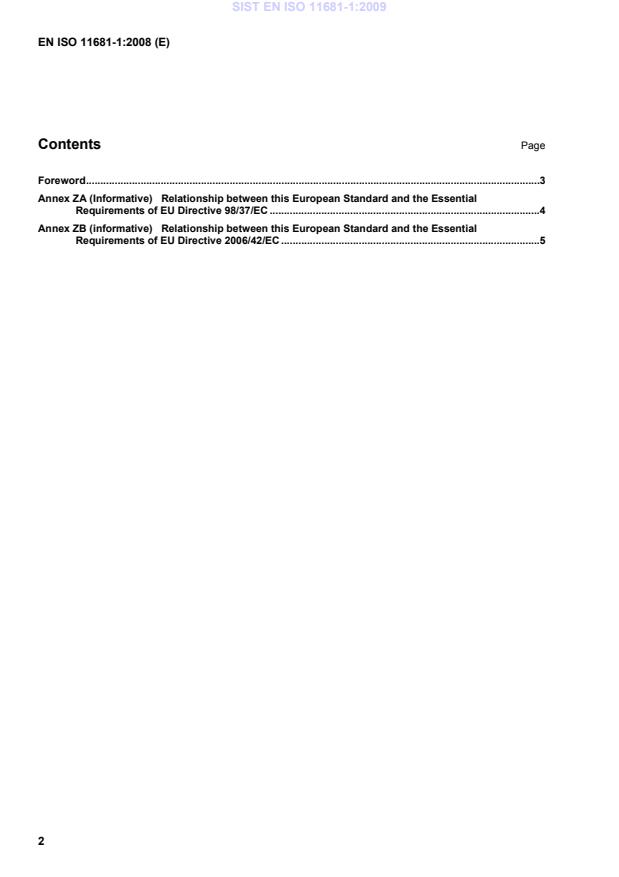
Relationship between this European Standard and the Essential Requirements of EU Directive 98/37/EC.4 Annex ZB (informative)
Relationship between this European Standard and the Essential Requirements of EU Directive 2006/42/EC.5
Relationship between this European Standard and the Essential Requirements of EU Directive 98/37/EC This International Standard has been prepared under a mandate given to CEN by the European Commission and the European Free Trade Association to provide a means of conforming to Essential Requirements of the New Approach Directive 98/37/EC on machinery.
Once this standard is cited in the Official Journal of the European Communities under that Directive and has been implemented as a national standard in at least one Member State, compliance with the normative clauses of this standard confers, within the limits of the scope of this standard, a presumption of conformity with the relevant Essential Requirements except Essential Requirements 2.2 first paragraph second indent for machines with an engine displacement over 80 cm3 of that Directive and associated EFTA regulations.
WARNING: Other requirements and other EU Directives may be applicable to the product(s) falling within the scope of this standard.
Relationship between this European Standard and the Essential Requirements of EU Directive 2006/42/EC
This document has been prepared under a mandate given to CEN by the European Commission and the European Free Trade Association to provide a means of conforming to Essential Requirements of the New Approach Directive 2006/42/EC on machinery.
Once this standard is cited in the Official Journal of the European Communities under that Directive and has been implemented as a national standard in at least one Member State, compliance with the normative clauses of this standard confers, within the limits of the scope of this standard, a presumption of conformity with the relevant Essential Requirements except Essential Requirements 1.2.1 fourth indent, 1.7.3 first paragraph, first and second indent, 1.7.4.2 q), t) and u) fourth paragraph second sentence, 2.2.1 first paragraph second indent for machines with an engine displacement over 80 cm3 and 2.2.1.1 first paragraph second indent of that Directive and associated EFTA regulations.
WARNING — Other requirements and other EU Directives may be applicable to the product(s) falling within the scope of this standard.
Reference numberISO 11681-1:2004(E)© ISO 2004
INTERNATIONAL STANDARD ISO11681-1Second edition2004-02-01Machinery for forestry — Portable chain-saw safety requirements and testing — Part 1: Chain-saws for forest service Matériel forestier — Exigences de sécurité et essais des scies à chaîne portatives —
Partie 1: Scies à chaîne pour travaux forestiers
ISO 11681-1:2004(E) PDF disclaimer This PDF file may contain embedded typefaces. In accordance with Adobe's licensing policy, this file may be printed or viewed but shall not be edited unless the typefaces which are embedded are licensed to and installed on the computer performing the editing. In downloading this file, parties accept therein the responsibility of not infringing Adobe's licensing policy. The ISO Central Secretariat accepts no liability in this area. Adobe is a trademark of Adobe Systems Incorporated. Details of the software products used to create this PDF file can be found in the General Info relative to the file; the PDF-creation parameters were optimized for printing. Every care has been taken to ensure that the file is suitable for use by ISO member bodies. In the unlikely event that a problem relating to it is found, please inform the Central Secretariat at the address given below.
©
ISO 2004 All rights reserved. Unless otherwise specified, no part of this publication may be reproduced or utilized in any form or by any means, electronic or mechanical, including photocopying and microfilm, without permission in writing from either ISO at the address below or ISO's member body in the country of the requester. ISO copyright office Case postale 56 • CH-1211 Geneva 20 Tel.
+ 41 22 749 01 11 Fax
+ 41 22 749 09 47 E-mail
copyright@iso.org Web
www.iso.org Published in Switzerland
ii © ISO 2004 – All rights reserved
ISO 11681-1:2004(E) © ISO 2004 – All rights reserved iii Contents Page Foreword.iv Introduction.v 1 Scope.1 2 Normative references.1 3 Terms and definitions.3 4 List of significant hazards.4 5 Safety requirements and verification.4 6 Information for use.14 Annex A (informative)
Pictorial.17 Bibliography.18
ISO 11681-1:2004(E) iv © ISO 2004 – All rights reserved Foreword ISO (the International Organization for Standardization) is a world-wide federation of national standards bodies (ISO member bodies). The work of preparing International Standards is normally carried out through ISO technical committees. Each member body interested in a subject for which a technical committee has been established has the right to be represented on that committee. International organizations, governmental and non-governmental, in liaison with ISO, also take part in the work. ISO collaborates closely with the International Electrotechnical Commission (IEC) on all matters of electrotechnical standardization. International Standards are drafted in accordance with the rules given in the ISO/IEC Directives, Part 2. The main task of technical committees is to prepare International Standards. Draft International Standards adopted by the technical committees are circulated to the member bodies for voting. Publication as an International Standard requires approval by at least 75 % of the member bodies casting a vote. Attention is drawn to the possibility that some of the elements of this document may be the subject of patent rights. ISO shall not be held responsible for identifying any or all such patent rights. ISO 11681-1 was prepared by Technical Committee ISO/TC 23, Tractors and machinery for agriculture and forestry, Subcommittee SC 17, Manually portable forest machinery. This second edition cancels and replaces the first edition (ISO 11681-1:1996), which has been technically revised.
ISO 11681 consists of the following parts, under the general title Machinery for forestry — Portable chain-saw safety requirements and testing: Part 1: Chain-saws for forest service Part 2: Tree service chain-saws SIST EN ISO 11681-1:2009
ISO 11681-1:2004(E) © ISO 2004 – All rights reserved v Introduction This document is a type C standard as defined in ISO 12100-2. The machinery concerned and the extent to which hazards, hazardous situations and events are covered are indicated in the scope of this document. The provisions of this type C standard are different from those stated in type A or B standards, in that they take precedence over the provisions of the other standards for machines that have been designed and built according to type C standard provisions.
INTERNATIONAL STANDARD ISO 11681-1:2004(E) © ISO 2004 – All rights reserved 1 Machinery for forestry — Portable chain-saw safety requirements and testing — Part 1: Chain-saws for forest service 1 Scope This part of ISO 11681 deals with the significant hazards and specifies safety requirements and their verification for design and construction of portable combustion-engine, hand-held chain-saws, designed only for use by one operator and intended for forest work. It describes methods for the elimination or reduction of hazards arising from their use. In addition it specifies the type of information on safe working practices to be provided by the manufacturer.
It deals with all significant hazards. It does not cover the hazard from kickback for machines with an engine displacement over 80 cm3. The environmental aspects, except for noise, have not been considered. Chain-saws covered by this part of ISO 11681 are designed for use by persons having read and understood the safety requirements in the instruction handbook and using the appropriate personal protective equipment (PPE). The chain-saws covered are designed only to be operated with the right hand on the rear handle and the left hand on the front handle. This part of ISO 11681 is not applicable to chain-saws which are manufactured before the date of publication of this document. 2 Normative references The following referenced documents are indispensable for the application of this document. For dated references, only the edition cited applies. For undated references, the latest edition of the referenced document (including any amendments) applies. ISO 6531:1999, Machinery for forestry — Portable chain-saws — Vocabulary ISO 6533:2001, Forestry machinery — Portable chain-saw front hand-guard — Dimensions and clearances ISO 6534:1992, Portable chain-saws — Hand guards — Mechanical strength ISO 6535:1991, Portable chain-saws — Chain brake performance ISO 7293:1997, Forestry machinery — Portable chain-saws — Engine performance and fuel consumption ISO 7914:2002, Forestry machinery — Portable chain-saws — Minimum handle clearance and sizes ISO 7915:1991, Forestry machinery — Portable chain-saws — Determination of handle strength ISO 8334:1985, Forestry machinery — Portable chain-saws — Determination of balance SIST EN ISO 11681-1:2009
ISO 11681-1:2004(E) 2 © ISO 2004 – All rights reserved ISO 9518:1998, Forestry machinery — Portable chain-saws — Kickback test ISO 10726:1992, Portable chain-saws — Chain catcher — Dimensions and mechanical strength ISO/TR 11688-1:1995, Acoustics — Recommended practice for the design of low-noise machinery and equipment — Part 1: Planning ISO 13772:1997, Forestry machinery — Portable chain-saws — Non-manually actuated chain brake performance ISO 12100-1:2003, Safety of machinery — Basic concepts, general principles for design — Part 1: Basic terminology, methodology ISO 12100-2:2003, Safety of machinery — Basic concepts, general principles for design — Part 2: Technical principles ISO 22867:—1), Portable hand-held forestry machines with internal combustion engine — Vibration test code — Measurement of vibration at the handles ISO 22868:—1), Noise test code for portable hand-held forestry machines with an internal combustion engine — Determination of A-weighted emission sound pressure levels at the operator's position, and the sound power level — Engineering method (grade 2) IEC 60335-1, Household and similar electrical appliances — Safety — Part 1: General requirements
1) To be published. SIST EN ISO 11681-1:2009
ISO 11681-1:2004(E) © ISO 2004 – All rights reserved 3 3 Terms and definitions For the purposes of this document, the terms definitions given in ISO 6531 and ISO 12100-1 apply. Figure 1 provides an example of a chain-saw.
Key 1 rear hand-guard 2 rear handle 3 throttle trigger 4 throttle trigger lock-out 5 front handle 6 front hand guard 7 spiked bumper 8 guide-bar cover 9 guide bar 10 saw chain
11 chain catcher Figure 1 — Example of chain-saw SIST EN ISO 11681-1:2009
ISO 11681-1:2004(E) 4 © ISO 2004 – All rights reserved 4 List of significant hazards This clause specifies the significant hazards, hazardous situations and events in as far as they are dealt with in this part of ISO 11681 (see Table 1), identified by risk assessment as significant for this type of machinery, and which require action to eliminate or reduce the risk. Table 1 — Significant hazards, hazardous situations and events covered by this part of ISO 11681 Hazard Subclause 1 Mechanical hazards created by cutting and impact, related to the saw chain. 5.3; 5.5; 5.6; 5.9; 5.19 2 Electrical hazards, created by contact with parts under high voltage (direct contact) or parts which have become under high voltage under faulty conditions (indirect contact). 5.12 3 Thermal hazards resulting in burns, scalds and other injuries, created by possible contact of persons with objects or materials with high temperature including the radiation of heat sources. 5.15 4 Noise hazards, resulting in hearing losses (deafness) and other physiological disorders (e.g. loss of balance, loss of awareness). 5.21; 6.2; 6.4 5 Vibration hazards (resulting in peripheral circulatory and nervous functional disturbances in the hand-arm system, such as the white finger disease). 5.20; 6.2; 6.4 6 Hazards from contact with or inhalation of harmful fluids, gases, mists, fumes and dusts related to exhaust gases. 5.16 7 Fire or explosion hazards related to fuel spillage. 5.18; 6.2 8 Hazards from neglect of ergonomic principles in machine design, such as hazards from unhealthy postures or excessive efforts and inadequate consideration of human hand-arm anatomy, related to handle design, machine balance and the use of spiked bumper. 5.2; 5.4; 5.7; 5.10; 6.2 9 Hazards from unexpected start-up, unexpected overrun/over-speed from failure/disorder of the control system related to failure in the handles and position of the controls. 5.2; 5.10; 5.11; 5.13 10 Hazards from impossibility of stopping the machine in the best possible conditions related to the handle strength and position of the engine stopping device. 5.2; 5.11 11 Hazards from failure of the control system related to handle strength, position of controls and marking. 5.2; 5.10; 5.11; 5.13; 6.312 Hazards from break-up (chain) during operation related to saw chain. 5.2; 5.3; 5.6; 5.17 13 Hazards from ejection of objects or fluids related to chip discharge and fuel spillage. 5.8; 5.18
5 Safety requirements and verification 5.1 General The safe running of chain-saws depends on both the safety requirements as given in this clause and the safe working conditions associated with the use of adequate personal protection equipment (PPE) such as gloves, leg protection, boots, and eye, ear and head protection equipment.
Chain-saws shall comply with the safety requirements and/or protective measures of this clause. Chain-saws shall also be marked according to 6.3 and carry warnings according to 6.4. In addition, the machine shall be designed according to the principles of ISO 12100-2 for hazards relevant but not significant, which are not dealt with by this document. SIST EN ISO 11681-1:2009
ISO 11681-1:2004(E) © ISO 2004 – All rights reserved 5 5.2 Handles 5.2.1 Requirements Chain-saws shall have a handle for each hand. These handles shall be designed such that they can be fully gripped by an operator when wearing protective gloves, they provide the necessary sureness of grip by their shaping and surface, and
they conform to the dimensions and clearances given in ISO 7914. The strength of both handles shall at least comply with ISO 7915. Chain-saws having a system for isolating the machine vibration from the handles shall be designed so that the operator has the possibility of stopping the engine in a controlled manner with the engine stopping device (see 5.11), even in case of failure of the vibration isolation system. 5.2.2 Verification Dimensions shall be verified by measurement. Strength requirements shall be verified by functional test in accordance with ISO 7915. The possibility of stopping the chain-saw engine, if a failure has occurred in the vibration isolation system, shall be verified by inspection of the design. 5.3 Hand protection 5.3.1 Protection at the front handle 5.3.1.1 Requirements A guard shall be fitted in the vicinity of the front handle to protect the operator's fingers from injury by contact with the saw chain. The dimensions of this front hand-guard shall comply with ISO 6533. Its strength shall comply with ISO 6534. 5.3.1.2 Verification Dimensions shall be verified by measurement. Strength requirements shall be verified by functional testing in accordance with ISO 6534. 5.3.2 Protection at the rear handle 5.3.2.1 Requirements A guard shall be provided along the length of the right side of the bottom of the rear handle to protect the operator's hand from contact with a broken saw-chain.
This guard shall extend from the right edge of the handle for at least 30 mm at the guide bar side and at least 100 mm lengthwise (see Figure 2). This requirement may also be fulfilled by parts of the machine. The strength of the rear hand guard shall comply with ISO 6534. 5.3.2.2 Verification Dimensions shall be verified by measurement. Strength requirements shall be verified by functional testing in accordance with ISO 6534. SIST EN ISO 11681-1:2009
ISO 11681-1:2004(E) 6 © ISO 2004 – All rights reserved Dimensions in millimetres
Figure 2 — Minimum dimensions of protection at the rear handle 5.4 Balance 5.4.1 Requirements There shall be means to evenly balance the chain-saw when fitted with the guide bars as recommended in the instruction handbook. The maximum angle between the centreline of the guide bar and the horizontal plane shall not exceed ± 30°. 5.4.2 Verification The possibility to balance the chain-saw shall be verified by functional testing in accordance with ISO 8334. 5.5 Protection against injury by kickback 5.5.1 Chain brake 5.5.1.1 Requirements The chain-saw shall be fitted with a chain brake. It shall be possible to activate the chain brake manually by means of the front-hand guard. The chain brake release force shall be between 20 N and 60 N. The average braking time shall not exceed 0,12 s and the maximum braking time shall not exceed 0,15 s. 5.5.1.2 Verification The chain brake release force shall be verified by functional testing in accordance with ISO 6535. The braking time shall be verified by functional testing in accordance with ISO 6535. 5.5.2 Non-manual chain brake system 5.5.2.1 Requirements There shall also be a non-manual chain brake system, which operates the chain brake when kickback occurs. This system shall meet the requirements given in ISO 13772. SIST EN ISO 11681-1:2009
ISO 11681-1:2004(E) © ISO 2004 – All rights reserved 7 5.5.2.2 Verification The non-manually activated chain brake system shall be verified by functional tests according to ISO 13772. 5.5.3 Kickback and chain stop angles 5.5.3.1 Requirements The computed kickback angle and chain stop angle shall be determined for each cutting attachment specified and shall not exceed 45° for saws with combustion engine displacement up to 80 cm3.
NOTE Sufficient information to set a limit is not available for saws over 80 cm3.
5.5.3.2 Verification The computed kickback angle and chain stop angle shall be verified by functional testing in accordance with ISO 9518. 5.6 Chain catcher 5.6.1 Requirements The chain-saw shall be fitted with a chain catcher located and with dimensions and strength as described in ISO 10726. 5.6.2 Verification Dimensions shall be verified by measurement. Strength requirements shall be verified by functional testing as described in ISO 10726. 5.7 Spiked bumper 5.7.1 Requirements The chain-saw shall be equipped with a spiked bumper (see Figure 1) or with provision to mount a spiked bumper. 5.7.2 Verification The presence of a spiked bumper or the provision to mount a spiked bumper shall be verified by inspection. 5.8 Chip disch
...