


EN 14626:2012
(Main)Ambient air - Standard method for the measurement of the concentration of carbon monoxide by non-dispersive infrared spectroscopy
General Information
- Abstract
This European Standard specifies a continuous measurement method for the determination of the concentration of carbon monoxide present in ambient air based on the non-dispersive infrared spectroscopic measuring principle. This standard describes the performance characteristics and sets the relevant minimum criteria required to select an appropriate non-dispersive infrared spectroscopic analyser by means of type approval tests. It also includes the evaluation of the suitability of an analyser for use in a specific fixed site so as to meet the data quality requirements as specified in Annex I of Directive 2008/50/EC [1] and requirements during sampling, calibration and quality assurance for use.
The method is applicable to the determination of the mass con¬centration of carbon monoxide present in ambient air up to 100 mg/m3 carbon monoxide. This concentration range represents the certification range for CO for the type approval test.
NOTE 1 Other ranges may be used depending on the levels present in ambient air.
NOTE 2 When the standard is used for other purposes than for measurements required by Directive 2008/50/EC, the ranges and uncertainty requirements may not apply.
The method covers the determination of ambient air concentrations of carbon monoxide in areas classified as rural, urban-background and traffic-orientated and those influenced by industrial sources.
The results are expressed in mg/m3 (at 20 °C and 101,3 kPa).
NOTE 3 100 mg/m3 of CO corresponds to 86 mol/mol of CO.
This standard contains information for different groups of users.
Clauses 5 to 7 and Annexes B, C and D contain general information about the principles of carbon monoxide measurement by non-dispersive infrared spectroscopic analyser and sampling equipment.
Clause 8 and Annex E are specifically directed towards test houses and laboratories that perform type-approval testing of carbon monoxide analysers. These sections contain information about:
- Type-approval test conditions, test procedures and test requirements;
- Analyser performance requirements;
- Evaluation of the type-approval test results;
- Evaluation of the uncertainty of the measurement results of the carbon monoxide analyser based on the type-approval test results.
Clauses 9 to 11 and Annex F are directed towards monitoring networks performing the practical measurements of carbon monoxide in ambient air. These sections contain information about:
- Initial installation of the analyser in the monitoring network and acceptance testing;
- Ongoing quality assurance/quality control;
- Calculation and reporting of measurement results;
- Evaluation of the uncertainty of measurement results under practical monitoring conditions.
- Status
- Withdrawn
- Publication Date
- 21-Aug-2012
- Withdrawal Date
- 16-Sep-2026
- Technical Committee
- CEN/TC 264 - Air quality
- Current Stage
- 9960 - Withdrawal effective - Withdrawal
- Start Date
- 18-Dec-2024
- Completion Date
- 17-Sep-2026

Relations
- Effective Date
- 22-Dec-2008
- Effective Date
- 13-Jun-2018
- Effective Date
- 28-Jan-2026
- Effective Date
- 28-Jan-2026
- Effective Date
- 28-Jan-2026
- Effective Date
- 28-Jan-2026
- Effective Date
- 28-Jan-2026
- Effective Date
- 28-Jan-2026
- Effective Date
- 28-Jan-2026
- Effective Date
- 28-Jan-2026
- Effective Date
- 28-Jan-2026
Get Certified
Connect with accredited certification bodies for this standard

CIS Institut d.o.o.
Personal Protective Equipment (PPE) certification body. Notified Body NB-2890 for EU Regulation 2016/425 PPE.

Kiwa BDA Testing
Building and construction product certification.
Kmetijski inštitut Slovenije
Agricultural Institute of Slovenia. Soil testing, plant health, agricultural product analysis.
Sponsored listings
Frequently Asked Questions
EN 14626:2012 is a standard published by the European Committee for Standardization (CEN). Its full title is "Ambient air - Standard method for the measurement of the concentration of carbon monoxide by non-dispersive infrared spectroscopy". This standard covers: This European Standard specifies a continuous measurement method for the determination of the concentration of carbon monoxide present in ambient air based on the non-dispersive infrared spectroscopic measuring principle. This standard describes the performance characteristics and sets the relevant minimum criteria required to select an appropriate non-dispersive infrared spectroscopic analyser by means of type approval tests. It also includes the evaluation of the suitability of an analyser for use in a specific fixed site so as to meet the data quality requirements as specified in Annex I of Directive 2008/50/EC [1] and requirements during sampling, calibration and quality assurance for use. The method is applicable to the determination of the mass con¬centration of carbon monoxide present in ambient air up to 100 mg/m3 carbon monoxide. This concentration range represents the certification range for CO for the type approval test. NOTE 1 Other ranges may be used depending on the levels present in ambient air. NOTE 2 When the standard is used for other purposes than for measurements required by Directive 2008/50/EC, the ranges and uncertainty requirements may not apply. The method covers the determination of ambient air concentrations of carbon monoxide in areas classified as rural, urban-background and traffic-orientated and those influenced by industrial sources. The results are expressed in mg/m3 (at 20 °C and 101,3 kPa). NOTE 3 100 mg/m3 of CO corresponds to 86 mol/mol of CO. This standard contains information for different groups of users. Clauses 5 to 7 and Annexes B, C and D contain general information about the principles of carbon monoxide measurement by non-dispersive infrared spectroscopic analyser and sampling equipment. Clause 8 and Annex E are specifically directed towards test houses and laboratories that perform type-approval testing of carbon monoxide analysers. These sections contain information about: - Type-approval test conditions, test procedures and test requirements; - Analyser performance requirements; - Evaluation of the type-approval test results; - Evaluation of the uncertainty of the measurement results of the carbon monoxide analyser based on the type-approval test results. Clauses 9 to 11 and Annex F are directed towards monitoring networks performing the practical measurements of carbon monoxide in ambient air. These sections contain information about: - Initial installation of the analyser in the monitoring network and acceptance testing; - Ongoing quality assurance/quality control; - Calculation and reporting of measurement results; - Evaluation of the uncertainty of measurement results under practical monitoring conditions.
This European Standard specifies a continuous measurement method for the determination of the concentration of carbon monoxide present in ambient air based on the non-dispersive infrared spectroscopic measuring principle. This standard describes the performance characteristics and sets the relevant minimum criteria required to select an appropriate non-dispersive infrared spectroscopic analyser by means of type approval tests. It also includes the evaluation of the suitability of an analyser for use in a specific fixed site so as to meet the data quality requirements as specified in Annex I of Directive 2008/50/EC [1] and requirements during sampling, calibration and quality assurance for use. The method is applicable to the determination of the mass con¬centration of carbon monoxide present in ambient air up to 100 mg/m3 carbon monoxide. This concentration range represents the certification range for CO for the type approval test. NOTE 1 Other ranges may be used depending on the levels present in ambient air. NOTE 2 When the standard is used for other purposes than for measurements required by Directive 2008/50/EC, the ranges and uncertainty requirements may not apply. The method covers the determination of ambient air concentrations of carbon monoxide in areas classified as rural, urban-background and traffic-orientated and those influenced by industrial sources. The results are expressed in mg/m3 (at 20 °C and 101,3 kPa). NOTE 3 100 mg/m3 of CO corresponds to 86 mol/mol of CO. This standard contains information for different groups of users. Clauses 5 to 7 and Annexes B, C and D contain general information about the principles of carbon monoxide measurement by non-dispersive infrared spectroscopic analyser and sampling equipment. Clause 8 and Annex E are specifically directed towards test houses and laboratories that perform type-approval testing of carbon monoxide analysers. These sections contain information about: - Type-approval test conditions, test procedures and test requirements; - Analyser performance requirements; - Evaluation of the type-approval test results; - Evaluation of the uncertainty of the measurement results of the carbon monoxide analyser based on the type-approval test results. Clauses 9 to 11 and Annex F are directed towards monitoring networks performing the practical measurements of carbon monoxide in ambient air. These sections contain information about: - Initial installation of the analyser in the monitoring network and acceptance testing; - Ongoing quality assurance/quality control; - Calculation and reporting of measurement results; - Evaluation of the uncertainty of measurement results under practical monitoring conditions.
EN 14626:2012 is classified under the following ICS (International Classification for Standards) categories: 13.040.20 - Ambient atmospheres. The ICS classification helps identify the subject area and facilitates finding related standards.
EN 14626:2012 has the following relationships with other standards: It is inter standard links to EN 14626:2005, EN 14626:2024, EN ISO 6143:2025, ENV 13005:1999, EN 15267-1:2023, EN ISO 6142-1:2015, EN 15267-2:2023, EN ISO 6144:2006, EN ISO 14956:2002, EN ISO 6145-6:2017, EN ISO 6145-7:2018. Understanding these relationships helps ensure you are using the most current and applicable version of the standard.
EN 14626:2012 is associated with the following European legislation: EU Directives/Regulations: 2000/69/EC. When a standard is cited in the Official Journal of the European Union, products manufactured in conformity with it benefit from a presumption of conformity with the essential requirements of the corresponding EU directive or regulation.
EN 14626:2012 is available in PDF format for immediate download after purchase. The document can be added to your cart and obtained through the secure checkout process. Digital delivery ensures instant access to the complete standard document.
Standards Content (Sample)
2003-01.Slovenski inštitut za standardizacijo. Razmnoževanje celote ali delov tega standarda ni dovoljeno.MLNRYHJDLuftqualität - Messverfahren zur Bestimmung der Konzentration von Kohlenmonoxid mit nicht-dispersiver Infrarot-PhotometrieAir ambiant - Méthode normalisée de mesurage de la concentration en monoxyde de carbone par spectroscopie à rayonnement infrarouge non dispersifAmbient air - Standard method for the measurement of the concentration of carbon monoxide by non-dispersive infrared spectroscopy13.040.20Kakovost okoljskega zrakaAmbient atmospheresICS:Ta slovenski standard je istoveten z:EN 14626:2012SIST EN 14626:2012en,fr,de01-december-2012SIST EN 14626:2012SLOVENSKI
STANDARDSIST EN 14626:20051DGRPHãþD
EUROPEAN STANDARD NORME EUROPÉENNE EUROPÄISCHE NORM
EN 14626
August 2012 ICS 13.040.20 Supersedes EN 14626:2005English Version
Ambient air - Standard method for the measurement of the concentration of carbon monoxide by non-dispersive infrared spectroscopy
Air ambiant - Méthode normalisée de mesurage de la concentration en monoxyde de carbone par spectroscopie à rayonnement infrarouge non dispersif
Luftqualität - Messverfahren zur Bestimmung der Konzentration von Kohlenmonoxid mit nicht-dispersiver Infrarot-Photometrie This European Standard was approved by CEN on 10 May 2012.
CEN members are bound to comply with the CEN/CENELEC Internal Regulations which stipulate the conditions for giving this European Standard the status of a national standard without any alteration. Up-to-date lists and bibliographical references concerning such national standards may be obtained on application to the CEN-CENELEC Management Centre or to any CEN member.
This European Standard exists in three official versions (English, French, German). A version in any other language made by translation under the responsibility of a CEN member into its own language and notified to the CEN-CENELEC Management Centre has the same status as the official versions.
CEN members are the national standards bodies of Austria, Belgium, Bulgaria, Croatia, Cyprus, Czech Republic, Denmark, Estonia, Finland, Former Yugoslav Republic of Macedonia, France, Germany, Greece, Hungary, Iceland, Ireland, Italy, Latvia, Lithuania, Luxembourg, Malta, Netherlands, Norway, Poland, Portugal, Romania, Slovakia, Slovenia, Spain, Sweden, Switzerland, Turkey and United Kingdom.
EUROPEAN COMMITTEE FOR STANDARDIZATION
COMITÉ EUROPÉEN DE NORMALISATION EUROPÄISCHES KOMITEE FÜR NORMUNG
Management Centre:
Avenue Marnix 17,
B-1000 Brussels © 2012 CEN All rights of exploitation in any form and by any means reserved worldwide for CEN national Members. Ref. No. EN 14626:2012: ESIST EN 14626:2012
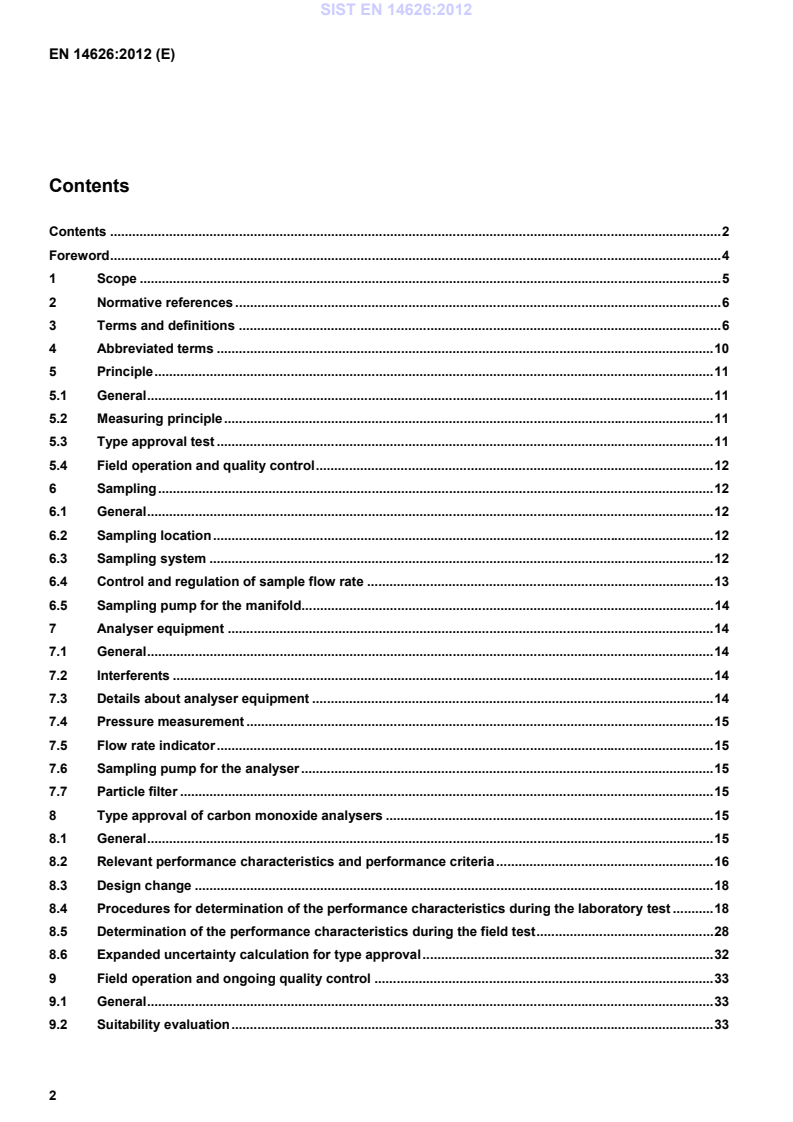
Test of lack of fit . 48Annex B (informative)
Sampling equipment. 50Annex C (informative)
Schematics of non-dispersive infrared spectrometer . 52Annex D (informative)
Manifold testing . 54Annex E (normative)
Type approval . 56Annex F (informative)
Calculation of uncertainty in field operation at the 8-hour limit value . 75Annex G (informative)
Significant technical changes . 83Bibliography . 84 SIST EN 14626:2012
According to the CEN/CENELEC Internal Regulations, the national standards organisations of the following countries are bound to implement this European Standard: Austria, Belgium, Bulgaria, Croatia, Cyprus, Czech Republic, Denmark, Estonia, Finland, Former Yugoslav Republic of Macedonia, France, Germany, Greece, Hungary, Iceland, Ireland, Italy, Latvia, Lithuania, Luxembourg, Malta, Netherlands, Norway, Poland, Portugal, Romania, Slovakia, Slovenia, Spain, Sweden, Switzerland, Turkey and the United Kingdom. SIST EN 14626:2012
NOTE 2 When the standard is used for other purposes than for measurements required by Directive 2008/50/EC, the ranges and uncertainty requirements may not apply. The method covers the determination of ambient air concentrations of carbon monoxide in zones classified as rural areas, urban-background areas and traffic-orientated locations and locations influenced by industrial sources.
The results are expressed in mg/m3 (at 20 °C and 101,3 kPa). NOTE 3 100 mg/m3 of CO corresponds to 86 µmol/mol of CO. This standard contains information for different groups of users. Clauses 5 to 7 and Annexes B, C and D contain general information about the principles of carbon monoxide measurement by non-dispersive infrared spectroscopic analyser and sampling equipment. Clause 8 and Annex E are specifically directed towards test houses and laboratories that perform type-approval testing of carbon monoxide analysers. These sections contain information about: type-approval test conditions, test procedures and test requirements; analyser performance requirements; evaluation of the type-approval test results; evaluation of the uncertainty of the measurement results of the carbon monoxide analyser based on the type-approval test results. Clauses 9 to 11 and Annex F are directed towards monitoring networks performing the practical measurements of carbon monoxide in ambient air. These sections contain information about: initial installation of the analyser in the monitoring network and acceptance testing; ongoing quality assurance/quality control; calculation and reporting of measurement results; evaluation of the uncertainty of measurement results under practical monitoring conditions.
(ISO 6144) EN ISO 6145-6, Gas analysis — Preparation of calibration gas mixtures using dynamic volumetric methods — Part 6: Critical orifices (ISO 6145-6) EN ISO 6145-7, Gas analysis — Preparation of calibration gas mixtures using dynamic volumetric methods — Part 7: Thermal mass-flow controllers (ISO 6145-7) EN ISO 14956, Air quality — Evaluation of the suitability of a measurement procedure by comparison with a required measurement uncertainty (ISO 14956) EN ISO/IEC 17025, General requirements for the competence of testing and calibration laboratories
(ISO/IEC 17025) ENV 13005:1999, Guide to the expression of uncertainty in measurement
3 Terms and definitions For the purpose of this document, the following terms and definitions apply. 3.1 adjustment set of operations carried out on a measuring system so that it provides prescribed indications corresponding to given values of a quantity to be measured Note 1 to entry:
Types of adjustment of a measuring system include zero adjustment of a measuring system, offset adjustment, and span adjustment (sometimes called gain adjustment). Note 2 to entry:
Adjustment of a measuring system should not be confused with calibration, which is a prerequisite for adjustment. [SOURCE: JCGM 200:2012 (VIM) [2]] Note 3 to entry:
In the context of this standard, adjustment is performed on measurement data rather than on the analyser. 3.2 ambient air outdoor air in the troposphere, excluding workplaces as defined by Directive 89/654/EEC, where provisions concerning health and safety at work apply and to which members of the public do not have regular access [SOURCE: 2008/50/EC[1]] SIST EN 14626:2012
3.5 calibration operation that, under specified conditions, in a first step, establishes a relation between the quantity values with measurement uncertainties provided by measurement standards and corresponding indications with associated measurement uncertainties and, in a second step, uses this information to establish a relation for obtaining a measurement result from an indication Note 1 to entry: A calibration may be expressed by a statement, calibration function, calibration diagram, calibration curve, or calibration table. In some cases, it may consist of an additive or multiplicative correction of the indication with associated measurement uncertainty. Note 2 to entry: Calibration should not be confused with adjustment of a measuring system, often mistakenly called “self-calibration”, nor with verification of a calibration. Note 3 to entry:
Often, the first step alone in the above definition is perceived as being calibration.
[SOURCE: JCGM 200:2012 (VIM) [2]] Note 4 to entry:
In the context of this standard, calibration is a comparison of the analyser response to a known gas concentration with a known uncertainty when the information obtained from the comparison is used for the successive adjustment (if needed) of the analyser. 3.6 certification range concentration range for which the analyser is type-approved 3.7 check verification that the analyser is still operating within specified performance limits
3.8 combined standard uncertainty standard uncertainty of the result of a measurement when that result is obtained from the values of a number of other quantities, equal to the positive square root of a sum of terms, the terms being the variances or co-variances of these other quantities weighted according to how the measurement result varies with changes in these quantities [SOURCE: ENV 13005:1999] 3.9 coverage factor numerical factor used as a multiplier of the combined standard uncertainty in order to obtain an expanded uncertainty [SOURCE: ENV 13005:1999] 3.10 designated body body which has been designated for a specific task (type approval tests and/or QA/QC activities in the field) by the competent authority in the Member States SIST EN 14626:2012
3.12 expanded uncertainty quantity defining an interval about the result of a measurement that may be expected to encompass a large fraction of the distribution of values that could reasonably be attributed to the measurand
Note 1 to entry:
The fraction may be viewed as the coverage probability or level of confidence of the interval. Note 2 to entry:
To associate a specific level of confidence with the interval defined by the expanded uncertainty requires explicit or implicit assumptions regarding the probability distribution characterised by the measurement result and its combined standard uncertainty. The level of confidence that may be attributed to this interval can be known only to the extent to which such assumptions may be justified. [SOURCE: ENV 13005:1999] Note 3 to entry: For the purpose of this standard the expanded uncertainty is the combined standard uncertainty multiplied by a coverage factor k=2 resulting in an interval with a level of confidence of 95 %. 3.13 fall time difference between the response time (fall) and the lag time (fall) 3.14 independent measurement individual measurement that is not influenced by a previous individual measurement by separating two individual measurements by at least four response times Note 1 to entry: The largest value of response time (rise) and response time (fall) are intended. 3.15 individual measurement measurement averaged over a time period equal to the response time of the analyser Note 1 to entry: The largest value of response time (rise) and response time (fall) are intended. Note 2 to entry: This definition differs from the meaning of the concept “individual measurement” in Directive 2008/50/EC [1]. 3.16 influence quantity quantity that is not the measurand but that affects the result of the measurement
[SOURCE: ENV 13005:1999] 3.17 interferent component of the air sample, excluding the measured constituent, that affects the output signal 3.18 lack of fit maximum deviation from the linear regression line of the average of a series of measurement results at the same concentration
3.23 parallel measurements measurements from different analysers, sampling from one and the same sampling manifold, starting at the same time and ending at the same time 3.24 performance characteristic one of the parameters assigned to equipment in order to define its performance 3.25 performance criterion limiting quantitative numerical value assigned to a performance characteristic, to which conformance is tested 3.26 period of unattended operation time period over which the drift complies with the performance criterion for long term drift 3.27 repeatability (of results of measurement) closeness of the agreement between the results of successive individual measurements of carbon monoxide carried out under the same conditions of measurement Note 1 to entry: These conditions include: a) the same measurement procedure; b) the same observer; c) the same analyser, used under the same conditions; d) at the same location; e) repetition over a short period of time. 3.28 reproducibility under field conditions closeness of the agreement between the results of simultaneous measurements with two analysers in ambient air carried out under the same conditions of measurement Note 1 to entry: These conditions are called field reproducibility conditions and include: a) the same measurement procedure; b) two identical analysers, used under the same conditions; SIST EN 14626:2012
Note 1 to entry: The term ‘gas’ may refer to a test gas used in type-approval testing or to ambient air transferred to the analyser.
3.32 sampling system the assembly of components needed to transfer ambient air to the analyser 3.33 short-term drift difference between zero or span readings at the beginning and end of a 12 h period 3.34 standard uncertainty uncertainty of the result of a measurement expressed as a standard deviation
[SOURCE: ENV 13005:1999] 3.35 surrounding temperature temperature of the air directly surrounding the analyser 3.36 type approval decision taken by a designated body that the pattern of an analyser conforms to specified requirements
3.37 type approval test examination of two or more analysers of the same pattern which are submitted by a manufacturer to a designated body including the tests necessary for approval of the pattern 3.38 uncertainty (of measurement) parameter associated with the result of a measurement that characterises the dispersion of the values that could reasonably be attributed to the measurand [SOURCE: ENV 13005:1999] 4 Abbreviated terms
FEP
perfluoro-ethylene-propylene MFC mass flow controller SIST EN 14626:2012
6.1 General Depending on the installation of the infrared analyser at a monitoring station, a single sampling line for the analyser may be chosen. Alternatively, sampling can take place from a sampling system consisting of a common sampling inlet with a sampling manifold to which other analysers and equipment may be attached. Conditions and layout of the sampling system will contribute to the uncertainty of the measurement; to minimise this contribution to the expanded uncertainty, requirements for the sampling equipment are given in the following sub-clauses. NOTE
In Annex B, different arrangements of the sampling equipment are schematically presented. 6.2 Sampling location
The location where the ambient air shall be sampled and analysed is not specified as this depends strongly on the category of a monitoring station (such as measurements taken in e.g. a rural area or background area). Criteria on sampling points on a micro scale are given in Annex III of Directive 2008/50/EC [1]. 6.3 Sampling system 6.3.1 Construction The sampling system shall include a sampling inlet and may include the following components: a sampling line or manifold; a particle filter placed between the sampling line or manifold and the analyser; a sampling pump in case a sampling manifold is used. The sample inlet shall be constructed in such a way that ingress of rainwater into the sampling line or manifold is prevented. The sampling line or manifold shall be as short as practical to minimise the residence time. In the case where a sampling manifold is used, an additional pump is necessary with sufficient capacity to fulfil the sampling requirements stated in the previous sub-clauses (see also 6.5 and Annex D).
The material of the sample inlet as well as the sampling line or manifold can influence the composition of the sample. In practice, the best materials, such as polytetrafluoroethylene (PTFE), perfluoro-ethylene-propylene SIST EN 14626:2012
NOTE This value can be achieved when the quality assurance and quality control requirements (see Clause 9) are followed.
The sampling line or manifold may be moderately heated to avoid condensation. Condensation may occur in the case of high ambient temperature and/or humidity. The influence on the measured concentrations of the pressure drop along the sampling inlet and line or manifold and the particle filter shall be ≤ 1,0 %. 6.3.2 Particle filter A particle filter shall be placed between the sampling line or manifold and the inlet of the analyser. The filter shall retain all particles likely to alter the performance of the analyser. It shall be made of PTFE. The material of the filter housing shall be chemically inert to carbon monoxide. The filter may be internal to the analyser (see 7.7) or external. In case the analyser contains a built-in filter, an external filter is not necessary. NOTE 1 A pore size of the filter of 5 µm usually fulfils this requirement. NOTE 2 Suitable materials for the filter housing are for example PTFE, stainless steel, or borosilicate glass.
The particle filter shall be conditioned before used in measurements. The filter shall be changed periodically depending on the dust loading at the sampling site (as indicated in 9.7). The filter housing shall be cleaned at least every six months. Overloading of the filter may cause loss of carbon monoxide by adsorption on the particle matter and may increase the pressure drop in the sampling line. 6.3.3 Loss of carbon monoxide Depending on the location of the particle filter, the sampling system can be contaminated by deposition of dust. This can induce losses of carbon monoxide. The sampling system shall be cleaned (as stated in 9.4.1) with a frequency which is dependent on the site-specific conditions. 6.3.4 Conditioning The sampling system and the particle filter shall be conditioned (at initial installation and after each cleaning) to avoid temporary decreases in the measured carbon monoxide concentrations by sampling ambient air for a period of at least 30 min at the nominal sample flow rate. Conditioning may also be done in the laboratory before installation. These conditioning periods shall not be included in the calculation of the availability of the analyser during the type approval test (see 8.5.7). NOTE Conditioning during field operation is considered a part of normal maintenance. Consequently, the concentrations measured during conditioning need not be included in the calculation of data capture, and eight-hourly averages. 6.4 Control and regulation of sample flow rate The sample flow rate into the analyser shall be maintained within the specifications of the manufacturer of the analyser.
NOTE The flow rate into the infrared analyser is usually controlled by means of restrictors. SIST EN 14626:2012
The influence of the pressure drop induced by the manifold sampling pump on the measured concentration shall be ≤ 1,0 %. 7 Analyser equipment 7.1 General In Annex C, schematic diagrams are given of two types of non-dispersive infrared analysers. The non-dispersive infrared analyser consists of the principal components that are described in 7.3 to 7.6. 7.2 Interferents 7.2.1 General As various gases absorb infrared radiation, interference from these gases can occur when their infrared absorption bands coincide or overlap the CO infrared absorption bands. The degree of interference varies among individual NDIR analysers. In general, gas correlation spectrophotometers are less sensitive to the influence of interferences (see 5.2). 7.2.2 Water vapour The primary interferent is water vapour.
NOTE Water vapour interference can be minimised by using one or more of the following measures: a) drying the sampled air with use of a semi permeable membrane or a similar drying agent; b) maintaining a constant humidity in the sample and calibration gases by refrigeration or saturation and making a volume correction for the constant humidity; c) using narrow-band optical filters. 7.2.3 Carbon dioxide Interference may be caused by carbon dioxide (CO2).
NOTE The effect of CO2 interference at concentrations normally present in ambient air is minimal; that is, 340 µmol/mol volume fraction may give a response equivalent to 0,2 µmol/mol volume fraction [4]. If necessary, CO2 may be scrubbed with soda lime. 7.2.4 Hydrocarbons Hydrocarbons at concentrations normally found in the ambient air do not ordinarily interfere. NOTE 500 µmol/mol volume fraction of methane may give a response equivalent to 0,5 µmol/mol volume fraction [4]. 7.3 Details about analyser equipment
The main parts of the analyser consist of an infrared source, one or two absorption cells, an infrared detector and a chopper wheel for modulation of the infrared radiation to the detector. SIST EN 14626:2012
The signal shall be corrected also for external pressure and temperature fluctuations. Significant pressure variations are due to synoptic meteorological changes (up to + 3 %) or due to the altitude of the measurement site (about 10 % decrease in pressure for an 800 m rise in altitude). 7.5 Flow rate indicator A flow rate indicator shall be included in the analyser. 7.6 Sampling pump for the analyser The sampling pump is situated at the outlet of the analyser, and draws the sample through the analyser. It can be separate or part of the analyser. In any case it shall be capable of operating within the specified flow requirements of the manufacturer of the analyser and pressure conditions required for the NDIR absorption cell. 7.7 Particle filter An analyser will generally contain an internal particle filter (see 6.3.2). This filter shall be considered an integral part of the analyser in type-approval testing. 8 Type approval of carbon monoxide analysers 8.1 General
The determination of the concentration of carbon monoxide in ambient air shall fulfil the requirement of a maximum uncertainty in the measured values, which is prescribed by Annex I of Directive 2008/50/EC (15 % for fixed measurements or 25 % for indicative measurements). In order to achieve an uncertainty less than (or equal to) this required uncertainty, the infrared spectrometric analyser shall fulfil all the criteria for a number of performance characteristics which are given in this standard. The values of the selected performance characteristics shall be evaluated by means of laboratory tests and field tests. By combining the values of the selected performance characteristics in the expanded uncertainty calculation, a judgement shall be made whether or not the infrared spectrometric analyser meets the criterion of maximum uncertainty prescribed by Annex I of Directive 2008/50/EC (15 % for fixed measurements or 25 % for indicative measurements). This process of assessment (type approval test) of the values of the performance characteristics comprises laboratory tests and field tests and the calculation of the expanded uncertainty. At least two analysers of the same type shall be tested in the laboratory. Two of these analysers shall be tested during the field test. All analysers tested are required to pass all tests. The type approval procedure shall fulfil the certification requirements laid down in EN 15267-1 and EN 15267-2. A designated body shall perform the type approval tests. The designated body for the type approval test shall be SIST EN 14626:2012
a) performance testing of an AMS; b) initial assessment of the AMS manufacturer’s quality management system; c) certification; d) post-certification product-surveillance. EN 15267-2 covers the supplementary requirements for an AMS manufacturer’s management system to
EN ISO 9001 [6] for the control of design and manufacturing of AMS. This European Standard also serves as a reference document for auditing the AMS manufacturer’s management system.
8.2 Relevant performance characteristics and performance criteria The performance characteristics which shall be determined during a laboratory and field test, and their related performance criteria, are given in Table 1. Table 1 applies to those ranges that are specified as normative in the scope of this standard. When type-approval tests are performed on analysers with other certification ranges, the performance criteria stated in absolute units such as µmol/mol/K may need to be modified in order to meet the uncertainty criteria in Annex I from Directive 2008/50/EC. All criteria expressed in relative units (e.g. %) shall remain the same. The determination of the value of the performance characteristics stated in Table 1 shall be performed by a designated body during the laboratory test and field test according to the procedures described in 8.4, 8.5 and Annex A. Table 1 — Relevant performance characteristics and criteria No. Performance characteristic Symbol SectionLab. t
...