

EN 1990:2023
(Main)Eurocode - Basis of structural and geotechnical design
- Abstract
Scope of FprEN 1990
(1) This document establishes principles and requirements for the safety, serviceability, robustness and durability of structures, including geotechnical structures, appropriate to the consequences of failure.
(2) This document is intended to be used in conjunction with the other Eurocodes for the design of buildings and civil engineering works, including temporary structures.
(3) This document describes the basis for structural and geotechnical design and verification according to the limit state principle.
(4) The verification methods in this document are based primarily on the partial factor method.
NOTE 1 Alternative methods are given in the other Eurocodes for specific applications.
NOTE 2 The Annexes to this document also provide general guidance concerning the use of alternative methods.
(5) This document is also applicable for:
- structural assessment of existing structures;
- developing the design of repairs, improvements and alterations;
- assessing changes of use.
NOTE Additional or amended provisions can be necessary.
(6) This document is applicable for the design of structures where materials or actions outside the scope of EN 1991 (all parts) to EN 1999 (all parts) are involved.
NOTE In this case, additional or amended provisions can be necessary.
1.2 Assumptions
(1) It is assumed that reasonable skill and care appropriate to the circumstances is exercised in the design, based on the knowledge and good practice generally available at the time the structure is designed.
(2) It is assumed that the design of the structure is made by appropriately qualified and experienced personnel.
(3) The design rules provided in the Eurocodes assume that:
- execution will be carried out by personnel having appropriate skill and experience;
- adequate control and supervision will be provided during design and execution of the works, whether in factories, plants, or on site;
- construction materials and products will be used in accordance with the Eurocodes, in the relevant product and execution standards, and project specifications;
- the structure will be adequately maintained;
- the structure will be used in accordance with the design assumptions.
NOTE Guidance on management measures to satisfy the assumptions for design and execution is given in
Annex B.
- Status
- Withdrawn
- Publication Date
- 21-Mar-2023
- Withdrawal Date
- 06-Oct-2026
- Technical Committee
- CEN/TC 250 - Structural Eurocodes
- Drafting Committee
- CEN/TC 250/SC 10 - EN 1990 Basis of structural design
- Current Stage
- 9960 - Withdrawal effective - Withdrawal
- Start Date
- 18-Mar-2026
- Completion Date
- 07-Oct-2026


Overview
EN 1990:2023 - Eurocode: Basis of structural and geotechnical design establishes the fundamental principles, requirements and verification framework for the safety, serviceability, robustness and durability of structures, including geotechnical works. Intended to be used together with the other Eurocodes (EN 1991 to EN 1999), EN 1990 defines the basis for structural and geotechnical design using the limit state principle and sets out verification methods primarily based on the partial factor method. It also applies to assessment and retrofit of existing structures, design of repairs and changes of use, and to structures involving materials or actions outside EN 1991–1999 (with possible additional provisions).
Key topics and requirements
- Limit state design framework - Defines Ultimate Limit States (ULS) and Serviceability Limit States (SLS) and their role in structural verification.
- Partial factor method - Primary verification approach for design values of actions, resistances, materials and geometry (EN 1990 gives principles; detailed application in other Eurocodes).
- Actions and environmental influences - Classification and representative values of actions, combinations and load models for design situations (permanent, variable, accidental, seismic, etc.).
- Reliability and robustness - Principles for structural reliability, consequence classes, robustness measures and requirements to avoid disproportionate collapse.
- Design service life and durability - Guidance on design life, durability considerations and maintenance assumptions that influence material selection and detailing.
- Assumptions on competence and execution - Design assumes appropriately qualified personnel, skilled execution, adequate supervision and maintenance; Annex B provides technical management guidance.
- Supplementary guidance and annexes - Annex A (application rules for buildings, bridges, towers, silos, tanks, cranes, marine works), Annex C (reliability analysis and code calibration), Annex D (design assisted by testing), Annex E (robustness guidance), Annex F (fatigue methods).
Practical applications and users
- Who uses EN 1990:
- Structural and geotechnical engineers and designers
- Bridge and infrastructure engineers
- Construction contractors, certifiers and authorities
- Engineers assessing existing structures, repairs or change of use
- Typical applications:
- Design of buildings, bridges, towers, masts, chimneys, silos, tanks, marine/coastal and temporary structures
- Structural assessment, retrofit and strengthening projects
- Calibration of project-specific partial factors and reliability analyses
- Integrating testing results into design verification
Related standards
- EN 1991 to EN 1999 (Eurocodes for actions, concrete, steel, composite, timber, masonry, geotechnical design, etc.)
- National Annexes and project specifications that adapt EN 1990 principles to country-specific safety levels and execution standards
EN 1990:2023 is the foundational Eurocode for consistent, reliable structural and geotechnical design across Europe - essential reading for professionals applying limit state design and partial factor verification in practice.
Relations
- Effective Date
- 29-Mar-2023
- Effective Date
- 29-Mar-2023
- Effective Date
- 29-Mar-2023
- Effective Date
- 29-Mar-2023
- Effective Date
- 29-Mar-2023
- Effective Date
- 19-Jan-2023
- Effective Date
- 18-May-2022
- Effective Date
- 17-Sep-2026
- Refers
EN 1998-1-2:2026 - Eurocode 8 - Design of structures for earthquake resistance - Part 1-2: Buildings - Effective Date
- 25-Mar-2026
- Effective Date
- 25-Mar-2026
- Effective Date
- 25-Mar-2026
- Effective Date
- 25-Mar-2026
- Effective Date
- 25-Mar-2026
- Effective Date
- 25-Mar-2026
- Refers
EN 1993-6:2026 - Eurocode 3 - Design of steel structures - Part 6: Crane supporting structures - Effective Date
- 25-Mar-2026
Get Certified
Connect with accredited certification bodies for this standard

DIBt (Deutsches Institut für Bautechnik)
German Institute for Building Technology.
DIN CERTCO
DIN Group product certification.

Aboma Certification B.V.
Specialized in construction, metal, and transport sectors.
Sponsored listings
Frequently Asked Questions
EN 1990:2023 is a standard published by the European Committee for Standardization (CEN). Its full title is "Eurocode - Basis of structural and geotechnical design". This standard covers: Scope of FprEN 1990 (1) This document establishes principles and requirements for the safety, serviceability, robustness and durability of structures, including geotechnical structures, appropriate to the consequences of failure. (2) This document is intended to be used in conjunction with the other Eurocodes for the design of buildings and civil engineering works, including temporary structures. (3) This document describes the basis for structural and geotechnical design and verification according to the limit state principle. (4) The verification methods in this document are based primarily on the partial factor method. NOTE 1 Alternative methods are given in the other Eurocodes for specific applications. NOTE 2 The Annexes to this document also provide general guidance concerning the use of alternative methods. (5) This document is also applicable for: - structural assessment of existing structures; - developing the design of repairs, improvements and alterations; - assessing changes of use. NOTE Additional or amended provisions can be necessary. (6) This document is applicable for the design of structures where materials or actions outside the scope of EN 1991 (all parts) to EN 1999 (all parts) are involved. NOTE In this case, additional or amended provisions can be necessary. 1.2 Assumptions (1) It is assumed that reasonable skill and care appropriate to the circumstances is exercised in the design, based on the knowledge and good practice generally available at the time the structure is designed. (2) It is assumed that the design of the structure is made by appropriately qualified and experienced personnel. (3) The design rules provided in the Eurocodes assume that: - execution will be carried out by personnel having appropriate skill and experience; - adequate control and supervision will be provided during design and execution of the works, whether in factories, plants, or on site; - construction materials and products will be used in accordance with the Eurocodes, in the relevant product and execution standards, and project specifications; - the structure will be adequately maintained; - the structure will be used in accordance with the design assumptions. NOTE Guidance on management measures to satisfy the assumptions for design and execution is given in Annex B.
Scope of FprEN 1990 (1) This document establishes principles and requirements for the safety, serviceability, robustness and durability of structures, including geotechnical structures, appropriate to the consequences of failure. (2) This document is intended to be used in conjunction with the other Eurocodes for the design of buildings and civil engineering works, including temporary structures. (3) This document describes the basis for structural and geotechnical design and verification according to the limit state principle. (4) The verification methods in this document are based primarily on the partial factor method. NOTE 1 Alternative methods are given in the other Eurocodes for specific applications. NOTE 2 The Annexes to this document also provide general guidance concerning the use of alternative methods. (5) This document is also applicable for: - structural assessment of existing structures; - developing the design of repairs, improvements and alterations; - assessing changes of use. NOTE Additional or amended provisions can be necessary. (6) This document is applicable for the design of structures where materials or actions outside the scope of EN 1991 (all parts) to EN 1999 (all parts) are involved. NOTE In this case, additional or amended provisions can be necessary. 1.2 Assumptions (1) It is assumed that reasonable skill and care appropriate to the circumstances is exercised in the design, based on the knowledge and good practice generally available at the time the structure is designed. (2) It is assumed that the design of the structure is made by appropriately qualified and experienced personnel. (3) The design rules provided in the Eurocodes assume that: - execution will be carried out by personnel having appropriate skill and experience; - adequate control and supervision will be provided during design and execution of the works, whether in factories, plants, or on site; - construction materials and products will be used in accordance with the Eurocodes, in the relevant product and execution standards, and project specifications; - the structure will be adequately maintained; - the structure will be used in accordance with the design assumptions. NOTE Guidance on management measures to satisfy the assumptions for design and execution is given in Annex B.
EN 1990:2023 is classified under the following ICS (International Classification for Standards) categories: 91.010.30 - Technical aspects. The ICS classification helps identify the subject area and facilitates finding related standards.
EN 1990:2023 has the following relationships with other standards: It is inter standard links to EN 1997-1:2004/A1:2013, EN 1990:2002/A1:2005/AC:2008, EN 1990:2002/A1:2005/AC:2010, EN 1997-1:2004/AC:2009, EN 1990:2002/A1:2005, EN 1990:2002, EN 1997-1:2004, EN 1993-7:2026, EN 1998-1-2:2026, EN 1993-4-1:2026, EN 1993-1-11:2026, EN 1991-1-8:2026, EN 1995-2:2026, EN 1993-4-2:2026, EN 1993-6:2026. Understanding these relationships helps ensure you are using the most current and applicable version of the standard.
EN 1990:2023 is associated with the following European legislation: EU Directives/Regulations: 2016/797/EU, 2016/797/EU, 2016/797/EU, 2016/797/EU, 2016/797/EU, 2016/797/EU, 2016/797/EU, 2016/797/EU, 2016/797/EU, 2016/797/EU, 2016/797/EU, 2016/797/EU, 2016/797/EU, 305/2011; Standardization Mandates: M/515. When a standard is cited in the Official Journal of the European Union, products manufactured in conformity with it benefit from a presumption of conformity with the essential requirements of the corresponding EU directive or regulation.
EN 1990:2023 is available in PDF format for immediate download after purchase. The document can be added to your cart and obtained through the secure checkout process. Digital delivery ensures instant access to the complete standard document.
Standards Content (Sample)
SLOVENSKI STANDARD
SIST EN 1990:2023
01-september-2023
Nadomešča:
SIST EN 1990:2004
SIST EN 1990:2004/A1:2006
SIST EN 1990:2004/A1:2006/AC:2009
SIST EN 1990:2004/A1:2006/AC:2010
SIST EN 1997-1:2005
SIST EN 1997-1:2005/A1:2014
SIST EN 1997-1:2005/AC:2009
Evrokod - Osnove projektiranja konstrukcij in geotehničnega projektiranja
Eurocode - Basis of structural and geotechnical design
Eurocode - Grundlagen der Planung von Tragwerken und geotechnischen Bauwerken
Eurocodes - Bases des calculs structuraux et géotechniques
Ta slovenski standard je istoveten z: EN 1990:2023
ICS:
91.010.30 Tehnični vidiki Technical aspects
SIST EN 1990:2023 en,fr,de
2003-01.Slovenski inštitut za standardizacijo. Razmnoževanje celote ali delov tega standarda ni dovoljeno.
SIST EN 1990:2023
SIST EN 1990:2023
EN 1990
EUROPEAN STANDARD
NORME EUROPÉENNE
March 2023
EUROPÄISCHE NORM
ICS 91.010.30 Supersedes EN 1990:2002, EN 1997-1:2004
English Version
Eurocode - Basis of structural and geotechnical design
Eurocodes - Bases des calculs structuraux et Eurocode - Grundlagen der Planung von Tragwerken
géotechniques und geotechnischen Bauwerken
This European Standard was approved by CEN on 2 January 2023.
CEN members are bound to comply with the CEN/CENELEC Internal Regulations which stipulate the conditions for giving this
European Standard the status of a national standard without any alteration. Up-to-date lists and bibliographical references
concerning such national standards may be obtained on application to the CEN-CENELEC Management Centre or to any CEN
member.
This European Standard exists in three official versions (English, French, German). A version in any other language made by
translation under the responsibility of a CEN member into its own language and notified to the CEN-CENELEC Management
Centre has the same status as the official versions.
CEN members are the national standards bodies of Austria, Belgium, Bulgaria, Croatia, Cyprus, Czech Republic, Denmark, Estonia,
Finland, France, Germany, Greece, Hungary, Iceland, Ireland, Italy, Latvia, Lithuania, Luxembourg, Malta, Netherlands, Norway,
Poland, Portugal, Republic of North Macedonia, Romania, Serbia, Slovakia, Slovenia, Spain, Sweden, Switzerland, Türkiye and
United Kingdom.
EUROPEAN COMMITTEE FOR STANDARDIZATION
COMITÉ EUROPÉEN DE NORMALISATION
EUROPÄISCHES KOMITEE FÜR NORMUNG
CEN-CENELEC Management Centre: Rue de la Science 23, B-1040 Brussels
© 2023 CEN All rights of exploitation in any form and by any means reserved Ref. No. EN 1990:2023 E
worldwide for CEN national Members.
SIST EN 1990:2023
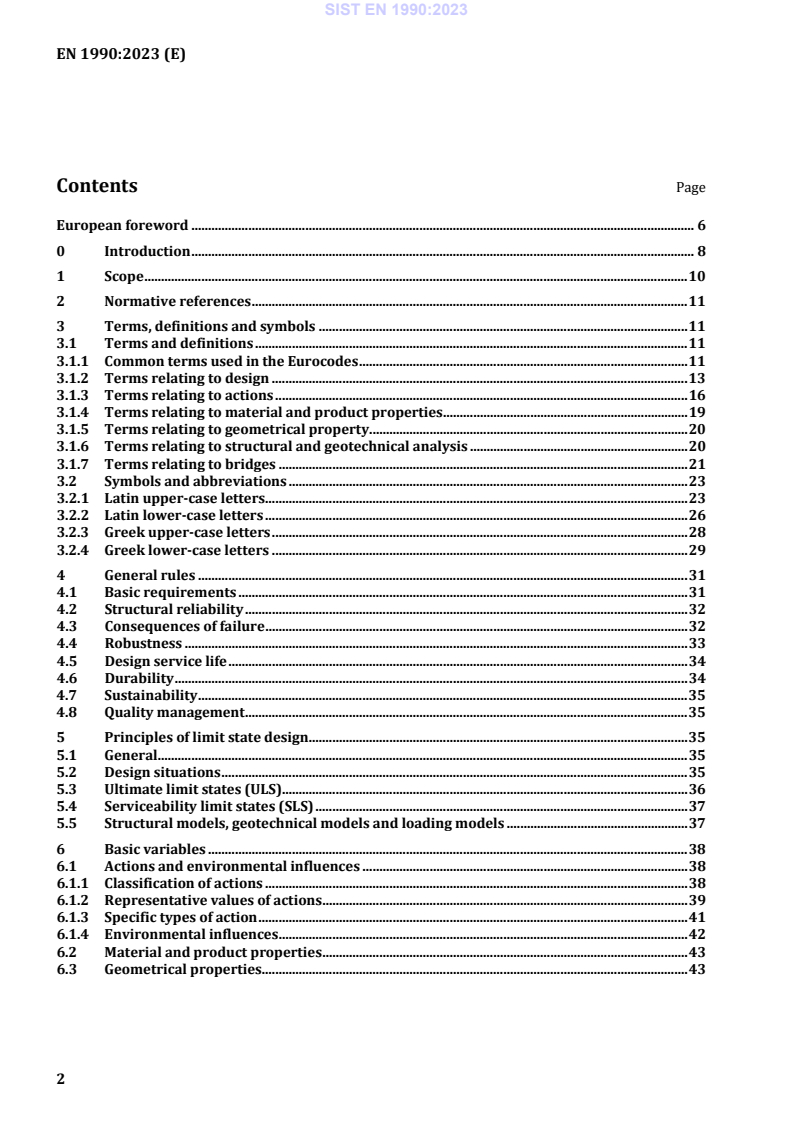
Contents Page
European foreword . 6
0 Introduction . 8
1 Scope . 10
2 Normative references . 11
3 Terms, definitions and symbols . 11
3.1 Terms and definitions . 11
3.1.1 Common terms used in the Eurocodes . 11
3.1.2 Terms relating to design . 13
3.1.3 Terms relating to actions . 16
3.1.4 Terms relating to material and product properties . 19
3.1.5 Terms relating to geometrical property . 20
3.1.6 Terms relating to structural and geotechnical analysis . 20
3.1.7 Terms relating to bridges . 21
3.2 Symbols and abbreviations . 23
3.2.1 Latin upper-case letters . 23
3.2.2 Latin lower-case letters . 26
3.2.3 Greek upper-case letters . 28
3.2.4 Greek lower-case letters . 29
4 General rules . 31
4.1 Basic requirements . 31
4.2 Structural reliability . 32
4.3 Consequences of failure . 32
4.4 Robustness . 33
4.5 Design service life . 34
4.6 Durability . 34
4.7 Sustainability . 35
4.8 Quality management . 35
5 Principles of limit state design . 35
5.1 General . 35
5.2 Design situations . 35
5.3 Ultimate limit states (ULS). 36
5.4 Serviceability limit states (SLS) . 37
5.5 Structural models, geotechnical models and loading models . 37
6 Basic variables . 38
6.1 Actions and environmental influences . 38
6.1.1 Classification of actions . 38
6.1.2 Representative values of actions . 39
6.1.3 Specific types of action . 41
6.1.4 Environmental influences . 42
6.2 Material and product properties . 43
6.3 Geometrical properties . 43
SIST EN 1990:2023
7 Structural analysis and design assisted by testing . 44
7.1 Structural modelling. 44
7.1.1 General . 44
7.1.2 Static actions. 44
7.1.3 Dynamic actions . 44
7.1.4 Actions inducing fatigue . 45
7.1.5 Fire design . 45
7.2 Structural analysis . 46
7.2.1 Linear analysis . 46
7.2.2 Non-linear analysis . 46
7.3 Design assisted by testing . 46
8 Verification by the partial factor method . 47
8.1 General . 47
8.2 Limitations . 47
8.3 Verification of ultimate limit states (ULS) . 48
8.3.1 General . 48
8.3.2 Design values of the effects of actions . 48
8.3.3 Design values of actions . 51
8.3.4 Combination of actions . 53
8.3.5 Design values of resistance . 56
8.3.6 Design values of material properties . 59
8.3.7 Design values of geometrical properties . 59
8.4 Verification of serviceability limit states (SLS). 60
8.4.1 General . 60
8.4.2 Design values of the effects of actions . 60
8.4.3 Combinations of actions . 61
8.4.4 Design criteria . 62
8.4.5 Design values of material properties . 62
8.4.6 Design values of geometrical properties . 62
Annex A (normative) Application rules . 63
A.1 General application and application for buildings . 63
A.2 Application for bridges . 78
A.3 Application for towers, masts and chimneys . 114
A.4 Application for silos and tanks . 114
A.5 Application for structures supporting cranes . 114
A.6 Application for marine coastal structures . 114
Annex B (informative) Technical management measures for design and execution . 115
B.1 Use of this annex . 115
B.2 Scope and field of application . 115
B.3 Choice of technical management measures . 115
B.4 Design quality . 115
B.5 Design checking . 116
B.6 Execution quality . 117
B.7 Inspection during execution . 117
B.8 Technical management measures . 118
SIST EN 1990:2023
Annex C (informative) Reliability analysis and code calibration . 119
C.1 Use of this annex. 119
C.2 Scope and field of application. 119
C.3 Basis for reliability analysis and partial factor design. 119
C.4 Approach for calibration of design values . 126
Annex D (informative) Design assisted by testing . 132
D.1 Use of this annex. 132
D.2 Scope and field of application. 132
D.3 Types of tests . 132
D.4 Planning of tests . 133
D.5 Derivation of characteristic or design values . 136
D.6 General principles for statistical evaluations. 137
D.7 Statistical determination of a single property . 138
D.8 Statistical determination of resistance models . 140
Annex E (informative) Additional guidance for enhancing the robustness of buildings and
bridges . 148
E.1 Use of this annex. 148
E.2 Scope and field of application. 148
E.3 Design strategies . 149
E.4 Design methods . 150
Annex F (informative) Rain-flow and reservoir counting methods for the determination of
stress ranges due to fatigue . 152
F.1 Use of this annex. 152
F.2 Scope and field of application. 152
F.3 Rain-flow counting method . 152
F.4 Reservoir counting method . 153
Annex G (normative) Basis of design for bearings . 155
G.1 Use of this annex. 155
G.2 Scope and field of application. 155
G.3 General rules . 155
G.4 Principles of limit state design . 160
G.5 Basic variables – Actions and environmental influences . 161
G.6 Structural analysis - Effects of deformation of piers and abutments . 161
G.7 Verification by the partial factor method . 162
Annex H (informative) Verifications concerning vibration of footbridges due to pedestrian
traffic . 169
H.1 Use of this annex. 169
SIST EN 1990:2023
H.2 Scope and field of application . 169
H.3 Dynamic load models and traffic classes . 169
H.4 Comfort criteria . 169
H.5 Design situations. 170
Bibliography . 172
SIST EN 1990:2023
European foreword
This document (EN 1990:2023) has been prepared by Technical Committee CEN/TC 250 “Structural
Eurocodes”, the secretariat of which is held by BSI. CEN/TC 250 is responsible for all Structural
Eurocodes and has been assigned responsibility for structural and geotechnical design matters by CEN.
This European Standard shall be given the status of a national standard, either by publication of an
identical text or by endorsement, at the latest by September 2027 and conflicting national standards
shall be withdrawn at the latest by March 2028.
Attention is drawn to the possibility that some of the elements of this document may be the subject of
patent rights. CEN shall not be held responsible for identifying any or all such patent rights.
This document supersedes EN 1990:2002 and its amendments and corrigenda.
In comparison with the previous edition, the following main changes have been made:
— extension of scope to include provisions for bearings;
— improved approach for ULS verification;
— improved provisions on robustness;
— improved provisions on fatigue verification;
— improved provisions for basis of design for geotechnical structures in alignment with EN 1997;
— inclusion of provisions for sustainability;
— improved guidance on reliability analysis and code calibration;
— improved guidance for SLS verification of buildings related to deflection limits, vibrations and
foundation movements;
— improved guidance on management of structural reliability of construction works;
— inclusion of guidance on verification of vibration of footbridges due to pedestrian traffic.
The first generation of EN Eurocodes was published between 2002 and 2007. This document forms
part of the second generation of the Eurocodes, which have been prepared under Mandate M/515
issued to CEN by the European Commission and the European Free Trade Association.
The Eurocodes have been drafted to be used in conjunction with relevant execution, material, product
and test standards, and to identify requirements for execution, materials, products and testing that are
relied upon by the Eurocodes.
The Eurocodes recognize the responsibility of each Member State and have safeguarded their right to
determine values related to regulatory safety matters at national level through the use of National
Annexes.
Any feedback and questions on this document should be directed to the users’ national standards
body. A complete listing of these bodies can be found on the CEN website.
SIST EN 1990:2023
According to the CEN-CENELEC Internal Regulations, the national standards organizations of the
following countries are bound to implement this European Standard: Austria, Belgium, Bulgaria,
Croatia, Cyprus, Czech Republic, Denmark, Estonia, Finland, France, Germany, Greece, Hungary,
Iceland, Ireland, Italy, Latvia, Lithuania, Luxembourg, Malta, Netherlands, Norway, Poland, Portugal,
Republic of North Macedonia, Romania, Serbia, Slovakia, Slovenia, Spain, Sweden, Switzerland, Türkiye
and the United Kingdom.
SIST EN 1990:2023
0 Introduction
0.1 Introduction to the Eurocodes
The Structural Eurocodes comprise the following standards generally consisting of a number of Parts:
— EN 1990 Eurocode – Basis of structural and geotechnical design
— EN 1991 Eurocode 1: Actions on structures
— EN 1992 Eurocode 2: Design of concrete structures
— EN 1993 Eurocode 3: Design of steel structures
— EN 1994 Eurocode 4: Design of composite steel and concrete structures
— EN 1995 Eurocode 5: Design of timber structures
— EN 1996 Eurocode 6: Design of masonry structures
— EN 1997 Eurocode 7: Geotechnical design
— EN 1998 Eurocode 8: Design of structures for earthquake resistance
— EN 1999 Eurocode 9: Design of aluminium structures
— New parts are under development, e.g. Eurocode for design of structural glass
The Eurocodes are intended for use by designers, clients, manufacturers, constructors, relevant
authorities (in exercising their duties in accordance with national or international regulations),
educators, software developers, and committees drafting standards for related product, testing and
execution standards.
NOTE Some aspects of design are most appropriately specified by relevant authorities or, where not
specified, can be agreed on a project-specific basis between relevant parties such as designers and clients. The
Eurocodes identify such aspects making explicit reference to relevant authorities and relevant parties.
0.2 Introduction to EN 1990
This document gives the principles and requirements for safety, serviceability, robustness, and
durability of structures that are common to all Eurocodes parts and are to be applied when using
them.
0.3 Verbal forms used in the Eurocodes
The verb “shall" expresses a requirement strictly to be followed and from which no deviation is
permitted in order to comply with the Eurocodes.
The verb “should” expresses a highly recommended choice or course of action. Subject to national
regulation and/or any relevant contractual provisions, alternative approaches could be used/adopted
where technically justified.
The verb “may" expresses a course of action permissible within the limits of the Eurocodes.
The verb “can" expresses possibility and capability; it is used for statements of fact and clarification of
concepts.
SIST EN 1990:2023
0.4 National Annex for EN 1990
National choice is allowed in this document where explicitly stated within notes. National choice
includes the selection of values for Nationally Determined Parameters (NDPs).
The national standard implementing EN 1990 can have a National Annex containing all national
choices to be used for the design of buildings and civil engineering works to be constructed in the
relevant country.
When no national choice is given, the default choice given in this document is to be used.
When no national choice is made and no default is given in this document, the choice can be specified
by a relevant authority or, where not specified, agreed for a specific project by appropriate parties.
National choice is allowed in EN 1990 through notes to the following:
4.2(3) 4.3(1) 4.4(2) 4.7(1)
6.1.3.2(4) – 3 choices 6.1.3.2(6) 7.1.5(7) 8.3.2.1(4)
8.3.3.1(5) 8.3.3.6(1) 8.3.4.2(2) – 2 choices A.1.3(1)
A.1.4(1) A.1.6.1(1) – 3 choices A.1.6.1(2) – 2 choices A.1.6.2(1)
A.1.6.3(1) A.1.6.3(2) A.1.7(1) – 2 choices A.1.8.1(1)
A.1.8.2.2(2) A.1.8.2.3(2) A.1.8.3(1) A.1.8.3(3)
A.1.8.3(4) A.1.8.4(2) A.1.8.4(4) – 3 choices A.2.3(1)
A.2.4(1) A.2.7.1(1) – 3 choices A.2.7.3.6(1) A.2.7.4.1(1) – 2 choices
A.2.7.4.3(1) A.2.7.4.5(1) A.2.7.4.6(1) – 2 choices A.2.7.5.1(1)
A.2.7.5.3(1) A.2.7.5.4(1) – 2 choices A.2.7.6.1(1) A.2.7.6.4(1)
A.2.7.10(5) – 2 choices A.2.7.10(9) A.2.8(1) – 3 choices A.2.9.1(1)
A.2.9.3.1(5) A.2.9.3.3(1) A.2.9.3.3(3) A.2.9.3.3(4)
A.2.9.4.1(1) – 2 choices A.2.9.4.2.1(3) A.2.9.4.2.2(4) A.2.9.4.2.2(5)
A.2.9.4.2.3(1) A.2.9.4.2.3(2) A.2.9.4.2.4(2) – 2 choices A.2.9.4.2.4(4)
A.2.9.5(1) A.2.10(1) A.2.11.1(9) A.2.11.4.5(3)
A.2.11.4.7(1) B.2(1) B.4(2) B.5(1)
B.6(1) B.6(2) B.7(1) B.8(1)
C.3.1(5) C.3.4.2(3) D.4.1(1) E.4(4)
G.2(1) G.3.1(6) G.3.3.2(1) G.3.3.2(2)
G.3.4(2) G.3.4(3) G.6(2) G.7.1.2(2)
G.7.1.3(2) G.7.3.2(2) G.7.4.2(1) G.7.5.1(1)
G.7.5.2(1) – 2 choices
National choice is allowed in EN 1990 on the application of the following informative annexes:
Annex B Annex C Annex D Annex E
Annex F Annex H
The National Annex can contain, directly or by reference, non-contradictory complementary
information for ease of implementation, provided it does not alter any provisions of the Eurocodes.
SIST EN 1990:2023
1 Scope
1.1 Scope of EN 1990
(1) This document establishes principles and requirements for the safety, serviceability, robustness
and durability of structures, including geotechnical structures, appropriate to the consequences of
failure.
(2) This document is intended to be used in conjunction with the other Eurocodes for the design of
buildings and civil engineering works, including temporary structures.
(3) This document describes the basis for structural and geotechnical design and verification
according to the limit state principle.
(4) The verification methods in this document are based primarily on the partial factor method.
NOTE 1 Alternative methods are given in the other Eurocodes for specific applications.
NOTE 2 The Annexes to this document also provide general guidance concerning the use of alternative
methods.
(5) This document is also applicable for:
— structural assessment of existing structures;
— developing the design of repairs, improvements and alterations;
— assessing changes of use.
NOTE Additional or amended provisions can be necessary.
(6) This document is applicable for the design of structures where materials or actions outside the
scope of EN 1991 (all parts) to EN 1999 (all parts) are involved.
NOTE In this case, additional or amended provisions can be necessary.
1.2 Assumptions
(1) It is assumed that reasonable skill and care appropriate to the circumstances is exercised in the
design, based on the knowledge and good practice generally available at the time the structure is
designed.
(2) It is assumed that the design of the structure is made by appropriately qualified and experienced
personnel.
(3) The design rules provided in the Eurocodes assume that:
— execution will be carried out by personnel having appropriate skill and experience;
— adequate control and supervision will be provided during design and execution of the works,
whether in factories, plants, or on site;
— construction materials and products will be used in accordance with the Eurocodes, in the
relevant product and execution standards, and project specifications;
— the structure will be adequately maintained;
— the structure will be used in accordance with the design assumptions.
NOTE Guidance on management measures to satisfy the assumptions for design and execution is given in
Annex B.
SIST EN 1990:2023
2 Normative references
The following documents are referred to in the text in such a way that some or all of their content
constitutes requirements of this document. For dated references, only the edition cited applies. For
undated references, the latest edition of the referenced document (including any amendments)
applies.
NOTE See the Bibliography for a list of other documents cited that are not normative references, including
those referenced as recommendations (i.e. in ‘should’ clauses), permissions (‘may’ clauses), possibilities ('can'
clauses), and in notes.
EN 1337-3, Structural bearings - Part 3: Elastomeric bearings
EN 1991 (all parts), Eurocode 1: Actions on structures
EN 1991-2:— , Eurocode 1: Actions on structures - Part 2: Traffic loads on bridges and other civil
engineering works
EN 1992 (all parts), Eurocode 2: Design of concrete structures
EN 1993 (all parts), Eurocode 3: Design of steel structures
EN 1994 (all parts), Eurocode 4: Design of composite steel and concrete structure
EN 1995 (all parts), Eurocode 5: Design of timber structures
EN 1996 (all parts), Eurocode 6: Design of masonry structures
EN 1997 (all parts), Eurocode 7: Geotechnical design
EN 1998 (all parts), Eurocode 8: Design of structures for earthquake resistance
EN 1999 (all parts), Eurocode 9: Design of aluminium structures
3 Terms, definitions and symbols
3.1 Terms and definitions
For the purposes of this document, the following terms and definitions apply.
3.1.1 Common terms used in the Eurocodes
3.1.1.1
construction works
everything that is constructed or results from construction operations
Note 1 to entry: The term covers both buildings and civil engineering works. It refers to the complete
construction works comprising structural members, geotechnical elements and elements other than structural.
Under preparation. Stage at the time of publication: prEN 1991-2:2021.
SIST EN 1990:2023
3.1.1.2
structure
part of the construction works that provides stability, resistance, and rigidity, to meet the safety,
serviceability and durability requirements
Note 1 to entry: This definition includes structures that comprise one member or a combination of connected
members.
3.1.1.3
structural member
physically distinguishable part of a structure, e.g. column, beam, plate, foundation
3.1.1.4
structural or geotechnical model
physical, mathematical, or numerical idealization of the structural or geotechnical system used for the
purposes of analysis, design, and verification
3.1.1.5
ground
soil, rock and fill existing in place prior to the execution of construction works
[SOURCE: ISO 6707-1:2020, 3.4.2.1]
3.1.1.6
geotechnical structure
structure that includes ground or a structural member that relies on the ground for resistance
3.1.1.7
elements other than structural
completion and finishing elements connected with the structure that are not classified as structural
members and that have the lowest consequence of failure
Note 1 to entry: See 4.3 for the classification of consequences of failure.
EXAMPLE Roofing; surfacing and coverings; partitions and linings; kerbs; wall cladding; suspended ceilings;
thermal insulation; bridge furniture, road surfacing; services fixed permanently to, or within, the structure such
as equipment for lifts and moving stairways; heating, ventilating and air conditioning equipment; electrical
equipment; pipes; cable trunking and conduits.
3.1.1.8
execution
all activities carried out for the physical completion of the work including procurement, the inspection
and documentation thereof
Note 1 to entry: The term covers work on site; it can also signify the fabrication of parts off site and their
subsequent erection on site.
3.1.1.9
quality
degree to which a set of inherent characteristics of an object fulfils requirements
Note 1 to entry: The term “quality” can be used with adjectives such as poor, good or excellent.
Note 2 to entry: “Inherent”, as opposed to “assigned”, means existing in the object.
[SOURCE: EN ISO 9000:2015, 3.6.2]
SIST EN 1990:2023
3.1.2 Terms relating to design
3.1.2.1
design criteria
quantitative formulations describing the conditions to be fulfilled for each limit state
3.1.2.2
design situation
physical conditions expected to occur during a certain time period for which it is to be demonstrated,
with sufficient reliability, that relevant limit states are not exceeded
3.1.2.3
persistent design situation
normal condition of use or exposure of the structure
Note 1 to entry: The duration of a persistent design situation is of the same order as the design service life of
the structure.
3.1.2.4
transient design situation
temporary conditions of use or exposure of the structure that are relevant during a period much
shorter than the design service life of the structure
Note 1 to entry: A transient design situation refers to temporary conditions of the structure, of use, or
exposure, e.g. during construction or repair.
3.1.2.5
fundamental design situation
design situation that is either a persistent or a transient design situation
3.1.2.6
accidental design situation
design situation in which the structure is subjected to exceptional events or exposure
Note 1 to entry: Caused by events such as fire, explosion, impact or local failure.
3.1.2.7
seismic design situation
design situation in which the structure is subjected to a seismic event
3.1.2.8
fatigue design situation
design situation where fatigue actions may cause fatigue failure
Note 1 to entry: For some materials, a distinction applies between low and high cycle fatigue. The other
Eurocodes give guidance, where relevant.
3.1.2.9
verification case
classification of load cases for fundamental design situations in ultimate limit states, for which a set of
partial factors is defined
3.1.2.10
fire design
design of a structure to fulfil the required performance in case of fire
SIST EN 1990:2023
3.1.2.11
design service life
assumed period for which a structure or part of it is to be used for its intended purpose with
anticipated maintenance but without major repair being necessary
3.1.2.12
load arrangement
identification of the position, magnitude, and direction of a free action
3.1.2.13
load case
compatible load arrangements, deformations and geometrical imperfections considered, where
relevant, for verification of a specific limit state
3.1.2.14
limit state
state beyond which the structure no longer satisfies the relevant design criteria
3.1.2.15
ultimate limit state
ULS
state associated with collapse or other forms of structural failure
3.1.2.16
serviceability limit state
SLS
state that corresponds to conditions beyond which specified service requirements for a structure or
structural member are no longer met
3.1.2.17
irreversible serviceability limit state
serviceability limit state in which effects of actions remain when the actions are removed
3.1.2.18
reversible serviceability limit state
serviceability limit state in which the effects of actions do not remain when the actions are removed
3.1.2.19
serviceability criterion
performance criterion for a serviceability limit state
3.1.2.20
resistance
capacity of a structure, or a part of it, to withstand actions without failure
3.1.2.21
strength
mechanical property of a material indicating its ability to resist actions, usually given in units of stress
3.1.2.22
fatigue
damaging process caused by cyclic actions or actions inducing cyclic effects that may culminate in
failure
SIST EN 1990:2023
3.1.2.23
excessive deformation
deformation that exceeds limits to such an extent that the structure can be considered to have reached
an ultimate limit state
3.1.2.24
structural reliability
ability of a structure or a structural member to fulfil the specified requirements during the service life
for which it has been designed
Note 1 to entry: Reliability covers safety, serviceability and durability of a structure.
3.1.2.25
reliability differentiation
measures intended for the socio-economic optimization of the resources to be used to execute
construction works, taking into account all the expected consequences of failure and the cost of the
construction works
3.1.2.26
basic variable
variable representing a physical quantity that characterizes actions and environmental influences,
geometrical quantities, and material properties, including ground properties
3.1.2.27
maintenance
set of activities performed during the service life of the structure so that it fulfils the requirements for
reliability
Note 1 to entry: Activities to restore the structure after an accidental or seismic event are normally outside the
scope of maintenance.
3.1.2.28
repair
activities, beyond the definition of maintenance, performed to preserve or to restore the function of a
structure
3.1.2.29
nominal value
value fixed on a non-statistical basis; for instance, on acquired experience or on physical conditions
3.1.2.30
robustness
ability of a structure to withstand unforeseen adverse events without being damaged to an extent
disproportionate to the original cause
3.1.2.31
durability
ability of a structure or structural member to satisfy, with planned maintenance, its design
performance requirements over the design service life
3.1.2.32
sustainability
ability to minimize the adverse impact of the construction works on non-renewable resources in the
environment, on society, and on economy during their entire life cycle
SIST EN 1990:2023
3.1.2.33
consequence class
categorization of the consequences of structural failure in terms of loss of human lives or personal
injury and of economic, social, or environmental losses
3.1.2.34
gross human error
error resulting from ignorance or oversight that causes a change in the behaviour or a reduction in
reliability of the structure that are unacceptable
3.1.3 Terms relating to actions
3.1.3.1
action
F
mechanical influence on a structure, or a structural member, exerted directly or indirectly from its
environment
3.1.3.2
direct action
set of forces, or loads, applied to the structure
3.1.3.3
indirect action
set of imposed deformations or accelerations
EXAMPLE Imposed deformations or accelerations caused by temperature changes, moisture variation,
uneven settlement or earthquakes.
3.1.3.4
effect of actions
E
action-effect
resulting effect, on a structural member or on the whole structure, from the application of actions
EXAMPLE Internal forces, moments, stresses, strains, deflections, and rotations.
3.1.3.5
permanent action
G
action that is likely to act throughout the design service life and for which any variation in magnitude
is either small, compared with the mean value, or monotonic; i.e. it either only increases or decreases,
until it reaches a limit value
3.1.3.6
variable action
Q
action that is likely to occur during the design service life for which the variation in magnitude with
time is neither negligible nor monotonic
3.1.3.7
fatigue action
F
fat
cyclic action or action inducing cyclic effects that can cause fatigue
--
...