

EN 1714:1997
(Main)Non-destructive examination of welds - Ultrasonic examination of welded joints
- Abstract
This European Standard specifies methods for the manual ultrasonic examination of fusion welded joints in metallic materials equal to and above 8 mm thick which exhibit low ultrasonic attenuation (especially that due to scatter). It is primarily intended for use on full penetration welded joints where both the welded and parent material are ferritic. Where specified and appropriate, techniques may also be used : - on materials other than those stated ; - on partial penetration welds ; - with automated equipment by agreement between the contracting parties. Where material dependent ultrasonic values are specified in this standard they are based on steels having an ultrasonic sound velocity of 5920 ñ 50 m/s for longitudinal waves, and 3255 ñ 30 m/s for transverse waves. This is to be taken into account when examining materials with a different velocity. The standard specifies four examination levels, each corresponding to a different probability of detection of imperfections. Guidance on the selection of examination levels A, B and C is given in annex A. The requirements of the fourth examination level, which is intended for special applications, are in accordance with the general requirements of this standard and as agreed between the contracting parties. This standard, by agreement between the contracting parties, permits assessment of indications, for acceptance purposes, by either of the following methods : 1) Evaluation based primarily on length and echo amplitude of the signal indication ; 2) Evaluation based on characterization and sizing of the indication by probe movement methods.
- Status
- Withdrawn
- Publication Date
- 19-Aug-1997
- Withdrawal Date
- 14-Dec-2010
- Technical Committee
- CEN/TC 121 - Welding
- Drafting Committee
- CEN/TC 121/SC 5 - Testing of welds (destructive and non-destructive)
- Current Stage
- 9960 - Withdrawal effective - Withdrawal
- Start Date
- 15-Dec-2010
- Completion Date
- 15-Dec-2010
87/404/EEC - Simple pressure vesselsOJ Ref: C, C 222 OJ Date: 04-Aug-1999
Buy Documents

EN 1714:1999
Relations
- Effective Date
- 18-Dec-2010
- Effective Date
- 28-Jan-2026
- Effective Date
- 28-Jan-2026
- Effective Date
- 28-Jan-2026
- Effective Date
- 28-Jan-2026
- Effective Date
- 28-Jan-2026
- Effective Date
- 28-Jan-2026
- Effective Date
- 28-Jan-2026
- Effective Date
- 28-Jan-2026
- Amended By
EN 1714:1997/A1:2002 - Non-destructive testing of welds - Ultrasonic testing of welded joints - Effective Date
- 08-Jun-2022
- Amended By
EN 1714:1997/A2:2003 - Non-destructive testing of welds - Ultrasonic testing of welded joints - Effective Date
- 08-Jun-2022
Buy Documents
EN 1714:1999
Get Certified
Connect with accredited certification bodies for this standard

DVS-ZERT GmbH
German welding certification society.
CARES (UK Certification Authority for Reinforcing Steels)
UK certification for reinforcing steels and construction.
EWF/IIW (European/International Welding Federation)
International welding personnel certification.
Sponsored listings
Frequently Asked Questions
EN 1714:1997 is a standard + national annex and/or foreword published by the European Committee for Standardization (CEN). Its full title is "Non-destructive examination of welds - Ultrasonic examination of welded joints". This standard covers: This European Standard specifies methods for the manual ultrasonic examination of fusion welded joints in metallic materials equal to and above 8 mm thick which exhibit low ultrasonic attenuation (especially that due to scatter). It is primarily intended for use on full penetration welded joints where both the welded and parent material are ferritic. Where specified and appropriate, techniques may also be used : - on materials other than those stated ; - on partial penetration welds ; - with automated equipment by agreement between the contracting parties. Where material dependent ultrasonic values are specified in this standard they are based on steels having an ultrasonic sound velocity of 5920 ñ 50 m/s for longitudinal waves, and 3255 ñ 30 m/s for transverse waves. This is to be taken into account when examining materials with a different velocity. The standard specifies four examination levels, each corresponding to a different probability of detection of imperfections. Guidance on the selection of examination levels A, B and C is given in annex A. The requirements of the fourth examination level, which is intended for special applications, are in accordance with the general requirements of this standard and as agreed between the contracting parties. This standard, by agreement between the contracting parties, permits assessment of indications, for acceptance purposes, by either of the following methods : 1) Evaluation based primarily on length and echo amplitude of the signal indication ; 2) Evaluation based on characterization and sizing of the indication by probe movement methods.
This European Standard specifies methods for the manual ultrasonic examination of fusion welded joints in metallic materials equal to and above 8 mm thick which exhibit low ultrasonic attenuation (especially that due to scatter). It is primarily intended for use on full penetration welded joints where both the welded and parent material are ferritic. Where specified and appropriate, techniques may also be used : - on materials other than those stated ; - on partial penetration welds ; - with automated equipment by agreement between the contracting parties. Where material dependent ultrasonic values are specified in this standard they are based on steels having an ultrasonic sound velocity of 5920 ñ 50 m/s for longitudinal waves, and 3255 ñ 30 m/s for transverse waves. This is to be taken into account when examining materials with a different velocity. The standard specifies four examination levels, each corresponding to a different probability of detection of imperfections. Guidance on the selection of examination levels A, B and C is given in annex A. The requirements of the fourth examination level, which is intended for special applications, are in accordance with the general requirements of this standard and as agreed between the contracting parties. This standard, by agreement between the contracting parties, permits assessment of indications, for acceptance purposes, by either of the following methods : 1) Evaluation based primarily on length and echo amplitude of the signal indication ; 2) Evaluation based on characterization and sizing of the indication by probe movement methods.
EN 1714:1997 is classified under the following ICS (International Classification for Standards) categories: 25.160.40 - Welded joints and welds. The ICS classification helps identify the subject area and facilitates finding related standards.
EN 1714:1997 has the following relationships with other standards: It is inter standard links to EN ISO 17640:2010, EN 14276-2:2007+A1:2011, EN 15001-1:2009, EN 1090-3:2008, EN 14620-2:2006, EN 378-2:2008+A2:2012, EN 14917:2009+A1:2012, EN 12542:2010, EN 13445-8:2009, EN 1714:1997/A1:2002, EN 1714:1997/A2:2003. Understanding these relationships helps ensure you are using the most current and applicable version of the standard.
EN 1714:1997 is associated with the following European legislation: EU Directives/Regulations: 2009/105/EC, 2009/105//EC, 87/404/EEC; Standardization Mandates: M/BC/CEN/89/2. When a standard is cited in the Official Journal of the European Union, products manufactured in conformity with it benefit from a presumption of conformity with the essential requirements of the corresponding EU directive or regulation.
EN 1714:1997 is available in PDF format for immediate download after purchase. The document can be added to your cart and obtained through the secure checkout process. Digital delivery ensures instant access to the complete standard document.
Standards Content (Sample)
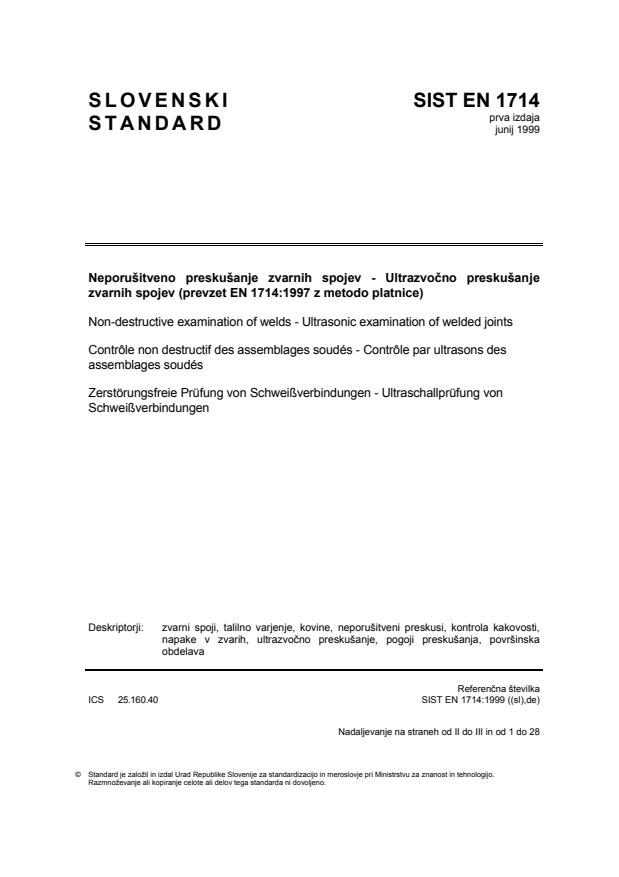
SLOVENSKI SIST EN 1714
prva izdaja
STANDARD
junij 1999
Neporušitveno preskušanje zvarnih spojev - Ultrazvočno preskušanje
zvarnih spojev (prevzet EN 1714:1997 z metodo platnice)
Non-destructive examination of welds - Ultrasonic examination of welded joints
Contrôle non destructif des assemblages soudés - Contrôle par ultrasons des
assemblages soudés
Zerstörungsfreie Prüfung von Schweißverbindungen - Ultraschallprüfung von
Schweißverbindungen
Deskriptorji: zvarni spoji, talilno varjenje, kovine, neporušitveni preskusi, kontrola kakovosti,
napake v zvarih, ultrazvočno preskušanje, pogoji preskušanja, površinska
obdelava
Referenčna številka
ICS 25.160.40 SIST EN 1714:1999 ((sl),de)
Nadaljevanje na straneh od II do III in od 1 do 28
© Standard je založil in izdal Urad Republike Slovenije za standardizacijo in meroslovje pri Ministrstvu za znanost in tehnologijo.
Razmnoževanje ali kopiranje celote ali delov tega standarda ni dovoljeno.
SIST EN 1714 : 1999
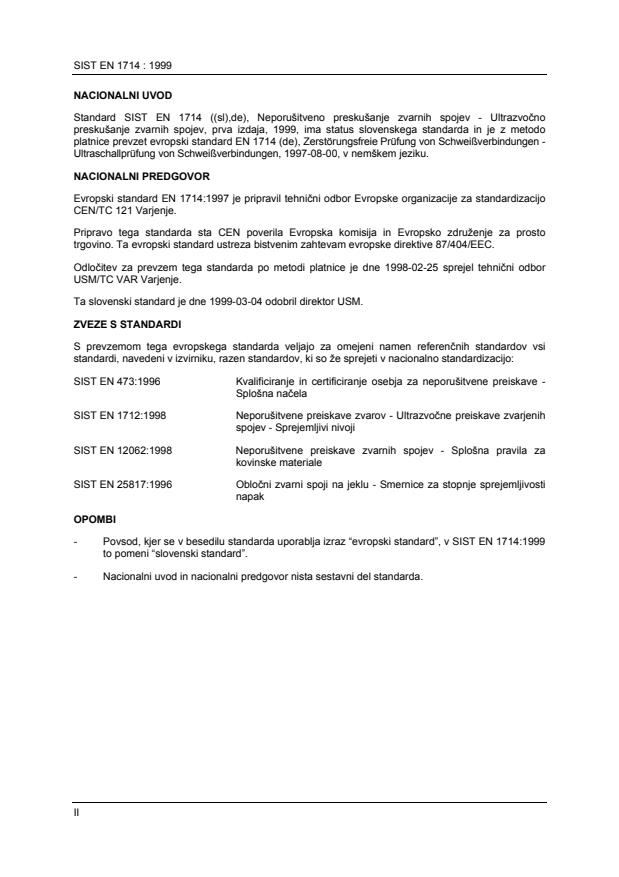
NACIONALNI UVOD
Standard SIST EN 1714 ((sl),de), Neporušitveno preskušanje zvarnih spojev - Ultrazvočno
preskušanje zvarnih spojev, prva izdaja, 1999, ima status slovenskega standarda in je z metodo
platnice prevzet evropski standard EN 1714 (de), Zerstörungsfreie Prüfung von Schweißverbindungen -
Ultraschallprüfung von Schweißverbindungen, 1997-08-00, v nemškem jeziku.
NACIONALNI PREDGOVOR
Evropski standard EN 1714:1997 je pripravil tehnični odbor Evropske organizacije za standardizacijo
CEN/TC 121 Varjenje.
Pripravo tega standarda sta CEN poverila Evropska komisija in Evropsko združenje za prosto
trgovino. Ta evropski standard ustreza bistvenim zahtevam evropske direktive 87/404/EEC.
Odločitev za prevzem tega standarda po metodi platnice je dne 1998-02-25 sprejel tehnični odbor
USM/TC VAR Varjenje.
Ta slovenski standard je dne 1999-03-04 odobril direktor USM.
ZVEZE S STANDARDI
S prevzemom tega evropskega standarda veljajo za omejeni namen referenčnih standardov vsi
standardi, navedeni v izvirniku, razen standardov, ki so že sprejeti v nacionalno standardizacijo:
SIST EN 473:1996 Kvalificiranje in certificiranje osebja za neporušitvene preiskave -
Splošna načela
SIST EN 1712:1998 Neporušitvene preiskave zvarov - Ultrazvočne preiskave zvarjenih
spojev - Sprejemljivi nivoji
SIST EN 12062:1998 Neporušitvene preiskave zvarnih spojev - Splošna pravila za
kovinske materiale
SIST EN 25817:1996 Obločni zvarni spoji na jeklu - Smernice za stopnje sprejemljivosti
napak
OPOMBI
- Povsod, kjer se v besedilu standarda uporablja izraz “evropski standard”, v SIST EN 1714:1999
to pomeni “slovenski standard”.
- Nacionalni uvod in nacionalni predgovor nista sestavni del standarda.
II
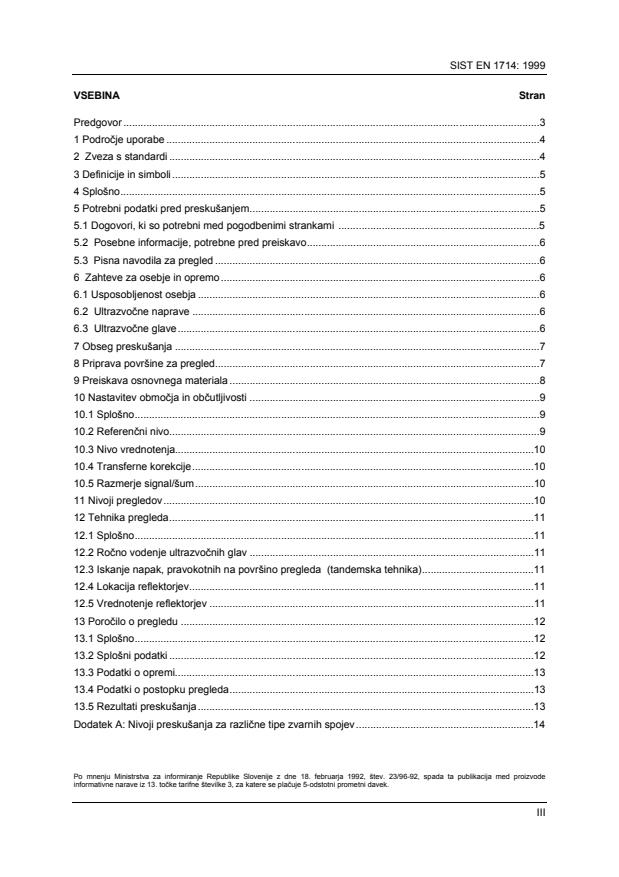
SIST EN 1714: 1999
VSEBINA Stran
Predgovor .3
1 Področje uporabe .4
2 Zveza s standardi .4
3 Definicije in simboli.5
4 Splošno.5
5 Potrebni podatki pred preskušanjem.5
5.1 Dogovori, ki so potrebni med pogodbenimi strankami .5
5.2 Posebne informacije, potrebne pred preiskavo.6
5.3 Pisna navodila za pregled .
...