

EN 13693:2004+A1:2009
(Main + Amendment)Precast concrete products - Special roof elements
- Abstract
This document identifies the requirements, the basic performance criteria and the evaluation of conformity for special precast roof elements made of reinforced or prestressed normal weight concrete, used for the construction of buildings, with or without separating function with respect to fire resistance.
NOTE The title of special roof elements refers to thin-walled structural elements with deformable transverse profile, such as folded plates, or shell elements, the intended use being specific for roofings with their typical loads. This type of elements combines the overall flexural behaviour along the main span with a complex distribution of in-plane forces and local moments.
Other types of elements can be used in roofing, such as ribbed units, floor slabs, ... . For these elements reference shall be made to their respective product standards.
!This document identifies also the requirements, the basic performance criteria and the evaluation of conformity of complementary elements made of reinforced or prestressed normal weight concrete, possibly used in combination with the main roof elements, such as load bearing shuttering plates and shells, for which reference shall be made to Annex F."Secondary structural components, possibly used in combination with the main roof elements, such as load bearing shuttering plates and shells, roof light frames, ..., shall refer to their respective product standard or technical approval.
This document covers terminology, performance criteria, tolerances, relevant physical properties, test methods, and aspects of transport and erection.
This document does not deal with seismic behaviour.
This document does not cover load bearing capacity determined by testing.
- Status
- Published
- Publication Date
- 28-Jul-2009
- Technical Committee
- CEN/TC 229 - Precast concrete products
- Current Stage
- 9093 - Decision to confirm - Review Enquiry
- Start Date
- 18-Jun-2010
- Completion Date
- 18-Jun-2010
- Directive
- 305/2011 - Regulation (eu) No 305/2011 of the European Parliament and of the Council of 9 march 2011 laying down harmonised conditions for the marketing of construction products and repealing council directive 89/106/eecOJ Ref: C, C 259 OJ Date: 08-Aug-2014
89/106/EEC - Construction productsOJ Ref: C, C 309 OJ Date: 18-Dec-2009



Overview
EN 13693:2004+A1:2009 is a CEN product standard for precast concrete products covering special roof elements made of reinforced or prestressed normal-weight concrete. It defines requirements, basic performance criteria and conformity assessment for thin‑walled roof components (for example folded plates and shell elements) used in building roof systems. The standard addresses terminology, tolerances, relevant physical properties, test methods, transport and erection, and includes provisions for complementary elements (Annex F). It is aligned with EN 13369 (common rules) and the structural Eurocodes for design and fire resistance.
Key topics and requirements
- Scope and element types
- Thin-walled structural roof elements with deformable transverse profiles (folded plates, shells).
- Complementary elements (load-bearing shuttering plates, shells) addressed in Annex F; secondary components may refer to other product standards.
- Materials and production
- Requirements for concrete, reinforcement and prestressing consistent with EN 13369 and EN 206-1.
- Special attention to reinforcement positioning in thin slabs (t ≤ 100 mm).
- Finished product requirements
- Geometrical tolerances, surface characteristics, mechanical resistance, fire resistance, acoustic and thermal properties, durability.
- Example tolerance guidance is given (e.g., flange thickness t ≤150 mm: +10 / −5 mm) and production checks per Clause 5.2.
- Testing and conformity
- Test methods for concrete, dimensional measurement, weighing and load tests (Clause 5).
- Conformity evaluation covering type testing and Factory Production Control (Clause 6).
- Marking, labelling and technical documentation requirements (Clauses 7–8).
- Limitations
- The standard does not cover seismic behaviour.
- It does not cover load-bearing capacity determined solely by testing.
Applications and users
EN 13693 is intended for practical use by:
- Precast manufacturers designing and producing special roof elements.
- Structural engineers and designers applying Eurocode 2 (EN 1992-1-1 / EN 1992-1-2) for strength and fire resistance.
- Architects and contractors specifying precast roof solutions (folded plates, shells).
- Certification bodies and authorities performing conformity assessment, CE marking and factory inspections. Practical applications include industrial and commercial roofing, long‑span coverings and architecturally complex roof structures where thin‑walled precast elements offer structural efficiency and rapid erection.
Related standards
- EN 13369 - Common rules for precast concrete products
- EN 1992-1-1 / EN 1992-1-2 - Eurocode 2 (design and structural fire design)
- EN 206-1 - Concrete specification and production
- Annex ZA - Relationship to EU Construction Products Directive and CE marking
Keywords: EN 13693, precast concrete products, special roof elements, folded plates, shell elements, CEN, Eurocode 2, tolerances, factory production control, CE marking.
Relations
- Effective Date
- 19-Jan-2023
- Effective Date
- 19-Jan-2023
- Effective Date
- 28-Jan-2026
- Effective Date
- 28-Jan-2026
- Effective Date
- 28-Jan-2026
- Effective Date
- 28-Jan-2026
- Effective Date
- 05-Aug-2026
Get Certified
Connect with accredited certification bodies for this standard

DIBt (Deutsches Institut für Bautechnik)
German Institute for Building Technology.
DIN CERTCO
DIN Group product certification.

Aboma Certification B.V.
Specialized in construction, metal, and transport sectors.
Sponsored listings
Frequently Asked Questions
EN 13693:2004+A1:2009 is a standard published by the European Committee for Standardization (CEN). Its full title is "Precast concrete products - Special roof elements". This standard covers: This document identifies the requirements, the basic performance criteria and the evaluation of conformity for special precast roof elements made of reinforced or prestressed normal weight concrete, used for the construction of buildings, with or without separating function with respect to fire resistance. NOTE The title of special roof elements refers to thin-walled structural elements with deformable transverse profile, such as folded plates, or shell elements, the intended use being specific for roofings with their typical loads. This type of elements combines the overall flexural behaviour along the main span with a complex distribution of in-plane forces and local moments. Other types of elements can be used in roofing, such as ribbed units, floor slabs, ... . For these elements reference shall be made to their respective product standards. !This document identifies also the requirements, the basic performance criteria and the evaluation of conformity of complementary elements made of reinforced or prestressed normal weight concrete, possibly used in combination with the main roof elements, such as load bearing shuttering plates and shells, for which reference shall be made to Annex F."Secondary structural components, possibly used in combination with the main roof elements, such as load bearing shuttering plates and shells, roof light frames, ..., shall refer to their respective product standard or technical approval. This document covers terminology, performance criteria, tolerances, relevant physical properties, test methods, and aspects of transport and erection. This document does not deal with seismic behaviour. This document does not cover load bearing capacity determined by testing.
This document identifies the requirements, the basic performance criteria and the evaluation of conformity for special precast roof elements made of reinforced or prestressed normal weight concrete, used for the construction of buildings, with or without separating function with respect to fire resistance. NOTE The title of special roof elements refers to thin-walled structural elements with deformable transverse profile, such as folded plates, or shell elements, the intended use being specific for roofings with their typical loads. This type of elements combines the overall flexural behaviour along the main span with a complex distribution of in-plane forces and local moments. Other types of elements can be used in roofing, such as ribbed units, floor slabs, ... . For these elements reference shall be made to their respective product standards. !This document identifies also the requirements, the basic performance criteria and the evaluation of conformity of complementary elements made of reinforced or prestressed normal weight concrete, possibly used in combination with the main roof elements, such as load bearing shuttering plates and shells, for which reference shall be made to Annex F."Secondary structural components, possibly used in combination with the main roof elements, such as load bearing shuttering plates and shells, roof light frames, ..., shall refer to their respective product standard or technical approval. This document covers terminology, performance criteria, tolerances, relevant physical properties, test methods, and aspects of transport and erection. This document does not deal with seismic behaviour. This document does not cover load bearing capacity determined by testing.
EN 13693:2004+A1:2009 is classified under the following ICS (International Classification for Standards) categories: 91.100.30 - Concrete and concrete products. The ICS classification helps identify the subject area and facilitates finding related standards.
EN 13693:2004+A1:2009 has the following relationships with other standards: It is inter standard links to EN 13693:2004, EN 13693:2004/prA1, EN 1990:2002, EN 1992-1-1:2004, EN 13369:2004, EN 1992-1-2:2004, EN 18190:2026. Understanding these relationships helps ensure you are using the most current and applicable version of the standard.
EN 13693:2004+A1:2009 is associated with the following European legislation: EU Directives/Regulations: 305/2011, 89/106/EEC; Standardization Mandates: M/100. When a standard is cited in the Official Journal of the European Union, products manufactured in conformity with it benefit from a presumption of conformity with the essential requirements of the corresponding EU directive or regulation.
EN 13693:2004+A1:2009 is available in PDF format for immediate download after purchase. The document can be added to your cart and obtained through the secure checkout process. Digital delivery ensures instant access to the complete standard document.
Standards Content (Sample)
2003-01.Slovenski inštitut za standardizacijo. Razmnoževanje celote ali delov tega standarda ni dovoljeno.Montažni betonski izdelki - Specialni strešni elementiBetonfertigteile - Besondere Fertigteile für DächerProduits préfabriqués en béton - Éléments spéciaux de toiturePrecast concrete products - Special roof elements91.100.30Beton in betonski izdelkiConcrete and concrete products91.060.20StreheRoofsICS:Ta slovenski standard je istoveten z:EN 13693:2004+A1:2009SIST EN 13693:2004+A1:2009en,fr,de01-november-2009SIST EN 13693:2004+A1:2009SLOVENSKI
STANDARDSIST EN 13693:20041DGRPHãþD
EUROPEAN STANDARD NORME EUROPÉENNE EUROPÄISCHE NORM
EN 13693:2004+A1
July 2009 ICS 91.100.30 Supersedes EN 13693:2004English Version
Precast concrete products - Special roof elements
Produits préfabriqués en béton - Éléments spéciaux de couverture
Betonfertigteile - Besondere Fertigteile für Dächer This European Standard was approved by CEN on 24 June 2004 and includes Amendment 1 approved by CEN on 19 June 2009.
CEN members are bound to comply with the CEN/CENELEC Internal Regulations which stipulate the conditions for giving this European Standard the status of a national standard without any alteration. Up-to-date lists and bibliographical references concerning such national standards may be obtained on application to the CEN Management Centre or to any CEN member.
This European Standard exists in three official versions (English, French, German). A version in any other language made by translation under the responsibility of a CEN member into its own language and notified to the CEN Management Centre has the same status as the official versions.
CEN members are the national standards bodies of Austria, Belgium, Bulgaria, Cyprus, Czech Republic, Denmark, Estonia, Finland, France, Germany, Greece, Hungary, Iceland, Ireland, Italy, Latvia, Lithuania, Luxembourg, Malta, Netherlands, Norway, Poland, Portugal, Romania, Slovakia, Slovenia, Spain, Sweden, Switzerland and United Kingdom.
EUROPEAN COMMITTEE FOR STANDARDIZATION
COMITÉ EUROPÉEN DE NORMALISATION EUROPÄISCHES KOMITEE FÜR NORMUNG
Management Centre:
Avenue Marnix 17,
B-1000 Brussels © 2009 CEN All rights of exploitation in any form and by any means reserved worldwide for CEN national Members. Ref. No. EN 13693:2004+A1:2009: ESIST EN 13693:2004+A1:2009
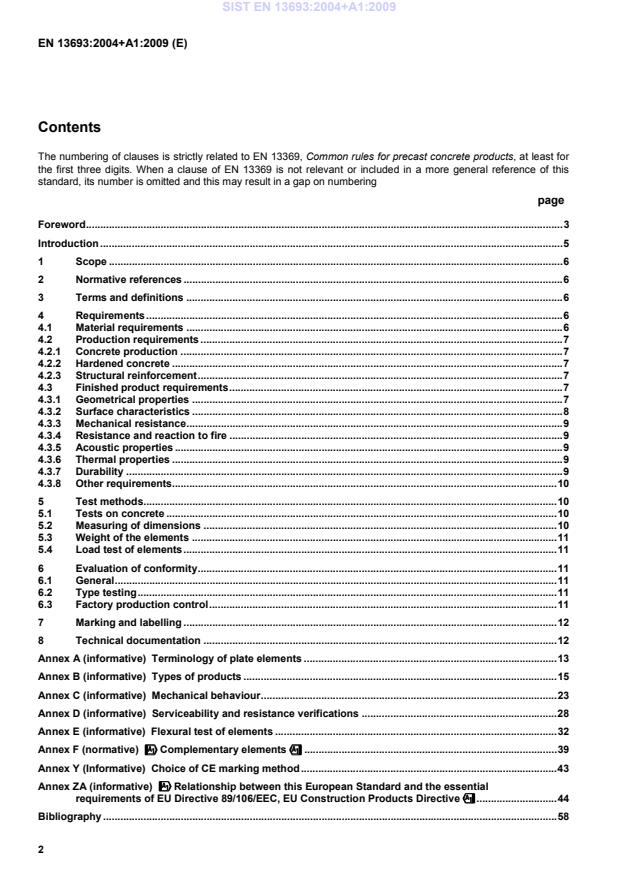
2 Contents
The numbering of clauses is strictly related to EN 13369, Common rules for precast concrete products, at least for the first three digits. When a clause of EN 13369 is not relevant or included in a more general reference of this standard, its number is omitted and this may result in a gap on numbering
page Foreword . 3 Introduction . 5 1 Scope . 6 2 Normative references . 6 3 Terms and definitions . 6 4 Requirements . 6 4.1 Material requirements . 6 4.2 Production requirements . 7 4.2.1 Concrete production . 7 4.2.2 Hardened concrete . 7 4.2.3 Structural reinforcement . 7 4.3 Finished product requirements . 7 4.3.1 Geometrical properties . 7 4.3.2 Surface characteristics . 8 4.3.3 Mechanical resistance . 9 4.3.4 Resistance and reaction to fire . 9 4.3.5 Acoustic properties . 9 4.3.6 Thermal properties . 9 4.3.7 Durability . 9 4.3.8 Other requirements. 10 5 Test methods . 10 5.1 Tests on concrete . 10 5.2 Measuring of dimensions . 10 5.3 Weight of the elements . 11 5.4 Load test of elements . 11 6 Evaluation of conformity . 11 6.1 General . 11 6.2 Type testing . 11 6.3 Factory production control . 11 7 Marking and labelling . 12 8 Technical documentation . 12 Annex A (informative)
Terminology of plate elements . 13 Annex B (informative)
Types of products . 15 Annex C (informative)
Mechanical behaviour . 23 Annex D (informative)
Serviceability and resistance verifications . 28 Annex E (informative)
Flexural test of elements . 32 Annex F (normative)
!!!!Complementary elements"""" . 39 Annex Y (Informative)
Choice of CE marking method . 43 Annex ZA (informative)
!!!!Relationship between this European Standard and the essential requirements of EU Directive 89/106/EEC, EU Construction Products Directive"""" . 44 Bibliography . 58
4 !EN 14843, Precast concrete products – Stairs" !EN 14844, Precast concrete products - Box culverts" !EN 14991, Precast concrete products - Foundation elements" !EN 14992, Precast concrete products - Wall elements" !EN 15037, Precast concrete products - Beams for beam-and-block floor systems" This standard defines in Annex ZA the application methods of CE marking to products designed using the relevant EN Eurocodes (EN 1992-1-1 and EN 1992-1-2). Where, in default of applicability conditions of EN Eurocodes to the works of destination, design Provisions other than EN Eurocodes are used for mechanical strength and/or fire resistance, the conditions to affix CE marking to the product are described in ZA.3.4. According to the CEN/CENELEC Internal Regulations, the national standards organizations of the following countries are bound to implement this European Standard: Austria, Belgium, Bulgaria, Cyprus, Czech Republic, Denmark, Estonia, Finland, France, Germany, Greece, Hungary, Iceland, Ireland, Italy, Latvia, Lithuania, Luxembourg, Malta, Netherlands, Norway, Poland, Portugal, Romania, Slovakia, Slovenia, Spain, Sweden, Switzerland and United Kingdom. SIST EN 13693:2004+A1:2009
6 1 Scope This document identifies the requirements, the basic performance criteria and the evaluation of conformity for special precast roof elements made of reinforced or prestressed normal weight concrete, used for the construction of buildings, with or without separating function with respect to fire resistance. NOTE The title of special roof elements refers to thin-walled structural elements with deformable transverse profile, such as folded plates, or shell elements, the intended use being specific for roofings with their typical loads. This type of elements combines the overall flexural behaviour along the main span with a complex distribution of in-plane forces and local moments. Other types of elements can be used in roofing, such as ribbed units, floor slabs, . . For these elements reference shall be made to their respective product standards. !This document identifies also the requirements, the basic performance criteria and the evaluation of conformity of complementary elements made of reinforced or prestressed normal weight concrete, possibly used in combination with the main roof elements, such as load bearing shuttering plates and shells, for which reference shall be made to Annex F." This document covers terminology, performance criteria, tolerances, relevant physical properties, test methods, and aspects of transport and erection. This document does not deal with seismic behaviour. This document does not cover load bearing capacity determined by testing. 2 Normative references The following referenced documents are indispensable for the application of this document. For dated references, only the edition cited applies. For undated references, the latest edition of the referenced document (including any amendments) applies. EN 1990:2002, Eurocode: Basis of structural design. EN 1992-1-1:2004, Eurocode 2: Design of concrete structures - Part 1-1: General rules and rules for buildings. EN 1992-1-2:2004, Eurocode 2: Design of concrete structures - Part
1-2: General rules - Structural fire design. EN 13369:2004, Common rules for precast concrete products. 3 Terms and definitions For the purposes of this document, the terms and definitions given in EN 13369:2004 and the following apply.
NOTE 1 See also Annex A. NOTE 2 Annex B gives a review of common types of special precast prestressed concrete roof elements together with some related terminology. 4 Requirements 4.1 Material requirements For general aspects, constituent materials of concrete, reinforcing and prestressing steel, inserts and connections, the relevant clauses of EN 13369:2004 4.1 shall apply. In particular the ultimate tensile and tensile yield strength of steel shall be considered. SIST EN 13693:2004+A1:2009
Bow horizontal mis- alignment of lateral edges ± ε L/700 Camber “v” in vertical plane ± ∆v L/700 For the length "L" and the reinforcement placing "c", the corresponding permitted deviation ∆L and ∆c are given in 4.3.1.1 of EN 13369:2004. For the size of holes and openings 1,5 time the value of ∆b tolerance may be assumed. For the overall positioning of holes and inserts 1,5 time the values of ∆L and ∆b tolerances may be assumed. Other values may be given in project specifications. SIST EN 13693:2004+A1:2009
8 For prestressed elements 1,5 time the value of ∆v tolerance may be assumed; this includes the effects of prestressing tolerances. Other values may be given in project specifications. Although production tolerances can refer to any dimension of the element, it is sufficient to follow the Standard Method of checking specified in point 5.2.
Key 1 Vertical 2 Horizontal 3 Cross section Figure 1 — Measure of production tolerances 4.3.1.2 Minimum dimensions Clause 4.3.1.2 of EN 13369:2004 shall apply. 4.3.2 Surface characteristics For surface characteristics, 4.3.2 of EN 13369:2004 shall apply. NOTE In addition to the possible cracking expected from calculation, cracking can occur in roof elements from normal function in some particular areas, such as the end edges of the ribs, the intersection lines of the different plates, the corners around holes or other shape discontinuities. Provided the width and the extension of these cracks are limited and there are no structural consequences, a simple local filling may be applied to restore the surface appearance. Completion works of ready finished elements (such as painting, waterproofing, .) are not covered by this document. SIST EN 13693:2004+A1:2009
Specific additional information are given in informative Annex C and D. 4.3.3.2 Detailing Overlapped splices of reinforcement shall be located out of the areas where the full strength is needed for the resistance of the element. In any case they need a minimum dimension of the concrete section, defined by t ≥ 5 ds where
t is the minimum local thickness of the element, and
ds is the diameter of the overlapped bars (or wires). The minimum transverse spacing between two adjacent laps shall be ≥ 10 ds. 4.3.4 Resistance and reaction to fire 4.3.4.1 Resistance to fire Fire resistance, dealing with load-bearing capacity R, integrity E and insulation I of precast prestressed concrete roof elements, expressed in terms of classes, shall be defined following 4.3.4.1, 4.3.4.2 and 4.3.4.3 of EN 13369:2004. NOTE Normally, with respect to fire resistance, the separating function EI is not required for the elements of concern. 4.3.4.2 Reaction to fire For reaction to fire, 4.3.4.4 of EN 13369:2004 shall apply. 4.3.5 Acoustic properties When required, the relevant acoustic properties of roof elements shall be declared following Clause 4.3.5 of EN 13369:2004. 4.3.6 Thermal properties Reference shall be made to 4.3.6 of EN 13369:2004. 4.3.7 Durability Clause 4.3.7 of EN 13369:2004 shall apply. SIST EN 13693:2004+A1:2009
10 Referring to Table A.1 and Table A.2 of Annex A of EN 13369:2004, the upper surface of roof elements equipped with ready finished adherent covering is taken to be in ambient condition B, provided it is not specified otherwise. The same ambient condition B can be referred to for the internal surfaces in hollow or sandwich roof elements and for closed box roof elements (see Annex B), provided it is not specified otherwise. For plate parts (slab conditions of A.1 of EN 13369: 2004) of roof elements the concrete cover given for reinforcing and prestressing steel in slab geometry shall apply. 4.3.8 Other requirements 4.3.8.1 Safety in handling Clause 4.3.8.1 of EN 13369:2004 shall apply. 5 Test methods 5.1 Tests on concrete Clause 5.1 of EN 13369:2004 shall apply. 5.2 Measuring of dimensions The Standard Method of measuring the dimensions related to the production tolerances of 4.3.1.1 is specified below. Except for reinforcement position in the section, measurements are taken in the demoulded finished element. a) the total length “L” is taken following the special indications given in the technical specifications of the product. (By rule three readings are taken, one at each edge and one in a central position); b) the total width “b” is taken in correspondence of three cross sections, two near the ends and one at the midspan; c) the thicknesses “t” are taken at the same three cross sections of item b, in the critical positions of the slabs indicated by the technical specifications of the product (at least one for each lateral flange); d) the total depth “h” is taken (by proper outside collimator systems) in correspondence of the same three cross sections of item b; e) the bow misalignment “ε“ is taken, for each lateral edge, at the midspan position with respect to its end points; f) the camber “v” at midspan is taken with respect to the end support straight line and compared to the design camber vo, adjusted with the computed deformation vc due to applied loads (∆v = v - vo - vc); g) concrete cover is taken at the lower side of the lateral flanges, in the critical positions indicated by the technical specifications of the product (at least one for each lateral flange in the three cross section of item b). For the measurements above listed (at least for items a, b, e and f), the element shall be set in an arrangement as similar as possible to its final position in the structure. Following the special features of the products, proper adaptations and variations to the Standard Method can be given by the technical specifications of the product. The reinforcement position, together with the setting of prestressing tendons and special devices, is verified following the pertinent items of Table D.3.2 in Table D.3 of EN 13369:2004. SIST EN 13693:2004+A1:2009
Subject Aspect Method Frequency Registration Elements surface finish visual inspection every element notice of imperfections Elements total length see point 5.2(a) every 10 elements notation in the record form Elements thickness see point 5.2(c) every 10 elements notation in the record form Elements concrete cover see point 5.2(g) every 10 elements notation in the record form Elements camber* see point 5.2(f) every month or 1/100 elements notation in the record form Elements other production tolerances see point 5.2(b)-(d)-(e) every year or 1/600 elements notation in the record form Elements (all types) mechanical strength (failure conditions) see Annex E initial type tests on 2 elements proper report Elements (type f of Annex C) mechanical strength (service conditions) see Annex E every 6 months on 1 element proper report * See 4.3.1.1 and Figure 1. SIST EN 13693:2004+A1:2009
12 The manufacturer shall keep the records of the elements produced (position number, date of casting and construction data) for the required period of archiving and make them available when required. 7 Marking and labelling
Clause 7 of EN 13369:2004 shall apply. NOTE For CE marking see Annex ZA. 8 Technical documentation Considering also 4.3.3.2, the detailing of the element, with respect to geometrical data and complementary properties of materials and inserts, shall be given in technical documentation, which includes the construction data, such as the dimensions, the tolerances, the layout of reinforcement, the concrete cover, the expected transient and final support conditions and lifting conditions. The composition of technical documentation is given in Clause 8 of EN 13369:2004. SIST EN 13693:2004+A1:2009
Terminology of plate elements A.1 Shell element As shown in Figure A.1, the internal actions transmitted along the thin walls of a shell structure are represented by eight components referred to its middle surface: In-plane forces normal force along x-axis nx normal force along y-axis ny tangential force nxy Moments bending moment along x-axis mx bending moment along y-axis my twisting moment mxy Transverse forces shearing force along x-axis qx shearing force along y-axis qy The above components are referred to the unit width and represent the proper integral over the plate thickness t of the stresses σx, σy, τxy, τzx, τyz. The first three components nx, ny, nxy are related to the extensional behaviour of the plate, the remaining five mx, my, mxy, qx, qy are related to its flexural behaviour. SIST EN 13693:2004+A1:2009
Figure A.1 — Components of internal actions A.2 Main flexural behaviour In general the roof elements considered in the present standard are spanning in one main direction between the two end supports. In this longitudinal direction, in analogy to the ordinary theory of beams, the three components M, V, T of the internal force can be referred to the current cross-section, as shown in Figure A.2. These components represent the global effects of the vertical loads in terms of flexural action with its possible eccentricity. When represented by an applied force, prestressing force P can be added with its eccentricity ep.
Local and transverse effects due to the warping of the cross section and to the deformation of its profile are not provided by this representation.
Figure A.2 — Components of the internal force SIST EN 13693:2004+A1:2009
Types of products
B.1a - “V” shape elements
B.1b - Three plates elements
B.1c - Hollow-core elements Figure B.1 - Types of simple wing-elements SIST EN 13693:2004+A1:2009
B.2a - Simple one-rib elements
B.2b - Hollow one-rib elements
B.2c - Sandwich one-rib elements Figure B.2 - Types of one-rib wing-elements
B.3a - Simple two-ribs elements
B.3b - Sandwich two-ribs elements
B.3c - Straddle two-ribs elements Figure B.3 - Types of two-ribs wing-elements
B.4a
B.4b
B.4c Figure B.4 - Types of box-elements SIST EN 13693:2004+A1:2009
B.5a
B.5b
B.5c Figure B.5 - Types of roof-light shed-elements SIST EN 13693:2004+A1:2009
B.6a - Upwards folded-plate elements
B.6b - Overturned folded-plate elements
B.6c - Shed folded-plate elements Figure B.6 - Types of folded-plate elements
B.7a - Simple paraboloid elements
B.7b - Box-shape paraboloid elements
B.7.3 - Sandwich paraboloid elements Figure B.7 - Paraboloid-elements SIST EN 13693:2004+A1:2009
Figure B.8 - "Y" shape elements
Key 1 Thermal insulation 2 Waterproof layer 3 Protective cover 4 Edge angle 5 Painted finish 6 Skylight sheets (added in situ) Figure B.9 - Typical ready finish of the product
The examples given in Annex B for roof elements and their ready finish are not intended to cover all the possible types of common production. SIST EN 13693:2004+A1:2009
Mechanical behaviour C.1 General In general, referring to the overall flexural behaviour along their main span and to the combined twist action, roof element can be classified as follows: a) core-beam elements, provided with a central solid core or box profile where the flow of tangential stresses can develop to give a circulatory torsional resistance (Figure C.1 a)); b) biflexural-beam systems, where twist actions are decomposed into two opposite combined flexures applied to the longitudinal ribs (Figure C.1 b)); c) folded-plate systems, made of three or more non convergent plates, where twist actions are decomposed into a complex combination of flexures of the single plates (Figure C.1 c)); d) star-plate systems, such as V or Y profiles, with the different plates convergent in a single axis, where the twist actions are decomposed into twisting moments of the single plates (Figure C.1 d)); e) special-shape elements, that is singular solution not covered by the previous definitions (such as thin shells designed in the geometry of a hyperbolic paraboloid, where the prestressing tendons are placed along the straight lines of the surface - Figure C.1 e)); f) integrated systems, such as sandwich elements, where the resistance of the structural part is improved by the completion parts of the unit (Figure C.1 f)). With reference to the transmission of vertical loads to the end supports, the following two principal types of elements can be distinguished. Web-shear systems, where the presence of vertical or quasi-vertical webs extended till over the bearings allows a beam-like transmission of the shear forces over the supports. Arch-tie systems, where the longitudinal shape, with possible variable depth, leads to an arch mechanism connected with the lower tie of the incorporated reinforcement. Other special types of elements can be produced and properly designed to allow the transmission of vertical loads to the end supports through different mechanisms (e.g. suspension systems, .). C.2 Types of structural behaviour C.2.1 General With reference to the U.L.S. - Ultimate Limit State to be verified by calculation and testing in order to ensure the due resistance of the elements, the following cases are distinguished. C.2.2 Beam-like behaviour For types "a" and "b" of C.1 the ordinary beam-model covered by EN 1992-1-1 can be in general applied with proper verifications. SIST EN 13693:2004+A1:2009
Figure C.1 — Types of roof elements Possible deviations of the ultimate mechanism of the section of the maximum bending moment can derive from the small thicknesses of the compression wings. This can be checked on the basis of the experimental results of the initial type testing (load tests up to failure) and represented by mean of a modified constitutive law σ-ε of the concrete (additional γ′c factor and/or reduced εcu deformation) to be employed in the ordinary equations for the consequent routine calculations. Other possible deviations (e.g. for shear and torsion) can be pointed out on the basis of the experimental results of the initial type testing. Transverse flexural effects of the loads (e.g. fixed-end bending moments of the cantilever wings) can be locally computed and verified in addition to the main longitudinal calculations (see also Annex D). C.2.3 Hyperstatic plate-systems behaviour For type "c" of C.1 a complete "folded-plate" analysis shall be performed, inclusive of transverse flexural effects due to loads and to the deformation of the cross profile. This analysis can be referred to an elastic model comprehensive of the extensional and flexural behaviours of the plates. SIST EN 13693:2004+A1:2009
26 C.3 Stability requirements Roof elements shall be verified in SLS - Serviceability Limit State and ULS - Ultimate Limit State for the combinations of actions specified in 2.4.3 of EN 1992-1-1. In general, serviceability and resistance shall be ensured for any partial condition deduced from the total loading by removing part of the variable load. In particular, referring to the ordinary arrangement of isolated member on two end simple supports, the following three standard load conditions shall be considered: a) total (symmetrical) loading (Figure C.2 a)) (with maximum bending moment and minimum twisting moment); b) half (disymmetrical) “upper” loading (Figure C.2 b)) (with maximum twisting moment and high bending moment); c) half (disymmetrical) “lower” loading (Figure C.2 c)) (with maximum twisting moment and low bending moment); where the load intensity is taken from the regulation valid in the place of use of the structure. If a plan for a controlled removal of snow is not implemented, for load condition "C" the full load intensity 1/1 shall apply For non symmetric units, such as shed-elements, conditions "b" and “c” refer both to the two possible complementary (non equivalent) half-loading conditions (Figure C.3). Proper integrative calculations can be added with reference to the assembled structure, for which particular conditions can be expected, such as: transmission of actions for the overall stability of the structure; horizontal actions coming from other parts of the construction (e.g. lateral thrust due to wind pressure on the supported outside walls); different lateral joint conditions due to the connection with the completion supported elements.
Figure C.2 — Standard load conditions SIST EN 13693:2004+A1:2009
Figure C.3 — Half – loading conditions for non symmetric units For special precast concrete roof elements the limitations of stresses under serviceability conditions should be checked in accordance with Clause 7.2 of EN 1992-1-1. Proper verifications shall be made by calculation and possible testing for the required compatibility of deformations, under the service conditions and any possible differential effects of loads, with the serviceability and integrity of the completion elements in the finished building. C.4 Supports and connections For dry bearings where the horizontal restraint of the supported element relies only on friction due to upper weights, Clause 10.5.1 of EN 1992-1-1 applies together with the following complementary specifications. Referring to point (2) of Clause 10.5.1 of EN 1992-1-1 (horizontal restraint supplied by friction), due to the uncertainty about the effectiveness of the joint, the overall stability of the structure shall be checked for both the case assuming perfect horizontal friction restraint and then assuming no restraint at all. When checking slip the ratio between the maximum design value of the horizontal actions Hsd and the minimum design value of the vertical action Vsd should be Hsd / Vsd ≤ µ/γ where µ
is the coefficient of friction (µ = 0,5 for clean concrete/pad surface) γ
is the partial safety factor (γ
= 1,1 for slip/friction resistance) In checking the beam support, the overturning effects of all the unintended eccentricities should be taken into account. Unless a more precise analysis of the tolerances is carried out, a notional horizontal force equal to 1 % of the weight may be applied at each floor or roof level, in addition to the eccentric vertical force which gives rise to the torsional effect T'sd = Vsdleff/300. These additional effects are given by Hsd = Vsd/100 (transverse horizontal force) T''sd = Hsd h (overturning torsional moment) where Vsd is the design value of the cohexisting vertical reaction (shear force) and h is the depth of the beam. SIST EN 13693:2004+A1:2009
28 Annex D (informative)
Serviceability and resistance verifications D.1 Biaxial strength of concrete Unless more precise assumptions are taken, the following safe side approximated constitutive laws can be assumed. In the following equations σx is the resistance value of the considered principal stress, σy is the action value of the transverse principal stress. Tensile strength of concrete (σ > 0 for tension, σ < 0 for compression) σx =
κtfctd
where κt = 1.0 for
ctd c1dff≤≤−y3.0σ κt = (1 + σy/fc1d) /0.7 for c1dyc1d3.0ff−≤≤−σ Compressive strength of uncracked concrete (σy < κtfctd) c1dcxfκσ−= where ctdyc7.01fσκ−= for ctdy0f≤≤σ 1c=κ for 0yd1c≤≤−σf Compressive strength of cracked concrete (σy = 0) d1cxf−=σ for plain concrete d2cxf−=σ for concrete with transverse reinforcement in tension where cdc1dffα= α = 0.85 to cover sustained loads cdc2dffν= ν = 0.5 for MPa20ck≥f with: fcd= design value of cylinder compressive strength of concrete, fctd= design value of axial tensile strength of concrete. SIST EN 13693:2004+A1:2009
with
1/1.05.0a≤+=dtκ
where t (≥ 2.4da) is the thickness of the flange and da is the maximum aggregate size. If a relevant bending moment my is acting in the transverse direction, the strength of the flange is computed with: c2dftnκ−=x D.2.3 Tensile strength of thin plates For flanges under uniform flow nx of longitudinal tensions (with ny ≅ 0 and nxy ≅ 0), the limit of cracking formation is defined by: ctdftn=x while the ultimate resistance limit in cracked state is given by pdsdff∆+=psxaan where
as, ap
are the areas per unit width of reinforcing and prestressing steel.
Material strengths are defined by syk/γffsd= posptkpd/9.0σγ−=∆ff
MPa)500≤( where
σpo
is the prestress in tendons at the considered time (inclusive of losses). This assumption refers to a structural analysis where prestressing is considered as an applied force P = σpoAp. SIST EN 13693:2004+A1:2009
30 D.2.4 Shear strength of thin plates For webs under uniform flow nxy of tangential forces, with possible longitudinal compressions (nx ≤ 0) and no transverse forces (ny ≅ 0), the limit of cracking formation is defined by: ctdftnΙ=λxy where ctdxI1fσλ−= and <=ncompressio for0 xx tn1 The ultimate resistance limit in cracked state, with a transverse reinforcement aw per unit width, is given by one of the two following equations. for weak reinforcement +≤2Iw11: csdwxyλαf=n where ()wwc/1ωωλ−=
()5.2≤ dcsdwwta2ff=ω for strong reinfo
...