

EN 1168:2005+A2:2009
(Main + Amendment)Precast concrete products - Hollow core slabs
- Abstract
This European Standard deals with the requirements and the basic performance criteria and specifies minimum values where appropriate for precast hollow core slabs made of prestressed or reinforced normal weight concrete according to EN 1992-1-1:2004.
This European Standard covers terminology, performance criteria, tolerances, relevant physical properties, special test methods, and special aspects of transport and erection.
Hollow core elements are used in floors, roofs, walls and similar applications. In this European Standard the material properties and other requirements for floors and roofs are dealt with; for special use in walls and other applications, see the relevant product standards for possible additional requirements.
The elements have lateral edges provided with a longitudinal profile in order to make a shear key for transfer of vertical shear through joints between contiguous elements. For diaphragm action the joints have to function as horizontal shear joints.
The elements are manufactured in factories by extrusion, slipforming or mouldcasting.
The application of the standard is limited for prestressed elements to a maximum depth of 500 mm and a maximum width of 1 200 mm. For reinforced elements the maximum depth is limited to 300 mm and the maximum width without transverse reinforcement to 1 200 mm and with transverse reinforcement to 2 400 mm.
The elements may be used in composite action with an in situ structural topping cast on site.
The applications considered are floors and roofs of buildings, including areas for vehicles in the category F and G of EN 1991-2 which are not subjected to fatigue loading. For building in seismic zones additional provisions are given in EN 1998-1.
This European Standard does not deal with complementary matters. E.g. the slabs should not be used in roofs without additional protection against water penetration.
- Status
- Withdrawn
- Publication Date
- 10-Mar-2009
- Withdrawal Date
- 11-Oct-2011
- Technical Committee
- CEN/TC 229 - Precast concrete products
- Current Stage
- 9960 - Withdrawal effective - Withdrawal
- Start Date
- 12-Oct-2011
- Completion Date
- 12-Oct-2011
89/106/EEC - Construction productsOJ Ref: C, C 152 OJ Date: 04-Jul-2009


Relations
- Effective Date
- 19-Jan-2023
- Effective Date
- 18-Jan-2023
- Effective Date
- 22-Dec-2008
- Effective Date
- 22-Dec-2008
- Effective Date
- 20-Jun-2009
Get Certified
Connect with accredited certification bodies for this standard

DIBt (Deutsches Institut für Bautechnik)
German Institute for Building Technology.
DIN CERTCO
DIN Group product certification.

Aboma Certification B.V.
Specialized in construction, metal, and transport sectors.
Sponsored listings
Frequently Asked Questions
EN 1168:2005+A2:2009 is a standard published by the European Committee for Standardization (CEN). Its full title is "Precast concrete products - Hollow core slabs". This standard covers: This European Standard deals with the requirements and the basic performance criteria and specifies minimum values where appropriate for precast hollow core slabs made of prestressed or reinforced normal weight concrete according to EN 1992-1-1:2004. This European Standard covers terminology, performance criteria, tolerances, relevant physical properties, special test methods, and special aspects of transport and erection. Hollow core elements are used in floors, roofs, walls and similar applications. In this European Standard the material properties and other requirements for floors and roofs are dealt with; for special use in walls and other applications, see the relevant product standards for possible additional requirements. The elements have lateral edges provided with a longitudinal profile in order to make a shear key for transfer of vertical shear through joints between contiguous elements. For diaphragm action the joints have to function as horizontal shear joints. The elements are manufactured in factories by extrusion, slipforming or mouldcasting. The application of the standard is limited for prestressed elements to a maximum depth of 500 mm and a maximum width of 1 200 mm. For reinforced elements the maximum depth is limited to 300 mm and the maximum width without transverse reinforcement to 1 200 mm and with transverse reinforcement to 2 400 mm. The elements may be used in composite action with an in situ structural topping cast on site. The applications considered are floors and roofs of buildings, including areas for vehicles in the category F and G of EN 1991-2 which are not subjected to fatigue loading. For building in seismic zones additional provisions are given in EN 1998-1. This European Standard does not deal with complementary matters. E.g. the slabs should not be used in roofs without additional protection against water penetration.
This European Standard deals with the requirements and the basic performance criteria and specifies minimum values where appropriate for precast hollow core slabs made of prestressed or reinforced normal weight concrete according to EN 1992-1-1:2004. This European Standard covers terminology, performance criteria, tolerances, relevant physical properties, special test methods, and special aspects of transport and erection. Hollow core elements are used in floors, roofs, walls and similar applications. In this European Standard the material properties and other requirements for floors and roofs are dealt with; for special use in walls and other applications, see the relevant product standards for possible additional requirements. The elements have lateral edges provided with a longitudinal profile in order to make a shear key for transfer of vertical shear through joints between contiguous elements. For diaphragm action the joints have to function as horizontal shear joints. The elements are manufactured in factories by extrusion, slipforming or mouldcasting. The application of the standard is limited for prestressed elements to a maximum depth of 500 mm and a maximum width of 1 200 mm. For reinforced elements the maximum depth is limited to 300 mm and the maximum width without transverse reinforcement to 1 200 mm and with transverse reinforcement to 2 400 mm. The elements may be used in composite action with an in situ structural topping cast on site. The applications considered are floors and roofs of buildings, including areas for vehicles in the category F and G of EN 1991-2 which are not subjected to fatigue loading. For building in seismic zones additional provisions are given in EN 1998-1. This European Standard does not deal with complementary matters. E.g. the slabs should not be used in roofs without additional protection against water penetration.
EN 1168:2005+A2:2009 is classified under the following ICS (International Classification for Standards) categories: 91.060.30 - Ceilings. Floors. Stairs; 91.100.30 - Concrete and concrete products. The ICS classification helps identify the subject area and facilitates finding related standards.
EN 1168:2005+A2:2009 has the following relationships with other standards: It is inter standard links to EN 1168:2005+A3:2011, EN 1168:2005+A1:2008, EN 1168:2005/prA2, EN 1168:2005, EN 1168:2005/FprA3. Understanding these relationships helps ensure you are using the most current and applicable version of the standard.
EN 1168:2005+A2:2009 is associated with the following European legislation: EU Directives/Regulations: 305/2011, 89/106/EEC; Standardization Mandates: M/100. When a standard is cited in the Official Journal of the European Union, products manufactured in conformity with it benefit from a presumption of conformity with the essential requirements of the corresponding EU directive or regulation.
EN 1168:2005+A2:2009 is available in PDF format for immediate download after purchase. The document can be added to your cart and obtained through the secure checkout process. Digital delivery ensures instant access to the complete standard document.
Standards Content (Sample)
2003-01.Slovenski inštitut za standardizacijo. Razmnoževanje celote ali delov tega standarda ni dovoljeno.Betonfertigteile - HohlplattenProduits préfabriqués en béton - Dalles alvéoléesPrecast concrete products - Hollow core slabs91.100.30Beton in betonski izdelkiConcrete and concrete productsICS:Ta slovenski standard je istoveten z:EN 1168:2005+A2:2009SIST EN 1168:2005+A2:2009en,fr01-junij-2009SIST EN 1168:2005+A2:2009SLOVENSKI
STANDARDSIST EN 1168:20051DGRPHãþD
EUROPEAN STANDARD NORME EUROPÉENNE EUROPÄISCHE NORM
EN 1168:2005+A2
March 2009 ICS 91.060.30; 91.100.30 Supersedes EN 1168:2005+A1:2008English Version
Precast concrete products - Hollow core slabs
Produits préfabriqués en béton - Dalles alvéolées
Vorgefertigte Betonerzeugnisse - Vorgefertigte HohlplattenThis European Standard was approved by CEN on 1 July 2004 and includes Amendment 1 approved by CEN on 14 January 2008 and Amendment 2 approved by CEN on 4 January 2009.
CEN members are bound to comply with the CEN/CENELEC Internal Regulations which stipulate the conditions for giving this European Standard the status of a national standard without any alteration. Up-to-date lists and bibliographical references concerning such national standards may be obtained on application to the CEN Management Centre or to any CEN member.
This European Standard exists in three official versions (English, French, German). A version in any other language made by translation under the responsibility of a CEN member into its own language and notified to the CEN Management Centre has the same status as the official versions.
CEN members are the national standards bodies of Austria, Belgium, Bulgaria, Cyprus, Czech Republic, Denmark, Estonia, Finland, France, Germany, Greece, Hungary, Iceland, Ireland, Italy, Latvia, Lithuania, Luxembourg, Malta, Netherlands, Norway, Poland, Portugal, Romania, Slovakia, Slovenia, Spain, Sweden, Switzerland and United Kingdom.
EUROPEAN COMMITTEE FOR STANDARDIZATION
COMITÉ EUROPÉEN DE NORMALISATION EUROPÄISCHES KOMITEE FÜR NORMUNG
Management Centre:
Avenue Marnix 17,
B-1000 Brussels © 2009 CEN All rights of exploitation in any form and by any means reserved worldwide for CEN national Members. Ref. No. EN 1168:2005+A2:2009: ESIST EN 1168:2005+A2:2009
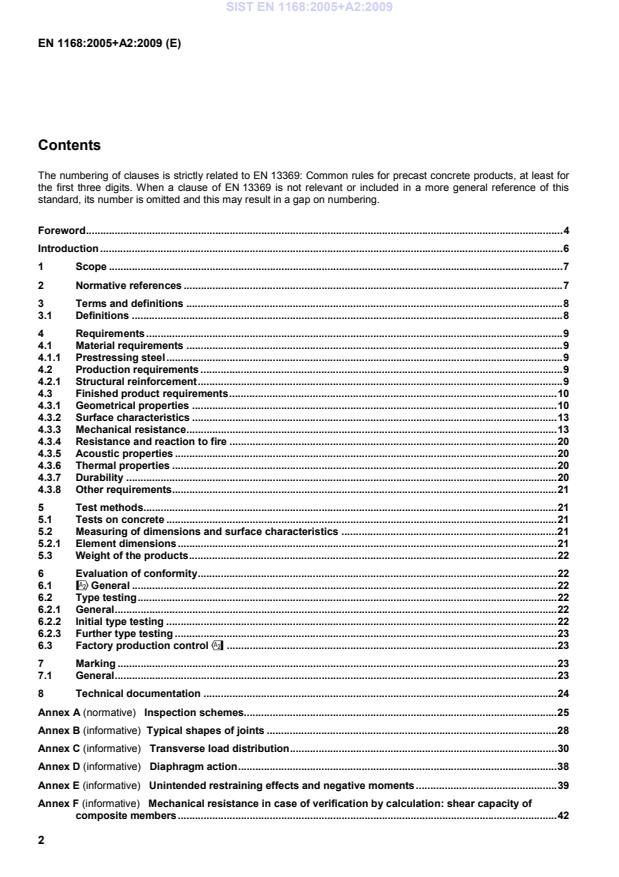
Inspection schemes. 25Annex B (informative)
Typical shapes of joints . 28Annex C (informative)
Transverse load distribution . 30Annex D (informative)
Diaphragm action . 38Annex E (informative)
Unintended restraining effects and negative moments . 39Annex F (informative)
Mechanical resistance in case of verification by calculation: shear capacity of composite members . 42SIST EN 1168:2005+A2:2009
Resistance to fire . 45Annex H (informative)
Design of connections . 48Annex J (normative)
!Full scale test" . 50Annex ZA (informative)
#Clauses of this European Standard addressing essential requirements or other provisions of EU Directives$ . 56Bibliography . 70 SIST EN 1168:2005+A2:2009
Key 1 Core 2 Web Figure 1 — Example of hollow core slab 3.1.2 core longitudinal void produced by specific industrial manufacturing techniques, located with a regular pattern and the shape of which is such that the vertical loading applied on the slab is transmitted to the webs 3.1.3 web vertical concrete part between two adjacent cores (intermediate webs) or on the lateral edges of the slab (outermost webs) 3.1.4 lateral joint lateral profile on the longitudinal edges of a hollow core slab shaped so to allow grouting between
two adjacent slabs 3.1.5 topping cast in situ concrete on the hollow core slab floor intended to increase its bearing capacity and so constituting a composite hollow core slab floor 3.1.6 screed cast in situ concrete or mortar layer used to level the upper face of the finished floor SIST EN 1168:2005+A2:2009
200 mm < h < 250 mm: linear interpolation may be applied; mean value per slab: ± 7 mm; the requirement in this paragraph shall not conflict with subclause 4.3.1.2.3 of this standard. !!!!4.3.1.1.2"""" Tolerances for construction purposes The maximum deviations, unless declared otherwise by the manufacturer, shall satisfy the following: a) slab length: ± 25 mm; b) slab width: ± 5 mm; c) slab width for longitudinally sawn slabs : ± 25 mm. !!!!4.3.1.1.3"""" Tolerances for concrete cover !The maximum deviation for concrete cover shall be ∆c = -10 mm. A more stringent tolerance may be declared by the manufacturer." 4.3.1.2 Minimum dimensions Complementary to 4.3.1.2 of EN 13369:2004 next subclauses shall apply. 4.3.1.2.1 Thickness of webs and flanges The nominal thickness specified on the drawings shall be at least the minimum thickness increased by the maximum deviation (minus tolerance) declared by the manufacturer. The minimum thickness shall be: for any web, not less than the largest of h/10, 20 mm and (dg + 5 mm), where dg and h are in millimetres; for any flange, not less than the largest value of h2, 17 mm and (dg + 5 mm), where dg and h are in millimetres; however for the upper flange, not less than 0,25 bc, where bc is the width of that part of the flange in which the greatest thickness is not greater than 1,2 times the smallest thickness (see Figure 2). Thickness of webs and flanges shall be measured in accordance with 5.2.1.1. SIST EN 1168:2005+A2:2009
$ Figure 2 — Minimum thickness of upper flange 4.3.1.2.2 Minimum concrete cover and axis distances of prestressing steel For indented wires or smooth and indented strands, the minimum concrete cover cmin to the nearest concrete surface and to the nearest edge of a core shall be at least: only with respect to the exposed face, the one determined in accordance with 4.4.1.2 of EN 1992-1-1:2004 shall apply; for preventing longitudinal cracking due to bursting and splitting and in the absence of specific calculations and/or tests: !a) when the nominal centre to centre distance of the strands is ≥ 3 Ø: cmin = 1,5 Ø; b) when the nominal centre to centre distance of the strands is < 2,5 Ø: cmin = 2,5 Ø; where Ø is the strand or wire diameter, in millimetres (in the case of different diameters, the average value shall be used for Ø). For intermediate centre to centre distance, cmin may be derived by linear interpolation between the values defined in a) and b). For ribbed wires, the concrete cover shall be increased by 1 Ø." 4.3.1.2.3 Minimum concrete cover of reinforcing steel Clause 4.4.1.2 of EN 1992-1-1:2004 shall apply. 4.3.1.2.4 Longitudinal joint shape The longitudinal joint width shall be: at least 30 mm at the top of the joint; greater than the larger value of 5 mm or dg at the lower part of the joint, where dg is the maximum aggregate size in the joint grout. SIST EN 1168:2005+A2:2009
e51opt12,3eowosp,,,,eebPl and #hk)-(e = .
oe≥ 0$ SIST EN 1168:2005+A2:2009
(positive if compressive)
∑=⋅+−⋅−⋅=ntdxldPISAAb1t1)()()()()()(xtccicwcp(y)CptYpYyyyyτ
This expression shall be applied with reference to the critical points of a straight line of failure rising from the edge of the support with an angle β = 35° with respect to the horizontal axis. The critical point is the point on the quoted line where the result of the expression of VRd,c is the lowest. The definition of symbols is given here below: I is the second moment of area of the cross section; bw(y) is the web width at the height y; Yc is the height of the centroidal axis; SIST EN 1168:2005+A2:2009
Cpt = -1 when y ≤ y
pt
Cpt =
0 when y > y pt Ypt is the height of the position of considered tendon layer. As an alternative to the above expression, the following simplified expression may be applied: ()ctdcp2ctdwRdcffSIbVσβαϕl+= where I/S is the second over first moment of area (= z lever arm); α = lx/ lpt2 is the degree of prestressing transmission (αI ≤ 1,0); lx is the distance of the considered section from the starting point of transmission length; lpt2 is the upper value of transmission length (see Equation (8.18) of EN 1992-1-1:2004); σcp = NEd/A is the full concrete compressive stress at the centroidal axis; fctd = fctk0,05/yc
is the design value of tensile strength of concrete; ϕ = 0,8 is the reducing factor; β = 0,9 is the reducing factor referred to transmission length. For hollow-core slabs deeper than 450 mm the shear strength, both for regions cracked or uncracked by bending, shall be reduced by 0,9 with respect to the equations quoted above." SIST EN 1168:2005+A2:2009
Figure 3 — Eccentric shear force 4.3.3.2.3 Shear capacity of the longitudinal joints Load distribution from an element to the adjacent element will cause vertical shear forces in the joint and the elements at both sides of the joint. The shear capacity in this case depends on the properties of the joint and of the elements. This shear capacity vRdj, expressed as resisting linear load, is the smaller value of the flange resistance v'Rdj or the joint resistance vRdj : v'Rdj = 0,25 fctd Σhf SIST EN 1168:2005+A2:2009
Figure 4 — Shear force in joints The shear capacity VRdj expressed as resisting concentrated load, shall be calculated as follows: VRdj = vRdj (a + hj + ht + 2 as) where vRdj is the smaller value of v'Rdj or vRdj ; a is the length of the load parallel to the joint ; as is the distance between the centre of the load and the centre of the joint. 4.3.3.2.4 Punching shear capacity In the absence of particular justifications, the punching shear capacity of slabs without topping VRd, in newtons, expressed as resisting point load, shall be calculated as follows: +=ctdcpctdefRd 30
1f1.,h fbVf
ll=α≤ 1 according to 6.2.2 of EN 1992-1-1:2004 where beff is the effective width of the webs according to Figure 5 ; σcp is the concrete compressive stress at the centroidal axis due to prestressing.
beff = bw1 + bw2 + bw3 a) General situation
beff = bw1 + bw2 + bw3 c) General situation with structural topping
beff = bw1 + bw2 b) Free edge of floor-bay
beff = bw1 + bw2 d) Free edge of floor-bay with structural topping Figure 5 — Effective width For concentrated loads of which more than 50 % is acting on outermost web (bw2 in Figures 5 b) and 5 d)) of a free edge of a floor bay, the resistance resulting from the equation is applicable only if at least one strand or wire in the outermost web and a transverse reinforcement are present. If one of these or both conditions are not satisfied, the resistance shall be divided by a factor of 2. The transverse reinforcement shall be strips or bars at the top of the element or in the structural topping, with a length of at least 1,20 m and fully anchored, and shall be designed for a tensile force equal to the total concentrated load. If a load above a core has a smaller width than half of the width of the core, a second resistance shall be calculated with the same equation, but in which h shall be replaced by the smallest thickness of the upper flange and beff by the width of the loading pad. The lowest value of the calculated resistances shall be applied. SIST EN 1168:2005+A2:2009
20ctk0,05bk+=ll for a linear load on an edge of a floor area: bfWqk2 10ctk0,05t+=ll for a point load anywhere on a floor area: Fk = 3 Wl fctk 0,05 where Wlb is the minimum section modulus in transverse direction per unit length related to the bottom fibre of the elements; Wlt is the minimum section modulus in transverse direction per unit length related to the top fibre; Wl is the smaller of Wlb or Wlt. If the elements are designed by assuming load distribution according to the elastic theory, which means that a part of the loads acting on one element are distributed to adjacent elements, the limiting value of the tensile stress is fctd in the ultimate limit state. The capacities for concentrated loads in this case, in the ultimate limit state, may be derived from the same equation, but in which qk, Fk and fctk 0,05 shall be replaced by qd, Fd and fctd. 4.3.3.2.6 Load capacity of elements supported on three edges Distributed imposed loads on an element of the floor with one supported longitudinal edge will cause torsional moments. The resulting support reaction due to this torsion shall be ignored in the design in the ultimate limit state. The shear stresses due to these torsional moments shall be limited to fctk 0,05/1,5 in the serviceability limit state. The load capacity qk for imposed load per unit area which is the total load minus the load due to the self weight of the elements, shall be calculated, in the serviceability limit state, as follows: 2tctk0,05k060 l,Wfq= SIST EN 1168:2005+A2:2009
Annex J.$ 4.3.4 Resistance and reaction to fire 4.3.4.1 Resistance to fire Complementary to 4.3.4.1 to 4.3.4.3 of EN 13369:2004 the calculation method and tabulated data in Annex G of this standard may be used. NOTE The topping or screed cast directly on the precast unit may be taken into account in the fire resistance of the floor for the separating function; the fire resistance given for a hollow core element is valid when installed in a floor structure with necessary tying system according to EN 1992-1-1:2004. 4.3.4.2 Reaction to fire For reaction to fire, 4.3.4.4 of EN 13369:2004 shall apply. 4.3.5 Acoustic properties Clause 4.3.5 of EN 13369:2004 shall apply. NOTE The impact sound insulation of a building is influenced by the total floor structure, including floor-covering, support conditions, joint details and walls. 4.3.6 Thermal properties Complementary to 4.3.6 of EN 13369:2004 the following rules may apply. A rough approximation of the thermal resistance of hollow core slabs (height > 0,2 m) may be estimated as follows: Rc = 0,35 (h + 0,25) where Rc is the thermal resistance of the slabs (exclusive !surface" resistance), in square metres Kelvins per Watt; h is the total height of the elements, in metres. 4.3.7 Durability Clause 4.3.7 of EN 13369:2004 shall apply. SIST EN 1168:2005+A2:2009
...