

EN 13501-5:2005
(Main)Fire classification of construction products and building elements - Part 5: Classification using data from external fire exposure to roofs tests
- Abstract
This European Standard provides the fire performance classification procedures for roofs/roof coverings exposed to external fire based on the four test methods given in ENV 1187:2002.
For the classification of a roof/roof covering, only those test methods need to be applied for which the corresponding classification is envisaged.
Products are considered in relation to their end use application.
NOTE The distinction between roofs with a steep slope and facades, in terms of the test and classification standard to be applied, may be subject to national regulations.
General information on the four test methods in ENV 1187:2002 is given in Annex A.
- Status
- Withdrawn
- Publication Date
- 20-Dec-2005
- Withdrawal Date
- 01-Sep-2009
- Technical Committee
- CEN/TC 127 - Fire safety in buildings
- Drafting Committee
- CEN/TC 127 - Fire safety in buildings
- Current Stage
- 9960 - Withdrawal effective - Withdrawal
- Start Date
- 02-Sep-2009
- Completion Date
- 02-Sep-2009

Relations
- Effective Date
- 19-Jan-2023
- Effective Date
- 28-Jan-2026
- Effective Date
- 22-Dec-2008
- Effective Date
- 22-Dec-2008
Get Certified
Connect with accredited certification bodies for this standard

CIS Institut d.o.o.
Personal Protective Equipment (PPE) certification body. Notified Body NB-2890 for EU Regulation 2016/425 PPE.

Kiwa BDA Testing
Building and construction product certification.
Kmetijski inštitut Slovenije
Agricultural Institute of Slovenia. Soil testing, plant health, agricultural product analysis.
Sponsored listings
Frequently Asked Questions
EN 13501-5:2005 is a standard published by the European Committee for Standardization (CEN). Its full title is "Fire classification of construction products and building elements - Part 5: Classification using data from external fire exposure to roofs tests". This standard covers: This European Standard provides the fire performance classification procedures for roofs/roof coverings exposed to external fire based on the four test methods given in ENV 1187:2002. For the classification of a roof/roof covering, only those test methods need to be applied for which the corresponding classification is envisaged. Products are considered in relation to their end use application. NOTE The distinction between roofs with a steep slope and facades, in terms of the test and classification standard to be applied, may be subject to national regulations. General information on the four test methods in ENV 1187:2002 is given in Annex A.
This European Standard provides the fire performance classification procedures for roofs/roof coverings exposed to external fire based on the four test methods given in ENV 1187:2002. For the classification of a roof/roof covering, only those test methods need to be applied for which the corresponding classification is envisaged. Products are considered in relation to their end use application. NOTE The distinction between roofs with a steep slope and facades, in terms of the test and classification standard to be applied, may be subject to national regulations. General information on the four test methods in ENV 1187:2002 is given in Annex A.
EN 13501-5:2005 is classified under the following ICS (International Classification for Standards) categories: 13.220.50 - Fire-resistance of building materials and elements. The ICS classification helps identify the subject area and facilitates finding related standards.
EN 13501-5:2005 has the following relationships with other standards: It is inter standard links to EN 13501-5:2005+A1:2009, CEN/TS 15117:2005, EN 13501-5:2005/AC:2006, EN 13501-5:2005/AC:2008. Understanding these relationships helps ensure you are using the most current and applicable version of the standard.
EN 13501-5:2005 is associated with the following European legislation: EU Directives/Regulations: 305/2011, 89/106/EEC; Standardization Mandates: M/117. When a standard is cited in the Official Journal of the European Union, products manufactured in conformity with it benefit from a presumption of conformity with the essential requirements of the corresponding EU directive or regulation.
EN 13501-5:2005 is available in PDF format for immediate download after purchase. The document can be added to your cart and obtained through the secure checkout process. Digital delivery ensures instant access to the complete standard document.
Standards Content (Sample)
2003-01.Slovenski inštitut za standardizacijo. Razmnoževanje celote ali delov tega standarda ni dovoljeno.Požarna klasifikacija gradbenih proizvodov in elementov stavb - 5. del: Klasifikacija na podlagi podatkov iz preskusov pri izpostavljenosti streh požaru z zunanje straniKlassifizierung von Bauprodukten und Bauarten zu ihrem Brandverhalten - Teil 5: Klassifizierung mit den Ergebnissen aus Prüfungen von Bedachungen bei Beanspruchung durch Feuer von außenClassement au feu des produits de construction et éléments de bâtiment - Partie 5: Classement utilisant des données d'essais au feu des toitures exposées a un feu extérieurFire classification of construction products and building elements - Part 5: Classification using data from external fire exposure to roofs tests91.060.20StreheRoofs13.220.50Požarna odpornost gradbenih materialov in elementovFire-resistance of building materials and elementsICS:Ta slovenski standard je istoveten z:EN 13501-5:2005SIST EN 13501-5:2006en01-maj-2006SIST EN 13501-5:2006SLOVENSKI
STANDARD
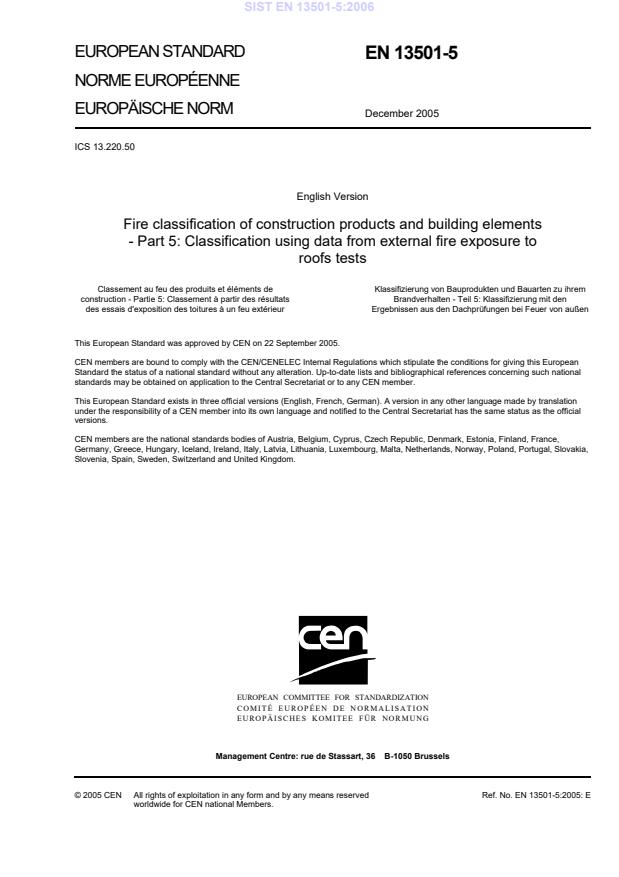
EUROPEAN STANDARDNORME EUROPÉENNEEUROPÄISCHE NORMEN 13501-5December 2005ICS 13.220.50 English VersionFire classification of construction products and building elements- Part 5: Classification using data from external fire exposure toroofs testsClassement au feu des produits et éléments deconstruction - Partie 5: Classement à partir des résultatsdes essais d'exposition des toitures à un feu extérieurKlassifizierung von Bauprodukten und Bauarten zu ihremBrandverhalten - Teil 5: Klassifizierung mit denErgebnissen aus den Dachprüfungen bei Feuer von außenThis European Standard was approved by CEN on 22 September 2005.CEN members are bound to comply with the CEN/CENELEC Internal Regulations which stipulate the conditions for giving this EuropeanStandard the status of a national standard without any alteration. Up-to-date lists and bibliographical references concerning such nationalstandards may be obtained on application to the Central Secretariat or to any CEN member.This European Standard exists in three official versions (English, French, German). A version in any other language made by translationunder the responsibility of a CEN member into its own language and notified to the Central Secretariat has the same status as the officialversions.CEN members are the national standards bodies of Austria, Belgium, Cyprus, Czech Republic, Denmark, Estonia, Finland, France,Germany, Greece, Hungary, Iceland, Ireland, Italy, Latvia, Lithuania, Luxembourg, Malta, Netherlands, Norway, Poland, Portugal, Slovakia,Slovenia, Spain, Sweden, Switzerland and United Kingdom.EUROPEAN COMMITTEE FOR STANDARDIZATIONCOMITÉ EUROPÉEN DE NORMALISATIONEUROPÄISCHES KOMITEE FÜR NORMUNGManagement Centre: rue de Stassart, 36
B-1050 Brussels© 2005 CENAll rights of exploitation in any form and by any means reservedworldwide for CEN national Members.Ref. No. EN 13501-5:2005: ESIST EN 13501-5:2006
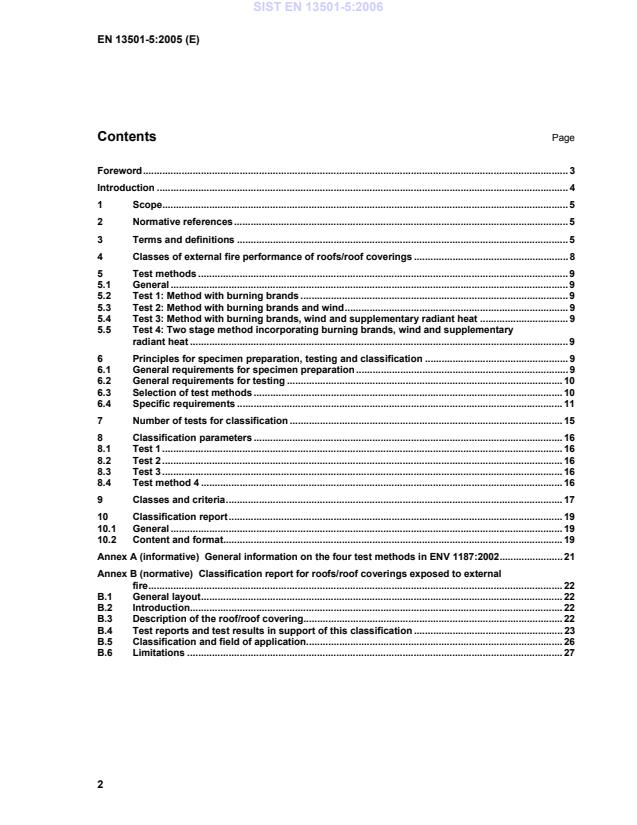
General information on the four test methods in ENV 1187:2002.21 Annex B (normative)
Classification report for roofs/roof coverings exposed to external fire.22 B.1 General layout.22 B.2 Introduction.22 B.3 Description of the roof/roof covering.22 B.4 Test reports and test results in support of this classification.23 B.5 Classification and field of application.26 B.6 Limitations.27
3 Foreword This European Standard (EN 13501-5:2005) has been prepared by Technical Committee CEN/TC 127 “Fire safety in buildings”, the secretariat of which is held by BSI. This European Standard shall be given the status of a national standard, either by publication of an identical text or by endorsement, at the latest by June 2006, and conflicting national standards shall be withdrawn at the latest by June 2006. This European Standard has been prepared under a mandate given to CEN by the European Commission and the European Free Trade Association, and supports essential requirements of the Construction Products Directive. CEN, CENELEC and EOTA committees preparing technical specifications which contain performance requirements against external fire exposure of roofs should make reference to the classification given in this European Standard and not refer directly to any specific fire test method. EN 13501 consists of the following parts: Part 1: Classification using data from reaction to fire tests, Part 2: Classification using data from fire resistance tests, excluding ventilation services, Part 3: Classification using data from fire resistance tests on components of normal building service installations: fire resisting ducts and fire dampers Part 4: Classification using data from fire resistance tests on components of smoke control systems, Part 5: Classification using data from external fire exposure to roof tests. According to the CEN/CENELEC Internal Regulations, the national standards organizations of the following countries are bound to implement this European Standard: Austria, Belgium, Cyprus, Czech Republic, Denmark, Estonia, Finland, France, Germany, Greece, Hungary, Iceland, Ireland, Italy, Latvia, Lithuania, Luxembourg, Malta, Netherlands, Norway, Poland, Portugal, Slovakia, Slovenia, Spain, Sweden, Switzerland and United Kingdom.
5 1 Scope This European Standard provides the fire performance classification procedures for roofs/roof coverings exposed to external fire based on the four test methods given in ENV 1187:2002. For the classification of a roof/roof covering, only those test methods need to be applied for which the corresponding classification is envisaged. Products are considered in relation to their end use application. NOTE The distinction between roofs with a steep slope and facades, in terms of the test and classification standard to be applied, may be subject to national regulations. General information on the four test methods in ENV 1187:2002 is given in Annex A. 2 Normative references The following referenced documents are indispensable for the application of this European Standard. For dated references, only the edition cited applies. For undated references, the latest edition of the referenced document (including any amendments) applies. ENV 1187:2002, Test methods for external fire exposure to roofs EN 13501-1, Fire classification of construction products and building elements - Part 1: Classification using test data from reaction to fire tests EN ISO 13943:2000, Fire safety — Vocabulary (ISO 13943:2000) 3 Terms and definitions For the purposes of this European Standard, the terms and definitions given in EN ISO 13943:2000 and the following apply. 3.1 roof covering and sealing system, including any insulating layers or vapour barriers normally provided together with their supporting elements including attachment (glued, mechanically fastened etc.), and roof lights or other closures for roof apertures that are intended to provide a weatherproof surface [ENV 1187:2002] 3.2 material basic single substance or uniformly dispersed mixture of substances (e.g. metal, stone, wood, bitumen, concrete, mineral wool) [ENV 1187:2002] 3.3 damaged material material that has been burnt, charred, melted or otherwise visually changed by heat. Discolouration and soot deposits are not to be regarded as damaged material [ENV 1187:2002] SIST EN 13501-5:2006
7 3.13 sustained flaming flames arising from an observed location, which persist for 5 s or longer [ENV 1187:2002] 3.14 external fire spread progression and extent of sustained flaming across the exposed surface of the specimen [ENV 1187:2002] 3.15 fire penetration appearance on the underside of the specimen of any sustained flaming or glowing due to combustion, including the occurrence of any flaming droplets falling from the underside. Charring and/or discolouration are not to be regarded as fire penetration (for tests 1 and 3) [ENV 1187:2002] 3.16 opening appearance during the test of any hole greater than 25 mm² in area or any crack greater than 2 mm wide, which penetrates completely through the specimen and which would allow burning materials to fall through the roof (for tests 1 and 3) [ENV 1187:2002] 3.17 internal damage extent of damaged material in each layer inside the specimen, measured from the edges of the projection of the ignition source in the upwards and downwards directions with respect to the pitch of the roof (for tests 1 and 3) [ENV 1187:2002] 3.18 fire spread within the roof/internal fire spread maximum burnt length measured from the upper edge of the projection of the ignition source in the upward direction and from the lower edge in the downward direction of each layer for sloped roofs, and in any direction for horizontal roofs (pitch of 0°) (for tests 1 and 3) [ENV 1187:2002] 3.19 flaming droplets or debris burning material falling from the specimen that continues to burn on the floor for at least 5 s [ENV 1187:2002] 3.20 joint any kind of connection or link within a layer in the roof, such as an overlap or seam [ENV 1187:2002] SIST EN 13501-5:2006
9 Products classified in a given class are deemed to satisfy all the requirements of any lower class for the same test method/fire hazard scenario. The classes with their corresponding fire performance are given in Table1. 5 Test methods 5.1 General The four test methods given in ENV 1187 are those to be used for classification purposes for roofs/roof coverings. The selection of the tests to be carried out is specified in 6.3. The classification parameters, the classes and the corresponding criteria are specified in Clauses 8 and 9. 5.2 Test 1: Method with burning brands The test evaluates the performance of a roof under the conditions of thermal attack with burning brands. The performance includes the fire spread across the external surface of the roof, the fire spread within the roof and the fire penetration. 5.3 Test 2: Method with burning brands and wind The test evaluates the performance of a roof covering under the conditions of thermal attack with burning brands and additional wind. The performance includes damaged length both on the roof covering and in the substrate. 5.4 Test 3: Method with burning brands, wind and supplementary radiant heat The test evaluates the performance of a roof under the conditions of thermal attack with burning brands, additional wind and radiant heat. The performance includes the external fire spread and the fire penetration. 5.5 Test 4: Two stage method incorporating burning brands, wind and supplementary radiant heat The test evaluates the performance of a roof under the conditions of thermal attack with burning brands, wind and radiant heat. The performance includes the external fire spread and the penetration by fire. 6 Principles for specimen preparation, testing and classification 6.1 General requirements for specimen preparation Before testing, the test specimens shall be prepared and conditioned and, where relevant, mounted in accordance with the relevant test method and product standards or other technical specifications. The external fire performance of a roof/roof covering includes such aspects as external and internal fire spread, external and internal damage, fire penetration and the occurrence of flaming droplets or debris. The external fire performance of a roof/roof covering therefore does not only depend on the burning behaviour of the exposed surface, the roof covering, but also on the influences of several components of the roof, such as the nature and thickness of insulating layers and vapour barriers together with their supporting elements. It may also depend on the systems of attachment of all components, e.g. glued or mechanically fastened. Therefore, the test specimens shall be representative, in all details of practical application with regard to: SIST EN 13501-5:2006
11 6.4 Specific requirements 6.4.1 General Each test specifies a series of standard specimen compositions and test conditions covering a wider field of direct application. The number of specimens to be prepared as well as the number of tests to be carried out depends on the envisaged field of application of the classification. Variables are the pitch of the roof, the deck and/or substrate applied for the test and the inclusion of joints. 6.4.2 Test 1 6.4.2.1 General Tests to be carried out are chosen to cover the envisaged field of direct application according to 6.4.2.5. 6.4.2.2 Pitch The standard test pitches are 15° and 45°. Tests may also be done at the actual intended pitch. 6.4.2.3 Nature of the deck The standard supporting decks for tests are specified in ENV 1187: a) wood particle board deck, constructed from planks 250 mm wide × 16 mm thick, density (680 ± 50) kg/m³ with plain edges and tightly but jointed so that gaps between planks do not exceed 0,5 mm; b) deck from wood particle board planks as under a) with plain edges with gaps of (5,0 ± 0,5) mm; c) deck of 10 mm thick reinforced calcium silicate board, dry density (680 ± 50) kg/m3; d) trapez
...