


EN 12158-1:2021
(Main)Builders' hoists for goods - Part 1: Hoists with accessible platforms
Builders' hoists for goods - Part 1: Hoists with accessible platforms
1.1 This document deals with power-operated temporarily installed builder’s hoists (referred to as "hoists" in this document) intended for use by persons who are permitted to enter sites of engineering and construction, serving landing levels, having a load-carrying device:
- designed for the transportation of goods only;
- guided;
- travelling vertically or along a path within 15° max. of the vertical;
- supported or sustained by drum-driven wire rope, chain, rack and pinion or an expanding linkage mechanism;
- where masts, when erected, may or may not require support from separate structures;
- which permits the access of instructed persons during loading and unloading;
- which are driven by appointed persons;
- which permits, if necessary, during erection, dismantling, maintenance and inspection, the access and travel by persons who are competent and authorized.
1.2 The document deals with the significant hazards, hazardous situations or hazardous events relevant to such equipment as listed in Annex C which arise during the various phases in the life of such equipment and describes methods for the elimination or reduction of these hazards when it is used as intended and under conditions of misuse which are reasonably foreseeable by the manufacturer.
1.3 This document does not specify the additional requirements for:
- hydraulic installations;
- operation in severe conditions (e.g. extreme climates, strong magnetic fields);
- lightning protection;
- operation subject to special rules (e.g. potentially explosive atmospheres);
- electromagnetic compatibility (emission, immunity);
- handling of loads the nature of which could lead to dangerous situations (e.g. molten metal, acids/bases, radiating materials, fragile loads);
- the use of combustion engines;
- the use of remote controls;
- hazards occurring during manufacture;
- hazards occurring as a result of mobility;
- hazards occurring as a result of being erected over a public road;
- earthquakes;
- noise;
- ergonomics;
- fixed guards;
- operator intervention.
1.4 This document is not applicable to:
- builder’s hoists for persons and materials;
- lifts according to EN 81 3:2000+A1:2008 and EN 81 20:2020;
- inclined hoists according to EN 12158 2:2000+A1:2010;
- work cages suspended from lifting appliances;
- work platforms carried on the forks of fork trucks;
- transport platforms according to EN 16719:2018;
- work platforms;
- funiculars;
- lifts specially designed for military purposes;
- mine lifts;
- theatre elevators;
- special purpose lifts.
1.5 This document deals with the hoist installation. It includes the base frame and base enclosure but excludes the design of any concrete, hard core, timber or other foundation arrangement. It includes the design of mast ties but excludes the design of anchorage bolts to the supporting structure. It includes the landing gates and their frames but excludes the design of any anchorage fixing bolts to the supporting structure.
1.6 This document is not applicable to builders' hoists for goods (hoists with accessible platforms) manufactured before the date of publication of this document by CEN.
Bauaufzüge für den Materialtransport - Teil 1: Aufzüge mit betretbarer Plattform
1.1 Dieses Dokument behandelt kraftbetriebene, vorübergehend errichtete Bauaufzüge (in diesem Dokument als „Aufzüge” bezeichnet), die für die Benutzung durch Personen bestimmt sind, denen das Betreten von Baustellen und technischen Anlagen erlaubt ist. Die Aufzüge bedienen Ladestellenebenen und haben ein Lastaufnahmemittel:
— das nur für den Materialtransport konstruiert ist;
— das geführt ist;
— das sich senkrecht oder entlang von Führungen bewegt, deren Neigung gegen die Senkrechte höchstens 15° beträgt;
— das gehalten oder getragen wird durch das Drahtseil eines Trommelantriebs, Kette, Zahnstange und Zahnrad oder durch einen ausfahrbaren Gestängemechanismus;
— wo Masten, wenn sie aufgestellt sind, eine Abstützung durch separate Konstruktionen benötigen oder nicht benötigen;
— das das Betreten durch unterwiesene Personen während des Be- und Entladens erlaubt;
— das von dazu beauftragten Personen gefahren wird;
— das, falls erforderlich, den Zutritt und das Mitfahren sachkundiger und befugter Personen während des Auf- und Abbaus sowie bei der Instandhaltung und Inspektion gestattet.
1.2 Das Dokument behandelt die in Anhang C aufgeführten signifikanten Gefährdungen, Gefährdungs-situationen oder -ereignisse, die auf die Maschine zutreffen und die während der verschiedenen Lebensphasen der Maschine entstehen, und beschreibt Verfahren zur Beseitigung oder Minderung dieser Gefährdungen, wenn die Einrichtungen bestimmungsgemäß und unter Bedingungen, die vom Hersteller als Fehlanwendung vernünftigerweise vorhersehbar sind, verwendet werden.
1.3 Dieses Dokument legt keine zusätzlichen Anforderungen fest für:
— hydraulische Anlagen;
— den Betrieb unter erschwerten Bedingungen (z. B. extreme Klimazonen, starke magnetische Felder);
— den Blitzschutz;
— den Betrieb unter besonderen Vorschriften (z. B. in explosionsgefährdeten Bereichen);
— die elektromagnetische Verträglichkeit (Störaussendung, Störfestigkeit);
— den Umgang mit Lasten, deren Eigenschaften zu gefährlichen Situationen führen könnten (z. B. Schmelzen, Säuren/Basen, strahlende Werkstoffe, zerbrechliche Lasten);
— die Verwendung von Verbrennungsmotoren;
— die Verwendung von Fernsteuerungen;
— Gefährdungen während der Herstellung;
— Gefährdungen, die aus der Ortsveränderlichkeit entstehen;
— Gefährdungen, die sich aus der Errichtung über einer öffentlichen Straße ergeben;
— Erdbeben;
— Geräusche;
— Ergonomie;
— feststehende trennende Schutzeinrichtungen;
— Eingriffe des Bedienungspersonals.
1.4 Dieses Dokument ist nicht anzuwenden für:
— Bauaufzüge zur Personen- und Materialbeförderung;
— Aufzüge nach EN 81-3:2000+A1:2008 und EN 81-20:2020;
— Schrägaufzüge nach EN 12158 2:2000+A1:2010;
— Arbeitskörbe, die an Hebezeugen hängen;
— von den Gabeln von Gabelstaplern getragene Arbeitsbühnen;
— Transportbühnen nach EN 16719:2018;
— Arbeitsbühnen;
— Seilbahnen;
— speziell für militärische Zwecke konstruierte Aufzüge;
— Bergwerksaufzüge;
— Theateraufzüge;
— Aufzüge für spezielle Zwecke.
1.5 Dieses Dokument befasst sich mit der Installation des Aufzugs. Es umfasst das Fußteil und die Bodenstationsumwehrung, schließt jedoch die Konstruktion von Fundamentanlagen aus Beton, Stahl, Holz oder anderen Materialien aus. Es umfasst die Konstruktion von Mastverankerungen, schließt jedoch die Konstruktion von Verankerungsschrauben an der Tragkonstruktion aus. Es umfasst die Ladestellentore und ihre Rahmen, schließt jedoch die Konstruktion von Verankerungsschrauben an der Tragkonstruktion aus.
1.6 Dieses Dokument ist nicht anzuwenden für Bauaufzüge für den Materialtransport (Aufzüge mit betretbarer Plattform), die vor dem Datum der Veröffentlichung dieses Dokuments durch CEN hergestellt wurden.
Monte-matériaux - Partie 1 : Monte-matériaux à plates-formes accessibles
1.1 Le présent document traite des élévateurs de chantier motorisés, installés temporairement (appelés « monte-matériaux » dans le présent document), destinés à être utilisés par des personnes autorisées à pénétrer sur des chantiers et des sites industriels, desservant des paliers et possédant un dispositif porte-charge :
- conçu uniquement pour le transport de matériaux ;
- guidé ;
- le déplaçant verticalement ou le long de guides, dont l'angle avec la verticale ne dépasse pas 15 ° maximum ;
- soutenu ou supporté par le câble métallique d'un tambour moteur, par chaîne, par crémaillère et pignon ou par un mécanisme à structure déployable ;
- où les mâts, lorsqu'ils sont installés, peuvent ou non nécessiter le soutien de structures distinctes ;
- permettant l'accès à des personnes ayant reçu les instructions nécessaires lors du chargement et du déchargement ;
- contrôlé par des personnes désignées ;
- permettant, si nécessaire, l'accès et le transport de personnes compétentes et autorisées durant le montage, le démontage ainsi que la maintenance et l'inspection.
1.2 Le document traite des risques significatifs, des situations dangereuses ou des événements dangereux relatifs à ces équipements, tels qu'ils sont énumérés à l'Annexe C, qui surviennent au cours des différentes phases de la vie de ces équipements, et décrit les méthodes d'élimination ou de réduction de ces risques lorsqu'ils sont utilisés conformément à leur destination et dans des conditions d'utilisation incorrecte qui sont raisonnablement prévisibles par le fabricant.
1.3 Le présent document ne spécifie pas de prescriptions supplémentaires pour :
- les installations hydrauliques ;
- le fonctionnement dans des conditions difficiles (par exemple, conditions climatiques extrêmes, champs magnétiques forts) ;
- la protection antifoudre ;
- l'utilisation soumises à des règles particulières (par exemple, risque d'explosion potentielle) ;
- la compatibilité électromagnétique (émission, immunité) ;
- la manutention de charge dont les caractéristiques peuvent conduire à des situations dangereuses (par exemple, métal en fusion, acides/bases, matériaux rayonnants, charges très fragiles) ;
- l'utilisation de moteurs à combustion interne ;
- l'utilisation de radiocommandes ;
- des risques survenant pendant la fabrication ;
- des risques dus à la mobilité ;
- des risques qui se posent lorsque le monte-matériaux est assemblé au-dessus d'une voie publique ;
- les tremblements de terre ;
- le bruit ;
- l’ergonomie ;
- les protecteurs fixes ;
- les interventions de l’opérateur.
1.4 Le présent document ne s'applique pas :
- aux ascenseurs de chantier pour personnes et matériaux ;
- aux ascenseurs selon l'EN 81-3:2000+A1:2008 et l'EN 81-20:2020 ;
- aux monte-matériaux inclinés selon l'EN 12158-2:2000+A1:2010 ;
- aux cages de travail suspendues à des appareils de levage ;
- aux plates-formes de travail portées par les fourches d'un chariot de manutention ;
- aux plates-formes de transport selon l’EN 16719:2018 ;
- aux plates-formes de travail ;
- aux funiculaires ;
- aux élévateurs spécialement conçus à des fins militaires ;
- aux élévateurs miniers ;
- aux élévateurs de machinerie théâtrale ;
- aux élévateurs à usage particulier.
1.5 Le présent document concerne l'installation complète du monte-matériaux, y compris le châssis de base et l'enceinte de base, mais exclut la conception de toute sorte de fondations, comme en béton, en acier ou en bois. Il inclut la conception des ancrages de mât, mais ne traite pas des dispositifs d'ancrage à la structure de support. Il inclut les portes palières et leurs cadres, mais ne traite pas la conception des dispositifs d'ancrage pour la structure de support.
1.6 Le présent document n'est pas applicable aux monte-matériaux (monte-matériaux à plate forme accessible) ...
Gradbena dvigala za prevoz materiala - 1. del: Dvigala z dostopno dvižno ploščadjo
1.1 Ta standard obravnava začasno postavljena gradbena dvigala s pogonskim mehanizmom (v nadaljevanju: »dvigala«), ki so namenjena osebam z dovoljenjem za vstop na gradbišča, se uporabljajo kot podesti s prilagodljivo višino in vključujejo napravo za prevoz tovora, ki:
– je zasnovana izključno za prevoz materiala;
– je vodena;
– potuje navpično ali pod kotom največ 15 stopinj od navpičnice;
– je podprta ali jo drži železna žica, ki jo poganja boben, tračnica in zobato kolesce, hidravlični vitel (neposredno ali posredno) ali podaljševalni spojni mehanizem;
– ima stebre, ki morda potrebujejo oporo ločenih konstrukcij, ko so postavljeni;
– med nakladanjem in razkladanjem omogoča dostop poučenim osebam;
– jo upravljajo imenovane osebe;
– med postavitvijo, razstavljanjem, vzdrževanjem in pregledom po potrebi omogoča dostop pooblaščenim pristojnim osebam ter njihovo premeščanje.
1.2 Standard opredeljuje nevarnosti, navedene v točki 4, do katerih pride med različnimi fazami življenjske dobe take opreme, in opisuje metode za odpravo ali zmanjševanje teh nevarnosti, kadar se oprema uporablja v skladu s predvidenim namenom.
1.3 Ta evropski standard ne določa dodatnih zahtev za:
– obratovanje v zahtevnih pogojih (npr. skrajne podnebne razmere, močna magnetna polja);
– zaščito pred udarom strele;
– obratovanje, pri katerem veljajo posebna pravila (npr. potencialno eksplozivne atmosfere);
– elektromagnetno združljivost (emisije, odpornost);
– ravnanje s tovori, ki lahko povzročijo nevarne razmere (npr. taljena kovina, kisline/baze, sevajoči materiali, krhki tovori);
– uporabo motorjev z notranjim zgorevanjem;
– uporabo daljinskih upravljalnikov;
– nevarnosti, ki se pojavljajo med proizvodnjo;
– nevarnosti, ki so posledica premikanja;
– nevarnosti, ki so posledica postavitve nad javno cesto;
– potrese;
– hrup.
1.4 Ta standard se ne uporablja za:
– gradbena dvigala za osebe in materiale;
– dvigala v skladu s standardom EN 8.
General Information
- Status
- Published
- Publication Date
- 30-Nov-2021
- Technical Committee
- CEN/TC 10 - Passenger, goods and service lifts
- Drafting Committee
- CEN/TC 10/SC 1/WG 2 - Building hoists for goods only
- Current Stage
- 6060 - Definitive text made available (DAV) - Publishing
- Start Date
- 01-Dec-2021
- Due Date
- 02-Feb-2022
- Completion Date
- 01-Dec-2021
Relations
- Replaces
EN 12158-1:2000+A1:2010 - Builders' hoists for goods - Part 1: Hoists with accessible platforms - Effective Date
- 08-Dec-2021
Overview
EN 12158-1:2021 - Builders' hoists for goods - Part 1: Hoists with accessible platforms - is a European (CEN) safety standard that specifies essential safety, design and verification requirements for power‑operated, temporarily installed construction hoists used to transport goods. It applies to guided hoists travelling vertically (or within 15° of vertical) with load‑carrying platforms supported by drum‑driven wire rope, chain, rack‑and‑pinion or expanding link mechanisms. The document addresses significant hazards during erection, operation, maintenance, inspection and dismantling and describes measures to eliminate or reduce those hazards.
Key topics and technical requirements
- Scope and applicability: Covers builders’ hoists for goods with accessible platforms (not hoists for persons, inclined hoists, work cages, or special‑purpose lifts). Excludes hydraulic installations, extreme environments, EMC, lightning protection, certain hazardous load types and remote controls.
- Structural design and calculations: Requirements for static calculations, proof calculations, limit states and stability assessments for masts, base frames, ties and buffers.
- Platform and enclosure: Rules for platform construction, landing gates, hoistway protection, clearances and materials for enclosures and guarding.
- Drive and braking systems: Requirements for suspension, braking, overspeed safety devices and monitoring (including inadvertent brake release).
- Safety controls and electrical systems: Electrical wiring, protection against faults, travel‑limit switches, slack rope/chain detection, stopping devices and control modes.
- Verification and testing: Procedures for verification of design and on‑machine tests (including overspeed governor tests and commissioning checks) and requirements for marking and instruction handbooks.
- Safety performance integration: Incorporates performance level concepts aligned with EN ISO 13849-1 (machine safety control performance).
- Annexes: Informative list of significant hazards (Annex C), performance level examples (Annex B) and relationship to EU Machinery Directive (Annex ZA).
Practical applications
- Ensures safe design, manufacture, installation, commissioning and maintenance of construction hoists for material handling.
- Used to prepare technical specifications, risk assessments, conformity documentation and operator/maintenance manuals.
- Basis for on‑site inspection, commissioning tests and market surveillance compliance checks.
- Supports design choices for masts, ties, landing access, enclosures, braking and electrical safety systems.
Who should use this standard
- Manufacturers and designers of construction hoists and related components
- Construction companies and site safety managers specifying hoists
- Test laboratories, certifiers and notified bodies
- Maintenance providers and competent persons involved in erection, inspection and repairs
- Regulators and health & safety authorities enforcing machinery conformity
Related standards
- EN 12158-2 (inclined hoists)
- EN 81-3 / EN 81-20 (lifts standards - excluded items)
- EN ISO 13849-1 (safety‑related control system performance levels)
- EN 16719 (transport platforms)
Keywords: EN 12158-1:2021, builders' hoists for goods, hoists with accessible platforms, construction hoists, safety requirements, landing gates, mast ties, overspeed safety, EN ISO 13849-1.

Frequently Asked Questions
EN 12158-1:2021 is a standard published by the European Committee for Standardization (CEN). Its full title is "Builders' hoists for goods - Part 1: Hoists with accessible platforms". This standard covers: 1.1 This document deals with power-operated temporarily installed builder’s hoists (referred to as "hoists" in this document) intended for use by persons who are permitted to enter sites of engineering and construction, serving landing levels, having a load-carrying device: - designed for the transportation of goods only; - guided; - travelling vertically or along a path within 15° max. of the vertical; - supported or sustained by drum-driven wire rope, chain, rack and pinion or an expanding linkage mechanism; - where masts, when erected, may or may not require support from separate structures; - which permits the access of instructed persons during loading and unloading; - which are driven by appointed persons; - which permits, if necessary, during erection, dismantling, maintenance and inspection, the access and travel by persons who are competent and authorized. 1.2 The document deals with the significant hazards, hazardous situations or hazardous events relevant to such equipment as listed in Annex C which arise during the various phases in the life of such equipment and describes methods for the elimination or reduction of these hazards when it is used as intended and under conditions of misuse which are reasonably foreseeable by the manufacturer. 1.3 This document does not specify the additional requirements for: - hydraulic installations; - operation in severe conditions (e.g. extreme climates, strong magnetic fields); - lightning protection; - operation subject to special rules (e.g. potentially explosive atmospheres); - electromagnetic compatibility (emission, immunity); - handling of loads the nature of which could lead to dangerous situations (e.g. molten metal, acids/bases, radiating materials, fragile loads); - the use of combustion engines; - the use of remote controls; - hazards occurring during manufacture; - hazards occurring as a result of mobility; - hazards occurring as a result of being erected over a public road; - earthquakes; - noise; - ergonomics; - fixed guards; - operator intervention. 1.4 This document is not applicable to: - builder’s hoists for persons and materials; - lifts according to EN 81 3:2000+A1:2008 and EN 81 20:2020; - inclined hoists according to EN 12158 2:2000+A1:2010; - work cages suspended from lifting appliances; - work platforms carried on the forks of fork trucks; - transport platforms according to EN 16719:2018; - work platforms; - funiculars; - lifts specially designed for military purposes; - mine lifts; - theatre elevators; - special purpose lifts. 1.5 This document deals with the hoist installation. It includes the base frame and base enclosure but excludes the design of any concrete, hard core, timber or other foundation arrangement. It includes the design of mast ties but excludes the design of anchorage bolts to the supporting structure. It includes the landing gates and their frames but excludes the design of any anchorage fixing bolts to the supporting structure. 1.6 This document is not applicable to builders' hoists for goods (hoists with accessible platforms) manufactured before the date of publication of this document by CEN.
1.1 This document deals with power-operated temporarily installed builder’s hoists (referred to as "hoists" in this document) intended for use by persons who are permitted to enter sites of engineering and construction, serving landing levels, having a load-carrying device: - designed for the transportation of goods only; - guided; - travelling vertically or along a path within 15° max. of the vertical; - supported or sustained by drum-driven wire rope, chain, rack and pinion or an expanding linkage mechanism; - where masts, when erected, may or may not require support from separate structures; - which permits the access of instructed persons during loading and unloading; - which are driven by appointed persons; - which permits, if necessary, during erection, dismantling, maintenance and inspection, the access and travel by persons who are competent and authorized. 1.2 The document deals with the significant hazards, hazardous situations or hazardous events relevant to such equipment as listed in Annex C which arise during the various phases in the life of such equipment and describes methods for the elimination or reduction of these hazards when it is used as intended and under conditions of misuse which are reasonably foreseeable by the manufacturer. 1.3 This document does not specify the additional requirements for: - hydraulic installations; - operation in severe conditions (e.g. extreme climates, strong magnetic fields); - lightning protection; - operation subject to special rules (e.g. potentially explosive atmospheres); - electromagnetic compatibility (emission, immunity); - handling of loads the nature of which could lead to dangerous situations (e.g. molten metal, acids/bases, radiating materials, fragile loads); - the use of combustion engines; - the use of remote controls; - hazards occurring during manufacture; - hazards occurring as a result of mobility; - hazards occurring as a result of being erected over a public road; - earthquakes; - noise; - ergonomics; - fixed guards; - operator intervention. 1.4 This document is not applicable to: - builder’s hoists for persons and materials; - lifts according to EN 81 3:2000+A1:2008 and EN 81 20:2020; - inclined hoists according to EN 12158 2:2000+A1:2010; - work cages suspended from lifting appliances; - work platforms carried on the forks of fork trucks; - transport platforms according to EN 16719:2018; - work platforms; - funiculars; - lifts specially designed for military purposes; - mine lifts; - theatre elevators; - special purpose lifts. 1.5 This document deals with the hoist installation. It includes the base frame and base enclosure but excludes the design of any concrete, hard core, timber or other foundation arrangement. It includes the design of mast ties but excludes the design of anchorage bolts to the supporting structure. It includes the landing gates and their frames but excludes the design of any anchorage fixing bolts to the supporting structure. 1.6 This document is not applicable to builders' hoists for goods (hoists with accessible platforms) manufactured before the date of publication of this document by CEN.
EN 12158-1:2021 is classified under the following ICS (International Classification for Standards) categories: 91.140.90 - Lifts. Escalators. The ICS classification helps identify the subject area and facilitates finding related standards.
EN 12158-1:2021 has the following relationships with other standards: It is inter standard links to EN 12158-1:2000+A1:2010. Understanding these relationships helps ensure you are using the most current and applicable version of the standard.
EN 12158-1:2021 is associated with the following European legislation: EU Directives/Regulations: 2006/42/EC; Standardization Mandates: M/396, M/BC/CEN/91/1. When a standard is cited in the Official Journal of the European Union, products manufactured in conformity with it benefit from a presumption of conformity with the essential requirements of the corresponding EU directive or regulation.
You can purchase EN 12158-1:2021 directly from iTeh Standards. The document is available in PDF format and is delivered instantly after payment. Add the standard to your cart and complete the secure checkout process. iTeh Standards is an authorized distributor of CEN standards.
Standards Content (Sample)
SLOVENSKI STANDARD
01-maj-2022
Nadomešča:
SIST EN 12158-1:2002+A1:2010
Gradbena dvigala za prevoz materiala - 1. del: Dvigala z dostopno dvižno
ploščadjo
Builders' hoists for goods - Part 1: Hoists with accessible platforms
Bauaufzüge für den Materialtransport - Teil 1: Aufzüge mit betretbarer Plattform
Monte-matériaux - Partie 1: Monte-matériaux à plates-formes accessibles
Ta slovenski standard je istoveten z: EN 12158-1:2021
ICS:
53.020.99 Druga dvigalna oprema Other lifting equipment
91.220 Gradbena oprema Construction equipment
2003-01.Slovenski inštitut za standardizacijo. Razmnoževanje celote ali delov tega standarda ni dovoljeno.
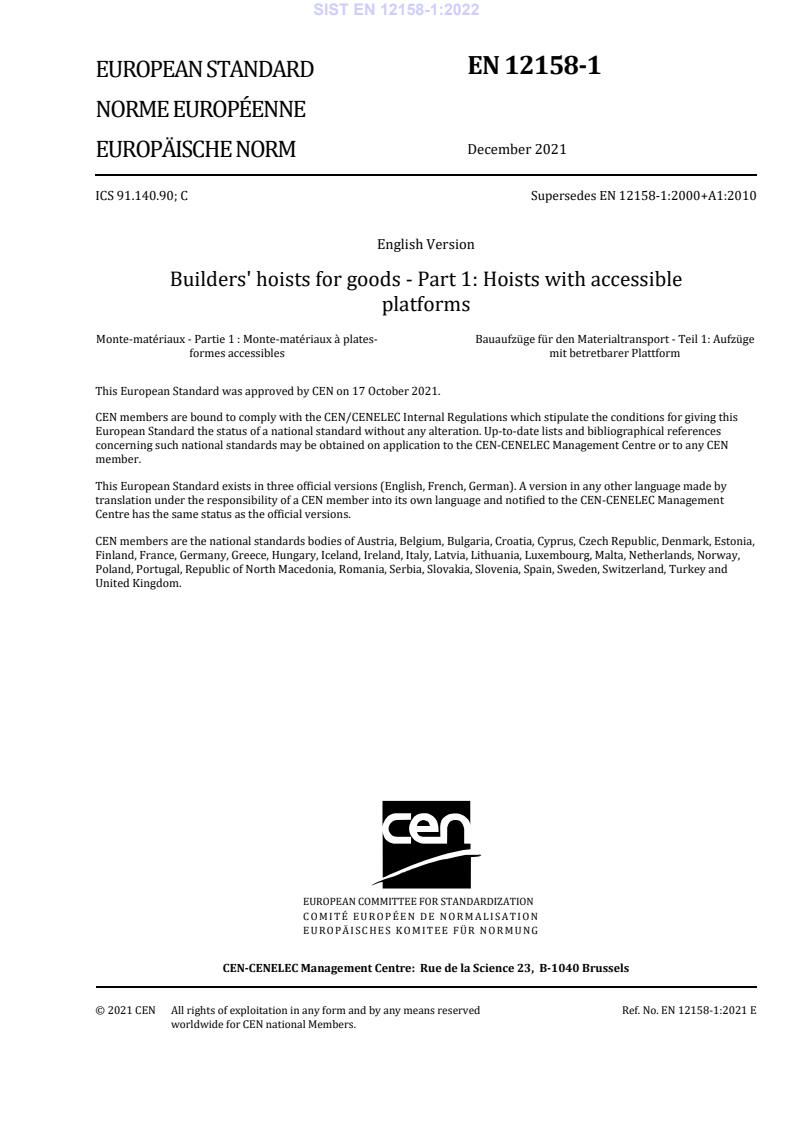
EN 12158-1
EUROPEAN STANDARD
NORME EUROPÉENNE
December 2021
EUROPÄISCHE NORM
ICS 91.140.90; C Supersedes EN 12158-1:2000+A1:2010
English Version
Builders' hoists for goods - Part 1: Hoists with accessible
platforms
Monte-matériaux - Partie 1 : Monte-matériaux à plates- Bauaufzüge für den Materialtransport - Teil 1: Aufzüge
formes accessibles mit betretbarer Plattform
This European Standard was approved by CEN on 17 October 2021.
CEN members are bound to comply with the CEN/CENELEC Internal Regulations which stipulate the conditions for giving this
European Standard the status of a national standard without any alteration. Up-to-date lists and bibliographical references
concerning such national standards may be obtained on application to the CEN-CENELEC Management Centre or to any CEN
member.
This European Standard exists in three official versions (English, French, German). A version in any other language made by
translation under the responsibility of a CEN member into its own language and notified to the CEN-CENELEC Management
Centre has the same status as the official versions.
CEN members are the national standards bodies of Austria, Belgium, Bulgaria, Croatia, Cyprus, Czech Republic, Denmark, Estonia,
Finland, France, Germany, Greece, Hungary, Iceland, Ireland, Italy, Latvia, Lithuania, Luxembourg, Malta, Netherlands, Norway,
Poland, Portugal, Republic of North Macedonia, Romania, Serbia, Slovakia, Slovenia, Spain, Sweden, Switzerland, Turkey and
United Kingdom.
EUROPEAN COMMITTEE FOR STANDARDIZATION
COMITÉ EUROPÉEN DE NORMALISATION
EUROPÄISCHES KOMITEE FÜR NORMUNG
CEN-CENELEC Management Centre: Rue de la Science 23, B-1040 Brussels
© 2021 CEN All rights of exploitation in any form and by any means reserved Ref. No. EN 12158-1:2021 E
worldwide for CEN national Members.
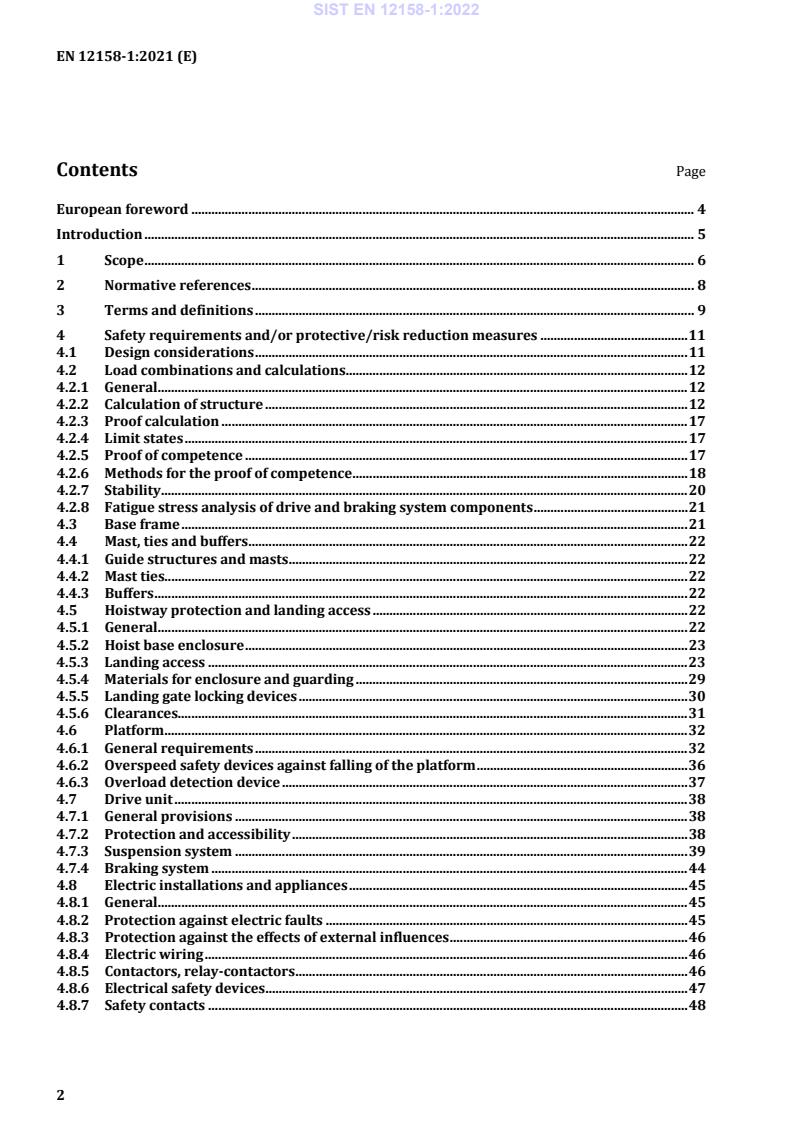
Contents Page
European foreword . 4
Introduction . 5
1 Scope . 6
2 Normative references . 8
3 Terms and definitions . 9
4 Safety requirements and/or protective/risk reduction measures . 11
4.1 Design considerations . 11
4.2 Load combinations and calculations. 12
4.2.1 General . 12
4.2.2 Calculation of structure . 12
4.2.3 Proof calculation . 17
4.2.4 Limit states . 17
4.2.5 Proof of competence . 17
4.2.6 Methods for the proof of competence . 18
4.2.7 Stability . 20
4.2.8 Fatigue stress analysis of drive and braking system components . 21
4.3 Base frame . 21
4.4 Mast, ties and buffers . 22
4.4.1 Guide structures and masts . 22
4.4.2 Mast ties. 22
4.4.3 Buffers . 22
4.5 Hoistway protection and landing access . 22
4.5.1 General . 22
4.5.2 Hoist base enclosure . 23
4.5.3 Landing access . 23
4.5.4 Materials for enclosure and guarding . 29
4.5.5 Landing gate locking devices . 30
4.5.6 Clearances. 31
4.6 Platform . 32
4.6.1 General requirements . 32
4.6.2 Overspeed safety devices against falling of the platform . 36
4.6.3 Overload detection device . 37
4.7 Drive unit . 38
4.7.1 General provisions . 38
4.7.2 Protection and accessibility . 38
4.7.3 Suspension system . 39
4.7.4 Braking system . 44
4.8 Electric installations and appliances . 45
4.8.1 General . 45
4.8.2 Protection against electric faults . 45
4.8.3 Protection against the effects of external influences . 46
4.8.4 Electric wiring . 46
4.8.5 Contactors, relay-contactors . 46
4.8.6 Electrical safety devices. 47
4.8.7 Safety contacts . 48
4.8.8 Travel-limit switches . 48
4.8.9 Slack rope/chain device . 49
4.8.10 Erection accessories . 49
4.8.11 Stopping devices . 49
4.8.12 Stopping the machine . 50
4.8.13 Control modes . 50
4.9 Breakdown conditions . 51
5 Verification of safety requirements and/or protective/risk reduction measures . 51
5.1 Verification of design . 51
5.2 Verification tests of overspeed safety device and overspeed governors . 53
5.2.1 General provisions . 53
5.2.2 Method of test . 53
5.2.3 Test report . 54
5.3 Verification tests on each machine before first use . 54
6 Information for use . 55
6.1 Instruction handbook . 55
6.1.1 Comprehensive information . 55
6.1.2 Contents of the instruction handbook . 55
6.2 Markings . 60
Annex A (informative) European stormwind map . 62
Annex B (normative) Performance levels for safety devices . 64
Annex C (informative) List of significant hazards . 65
Annex ZA (informative) Relationship between this European Standard and the essential
requirements of Directive 2006/42/EC aimed to be covered . 67
European foreword
This document (EN 12158-1:2021) has been prepared by Technical Committee CEN/TC 10 “Lifts,
escalators and moving walks”, the secretariat of which is held by AFNOR.
This European Standard shall be given the status of a national standard, either by publication of an
identical text or by endorsement, at the latest by June 2022, and conflicting national standards shall be
withdrawn at the latest by December 2023.
Attention is drawn to the possibility that some of the elements of this document may be the subject of
patent rights. CEN shall not be held responsible for identifying any or all such patent rights.
This document supersedes EN 12158-1:2000+A1:2010.
In comparison with the previous edition, the following technical modifications have been made:
a) static calculations;
b) out-of-service wind;
c) safety requirements for platform locking;
d) enclosures for platform and landing gates;
e) requirements for platform inclination on twin-masted units;
f) integration of performance levels according to EN ISO 13849-1:2015;
g) monitoring of the inadvertent brake release.
This document has been prepared under a Standardization Request given to CEN by the European
Commission and the European Free Trade Association, and supports essential requirements of EU
Directive(s) / Regulation(s).
For relationship with EU Directive(s) / Regulation(s), see informative Annex ZA, which is an integral part
of this document.
Any feedback and questions on this document should be directed to the users’ national standards body.
A complete listing of these bodies can be found on the CEN website.
According to the CEN-CENELEC Internal Regulations, the national standards organisations of the
following countries are bound to implement this European Standard: Austria, Belgium, Bulgaria, Croatia,
Cyprus, Czech Republic, Denmark, Estonia, Finland, France, Germany, Greece, Hungary, Iceland, Ireland,
Italy, Latvia, Lithuania, Luxembourg, Malta, Netherlands, Norway, Poland, Portugal, Republic of North
Macedonia, Romania, Serbia, Slovakia, Slovenia, Spain, Sweden, Switzerland, Turkey and the United
Kingdom.
Introduction
This document is one of a series of standards produced by CEN/TC 10/SC 1 “Building hoists” as part of
the CEN programme of work to produce machinery safety standards.
The document is a type-C standard relating to safety for builder’s hoists for goods.
This document is a type-C standard as stated in EN ISO 12100:2010.
This document is of relevance, in particular, for the following stakeholder groups representing the market
players with regard to machinery safety:
— machine manufacturers (small, medium and large enterprises);
— health and safety bodies (regulators, accident prevention organizations, market surveillance, etc.).
Others can be affected by the level of machinery safety achieved with the means of the document by the
above-mentioned stakeholder groups:
— machine users/employers (small, medium and large enterprises);
— machine users/employees (e.g. trade unions, organizations for people with special needs);
— service providers, e.g. for maintenance (small, medium and large enterprises);
— consumers (in case of machinery intended for use by consumers).
The above-mentioned stakeholder groups have been given the possibility to participate at the drafting
process of this document.
The machinery concerned and the extent to which hazards, hazardous situations or hazardous events are
covered are indicated in the scope of this document. In addition, machinery shall comply as appropriate
with EN ISO 12100:2010 for hazards which are not covered by this document.
When provisions of this type-C standard are different from those which are stated in type-A or -
B standards, the provisions of this type-C standard take precedence over the provisions of the other
standards for machines that have been designed and built according to the provisions of this type-C
standard.
1 Scope
1.1 This document deals with power-operated temporarily installed builder’s hoists (referred to as
“hoists” in this document) intended for use by persons who are permitted to enter sites of engineering
and construction, serving landing levels, having a load-carrying device:
— designed for the transportation of goods only;
— guided;
— travelling vertically or along a path within 15° max. of the vertical;
— supported or sustained by drum-driven wire rope, chain, rack and pinion or an expanding linkage
mechanism;
— where masts, when erected, require or do not require support from separate structures;
— which permits the access of instructed persons during loading and unloading;
— which are driven by appointed persons;
— which permits, if necessary, during erection, dismantling, maintenance and inspection, the access
and travel by persons who are competent and authorized.
1.2 The document deals with the significant hazards, hazardous situations or hazardous events
relevant to the machine as listed in Annex C which arise during the various phases in the life of the
machine and describes methods for the elimination or reduction of these hazards when it is used as
intended and under conditions of misuse which are reasonably foreseeable by the manufacturer.
1.3 This document does not specify the additional requirements for:
— hydraulic installations;
— operation in severe conditions (e.g. extreme climates, strong magnetic fields);
— lightning protection;
— operation subject to special rules (e.g. potentially explosive atmospheres);
— electromagnetic compatibility (emission, immunity);
— handling of loads the nature of which could lead to dangerous situations (e.g. molten metal,
acids/bases, radiating materials, fragile loads);
— the use of combustion engines;
— the use of remote controls;
— hazards occurring during manufacture;
— hazards occurring as a result of mobility;
— hazards occurring as a result of being erected over a public road;
— earthquakes;
— noise;
— ergonomics;
— fixed guards;
— operator intervention.
1.4 This document does not apply to:
— builder’s hoists for persons and materials;
— lifts according to EN 81-3:2000+A1:2008 and EN 81-20:2020;
— inclined hoists according to EN 12158-2:2000+A1:2010;
— work cages suspended from lifting appliances;
— work platforms carried on the forks of fork trucks;
— transport platforms according to EN 16719:2018;
— work platforms;
— funiculars;
— lifts specially designed for military purposes;
— mine lifts;
— theatre elevators;
— special purpose lifts.
1.5 This document deals with the hoist installation. It includes the base frame and base enclosure but
excludes the design of any concrete, hard core, timber or other foundation arrangement. It includes the
design of mast ties but excludes the design of anchorage bolts to the supporting structure. It includes the
landing gates and their frames but excludes the design of any anchorage fixing bolts to the supporting
structure.
1.6 This document does not apply to builders' hoists for goods (hoists with accessible platforms)
manufactured before the date of publication of this document by CEN.
2 Normative references
The following documents are referred to in the text in such a way that some or all of their content
constitutes requirements of this document. For dated references, only the edition cited applies. For
undated references, the latest edition of the referenced document (including any amendments) applies.
EN 81-20:2020, Safety rules for the construction and installation of lifts — Lifts for the transport of persons
and goods — Part 20: Passenger and goods passenger lifts
EN 1999-1-1:2007, Eurocode 9: Design of aluminium structures — Part 1-1: General structural rules
EN 60204-1:2018, Safety of machinery — Electrical equipment of machines — Part 1: General
requirements
EN 60204-32:2008, Safety of machinery — Electrical equipment of machines — Part 32: Requirements for
hoisting machines
EN 60529:1991, Degrees of protection provided by enclosures (IP Code) (IEC 60529:1989)
EN IEC 60947-4-1:2019, Low-voltage switchgear and controlgear — Part 4-1: Contactors and motor-
starters — Electromechanical contactors and motor-starters
EN 60947-5-1:2017, Low-voltage switchgear and controlgear — Part 5-1: Control circuit devices and
switching elements — Electromechanical control circuit devices
EN ISO 12100:2010, Safety of machinery — General principles for design — Risk assessment and risk
reduction (ISO 12100:2010)
EN ISO 13849-1:2015, Safety of machinery — Safety-related parts of control systems — Part 1: General
principles for design (ISO 13849-1:2015)
EN ISO 13849-2:2012, Safety of machinery — Safety-related parts of control systems — Part 2: Validation
(ISO 13849-2:2012)
EN ISO 13850:2015, Safety of machinery — Emergency stop function — Principles for design
(ISO 13850:2015)
EN ISO 13857:2019, Safety of machinery — Safety distances to prevent hazard zones being reached by
upper and lower limbs (ISO 13857:2019)
EN ISO 14118:2018, Safety of machinery — Prevention of unexpected start-up (ISO 14118:2017)
EN ISO 14119:2013, Safety of machinery — Interlocking devices associated with guards — Principles for
design and selection (ISO 14119:2013)
ISO 2394:2015, General principles on reliability for structures
ISO 2408:2017, Steel wire ropes — Requirements
As impacted by EN 1999-1-1:2007/A1:2009 and EN 1999-1-1:2007/A2:2013.
As impacted by EN 60529:1991/corrigendum May 1993, EN 60529:1991/A1:2000, EN 60529:1991/A2:2013,
EN 60529:1991/AC:2016-02 and EN 60529:1991/A2:2013/AC:2019-02.
ISO 4302:2016, Cranes — Wind load assessment
ISO 4309:2017, Cranes — Wire ropes — Care and maintenance, inspection and discard
ISO 6336-1:2019, Calculation of load capacity of spur and helical gears — Part 1: Basic principles,
introduction and general influence factors
ISO 6336-2:2019, Calculation of load capacity of spur and helical gears — Part 2: Calculation of surface
durability (pitting)
ISO 6336-3:2019, Calculation of load capacity of spur and helical gears — Part 3: Calculation of tooth
bending strength
ISO 6336-5:2016, Calculation of load capacity of spur and helical gears — Part 5: Strength and quality of
materials
3 Terms and definitions
For the purposes of this document, the terms and definitions given in EN ISO 12100:2010 and the
following apply.
ISO and IEC maintain terminological databases for use in standardization at the following addresses:
— IEC Electropedia: available at https://www.electropedia.org/
— ISO Online browsing platform: available at https://www.iso.org/obp
3.1
builder’s hoist
temporary lifting machine serving landing levels on sites of engineering and construction with a platform,
cage or other load-carrying device which is guided
3.2
working load
rated load
maximum load which the hoist has been designed to carry in service
3.3
rated speed
speed of the platform for which the equipment has been designed
3.4
wire rope hoist
hoist which uses wire rope as the load suspension system
3.5
positive drive
drive using means other than friction
3.7
rack and pinion hoist
hoist which uses a toothed rack and pinion as the load suspension system
3.8
expanding linkage mechanism
mechanical linkage system which supports and guides the platform by means of expansion or contraction
under the control of an actuator
EXAMPLE Scissors.
3.9
base frame
lowest framework of the hoist upon which all other components are mounted
3.10
guides
rigid elements which determine the travel way of the platform
3.11
mast
structure that supports and guides the platform
3.12
mast section
indivisible piece of mast, between two adjacent mast joints
3.13
mast tie
connection system between the mast and any building structure, providing lateral support for the mast
3.14
hoistway
total space which is travelled by the platform and its load
3.15
platform
load-carrying device including the floor, sides and entrances
3.16
stopping distance
distance the platform moves from the moment when the control or safety circuit is broken until the
platform has come to a full stop
3.17
overspeed safety device
mechanical device for stopping and maintaining stationary the platform in the event of overspeed in
down direction
3.18
slack rope
rope, normally under tension, from which all external loads have been removed
3.19
wire rope termination
adaptation at the end of a wire rope permitting attachment
3.20
landing
level in a building or construction intended for loading and unloading the platform
3.21
safety distance
minimum acceptable distance between any moving part of a hoist and any point of access
3.22
guard rail
fixed equipment, other than gates, which is used to prevent people from falling or from reaching
hazardous areas
3.23
normal operation
usual operating conditions for the equipment when in use for carrying loads but excluding routine
maintenance, erection, dismantling
3.24
in service
condition during use of the hoist when the platform is in any position, laden or unladen, moving or
stationary
3.25
out of service
installed condition when the unladen platform is positioned such that it is provided with the most shelter
from the wind (normally, but not necessarily, on the ground level)
3.26
competent person
designated person, suitably trained, qualified by knowledge and practical experience, and provided with
the necessary instructions to enable the required procedures to be carried out
4 Safety requirements and/or protective/risk reduction measures
4.1 Design considerations
The design of the hoist shall consider safe use, erection, dismantling and maintenance. It shall be possible
to erect the hoist using safe access methods such as those offered by the platform or equivalent facilities.
The design of all components that have to be handled during erection, e.g. mast sections, shall have their
weight assessed against manual handling. Where the permissible weight for manual handling is exceeded,
the manufacturer shall make available suitable lifting equipment. All removable and detachable covers
shall be retained by captive fastenings.
Builders' hoists for goods shall comply with the safety requirements and/or protective measures of this
clause. In addition, the machine shall be designed according to the principles of EN ISO 12100:2010 for
relevant, but not significant hazards, which are not dealt with by this document (e.g. sharp edges).
4.2 Load combinations and calculations
4.2.1 General
The structure of the hoist shall be designed and constructed in such a way that its strength is satisfactory
under all intended operating conditions, including erection and dismantling and e.g. low temperature
environments.
The design of the structure as a whole and each part of it shall be based on the effects of any possible
combination of loads as specified in this 4.2. The load combinations shall consider the least favourable
locations of the platform and load relative to the mast and its ties, both during the vertical passage of the
platform and any horizontal movement, e.g. swivelling of the platform. Ties between the mast and the
supporting structure are considered to be part of the hoist structure.
In cases not covered by this document (e.g. where two hoist cars are running on one mast tower or
multiple machines are running on one or more mast towers), the load cases may be combined based on
state of the art approaches which are taking probabilities of occurrence into consideration.
4.2.2 Calculation of structure
When calculating the hoist structure and every related component, the following forces and loads shall
be taken into account:
a) all dead weights with the exception of the platform and equipment which moves together with the
platform;
b) dead weights of the unladen platform and all equipment which moves together with the platform;
c) dead weight of landing platforms and gates if supported by the hoist;
d) rated load on the platform.
The effect of the forces on the platform and mast resulting from the application of the rated load shall
be allowed for in one of the two following ways which reflect the chosen density of loading on the
platform:
m
r
< 300 kg /²m
Ax 0,75
1) if ,
where
m is the rated load [kg] and
r
A is the total floor area [m ],
the rated load shall be assumed to be distributed over a reduced area (A ) which results in a
distribution of 300 kg/m . The format and the location of this area shall be taken as that which
gives the least favourable stress for the mast and also for the platform. One example is shown in
Figure 1;
Key
A total floor area [m ]
A = m /300 [kg/m ]
1 r
Figure 1 — Example of loading according to 4.2.2 d) 1)
m
r
≥ 300 kg / m
A × 0,75
2) if ,
the rated load shall be assumed to be distributed over an area (A ) equivalent to 75 % of the
total floor area of the platform. The format and the location of this area shall be taken as that
which gives the least favourable stress for the mast and also for the platform. One example is
shown in Figure 2;
Key
A = 0,75 A
Figure 2 — Example of loading according to 4.2.2 d) 2)
e) where the uniform distribution of the rated load over the full area of the platform is less than
2 2
250 kg/m , then for calculation purposes, a minimum of 250 kg/m shall be placed over the whole
area (A ) of the platform (see Figure 3);
Key
A total floor area [m ]
Figure 3 — Evenly distributed load case according to 4.2.2 e)
f) forces during loading and unloading shall be considered as the concurrent effect of a vertical force
and a horizontal force, illustrated by Figure 4, each calculated as follows:
1) a vertical force F with an amplitude of
v
F = m ⋅ g
v v
where
F is the vertical force [N]
v
g is the gravitational acceleration (9,81 m/s )
m is a mass [kg] used for vertical force and is calculated as a function of the rated load (m ):
v r
if m < 400 kg
r
m = 200 kg
v
if m > 2 000 kg
r
m = 400 + 0,3 ⋅ m
v r
other load ratings
m = 0,5 ⋅ m
v r
2) horizontal force F shall be applied in the direction of loading and with an amplitude
H
F = m ⋅ g
H h
where
F is the horizontal force [kN]
H
g is the gravitational acceleration (9,81 m/s )
m is a mass [kg] used for horizontal force and is calculated as a function of the rated load (m ):
h r
if m < 200 kg
r
m = 30 kg
h
if m > 1 700 kg
r
m = 255 kg
h
other load ratings
= 0,15 ⋅ m
m
h r
both forces acting at 1/3 of the width of the platform entrance, at floor level, in the least favourable
direction and location. The stresses in the mast and also in the platform shall be calculated for at least
the following application points of the loading and unloading forces:
1) the platform threshold;
2) the leading edge of any ramp or other extension which is not supported by the landing.
At the same time, any remaining part of the rated load shall be applied in the centre of the platform
(F = (m - m ) ⋅ g).
V1 r v
Equivalent forces shall be used to design the landing threshold and all relevant supporting structures.
Information shall be given in the instruction handbook with regard to these forces;
Key
F vertical force resulting from the remaining part of the rated load applied in the centre of the platform
V1
[kN]
F vertical force [kN]
v
F horizontal force [kN]
H
Figure 4 — Example of forces during loading and unloading
g) for hoists according to 4.8.8.2.5, the design of the hoist shall consider failure of the upper terminal
stopping switch in combination with impact with the upper buffers both with and without load. The
stalling torque and inertia of the drive system shall be taken into account;
h) the effect of moving loads shall be determined by taking the weight of all actual loads (platform, rated
load, wire ropes, etc.) and multiplying them by a dynamic factor μ = (1,1 + 0,264 v) where v is the
rated speed in m/s. Alternative factors may be used if they can be proved to be more accurate;
i) to determine the forces produced by an operation of the overspeed safety device, the sum total of the
travelling load shall be multiplied by a dynamic factor (μ ) 2,5.
A lower factor, but not less than 1,2 can be used if it can be verified by test under all conditions of
loading up to 1,3 times rated load including any inertia effects of the drive system;
j) the platform floor surface shall be designed to withstand without permanent deformation a static
load of 150 kg or 25 % of the rated load, whichever is the greater, but in no case more than 300 kg,
the force applied on the least favourable square area of 0,1 m × 0,1 m;
k) design wind conditions: the aerodynamic pressure q is given by the general formula:
v
w
q=
16,
where
q is the pressure in N/m and v the wind velocity in m/s.
W
In all cases, it shall be assumed that the wind can blow horizontally in any direction, and the least
favourable direction shall be taken into account.
The calculation shall be done according to ISO 4302:2016 with the exception of the following:
1) action of the wind on the platform: when calculating wind pressure on the platform, it shall be
assumed that the platform sides and any guards are solid and an aerodynamic coefficient of
c = 1,2 shall be applied. The factor 1,2 covers both the shape factor and the shielding factor;
2) wind pressure: three design wind conditions shall be taken into account when calculating wind
pressure on hoists:
i. in-service wind: irrespective of height, the minimum value for wind pressure shall be
q = 250 N/m which corresponds to a wind velocity of v = 20 m/s;
w
ii. out-of-service wind: the out-of-service wind pressure depends on the height above ground
and the area where the hoist is installed. The minimum wind pressure shall be based on the
wind speed calculated according to ISO 4302:2016 with a recurrence interval R = 10. The
recommended minimum out-of-service wind pressure for general use is given in Table 1
(values based on ISO 4302:2016, Formula (11)). The minimum design wind pressures shall
be taken into account;
Table 1 — Minimum design wind pressure
Height H of parts of hoist Wind pressure q for geographical Region A-E
above ground level N/m
m A/B C D E
0 < H ≤ 10 527 718 938 1 187
10 < H ≤ 20 607 826 1 079 1 366
20 < H ≤ 50 735 1 000 1 307 1 654
50 < H ≤ 100 853 1 161 1 516 1 919
100 < H ≤ 150 932 1 268 1 657 2 097
The regions A-E are taken from the European Stormwind Map (see Annex A).
Local terrain factors and detailed reference wind speed maps are allowed to use if such
detailed information is available.
iii. erection and dismantling wind: irrespective of height, the minimum value for wind pressure
shall be q = 100 N/m , which corresponds to a wind velocity of v = 12,5 m/s;
w
l) an error of erection of 0,5° is included in the safety factors of this document;
m) forces created by the lower buffers shall correspond to a retardation of 2 g (i.e. μ = 3) unless a lower
value of retardation can be verified.
4.2.3 Proof calculation
The proof of competence according to this standard shall be carried out by using the general principles
and methods appropriate for this purpose and corresponding with the recognized state of the art in
mechanical design. For guidance governing analysis of structural members and their connections (e.g.
fatigue, welding, bolts), EN 13001-3-1:2012+A2:2018 is recommended. For aluminium, consider
EN 1999-1-1:2007 .
Alternatively, advanced and recognized theoretical or experimental methods may be used in general,
provided that they conform to the principles of this document.
4.2.4 Limit states
During analysis of the hoist, its components or materials, two different limit states need to be considered
(ultimate limit state which concerns safety of people and structure, service limit state which concerns
function and appearance of the structure as well as the comfort of the user).
There is a distinction between ultimate limit states and serviceability limit states as follows:
a) Ultimate limit states, given by:
1) plastic deformations from the effect of nominal stresses or sliding of frictional connections;
2) failure of components or connections (e.g. static failure, failure by fatigue or formation of critical
cracks);
3) elastic instability of the hoist or its parts (e.g. buckling, bulging);
4) rigid body instability of the hoist or its parts (e.g. tilting, shifting).
b) Serviceability limit states, examples of which are:
1) deformations which impair the intended utilization of the hoist (e.g. function of moving
components, clearances of parts);
2) exceeding temperature limits (e.g. overheating of motors and brakes).
4.2.5 Proof of competence
The proof of competence shall contain validation proving that the stresses or forces do not exceed the
structural limitations of components.
Loads in 4.2.2. shall be superimposed in such a way that the resulting load effects attain their
instantaneous extreme values for the considered situation of use. Such superimpositions are called load
combinations. Load combinations containing dynamic effects may be treated as quasi static by the use of
appropriate dynamic factors. Basic load combinations are given in 4.2.6.
For the proof of fatigue strength, the number and magnitude of significant stress cycles shall be specified.
The limit states applicable to the combination of material selection, manufacturing techniques and the
specified service conditions shall be stated in the proof of competence. For the verification that the
ultimate limit states are not exceeded, the following proofs shall be established:
a) proof of strength of members, connections and components:
1) under static and quasi-static loading;
2) under cyclic loading (fatigue);
b) proof of elastic stability of the hoist and its parts;
c) proof of hoist stability.
For the verification that the serviceability limit states are not exceeded, the following aspects shall
be considered and a proof be established where appropriate:
d) proof of deformation;
e) thermal performance.
4.2.6 Methods for the proof of competence
4.2.6.1 Limit state method
Individual characteristic loads according to 4.2.2 are amplified by the appropriate partial safety factors
γ . Moving loads are also amplified by a dynamic factor (μ) to create quasi static characteristic loads.
p
All amplified load actions shall be superimposed according to the set load combination found in Table 3.
Descriptions for the different load cases are found in Table 2.
Table 2 — Description of load cases
Load case Description
A
normal use
A
loading and unloading
B
out-of-service wind
B
erection
C
exceptional load
activation of overspeed
C
safety device
C
buffer impact
Table 3 — Load cases
Load case A Load case B Load case C
Subclause of
No Loads
4.2.2
γ A A γ B B γ C C C
p 1 2 p 1 2 p 1 2 3
1,22 1,16 1,1 (1
dead weights not
1 a), c) 1 1 1 1 1
a a a
moving (1,16 ) (1,1 ) )
1,22 1,16 1,1 (1
μ μ μ μ μ
2 b) dead weights moving 1
1 1 1 2 3
a a
(1,16 ) (1,1 ) a)
μ μ μ μ
3 d) rated load 1,35 1,22 1,1
1 1 2 3
uniformly distributed
μ
4 e) 1,1
load
5 f) loading/unloading 1,35 1
6 k) wind 1,35 1 1 1,16 1 1 1,1 1 1
7 l) effect of retardation 1
Key
γ resistance coefficient (partial)
p
μ the effect of moving load by a dynamic factor (4.2.2 h))
μ the effect of the overspeed safety device by a dynamic factor (4.2.2 i))
μ the effect of buffer impact by a dynamic factor (4.2.2 m))
a
Weight determined by weighing.
For the proof that excessive yielding does not occur, the resulting stress including nominal and local
stress distributions shall be compared with the yield strength of the material connection or component
divided by a material resistance coefficient γ listed in Table 4.
M
Table 4 — Material resistance coefficient
steel 1,1
γ
aluminium 1,1
M
aluminium, welded 1,25
Other criteria may be used, e.g. attainment of a limiting value of the principal membrane strain,
attainment of the yielding criterion or limitation of the yielding zone.
The limit state method applied in this calculation method is defined in ISO 2394:2015 for all structural
systems covered by this document.
4.2.6.2 Allowable stress method
Moving individual characteristic loads according to 4.2.2 are amplified by a dynamic factor (μ) to create
quasi static characteristic loads.
Superimposion of loads are described as load cases in Table 2 and presented in columns with dynamic
factors in Table 3. For allowable stress method safety factors, γ are set to 1.
p
For the proof that yielding does not occur, the resulting stress including nominal and local stress
distributions shall be compared with the allowable stress that is derived from the nominal yield strength
of the material using the safety factor S (see Table 5). Aluminium structures also need to be evaluated
y
using the ultimate strength of the material together with the safety factor S (see Table 6).
o
a) steel structures (permissible stresses)
f
y
σ =
S
y
b) aluminium structures (permissible stresses)
f
f
y
u
σ = min ,
SS
yu
where
f
...
The article discusses EN 12158-1:2021, which focuses on power-operated builder's hoists with accessible platforms. These hoists are designed for the transportation of goods and are used in engineering and construction sites. The document outlines the requirements and safety measures for these hoists, including their design, operation, and maintenance. It also addresses the hazards and potential risks associated with these hoists and provides methods for their elimination or reduction. However, the document does not cover certain additional requirements, such as hydraulic installations, extreme conditions, lightning protection, and electromagnetic compatibility. It also excludes specific hoist types, such as hoists for persons and materials, inclined hoists, and lifts used for specific purposes like military or theater elevators. The document focuses on the hoist installation, including the base frame, enclosure, mast ties, and landing gates, but excludes the design of the foundation and anchorage bolts. Finally, the document is not applicable to hoists manufactured before its publication.
기사 제목: EN 12158-1:2021 - 화물용 건설용재 승강기 - 제1부: 접근 가능한 플랫폼이 있는 승강기 기사 내용: 1.1 이 문서는 "승강기"로 지칭되는 공학 및 건설 현장에 출입이 허가된 사람들에 의해 사용되는 전원작동 임시 설치 빌더용 승강기에 대해 다룹니다. 이 승강기는 다음과 같은 특성을 갖추고 있습니다: - 화물 운송을 목적으로 설계됨 - 안내되는 승강 - 수직 또는 최대 15°까지 수직 방향으로 이동 - 드럼으로 구동되는 철사로프, 체인, 랙 앤 핀언 또는 확장 링크 메커니즘에 의해 지지 또는 유지되는 - 기둥이 세워질 때 별도의 구조물로부터 지지를 받아야 할 수도 있고 받지 않을 수도 있는 - 로딩 및 언로딩 중에 교육을 받은 사람의 출입을 허용하는 - 지정된 사람에 의해 구동되는 - 필요한 경우 조립, 해체, 유지 보수 및 검사 중에 유능하고 권한을 가진 사람의 출입 및 이동을 허용하는 1.2 이 문서는 이 장비에 관련된 중대한 위험, 위험 상황 또는 위험 사건, 즉 부적절한 사용 조건이 제조사에 의해 예상 가능한 경우 발생하는 위험에 대해 다룹니다. 그리고 이는 사용 목적에 맞게 사용되고, 제조사가 합리적으로 예상 가능한 남용 조건에서 사용될 때 이러한 위험을 제거하거나 줄이는 방법을 설명합니다. 1.3 이 문서는 다음과 같은 추가 요건을 규정하지 않습니다: - 유압 설치물 - 극한 기후, 강력한 자기장과 같은 극한 조건에서의 작동 - 번개 보호 - 특수 규정에 따른 작동(예: 잠재적으로 폭발성 대기 환경) - 전자기적 호환성(방출, 내구성) - 위험한 상황을 초래할 수 있는 로드 처리(예: 녹은 금속, 산/염기, 방사성 물질, 파손 위험 로드) - 연소 엔진의 사용 - 원격 제어의 사용 - 제조 중 발생하는 위험 - 이동성으로 인한 위험 - 공공도로 위에 설치된 결과로 발생하는 위험 - 지진 - 소음 - 인간공학 - 고정 가드 - 운전자 개입 1.4 이 문서는 다음에 해당하지 않습니다: - 사람과 물자를 위한 건설용 승강기 - EN 81 3:2000+A1:2008 및 EN 81 20:2020에 따른 승강기 - EN 12158 2:2000+A1:2010에 따른 경사 승강기 - 리프팅 장치로 매달린 작업용 케이지 - 포크 트럭의 포크에 실려지는 작업용 플랫폼 - EN 16719:2018에 따른 운송 플랫폼 - 작업용 플랫폼 - 풍경선 - 군사용으로 특별히 설계된 승강기 - 광산용 승강기 - 극장용 엘리베이터 - 특수 목적용 리프트 1.5 이 문서는 승강기 설치를 다룹니다. 그것은 베이스 프레임과 베이스 보호를 포함하지만, 콘크리트, 하드 코어, 목재 또는 기타 토대 배열의 설계는 제외됩니다. 기둥 매립 핀의 설계는 포함되지만 지지 구조물에 대한 표면 고정 볼트의 설계는 제외됩니다. 랜딩 게이트와 그 프레임은 포함되지만 지지 구조물에 대한 어떠한 고정 고정 볼트의 설계는 제외됩니다. 1.6 이 문서는 CEN의 출판일 이전에 제조된 화물용 건설용 승강기 (접근 가능한 플랫폼이 있는 승강기)에는 적용되지 않습니다.
記事タイトル:EN 12158-1:2021-荷物用ビルダーズホイスト-第1部:アクセス可能なプラットフォームを備えたホイスト 記事内容:本文書は、エンジニアリングおよび建設現場へ入場が許可された人々によって使用される、一時的に設置される電動式のビルダーズホイスト(以下「ホイスト」と称する)に関するものです。このホイストは、次のような特徴を持っています: - 荷物の輸送を目的として設計されている - ガイドされる昇降装置 - 垂直または最大15°までの垂直方向またはその近くを移動する - ドラム駆動のワイヤーロープ、チェーン、ラックおよびピニオン、または展開式リンク機構によって支持または保持される - マストが建設される際には、別の構造物からの支持を必要とする場合もあれば、必要としない場合もある - 積み込みおよび荷卸し中に指示を受けた人物のアクセスを許可する - 指定された人物によって駆動される - 必要に応じて、組立、解体、メンテナンス、および検査中に、有能かつ権限を持った人々によるアクセスと移動を許可する 本文書では、この装置に関連する重大な危険、危険な状況、または予測可能な誤用の条件下で発生する危険、およびこれらの危険を排除または軽減する方法について説明しています。しかし、本文書では、次の追加要件については指定していません: - 液圧設備 - 過酷な条件での運転(例:極端な気候、強力な磁場) - 雷撃保護 - 特殊な規則による運転(例:潜在的に爆発性の大気中での運転) - 電磁適合性(発信、耐性) - 危険な状況が引き起こされる可能性のある荷物の取り扱い(例:溶融金属、酸/アルカリ、放射性材料、壊れやすい荷物) - 燃焼エンジンの使用 - リモコンの使用 - 製造時に発生する危険 - 機動性による危険 - 道路上に設置された場合に発生する危険 - 地震 - 騒音 - 人間工学 - 固定ガード - オペレーターの介入 本文書は以下には適用されません: - 人員および物資用のビルダーズホイスト - EN 81 3:2000+A1:2008およびEN 81 20:2020に準拠したエレベーター - EN 12158-2:2000+A1:2010に準拠した傾斜ホイスト - 揚げ装置に吊られた作業ケージ - フォークトラックのフォークに搭載される作業プラットフォーム - EN 16719:2018に準拠した輸送プラットフォーム - 作業プラットフォーム - フニクラ - 軍事目的に特別に設計されたエレベーター - 鉱山用エレベーター - 劇場用エレベーター - 特殊用途用リフト 本文書はホイストの設置に関連しており、基礎フレームと基礎ケースを含みますが、コンクリート、ハードコア、木材などの基礎の配置の設計は含まれません。マストタイも含まれますが、支持構造物への固定締結ボルトの設計は含まれません。着地ゲートとそのフレームは含まれますが、支持構造物への固定締結ボルトの設計は含まれていません。 本文書は、公開日より前に製造されたビルダーズホイスト(アクセス可能なプラットフォームを備えたホイスト)には適用されません。
The article discusses the standards outlined in EN 12158-1:2021 for builders' hoists with accessible platforms. These hoists are temporary installations used in engineering and construction sites for the transportation of goods. The document specifies the design and requirements for these hoists, including their load-carrying capacity, guidance system, support mechanism, and accessibility for authorized individuals. It also addresses the potential hazards associated with the use of such equipment and provides methods for hazard reduction. However, the document does not cover certain additional requirements such as hydraulic installations, operation in extreme conditions, lightning protection, and electromagnetic compatibility. It also does not apply to builders' hoists for people and materials or other specific types of lifts. The document covers the hoist installation, including the base frame, enclosure, and mast ties, but excludes the design of the foundation arrangement and anchorage bolts. Finally, the standards outlined in the document are not applicable to hoists manufactured prior to its publication.
記事のタイトル:EN 12158-1:2021 - 貨物用建設用エレベーター - 第1部:アクセス可能なプラットフォームを備えたエレベーター 記事の内容:1.1 この文書は、一時的に設置される電動建設用エレベーター(以下、「エレベーター」と呼ぶ)に関するもので、エンジニアリングおよび建設現場に入場が許可された者が使用することを意図しています。このエレベーターは次のような荷物輸送専用の装置である: - 貨物の輸送のために設計されている。 - 誘導される。 - 垂直または垂直から最大15°の経路で移動する。 - ドラム駆動ワイヤロープ、チェーン、ラック・アンド・ピニオンまたは拡張リンケージ機構によって支えられる。 - エレクト時には別の構造物からサポートを必要とするかもしれない。 - 積み込みおよび荷降ろし時に教育を受けた人々のアクセスを許可する。 - 指定された人物によって駆動される。 - 建設、解体、メンテナンス、点検時に必要な場合には、適格で認可された人物がアクセスおよび移動することを許可する。 1.2 この文書は、このような機器に関連する重要な危険、危険な状況または危険な事象に焦点を当てています(付録Cにリスト化されています)。これらの危険は、製造業者によって合理的に予見される誤用の条件で使用する場合に発生するものであり、これらの危険の除去または軽減の方法について説明しています。 1.3 この文書は以下の追加要件を特定していません: - 油圧設置 - 厳しい条件での運営(例:極端な気候、強い磁界) - 雷保護 - 特別な規則に従った運営(例:爆発性大気) - 電磁環境適合性(放射、免疫) - 危険な状況をもたらす可能性がある荷物の取り扱い(溶融金属、酸・アルカリ、放射性物質、破損しやすい荷物) - 燃焼エンジンの使用 - リモートコントロールの使用 - 製造中に発生する危険 - 移動に起因する危険 - 公道上に設置された際に発生する危険 - 地震 - 騒音 - 人間工学 - 固定ガード - オペレーターの介入 1.4 この文書は、以下に該当するものでは適用されません: - 人員および物品用建設用エレベーター - EN 81 3:2000+A1:2008およびEN 81 20:2020に準拠した昇降機 - EN 12158 2:2000+A1:2010に準拠した傾斜エレベーター - 起重機に吊り下げられた作業ケージ - フォークリフトのフォークに載せられた作業プラットフォーム - EN 16719:2018に準拠した輸送プラットフォーム - 作業プラットフォーム - フニキュラー - 軍事目的のために特別に設計されたエレベーター - 鉱山用エレベーター - 劇場のエレベーター - 特殊用途のエレベーター 1.5 この文書はエレベーターの設置について取り扱っており、ベースフレームとベースエンクロージャを含みますが、コンクリート、ハードコア、木材、または他の基礎構造の設計は含まれていません。マストの結びつけの設計は含まれますが、支持構造への固定用アンカーボルトの設計は含まれていません。ランディングゲートとその枠を含みますが、支持構造への固定用アンカーボルトの設計は含まれていません。 1.6 この文書は、CENによって本文書の発行日以前に製造された貨物用建設用エレベーター(アクセス可能なプラットフォームを備えたエレベーター)には適用されません。
기사 제목: EN 12158-1:2021 - 상품용 건설용 승강기 - 제1부: 접근 가능한 플랫폼을 갖춘 승강기 기사 내용: 1.1 이 문서는 일시적으로 설치되는 동력 작동 건설용 승강기(이 문서에서는 "승강기"로 지칭됨)에 대해 다룹니다. 이 승강기는 공학 및 건설 현장에 출입이 허가된 사람들이 사용하는 것을 목적으로 하며, 다음과 같은 적재장치를 갖추고 있습니다: - 상품 운송 전용으로 설계됨 - 유도된 - 수직으로 이동하거나 수직에서 최대 15° 경로로 이동함 - 드럼식 와이어로프, 체인, 랙 앤 핀언, 또는 확장 링케이지 메커니즘을 통해 지지되거나 지속됨 - 기둥이 세워져 있을 때 별도의 구조물로부터 지지를 받을 필요가 있을 수도 있음 - 실장 및 제거 중에 교육을 받은 사람들의 출입이 허용되는 것 - 임명된 사람에 의해 구동됨 - 필요한 경우 설치, 해체, 유지보수 및 검사 중에 유능하고 승인된 사람들이 출입하고 이동할 수 있는 것 1.2 이 문서는 이 장비와 관련된 중대한 위험, 위험 상황 또는 위험 사건을 다루며, 제조업자가 합리적으로 예상할 수 있는 실사용 조건에서 의도된 용도로 사용될 때 이러한 위험을 제거하거나 줄이기 위한 방법을 설명합니다. 이러한 위험과 관련된 더 자세한 사항은 부록 C에 명시되어 있습니다. 1.3 이 문서는 다음과 같은 추가 요구 사항을 명시하지 않습니다: - 유압 설치 - 심한 조건에서의 운영(예: 극한 기후, 강한 자기장) - 번개 보호 - 특수 규칙에 따른 운영(예: 잠재적으로 폭발 가능한 대기 환경) - 전자파 호환성(방출, 내화) - 위험한 상황을 야기할 수 있는 물품의 취급(예: 용해된 금속, 산/알칼리, 방사성 물질, 파손 가능한 하중) - 연료 엔진 사용 - 원격 조종 사용 - 제조 과정에서 발생하는 위험 - 이동성으로 인한 위험 - 도로 위에 설치된 것으로 인한 위험 - 지진 - 소음 - 작업 생활 - 고정 가드 - 운전자 개입 1.4 이 문서는 다음에 해당하는 경우에는 적용되지 않습니다: - 사람 및 재료용 건설용 승강기 - EN 81 3:2000+A1:2008 및 EN 81 20:2020에 따른 엘리베이터 - EN 12158 2:2000+A1:2010에 따른 경사 승강기 - 기어가 장착된 기어를 사용한 작업 케이지 - 포크 리프트의 포크에 장착된 작업 플랫폼 - EN 16719:2018에 따른 운송 플랫폼 - 작업 플랫폼 - 산악열차 - 군사 목적으로 특별히 설계된 승강기 - 광산용 승강기 - 극장 엘리베이터 - 특수 목적용 리프트 1.5 이 문서는 승강기 설치에 대해 다룹니다. 기초 프레임과 기초 보호를 포함하지만 콘크리트, 하드 코어, 목재 또는 기타 기초 배열의 설계는 포함되지 않습니다. 기둥 매설을 포함하지만 지지 구조물에 대한 고정 체결 나사의 설계는 포함되지 않습니다. 상차문 및 해당 프레임을 포함하지만 지지 구조물에 대한 체결 체결 나사의 설계는 포함되지 않습니다. 1.6 이 문서는 CEN에 의해 이 문서의 발표 날짜 이전에 생산된 상품용 건설용 승강기(접근 가능한 플랫폼을 갖춘 승강기)에는 적용되지 않습니다.
Questions, Comments and Discussion
Ask us and Technical Secretary will try to provide an answer. You can facilitate discussion about the standard in here.
Loading comments...