

EN 14737-1:2004
(Main)Space engineering - Ground systems and operations - Part 1: Principles and requirements
- Abstract
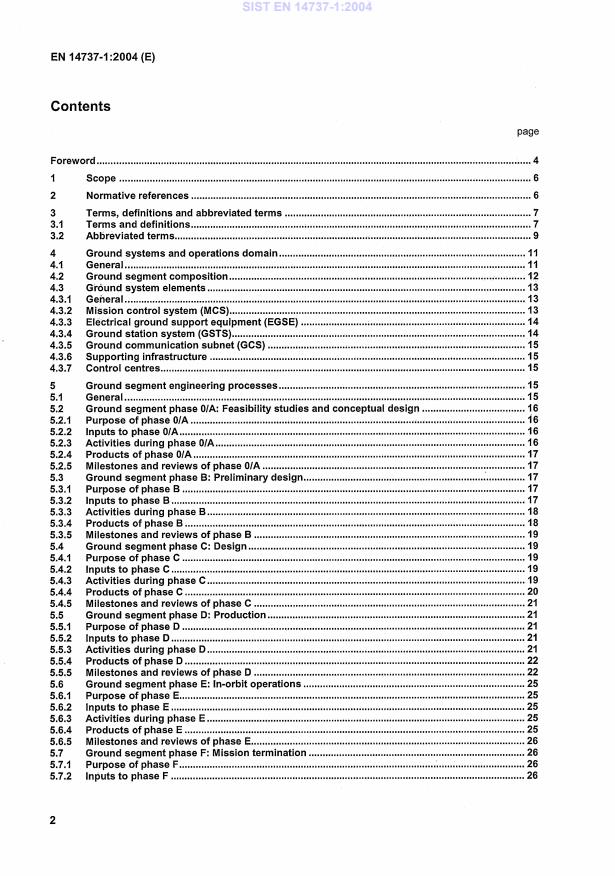
Within the frame of the overall engineering standards for space missions, this European Standard contains the basic rules, principles and requirements to be applied to the engineering of the ground segment and mission operations, which form an integral part of the overall system implementing a space mission.
This European Standard includes development of ground segment, operations preparation activities, mission planning activities, mission evaluation activities, the conduct of operations proper, and all post-operational activities. The ground segment comprises the ground systems (i.e. all ground facilities, hardware and software) and all operational aspects such as personnel and related data repositories required on ground to perform mission operations.
For reasons of recognized commonality, ground segment within the meaning of this European Standard includes those elements and facilities required for the purpose of implementing the mission and fulfilling the missions requirements while the relevant space segments are in-orbit. It covers ground elements used for purposes of assembly, integration and verification of the space segment, to the extent needed for ground segment end-to-end verification activities. It also covers elements integrated into the ground segment after completion of space segment AIT; space segment AIT proper being considered outside the scope of this Standard.
It does not however cover the spacecraft activities and facilities interfacing the launch service segment. Furthermore, while this European Standard is applicable to all classes of missions it does not consider aspects that are specific to manned space missions.
- Status
- Withdrawn
- Publication Date
- 23-Mar-2004
- Withdrawal Date
- 06-Oct-2026
- Technical Committee
- CEN/SS T02 - Aerospace
- Drafting Committee
- CEN/SS T02 - Aerospace
- Current Stage
- 9960 - Withdrawal effective - Withdrawal
- Start Date
- 28-Jan-2015
- Completion Date
- 07-Oct-2026



Relations
- Effective Date
- 04-Feb-2015
- Effective Date
- 28-Jan-2026
- Effective Date
- 28-Jan-2026
- Effective Date
- 28-Jan-2026
- Effective Date
- 28-Jan-2026
- Effective Date
- 28-Jan-2026
- Effective Date
- 28-Jan-2026
- Effective Date
- 28-Jan-2026
- Effective Date
- 28-Jan-2026
- Effective Date
- 28-Jan-2026
Get Certified
Connect with accredited certification bodies for this standard

BUREAU VERITAS Certification Germany
Bureau Veritas certification in Germany.

Element Materials Technology
Materials testing and product certification.

AQMS Ltd.
AQMS provides ISO certification to SMEs across the UK.
Sponsored listings
Frequently Asked Questions
EN 14737-1:2004 is a standard published by the European Committee for Standardization (CEN). Its full title is "Space engineering - Ground systems and operations - Part 1: Principles and requirements". This standard covers: Within the frame of the overall engineering standards for space missions, this European Standard contains the basic rules, principles and requirements to be applied to the engineering of the ground segment and mission operations, which form an integral part of the overall system implementing a space mission. This European Standard includes development of ground segment, operations preparation activities, mission planning activities, mission evaluation activities, the conduct of operations proper, and all post-operational activities. The ground segment comprises the ground systems (i.e. all ground facilities, hardware and software) and all operational aspects such as personnel and related data repositories required on ground to perform mission operations. For reasons of recognized commonality, ground segment within the meaning of this European Standard includes those elements and facilities required for the purpose of implementing the mission and fulfilling the missions requirements while the relevant space segments are in-orbit. It covers ground elements used for purposes of assembly, integration and verification of the space segment, to the extent needed for ground segment end-to-end verification activities. It also covers elements integrated into the ground segment after completion of space segment AIT; space segment AIT proper being considered outside the scope of this Standard. It does not however cover the spacecraft activities and facilities interfacing the launch service segment. Furthermore, while this European Standard is applicable to all classes of missions it does not consider aspects that are specific to manned space missions.
Within the frame of the overall engineering standards for space missions, this European Standard contains the basic rules, principles and requirements to be applied to the engineering of the ground segment and mission operations, which form an integral part of the overall system implementing a space mission. This European Standard includes development of ground segment, operations preparation activities, mission planning activities, mission evaluation activities, the conduct of operations proper, and all post-operational activities. The ground segment comprises the ground systems (i.e. all ground facilities, hardware and software) and all operational aspects such as personnel and related data repositories required on ground to perform mission operations. For reasons of recognized commonality, ground segment within the meaning of this European Standard includes those elements and facilities required for the purpose of implementing the mission and fulfilling the missions requirements while the relevant space segments are in-orbit. It covers ground elements used for purposes of assembly, integration and verification of the space segment, to the extent needed for ground segment end-to-end verification activities. It also covers elements integrated into the ground segment after completion of space segment AIT; space segment AIT proper being considered outside the scope of this Standard. It does not however cover the spacecraft activities and facilities interfacing the launch service segment. Furthermore, while this European Standard is applicable to all classes of missions it does not consider aspects that are specific to manned space missions.
EN 14737-1:2004 is classified under the following ICS (International Classification for Standards) categories: 49.140 - Space systems and operations. The ICS classification helps identify the subject area and facilitates finding related standards.
EN 14737-1:2004 has the following relationships with other standards: It is inter standard links to EN 16603-70:2015, EN 16603-10:2018, EN 16603-10-02:2018, EN 13701:2001, EN 13290-4:2001, EN 16602-40:2018, EN 14737-2:2004, EN ISO 16091:2002, EN 16603-40:2014, EN 14776:2004. Understanding these relationships helps ensure you are using the most current and applicable version of the standard.
EN 14737-1:2004 is associated with the following European legislation: Standardization Mandates: M/237. When a standard is cited in the Official Journal of the European Union, products manufactured in conformity with it benefit from a presumption of conformity with the essential requirements of the corresponding EU directive or regulation.
EN 14737-1:2004 is available in PDF format for immediate download after purchase. The document can be added to your cart and obtained through the secure checkout process. Digital delivery ensures instant access to the complete standard document.
Standards Content (Sample)
2003-01.Slovenski inštitut za standardizacijo. Razmnoževanje celote ali delov tega standarda ni dovoljeno.Raumfahrttechnik - Bodensysteme und Bodenbetrieb - Teil 1: Grundsätze und AnforderungenIngénierie spatiale - Systemes au sol et exploitation - Partie 1: Principes et exigencesSpace engineering - Ground systems and operations - Part 1: Principles and requirements49.140Vesoljski sistemi in operacijeSpace systems and operationsICS:Ta slovenski standard je istoveten z:EN 14737-1:2004SIST EN 14737-1:2004en01-september-2004SIST EN 14737-1:2004SLOVENSKI
STANDARD
SIST EN 1473
...