

EN 1177:2018+AC:2019/FprA1
(Amendment)Impact attenuating playground surfacing - Methods of test for determination of impact attenuation
- Abstract
This European Standard specifies the test apparatus and the impact test methods for determining the impact attenuation of surfacing by measuring the acceleration experienced during impact. Test apparatus in compliance with this standard are applicable to tests carried out in a laboratory or on site by either methods described.
NOTE The test methods described in this standard are also applicable for impact areas required in other standards than for playground equipment, e.g. for outdoor fitness equipment and parkour equipment.
- Status
- Not Published
- Publication Date
- 31-Dec-2023
- Technical Committee
- CEN/TC 136 - Sports, playground and other recreational equipment
- Drafting Committee
- CEN/TC 136/SC 1/WG 1 - Surfacing
- Current Stage
- 5060 - Closure of Vote - Formal Approval
- Start Date
- 26-Oct-2023
- Due Date
- 13-Oct-2023
- Completion Date
- 26-Oct-2023

Overview
EN 1177:2018+AC:2019/FprA1 is a European Standard developed by CEN, specifying methods to test the impact attenuation performance of playground surfacing materials. Impact attenuation is crucial to reducing the severity of injuries from falls on playgrounds, outdoor fitness areas, and parkour installations. This standard covers laboratory and on-site testing, ensuring consistent measurement of surface safety by determining the acceleration experienced during impact, also known as Head Injury Criterion (HIC).
Key Topics
- Impact Attenuating Surfaces: Methods focus on surfacing materials that can absorb impact energy, thereby reducing injury risk.
- Testing Procedures: Includes detailed procedures for both laboratory and on-site testing, ensuring reliable and reproducible results for critical fall height (CFH) and HIC.
- Environmental Conditions: Testing must be performed under specific climatic conditions (e.g., temperature, humidity) and excludes saturated surfaces or inclined planes exceeding 10°, ensuring valid and consistent data.
- Surface Variations: Requires that surfacing variations, such as layer thickness or material type, are tested independently to reflect real-world scenarios.
- Composite Products: Procedures are outlined for testing systems comprised of multiple layers or materials (e.g., artificial turf with shockpads).
- Data Reporting: Specifies comprehensive reporting requirements, including maximum HIC values, critical fall height, and relevant environmental data.
- Uncertainty and Reproducibility: Acknowledges possible measurement variations, especially in on-site testing due to uncontrolled environmental factors, and highlights advancements in equipment accuracy and calibration.
Applications
The EN 1177:2018+AC:2019/FprA1 standard is highly relevant for:
- Playground Safety Compliance: Ensuring that playground surfacing meets mandatory safety requirements across Europe.
- Product Development and Certification: Manufacturers of impact attenuating surfaces use these standardized methods for product validation and CE marking.
- On-Site Inspection and Maintenance: Playground operators and safety inspectors utilize on-site testing procedures to monitor surface performance over time and after installation.
- Urban Fitness and Parkour Facilities: The standard is also applicable to outdoor fitness and parkour areas, addressing a broad spectrum of recreational environments beyond traditional playgrounds.
- Risk Assessment: Utilized by risk assessors to verify that surfacing materials provide adequate protection at potential fall zones, contributing to liability reduction.
Related Standards
- EN 1176 - Playground equipment and surfacing; provides requirements for equipment, including reference to critical fall heights from EN 1177 test data.
- ISO/TR 24679-7 - Guidance on impact attenuation measurements in other safety contexts.
- EN 16630 - Permanently installed outdoor fitness equipment, which may refer to impact area testing methods from EN 1177.
- ASTM F1292 - Impact attenuation of surfacing materials within the U.S., offering technical alignment with EN 1177 for international projects.
Adopting EN 1177:2018+AC:2019/FprA1 ensures playground and outdoor recreation sites provide safer environments for users of all ages. By standardizing the test apparatus and procedures for impact attenuation, the safety performance of playground surfacing can be objectively verified, fostering public trust and regulatory compliance.
Relations
- Effective Date
- 01-Nov-2023
- Effective Date
- 28-Jan-2026
- Effective Date
- 28-Jan-2026
- Effective Date
- 28-Jan-2026
- Effective Date
- 28-Jan-2026
- Effective Date
- 28-Jan-2026
- Effective Date
- 28-Jan-2026
- Effective Date
- 28-Jan-2026
- Effective Date
- 28-Jan-2026
- Effective Date
- 28-Jan-2026
- Effective Date
- 28-Jan-2026
- Effective Date
- 28-Jan-2026
- Effective Date
- 28-Jan-2026
- Effective Date
- 29-Sep-2021
Frequently Asked Questions
EN 1177:2018+AC:2019/FprA1 is a draft published by the European Committee for Standardization (CEN). Its full title is "Impact attenuating playground surfacing - Methods of test for determination of impact attenuation". This standard covers: This European Standard specifies the test apparatus and the impact test methods for determining the impact attenuation of surfacing by measuring the acceleration experienced during impact. Test apparatus in compliance with this standard are applicable to tests carried out in a laboratory or on site by either methods described. NOTE The test methods described in this standard are also applicable for impact areas required in other standards than for playground equipment, e.g. for outdoor fitness equipment and parkour equipment.
This European Standard specifies the test apparatus and the impact test methods for determining the impact attenuation of surfacing by measuring the acceleration experienced during impact. Test apparatus in compliance with this standard are applicable to tests carried out in a laboratory or on site by either methods described. NOTE The test methods described in this standard are also applicable for impact areas required in other standards than for playground equipment, e.g. for outdoor fitness equipment and parkour equipment.
EN 1177:2018+AC:2019/FprA1 is classified under the following ICS (International Classification for Standards) categories: 97.200.40 - Playgrounds. The ICS classification helps identify the subject area and facilitates finding related standards.
EN 1177:2018+AC:2019/FprA1 has the following relationships with other standards: It is inter standard links to EN 1177:2018+A1:2023, EN ISO 3262-11:2024, EN ISO 3262-8:2023, EN ISO 3262-12:2023, EN ISO 3262-9:2023, EN ISO 3262-7:2023, EN ISO 3262-6:2022, EN ISO 3262-21:2023, EN ISO 3262-10:2024, EN ISO 3262-13:2023, EN ISO 3262-15:2023, EN ISO 3262-14:2023, EN ISO 3262-16:2023, EN 1177:2018+AC:2019. Understanding these relationships helps ensure you are using the most current and applicable version of the standard.
EN 1177:2018+AC:2019/FprA1 is available in PDF format for immediate download after purchase. The document can be added to your cart and obtained through the secure checkout process. Digital delivery ensures instant access to the complete standard document.
Standards Content (Sample)
SLOVENSKI STANDARD
SIST EN 1177:2018+AC:2019/oprA1:2022
01-marec-2022
Podloge otroških igrišč, ki ublažijo udarce - Ugotavljanje kritične višine padca -
Dopolnilo A1
Impact attenuating playground surfacing - Methods of test for determination of impact
attenuation
Stoßdämpfende Spielplatzböden - Prüfverfahren zur Bestimmung der Stoßdämpfung
Sols d'aires de jeux absorbant l'impact - Méthodes d'essai pour la détermination de
l'atténuation de l'impact
Ta slovenski standard je istoveten z: EN 1177:2018+AC:2019/prA1:2022
ICS:
97.200.40 Igrišča Playgrounds
SIST EN en,fr,de
1177:2018+AC:2019/oprA1:2022
2003-01.Slovenski inštitut za standardizacijo. Razmnoževanje celote ali delov tega standarda ni dovoljeno.
SIST EN 1177:2018+AC:2019/oprA1:2022
SIST EN 1177:2018+AC:2019/oprA1:2022
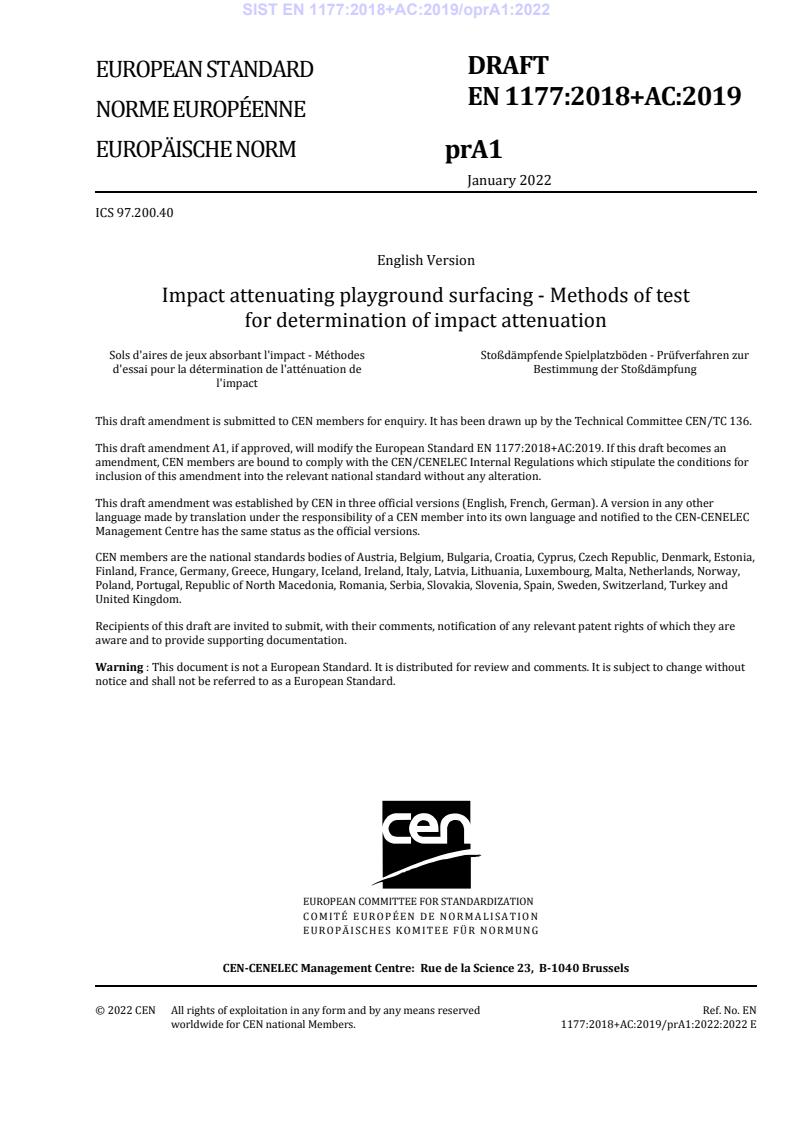
DRAFT
EUROPEAN STANDARD
EN 1177:2018+AC:2019
NORME EUROPÉENNE
EUROPÄISCHE NORM
prA1
January 2022
ICS 97.200.40
English Version
Impact attenuating playground surfacing - Methods of test
for determination of impact attenuation
Sols d'aires de jeux absorbant l'impact - Méthodes Stoßdämpfende Spielplatzböden - Prüfverfahren zur
d'essai pour la détermination de l'atténuation de Bestimmung der Stoßdämpfung
l'impact
This draft amendment is submitted to CEN members for enquiry. It has been drawn up by the Technical Committee CEN/TC 136.
This draft amendment A1, if approved, will modify the European Standard EN 1177:2018+AC:2019. If this draft becomes an
amendment, CEN members are bound to comply with the CEN/CENELEC Internal Regulations which stipulate the conditions for
inclusion of this amendment into the relevant national standard without any alteration.
This draft amendment was established by CEN in three official versions (English, French, German). A version in any other
language made by translation under the responsibility of a CEN member into its own language and notified to the CEN-CENELEC
Management Centre has the same status as the official versions.
CEN members are the national standards bodies of Austria, Belgium, Bulgaria, Croatia, Cyprus, Czech Republic, Denmark, Estonia,
Finland, France, Germany, Greece, Hungary, Iceland, Ireland, Italy, Latvia, Lithuania, Luxembourg, Malta, Netherlands, Norway,
Poland, Portugal, Republic of North Macedonia, Romania, Serbia, Slovakia, Slovenia, Spain, Sweden, Switzerland, Turkey and
United Kingdom.
Recipients of this draft are invited to submit, with their comments, notification of any relevant patent rights of which they are
aware and to provide supporting documentation.
Warning : This document is not a European Standard. It is distributed for review and comments. It is subject to change without
notice and shall not be referred to as a European Standard.
EUROPEAN COMMITTEE FOR STANDARDIZATION
COMITÉ EUROPÉEN DE NORMALISATION
EUROPÄISCHES KOMITEE FÜR NORMUNG
CEN-CENELEC Management Centre: Rue de la Science 23, B-1040 Brussels
© 2022 CEN All rights of exploitation in any form and by any means reserved Ref. No. EN
worldwide for CEN national Members. 1177:2018+AC:2019/prA1:2022:2022 E
SIST EN 1177:2018+AC:2019/oprA1:2022
EN 1177:2018+AC:2019/prA1:2021 (E)
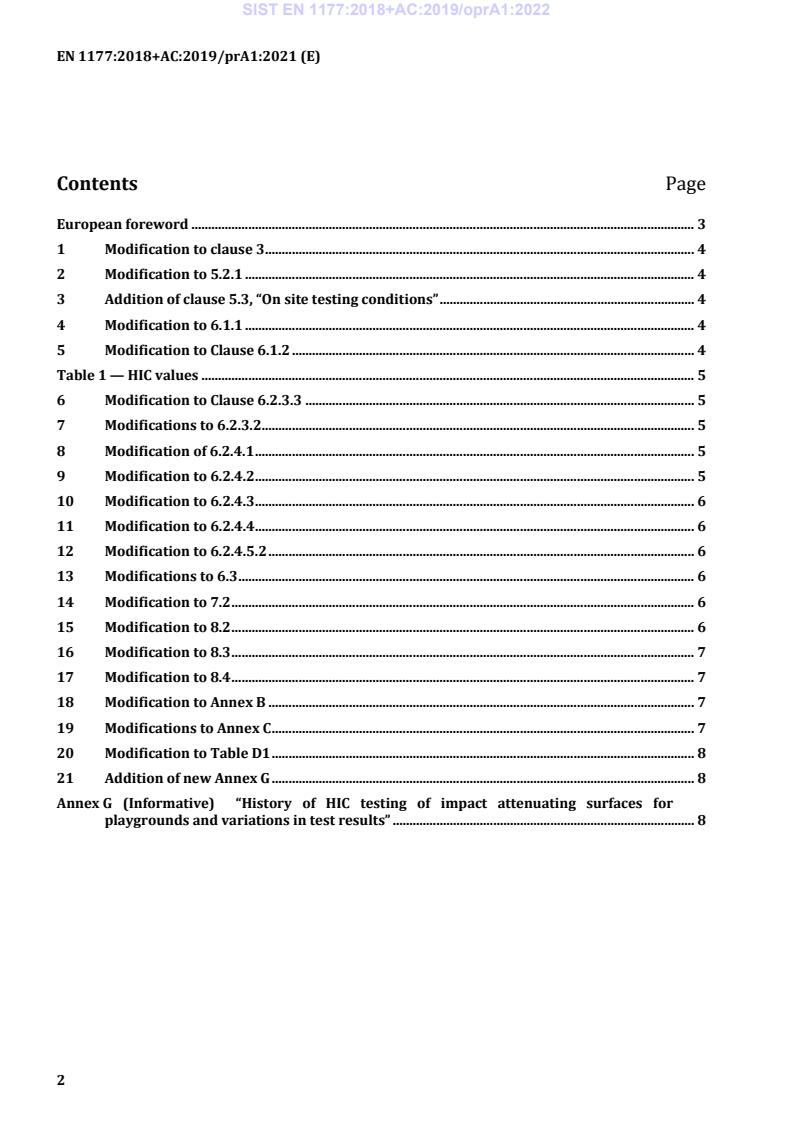
Contents Page
European foreword . 3
1 Modification to clause 3 . 4
2 Modification to 5.2.1 . 4
3 Addition of clause 5.3, “On site testing conditions” . 4
4 Modification to 6.1.1 . 4
5 Modification to Clause 6.1.2 . 4
Table 1 — HIC values . 5
6 Modification to Clause 6.2.3.3 . 5
7 Modifications to 6.2.3.2. 5
8 Modification of 6.2.4.1 . 5
9 Modification to 6.2.4.2. 5
10 Modification to 6.2.4.3. 6
11 Modification to 6.2.4.4. 6
12 Modification to 6.2.4.5.2 . 6
13 Modifications to 6.3 . 6
14 Modification to 7.2 . 6
15 Modification to 8.2 . 6
16 Modification to 8.3 . 7
17 Modification to 8.4 . 7
18 Modification to Annex B . 7
19 Modifications to Annex C . 7
20 Modification to Table D1 . 8
21 Addition of new Annex G . 8
Annex G (Informative) “History of HIC testing of impact attenuating surfaces for
playgrounds and variations in test results” . 8
SIST EN 1177:2018+AC:2019/oprA1:2022
EN 1177:2018+AC:2019/prA1:2022 (E)
European foreword
This document (EN 1177:2018+AC:2019/prA1:2022) has been prepared by Technical Committee
CEN/TC 136 “Sports, playground and other recreational equipment”, the secretariat of which is held by
DIN.
This document is currently submitted to the CEN Enquiry.
SIST EN 1177:2018+AC:2019/oprA1:2022
EN 1177:2018+AC:2019/prA1:2022 (E)
1 Modification to clause 3
In definition 3.9, replace the note to entry with the following:
“The number of drops and the drop heights of drop tests are specified separately in Method 1 and in
Method 2. Particularities exist for some specific types of surfacing material (e.g. for loose fil material the
four impacts measurement of the drop test are conduct in a different test position).”
2 Modification to 5.2.1
Change the beginning of the note to read as follows:
“NOTE Requirements for the adequate level of impact attenuation […].”
3 Addition of clause 5.3, “On site testing conditions”
Move the text in 6.3 to become a new clause 5.3.
“5.3 On site testing conditions
5.3.1 Testing shall only be carried out when the temperature of the surface is between 5 °C and 55 °C.
Temperature as well as all relevant climatic conditions existing throughout the test, e.g. humidity,
moisture, etc., shall be measured and recorded.
5.3.2 Testing shall not be carried out on surfaces that are saturated with water.
5.3.3 Tests shall not be conducted on a test zone if it is inclined at an angle of > 10° to the horizontal.
NOTE Guided systems will give invalid results on inclined surfaces and free falling head forms can experience
excessive rotation
...