

EN 13126-16:2008
(Main)Building hardware - Requirements and test methods for windows and doors height windows - Part 16: Hardware for Lift&Slide windows and doors
- Abstract
This part of EN 13126 provides requirements and test methods for durability, strength, security and function of hardware for Lift&Slide windows and door height windows, regardless of whether the hardware enables an additional tilt position.
NOTE This Standard is also applicable to hardware systems, whereby the sash itself is not lifted but a gasket mechanism is moved.
- Status
- Withdrawn
- Publication Date
- 22-Jan-2008
- Withdrawal Date
- 06-Oct-2026
- Technical Committee
- CEN/TC 33 - Doors, windows, shutters and building hardware
- Drafting Committee
- CEN/TC 33/WG 4 - Building hardware
- Current Stage
- 9960 - Withdrawal effective - Withdrawal
- Start Date
- 17-Apr-2019
- Completion Date
- 07-Oct-2026

Relations
- Effective Date
- 22-Dec-2008
- Effective Date
- 24-Apr-2019
- Effective Date
- 25-Aug-2026
- Effective Date
- 28-Jan-2026
- Effective Date
- 28-Jan-2026
- Effective Date
- 28-Jan-2026
Get Certified
Connect with accredited certification bodies for this standard

DIBt (Deutsches Institut für Bautechnik)
German Institute for Building Technology.
DIN CERTCO
DIN Group product certification.

Aboma Certification B.V.
Specialized in construction, metal, and transport sectors.
Sponsored listings
Frequently Asked Questions
EN 13126-16:2008 is a standard published by the European Committee for Standardization (CEN). Its full title is "Building hardware - Requirements and test methods for windows and doors height windows - Part 16: Hardware for Lift&Slide windows and doors". This standard covers: This part of EN 13126 provides requirements and test methods for durability, strength, security and function of hardware for Lift&Slide windows and door height windows, regardless of whether the hardware enables an additional tilt position. NOTE This Standard is also applicable to hardware systems, whereby the sash itself is not lifted but a gasket mechanism is moved.
This part of EN 13126 provides requirements and test methods for durability, strength, security and function of hardware for Lift&Slide windows and door height windows, regardless of whether the hardware enables an additional tilt position. NOTE This Standard is also applicable to hardware systems, whereby the sash itself is not lifted but a gasket mechanism is moved.
EN 13126-16:2008 is classified under the following ICS (International Classification for Standards) categories: 91.190 - Building accessories. The ICS classification helps identify the subject area and facilitates finding related standards.
EN 13126-16:2008 has the following relationships with other standards: It is inter standard links to CEN/TS 13126-16:2004, EN 13126-16:2019, ISO 4520:1981, EN 12519:2004, EN 1670:2007, EN 13126-1:2006. Understanding these relationships helps ensure you are using the most current and applicable version of the standard.
EN 13126-16:2008 is associated with the following European legislation: EU Directives/Regulations: 305/2011, 89/106/EEC. When a standard is cited in the Official Journal of the European Union, products manufactured in conformity with it benefit from a presumption of conformity with the essential requirements of the corresponding EU directive or regulation.
EN 13126-16:2008 is available in PDF format for immediate download after purchase. The document can be added to your cart and obtained through the secure checkout process. Digital delivery ensures instant access to the complete standard document.
Standards Content (Sample)
2003-01.Slovenski inštitut za standardizacijo. Razmnoževanje celote ali delov tega standarda ni dovoljeno.Building hardware - Hardware for windows and balcony doors - Requirements and test methods - Part 16: Hardware for Lift&Slide windows and doorsStavbno okovje - Okovje za okna in balkonska vrata - Zahteve in preskusne metode - 16. del: Okovje za dvižno-drsna okna in vrataQuincaillerie pour le bâtiment - Ferrures pour fenetres et portes-fenetres - Exigences et méthodes d'essai - Partie 16 : Ferrures pour portes-fenetres et fenetres coulissantes a levageBaubeschläge - Beschläge für Fenster und Fenstertüren - Anforderungen und Prüfverfahren - Teil 16: Beschläge für Hebeschiebe-Fenster und -FenstertürenTa slovenski standard je istoveten z:EN 13126-16:2008SIST EN 13126-16:2008en,fr,de91.190ICS:SIST-TS CEN/TS 13126-16:20051DGRPHãþDSLOVENSKI
STANDARDSIST EN 13126-16:200801-maj-2008
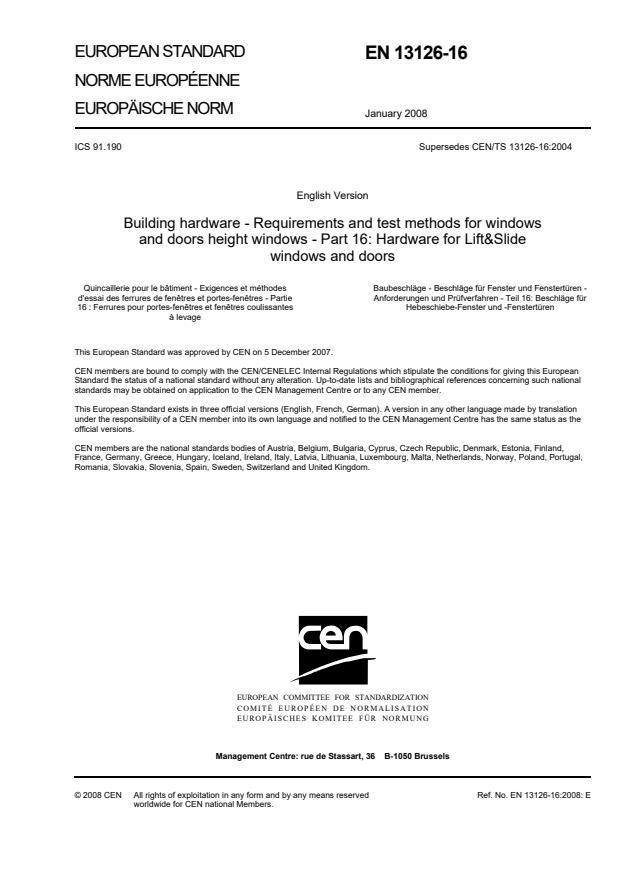
EUROPEAN STANDARDNORME EUROPÉENNEEUROPÄISCHE NORMEN 13126-16January 2008ICS 91.190Supersedes CEN/TS 13126-16:2004
English VersionBuilding hardware - Requirements and test methods for windowsand doors height windows - Part 16: Hardware for Lift&Slidewindows and doorsQuincaillerie pour le bâtiment - Exigences et méthodesd'essai des ferrures de fenêtres et portes-fenêtres - Partie16 : Ferrures pour portes-fenêtres et fenêtres coulissantesà levageBaubeschläge - Beschläge für Fenster und Fenstertüren -Anforderungen und Prüfverfahren - Teil 16: Beschläge fürHebeschiebe-Fenster und -FenstertürenThis European Standard was approved by CEN on 5 December 2007.CEN members are bound to comply with the CEN/CENELEC Internal Regulations which stipulate the conditions for giving this EuropeanStandard the status of a national standard without any alteration. Up-to-date lists and bibliographical references concerning such nationalstandards may be obtained on application to the CEN Management Centre or to any CEN member.This European Standard exists in three official versions (English, French, German). A version in any other language made by translationunder the responsibility of a CEN member into its own language and notified to the CEN Management Centre has the same status as theofficial versions.CEN members are the national standards bodies of Austria, Belgium, Bulgaria, Cyprus, Czech Republic, Denmark, Estonia, Finland,France, Germany, Greece, Hungary, Iceland, Ireland, Italy, Latvia, Lithuania, Luxembourg, Malta, Netherlands, Norway, Poland, Portugal,Romania, Slovakia, Slovenia, Spain, Sweden, Switzerland and United Kingdom.EUROPEAN COMMITTEE FOR STANDARDIZATIONCOMITÉ EUROPÉEN DE NORMALISATIONEUROPÄISCHES KOMITEE FÜR NORMUNGManagement Centre: rue de Stassart, 36
B-1050 Brussels© 2008 CENAll rights of exploitation in any form and by any means reservedworldwide for CEN national Members.Ref. No. EN 13126-16:2008: E
roller assembly of one or more rolls in a single or multiple casing which supports Lift&Slide windows and door height windows. These may be aligned in a straight line or rotate about an axis for Lift&Slide windows and door height windows. Otherwise known as a bogey 3.2 roll singular wheel in a roller 3.3 lateral guide hardware component which guides the lateral movement of the Lift&Slide windows and door height windows 3.4 guide track track fixed on the top (top guide track) or bottom (bottom guide track) which enables a lateral guide to run 3.5 rail rail fixed on the top (top rail) or bottom (bottom rail) which enables the rollers to run
During this action the sash can be moved a limited distance away from the frame in the direction of the opening position. 3.9 closed position position in which the active sash is forced into the raised position by the lifting action, and the hardware is unlocked 3.10 tilted position position in which the rollers on the bottom of the active sash rest on the roller track. The top area is held in the final tilt position by means of the projecting mechanisms 3.11 sliding position position in which the active sash is lifted, so that it can be moved in-line 3.12 opening position position in which the active sash is at the end of the sliding position (the largest possible opening width) 4 Classification 4.1 General The classification of hardware for Lift&Slide windows and door height windows shall be in accordance with the requirements of clause 4 EN 13126-1:2006. 4.2 Category of use (1 – first digit) No marking is required for the category of use in accordance with 4.2 of EN 13126-1:2006. 4.3 Durability (2 – second digit) Grades shall be in accordance with 4.3 of EN 13126-1:2006. 4.4 Mass (3 – third digit) Grades shall be in accordance with 4.4 of EN 13126-1:2006.
grade 1: The hardware shall conform to the requirements of part 1 and part 16 of this standard. 4.7 Corrosion resistance (6 – sixth digit) Grades shall conform to EN 1670, whereby grade 3 is the minimum requirement. 4.8 Security (7 – seventh digit) No marking is required for the category of security in accordance with 4.8 of EN 13126-1:2006. 4.9 Application (8 – eighth digit) The eighth digit shows “16” indicating the part of the standard which was used for testing the hardware for Lift&Slide windows and door height windows in accordance with 4.9 of EN 13126-1:2006. 4.10 Test Sizes (9 – ninth digit) The ninth digit shows the test sizes (active sash) in accordance with 4.10 of EN 13126-1:2006 as follows: S.W.1) in mm / S.H.2) in mm – tolerance ± 5 mm. 1 200 mm S.W1) x 2 000 mm S.H2)
The stated sizes are test sizes only. They do not relate to the maximum or minimum sizes to which a window may be fabricated. NOTE 1 The manufacturer’s product-documentation should advise that in daily use windows, smaller or larger than those tested, should not be subjected to stronger forces than those for the specified test size. In the case of not being capable of manufacturing the specified test size due to the fact that the hardware field of application is smaller than these specified test sizes, smaller test sizes shall be used. In this case the window shall be tested in accordance with the largest possible S.W.1)
(or S.H.2)) as specified by the hardware manufacturers appropriate documentation and a S.H.2) (or S.W.1)) in a ratio of 2 000/1 200 mm (factor ≈ 1,67). NOTE 2 This means that if the specified test sizes are larger than those which can be manufactured, the test specimens shall be tested using the largest possible S.W.1)
or S.H.2) in accordance with the manufacturer's documentation and using a S.H.2) to S.W.1) ratio of 2 000/1 200 mm (factor ≈ 1,67).
Example 1 largest possible S.W.1)
= 800 mm
=
S.W.1) of the test specimen
800 mm X 2 000/1 200 = 1 333 mm
S.H.2)
= 1 333 mm
=
S.H.2) of the test specimen
= 1 600 mm
=
S.H.1) of the test specimen
1 600 mm X 1 200/2 000 = 960 mm
S.W.2)
= 960 mm
=
S.W.2) of the test specimen 1)
S.W. = sash width 2)
S.H. = sash height NOTE 3 The missing dimensions in each case (S.H1) or S.W2).) should be calculated in accordance with example 1 or example 2 with the objective of establishing the maximum test-format, which lies within the hardware manufacturers application range. 4.11 Example of classification for hardware for Lift&Slide windows and doors
Table 1 – Example of classification for hardware for Lift&Slide windows and doors 1 2 3 4 5 6 7 8 9 - 4 250 0 1 4 - 16 1 200 / 2 000
This denotes hardware for Lift&Slide windows and door height windows, which have: Digit 1 category of use
- (no requirements) Digit 2 durability
grade 4 (15 000 cycles) Digit 3 mass
250 kg Digit 4 fire resistance
grade 0 (no requirements) Digit 5 safety in use
grade 1 Digit 6 corrosion resistance
grade 4 Digit 7 security
- (no requirements) Digit 8 applicable part
tested according to part 16 of this standard Digit 9 test sizes
S.W.1)
= 1 200 mm, S.H.2)
= 2 000 mm 1)
S.W. = sash width 2)
S.H.
= sash height 5 Requirements 5.1 General Hardware for Lift&Slide windows and door height windows shall conform to clause 5 of EN 13126-1:2006.
For example: length of the handle =
250 mm
operative length (key 4, Figure 1) =
250 mm – 20 mm
= 230 mm
torque Th = operative length X force F =
230 mm X 100 N
= 23 Nm
Dimensions in millimetres
Key
1 location for the force l1 length of the handle l2 operative length 2 force F = 100 N Figure 1 — Handle length 5.2.2 Sliding operation crash-tests After the sliding operation crash, test in accordance with 7.4.1 and 7.4.2: active sash shall not drop and shall still be constrained by its fixings; active sash shall function correctly. NOTE After the sliding operation crash-test all adjustment possibilities may be used to operate the sash.
The closing device shall withstand a torque Thr, which is the threefold torque Th as calculated and recorded in accordance with 5.2.1. For example:
length of the handle
= 220 mm
operative length (key 4, Figure 1)
= 220 mm – 20 mm = 200 mm
torque Th = operative length X force F = 200 mm X 100 N
= 20 Nm
torque Thr = 3 X Th
= 3 X 20 Nm
= 60 Nm NOTE Hardware with tilt function without positive control
...