

EN 1175-1:1998+A1:2010
(Main + Amendment)Safety of industrial trucks - Electrical requirements - Part 1: General requirements for battery powered trucks
- Abstract
1.1 This standard specifies electrical and related mechanical safety requirements for design and construction of the electrical installation in battery powered industrial trucks hereinafter referred to as trucks, with nominal voltages of the truck system up to 240 V. The Annex A is normative and gives requirements for "Connectors for traction batteries". Annex B is normative and contains "Electric motors - Output and test rules" and Annex C is normative and contains "Electromagnetic contactors".
NOTE 1 Reference is made to this standard in other standards which cover the non-electrical requirements of the various industrial truck types.
NOTE 2 This standard does not address the subject of charging of traction batteries (CENELEC TC 21X is preparing safety standards for battery charging).
NOTE 3 The special requirements for operation in potentially explosive atmospheres are not covered in this European Standard.
1.2 The requirements of this standard are applicable, when trucks are operated under the following climatic conditions:
- Average ambient temperature for continuous duty: +25°C;
- Maximum ambient temperature, short term (up to 1 h): +40°C;
- Lowest ambient temperature for trucks intended for use in normal indoor conditions: +5 °C;
- Lowest ambient temperature for trucks intended for use in normal outdoor conditions: -20 °C;
- Altitude: up to 2000 m;
- Relative humidity: in the range 30 % to 95 % (non condensing).
1.3 This standard covers specific hazards (listed in clause 4), which could occur during the intended use of trucks. For hazards occurring during construction, transportation, commissioning, decommissioning and disposal, reference should be made to EN ISO 12100-2:2003.
- Status
- Withdrawn
- Publication Date
- 02-Nov-2010
- Withdrawal Date
- 06-Oct-2026
- Technical Committee
- CEN/TC 150 - Industrial trucks - Safety
- Drafting Committee
- CEN/TC 150 - Industrial trucks - Safety
- Current Stage
- 9960 - Withdrawal effective - Withdrawal
- Start Date
- 22-Jul-2020
- Completion Date
- 07-Oct-2026
- Directive
- 2006/42/EC - Directive 2006/42/EC of the European Parliament and of the Council of 17 May 2006 on machinery, and amending Directive 95/16/EC (recast)OJ Ref: C, C 110 OJ Date: 08-Apr-2011

Relations
- Effective Date
- 18-Jan-2023
- Effective Date
- 06-Sep-2010
- Effective Date
- 10-Feb-2016
- Effective Date
- 25-Aug-2026
- Effective Date
- 09-Feb-2026
- Effective Date
- 09-Feb-2026
- Effective Date
- 09-Feb-2026
- Effective Date
- 09-Feb-2026
- Effective Date
- 09-Feb-2026
- Effective Date
- 09-Feb-2026
- Effective Date
- 09-Feb-2026
- Effective Date
- 09-Feb-2026
- Effective Date
- 28-Jan-2026
- Effective Date
- 28-Jan-2026
- Effective Date
- 28-Jan-2026
Frequently Asked Questions
EN 1175-1:1998+A1:2010 is a standard published by the European Committee for Standardization (CEN). Its full title is "Safety of industrial trucks - Electrical requirements - Part 1: General requirements for battery powered trucks". This standard covers: 1.1 This standard specifies electrical and related mechanical safety requirements for design and construction of the electrical installation in battery powered industrial trucks hereinafter referred to as trucks, with nominal voltages of the truck system up to 240 V. The Annex A is normative and gives requirements for "Connectors for traction batteries". Annex B is normative and contains "Electric motors - Output and test rules" and Annex C is normative and contains "Electromagnetic contactors". NOTE 1 Reference is made to this standard in other standards which cover the non-electrical requirements of the various industrial truck types. NOTE 2 This standard does not address the subject of charging of traction batteries (CENELEC TC 21X is preparing safety standards for battery charging). NOTE 3 The special requirements for operation in potentially explosive atmospheres are not covered in this European Standard. 1.2 The requirements of this standard are applicable, when trucks are operated under the following climatic conditions: - Average ambient temperature for continuous duty: +25°C; - Maximum ambient temperature, short term (up to 1 h): +40°C; - Lowest ambient temperature for trucks intended for use in normal indoor conditions: +5 °C; - Lowest ambient temperature for trucks intended for use in normal outdoor conditions: -20 °C; - Altitude: up to 2000 m; - Relative humidity: in the range 30 % to 95 % (non condensing). 1.3 This standard covers specific hazards (listed in clause 4), which could occur during the intended use of trucks. For hazards occurring during construction, transportation, commissioning, decommissioning and disposal, reference should be made to EN ISO 12100-2:2003.
1.1 This standard specifies electrical and related mechanical safety requirements for design and construction of the electrical installation in battery powered industrial trucks hereinafter referred to as trucks, with nominal voltages of the truck system up to 240 V. The Annex A is normative and gives requirements for "Connectors for traction batteries". Annex B is normative and contains "Electric motors - Output and test rules" and Annex C is normative and contains "Electromagnetic contactors". NOTE 1 Reference is made to this standard in other standards which cover the non-electrical requirements of the various industrial truck types. NOTE 2 This standard does not address the subject of charging of traction batteries (CENELEC TC 21X is preparing safety standards for battery charging). NOTE 3 The special requirements for operation in potentially explosive atmospheres are not covered in this European Standard. 1.2 The requirements of this standard are applicable, when trucks are operated under the following climatic conditions: - Average ambient temperature for continuous duty: +25°C; - Maximum ambient temperature, short term (up to 1 h): +40°C; - Lowest ambient temperature for trucks intended for use in normal indoor conditions: +5 °C; - Lowest ambient temperature for trucks intended for use in normal outdoor conditions: -20 °C; - Altitude: up to 2000 m; - Relative humidity: in the range 30 % to 95 % (non condensing). 1.3 This standard covers specific hazards (listed in clause 4), which could occur during the intended use of trucks. For hazards occurring during construction, transportation, commissioning, decommissioning and disposal, reference should be made to EN ISO 12100-2:2003.
EN 1175-1:1998+A1:2010 is classified under the following ICS (International Classification for Standards) categories: 53.060 - Industrial trucks. The ICS classification helps identify the subject area and facilitates finding related standards.
EN 1175-1:1998+A1:2010 has the following relationships with other standards: It is inter standard links to EN 1175-1:1998/FprA1, EN 1175-1:1998, EN 1175:2020, ISO 5053:1987, EN 60529:1991, EN 60332-1-1:2004, EN 60332-1-2:2004, ISO 6743-4:1982, EN 60204-1:1992, HD 53.8 S4:1993, EN 60947-3:1992, EN 60947-5-1:1991, EN ISO 13849-1:2008, EN 1050:1996, EN 13479:2004. Understanding these relationships helps ensure you are using the most current and applicable version of the standard.
EN 1175-1:1998+A1:2010 is associated with the following European legislation: EU Directives/Regulations: 2006/42/EC; Standardization Mandates: M/396. When a standard is cited in the Official Journal of the European Union, products manufactured in conformity with it benefit from a presumption of conformity with the essential requirements of the corresponding EU directive or regulation.
EN 1175-1:1998+A1:2010 is available in PDF format for immediate download after purchase. The document can be added to your cart and obtained through the secure checkout process. Digital delivery ensures instant access to the complete standard document.
Standards Content (Sample)
2003-01.Slovenski inštitut za standardizacijo. Razmnoževanje celote ali delov tega standarda ni dovoljeno.Sicherheit von Flurförderzeugen - Elektrische Anforderungen - Teil 1: Allgemeine Anforderungen für Flurförderzeuge mit batterieelektrischem AntriebSécurité des chariots de manutention - Prescriptions électriques - Partie 1: Prescriptions générales des chariots alimentés par batterieSafety of industrial trucks - Electrical requirements - Part 1: General requirements for battery powered trucks53.060Industrijski tovornjakiIndustrial trucks43.120Electric road vehiclesICS:Ta slovenski standard je istoveten z:EN 1175-1:1998+A1:2010SIST EN 1175-1:1998+A1:2011en01-junij-2011SIST EN 1175-1:1998+A1:2011SLOVENSKI
STANDARDSIST EN 1175-1:19981DGRPHãþD
EUROPEAN STANDARD NORME EUROPÉENNE EUROPÄISCHE NORM
EN 1175-1:1998+A1
November 2010 ICS 53.060 Supersedes EN 1175-1:1998English Version
Safety of industrial trucks - Electrical requirements - Part 1: General requirements for battery powered trucks
Sécurité des chariots de manutention - Prescriptions électriques - Partie 1: Prescriptions générales des chariots alimentés par batterie
Sicherheit von Flurförderzeugen - Elektrische Anforderungen - Teil 1: Allgemeine Anforderungen für Flurförderzeuge mit batterieelektrischem Antrieb This European Standard was approved by CEN on 23 November 1997 and includes Amendment 1 approved by CEN on 26 September 2010.
CEN members are bound to comply with the CEN/CENELEC Internal Regulations which stipulate the conditions for giving this European Standard the status of a national standard without any alteration. Up-to-date lists and bibliographical references concerning such national standards may be obtained on application to the CEN Management Centre or to any CEN member.
This European Standard exists in three official versions (English, French, German). A version in any other language made by translation under the responsibility of a CEN member into its own language and notified to the CEN Management Centre has the same status as the official versions.
CEN members are the national standards bodies of Austria, Belgium, Bulgaria, Croatia, Cyprus, Czech Republic, Denmark, Estonia, Finland, France, Germany, Greece, Hungary, Iceland, Ireland, Italy, Latvia, Lithuania, Luxembourg, Malta, Netherlands, Norway, Poland, Portugal, Romania, Slovakia, Slovenia, Spain, Sweden, Switzerland and United Kingdom.
EUROPEAN COMMITTEE FOR STANDARDIZATION
COMITÉ EUROPÉEN DE NORMALISATION EUROPÄISCHES KOMITEE FÜR NORMUNG
Management Centre:
Avenue Marnix 17,
B-1000 Brussels © 2010 CEN All rights of exploitation in any form and by any means reserved worldwide for CEN national Members. Ref. No. EN 1175-1:1998+A1:2010: ESIST EN 1175-1:1998+A1:2011
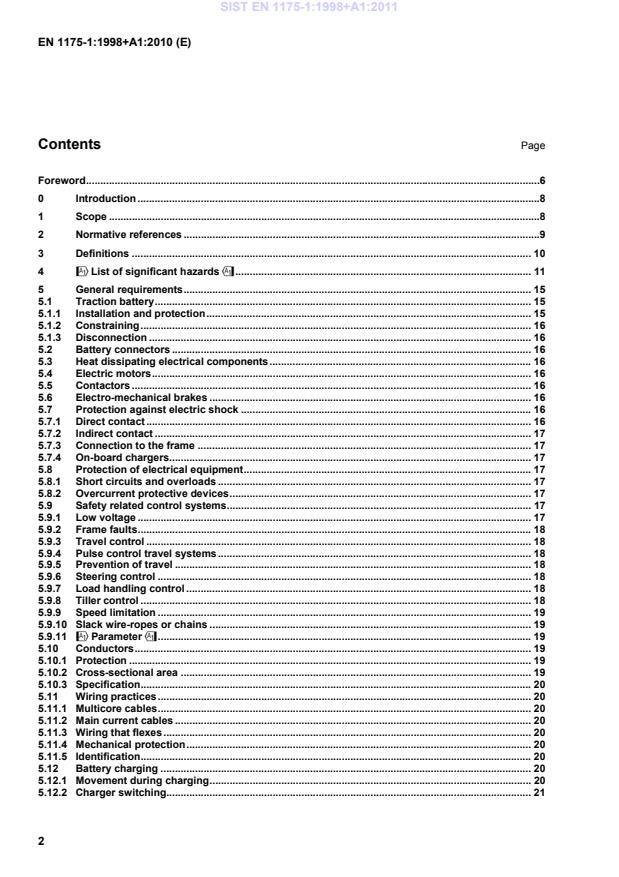
Connectors for traction batteries . 26A.1 Normative references . 26A.2 Definitions . 26A.3 Requirements . 27A.3.1 Mounting bracket . 27A.3.2 Physical properties . 27A.3.3 Contacts . 27A.3.4 Rated current . 27A.3.5 Polarity reversing . 27A.3.6 Contacts with connector casing . 27A.3.7 Temperature resistance . 27A.3.8 Enclosure protection . 27A.3.9 Protection of half-connector fitted to the battery . 27A.3.10 Coding . 28A.3.11 Cable sections . 28A.3.12 Locking of half-connectors . 28A.4 Type-test methods . 28A.4.1 Coding test . 28A.4.2 Samples . 28SIST EN 1175-1:1998+A1:2011
Electric motors - Output and test rules . 33B.1 Normative references . 33B.2 Definitions . 33B.3 Classification of enclosure and cooling . 34B.3.1 Protection . 34B.3.2 Cooling . 34B.4 Requirements . 35B.4.1 Rated output . 35B.4.2 Classes of insulation . 35B.4.3 Rated output test . 35B.4.4 Characteristic curves . 36B.4.5 Tolerances on characteristic curves . 36B.4.6 Overspeed test . 37B.4.7 Dielectric test . 37B.4.8 Terminal markings . 37B.4.9 Markings – Identification . 38B.5 Testing . 38B.5.1 General . 38B.5.2 Type tests . 38B.5.3 Routine tests . 39Annex C (normative)
Electromagnetic contactors . 40C.1 Definitions . 40C.2 Nominal service conditions . 40C.2.1 Climatic conditions . 40C.2.2 Voltage . 40C.3 Types of contactor . 40C.3.1 Type A . 41C.3.2 Type B . 41C.3.3 Type C . 41C.3.4 Type D . 41C.4 General requirements . 41C.4.1 Limits of operation. 41C.4.2 Mechanical durability . 42C.5 Type tests . 42C.5.1 Temperature rise test of main circuit . 42C.5.2 Temperature rise tests of operating coils . 43C.5.3 Dielectric tests . 44C.5.4 Verification of operating limits . 44C.5.5 Verification of making and breaking capacities in proving operation . 45C.5.6 Verification of rated making and breaking capacities of intermittently rated contactors of table C.6 category 2 . 45C.5.7 Verification of mechanical durability . 46C.6 Routine test . 46C.6.1 Operating limits . 46C.6.2 Dielectric test . 46C.7 Marking . 46SIST EN 1175-1:1998+A1:2011
!Relationship between this European Standard and the Essential Requirements of EU Directive 2006/42/EC" . 47 SIST EN 1175-1:1998+A1:2011
EN ISO 12100-2:2003 and EN 954-1 be replaced with EN ISO 13849-1:2008; addition of requirements for radiation and software parameter." !deleted text" The start and finish of text introduced or altered by amendment is indicated in the text by tags ! ". Attention is drawn to the possibility that some of the elements of this document may be the subject of patent rights. CEN [and/or CENELEC] shall not be held responsible for identifying any or all such patent rights. This European Standard is one of a package of standards for the safety of industrial trucks: !prEN ISO 3691-1, Industrial trucks — Safety requirements and verification — Part 1: Self-propelled industrial trucks, other than driverless trucks, variable-reach trucks and burden-carrier trucks (ISO/DIS 3691-1:2008)" !EN 1726-2" Safety of machinery - Industrial trucks - Self propelled trucks up to and including
10 000 kg capacity and tractors with a drawbar pull up to and including 20 000 N -
Part 2: Additional requirements for trucks with elevating operator position and trucks specially designed to travel with elevated load !EN 1551" Safety of industrial trucks - Self propelled trucks over 10 000 kg capacity !EN 1459" Safety of industrial trucks - !Self propelled variable" reach trucks !EN ISO 3691-5, Industrial trucks — Safety requirements and verification — Part 5: Pedestrian-propelled trucks (ISO 3691-5:2009)" SIST EN 1175-1:1998+A1:2011
Safety of industrial trucks - Pedestrial controlled manual and semi manual trucks -
Part 3: Platform trucks !deleted text" EN 1525 Safety of industrial trucks - Driverless trucks and their systems EN 1175-1 Safety of industrial trucks - Electrical requirements - Part 1 - General requirements for battery powered trucks EN 1175-2 Safety of industrial trucks - Electrical requirements - Part 2 - General requirements for internal combustion engine powered trucks EN 1175-3 Safety of industrial trucks - Electrical requirements - Part 3 - Specific requirements for the electric power transmission systems of internal combustion engine powered trucks EN 1526 Safety of industrial trucks - Additional requirements for automated functions on trucks !EN 1755" Safety of !industrial" trucks - Operation in potentially explosive atmospheres; Use in flammable gas, vapour, mist and dust !EN 12053" Safety of industrial trucks - Test methods for measuring noise !emissions" prEN ISO/DIS 13564 Test method for measuring visibility from self-propelled trucks
(ISO/DIS 13564:1996) !EN 13059" Safety of industrial trucks - Test methods for measuring vibration !EN 12895" Industrial trucks - Electromagnetic compatibility !deleted text" According to the CEN/CENELEC Internal Regulations, the national standards organizations of the following countries are bound to implement this European Standard: Austria, Belgium, Bulgaria, Croatia, Cyprus, Czech Republic, Denmark, Estonia, Finland, France, Germany, Greece, Hungary, Iceland, Ireland, Italy, Latvia, Lithuania, Luxembourg, Malta, Netherlands, Norway, Poland, Portugal, Romania, Slovakia, Slovenia, Spain, Sweden, Switzerland and United Kingdom.
+25°C; Maximum ambient temperature, short term (up to 1 h):
+40°C; Lowest ambient temperature for trucks intended for use in normal indoor conditions:
+5 °C; Lowest ambient temperature for trucks intended for use in normal outdoor conditions:
-20 °C; Altitude:
up to 2000 m; Relative humidity:
in the range 30 % to 95 % (non condensing). 1.3 This standard covers specific hazards (listed in clause 4), which could occur during the intended use of trucks. !For hazards occurring during construction, transportation, commissioning, decommissioning and disposal, reference should be made to EN ISO 12100-2:2003." SIST EN 1175-1:1998+A1:2011
Part 1: Rating and performance (IEC 34-1:1994, modified) EN 60204-1:1992 Safety of machinery - Electrical equipment of machines
Part 1: General requirements (IEC 204-1:1992, modified)1 ) EN 60529:1991 Degrees of protection provided by enclosures (IP Code) (IEC 529:1989) EN 60947-3:1992 Low-voltage switchgear and controlgear
Part 3: Switches, disconnectors, switch-disconnectors and fuse-combination units (IEC 947-3:1990, modified + Corrigendum December 1991) EN 60947-5-1:1991 Low-voltage switchgear and controlgear
Part 5: Control circuit devices and switching elements
Section one: Electromechanical control circuit devices (IEC 947-5-1:1990) HD 53.6 S2:1992 Rotating electrical machines;
Part 6: Methods of cooling (IC Code) (IEC 34-6:1991) HD 53.8 S4:1993 Rotating electrical machines;
Part 8: Terminal markings and direction of rotation of rotating machines
(IEC 34-8:1972 + A1:1990, modified) HD 405.1 S1 Tests on electric cables under fire conditions. Part 1 : Test on a single vertical insulated wire or cable !EN ISO 12100-1:2003, Safety of machinery — Basic concepts, general principles for design — Part 1: Basic terminology, methodology (ISO 12100-1:2003) EN ISO 12100-2:2003, Safety of machinery — Basic concepts, general principles for design — Part 2: Technical principles (ISO 12100-2:2003) EN ISO 13849-1:2008, Safety of machinery — Safety-related parts of control systems — Part 1: General principles for design (ISO 13849-1:2006)" IEC 85:1984 Thermal evaluation and classification of electrical insulation
1 ) This standard applies only in parts (option 3). Specific clauses have been indicated in the text. SIST EN 1175-1:1998+A1:2011
Classification - Part 4: Family H (Hydraulic systems) 3 Definitions For the purposes of this standard, definitions given in ISO 5053:1987 apply together with the following: 3.1 nominal voltage (of the truck system) the total number of battery cells connected in series in the truck system multiplied by 2 V for lead acid batteries and by 1,2 V for alkaline batteries 3.2 truck type test one-off test to verify compliance with this standard for each truck type. 3.3 truck routine test repetitive test required for all production trucks. 3.4 nominal current current in amperes that the connector is able to carry continuously without exceeding the allowable temperature indicated in A.3.7 3.5 emergency breaking current current in amperes specified in A.4.11 that the connector shall be able to break in the case of exceptional circumstance or hazard. 3.6 motor type test a test made on one or more items of electrical equipment of a new design or of a new manufacture to demonstrate that it complies with this standard.
3.7 motor routine test a test to which the electrical equipment on an order is subjected to prove its soundness. This can be reduced by agreement to testing a percentage of a production batch. 3.8 maximum service rotational frequency (speed) of a motor the highest rotational frequency assigned to the machine by the manufacturer. SIST EN 1175-1:1998+A1:2011
3.11 continuous rated motor output The rated output assigned by the manufacturer that can be sustained indefinitely on test without exceeding the temperature rises specified in table B.1 3.12 one hour rated motor output the rated output assigned by the manufacturer that can be sustained for one hour, starting from normal ambient temperature without exceeding the temperature rises specified in table B.1 3.13 short time rated motor output the rated output assigned by the manufacturer that can be sustained for a specified period starting from the normal ambient temperature without exceeding the temperature rises specified in table B.1 3.14 duty type motor rating the time for a duty cycle is 10 min and the cyclic duration factor is expressed as a percentage that can be sustained, starting from the normal ambient temperature without exceeding the temperature rise specified in table B.1 4 !List of significant hazards" The following significant hazards from Annex A of EN 1050:1996 (within brackets) are applicable in the situations described and could involve risks to persons if not reduced or eliminated. The corresponding requirements are designed to limit the risk or remove the hazard in each situation. SIST EN 1175-1:1998+A1:2011
4.1 Mechanical hazards (1)
4.1.1 Crushing hazard (1.1)
- between truck components
- between truck & obstacles
4.1.2 Impact by collision (20)
4.1.2.1
- when driven by the operator
4.1.3
Loss of stability (18)
- from excess speed
- from faulty battery mass
5.1.2
Constraining
5.6
Electro-mechanical brakes
5.9.3
Travel control system
5.9.4
Pulse control travel system
5.9.8
Tiller control
5.9.9
Speed limitation
5.9.10 Slack wire-ropes or chains
7.4 Battery
4.2
Electrical hazards
(2)
4.2.1
electric shock
(2.1)
4.2.2
short circuit
4.2.3
overloading
- all voltages
5.1.1.1
Covers
5.1.1.2
Design of covers
5.1.3
Disconnection
5.2
Battery connectors
5.4
Electric motors
5.5
Contactors
5.7.1
Direct contact
5.7.2
Indirect contact
5.7.3 Connection to the frame
5.7.4
On-board chargers
5.8
Protection of electrical equipment
5.10.1
Protection
5.10.2
Cross-sectional area
5.11.1
Multicore cables
5.11.2
Main current cables
5.11.3
Wiring that flexes
5.11.4 Protection
5.12.1 Movement during charging SIST EN 1175-1:1998+A1:2011
5.12.2
Charger switching
5.14
Dielectric test
5.15
Insulation resistance test
120 V < voltages ≤ 240 V
6.1.1
Battery
6.1.2
Terminals and connectors
6.1.3
Poles
6.1.4
Cover
6.2
Battery connectors
6.3.1
Electrical enclosures
6.3.2
Circuits
6.3.3
Bonding
6.3.4
Detection of frame faults
6.5
Insulation resistance test
7.4
Minimum marking
4.3
Thermal hazards (3)
5.3 Heat dissipating electrical components SIST EN 1175-1:1998+A1:2011
Hazard Corresponding requirements
4.4
Hazards generated by substances
(7)
4.4.1
Battery electrolyte
4.4.2
Fire or explosion hazard (7.2)
- all voltages
!- battery charging"
5.1.1.3
Sparking components
5.1.1.4
Ventilation
5.1.1.5
Internal surface
5.2
Battery connectors
7.3
Battery
120 V > voltages ≤ 240 V
6.1.3
Poles
6.2.1
Requirements
6.2.2
Emergency disconnection
6.4
Emergency switching off
6.5
Insulation resistance test
4.5
Ergonomic hazards (8)
4.5.1
Human error (8.6)
4.5.1.1
- when the truck is serviced
5.11.5
Identification !5.9.11 Parameter" !7.5
Non ionising radiation"
7.1
Electrical diagram
7.2 Safety checks
7.3 Battery
7.4
Minimum marking
4.6
Hazards due to functional disorders
(10)
4.6.1
failure of energy supply
4.6.2
failure of control system
4.6.3
loss of machine stability
5.4
Electric motors
5.5
Contactors
5.9.1
Low voltage
5.9.2
Frame faults
5.9.3
Travel control system
5.9.4
Pulse control travel system
5.9.5
Prevention of
travel
5.9.6
Steering control
5.9.7
Load handling control
5.9.9
Speed limitation
!5.9.11 Parameter"
5.10.3
Specification
5.13
Emergency switching off
6.4
Emergency switching off !Programming errors 5.9.11 Parameter" !Electromagnetic radiation 5.16.1 Non ionising radiation 5.16.2 Electromagnetic compatibility"
5 General requirements 5.1 Traction battery This clause specifies the safety requirements for lead acid and alkaline (nickel cadmium or nickel iron) type of batteries when the truck is used as intended by the manufacturer.
NOTE For other types of batteries special requirements can be necessary. 5.1.1 Installation and protection 5.1.1.1 Covers Battery shall be covered. Metal covers shall be designed to provide an air space of at least 30 mm above the live parts of the battery. Alternatively the air space may be reduced to a minimum of 10 mm provided covers or live parts of the battery are insulated in such a manner that disintegration and/or displacement of the insulation is prevented. 5.1.1.2 Design of covers The cover(s) shall be so constructed that no force is transmitted to or contact made with the battery cells or connectors when a force of 980 N is applied to the cover(s) over any area 300 mm x 300 mm. The cover(s) shall be fitted in such a way as to prevent unintentional displacement. 5.1.1.3 Sparking components Sparking components which can reach a temperature of 300°C or more shall not be located where explosive gas/air mixtures ca
...