


prEN 13670
(Main)Execution of concrete structures
Execution of concrete structures
(1) This document gives common requirements for execution of concrete structures, it applies to both in situ construction works and use of prefabricated concrete elements.
(2) This document expects the execution specification to state all the specific requirements relevant to the particular structure.
(3) This document is applicable to permanent as well as temporary concrete structures.
(4) This document does not apply to concrete members used only as equipment or construction aids for the execution.
(5) This document does not cover the specification, production and conformity of concrete.
(6) This document is not applicable to the production of precast concrete elements made in accordance with product standards.
(7) This document does not cover safety and health aspects of execution, or third-party safety requirements.
(8) This document does not cover contractual issues or responsibilities for the identified actions.
Ausführung von Tragwerken aus Beton
(1) Dieses Dokument enthält die allgemein üblichen Anforderungen an die Bauausführung von Tragwerken aus Beton. Es gilt sowohl für Bauwerke aus Ortbeton als auch für die Verwendung von Betonfertigteilen.
(2) Dieses Dokument setzt voraus, dass die bautechnischen Unterlagen für die Bauausführung alle spezifischen Anforderungen enthalten, die für das jeweilige Tragwerk von Bedeutung sind.
(3) Dieses Dokument ist sowohl für dauerhafte als auch für vorübergehend errichtete Betontragwerke anwendbar.
(4) Dieses Dokument ist nicht anwendbar für Betonbauteile, die lediglich als Ausrüstungsteile oder Bauhilfsmaßnahmen bei der Bauausführung dienen.
(5) Dieses Dokument behandelt nicht die Festlegung, Herstellung und Konformität von Beton.
(6) Dieses Dokument ist nicht anwendbar für die Herstellung von Betonfertigteilen, die nach Produktnormen gefertigt werden.
(7) Dieses Dokument behandelt keine Gesichtspunkte des Arbeitsschutzes bei der Bauausführung oder Sicherheitsanforderungen durch Dritte.
(8) Dieses Dokument behandelt keine vertraglichen Aspekte oder Verantwortlichkeiten für die ausgewiesenen Tätigkeiten.
Exécution des structures en béton
Izvajanje betonskih konstrukcij
General Information
- Status
- Not Published
- Publication Date
- 02-Dec-2026
- Technical Committee
- CEN/TC 104 - Concrete ( performance, production, placing and compliance criteria )
- Drafting Committee
- CEN/TC 104/SC 2 - Execution of concrete structures
- Current Stage
- 4599 - Dispatch of FV draft to CMC - Finalization for Vote
- Start Date
- 16-Jun-2026
- Due Date
- 19-Jun-2026
- Completion Date
- 16-Jun-2026



Relations
- Effective Date
- 18-Dec-2024
Overview
prEN 13670 - Execution of concrete structures (CEN draft, 2025) sets out common European requirements for the execution of concrete structures. It covers both in-situ construction and the use of prefabricated concrete elements, and applies to permanent and temporary concrete works. This draft standard (prEN 13670:2025) is intended to supersede EN 13670:2009 and focuses on execution practice, documentation and quality management rather than concrete production, product conformity, safety/health or contractual responsibilities.
Key topics and technical requirements
The standard organizes execution requirements around practical construction activities and quality control. Main technical topics include:
- Execution management
- Requirements for an execution specification, quality plan, execution records and special record documentation
- Definition of execution classes, inspection regimes and procedures for handling non-conformities
- Formwork and falsework
- Design, materials, installation and removal principles for formwork and temporary supports
- Handling of inserts, temporary recesses and finishing requirements
- Reinforcement
- Material handling, cutting, bending, storage, placement, joints and welding rules; treatment of FRP and CFRP reinforcements
- Prestressing
- Requirements for tendon systems, installation, tensioning, grouting/greasing and protection for pre- and post-tensioning
- Concreting operations
- Pre-concreting checks, delivery/transport of fresh concrete, placing and compaction (including self‑compacting, lightweight and sprayed concretes), curing, protection and post-concreting operations
- Precast execution
- Site handling, storage, placing, adjustment, jointing and connections for factory and site-made precast elements
- Geometrical tolerances
- Reference systems and permissible tolerances for foundations, columns, walls, beams and slabs
(Note: prEN 13670 does not cover specification, production or conformity assessment of concrete products, nor safety/health or contractual clauses.)
Practical applications
This standard is used to ensure quality, consistency and safety in the execution phase of concrete construction. Typical uses:
- Developing the project execution specification and site quality plan
- Establishing inspection and testing regimes during formwork, reinforcement, prestressing and concreting
- Defining procedures for non‑conformity handling and record-keeping
- Guiding installation, handling and jointing of precast elements
- Setting geometrical tolerance requirements for site acceptance
Who should use this standard
- Structural and site engineers, contractors and subcontractors
- Precast manufacturers (for site interfaces), quality managers and inspectors
- Clients, project managers and consultants preparing execution specifications
- Certification bodies and authorities overseeing construction execution
Related standards
prEN 13670 is intended to be used alongside product and concrete specification standards and national health & safety regulations. It complements-but does not replace-concrete production and product conformity standards.
Get Certified
Connect with accredited certification bodies for this standard

DIBt (Deutsches Institut für Bautechnik)
German Institute for Building Technology.
DIN CERTCO
DIN Group product certification.

Aboma Certification B.V.
Specialized in construction, metal, and transport sectors.
Sponsored listings
Frequently Asked Questions
prEN 13670 is a draft published by the European Committee for Standardization (CEN). Its full title is "Execution of concrete structures". This standard covers: (1) This document gives common requirements for execution of concrete structures, it applies to both in situ construction works and use of prefabricated concrete elements. (2) This document expects the execution specification to state all the specific requirements relevant to the particular structure. (3) This document is applicable to permanent as well as temporary concrete structures. (4) This document does not apply to concrete members used only as equipment or construction aids for the execution. (5) This document does not cover the specification, production and conformity of concrete. (6) This document is not applicable to the production of precast concrete elements made in accordance with product standards. (7) This document does not cover safety and health aspects of execution, or third-party safety requirements. (8) This document does not cover contractual issues or responsibilities for the identified actions.
(1) This document gives common requirements for execution of concrete structures, it applies to both in situ construction works and use of prefabricated concrete elements. (2) This document expects the execution specification to state all the specific requirements relevant to the particular structure. (3) This document is applicable to permanent as well as temporary concrete structures. (4) This document does not apply to concrete members used only as equipment or construction aids for the execution. (5) This document does not cover the specification, production and conformity of concrete. (6) This document is not applicable to the production of precast concrete elements made in accordance with product standards. (7) This document does not cover safety and health aspects of execution, or third-party safety requirements. (8) This document does not cover contractual issues or responsibilities for the identified actions.
prEN 13670 is classified under the following ICS (International Classification for Standards) categories: 91.080.40 - Concrete structures. The ICS classification helps identify the subject area and facilitates finding related standards.
prEN 13670 has the following relationships with other standards: It is inter standard links to EN 13670:2009. Understanding these relationships helps ensure you are using the most current and applicable version of the standard.
prEN 13670 is available in PDF format for immediate download after purchase. The document can be added to your cart and obtained through the secure checkout process. Digital delivery ensures instant access to the complete standard document.
Standards Content (Sample)
SLOVENSKI STANDARD
01-december-2025
Izvajanje betonskih konstrukcij
Execution of concrete structures
Ausführung von Tragwerken aus Beton
Exécution des structures en béton
Ta slovenski standard je istoveten z: prEN 13670
ICS:
91.080.40 Betonske konstrukcije Concrete structures
2003-01.Slovenski inštitut za standardizacijo. Razmnoževanje celote ali delov tega standarda ni dovoljeno.
DRAFT
EUROPEAN STANDARD
NORME EUROPÉENNE
EUROPÄISCHE NORM
October 2025
ICS 91.080.40 Will supersede EN 13670:2009
English Version
Execution of concrete structures
Exécution des structures en béton Ausführung von Tragwerken aus Beton
This draft European Standard is submitted to CEN members for enquiry. It has been drawn up by the Technical Committee
CEN/TC 104.
If this draft becomes a European Standard, CEN members are bound to comply with the CEN/CENELEC Internal Regulations
which stipulate the conditions for giving this European Standard the status of a national standard without any alteration.
This draft European Standard was established by CEN in three official versions (English, French, German). A version in any other
language made by translation under the responsibility of a CEN member into its own language and notified to the CEN-CENELEC
Management Centre has the same status as the official versions.
CEN members are the national standards bodies of Austria, Belgium, Bulgaria, Croatia, Cyprus, Czech Republic, Denmark, Estonia,
Finland, France, Germany, Greece, Hungary, Iceland, Ireland, Italy, Latvia, Lithuania, Luxembourg, Malta, Netherlands, Norway,
Poland, Portugal, Republic of North Macedonia, Romania, Serbia, Slovakia, Slovenia, Spain, Sweden, Switzerland, Türkiye and
United Kingdom.
Recipients of this draft are invited to submit, with their comments, notification of any relevant patent rights of which they are
aware and to provide supporting documentation.
Warning : This document is not a European Standard. It is distributed for review and comments. It is subject to change without
notice and shall not be referred to as a European Standard.
EUROPEAN COMMITTEE FOR STANDARDIZATION
COMITÉ EUROPÉEN DE NORMALISATION
EUROPÄISCHES KOMITEE FÜR NORMUNG
CEN-CENELEC Management Centre: Rue de la Science 23, B-1040 Brussels
© 2025 CEN All rights of exploitation in any form and by any means reserved Ref. No. prEN 13670:2025 E
worldwide for CEN national Members.
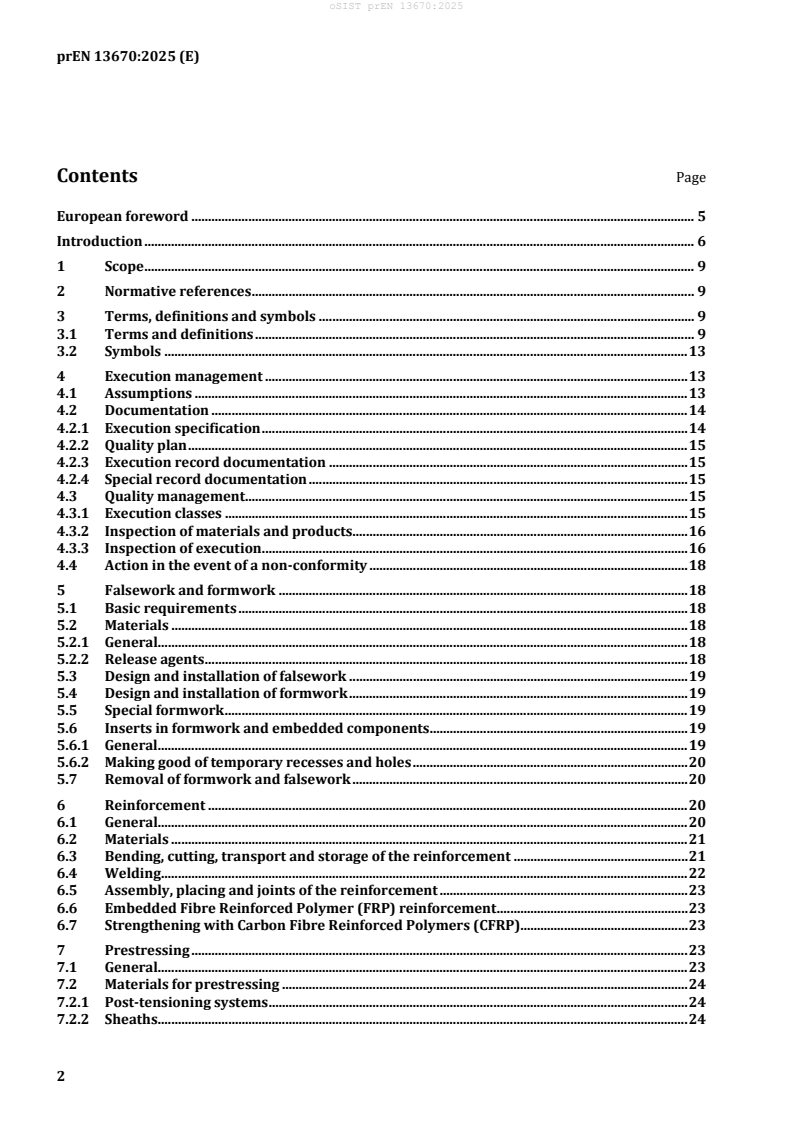
Contents Page
European foreword . 5
Introduction . 6
1 Scope . 9
2 Normative references . 9
3 Terms, definitions and symbols . 9
3.1 Terms and definitions . 9
3.2 Symbols . 13
4 Execution management . 13
4.1 Assumptions . 13
4.2 Documentation . 14
4.2.1 Execution specification . 14
4.2.2 Quality plan . 15
4.2.3 Execution record documentation . 15
4.2.4 Special record documentation . 15
4.3 Quality management . 15
4.3.1 Execution classes . 15
4.3.2 Inspection of materials and products . 16
4.3.3 Inspection of execution . 16
4.4 Action in the event of a non-conformity . 18
5 Falsework and formwork . 18
5.1 Basic requirements . 18
5.2 Materials . 18
5.2.1 General. 18
5.2.2 Release agents . 18
5.3 Design and installation of falsework . 19
5.4 Design and installation of formwork . 19
5.5 Special formwork . 19
5.6 Inserts in formwork and embedded components. 19
5.6.1 General. 19
5.6.2 Making good of temporary recesses and holes . 20
5.7 Removal of formwork and falsework . 20
6 Reinforcement . 20
6.1 General. 20
6.2 Materials . 21
6.3 Bending, cutting, transport and storage of the reinforcement . 21
6.4 Welding . 22
6.5 Assembly, placing and joints of the reinforcement . 23
6.6 Embedded Fibre Reinforced Polymer (FRP) reinforcement . 23
6.7 Strengthening with Carbon Fibre Reinforced Polymers (CFRP). 23
7 Prestressing . 23
7.1 General. 23
7.2 Materials for prestressing . 24
7.2.1 Post-tensioning systems . 24
7.2.2 Sheaths . 24
7.2.3 Tensile elements . 24
7.2.4 Anchorage elements and accessories . 25
7.2.5 Tendon supports . 25
7.2.6 Cement-based grout . 25
7.2.7 Grease, wax or other products . 25
7.3 Transport and storage . 25
7.4 Installation of tendons . 25
7.4.1 General . 25
7.4.2 Pre-tensioned tendons . 26
7.4.3 Post-tensioned bonded tendons . 26
7.4.4 Internal and external unbonded tendons . 26
7.5 Tensioning . 26
7.5.1 General . 26
7.5.2 Pre-tensioned tendons . 27
7.5.3 Post-tensioned bonded tendons . 27
7.5.4 Internal and external unbonded tendons . 27
7.6 Protective measures (grouting, greasing) . 27
7.6.1 General . 27
7.6.2 Pre-tensioned tendons . 27
7.6.3 Post-tensioned bonded tendons . 27
7.6.4 Internal or external unbonded tendons . 27
7.6.5 Grouting operations . 28
7.6.6 Greasing operations. 28
7.6.7 Sealing . 28
8 Concreting . 28
8.1 General . 28
8.2 Specification of concrete . 28
8.3 Pre-concreting operations . 29
8.4 Delivery, reception and site transport of fresh concrete . 29
8.5 Placing and compaction . 30
8.5.1 General . 30
8.5.2 Lightweight aggregate concrete . 30
8.5.3 Self-compacting concrete . 30
8.5.4 Sprayed concrete . 30
8.5.5 Slipforming . 31
8.5.6 Underwater concreting . 31
8.5.7 SFRC . 31
8.6 Curing and protection . 31
8.7 Post-concreting operations . 32
8.8 Concreting of composite structures . 33
8.9 Surface Finish . 33
9 Execution with precast concrete elements . 33
9.1 General . 33
9.2 Factory produced precast elements . 33
9.3 Site manufactured precast elements . 33
9.4 Handling and storage . 33
9.4.1 General . 33
9.4.2 Handling . 33
9.4.3 Storage . 34
9.5 Placing and adjustment . 34
9.5.1 General . 34
9.5.2 Placing . 34
9.6 Jointing and completion of construction works . 34
9.6.1 General. 34
9.6.2 In situ construction works . 34
9.6.3 Structural connections . 35
10 Geometrical tolerances . 35
10.1 General. 35
10.2 Reference system . 36
10.3 Base supports (foundations) . 36
10.4 Columns and walls . 37
10.5 Beams and slabs . 38
10.6 Sections . 38
10.7 Surfaces and edge straightness . 40
10.8 Tolerances for holes and inserts . 40
Annex A (informative) Guidance on documentation. 41
Annex B (informative) Guidance on quality management . 48
Annex C (informative) Guidance on falsework and formwork . 50
Annex D (informative) Guidance on reinforcement . 52
Annex E (informative) Guidance on prestressing . 54
Annex F (informative) Guidance on concreting . 57
Annex G (informative) Guidance on geometrical tolerances . 64
Annex H (informative) Strengthening of Existing Concrete Structures with FRP . 71
Bibliography . 75
European foreword
This document (prEN 13670:2025) has been prepared by Technical Committee CEN/TC 104 “Concrete
and related products”, the secretariat of which is held by SN.
This document is currently submitted to the CEN Enquiry.
This document will supersede EN 13670:2009.
a) Annex H has been removed and replaced with Clause 0.2 “Provisions valid in the place of use for
EN 13670”;
b) The main text has been updated on FRP, CFRP and SFRC;
c) Annex F has been updated on SFRC;
d) New Annex H on “Strengthening of Existing Concrete Structures with FRP“ has been added;
e) General updates to align with revised EN 1992-1-1:2023;
f) General updates to align with the forthcoming prEN 206-1;
Because of the close connection between design rules and rules for execution, CEN/TC 104/SC 2 has
developed this document in liaison with CEN/TC 250/SC 2, and CEN TC 229.
Introduction
0.1 Introduction to EN 13670
(1) This document applies to the execution of concrete structures to achieve the intended level of
safety and serviceability during its service life, as given by EN 1990, Eurocode – Basis of structural
design, EN 1992, Eurocode 2 – Design of concrete structures and EN 1994, Eurocode 4 – Design of
composite steel and concrete structures, with the Nationally Determined Parameters (NDPs) applicable
in the place of use.
(2) This document has three functions:
a) to transfer the requirements set during design to the constructor i.e. to be a link between design
and execution;
b) to give a set of standardized technical requirements for the execution when ordering a concrete
structure;
c) to serve as a check list to ensure that the designer provides the constructor with all relevant
technical information for the execution of the structure (see Annex A).
(3) In order to achieve these objectives, the design should result in a set of documents and drawings
giving all information required for the execution of the construction work in accordance with the plans.
This set of documents is, in this document, referred to as the “execution specification”. This document
leaves a number of items open to be decided in the execution specification.
(4) In areas where national provisions apply, these should be referred to in the execution specification.
(5) It is recognized in this document that areas such as detailed requirements for competence of
personnel, and details related to the Quality Management are within the competence of the Member
States.
(6) If the national CEN member publishes a National Annex to this document, it may refer to national
standards approved and published by the CEN member or national provisions, which supplement this
document. Alternatively, the supplementing rules can be given directly in the National Annex.
(7) A detailed overview of the system of European Standards related to concrete construction works is
shown in Figure 1.
Figure 1 — System of European Standards as basis for design, execution and materials selection
for concrete construction works (only main modules)
(8) Supplementing requirements are given in some member states when using, for example:
a) lightweight aggregate concrete;
b) other materials (e.g. fibres, ultra-high performance concrete) or constituent materials;
c) special technologies/innovative designs.
0.2 Provisions valid in the place of use for EN 13670
(1) National choice is allowed in this document where explicitly stated that provisions valid in the place
of use may be given.
(2) The national standard implementing EN 13670 can have a National Annex or complementary
standard containing all national choices to be used in the relevant country.
(3) National choice is allowed in EN 13670 in the following:
4.1 (4) 4.2.1 (2) 4.2.2 (1) 4.2.4 (1)
4.3.1 (7) 4.3.2 (1) 4.3.3 (1) 4.4 (3)
5.1 (3) 5.2.2 (1) 5.3 (1) 5.4 (1)
5.4 (6) 5.7(1) 6.2 (1) NOTE 6.2 (2)
6.2 (3) 6.2 (6) 6.3 (1) b) 6.3 (1) c)
6.3 (2) 6.3 (3) 6.3 (5) 6.4 (1)
6.4 (2) 6.4 (3) 6.5 (1) 6.5 (2)
7.1 (2) 7.2.1 (1) 7.2.3 (1) 7.2.3 (2)
7.3 (1) 7.4.1 (1) 7.4.1 (3) 7.4.1 (4)
7.4.4 (1) 7.5.1 (2) 7.5.1 (7) 7.5.2 (1)
7.5.3 (1) 7.6.1 (5) 8.3 (1) 8.3 (4)
8.3 (7) 8.3 (10) 8.3 (11) 8.4 (4)
8.4 (6) 8.4 (7) 8.5.1 (1) 8.5.1 (3)
8.5.1 (4) 8.5.1 (5) 8.5.1 (6) 8.5.4 (1)
8.5.5 (2) 8.5.6 (1) 8.6 (9) 8.6 (10)
8.6 (15) 8.6 (18) 8.9 (1) 9.4.1 (1)
9.4.1 (3) 9.6.3 (1) 10.1 (3) 10.1 (5)
10.1 (6) 10.1 (7) 10.1 (8) 10.1 (11)
10.2 (3) 10.6 (3) B.4.3.1 (4) B.4.3.3 (3) c)
E.7.6.1
(1) National choice is allowed in EN 13670 on the application of the following informative annexes:
Annex A Annex B Annex C Annex D
Annex E Annex F Annex G Annex H
NOTE The National Annex can contain, directly or by reference, non-contradictory complementary
information for ease of implementation, provided it does not alter any provisions of this document.
1 Scope
(1) This document gives common requirements for execution of concrete structures, it applies to both
in situ construction works and use of prefabricated concrete elements.
(2) This document expects the execution specification to state all the specific requirements relevant to
the particular structure.
(3) This document is applicable to permanent as well as temporary concrete structures.
(4) This document does not apply to concrete members used only as equipment or construction aids for
the execution.
(5) This document does not cover the specification, production and conformity of concrete.
(6) This document is not applicable to the production of precast concrete elements made in accordance
with product standards.
(7) This document does not cover safety and health aspects of execution, or third-party safety
requirements.
(8) This document does not cover contractual issues or responsibilities for the identified actions.
2 Normative references
The following documents are referred to in the text in such a way that some or all of their content
constitutes requirements of this document. For dated references, only the edition cited applies. For
undated references, the latest edition of the referenced document (including any amendments) applies.
prEN 206-1, Concrete - Specification, performance, production and conformity - Part 1: Performance,
requirements, factory production control and assessment criteria for individual values
EN 446, Grout for prestressing tendons - Grouting procedures
EN 447, Grout for prestressing tendons - Basic requirements
EN 523, Steel strip sheaths for prestressing tendons - Terminology, requirements, quality control
EN 10080, Steel for the reinforcement of concrete - Weldable reinforcing steel - General
EN ISO 17660-1, Welding - Welding of reinforcing steel - Part 1: Load-bearing welded joints (ISO 17660-1)
EN 17678-1, Installation of post-tensioning kits for prestressing of structures - Part 1: Competence of
personnel
3 Terms, definitions and symbols
3.1 Terms and definitions
For the purposes of this document, the following terms and definitions apply.
3.1.1
backpropping
propping installed at levels below the slab that supports the falsework in order to distribute the load to
suitable support
3.1.2
chair
device used to secure the position between reinforcement layers e.g. supporting top reinforcement in a
slab
3.1.3
construction works
everything that is constructed or results from construction operations
[SOURCE: EN 1990]
Note 1 to entry: The term covers both building and civil engineering works. It refers to the complete construction
works comprising structural and non-structural and geotechnical elements.
3.1.4
constructor
organization executing the construction works
3.1.5
erection documentation
documents covering all drawings, technical data and requirements required for the safe erection of
precast elements
3.1.6
execution
all activities carried out for the physical completion of the construction work, i.e. procurement,
scaffolding, formwork, reinforcing, concreting, curing, erection of precast elements etc., and the
inspection and documentation thereof
3.1.7
execution class
classified set of requirements specified for the execution of the construction works as a whole or an
individual component
3.1.8
execution specification
documents covering all drawings, technical data and requirements necessary for the execution of a
particular project
Note 1 to entry: The execution specification is not one document but signifies the total sum of documents
required for the execution of the construction work as provided by the designer to the constructor. It includes the
project specification prepared to supplement and qualify the requirements of this document, as well as referring
to the national provisions relevant in the place of use.
3.1.9
falsework
temporary support for a part of a structure while it is not self-supporting and for associated service
load
3.1.10
formwork
structure, permanent or temporary, for containing poured concrete, moulding it to the required
dimensions and supporting it until it is able to support itself
Note 1 to entry: Formwork consists of the face contact material and the bearers directly supporting the face
contact material.
3.1.11
inspection
conformity evaluation by observation and judgement accompanied as appropriate by measurement,
testing or gauging
[EN ISO 9000:2005, 3.8.2]
3.1.12
method statement
documentation describing the methods and procedures to be used to perform the work
3.1.13
permitted deviation
permitted algebraic differences between the limits of size and the corresponding reference size
[SOURCE: ISO 1803:1997, 3.8, modified – ]
3.1.14
precast concrete element
concrete element cast and cured in a place other than the final location of use (factory produced or site
manufactured)
Note 1 to entry: Precast concrete element manufactured in compliance with relevant European product standard
is called precast concrete product.
Note 2 to entry: In this document the shorter terms “precast element” and “precast product” are used.
3.1.15
project specification
project specific document describing the requirements applicable for the particular project
3.1.16
quality plan
document specifying which procedures and associated resources shall be applied by whom and when to
a specific project, product, process or contract
[SOURCE: EN ISO 9000:2005, 3.7.5]
Note 1 to entry: Guidance might be found in EN ISO 9000 concerning the content of a quality plan.
3.1.17
reference line
line defined in the execution specification to which positions are related
3.1.18
secondary line
line used for the purpose of setting-out the proposed building and for checking and compliance of the
building or building parts
[SOURCE: ISO 4463-1:1989, 4.4]
3.1.19
spacer
device used to secure correct spacing between the formwork and the reinforcement
3.1.20
Steel Fibre Reinforced Concrete
SFRC
concrete to which steel fibres are included into the concrete matrix to achieve post cracking residual
strength
[SOURCE: EN 1992-1-1:2023, 3.1.111]
3.1.21
Carbon Fibre Reinforced Polymer
CFRP
fibre-polymer composite material comprising industrially manufactured carbon fibres embedded in a
polymer matrix
[SOURCE: EN 1992-1-1:2023, 3.1.102]
3.1.22
Carbon Fibre Reinforced Polymer (CFRP) System
composite comprising carbon fibres with an accompanying adhesive material that is bonded to an
adequately prepared concrete strata for the purpose of strengthening a structural concrete component
[SOURCE: EN 1992-1-1:2023, 3.1.103]
3.1.23
Fibre Reinforced Polymer
FRP
fibre-polymer composite material comprising industrially manufactured fibres embedded in a polymer
matrix
[SOURCE: EN 1992-1-1:2023, 3.1.116]
3.1.24
fibre reinforced polymer (FRP) reinforcement
assembly of profiled or roughened fibre reinforced polymer reinforcement bars, embedded in or
connected to concrete members
[SOURCE: EN 1992-1-1:2023, 3.1.117]
3.1.25
surface finish
description of the appearance of the concrete surface including aspects of geometry, texture, colour etc
3.1.26
temporary structure
structure designed for a short design working life
3.1.27
tolerance
difference between upper limit of size and the lower limit of size
[ISO 1803:1997, 3.11]
Note 1 to entry: Geometrical tolerances for precast concrete elements are subdivided as follows:
a) production tolerances as defined in the product standards;
b) erection tolerances i.e. geometrical tolerances relating to location, verticality, horizontality or other
characteristics of the construction assembly;
c) construction tolerances i.e. geometrical tolerances that are a combination of production, site construction and
erection tolerances.
Note 2 to entry: Tolerance is an absolute value without sign, it is however commonly expressed by “the sum of
the ± permitted deviation” so that the value of the tolerance is implicit.
3.1.28
normal tolerances
basic limits for geometrical deviations that ensures that the structure:
a) satisfies the design assumptions;
b) achieves other functional requirements of the construction works.
Note 1 to entry: In this document, normal tolerances are referred to as tolerance class 1.
3.1.29
special tolerances
other tolerances than normal tolerances
3.2 Symbols
For the purposes of this document, the following symbols apply.
D smallest value of the upper sieve size D in an aggregate for the coarsest fraction of
lower
aggregates in the concrete permitted by the specification of concrete [EN 206]
D declared value of the upper sieve size D of the coarsest fraction of aggregates actually used
max
in the concrete [EN 206]
D largest value of the upper sieve size D in an aggregate for the coarsest fraction of
upper
aggregates in the concrete permitted by the specification of concrete [EN 206]
4 Execution management
4.1 Assumptions
(1) This document assumes:
a) the availability of a comprehensive design of the structure;
b) a project management in charge of the supervision of the construction works which will enable the
execution of a conforming structure;
c) a site management which will take charge of the organization of the construction works and enable
the correct and safe use of the equipment and machinery, the required quality of materials, the
execution of a conforming structure and its safe use up to the delivery of the construction works.
(2) When precast elements are used, the following additional assumptions are made:
a) the availability of a specific design of the precast elements conforming to the relevant standards;
b) the availability of a design coordination between precast elements and site manufactured
components;
c) a technical specification of the precast structure with instructions for installation;
d) there is an erection management to direct the erection team.
(3) This document presupposes that the construction work is carried out with the necessary skill and
adequate equipment and resources to perform the work in accordance with this document and the
requirements of the execution specification.
(4) Provisions valid in the place of use may give additional provisions on knowledge, training and
experience of personnel involved in the various tasks.
(5) It is assumed that the constructor will comply with national regulations and standards e.g. with
respect to:
a) quality management;
b) qualifications for the personnel doing the various activities covered by this document;
c) health and safety aspects of construction;
d) environmental aspects.
(6) This document assumes that the structure after completion is used as intended in the design and
submitted to the planned inspection and maintenance necessary to achieve the intended design
working life and to detect weaknesses or any unexpected behaviour.
4.2 Documentation
4.2.1 Execution specification
(1) Before commencement of execution of any part of the construction works, the execution
specification relevant to that part of the construction works shall be complete and available.
(2) The following items shall be included in the execution specification (additional items may be given
in provisions valid in the place of use):
a) a reference to this document and, if published, and its National Annex;
b) a reference to other relevant European standards and ETAs;
c) a reference to relevant national regulations and standards;
d) a project specification giving information and requirements for the particular project prepared to
supplement and qualify the requirements of the above listed documents;
e) drawings and other technical documents needed for the execution.
NOTE Informative Annex A, Table A.1 contains a checklist of requirements and information that, as
appropriate, can be included in the execution specification.
(3) In addition, where relevant procedures shall be established for:
a) making alterations to previously agreed requirements;
b) the distribution, the filing and recording of technical documents used for the construction works.
4.2.2 Quality plan
(1) Where a quality plan is required by the execution specification, it shall be available at site.
Provisions valid in the place of use may give requirements for when a quality plan should be required
and its contents.
(2) There may be one quality plan covering all activities or one overall plan supplemented by separate
plans for the various phases and activities to be performed.
4.2.3 Execution record documentation
(1) A record shall be made giving the required information as specified for the execution class in Tables
1, 2 and 3.
4.2.4 Special record documentation
(1) If special documentation is required, the type and extent of the documentation shall be stated in the
execution specification. Provisions valid in the place of use may give requirements for when special
documentation is required and its contents.
4.3 Quality management
4.3.1 Execution classes
(1) Supervision and inspection of the construction work shall ensure that the construction is completed
in accordance with the execution specification.
(2) Inspection in this context refers to verifying conformity of the properties of products and materials
to be used as well as inspection of the execution of the construction works.
(3) Requirements for quality management are specified using one of the following 3 classes, for which
the required strictness increases from class 1 to class 3:
a) execution class 1;
b) execution class 2;
c) execution class 3.
(4) The execution class may refer to the complete structure, to components of the structure or to
certain materials/technologies used for the execution.
(5) The execution class(es) to be used shall be stated in the execution specification.
(6) This document does not deal with provisions related to degree of independence of the personnel
performing the inspection.
(7) Further detailing of the requirements for the quality management regime in excess of what is given
in this document, may be given in the execution specification. Additional provisions may be given in the
place of use.
NOTE Informative Annex B gives guidance on quality management.
4.3.2 Inspection of materials and products
(1) The inspection requirements for conformity with the execution specification are given in Table 1.
Alternative requirements may be given in provisions valid in the place of use.
Table 1 — Inspection for materials and products
Subject Execution class 1 Execution class 2 Execution class 3
1 Materials for scaffold, In accordance with 5.1 and 5.2
a
formwork and falsework
a
2 Reinforcing steel In accordance with 6.2
3 FRP Reinforcement Not to be used in In accordance with 6.2
this class
4 Carbon Fibre Reinforced Not to be used in In accordance with 6.2
Polymers (CFRP) this class
5 Prestressing system Not to be used in In accordance with 7.2
a
components this class
a, c
6 Fresh concrete; In accordance with 8.2 and 8.4
ready-mixed or site-mixed
At reception of ready-mixed concrete a delivery ticket shall
be present
7 Fresh ready-mixed or site- Not to be used in In accordance with 8.4
mixed SFRC for load- this class
carrying concrete members
a, b
8 Other items In accordance with the execution specification
a
9 Precast elements In accordance with 9.2 and 9.3
10 Inspection report Not required Required
a
For products bearing the CE mark the Declaration of Performance and Conformity (DoPC) shall be
assessed against the required performance according to the execution specification. Other products shall be
subject to inspection and assessment as defined in the execution specification to ensure that all requirements
are met. In cases of doubt, further inspection shall be undertaken to check that the product conforms to its
specification.
b
For example, items such as embedded steel components etc.
c
If prescribed concrete is used, the relevant properties are to be checked by tests.
4.3.3 Inspection of execution
(1) The inspection requirements for conformity with the execution specification are given in Table 2
and Table 3. Alternative requirements may be given in provisions valid in the place of use.
Table 2 — Subjects for inspection of execution
Subject Execution Execution Execution
class 1 class 2 class 3
1 Scaffolding, formwork and falsework According to requirements given in 5
2 Embedded items According to requirements given in 5.6
3 Ordinary reinforcement According to requirements given in 6
4 FRP Reinforcement Not to be used According to requirements given
in this class in 6
5 Carbon Fibre Reinforced Polymers Not to be used According to requirements given
(CFRP) in this class in 6
6 Prestressing reinforcement Not to be used According to requirements given
in this class in 7
7 Fresh ready-mixed or site-mixed SFRC Not to be used In accordance with 8.4
for load-carrying concrete m
...