

EN 1176-2:2017
(Main)Playground equipment and surfacing - Part 2: Additional specific safety requirements and test methods for swings
- Abstract
This European Standard specifies additional safety requirements for swings intended for permanent installation for use by children. Where the main play function is not swinging, the relevant requirements in this part of EN 1176 may be used, as appropriate.
NOTE Recommendations on the design and siting of swings are given in Annex A.
- Status
- Withdrawn
- Publication Date
- 17-Oct-2017
- Withdrawal Date
- 06-Oct-2026
- Technical Committee
- CEN/TC 136 - Sports, playground and other recreational equipment
- Drafting Committee
- CEN/TC 136/SC 1 - Playground equipment for children
- Current Stage
- 9960 - Withdrawal effective - Withdrawal
- Start Date
- 23-Oct-2019
- Completion Date
- 07-Oct-2026



Relations
- Effective Date
- 23-Oct-2013
- Effective Date
- 16-Jan-2023
- Effective Date
- 25-Aug-2026
- Effective Date
- 28-Jan-2026
- Effective Date
- 28-Jan-2026
- Effective Date
- 28-Jan-2026
- Effective Date
- 10-Feb-2026
- Effective Date
- 28-Jan-2026
- Effective Date
- 28-Jan-2026
- Effective Date
- 28-Jan-2026
- Effective Date
- 28-Jan-2026
- Effective Date
- 28-Jan-2026
- Effective Date
- 28-Jan-2026
- Effective Date
- 28-Jan-2026
- Referred By
EN 13814-1:2019 - Safety of amusement rides and amusement devices - Part 1: Design and manufacture - Effective Date
- 28-Jan-2026
Frequently Asked Questions
EN 1176-2:2017 is a standard published by the European Committee for Standardization (CEN). Its full title is "Playground equipment and surfacing - Part 2: Additional specific safety requirements and test methods for swings". This standard covers: This European Standard specifies additional safety requirements for swings intended for permanent installation for use by children. Where the main play function is not swinging, the relevant requirements in this part of EN 1176 may be used, as appropriate. NOTE Recommendations on the design and siting of swings are given in Annex A.
This European Standard specifies additional safety requirements for swings intended for permanent installation for use by children. Where the main play function is not swinging, the relevant requirements in this part of EN 1176 may be used, as appropriate. NOTE Recommendations on the design and siting of swings are given in Annex A.
EN 1176-2:2017 is classified under the following ICS (International Classification for Standards) categories: 97.200.40 - Playgrounds. The ICS classification helps identify the subject area and facilitates finding related standards.
EN 1176-2:2017 has the following relationships with other standards: It is inter standard links to EN 1176-2:2008, EN 1176-2:2017+AC:2019, ISO 6487:2015, EN 71-19:2024, EN 1176-1:2017, EN ISO/IEC 17025:2017, CEN/CLC Guide 14:2009, EN 17232:2020, EN 1176-4:2017, CEN/TR 16598:2014, EN 1176-10:2023, EN 1176-5:2019, CEN/TR 16598:2023, CEN/TR 17207:2018, EN 13814-1:2019. Understanding these relationships helps ensure you are using the most current and applicable version of the standard.
EN 1176-2:2017 is available in PDF format for immediate download after purchase. The document can be added to your cart and obtained through the secure checkout process. Digital delivery ensures instant access to the complete standard document.
Standards Content (Sample)
2003-01.Slovenski inštitut za standardizacijo. Razmnoževanje celote ali delov tega standarda ni dovoljeno.Spielplatzgeräte und Spielplatzböden - Teil 2: Zusätzliche besondere sicherheitstechnische Anforderungen und Prüfverfahren für SchaukelnÉquipement et sols d'aires de jeux - Partie 2: Exigences de sécurité et méthodes d'essai complémentaires spécifiques aux balançoiresPlayground equipment and surfacing - Part 2: Additional specific safety requirements and test methods for swings97.200.40,JULãþDPlaygroundsICS:Ta slovenski standard je istoveten z:EN 1176-2:2017SIST EN 1176-2:2018en,fr,de01-januar-2018SIST EN 1176-2:2018SLOVENSKI
STANDARDSIST EN 1176-2:20081DGRPHãþD
EUROPEAN STANDARD NORME EUROPÉENNE EUROPÄISCHE NORM
EN 1176-2
October
t r s y ICS
{ yä t r rä v r Supersedes EN
s s y xæ tã t r r zEnglish Version
Playground equipment and surfacing æ Part
tã Additional specific safety requirements and test methods for swingsÉquipement et sols d 5aires de jeux æ Partie
tã Exigences de sécurité et méthodes d 5essai complémentaires spécifiques aux balançoires
Spielplatzgeräte und Spielplatzböden æ Teil
tã Zusätzliche besondere sicherheitstechnische Anforderungen und Prüfverfahren für Schaukeln This European Standard was approved by CEN on
x August
t r s xä
egulations which stipulate the conditions for giving this European Standard the status of a national standard without any alterationä Upætoædate lists and bibliographical references concerning such national standards may be obtained on application to the CENæCENELEC Management Centre or to any CEN memberä
translation under the responsibility of a CEN member into its own language and notified to the CENæCENELEC Management Centre has the same status as the official versionsä
CEN members are the national standards bodies of Austriaá Belgiumá Bulgariaá Croatiaá Cyprusá Czech Republicá Denmarká Estoniaá Finlandá Former Yugoslav Republic of Macedoniaá Franceá Germanyá Greeceá Hungaryá Icelandá Irelandá Italyá Latviaá Lithuaniaá Luxembourgá Maltaá Netherlandsá Norwayá Polandá Portugalá Romaniaá Serbiaá Slovakiaá Sloveniaá Spainá Swedená Switzerlandá Turkey and United Kingdomä
EUROPEAN COMMITTEE FOR STANDARDIZATION COMITÉ EUROPÉEN DE NORMALISATION EUROPÄISCHES KOMITEE FÜR NORMUNG
CEN-CENELEC Management Centre:
Avenue Marnix 17,
B-1000 Brussels
t r s y CEN All rights of exploitation in any form and by any means reserved worldwide for CEN national Membersä Refä Noä EN
s s y xæ tã t r s y ESIST EN 1176-2:2018
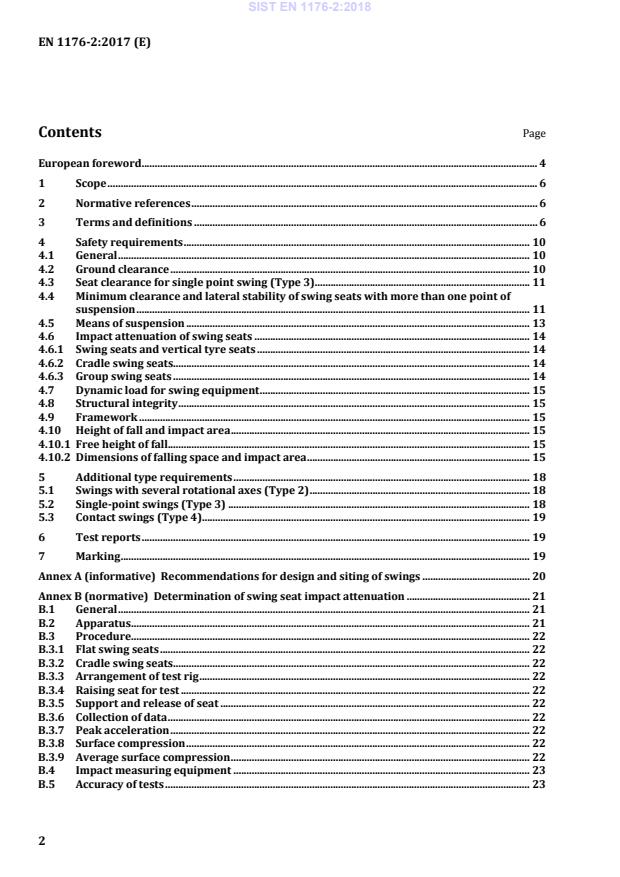
Recommendations for design and siting of swings . 20 Annex B (normative)
Determination of swing seat impact attenuation . 21 B.1 General . 21 B.2 Apparatus . 21 B.3 Procedure. 22 B.3.1 Flat swing seats . 22 B.3.2 Cradle swing seats . 22 B.3.3 Arrangement of test rig . 22 B.3.4 Raising seat for test . 22 B.3.5 Support and release of seat . 22 B.3.6 Collection of data . 22 B.3.7 Peak acceleration . 22 B.3.8 Surface compression . 22 B.3.9 Average surface compression . 22 B.4 Impact measuring equipment . 23 B.5 Accuracy of tests . 23 SIST EN 1176-2:2018
Dynamic load test for suspension systems of swings . 24 C.1 Principle . 24 C.2 Procedure . 24 Bibliography . 25
a) b) Figure 1 — Examples of a swing with one rotational axis (Type 1) 3.3 swing with several rotational axes (Type 2) seat suspended from one or more load bearing cross beams, supported in such a way that it can move at right angles or longitudinally to the cross beams in as horizontal position as practicable Note 1 to entry: See Figure 2.
Figure 2 — Example of a swing with several rotational axes (Type 2) 3.4 single point swing (Type 3) seat or platform with cables or chains that meet at one fixing point so that the swing can move in all directions Note 1 to entry: See Figure 3. SIST EN 1176-2:2018
a) b) Figure 3 — Examples of a single point swings (Type 3) 3.5 contact swing (Type 4) group of seats flexibly suspended individually from load bearing cross beams, which are arranged around a central axis (a centre point), typically six in number Note 1 to entry: See Figure 4.
Key 1 central axis Figure 4 — Example of a contact swing (Type 4) 3.6 swing height distance between the middle of the fulcrum of the suspension and the playing surface Note 1 to entry: See Figure 5. SIST EN 1176-2:2018
Key 1 rotational axis h1 swing height h2 length of swing suspension member (h1-h3) h3 height of seat h4 ground clearance Figure 5 — Height dimensions 3.9 ground clearance distance between the specified under-part of the seat and the playing surface Note 1 to entry: The measurement position depends on seat type, see 4.2. 3.10 seat clearance distance between the lower edge of the seat and any obstacle adjacent to the path of the swing Note 1 to entry: See Figure 6. SIST EN 1176-2:2018
Key h5 seat clearance Figure 6 — Example of a Type 3 swing showing seat clearance 3.11 flat swing seat seat without back and side protections 3.12 cradle swing seat seat provided with greater body support for younger or less able users, typically designed so that the user cannot slip through the constructional parts surrounding the seat 3.13 group swing seat seat with a large surface area intended for several users, typically nest or basket swing seats, single point swing seats, tyre seats, and swinging beds 4 Safety requirements 4.1 General Swings shall conform to EN 1176-1 unless otherwise specified in this part of EN 1176. 4.2 Ground clearance The minimum ground clearance for single-use swings (see Figures 5 and 6) at rest position shall be 350 mm. For group swing seats, the minimum ground clearance at rest position shall be 400 mm. For group swing seats with a flexible lower part the ground clearance shall be a minimum of 400 mm measured from the underside of the rigid part of the seat in its most onerous position (see Figure 7). SIST EN 1176-2:2018
Key 1 rigid part 2 flexible part h4 ground clearance Figure 7 — Ground Clearance 4.3 Seat clearance for single point swing (Type 3) The seat clearance (see Figure 6) shall be at least 400 mm except in the direction of the beam on which the suspension is fixed. If during use, the side of the swing seat can come into contact with the swing frame, then protective material may be fitted to the frame at this point to protect the beam and the seat. NOTE The design of Type 3 swings permits a deviation from the free space requirement in EN 1176–1 because the hazard of colliding with the beam is readily foreseeable and the benefit to children of playing on swings o
...