

CEN/TS 15676:2007
(Main)Wood flooring - Slip resistance - Pendulum test
- Abstract
This Technical Specification specifies the method of applying the pendulum test to wood flooring, in order to determine the slip resistance.
- Status
- Published
- Publication Date
- 20-Nov-2007
- Technical Committee
- CEN/TC 175 - Round and sawn timber
- Drafting Committee
- CEN/TC 175/WG 33 - Specific user requirements - Timber in flooring
- Current Stage
- 9093 - Decision to confirm - Review Enquiry
- Start Date
- 20-May-2025
- Completion Date
- 07-Oct-2026


Overview - CEN/TS 15676:2007 (Wood flooring - Slip resistance - Pendulum test)
CEN/TS 15676:2007 is a European Technical Specification that defines how to apply the pendulum friction (pendulum) test to wood flooring to determine slip resistance. It specifies the test principle, required apparatus, slider properties, sampling, conditioning, test procedure, calculation and reporting. The document is intended for assessing the frictional behaviour of wood flooring surfaces under dry conditions (with an informative annex for wet testing).
Key topics and technical requirements
- Test principle: Use a spring-loaded rubber slider on a pendulum arm; reduction in swing length is read on a calibrated scale (C scale) to give a pendulum test value.
- Apparatus features:
- Pendulum arm mass: 1.50 ± 0.03 kg; centre of gravity at 410 ± 5 mm from suspension.
- Slider dimensions: 76.2 ± 0.5 mm wide, 25.4 ± 1.0 mm long, 6.4 ± 0.5 mm thick; combined mass 32 ± 5 g.
- Slider angle at lowest swing: 26 ± 3° to horizontal; sliding length nominal 126 ± 1 mm.
- Pointer and circular C scale (0–150) for readings.
- Slider material and conditioning:
- Resilience and hardness limits provided; hardness measured by IRHD (ISO 48) and resilience by rebound test (ISO 4662).
- Sliders must be certified, stored 5–20 °C, conditioned by five swings on a high-friction surface before use.
- Discard slider if striking edge width > 3 mm or IRHD out of range (or after three years from manufacture).
- Sampling and conditioning:
- Representative sample of 10 specimens from the same surface family.
- Specimens sized to allow a test area of 136 × 86 mm.
- Condition specimens 2 weeks at 23 ± 2 °C and 50 ± 5 % RH.
- Procedure and reporting:
- Perform three swings per specimen, average the three readings.
- Slip resistance is the mean pendulum value across the 10 specimens (nearest 1 unit).
- Annual apparatus recalibration is required.
- Test report must include lab and client details, sample ID, conditioning, mean values and any deviations from the method.
- Wet testing: Annex A describes repeating the same procedure with the specimen and slider wetted and rewet between each of three swings.
Applications and intended users
This Technical Specification is practical for:
- Wood flooring manufacturers validating product slip resistance for safety and marketing.
- Independent testing laboratories performing standardized pendulum tests.
- Architects, specifiers and facility managers evaluating flooring for pedestrian safety in public and commercial buildings.
- Health & safety officers and building code assessors assessing floor slip risk under dry and wet conditions.
Keywords: wood flooring slip resistance, pendulum test, pendulum friction test, CEN/TS 15676:2007, slider IRHD, flooring safety, slip resistance testing.
Related standards
- EN 13756:2002 (Wood flooring - Terminology)
- ISO 7619-2 (IRHD pocket meter method)
- ISO 48, ISO 4662 (rubber hardness and resilience tests)
Relations
- Effective Date
- 25-Aug-2026
- Effective Date
- 28-Jan-2026
- Effective Date
- 28-Jan-2026
- Effective Date
- 28-Jan-2026
- Referred By
EN 14342:2005+A1:2008 - Wood flooring - Characteristics, evaluation of conformity and marking - Effective Date
- 28-Jan-2026
- Referred By
EN 14342:2013 - Wood flooring and parquet - Characteristics, evaluation of conformity and marking - Effective Date
- 28-Jan-2026
Get Certified
Connect with accredited certification bodies for this standard

Gozdarski inštitut Slovenije
Slovenian Forestry Institute. Forest management certification support, timber testing.
Sponsored listings
Frequently Asked Questions
CEN/TS 15676:2007 is a technical specification published by the European Committee for Standardization (CEN). Its full title is "Wood flooring - Slip resistance - Pendulum test". This standard covers: This Technical Specification specifies the method of applying the pendulum test to wood flooring, in order to determine the slip resistance.
This Technical Specification specifies the method of applying the pendulum test to wood flooring, in order to determine the slip resistance.
CEN/TS 15676:2007 is classified under the following ICS (International Classification for Standards) categories: 79.080 - Semi-manufactures of timber; 97.150 - Floor coverings. The ICS classification helps identify the subject area and facilitates finding related standards.
CEN/TS 15676:2007 has the following relationships with other standards: It is inter standard links to ISO 7619-2:2004, EN 13756:2002, EN 15534-1:2014+A1:2017, EN 15534-1:2014, EN 14342:2005+A1:2008, EN 14342:2013. Understanding these relationships helps ensure you are using the most current and applicable version of the standard.
CEN/TS 15676:2007 is available in PDF format for immediate download after purchase. The document can be added to your cart and obtained through the secure checkout process. Digital delivery ensures instant access to the complete standard document.
Standards Content (Sample)
SLOVENSKI STANDARD
01-april-2008
Lesene talne obloge - Odpornost proti zdrsu - Preskus z nihalom
Wood flooring - Slip resistance - Pendulum test
Holzfußböden - Gleitwiderstand - Pendelprüfung
Plancher en bois - Résistance a la glissance - Essai au pendule
Ta slovenski standard je istoveten z: CEN/TS 15676:2007
ICS:
79.080
97.150
2003-01.Slovenski inštitut za standardizacijo. Razmnoževanje celote ali delov tega standarda ni dovoljeno.
TECHNICAL SPECIFICATION
CEN/TS 15676
SPÉCIFICATION TECHNIQUE
TECHNISCHE SPEZIFIKATION
November 2007
ICS 97.150
English Version
Wood flooring - Slip resistance - Pendulum test
Plancher en bois - Résistance à la glissance - Essai au Holzfußböden - Gleitwiderstand - Pendelprüfung
pendule
This Technical Specification (CEN/TS) was approved by CEN on 27 October 2007 for provisional application.
The period of validity of this CEN/TS is limited initially to three years. After two years the members of CEN will be requested to submit their
comments, particularly on the question whether the CEN/TS can be converted into a European Standard.
CEN members are required to announce the existence of this CEN/TS in the same way as for an EN and to make the CEN/TS available
promptly at national level in an appropriate form. It is permissible to keep conflicting national standards in force (in parallel to the CEN/TS)
until the final decision about the possible conversion of the CEN/TS into an EN is reached.
CEN members are the national standards bodies of Austria, Belgium, Bulgaria, Cyprus, Czech Republic, Denmark, Estonia, Finland,
France, Germany, Greece, Hungary, Iceland, Ireland, Italy, Latvia, Lithuania, Luxembourg, Malta, Netherlands, Norway, Poland, Portugal,
Romania, Slovakia, Slovenia, Spain, Sweden, Switzerland and United Kingdom.
EUROPEAN COMMITTEE FOR STANDARDIZATION
COMITÉ EUROPÉEN DE NORMALISATION
EUROPÄISCHES KOMITEE FÜR NORMUNG
Management Centre: rue de Stassart, 36 B-1050 Brussels
© 2007 CEN All rights of exploitation in any form and by any means reserved Ref. No. CEN/TS 15676:2007: E
worldwide for CEN national Members.
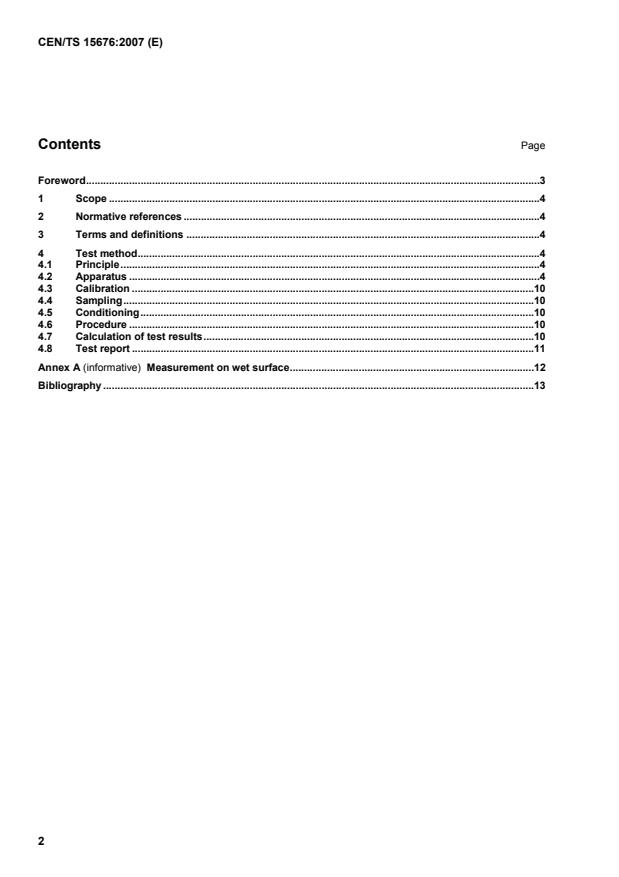
Contents Page
Foreword.3
1 Scope.4
2 Normative references.4
3 Terms and definitions .4
4 Test method.4
4.1 Principle.4
4.2 Apparatus.4
4.3 Calibration.10
4.4 Sampling.10
4.5 Conditioning.10
4.6 Procedure.10
4.7 Calculation of test results.10
4.8 Test report.11
Annex A (informative) Measurement on wet surface.12
Bibliography .13
Foreword
This document (CEN/TS 15676:2007) has been prepared by Technical Committee CEN/TC 175 “Round and
sawn timber”, the secretariat of which is held by AFNOR.
Attention is drawn to the possibility that some of the elements of this document may be the subject of patent
rights. CEN [and/or CENELEC] shall not be held responsible for identifying any or all such patent rights.
According to the CEN/CENELEC Internal Regulations, the national standards organizations of the following
countries are bound to announce this Technical Specification: Austria, Belgium, Bulgaria, Cyprus, Czech
Republic, Denmark, Estonia, Finland, France, Germany, Greece, Hungary, Iceland, Ireland, Italy, Latvia,
Lithuania, Luxembourg, Malta, Netherlands, Norway, Poland, Portugal, Romania, Slovakia, Slovenia, Spain,
Sweden, Switzerland and the United Kingdom.
1 Scope
This Technical Specification specifies the method of applying the pendulum test to wood flooring, in order to
determine the slip resistance.
2 Normative references
The following referenced documents are indispensable for the application of this document. For dated
references, only the edition cited applies. For undated references, the latest edition of the referenced
document (including any amendments) applies.
EN 13756:2002, Wood flooring — Terminology
ISO 7619-2, Rubber, vulcanised or thermoplastic — Determination of indentation hardness — Part 2: IRHD
pocket meter method
3 Terms and definitions
For the purposes of this document, the terms and definitions given in EN 13756:2002 apply.
4 Test method
4.1 Principle
The measurement of slip resistance on the specimen is made using the pendulum friction test equipment to
evaluate the frictional properties of the specimen on the upper face.
The pendulum friction test equipment incorporates a spring loaded slider made of a standard rubber attached
to the end of the pendulum. On swinging the pendulum the frictional force between the slider and test surface
is measured by the reduction in length of the swing using a calibrated scale.
Due to the intended uses of the wood flooring the measurement is carried out on dried surface (see Annex A
for wet measurement).
4.2 Apparatus
4.2.1 The pendulum friction test equipment shall be manufactured as show in Figure 1. All bearings and
working parts shall be enclosed as far as possible.
Key
1 C scale (126 mm sliding length) 6 levelling screw
2 F scale (76 mm sliding length) 7 test specimen holder
3 pointer 8 spirit level
4 pendulum 9 vertical adjustment screw
5 rubber slider
Figure 1 — Pendulum friction test equipment
4.2.2 The pendulum test equipment shall have the following features:
1) a spring loaded rubber coated slider as specified in 4.2.4 to 4.2.10. It shall be mounted on the end of
a pendulum arm so that the sliding edge is (510 ± 1) mm from the axis of suspension;
2) means of setting the support column of the equipment vertical;
3) a base of sufficient mass to ensure the equipment remains stable during the test;
4) means of raising and lowering of suspension of the pendulum arm so that the slider can:
...