

EN 12467:2012
(Main)Fibre-cement flat sheets - Product specification and test methods
- Abstract
This European Standard specifies the technical requirements and establishes methods of inspection and test as well as acceptance conditions for fibre-cement flat sheets, siding shingles and planks (referred to as sheets later in this document) for one or more of the following uses:
- internal wall and ceiling finishes;
- external wall and ceiling finishes.
Products covered by this European Standard can be used for other purposes provided they comply with the relevant application standard, e.g. rigid underlays.
This European Standard covers sheets reinforced with fibres of different types as specified in 5.1.1.
This European Standard does not cover sheets for fire protection purposes.
This European Standard does not include calculations with regard to works, design requirements, installation techniques, wind uplift or rain proofing of the installed sheets.
- Status
- Withdrawn
- Publication Date
- 18-Sep-2012
- Withdrawal Date
- 06-Oct-2026
- Technical Committee
- CEN/TC 128 - Roof covering products for discontinuous laying and products for wall cladding
- Drafting Committee
- CEN/TC 128/SC 4 - Fibre cement products for roofing
- Current Stage
- 9960 - Withdrawal effective - Withdrawal
- Start Date
- 06-Jul-2016
- Completion Date
- 07-Oct-2026
- Directive
- 305/2011 - Regulation (eu) No 305/2011 of the European Parliament and of the Council of 9 march 2011 laying down harmonised conditions for the marketing of construction products and repealing council directive 89/106/eecOJ Ref: C, C 259 OJ Date: 08-Aug-2014
89/106/EEC - Construction productsOJ Ref: C, C 59 OJ Date: 28-Feb-2013


Relations
- Effective Date
- 26-Sep-2012
- Effective Date
- 26-Sep-2012
- Effective Date
- 26-Sep-2012
- Merged Into
EN 12467:2012+A1:2016 - Fibre-cement flat sheets - Product specification and test methods - Effective Date
- 18-Jan-2023
- Effective Date
- 25-Aug-2026
- Effective Date
- 25-Aug-2026
- Effective Date
- 25-Aug-2026
- Effective Date
- 28-Jan-2026
- Effective Date
- 28-Jan-2026
- Effective Date
- 28-Jan-2026
- Effective Date
- 28-Jan-2026
- Effective Date
- 28-Jan-2026
- Effective Date
- 28-Jan-2026
- Effective Date
- 28-Jan-2026
- Amended By
EN 12467:2012/FprA1:2015 - Fibre-cement flat sheets - Product specification and test methods - Effective Date
- 16-Jul-2014
Get Certified
Connect with accredited certification bodies for this standard

DIBt (Deutsches Institut für Bautechnik)
German Institute for Building Technology.
DIN CERTCO
DIN Group product certification.

Aboma Certification B.V.
Specialized in construction, metal, and transport sectors.
Sponsored listings
Frequently Asked Questions
EN 12467:2012 is a standard published by the European Committee for Standardization (CEN). Its full title is "Fibre-cement flat sheets - Product specification and test methods". This standard covers: This European Standard specifies the technical requirements and establishes methods of inspection and test as well as acceptance conditions for fibre-cement flat sheets, siding shingles and planks (referred to as sheets later in this document) for one or more of the following uses: - internal wall and ceiling finishes; - external wall and ceiling finishes. Products covered by this European Standard can be used for other purposes provided they comply with the relevant application standard, e.g. rigid underlays. This European Standard covers sheets reinforced with fibres of different types as specified in 5.1.1. This European Standard does not cover sheets for fire protection purposes. This European Standard does not include calculations with regard to works, design requirements, installation techniques, wind uplift or rain proofing of the installed sheets.
This European Standard specifies the technical requirements and establishes methods of inspection and test as well as acceptance conditions for fibre-cement flat sheets, siding shingles and planks (referred to as sheets later in this document) for one or more of the following uses: - internal wall and ceiling finishes; - external wall and ceiling finishes. Products covered by this European Standard can be used for other purposes provided they comply with the relevant application standard, e.g. rigid underlays. This European Standard covers sheets reinforced with fibres of different types as specified in 5.1.1. This European Standard does not cover sheets for fire protection purposes. This European Standard does not include calculations with regard to works, design requirements, installation techniques, wind uplift or rain proofing of the installed sheets.
EN 12467:2012 is classified under the following ICS (International Classification for Standards) categories: 91.100.40 - Products in fibre-reinforced cement. The ICS classification helps identify the subject area and facilitates finding related standards.
EN 12467:2012 has the following relationships with other standards: It is inter standard links to EN 12467:2004/A2:2006, EN 12467:2004/A1:2005, EN 12467:2004, EN 12467:2012+A1:2016, ISO 3951-1:2005, ISO 2602:1980, ISO 2859-1:1999, EN 196-1:1994, EN ISO 1716:2018, EN ISO 12572:2016, EN 13501-1:2018, EN 197-1:2011, EN 13823:2020+A1:2022, EN ISO 8321-1:2002, EN 12467:2012/FprA1:2015. Understanding these relationships helps ensure you are using the most current and applicable version of the standard.
EN 12467:2012 is associated with the following European legislation: EU Directives/Regulations: 305/2011, 89/106/EEC; Standardization Mandates: M/121, M/122. When a standard is cited in the Official Journal of the European Union, products manufactured in conformity with it benefit from a presumption of conformity with the essential requirements of the corresponding EU directive or regulation.
EN 12467:2012 is available in PDF format for immediate download after purchase. The document can be added to your cart and obtained through the secure checkout process. Digital delivery ensures instant access to the complete standard document.
Standards Content (Sample)
2003-01.Slovenski inštitut za standardizacijo. Razmnoževanje celote ali delov tega standarda ni dovoljeno.Faserzement-Tafeln - Produktspezifikation und PrüfverfahrenPlaques planes en fibres-ciment - Spécifications du produit et méthodes d'essaiFibre-cement flat sheets - Product specification and test methods91.100.40YODNQLProducts in fibre-reinforced cementICS:Ta slovenski standard je istoveten z:EN 12467:2012SIST EN 12467:2013en,fr,de01-april-2013SIST EN 12467:2013SLOVENSKI
STANDARDSIST EN 12467:2005/A2:2006SIST EN 12467:2005/A1:2006SIST EN 12467:20051DGRPHãþD
EUROPEAN STANDARD NORME EUROPÉENNE EUROPÄISCHE NORM
EN 12467
September 2012 ICS 91.100.40 Supersedes EN 12467:2004English Version
Fibre-cement flat sheets - Product specification and test methods
Plaques planes en fibres-ciment - Spécifications du produit et méthodes d'essai
Faserzement-Tafeln - Produktspezifikation und Prüfverfahren This European Standard was approved by CEN on 4 August 2012.
CEN members are bound to comply with the CEN/CENELEC Internal Regulations which stipulate the conditions for giving this European Standard the status of a national standard without any alteration. Up-to-date lists and bibliographical references concerning such national standards may be obtained on application to the CEN-CENELEC Management Centre or to any CEN member.
This European Standard exists in three official versions (English, French, German). A version in any other language made by translation under the responsibility of a CEN member into its own language and notified to the CEN-CENELEC Management Centre has the same status as the official versions.
CEN members are the national standards bodies of Austria, Belgium, Bulgaria, Croatia, Cyprus, Czech Republic, Denmark, Estonia, Finland, Former Yugoslav Republic of Macedonia, France, Germany, Greece, Hungary, Iceland, Ireland, Italy, Latvia, Lithuania, Luxembourg, Malta, Netherlands, Norway, Poland, Portugal, Romania, Slovakia, Slovenia, Spain, Sweden, Switzerland, Turkey and United Kingdom.
EUROPEAN COMMITTEE FOR STANDARDIZATION
COMITÉ EUROPÉEN DE NORMALISATION EUROPÄISCHES KOMITEE FÜR NORMUNG
Management Centre:
Avenue Marnix 17,
B-1000 Brussels © 2012 CEN All rights of exploitation in any form and by any means reserved worldwide for CEN national Members. Ref. No. EN 12467:2012: ESIST EN 12467:2013
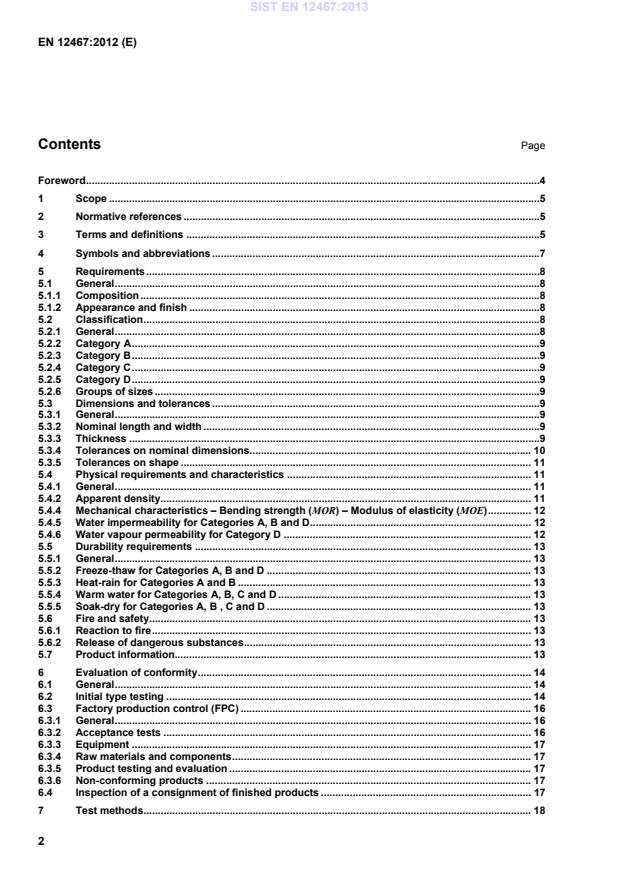
Consignment inspection sampling . 41Annex B (normative)
Statistical method for determining the corresponding wet values or revised dry specifications for the MOR when carrying out the dry method of test or when tested prior to coating for quality control purposes . 42B.1Procedure . 42B.2Determination of the correlation between the results of testing wet and dry specimens . 42B.3Determination of the regression line . 43B.4Determination of a value for wet testing from an obtained value for dry testing . 43B.5Determination of the minimum value specified for dry testing xstd corresponding to the minimum value specified for wet testing in this document ystd. 44Annex C (normative)
Test method for the determination of moisture movement characteristic of fibre-cement sheets . 45C.1General . 45C.2Principle. 45C.3Apparatus . 45C.4Specimen preparation . 45C.5Test procedure . 45C.6Calculation of results . 46C.7Test report . 46Annex ZA (informative)
Clauses of this European Standard addressing the provisions of the EU Construction Products Directive . 47ZA.1Scope and relevant characteristics . 47ZA.2Procedure for the attestation of conformity of fibre cement flat sheets . 48ZA.2.1Systems of attestation of conformity . 48ZA.2.2EC Declaration of conformity . 51ZA.3CE marking . 52Bibliography . 54 SIST EN 12467:2013
This European Standard does not include calculations with regard to works, design requirements, installation techniques, wind uplift or rain proofing of the installed sheets. 2 Normative references The following documents, in whole or in part, are normatively referenced in this document and are indispensable for its application. For dated references, only the edition cited applies. For undated references, the latest edition of the referenced document (including any amendments) applies. EN 197-1, Cement — Part 1: Composition, specifications and conformity criteria for common cements EN 13501-1, Fire classification of construction products and building elements — Part 1: Classification using test data from reaction to fire tests EN 13823, Reaction to fire tests for building products — Building products excluding floorings exposed to the thermal attack by a single burning item EN ISO 1716, Reaction to fire tests for building products — Determination of the gross heat of combustion (calorific value) (ISO 1716) EN ISO 12572, Hygrothermal performance of building materials and products — Determination of water vapour transmission properties (ISO 12572) ISO 2602, Statistical interpretation of test results — Estimation of the mean — Confidence interval ISO 2859-1, Sampling procedures for inspection by attributes — Part 1: Sampling schemes indexed by acceptance quality limit (AQL) for lot-by-lot inspection ISO 3951-1, Sampling procedures for inspection by variables — Part 1: Specification for single sampling plans indexed by acceptance quality limit (AQL) for lot-by-lot inspection for a single quality characteristic and a single AQL 3 Terms and definitions For the purposes of this document, the following terms and definitions apply. SIST EN 12467:2013
Note 1 to entry: Test methods, specifications and limit values are specified in this document. Sampling levels and acceptance criteria are specified in 6.3.2. 3.2 initial type test test carried out to demonstrate conformity with the requirements of this document or for the approval of a new product and/or when a fundamental change is made in formulation and/or method of manufacture, the effects of which cannot be predicted on the basis of previous experience Note 1 to entry: The test is performed on the as delivered product, but is not required for each production batch. 3.3 acceptable quality level (AQL) quality level which in a sampling plan corresponds to a specified, relatively high probability of acceptance Note 1 to entry: It is the maximum percent defective (or maximum number of defects per 100 units) that for purposes of sampling inspection can be considered satisfactory as a process average. Note 2 to entry: A sampling scheme with an AQL of 4 % means that batches containing up to 4 % defective items have a high probability of acceptance. 3.4 apparent density density based on the external dimensions of the sample to calculate the volume Note 1 to entry: This is an average density of material and pores. 3.5 as delivered same condition as the producer intends to supply the product after completing all aspects of the process including maturing and, when appropriate, painting 3.6 upper face face normally exposed 3.7 under face reverse of upper face 3.8 textured sheets sheets which have a relief pattern embossed or applied as a coating on their upper face before delivery 3.9 NT type of fibre-cement flat sheets which cover products made using a non-asbestos technology 3.10 ambient laboratory conditions ambient laboratory conditions which are a temperature of (23 ± 5) °C and a relative humidity of (50 ± 20) % SIST EN 12467:2013
b 1. dimension of the specimen (length or width) measured parallel to the test machine supports, in millimetres
2. one of the coefficients of the regression line (see Annex B) d apparent density of the sheet in grams per cubic centimetre e thickness of the sheet, in millimetres F breaking load, in newtons l length, in millimetres ls span between the centres of the test machine supports in the bending strength test, in millimetres m mass of the specimen after drying, in grams n
number of paired specimens MOE modulus of elasticity, in Gigapascals or megapascals MOR modulus of rupture, in megapascals MORfi modulus of rupture of the ith exposed specimen after the type test
MORfci
modulus of rupture of the ith unexposed reference specimen MRi individual ratio of the modulus of rupture of the ith pair of exposed and unexposed specimens R average ratio of the modulus of rupture of exposed and unexposed specimens RL lower estimate of the mean of the ratios at 95 % confidence level of the modulus of rupture of exposed and unexposed specimens s standard deviation of the values in the appropriate calculation µ
water vapour resistance value V volume of the specimen, in cubic centimetres w width, in millimetres xi individual value of the ith specimen tested dry xstd minimum value to be used as the specification for the dry method of test. This value is calculated at the 97,5 % lower confidence level from the value specified for the wet method of test in this document (see B.5) ystd minimum value specified in the standard for wet testing (see B.5) SIST EN 12467:2013
mean of the values of yi for i = 1 to n 5 Requirements
5.1 General
5.1.1 Composition Sheets shall consist essentially of cement or a calcium silicate formed by a chemical reaction of a siliceous and a calcareous material, reinforced by fibres. The cement shall comply with EN 197-1 or with technical specifications relevant in the country of use. This European Standard covers fibre-reinforced cement flat sheets of type NT. The reinforcing fibres shall be one or more of the following forms: discrete elements randomly dispersed; continuous strands or tapes; nets or webs. Process aids, fillers, aggregates and pigments may be added. 5.1.2 Appearance and finish The exposed face of the sheets can be with or without texture. The sheets can be coloured or left in their natural colour. The sheets can also receive adherent coloured or uncoloured coatings on their surface. Variations of the surface appearance which do not impair the fitness for purpose of the sheets are permitted. The sheets may be supplied with holes for fixing and/or cut to size. 5.2 Classification 5.2.1 General Sheets covered by this document are divided into: four categories in accordance with their weather resistance (see 5.2.2 to 5.2.5); five classes in accordance with their bending strength (see 5.4.3); two groups of sizes in accordance with their method of installation (see 5.2.6); two levels in accordance with their dimensional tolerances (see 5.3.4). Type tests for each category are specified in Table 7. SIST EN 12467:2013
5.2.6 Groups of sizes 5.2.6.1 Small size sheets Sheets for which the method of installation includes horizontal overlap. Their dimensions are generally such that their area is < 0,4 m² and have a length/width relation ≤ 3. 5.2.6.2 Large size sheets Sheets which do not correspond to indicators for small size sheets. Large sheets may be declared as "small size sheets" provided tolerances for small size sheets apply and are specified in the manufacturer's literature. 5.3 Dimensions and tolerances 5.3.1 General There are two levels of tolerances for length, width, straightness and squareness of edges. Sheets shall comply with the requirements of the same level for the four sets of tolerances. 5.3.2 Nominal length and width The manufacturer shall specify the nominal length and width of the sheets. NOTE Sheets are normally available in nominal lengths up to 3 000 mm and nominal width up to 1 250 mm. Greater nominal lengths and widths can be supplied. 5.3.3 Thickness The manufacturer shall specify the nominal thickness of the sheets. For non-textured sheets, the nominal thickness refers to the average thickness. For textured sheets, the nominal thickness refers to the maximum thickness. NOTE 1 The nominal thickness of textured sheets cannot be used for the calculation of mechanical performance. Sheets are normally available in thickness from 3 mm to 30 mm. NOTE 2 Thicker sheets can be supplied. SIST EN 12467:2013
5.3.4.1 Tolerances on length and width Tolerances on length and width shall be in accordance with Table 1, for the appropriate level. Table 1 — Tolerances on nominal dimensions in accordance with value and level Nominal dimension aa Level I Level II a ≤ 600 mm ± 3 mm ± 4 mm 600 mm < a ≤ 1 000 mm ± 3 mm ± 5 mm 1 000 mm < a ≤ 1 600 mm ± 0,3% a ± 0,5% a 1 600 mm < a ± 5 mm ± 8 mm a a is the nominal width or length.
These tolerances are not applicable to oversize sheets. The method of measurement is given in 7.2.3.1. 5.3.4.2 Tolerances on thickness For non-textured sheets, tolerances shall be in accordance with Table 2. Table 2 — Tolerances on thickness for non-textured sheets e ≤ 6 mm ± 0,6 mm 6 mm < e ≤ 20 mm ± 10 % e e > 20 mm ± 2 mm
For sheets without texture, the maximum difference between extreme values of the thickness measurements within one sheet shall not exceed 10 % of the maximum measured value. For textured sheets, tolerances shall be in accordance with Table 3. Table 3 — Tolerances on thickness for textured sheets e ≤ 6 mm - 0,6 mm + 0,9 mm 6 mm < e ≤ 20 mm - 10 % e + 15 % e e > 20 mm - 2 mm + 3 mm
For textured sheets, the maximum difference between extreme values of the eight thickness measurements within one sheet shall not exceed 15 % of the maximum measured value. The method of measurement is given in 7.2.3.2.
1) For certain applications, tighter tolerances could be demanded. SIST EN 12467:2013
5.3.5.1 Straightness of edges Tolerances are applicable only to large size sheets. The tolerances on the straightness of edges are defined as a percentage of the length of the edge of the relevant dimensions (length or width), and shall be in accordance with Table 4 for the appropriate level. Table 4 — Tolerances on straightness of edges Level I Level II 0,1 % 0,3 %
The method of measurement is given in 7.2.3.3. These tolerances are not applicable for oversize sheets. 5.3.5.2 Squareness of edges The tolerances on squareness of sheets shall be in accordance with Table 5 for the appropriate level. Table 5 — Tolerances on squareness of edges Level I Level II 2 mm/m 4 mm/m
The method of measurement is given in 7.2.3.4. These tolerances are not applicable for oversize sheets. 5.4 Physical requirements and characteristics 5.4.1 General Mechanical and material properties are normally determined on sheets as delivered. The results shall be identified as applying to coated or uncoated material. NOTE See Annex B for statistic interpretation. 5.4.2 Apparent density
The manufacturer shall specify in his literature the minimum apparent density for each category and each class of sheet. When tested in accordance with the method specified in 7.3.1, the density shall be not less than this value. 5.4.3 Moisture movement The manufacturer's literature shall state the percentage value of linear sheet moisture movement measured when the sheet is exposed to a relative humidity change from 30 % to 90 %. The stated value shall be determined in accordance with 7.3.7 using the test method given in Annex C.
2) For certain applications, tighter tolerances are demanded and should be agreed on between the manufacturer and the purchaser. SIST EN 12467:2013
It is up to the manufacturer to determine the MOE for information purposes, i.e. with type testing. Table 6 — Minimum modulus of rupture (MOR) min. MOR in the wet condition MPa min. MOR in the ambient laboratory conditions MPa Classes 1 2 3 4 5 Category A & B 4 7 13 18 24 Classes 1 2 3 4 5 Category C & D 4 7 10 16 22 Where manufacturers state minimum product MOR this should be at the 4 % acceptable quality level (AQL).
NOTE For textured sheets, the MOR cannot be used for calculating mechanical performance.
5.4.5 Water impermeability for Categories A, B and D When tested in accordance with 7.3.3, traces of moisture may appear on the under face of the sheet, but in no instance shall there be any formation of drops of water. 5.4.6 Water vapour permeability for Category D For flat sheets used as rigid underlays, the water vapour resistance value µ shall be determined according to 7.3.4 and shall be specified in the manufacturer's literature. SIST EN 12467:2013
When tested in accordance with 7.4.1, after 100 freeze-thaw cycles for Category A and 25 cycles for Category B and D, the ratio RL as defined in 7.4.1.4 shall be not less than 0,75. 5.5.3 Heat-rain for Categories A and B When tested in accordance with 7.4.2, after 50 heat-rain cycles for Category A and 25 cycles for Category B, any visible cracks, delamination, warping and bowing or other defects in the sheets shall not be of such a degree as to affect their performance in use. a) Water tightness is tested according to 5.4.4. b) Warping and bowing are visually assessed. 5.5.4 Warm water for Categories A, B, C and D When tested in accordance with 7.3.5, after 56 days at 60 °C, the ratio RL as defined in 7.3.5.4 shall be not less than 0,75. 5.5.5 Soak-dry for Categories A, B , C and D When tested in accordance with 7.3.6, after 50 soak-dry cycles for Category A and 25 cycles for Categories B, C and D the ratio RL as defined in 7.3.6.4 shall be not less than 0,75.
5.6 Fire and safety 5.6.1 Reaction to fire When subject to regulatory requirements, the reaction to fire of the sheets shall be declared in accordance with 7.5.
5.6.2 Release of dangerous substances Materials used in products shall not release any dangerous substances in excess of the maximum permitted levels specified in a relevant European Standard for the material or permitted in the national regulations of the member state of destination.
NOTE See Notes in ZA.1 and ZA.3. 5.7 Product information The manufacturer shall include the following in his literature: a) designation of the sheet:
Category
A B C D Water impermeability Warm water Soak-dry Freeze-thaw Heat-rain Water vapour permeability Reaction to fire Release of dangerous substances yes yes 50 cycles 100 cycles 50 cycles n.a. a yes yes
yes yes 25 cycles 25 cycles 25 cycles n.a. a yes
yes
n.a. a yes 25 cycles n.a. a n.a. a n.a a yes
yes
yes yes 25 cycles 25 cycles n.a. a yes yes
yes
a
Not applicable.
Testing of mechanical characteristics is normally carried out with the upper face in compression. If required to establish a relationship between upper and under face testing where significant differences are expected or if required for design purposes, the load shall be applied on the under face. Results obtained for under face testing are not relevant for classification. Initial type testing shall be performed to demonstrate conformity to this document. Tests previously performed in accordance with the provisions of this document (same product, same characteristic(s), test method, sampling procedure, same attestation of conformity, etc.) may be taken into account. In addition, initial type testing shall be performed for the approval of a new product, a fundamental change in formulation or method of manufacture the effects of which cannot be predicted on the basis of previous experience. The results of all type tests shall be recorded and held by the manufacturer for at least five years after production of products covered by the type test has ceased. Whenever a change occurs in the fibre-cement sheet design, the raw material or supplier of components, or the production process, which would change significantly one or more of the characteristics, the type test shall be performed for the appropriate characteristic(s). SIST EN 12467:2013
5.6.2 Warm water 5.5.4 7.3.5 10 samples 5.5.4 and 7.3.5.4 Soak-dry 5.5.5 7.3.6 10 samples 5.5.5 and 7.3.6.4 Freeze-thaw 5.5.2 7.4.1 10 samples 5.5.2 and 7.4.1.4 Heat rain 5.5.3 7.4.2 7.4.2.4 5.5.3 and 7.4.2.5
6.3 Factory production control (FPC) 6.3.1 General The manufacturer shall establish, document and maintain a FPC system to ensure that the products placed on the market conform to the stated performance characteristics. The FPC system shall consist of procedures, regular inspections and tests and/or assessments and the use of the results to control raw and other incoming materials or components, equipment, the production process and the product. A manufacturer who has established a Quality management system according to EN ISO 9001 and made specific to the requirements of this standard, is considered to satisfy the above requirements. The results of inspections, tests or assessments requiring action shall be recorded, as shall the action(s) being taken. 6.3.2 Acceptance tests The specifications of acceptance tests apply to the product as delivered, but may be carried out at an earlier stage of maturity. Sampling from continuous production testing on the base sheet prior to coating and/or in conditions other than in Table 10, SIST EN 12467:2013
Table 9 — Minimum sampling schemes Length and width Thickness Straightness of edges Squareness of edges ISO 2859-1 Inspection by attribute Double sampling AQL 4 % Level S1 Apparent density Bending strength ISO 3951-1 Inspection by variable; method 1 or s
AQL 4 % Level S3
6.3.3 Equipment All weighing, measuring and testing equipment shall be calibrated and regularly inspected according to documented procedures, frequencies and criteria. 6.3.4 Raw materials and components The specification of all incoming raw materials and components shall be documented, as shall the inspection scheme for ensuring conformity. 6.3.5 Product testing and evaluation The manufacturer shall establish procedures to ensure that the declared values of all of the characteristics are maintained. 6.3.6 Non-conforming products Non-conforming products shall be separated and handled according to documented procedures. 6.4 Inspection of a consignment of finished products Inspection of a consignment of finished products is not a requirement of this document but if, in special cases, it is demanded, it may be carried out in accordance with Annex A and ISO 3951-1 and ISO 2859-1. SIST EN 12467:2013
...