

EN 14752:2019
(Main)Railway applications - Bodyside entrance systems for rolling stock
- Abstract
This document applies to passenger body side entrance systems of all newly designed railway vehicles such as tram, metro, suburban, mainline and high-speed trains that carry passengers. The requirements of this document also apply to existing vehicles undergoing refurbishment of the door equipment, as far as it is reasonably practicable.
This document also specifies the requirements for testing of entrance systems.
This document makes reference to manual and power operated entrance systems. For manual doors, clauses referring to power operation are not applicable.
This document does not apply to the following:
- entrance systems for equipment access, inspection or maintenance purposes and for crew only use;
- doors on freight wagons; and
- doors or hatches specifically provided for escape under emergency conditions.
- Status
- Withdrawn
- Publication Date
- 12-Nov-2019
- Withdrawal Date
- 06-Oct-2026
- Technical Committee
- CEN/TC 256 - Railway applications
- Drafting Committee
- CEN/TC 256/WG 27 - Doors
- Current Stage
- 9960 - Withdrawal effective - Withdrawal
- Start Date
- 22-Dec-2021
- Completion Date
- 07-Oct-2026



Relations
- Effective Date
- 18-Nov-2015
- Merged Into
EN 14752:2019+A1:2021 - Railway applications - Bodyside entrance systems for rolling stock - Effective Date
- 18-Jan-2023
- Effective Date
- 09-Feb-2026
- Effective Date
- 09-Feb-2026
- Effective Date
- 09-Feb-2026
- Effective Date
- 09-Feb-2026
- Refers
EN 50657:2017 - Railways Applications - Rolling stock applications - Software on Board Rolling Stock - Effective Date
- 09-Feb-2026
- Effective Date
- 09-Feb-2026
- Effective Date
- 09-Feb-2026
- Effective Date
- 09-Feb-2026
- Effective Date
- 09-Feb-2026
- Effective Date
- 09-Feb-2026
- Effective Date
- 09-Feb-2026
- Effective Date
- 09-Feb-2026
- Effective Date
- 28-Jan-2026
Get Certified
Connect with accredited certification bodies for this standard

IRIS Certification (UNIFE)
International Railway Industry Standard certification.

TÜV SÜD Rail GmbH
TÜV SÜD railway certification services.

Bureau Veritas Railway Certification
Railway and transportation certification.
Sponsored listings
Frequently Asked Questions
EN 14752:2019 is a standard published by the European Committee for Standardization (CEN). Its full title is "Railway applications - Bodyside entrance systems for rolling stock". This standard covers: This document applies to passenger body side entrance systems of all newly designed railway vehicles such as tram, metro, suburban, mainline and high-speed trains that carry passengers. The requirements of this document also apply to existing vehicles undergoing refurbishment of the door equipment, as far as it is reasonably practicable. This document also specifies the requirements for testing of entrance systems. This document makes reference to manual and power operated entrance systems. For manual doors, clauses referring to power operation are not applicable. This document does not apply to the following: - entrance systems for equipment access, inspection or maintenance purposes and for crew only use; - doors on freight wagons; and - doors or hatches specifically provided for escape under emergency conditions.
This document applies to passenger body side entrance systems of all newly designed railway vehicles such as tram, metro, suburban, mainline and high-speed trains that carry passengers. The requirements of this document also apply to existing vehicles undergoing refurbishment of the door equipment, as far as it is reasonably practicable. This document also specifies the requirements for testing of entrance systems. This document makes reference to manual and power operated entrance systems. For manual doors, clauses referring to power operation are not applicable. This document does not apply to the following: - entrance systems for equipment access, inspection or maintenance purposes and for crew only use; - doors on freight wagons; and - doors or hatches specifically provided for escape under emergency conditions.
EN 14752:2019 is classified under the following ICS (International Classification for Standards) categories: 45.140 - Metro, tram and light rail equipment. The ICS classification helps identify the subject area and facilitates finding related standards.
EN 14752:2019 has the following relationships with other standards: It is inter standard links to EN 14752:2015, EN 14752:2019+A1:2021, EN 50126-1:2017, EN 50153:2014, EN 60077-1:2002, EN 50121-3-2:2016, EN 50657:2017, EN 50126-2:2017/A1:2024, EN 50155:2017, EN 50126-1:2017/A1:2024, EN 50215:2009, EN 50125-1:2014, EN 50126-2:2017, EN 61373:2010, EN 45545-2:2013+A1:2015. Understanding these relationships helps ensure you are using the most current and applicable version of the standard.
EN 14752:2019 is associated with the following European legislation: EU Directives/Regulations: 2008/57/EC, 2016/797/EU, 2016/797/EU, 2016/797/EU, 2016/797/EU, 2016/797/EU, 2016/797/EU, 2016/797/EU, 2016/797/EU, 2016/797/EU, 2016/797/EU, 2016/797/EU, 2016/797/EU, 2016/797/EU; Standardization Mandates: M/483. When a standard is cited in the Official Journal of the European Union, products manufactured in conformity with it benefit from a presumption of conformity with the essential requirements of the corresponding EU directive or regulation.
EN 14752:2019 is available in PDF format for immediate download after purchase. The document can be added to your cart and obtained through the secure checkout process. Digital delivery ensures instant access to the complete standard document.
Standards Content (Sample)
SLOVENSKI STANDARD
01-januar-2020
Nadomešča:
SIST EN 14752:2015
Železniške naprave - Vrata in zapiralni sistemi na železniških potniških vozilih
Railway applications - Bodyside entrance systems for rolling stock
Bahnanwendungen - Seiteneinstiegssysteme für Schienenfahrzeuge
Applications ferroviaires - Systèmes d'accès latéraux pour matériel roulant
Ta slovenski standard je istoveten z: EN 14752:2019
ICS:
45.060.20 Železniški vagoni Trailing stock
45.140 Oprema za podzemne vlake, Metro, tram and light rail
tramvaje in lahka tirna vozila equipment
2003-01.Slovenski inštitut za standardizacijo. Razmnoževanje celote ali delov tega standarda ni dovoljeno.
EN 14752
EUROPEAN STANDARD
NORME EUROPÉENNE
November 2019
EUROPÄISCHE NORM
ICS 45.140 Supersedes EN 14752:2015
English Version
Railway applications - Bodyside entrance systems for
rolling stock
Applications ferroviaires - Systèmes d'accès latéraux Bahnanwendungen - Seiteneinstiegssysteme für
pour matériel roulant Schienenfahrzeuge
This European Standard was approved by CEN on 12 May 2019.
CEN members are bound to comply with the CEN/CENELEC Internal Regulations which stipulate the conditions for giving this
European Standard the status of a national standard without any alteration. Up-to-date lists and bibliographical references
concerning such national standards may be obtained on application to the CEN-CENELEC Management Centre or to any CEN
member.
This European Standard exists in three official versions (English, French, German). A version in any other language made by
translation under the responsibility of a CEN member into its own language and notified to the CEN-CENELEC Management
Centre has the same status as the official versions.
CEN members are the national standards bodies of Austria, Belgium, Bulgaria, Croatia, Cyprus, Czech Republic, Denmark, Estonia,
Finland, France, Germany, Greece, Hungary, Iceland, Ireland, Italy, Latvia, Lithuania, Luxembourg, Malta, Netherlands, Norway,
Poland, Portugal, Republic of North Macedonia, Romania, Serbia, Slovakia, Slovenia, Spain, Sweden, Switzerland, Turkey and
United Kingdom.
EUROPEAN COMMITTEE FOR STANDARDIZATION
COMITÉ EUROPÉEN DE NORMALISATION
EUROPÄISCHES KOMITEE FÜR NORMUNG
CEN-CENELEC Management Centre: Rue de la Science 23, B-1040 Brussels
© 2019 CEN All rights of exploitation in any form and by any means reserved Ref. No. EN 14752:2019 E
worldwide for CEN national Members.
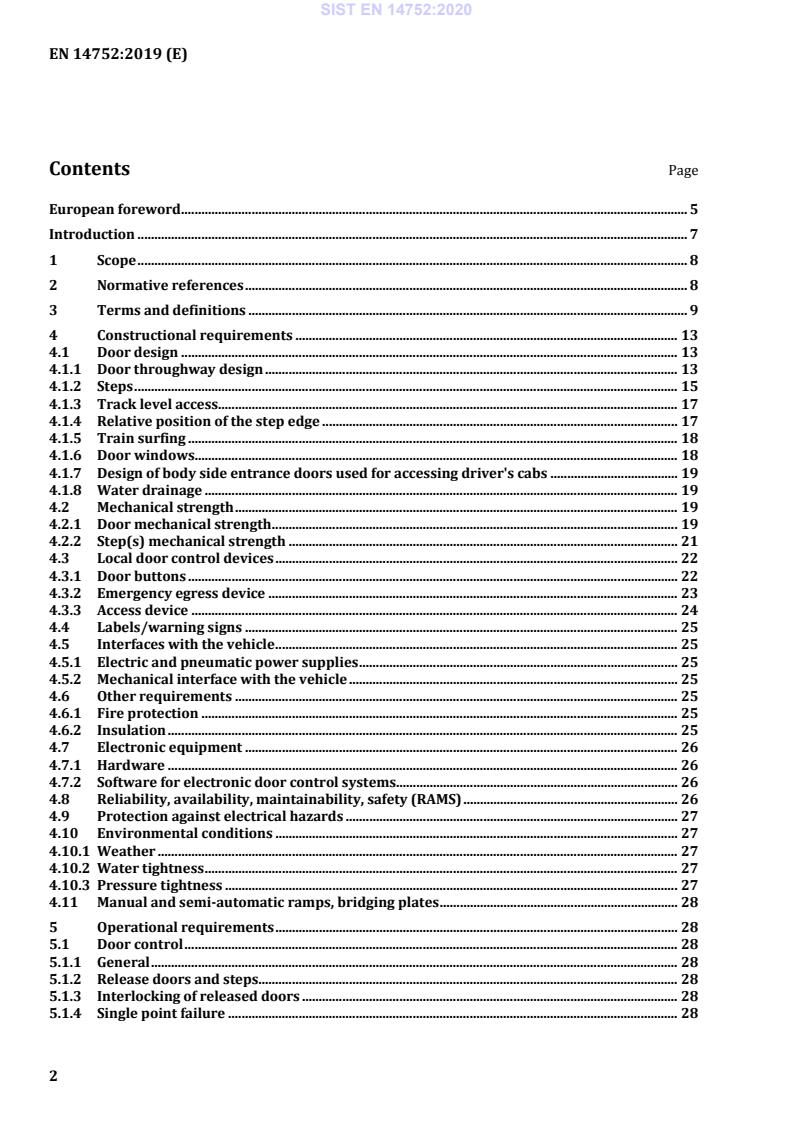
Contents Page
European foreword . 5
Introduction . 7
1 Scope . 8
2 Normative references . 8
3 Terms and definitions . 9
4 Constructional requirements . 13
4.1 Door design . 13
4.1.1 Door throughway design . 13
4.1.2 Steps . 15
4.1.3 Track level access. 17
4.1.4 Relative position of the step edge . 17
4.1.5 Train surfing . 18
4.1.6 Door windows. 18
4.1.7 Design of body side entrance doors used for accessing driver's cabs . 19
4.1.8 Water drainage . 19
4.2 Mechanical strength . 19
4.2.1 Door mechanical strength . 19
4.2.2 Step(s) mechanical strength . 21
4.3 Local door control devices . 22
4.3.1 Door buttons . 22
4.3.2 Emergency egress device . 23
4.3.3 Access device . 24
4.4 Labels/warning signs . 25
4.5 Interfaces with the vehicle . 25
4.5.1 Electric and pneumatic power supplies . 25
4.5.2 Mechanical interface with the vehicle . 25
4.6 Other requirements . 25
4.6.1 Fire protection . 25
4.6.2 Insulation . 25
4.7 Electronic equipment . 26
4.7.1 Hardware . 26
4.7.2 Software for electronic door control systems. 26
4.8 Reliability, availability, maintainability, safety (RAMS) . 26
4.9 Protection against electrical hazards . 27
4.10 Environmental conditions . 27
4.10.1 Weather . 27
4.10.2 Water tightness . 27
4.10.3 Pressure tightness . 27
4.11 Manual and semi-automatic ramps, bridging plates . 28
5 Operational requirements . 28
5.1 Door control . 28
5.1.1 General . 28
5.1.2 Release doors and steps. 28
5.1.3 Interlocking of released doors . 28
5.1.4 Single point failure . 28
5.1.5 Mechanical locking . 28
5.1.6 Out-of-service devices . 29
5.1.7 Isolation for maintenance purposes . 30
5.2 Closing and opening conditions. 31
5.2.1 Safety during closing . 31
5.2.2 Entrance system closed proving. 42
5.3 Opening conditions . 42
5.3.1 Safety during opening . 42
5.3.2 Limitation of opening . 42
5.4 Moveable step obstacle detection . 43
5.4.1 General . 43
5.4.2 Steps outside the vehicle . 43
5.4.3 Steps inside the vehicles . 43
5.5 Emergency operation . 43
5.5.1 Emergency egress . 43
5.5.2 Emergency windows in access doors. 46
5.5.3 Access device . 46
5.5.4 Powering up . 47
5.6 Other requirements . 47
5.6.1 Passenger access door area illumination . 47
5.6.2 Status indication . 47
6 Categories of tests . 47
6.1 General . 47
6.2 Type tests . 47
6.3 Routine tests during manufacture. 48
6.4 Routine test on the fully assembled vehicle/train consist . 48
7 Documentation related to installation and maintenance of the entrance system . 48
Annex A (normative) Passenger interface devices . 49
A.1 Purpose . 49
A.2 Design of door buttons . 49
A.3 Labels on or near door buttons . 50
A.4 Recommended emergency egress device . 52
A.5 Sample of labels . 52
Annex B (normative) Water test procedure . 53
B.1 Purpose . 53
B.2 Test arrangement . 53
B.3 Test procedure . 54
B.4 Test decision . 55
Annex C (normative) Specification and testing of the pressure tightness of door . 57
C.1 Purpose . 57
C.2 Calculation – Flowchart . 57
C.3 Example of pressure tightness requirement specification . 57
C.4 Pressure tightness testing . 58
C.4.1 General . 58
C.4.2 Variable pressure measurement method . 58
C.4.3 Variant: Constant pressure method of measurement . 60
Annex D (normative) Requirements for measuring the closing forces of power-operated
doors. 62
D.1 General . 62
D.2 Terms and definitions . 62
D.3 Measurements . 63
D.3.1 Conditions of measurement . 63
D.3.2 Measurement points . 63
D.3.3 Measuring method . 63
Annex E (normative) Test plan . 65
Annex F (normative) Load requirements for doors due to aerodynamic loads on passenger
trains . 67
Annex G (informative) Clauses in this European Standard requiring clarification in the
technical specification . 68
Annex H (normative) RIC-KEY . 70
Annex I (informative) Calculation of kinetic energy . 71
Annex J (informative) Non-contact obstacle detection . 77
J.1 General . 77
J.2 Light barrier . 77
J.3 Step sensors for external steps . 77
J.4 Area monitoring systems . 77
J.4.1 Arrangement of area monitoring system . 77
J.4.2 Testing of area monitoring system . 80
Annex ZA (informative) Relationship between this European Standard and the Essential
Requirements of EU Directive 2016/797 aimed to be covered . 82
Bibliography . 84
European foreword
This document (EN 14752:2019) has been prepared by Technical Committee CEN/TC 256 “Railway
applications”, the secretariat of which is held by DIN.
This European Standard shall be given the status of a national standard, either by publication of an
identical text or by endorsement, at the latest by May 2020, and conflicting national standards shall be
withdrawn at the latest by May 2020.
Attention is drawn to the possibility that some of the elements of this document may be the subject of
patent rights. CEN shall not be held responsible for identifying any or all such patent rights.
This document supersedes EN 14752:2015.
This document has been prepared under a mandate given to CEN by the European Commission and the
European Free Trade Association, and supports essential requirements of EU Directive 2016/797.
For relationship with EU Directive 2016/797, see informative Annex ZA, which is an integral part of this
document.
Subclause/paragraph/ Change
table/figure
General Figures renumbered due to adding a figure to 4.1.6
Clause 2 Normative References Some references updated and dated
3.2 Bridging plate Reference to PRM standard
3.12 First step Reference to PRM standard
3.19 Palm operated Reference to PRM standard
3.25 Slip resistant Reference to PRM standard
3.27 Technical Specification Reworded
4.1.1.1 Minimum width Reference to manual or semi-automatic ramps added
4.1.5 Train surfing Reference to crew access needs added
4.1.6 Door windows Details for step downwards added, Fig. enhanced
4.2.1.5 Vibration and shock Design and testing separated
4.2.2 Step mechanical strength Fig. improved
5.1.6.1 Door out of service Operation from inside no more mandatory, defined in
specification
5.2.1.3.1 Closing and opening signal - general Amended to read: …under the supervision of the train
crew or in the case of:
5.2.1.3.2.3 Release/Opening door signal Reference to obsolete TSI RST deleted
5.2.1.3.3.1 General Provisions for LED strps added
5.2.1.3.3.2 Visual signal Duration becomes mandatory (…shall…)
5.2.1.3.4 Visual signals of door buttons Moved from 4.3.1.7.1 in former edition
5.2.1.4.1 Sensitivity of obstacle detection Mode of inserting test bar modified
5.2.1.4.3 Obstacle removal force Mode of inserting test bar modified
5.2.1.4.2.2 Closing force Reference to “traffic regularity” added, peak force
definition modified, see also Annex D
5.2.1.5 Anti drag Figure 16, Diameter corrected to 20 mm
Table 1 test 2 dynamic –pulling from outside added
5.2.2.2 Stepand traction interlock system In case of no interlock need for gauge infringement
definition added
5.3.2 Limitationof opening Disabling of opening in case of central closing added
5.5.1.8 Protection against accidential Signal to train system after first action added
operation
6.2 Type tests Additional test at a cant of 3°
B.2 and B.3 Watertesting Testing arrangement and procedure amended
D.2.4 Force graph and D.3.3 Measuring Method Peak force definition amended
D.3.1 Condition of measurement Reference to non contact detection added
D.3.3 Measuring Method Reference to further attempts added
Annex F Load requirements Order and wording changed due to TSi requirements
Annex K Migration Rule Deleted
Annex ZA Relationship with TSI Updated
Bibliography Some references updated
NOTE The technical changes referred to include the significant technical changes from the EN revised but are
not an exhaustive list of all modifications from the previous edition.
According to the CEN-CENELEC Internal Regulations, the national standards organizations of the
following countries are bound to implement this European Standard: Austria, Belgium, Bulgaria,
Croatia, Cyprus, Czech Republic, Denmark, Estonia, Finland, France, Germany, Greece, Hungary, Iceland,
Ireland, Italy, Latvia, Lithuania, Luxembourg, Malta, Netherlands, Norway, Poland, Portugal, Republic of
North Macedonia, Romania, Serbia, Slovakia, Slovenia, Spain, Sweden, Switzerland, Turkey and the
United Kingdom.
Introduction
This document specifies the minimum requirements for construction and operation of railway
passenger access systems to ensure:
— safe access and egress from passenger trains through body side doors and steps;
— usability for persons with reduced mobility;
— a minimum risk of injury to persons as a result of door and step operation;
— that the doors and moveable steps, ramps, bridging plates remain closed when the vehicle is in
motion; and
— safe maintenance of the entrance systems.
1 Scope
This document applies to passenger body side entrance systems of all newly designed railway vehicles
such as tram, metro, suburban, mainline and high-speed trains that carry passengers. The requirements
of this document also apply to existing vehicles undergoing refurbishment of the door equipment, as far
as it is reasonably practicable.
This document also specifies the requirements for testing of entrance systems.
This document makes reference to manual and power operated entrance systems. For manual doors,
clauses referring to power operation are not applicable.
This document does not apply to the following:
— entrance systems for equipment access, inspection or maintenance purposes and for crew only use;
— doors on freight wagons; and
— doors or hatches specifically provided for escape under emergency conditions.
2 Normative references
The following documents are referred to in the text in such a way that some or all of their content
constitutes requirements of this document. For dated references, only the edition cited applies. For
undated references, the latest edition of the referenced document (including any amendments) applies.
EN 12663-1:2010+A1:2014, Railway applications — Structural requirements of railway vehicle bodies —
Part 1: Locomotives and passenger rolling stock (and alternative method for freight wagons)
EN 13032-1:2004+A1:2012, Light and lighting — Measurement and presentation of photometric data of
lamps and luminaires — Part 1: Measurement and file format
EN 13272:2012, Railway applications — Electrical lighting for rolling stock in public transport systems
EN 14067 (all parts), Railway applications — Aerodynamics
EN 16116-1:2013, Railway applications — Design requirements for steps, handrails and associated access
for staff — Part 1: Passenger vehicles, luggage vans and locomotives
EN 45545-2:2013+A1:2015, Railway applications — Fire protection on railway vehicles — Part 2:
Requirements for fire behaviour of materials and components
EN 50121-3-2:2016, Railway applications — Electromagnetic compatibility — Part 3-2: Rolling stock —
Apparatus
EN 50125-1:2014, Railway applications — Environmental conditions for equipment — Part 1: Rolling
stock and on-board equipment
EN 50126 (all parts), Railway applications — The specification and demonstration of Reliability,
Availability, Maintainability and Safety (RAMS)
EN 50153:2014, Railway applications — Rolling stock — Protective provisions relating to electrical
hazards
EN 50155:2017, Railway applications — Rolling stock — Electronic equipment
EN 50215:2009, Railway applications — Rolling stock — Testing of rolling stock on completion of
construction and before entry into service
EN 50657:2017, Railways Applications — Rolling stock applications — Software on Board Rolling Stock
EN 60077-1:2002, Railway applications — Electric equipment for rolling stock — Part 1: General service
conditions and general rules (IEC 60077-1:1999, modified)
EN 61373:2010, Railway applications — Rolling stock equipment — Shock and vibration tests
(IEC 61373:2010)
EN ISO 4762:2004, Hexagon socket head cap screws (ISO 4762:2004)
EN ISO 10140-2:2010, Acoustics — Laboratory measurement of sound insulation of building elements —
Part 2: Measurement of airborne sound insulation (ISO 10140-2:2010)
EN ISO 12567-1:2010, Thermal performance of windows and doors — Determination of thermal
transmittance by the hot-box method — Part 1: Complete windows and doors (ISO 12567-1:2010)
DIN 5032-7:2017, Photometry — Part 7: Classification of illuminance meters and luminance meters
DIN 7340:2011, Tubular rivets cut from the tube
UIC 566:1990, Loadings of coach bodies and their components
UIC 660:2002, Measures to ensure the technical compatibility of high-speed trains
3 Terms and definitions
For the purposes of this document, the following terms and definitions apply.
ISO and IEC maintain terminological databases for use in standardization at the following addresses:
• IEC Electropedia: available at http://www.electropedia.org/
• ISO Online browsing platform: available at http://www.iso.org/obp
3.1
access device
operating element used to unlock a locked door in order to allow for door opening from outside when
the door is not available for normal operation
3.2
bridging plate
retractable device integrated into the vehicle as close as possible to the door threshold level that
enables access for wheelchair users, fully automatic and activated/controlled in conjunction with the
door opening/closing sequences or semi-automatic on demand from passenger or staff
Note 1 to entry: It retains its strength without support on the station platform when extended.
[SOURCE: EN 16586-1:2017, 3.2]
3.3
central closing
powered closing of the door by remote command without intervention by the passenger
3.4
contrast
perception of a difference visually between one surface or element of a building/rail vehicle and
another by reference to their light reflectance values (LRV)
[SOURCE: EN 16584-1:2017, 3.5]
3.5
door
body side panel available for passenger access and egress, including its components
3.6
door button
device to initiate door opening or closing command
3.7
door/step out-of-service
door or step which is locked and not available for use
3.8
door/step isolated
door and/or step to which the pneumatic and/or electric power supply is isolated
3.9
door operation
all door operating sequences
3.10
emergency egress device
operating element used to unlock a locked door in order to allow for manual opening of the door from
inside in case of an emergency
3.11
entrance system
system to facilitate passenger entrance to vehicles including door, step/ramp/bridging plates and the
related drive and control devices
3.12
first step
step that is the first step for a passenger to use, to overcome a height change
Note 1 to entry: For the external access/egress steps this will normally be the step that is closest to the platform
edge (it may be a fixed or a movable step), therefore this is the first step when boarding and the last step when
alighting.
Note 2 to entry: In the context of steps for internal height changes (other than the external access/egress steps)
this means the first usable step when ascending and the edge of the walking floor when descending.
[SOURCE: EN 16586-1:2017, 3.6]
3.13
leading edge
edge of the door, leading during closing movement
3.14
local closing
powered closing by intervention of a person or by a local automatic device
3.15
locked door
closed door held closed by a mechanical device
3.16
manual door
door that is closed or opened exclusively by hand power
3.17
manual ramp
device designed for the passage from one level to another, which is compatible with the vehicle and
which is supported on the station platform when extended
Note 1 to entry: Deployment by train crew or platform staff is manual.
Note 2 to entry: The purpose of the manual ramp is to facilitate wheelchair access.
Note 3 to entry: See EN 16586-2 for further details.
3.18
moveable step
retractable device integrated into the vehicle forming a step with the threshold, fully automatic and
activated/controlled in conjunction with the door opening/closing sequences to reduce the gap in
width and height between vehicle and platform
Note 1 to entry: The moveable step retains its strength without support on the station platform.
3.19
palm operated
operable by the palm or any part of the hand, not requiring fingers to be unclenched
Note 1 to entry: The design need is that passengers with painful conditions, which affect their joints such as
arthritis, may be unable to (and are likely to experience discomfort or pain if they do) exert any force with the tip
of a single finger. Many may not be able to unclench their fingers to do this or perform any pulling action.
[SOURCE: EN 16585-1:2017, 3.7, modified — The original term was “palm operable”.]
3.20
power operated door system
door system which operates doors in opening and closing direction by machine power
3.21
released door
door in a state in which it may be opened by a member of the public or train crew by operating the door
buttons
3.22
RIC-KEY
key according to the agreement on mutual use of vehicles for persons and goods in international
transport (RIC = International coach regulations)
Note 1 to entry: See Annex H.
3.23
routine test
test to which each entrance system equipment is subjected during or after manufacturing or assembly
to the vehicle
3.24
semi-automatic ramp
device designed for the passage from one level to another, which is integrated into the vehicle and
which is supported on the station platform when extended
Note 1 to entry: Deployment is locally activated and supervised.
Note 2 to entry: The purpose of the semi-automatic ramp is to facilitate wheelchair access.
Note 3 to entry: See EN 16586-2 for further details.
3.25
slip resistant
surface finish that is sufficiently rough or otherwise specially formulated so that friction between the
surface and a person's footwear or mobility aid is maintained at an acceptable level in both wet and dry
conditions
Note 1 to entry: Snow and ice are outside this definition and this standard, therefore other special measures
(e.g. operational) should be taken for steps and platforms, etc. that are exposed to these weather conditions.
[SOURCE: EN 16584-3:2017, 3.5]
3.26
tactile
appertaining to touch
Note 1 to entry: Tactile signs or controls may include raised pictograms, raised characters or Braille lettering.
Note 2 to entry: See also EN 16584-1.
[SOURCE: EN ISO 9241-910:2011, 2.5, modified — Both Notes 1 and 2 to entry were added.]
3.27
Technical Specification
document describing specific parameter and/or product requirements as an addition to the
requirements of this standard
3.28
train crew
persons authorized to carry out the duties for door operation
3.29
type test
test of one entrance system and its components to prove that the design meets the standard and the
relevant specifications
3.30
unlocked door
door with mechanical door locking released
4 Constructional requirements
4.1 Door design
4.1.1 Door throughway design
4.1.1.1 Minimum width
Doors shall have an unrestricted clear usable width (1) of 800 mm minimum to allow unimpeded access
and egress of passengers (Figure 1 shows two examples of doors). On trains where there is no step
between the threshold of a dedicated wheelchair access door and the adjacent vestibule, usable without
manual or semi-automatic ramps as defined in 4.11, that door shall have a minimum clear useable
width of 1 000 mm when open.
Key
1 clear usable width 3 vehicle
2 door leaf 4 leading edge
Figure 1 — Minimum width
4.1.1.2 Minimum height
Doors shall have an unrestricted vertical clearway height of l ≥ 1 900 mm minimum (see Figure 2 for
the measuring method).
Dimensions in millimetres
Key
l1 ≥ 1 900 mm
Figure 2 — Minimum height
4.1.2 Steps
4.1.2.1 Entrance area − General
External steps shall have at least the same clear width as the door and be in line with the throughway of
the door.
Internal steps should have at least the same clear width as the door and be in line with the throughway
of the door.
Passenger access from the defined platform to the vestibule of the vehicle shall be achieved with a
maximum of four steps.
4.1.2.2 Step dimensions
4.1.2.2.1 Internal steps for external access
Internal steps for external access shall have a maximum height of l = 200 mm and a minimum depth of
l = 240 mm between the vertical edges of the step. The rising height of each step shall be equal.
The height of each step may be increased to a maximum of l = 230 mm if it can be demonstrated that
this achieves a reduction of one in the total number of steps required.
EXAMPLE If a vertical distance of 460 mm is to be traversed, it can be demonstrated that using steps of up to
l1 = 230 mm reduces the number of steps required from 3 to 2.
See Figure 3 for details.
4.1.2.2.2 External steps
An external access step, fixed or moveable, shall have a maximum height of l = 230 mm between steps
and a minimum depth of l = 150 mm.
Dimensions in millimetres
Key
1 fixed steps inside the train l ≤ 200 or ≤ 230 l ≥ 240
1 4
2 external fixed or moveable step l2 ≤ 230 α ≤ 59°
3 door leaf l3 ≥ 150 β ≤ 55°
Figure 3 — Step dimensions
A minimal drop in level, with a maximum of l = 60 mm (Figure 3), between the floor surface of the
vestibule/last step and that of the external step of the vehicle used to guide and seal the door is also
permissible and shall not be considered as a step so the minimum depth of l = 150 mm (Figure 3) does
not apply. See Figure 4 for the permissible position of the external extension of the door sill.
If the external step depth l is ≥ 150 mm the surface of the exterior step may be used as a reference for
defining the stepping height when stepping up from a lower platform whereas the floor surface of the
vestibule may be used when stepping down from a higher platform.
If a step is fitted and it is an extension of a door sill outside the vehicle, and there is no drop in level
between the floor surface of the vestibule and that of the external step of the vehicle, this shall not be
considered to be a step for the purposes of this specification. See Figure 4 for details.
Key
1 floor surface vestibule l1 ≤ 60 mm
2 extension of door sill
Figure 4 — Extension of door sill
4.1.2.3 Step surface
Steps shall be provided with a slip resistant surface across the usable surface area.
The first and the last step inside the vehicle shall be indicated by a contrasting band with a depth of
45 mm to 55 mm extending the maximum useable width of the steps on the front and the top surfaces
of the step nosing.
The first and the last step outside the vehicle shall be indicated by a contrasting band with a depth of
45 mm to 55 mm extending the full width of the steps on the top surfaces of the step nosing.
4.1.2.4 Protection against water accumulation
The steps shall be arranged to allow water to drain away from the anti-slip surface. The design shall
prevent water accumulation.
4.1.2.5 Manual operation
If a retractable step fails to close and the deployed step exceeds the vehicle kinematic gauge, it shall be
possible to manually retract the step to a closed position, particularly from the platform it is intended
for.
The operation manuals shall include an instruction stating that the step drive shall be isolated prior to
manual operation, if this is necessary to avoid a possible injury due to the activation of the automatic
drive.
4.1.3 Track level access
If required in the technical specification, means shall be provided to ensure access and egress to and
from the track level for staff on dedicated doors. Details need to be clarified in the technical
specification as far as not defined in EN 16116-1.
4.1.4 Relative position of the step edge
The relative position of the step edge in relation to the vehicle body shell and vehicle floor (dimensions
l and l of Figure 3) shall be defined in the technical specification considering the requirements
2 3
regarding the gap between step and platform.
NOTE See EN 16586-1:2017 for further details.
4.1.5 Train surfing
Handholds on the outside surface of the entrance system shall be avoided or designed so they are
minimizing grip when the doors are closed (to avoid so called 'train surfing') unless needed for crew
access.
4.1.6 Door windows
Doors shall be fitted with transparent windows to allow passengers to identify the presence of a
platform.
All door windows shall be fitted with safety glass (either laminated or toughened glass) which is in
accordance with a relevant national or international standard. Other material achieving a comparable
level of safety may also be used.
Where the distance of the lower edge of the door window is less than h 800 mm (recommended
1 =
1 000 mm) above vehicle floor level adjacent to the door, a means of protection shall be provided to
prevent passengers falling through the window when broken. Where internal steps are fitted this
dimension shall be increased to h 1 000 mm (recommended 1 200 mm).
2 =
In case there is a step downwards inside adjacent to the door the minimum dimension of h = 800 mm
(recommended 1 000 mm) shall be achieved (see Figure 5).
Protection may be achieved by the use of a suitable laminated glazing system retained by appropriate
fixing (mechanical retention, suitable bonding, etc.), or mechanical elements (e.g. a bar) or equivalent
measures. If bars are used, they shall be fitted so that they do not create hazards to passengers.
Key
1 first step inside the train h 800 mm
2 floor level h2 1 000 mm
3 door leaf h3 800 mm
Figure 5 — Height of bottom edge of window
4.1.7 Design of body side entrance doors used for accessing driver's cabs
If a body side entrance door is used for accessing the driver's cab, the requirements shall be defined in
the technical specification.
4.1.8 Water drainage
Means shall be provided to divert water from the vehicle roof away from the door throughway.
4.2 Mechanical strength
4.2.1 Door mechanical strength
4.2.1.1 Passenger retention forces
The doors shall withstand the forces that occur when passengers are leaning or falling against the door
leaves without causing any non-elastic deformation or loss of operation. It is permissible for some
residual deflection after first loading to occur.
For this purpose a closed and locked door including the glazing shall withstand a pushing force applied
from inside the vehicle onto the door leaf.
The load
...