

EN 12909:2012
(Main)Products used for treatment of water intended for human consumption - Anthracite
- Abstract
This European Standard is applicable to anthracite used for treatment of water intended for human consumption. It describes the characteristics of anthracite and specifies the requirements and the corresponding test methods for anthracite. It gives information on its use in water treatment.
- Status
- Published
- Publication Date
- 13-Nov-2012
- Withdrawal Date
- 30-May-2013
- Technical Committee
- CEN/TC 164 - Water supply
- Drafting Committee
- CEN/TC 164/WG 9 - Drinking water treatment
- Current Stage
- 9093 - Decision to confirm - Review Enquiry
- Start Date
- 13-Jun-2019
- Completion Date
- 07-Oct-2026

Overview
EN 12909:2012 (CEN) is the European product standard for anthracite used in the treatment of water intended for human consumption. It defines the material description, minimum purity and compositional limits, physical properties, test methods and practical information on delivery, labelling, transportation and storage. The standard applies to anthracite as a filtration and support media in drinking-water treatment and is intended for use by suppliers, water utilities, testing laboratories and regulators.
Key topics and technical requirements
- Scope and applicability: Anthracite for use in single- or multi-media filters treating drinking water; describes characteristics, requirements and test methods.
- Composition limits (commercial product):
- Carbon (water-and-ash-free basis): min 90%
- Ash: max 7%
- Volatile matter: max 10%
- Particle size & grading:
- Determined per EN 12902 (referenced test standard).
- Effective size (d10) ±5% and uniformity coefficient (U) < 1.5 as one option.
- Permitted oversize/undersize mass fractions: 5% (multimedia filters), 10% (single media), 15% (support layer). Example particle ranges are provided in the informative annex.
- Density and physical properties:
- Bulk density (loose): 650–800 kg/m³
- Bulk density (packed): 670–820 kg/m³
- Absolute/particle density: typically 1.35–1.6 g/cm³
- Appearance: black, lustrous granular material; mechanically strong.
- Testing and sampling: Sampling and all routine tests (particle size, densities, carbon/ash/volatile content) are carried out according to EN 12902.
- Labelling, transport and storage:
- Marking must include product name (“Anthracite”), particle size range, net mass/volume, supplier details and statement “this product conforms to EN 12909”.
- Anthracite is not classified as dangerous cargo and can be stored indefinitely.
- Safety: Non‑hazardous; avoid dust (use masks when handling dry product). First-aid and spillage guidance provided.
Applications and users
- Used as a filter medium in open/closed, single- and multi-media filters for municipal and industrial drinking-water treatment.
- Primary users:
- Water utilities and treatment plant operators
- Media manufacturers and suppliers
- Procurement teams specifying filtration media
- Testing laboratories performing quality control
- Consultants and regulators assessing material suitability
Related standards and regulation
- EN 12901:1999 (definitions for inorganic supporting/filtering materials)
- EN 12902 (methods of test for inorganic filtering materials)
- EU directives referenced: Council Directive 98/83/EC (drinking water quality) and Regulation (EC) No 1272/2008 (classification, labelling and packaging)
EN 12909:2012 provides the technical baseline for specifying, testing and using anthracite in drinking-water filtration - ensuring compatibility, consistent performance and traceable quality control across supply chains.
Relations
- Replaces
EN 12909:2005 - Products used for treatment of water intended for human consumption - Anthracite - Effective Date
- 08-Jun-2022
- Effective Date
- 28-Jan-2026
- Effective Date
- 28-Jan-2026
- Effective Date
- 28-Jan-2026
- Effective Date
- 28-Jan-2026
- Effective Date
- 28-Jan-2026
- Effective Date
- 28-Jan-2026
- Effective Date
- 28-Jan-2026
- Effective Date
- 28-Jan-2026
- Effective Date
- 28-Jan-2026
- Effective Date
- 28-Jan-2026
- Revised
prEN 12909 - Products used for treatment of water intended for human consumption - Anthracite - Effective Date
- 08-Jun-2022
Get Certified
Connect with accredited certification bodies for this standard

ECOCERT
Organic and sustainability certification.

Eurofins Food Testing Global
Global leader in food, environment, and pharmaceutical product testing.

Intertek Bangladesh
Intertek certification and testing services in Bangladesh.
Sponsored listings
Frequently Asked Questions
EN 12909:2012 is a standard published by the European Committee for Standardization (CEN). Its full title is "Products used for treatment of water intended for human consumption - Anthracite". This standard covers: This European Standard is applicable to anthracite used for treatment of water intended for human consumption. It describes the characteristics of anthracite and specifies the requirements and the corresponding test methods for anthracite. It gives information on its use in water treatment.
This European Standard is applicable to anthracite used for treatment of water intended for human consumption. It describes the characteristics of anthracite and specifies the requirements and the corresponding test methods for anthracite. It gives information on its use in water treatment.
EN 12909:2012 is classified under the following ICS (International Classification for Standards) categories: 71.100.80 - Chemicals for purification of water. The ICS classification helps identify the subject area and facilitates finding related standards.
EN 12909:2012 has the following relationships with other standards: It is inter standard links to EN 12909:2005, EN 12902:2004, EN 12901:1999, CEN/TR 16110:2010, EN ISO 20963:2011, EN ISO 15952:2011, EN 15798:2010, EN 17093:2018, EN ISO 22030:2011, EN 14898:2006+A1:2007, EN 15798:2022, prEN 12909. Understanding these relationships helps ensure you are using the most current and applicable version of the standard.
EN 12909:2012 is available in PDF format for immediate download after purchase. The document can be added to your cart and obtained through the secure checkout process. Digital delivery ensures instant access to the complete standard document.
Standards Content (Sample)
2003-01.Slovenski inštitut za standardizacijo. Razmnoževanje celote ali delov tega standarda ni dovoljeno.Proizvodi, ki se uporabljajo za pripravo pitne vode - AntracitProdukte zur Aufbereitung von Wasser für den menschlichen Gebrauch - AnthrazitProduits utilisés pour le traitement de l'eau destinée à la consommation humaine - AnthraciteProducts used for treatment of water intended for human consumption - Anthracite71.100.80Chemicals for purification of water13.060.20Pitna vodaDrinking waterICS:Ta slovenski standard je istoveten z:EN 12909:2012SIST EN 12909:2013en,fr,de01-maj-2013SIST EN 12909:2013SLOVENSKI
STANDARDSIST EN 12909:20061DGRPHãþD
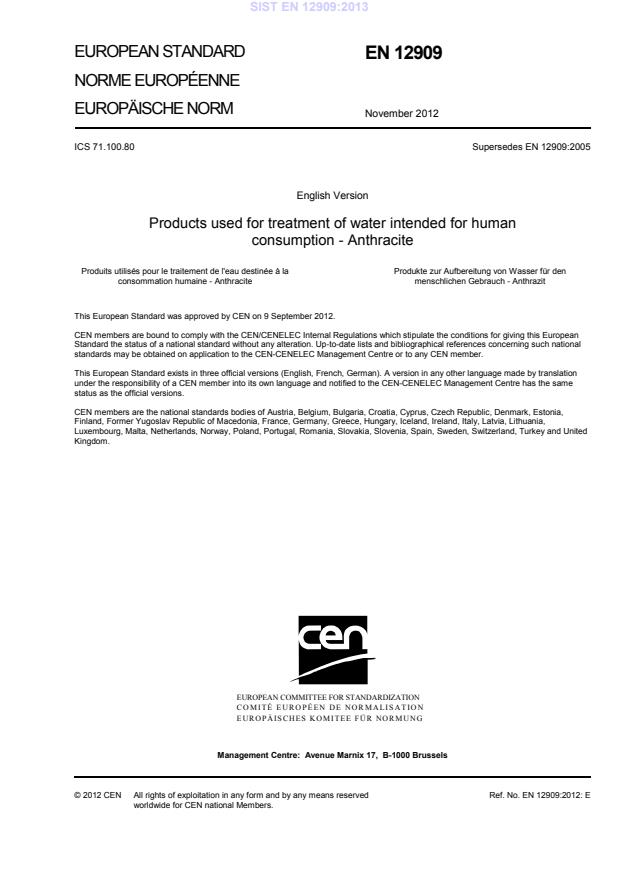
EUROPEAN STANDARD NORME EUROPÉENNE EUROPÄISCHE NORM
EN 12909
November 2012 ICS 71.100.80 Supersedes EN 12909:2005English Version
Products used for treatment of water intended for human consumption - Anthracite
Produits utilisés pour le traitement de l'eau destinée à la consommation humaine - Anthracite
Produkte zur Aufbereitung von Wasser für den menschlichen Gebrauch - Anthrazit This European Standard was approved by CEN on 9 September 2012.
CEN members are bound to comply with the CEN/CENELEC Internal Regulations which stipulate the conditions for giving this European Standard the status of a national standard without any alteration. Up-to-date lists and bibliographical references concerning such national standards may be obtained on application to the CEN-CENELEC Management Centre or to any CEN member.
This European Standard exists in three official versions (English, French, German). A version in any other language made by translation under the responsibility of a CEN member into its own language and notified to the CEN-CENELEC Management Centre has the same status as the official versions.
CEN members are the national standards bodies of Austria, Belgium, Bulgaria, Croatia, Cyprus, Czech Republic, Denmark, Estonia, Finland, Former Yugoslav Republic of Macedonia, France, Germany, Greece, Hungary, Iceland, Ireland, Italy, Latvia, Lithuania, Luxembourg, Malta, Netherlands, Norway, Poland, Portugal, Romania, Slovakia, Slovenia, Spain, Sweden, Switzerland, Turkey and United Kingdom.
EUROPEAN COMMITTEE FOR STANDARDIZATION
COMITÉ EUROPÉEN DE NORMALISATION EUROPÄISCHES KOMITEE FÜR NORMUNG
Management Centre:
Avenue Marnix 17,
B-1000 Brussels © 2012 CEN All rights of exploitation in any form and by any means reserved worldwide for CEN national Members. Ref. No. EN 12909:2012: ESIST EN 12909:2013
The particle size distribution shall be determined on samples taken at the point of manufacture using the method of test given in EN 12902.
NOTE 1 The particle size can decrease during transportation and handling. The particle size distribution shall be described by either: a) effective size: (d10) with a maximum deviation of ± 5 %; uniformity coefficient: (U) which shall be less than 1,5; minimum size: (d1) with a maximum deviation of ± 5 %; or
b) by particle size range and by mass of oversize and undersize particles according to application.
The maximum contents of oversize and undersize s
...