

CEN/TR 17797:2022
(Main)Gas infrastructure - Consequences of hydrogen in the gas infrastructure and identification of related standardisation need in the scope of CEN/TC 234
- Abstract
This document is written in preparation of future standardization and provides guidance on the
impact of the injection of H2 into the gas infrastructure from the input of gas into the onshore
transmission network up to the inlet connection of gas appliances.
Furthermore, it identifies the expected revision need of the existing CEN/TC 243 standards as
well as the need of further new standardisation deliverables.
It examines the effects on each part of the gas infrastructure in the scope of the CEN/TC 234
Working Groups 1 to 12 inclusive, based on available studies, reports and research. Due to
several limitations at different hydrogen concentrations, the impacts are specified.
For some specific impact, prestandardization research is needed.
By convention, for this technical report, the injection of pure hydrogen, i. e. without trace
components is considered.
The information from this report is intended to define the CEN/TC 234 work program for the
coverage of H2NG in relation to the scope of the CEN/TC 234 and its WGs.
NOTE Progress on hydrogen will develop over time. In principle this will be reflected in the
standardisation process in CEN/TC 234.
- Status
- Published
- Publication Date
- 22-Mar-2022
- Technical Committee
- CEN/TC 234 - Gas infrastructure
- Drafting Committee
- CEN/TC 234 - Gas infrastructure
- Current Stage
- 6060 - Definitive text made available (DAV) - Publishing
- Start Date
- 23-Mar-2022
- Due Date
- 27-Feb-2022
- Completion Date
- 23-Mar-2022

Overview
CEN/TR 17797:2022 - Gas infrastructure: Consequences of hydrogen in the gas infrastructure is a CEN technical report produced by CEN/TC 234. It provides guidance to prepare future standardization work on the injection of hydrogen (H2) into the gas infrastructure - from onshore transmission network entry to the inlet of gas appliances. The report examines effects of hydrogen and hydrogen–natural gas (H2NG) mixtures across the gas value chain, identifies limits at different hydrogen concentrations, and lists where pre‑standardization research and standards revisions are needed.
Key topics
- Scope and purpose: Guidance for CEN/TC 234 work programme on H2 readiness, addressing pure hydrogen and H2NG blending scenarios.
- Safety and explosion protection: Characteristics of H2 and H2NG mixtures and implications for explosion prevention and gas warning devices.
- Materials compatibility: Impact of hydrogen on steels, polyethylene (PE), polyamide (PA‑U), elastomers and alloys - pressure integrity, gas tightness and component functionality.
- System performance: Volume/energy content effects on transport, distribution capacity, compression and metering accuracy.
- Infrastructure elements covered: Gas quality (EN 16726), compression, transmission (>16 bar, EN 1594), distribution (≤16 bar), service lines, industrial piping, building pipework (EN 1775), underground gas storage, pressure control, metering and welding.
- Management systems: Safety management, integrity management and management of change for H2 introduction.
- Concentration ranges considered: Findings and suitability are reported for ranges such as <1%, 1–5%, up to 10%, 1–20% for storage and up to 100% hydrogen replacement in some assessments.
- Standards revision needs: Identifies expected updates to existing standards (e.g., EN 16726, EN 12583, EN 1594, EN 1776, EN 12007 series, EN 12327, EN 12732, EN 1775, EN 1918 series and others) and additional deliverables for H2 readiness.
Applications and users
This report is practical for:
- Gas network operators and transmission/distribution designers planning hydrogen blending or conversion projects
- Pipeline and compressor station engineers assessing material and pressure integrity
- Metering and appliance manufacturers evaluating H2 compatibility
- Standards developers (CEN/TC 234 working groups) and regulators setting gas quality and safety rules
- Safety/integrity managers, testing laboratories and research organizations identifying pre‑standardization research needs
Practical value
- Helps prioritize standards revisions and new deliverables to enable safe hydrogen integration into existing gas infrastructure.
- Provides a consolidated technical reference on where hydrogen impacts system components, materials and operations.
- Supports risk‑based decision making for pilot projects, pipeline requalification and long‑term network planning for hydrogen and H2NG.
Keywords: CEN/TR 17797:2022, hydrogen in gas infrastructure, H2NG, CEN/TC 234, gas quality, materials compatibility, pipeline integrity, gas metering, standards revision.
Get Certified
Connect with accredited certification bodies for this standard

Element Materials Technology
Materials testing and product certification.

ABS Group Brazil
ABS Group certification services in Brazil.

ABS Quality Evaluations Inc.
American Bureau of Shipping quality certification.
Sponsored listings
Frequently Asked Questions
CEN/TR 17797:2022 is a technical report published by the European Committee for Standardization (CEN). Its full title is "Gas infrastructure - Consequences of hydrogen in the gas infrastructure and identification of related standardisation need in the scope of CEN/TC 234". This standard covers: This document is written in preparation of future standardization and provides guidance on the impact of the injection of H2 into the gas infrastructure from the input of gas into the onshore transmission network up to the inlet connection of gas appliances. Furthermore, it identifies the expected revision need of the existing CEN/TC 243 standards as well as the need of further new standardisation deliverables. It examines the effects on each part of the gas infrastructure in the scope of the CEN/TC 234 Working Groups 1 to 12 inclusive, based on available studies, reports and research. Due to several limitations at different hydrogen concentrations, the impacts are specified. For some specific impact, prestandardization research is needed. By convention, for this technical report, the injection of pure hydrogen, i. e. without trace components is considered. The information from this report is intended to define the CEN/TC 234 work program for the coverage of H2NG in relation to the scope of the CEN/TC 234 and its WGs. NOTE Progress on hydrogen will develop over time. In principle this will be reflected in the standardisation process in CEN/TC 234.
This document is written in preparation of future standardization and provides guidance on the impact of the injection of H2 into the gas infrastructure from the input of gas into the onshore transmission network up to the inlet connection of gas appliances. Furthermore, it identifies the expected revision need of the existing CEN/TC 243 standards as well as the need of further new standardisation deliverables. It examines the effects on each part of the gas infrastructure in the scope of the CEN/TC 234 Working Groups 1 to 12 inclusive, based on available studies, reports and research. Due to several limitations at different hydrogen concentrations, the impacts are specified. For some specific impact, prestandardization research is needed. By convention, for this technical report, the injection of pure hydrogen, i. e. without trace components is considered. The information from this report is intended to define the CEN/TC 234 work program for the coverage of H2NG in relation to the scope of the CEN/TC 234 and its WGs. NOTE Progress on hydrogen will develop over time. In principle this will be reflected in the standardisation process in CEN/TC 234.
CEN/TR 17797:2022 is classified under the following ICS (International Classification for Standards) categories: 01.120 - Standardization. General rules; 75.180.01 - Equipment for petroleum and natural gas industries in general. The ICS classification helps identify the subject area and facilitates finding related standards.
CEN/TR 17797:2022 is available in PDF format for immediate download after purchase. The document can be added to your cart and obtained through the secure checkout process. Digital delivery ensures instant access to the complete standard document.
Standards Content (Sample)
SLOVENSKI STANDARD
01-september-2022
Infrastruktura za plin - Posledice zaradi vodika v infrastrukturi za plin in
ugotavljanje s tem povezanih potreb po standardizaciji na področju CEN/TC 234
Gas infrastructure - Consequences of hydrogen in the gas infrastructure and
identification of related standardisation need in the scope of CEN/TC 234
Gasinfrastruktur - Auswirkungen von Wasserstoff in der Gasinfrastruktur und
Identifikation des zugehörigen Normungsbedarfs im Zuständigkeitsbereich des CEN/TC
Infrastructure gazière Consequences d'hydrogen dans l'infrastructure gazière et
l'identification des besoins relatifs à la normalisation dans le domaine d'application de
CEN/TC 234
Ta slovenski standard je istoveten z: CEN/TR 17797:2022
ICS:
01.120 Standardizacija. Splošna Standardization. General
pravila rules
75.180.01 Oprema za industrijo nafte in Equipment for petroleum and
zemeljskega plina na splošno natural gas industries in
general
2003-01.Slovenski inštitut za standardizacijo. Razmnoževanje celote ali delov tega standarda ni dovoljeno.
CEN/TR 17797
TECHNICAL REPORT
RAPPORT TECHNIQUE
March 2022
TECHNISCHER BERICHT
ICS 01.120; 75.180.01
English Version
Gas infrastructure - Consequences of hydrogen in the gas
infrastructure and identification of related standardisation
need in the scope of CEN/TC 234
Infrastructure gazière - Consequences d'hydrogen dans Gasinfrastruktur - Auswirkungen von Wasserstoff in
l'infrastructure gazière et l'identification des besoins der Gasinfrastruktur und Identifikation des
relatifs à la normalisation dans le domaine zugehörigen Normungsbedarfs im
d'application de CEN/TC 234 Zuständigkeitsbereich des CEN/TC 234
This Technical Report was approved by CEN on 24 January 2022. It has been drawn up by the Technical Committee CEN/TC 234.
CEN members are the national standards bodies of Austria, Belgium, Bulgaria, Croatia, Cyprus, Czech Republic, Denmark, Estonia,
Finland, France, Germany, Greece, Hungary, Iceland, Ireland, Italy, Latvia, Lithuania, Luxembourg, Malta, Netherlands, Norway,
Poland, Portugal, Republic of North Macedonia, Romania, Serbia, Slovakia, Slovenia, Spain, Sweden, Switzerland, Turkey and
United Kingdom.
EUROPEAN COMMITTEE FOR STANDARDIZATION
COMITÉ EUROPÉEN DE NORMALISATION
EUROPÄISCHES KOMITEE FÜR NORMUNG
CEN-CENELEC Management Centre: Rue de la Science 23, B-1040 Brussels
© 2022 CEN All rights of exploitation in any form and by any means reserved Ref. No. CEN/TR 17797:2022 E
worldwide for CEN national Members.
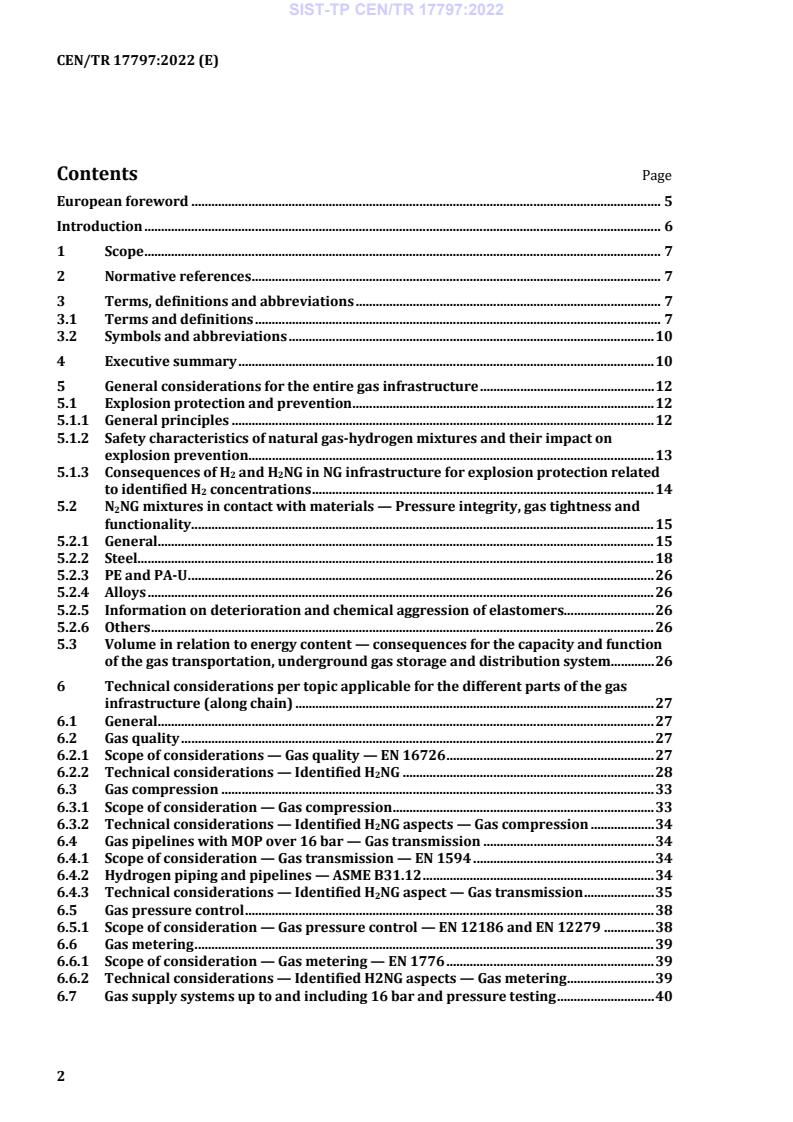
Contents Page
European foreword . 5
Introduction . 6
1 Scope . 7
2 Normative references . 7
3 Terms, definitions and abbreviations . 7
3.1 Terms and definitions . 7
3.2 Symbols and abbreviations . 10
4 Executive summary . 10
5 General considerations for the entire gas infrastructure . 12
5.1 Explosion protection and prevention . 12
5.1.1 General principles . 12
5.1.2 Safety characteristics of natural gas-hydrogen mixtures and their impact on
explosion prevention. 13
5.1.3 Consequences of H2 and H2NG in NG infrastructure for explosion protection related
to identified H concentrations . 14
5.2 N NG mixtures in contact with materials — Pressure integrity, gas tightness and
functionality . 15
5.2.1 General. 15
5.2.2 Steel. 18
5.2.3 PE and PA-U . 26
5.2.4 Alloys . 26
5.2.5 Information on deterioration and chemical aggression of elastomers. 26
5.2.6 Others . 26
5.3 Volume in relation to energy content — consequences for the capacity and function
of the gas transportation, underground gas storage and distribution system. 26
6 Technical considerations per topic applicable for the different parts of the gas
infrastructure (along chain) . 27
6.1 General. 27
6.2 Gas quality . 27
6.2.1 Scope of considerations — Gas quality — EN 16726 . 27
6.2.2 Technical considerations — Identified H NG . 28
6.3 Gas compression . 33
6.3.1 Scope of consideration — Gas compression . 33
6.3.2 Technical considerations — Identified H NG aspects — Gas compression . 34
6.4 Gas pipelines with MOP over 16 bar — Gas transmission . 34
6.4.1 Scope of consideration — Gas transmission — EN 1594 . 34
6.4.2 Hydrogen piping and pipelines — ASME B31.12 . 34
6.4.3 Technical considerations — Identified H NG aspect — Gas transmission . 35
6.5 Gas pressure control . 38
6.5.1 Scope of consideration — Gas pressure control — EN 12186 and EN 12279 . 38
6.6 Gas metering . 39
6.6.1 Scope of consideration — Gas metering — EN 1776 . 39
6.6.2 Technical considerations — Identified H2NG aspects — Gas metering . 39
6.7 Gas supply systems up to and including 16 bar and pressure testing . 40
6.7.1 Statement for gas pipelines with MOP up to and including 16 bar for all
concentrations . 40
6.7.2 Requalifying existing pipelines for hydrogen service . 41
6.7.3 Technical consideration — Scoping considerations — EN 2007-1 to -4,
CEN/TS 12007-6, EN 12327 and EN 12732 . 41
6.8 Service lines . 45
6.8.1 Scoping considerations — Service lines — EN 12007-5 . 45
6.8.2 Technical considerations — Identified H NG aspects integrity and safety, reliability
and operation . 46
6.9 Industrial piping . 47
6.9.1 Scope of consideration – Industrial piping – EN 15001-1 and EN 15001-2 . 47
6.9.2 Technical considerations — Industrial piping . 48
6.10 Gas pipework for buildings . 49
6.10.1 Scope of consideration — Gas pipework for buildings – EN 1775 . 49
6.10.2 Technical considerations — Gas pipework for buildings . 49
6.11 Underground gas storage . 49
6.11.1 Scope of consideration for underground gas storage — Generals EN 1918-1 to -5. 49
6.11.2 Technical considerations — Underground gas storage . 50
6.11.3 Identified H2NG impacts — Underground gas storage . 51
6.12 Safety management and integrity management. 52
6.12.1 Scope of considerations . 52
6.12.2 Safety management system — Management of change . 52
6.12.3 Pipeline integrity management system . 53
7 Conclusions — H suitability of components, materials and procedures used in the
gas infrastructure related to identified H concentrations . 54
7.1 General . 54
7.2 H suitability —Gas quality . 55
7.2.1 H-gas quality – Admixture of H . 55
7.2.2 Hydrogen quality in converted natural gas grids . 56
7.3 H suitability — Gas compressor stations . 57
7.3.1 General . 57
7.3.2 Less than 1 % hydrogen in natural gas . 58
7.3.3 Over 1 Vol.-% up to 5 Vol.-% H in natural gas . 58
7.4 H suitability — Gas transmission pipelines with MOP over 16 bar . 61
7.5 H suitability — Gas pressure control . 62
7.5.1 Introduction . 62
7.5.2 General . 63
7.5.3 Up to 10 Vol.-% H in natural gas . 63
7.5.4 Over 10 Vol.-% up to 100 % H in natural gas . 64
7.6 H suitability — Gas metering . 65
7.7 H suitability — Gas pipelines with MOP up to and including 16 bar . 65
7.7.1 A Summary of findings for gas pipeline systems up to and including 16 bar and
pressure testing (CEN/TC 234 WG 2) . 65
7.8 H suitability — Service lines . 66
7.9 H suitability — Industrial piping . 66
7.10 H suitability — Gas pipework for buildings . 67
7.11 H2 suitability — Underground gas storage . 67
7.11.1 Between 0 % and 1 % hydrogen in natural gas . 67
7.11.2 Between 1 % and 20 % hydrogen in natural gas . 68
7.11.3 Above 20 % hydrogen up to full replacement of natural gas by hydrogen (100 %
hydrogen) . 68
8 Revision needs of existing CEN/TC 234 standards and additional deliverables for the
H -readiness of the gas infrastructure . 68
8.1 Action need. 68
8.2 Gas quality — Expected revision of EN 16726:2015+A1:2018 . 69
8.3 Gas compression — Expected revision of EN 12583:2014 . 69
8.4 Pipelines for maximum operating pressure over 16 bar — Expected revisions of
EN 1594:2013 . 70
8.5 Gas pressure control — Expected revisions of EN 12186:2014 and EN 12279:2000 71
8.6 Gas measuring systems — Expected revision of EN 1776:2015 . 73
8.7 Pipelines for maximum operating pressure up to and including 16 bar — Expected
revision of EN 12007 Parts 1 to 4 and EN 12327:2012 . 74
8.8 Pressure testing, commissioning and decommissioning procedures — Expected
revision of EN 12327:2012 . 77
8.9 Welding of steel — Expected revision of EN 12732:2013 . 78
8.10 Service lines — Expected revision of EN 12007-5:2014 . 78
8.11 Gas installation pipework– Expected revision of FprEN 15001-1:2019 and EN 15001-
2:2019 . 81
8.12 Gas pipework for buildings — Expected revision of EN 1775 . 85
8.13 Underground gas storage– Expected revision of EN 1918-1:2016 to -5:2016 . 86
8.14 Safety and Integrity Management System — Expected revision of EN 16348 and
EN 15399 by prEN 17649 (merged standard) . 91
Annex A (informative) Any issue coming up during the discussion and outside of the TC 234
scope . 92
Annex B (informative) Safety characteristics of natural gas-hydrogen mixtures . 93
Annex C (informative) Operating principles for gas warning devices [2] . 94
Annex D (informative) Hydrogen pressure versus hydrogen percentage . 96
Annex E (informative) Hydrogen pressure versus hydrogen fugacity . 97
Annex F (informative) An example of the use of an existing gas pipeline for hydrogen gas 99
Annex G (informative) Use of polyamide (PA-U) in gas piping systems in relation to
hydrogen, methane or their mixtures . 101
Annex H (informative) Netbeheer Nederland Study for biomethane and 100 % hydrogen
................................................................................................................................................................ 112
Annex I (informative) Responsibility of CEN/TC 234 'Gas infrastructure' Working groups
for the parts of the gas infrastructure along the chain . 114
Annex J (informative) Symbols and abbreviations . 115
Bibliography . 118
European foreword
This document (CEN/TR 17797:2022) has been prepared by Technical Committee CEN/TC 234 “Gas
infrastructure”, the secretariat of which is held by DIN.
Attention is drawn to the possibility that some of the elements of this document may be the subject of
patent rights. CEN shall not be held responsible for identifying any or all such patent rights.
Any feedback and questions on this document should be directed to the users’ national standards body.
A complete listing of these bodies can be found on the CEN website.
Introduction
The injection of hydrogen in natural gas infrastructures demands considerations with regard to the
integrity, safety and performance of the systems facing increasing hydrogen levels, its fluctuation and
variation.
There is extensive research on the use of hydrogen as an admixture with natural gas in various
percentages or as pure hydrogen. Impact studies already completed or in progress are focusing on the
use of existing gas networks but also of dedicated gas networks for hydrogen. They also include the
impact of the introduction of hydrogen in various percentages into the gas infrastructure on all the
existing technologies within the gas supply chain.
Accepting hydrogen into the natural gas network requires input from many gas TCs at CEN, i.e.
CEN/TC 234 and particularly from the manufacturers of essential components, e.g. valves, gas pressure
regulators, gas meters, safety control devices, leak detection devices, and many more (see Annex A). Many
of these manufacturers are assessing the potential impact of hydrogen on existing components in natural
gas service.
Co-operation with these other CEN and ISO/TCs for various essential components and applications will
be necessary to ensure that projects to introduce hydrogen have all the essential elements of the gas chain
fully co-ordinated into the plan. The positive co-operation of the component manufacturers will be
particularly important.
In the transition scheme to hydrogen, there is a large body of knowledge and experience available from
the hydrogen industry for gas production and use. The long-established safety requirements in this sector
will aid the amendment of natural gas standards and codes of practice and the development of any new
standards
This report is written for
— CEN/TC 234 as basis for definition of a TC roadmap for standardisation
— CEN/TC 234 WGs as a guideline for the standardisation work
— interested parties to get an insight in the decision process of CEN/TC 234’s hydrogen standardisation.
NOTE This document has been elaborated in co-operation between the Working Group convenors, secretaries
and experts, TC chair and secretariat of CEN/TC 234. Respecting different working group contributions, the way in
which the content is presented and the level of details differs for the different topics. This is acceptable as the real
technical work will take place in the dedicated working groups with co-ordination of the TC 234
Convenors/Secretaries group to ensure the final coherence of the resulting standardisation deliverables.
1 Scope
This document is written in preparation of future standardization and provides guidance on how
injection of H into the gas infrastructure can impact processes from the input of gas into the on-shore
transmission network up to the inlet connection of gas appliances.
NOTE 1 Gas infrastructure includes gas installation pipework between the delivery point of the gas and the inlet
connection to the gas appliance in buildings and on industrial sites.
The assessments refer to the concentrations of 2, 5, 10, 20 and up to 100 Vol.- % hydrogen in natural gas.
Furthermore, it identifies the expected revision need of the existing CEN/TC 234 standards as well as the
need of further new standardisation deliverables.
It examines the effects on each part of the gas infrastructure in the scope of the CEN/TC 234 Working
Groups 1 to 12 inclusive, based on available studies, reports and research. Due to several limitations at
different hydrogen concentrations, the impacts are specified.
For some specific impacts, pre-standardization research is needed.
By convention, for this technical report, the injection of pure hydrogen, i. e. without trace and/or minor
components is considered. Awareness is given that there is the need to consider trace and/or minor
components and limits set on the gas quality on European and national level, too.
The information from this report is intended to define the CEN/TC 234 work program for the coverage
of H NG in relation to the scope of the CEN/TC 234 and its WGs.
NOTE 2 Progress on hydrogen will develop over time. In principle this will be reflected in the standardisation
process in CEN/TC 234.
2 Normative references
There are no normative references in this document.
3 Terms, definitions and abbreviations
For the purposes of this document, the following terms and definitions apply.
ISO and IEC maintain terminological databases for use in standardization at the following addresses:
— IEC Electropedia: available at http://www.electropedia.org/
— ISO Online browsing platform: available at http://www.iso.org/obp
The International Gas Union glossary on Underground Gas Storage [1] can be useful too:
3.1 Terms and definitions
3.1.1
hydrogen embrittlement
HE
interaction of hydrogen atoms and steel can have a negative effect on the mechanical behaviour of steel.
Note 1 to entry: The general term for this degrading effect is called hydrogen embrittlement
3.2.2
explosive atmosphere
mixture with air, under atmospheric conditions, of flammable substances in the form of gases, vapours,
mists or dusts in which, after ignition has occurred, combustion spreads to the entire unburned mixture
[SOURCE: EN 13723:2013, 3.28]
3.2.3
hazardous explosive atmosphere
explosive atmosphere present in such quantities that precautions against ignition are required
[SOURCE: IEC 61340-4-4:2018, 3.6]
3.2.4
hazardous area
area in which an explosive atmosphere is present, or can be expected to be present, in quantities such as
to require special precautions for the construction, installation and use of equipment
[SOURCE: IEC 60079-0:2013]
3.2.5
explosion group
ranking of flammable gas-air mixtures with respect to the Maximum Experimental Safe Gap (MESG)
[SOURCE: EN ISO 16852:2016, 3.12.2]
3.2.6
temperature class
temperature range used for:
— classification of equipment, protective system for explosive atmospheres based on its maximum
surface temperature; or
— classification of flammable gases and vapours based on their auto ignition
[SOURCE: EN 13237:2012, 3.63]
3.2.7
explosion pressure
highest pressure occurring in a closed vessel during the explosion of a specific mixture of flammable
substances with air or air and inert gases determined under specified test conditions
[SOURCE: EN 15967:2011]
3.2.8
ignition temperature
lowest temperature (of a hot surface) at which under specified test conditions an ignition of a flammable
gas or flammable vapour in mixture with air or air/inert gas occurs
[SOURCE: EN 14522:2005]
3.2.9
limiting oxygen concentration
LOC
maximum oxygen concentration in a mixture of a flammable substance and air and an inert gas, in which
an explosion will not occur, determined under specified test conditions
[SOURCE: EN 13237:2012, 3.49]
3.2.10
lower explosion limit
LEL
lowest concentration of the explosion range at which an explosion can occur
[SOURCE: EN 13237:2012, 3.19.1]
3.2.11
maximum experimental safe gap
MESG
maximum gap of the joint between the two parts of the interior chamber of a test apparatus which, when
the internal gas mixture is ignited and under specified conditions, prevents ignition of the external gas
mixture through a 25 mm long joint, for all concentrations of the tested gas or vapour in air
[SOURCE: EN 13237:2012, 3.51]
3.2.12
maximum explosion pressure
maximum value of explosion pressure measured in the tests for explosion pressure when the content of
the flammable substances in the mixture is varied
[SOURCE: EN 13237:2012, 3.2]
3.2.13
minimum ignition energy
MIE
lowest electrical energy stored in a capacitor, which upon discharge is sufficient to effect ignition of the
most ignitable atmosphere under specified test conditions
[SOURCE: EN 13237:2012, 3.54]
3.2.14
upper explosion limit
UEL
highest concentration of the explosion range at which an explosion can occur
[SOURCE: EN 13237:2012, 3.19.2]
3.2.15
ventilation
movement of air and its replacement with fresh air due to the effects of wind, temperature gradients, or
artificial means (for example, fans or extractors)
[SOURCE: IEC 60079-10-0:2015]
3.2 Symbols and abbreviations
Symbols and abbreviations should be selected from those already established in relevant ISO and/or
CEN standards. New symbols and abbreviations should be defined only where there is no suitable
alternative and recorded in CEN/TC 234 Doc N 776 (so called N 215).
The symbols and abbreviations used in this document are listed in Annex J.
4 Executive summary
Intention of the European gas industry is to enable the use of natural gas infrastructure for hydrogen.
For the use of hydrogen in the natural gas infrastructure it is reasonable to identify:
— the similarities (what is equal) and differences (what is different) between methane (natural gas)
and hydrogen and – based on these
— the consequences or the impact of hydrogen on the gas system (e.g. materials, safety, maintenance).
NOTE 1 Acknowledging the impact of the similarities on applications, in this document only the impact on gas
infrastructure is considered as in the scope of CEN/TC 234.
NOTE 2 Natural gas is a mixture of hydrocarbon gases and other gases (e.g. nitrogen). Its main component is
methane.
The following similarities and differences of the properties of methane and hydrogen need consideration:
Table 1 gives common properties of hydrogen and natural gas whereas Table 2 shows differences in the
nominal values of the common properties of hydrogen and methane.
Table 1 — Common properties of hydrogen and natural gas
Characteristic Methane (natural gas) Hydrogen
gaseous yes yes
colourless yes yes
odourless yes yes
toxic no no
flammable yes yes
explosive yes yes
corrosive no no
Table 2 — Properties of hydrogen and methane — differences
Parameter Methane Hydrogen
Relative density (air = 1) 0,55 0,07
Flammability limits [Mol.- %] 4,4–17 4,0–77
Ignition energy [mJ] 0,26 0,017
Combustion energy up/low) [MJ/m ] 40/36 13/11
upper: 54
Wobbe number [MJ/m ] 48–41
lower: 48
Gross calorific value [kJ/mol, at 20 °C] 891 286
Flame colour blue colourless
Molecular mass [g/mol] 16 2
Molecule size [pm] 220 75
−4 2
Diffusion coefficient in air [10 m /s] 0,61 0,20
Infrared absorption yes no
Joule-Thomson coefficient [K/bar] 0,4 −0,03
a
Sound velocity [m/s] 388 1 203
NOTE 1 This Table is meant as indication of general differences between methane (CH4) and hydrogen (H2)
without referring to the specific conditions.
NOTE 2 More details related to mixtures of methane with hydrogen are given in Table B.1.
a
High caloric natural gas
In Clause 6, a detailed evaluation of technical safety and integrity and performance aspects is given per
part of the natural gas infrastructure.
In Clause 7, the suitability of the different parts of the gas infrastructure for hydrogen and hydrogen
admixtures are summarised in form of tables.
As a conclusion, the following aspects need specific attention:
1) materials
• embrittlement of steel (5.2.2)
• diffusion and/or permeation of the gas through materials
• deterioration of elastomers
• suitability of sealing materials
• …
NOTE 3 Consideration should be given also to historic materials remaining in networks such as grey cast iron
and ductile cast iron.
2) safety aspects of hydrogen/, explosion prevention and protection
• ATEX requirements
• purging
• venting
• proof of gas tightness
• detection of hydrogen and admixtures
• odorization
• fire detection
3) technical system
• compression
• biochemical reactions in reservoirs and caverns
• metering
• gas preheating
• Joule-Thomson-Dehydration
• …
4) Other aspects
• Volume in relation to energy content (5.3)
• Gas quality
The existing standards of CEN/TC 234 can be amended to cover natural gas infrastructure used for
hydrogen services. For some aspects new CEN deliverables are needed.
The revision needs of the CEN/TC 234 standards respectively the need to elaborate additional standards
is documented in Clause 8. The extent and timeframe of revision differs for the single aspects and for
some aspects rely on further research results.
The involvement of the competent experts will be ensured by calls to the NSB, with the new work item
proposals and beyond. Strong involvement of the sector is required.
NOTE 4 CEN/TC 234 intends to elaborate the related revisions in cooperation with the relevant TCs (e.g. CEN-
CLC/JTC 6) and stakeholders. Preparations and first work items are already in process in the dedicated working
groups.
5 General considerations for the entire gas infrastructure
5.1 Explosion protection and prevention
5.1.1 General principles
The general principles for the prevention of and protection against explosions are laid down in the
European Directive 1999/92/EC (ATEX II). It addresses employers in order to protect workers and other
persons from explosion hazards. The provisions given in this European Directive are detailed in national
regulations. However, operators of plants and equipment also apply the general principles given of
Directive 1999/92/EC with regard to third party protection.
With a view to preventing and providing protection against explosions, technical and/or organizational
measures need to be taken, in order of priority and in accordance with the following basic principles:
— prevention of the formation of explosive atmospheres, or where the nature of the activity does not
allow that,
— avoidance of the ignition of explosive atmospheres, and
— mitigation of the detrimental effects of an explosion to ensure the health and safety of workers.
Safety measures of the gas industry include safe gas infrastructure as well as safe gas utilisation and does
focus on the prevention of unsafe situations, as explosions, by preventing the formation of explosive
atmosphere and avoidance of the ignition where the formation of hazardous explosive atmospheres
cannot be safely excluded. For pipework in buildings, also prevention measures in case of external fire
are required. These basic principles are applying equally to natural gas, hydrogen and any admixtures of
these. Public and workers safety is the prime consideration.
5.1.2 Safety characteristics of natural gas-hydrogen mixtures and their impact on explosion
prevention
5.1.2.1 General
The safety characteristics of natural gas and hydrogen are well known. In a detailed study the safety
characteristics of natural gas – hydrogen mixtures were examined in order to determine possible risks
relating to occupational safety and health for hydrogen concentrations of up to 10 Vol.-%. The results of
the measurements are given in Annex B.
A safety design for hydrogen can fully be used for natural gas application. Gas detecting equipment needs
special consideration as detailed in Annex C.
5.1.2.2 Prevention of the formation of explosive atmospheres
Basic requirement for the prevention of the formation of explosive atmospheres is the gas tightness of
the gas system. Wherever possible, the gas bearing part of the gas infrastructure is designed and operated
to be permanently technically gastight. The gas tightness of the gas system is proven by tightness tests.
On components of the system for natural gas tightness test are carried out with air. If components of the
gas system are specified for higher contents of hydrogen the test gases for the tightness tests need to be
specified to verify the gas tightness against hydrogen leakage. For existing systems, the gas tightness can
be verified with operating gas after the overall gas tightness test with inert gas, e.g. nitrogen.
Gas releases from the gas system can occur e.g. from:
— shaft sealing systems of valves or rotating equipment
— joints (e.g. pipe joints)
— venting of block and bleed systems
— depressurization and opening of equipment for maintenance activities
— emergency shut down with depressurization
— equipment failure
Where the release of gas cannot safely be avoided, the gas needs to be vented to safe atmosphere, as
already detailed in the applicable European standards.
The amount of gas escaping through any shaft sealing systems, e.g. for rotating equipment, compressors,
can increase with increasing hydrogen content.
The lower density will support the dilution and venting of the gas mixture near gas leakages. The lower
explosion limit (LEL) is about the same value for natural gas and hydrogen and any mixture of these gases.
The extent of hazardous areas at the apertures of venting lines and vent stacks was calculated with
natural gas and natural gas with 10 Vol.-% H [2] There was no significant difference between the results
for pure natural gas and natural gas with 10 Vol.-% H2. For H2 contents above 10 Vol.-% the extent of
hazardous areas is being investigated.
Flammable gases should be odorized for detection of gas in public areas and in buildings, depending on
national legal and/or technical framework.
The UEL of natural gas-hydrogen mixtures increases with the increase of the hydrogen concentration.
The MIE decreases significantly. However, this effect will be negligible up to 10 Vol.-%, but need
consideration at higher H -concentrations. By purging with inert gas, the formation of hazardous
explosive atmosphere can be avoided.
5.1.2.3 Avoidance of the ignition of explosive atmospheres
For equipment according to Directive 2014/34/EU the classification is made with regard to the ignition
temperature and the explosion group related to the MESG.
The ignition temperature of pure hydrogen and natural gas is in the same order of magnitude. Therefore,
the concentration of hydrogen in natural gas will have no significant effect on the possible ignition on hot
surfaces and the temperature class of the equipment.
The value of MESG decreases with the increase of the hydrogen concentration in natural gas.
5.1.3 Consequences of H and H NG in NG infrastructure for explosion protection related to
2 2
identified H concentrations
5.1.3.1 Hydrogen content up to 10 Vol.-%
The results given in Annex B indicate that up to 10 Vol.-% H in natural gas the safety characteristics of
gas mixture do not deviate from the safety characteristics of natural gas. None of the examined
characteristics is affected significantly by the addition of up to 10 Vol.-% hydrogen. The explosion ranges
are increased only slightly and the mixtures remain in explosion group IIA; as is pure natural gas.
The explosion hazard for pipework up to 100 mbar according to EN 1775 with H NG up to 20 Vol.-% was
investigated in a DVGW research study (G 201615) [3] and no significant deviation from the safety
concept according to EN 1775 was found.
Comparative calculations – based on gas dispersion calculations – to determine hazardous areas
(explosion zones) for pure natural gas and natural gas-hydrogen mixtures with up to 10 Vol.-% hydrogen,
also revealed only minor differences within the margin of error of the calculation methods.
In principle, gas detectors that are suitable for natural gas can be used for natural gas-hydrogen mixtures
with a maximum of 10 Vol.-% hydrogen. However, this requires a separate safety assessment and, if
necessary, a recalibration, see Annex C.
5.1.3.2 Hydrogen content above 10 Vol.-% up to full replacement of natural gas by hydrogen
(100 % hydrogen)
For hydrogen concentrations above 10 Vol.-% up to 100 % a specific safety assessment is needed to
assess the impact and possible modifications of the protection measures used for an existing natural gas
system.
The explosion hazard for pipework up to 100 mbar according to EN 1775 with H NG up to 20 Vol.-% was
investigated in a DVGW research study (G 201615) [3] and no significant deviation from the safety
concept according to EN 1775 was found.
The explosion group of the equipment installed will be affected by the hydrogen concentration. Methane
including natural gas is classified in explosion group IIA unless the hydrogen content exceeds 25 Vol.-%
[EN ISO 80079-20-1]. For hydrogen contents above this limit in any part of the system, equipment
complying with explosion group IIC is recommended. In Table B.1 the details of experiments are given. A
detailed risk analysis should be carried out to adapt safety measures when reaching this hydrogen
concentration.
For systems operated with hydrogen, ASME B 31.12 requires purging with inert gas prior to opening of
the system, e.g. for maintenance work, and prior to commissioning.
For venting hydrogen to atmosphere or flaring of hydrogen, where permitted, specific precautions are
given in EIGA IGC Doc 121/14 [4].
Since hydrogen is the more critical component in a natural gas–hydrogen mixture, a system design for
100 % hydrogen should be safe with regard to the extension of hazardous areas and the explosion group
of the equipment used in these hazardous areas. However, a detailed, individual safety assessment is
recommended.
5.2 N2NG mixtures in contact with materials — Pressure integrity, gas tightness and
functionality
5.2.1 General
5.2.1.1 Hydrogen tolerance of pipeline materials
Table 3 indicates the pipeline materials’ tolerance of hydrogen concentrations in the admixture with
natural gas up to 100 Vol.-% of hydrogen as resulted from various studies:
— Netbeheer Nederland/KIWA report Future proofed gas distribution networks [5]
NOTE A summary of the Netbeheer Nederland/Kiwa report is given in Annex H.
— further KIWA findings
— Kiwa report on hydrogen in natural gas on Ameland [6]
— GERG Report on admissible hydrogen concentration in natural gas systems [7]
— Additional information (based on presentations at Marcogaz/GERG EGATEC on 7 Nov. 2019)
— Findings from N.V. Nederlandse Gasunie and Open Grid Europe documented in the CEN/TC 234 WG
3 internal document N 795]
Table 3 — Hydrogen tolerance of piping material used in natural gas infrastructure
Pressure
Up to
Materials ≤ 2 Vol.-% ≤ 5 Vol.-% ≤ 10 Vol.-%
100 Vol.-%
[bar g]
a
Steel
✔ ✔ ✔ ✔
Stainless steel ✔ ✔ ✔ ✔
< 5,0 Copper (alloys)
✔ ✔ ✔ ⚊
Multilayer/PEX
✔
PE ✔ ✔ ✔ ✔
Steel
✔ ✔ ✔ ⚊
Stainless steel ✔ ✔ ✔ ⚊
< 8,0
Copper (alloys) ✔ ⚊ ⚊ ⚊
PE
✔ ✔ ✔ ✔
Steel ✔ ✔ ✔
Stainless steel
✔ ✔ ✔
< 10,0
Copper (alloys)
✔
PE ✔
Steel
Stainless steel
< 60,0
Copper (alloys)
PE
Key
✔: No effect expected
⚊: No short-term effect expected
empty box: not part of the study findings at time when drafting this document
a
till 20 Vol.-%
NOTE Consideration should be given to historic materials remained in networks.
5.2.1.2 Hydrogen tolerance of fitting materials
Table 4 indicates the fitting materials’ tolerance of concentrations in the admixture with natural gas up
to 100 Vol.- % of hydrogen based on Netbeheer Netherland/KIWA report [5] (Annex H)
Table 4 — Hydrogen tolerance of fitting materials used in natural gas infrastructure
Pressure
Up to
Materials ≤ 2 Vol.-% ≤ 5 Vol.-% ≤ 10 Vol.-%
100 Vol.-%
[bar g]
Poly oxymethylene/
a
✔ ⚊ ⚊ ⚊
polyacetal (POM/PA-U)
Teflon, polyvinylydene
✔
fluoride (PFTE)
Poly tetra fluor ethylene
< 0,1
a
✔ ⚊ ⚊ ⚊
(NBR)
Styreen butadyene rubber
a
✔ ⚊ ⚊ ⚊
(SBR)
Silicon rubber (SR) ✔
Poly oxymethy
...