

EN 15400:2011
(Main)Solid recovered fuels - Determination of calorific value
- Abstract
This European Standard specifies a method for the determination of gross calorific value of solid recovered fuels at constant volume and at the reference temperature 25 °C in a bomb calorimeter calibrated by combustion of certified benzoic acid.
- Status
- Withdrawn
- Publication Date
- 08-Mar-2011
- Withdrawal Date
- 06-Oct-2026
- Technical Committee
- CEN/TC 343 - Solid Recovered Fuels
- Drafting Committee
- CEN/TC 343/WG 4 - Physical/Mechanical tests
- Current Stage
- 9960 - Withdrawal effective - Withdrawal
- Start Date
- 07-Jul-2021
- Completion Date
- 07-Oct-2026

Relations
- Replaces
CEN/TS 15400:2006 - Solid recovered fuels - Methods for the determination of calorific value - Effective Date
- 12-Mar-2011
- Replaced By
EN ISO 21654:2021 - Solid recovered fuels - Determination of calorific value (ISO 21654:2021) - Effective Date
- 14-Jul-2021
- Effective Date
- 28-Jan-2026
- Effective Date
- 28-Jan-2026
- Effective Date
- 28-Jan-2026
- Effective Date
- 28-Jan-2026
- Effective Date
- 28-Jan-2026
- Effective Date
- 28-Jan-2026
- Effective Date
- 28-Jan-2026
- Effective Date
- 28-Jan-2026
Get Certified
Connect with accredited certification bodies for this standard

Element Materials Technology
Materials testing and product certification.

ABS Group Brazil
ABS Group certification services in Brazil.

ABS Quality Evaluations Inc.
American Bureau of Shipping quality certification.
Sponsored listings
Frequently Asked Questions
EN 15400:2011 is a standard published by the European Committee for Standardization (CEN). Its full title is "Solid recovered fuels - Determination of calorific value". This standard covers: This European Standard specifies a method for the determination of gross calorific value of solid recovered fuels at constant volume and at the reference temperature 25 °C in a bomb calorimeter calibrated by combustion of certified benzoic acid.
This European Standard specifies a method for the determination of gross calorific value of solid recovered fuels at constant volume and at the reference temperature 25 °C in a bomb calorimeter calibrated by combustion of certified benzoic acid.
EN 15400:2011 is classified under the following ICS (International Classification for Standards) categories: 75.160.10 - Solid fuels; 75.160.40 - Biofuels. The ICS classification helps identify the subject area and facilitates finding related standards.
EN 15400:2011 has the following relationships with other standards: It is inter standard links to CEN/TS 15400:2006, EN ISO 21654:2021, EN ISO 21644:2021, EN ISO 21660-3:2021, EN ISO 10304-1:2009, EN 15357:2011, EN ISO 21646:2022, EN ISO 16993:2016, EN 15358:2011, EN ISO 10651-5:2021. Understanding these relationships helps ensure you are using the most current and applicable version of the standard.
EN 15400:2011 is associated with the following European legislation: Standardization Mandates: M/325. When a standard is cited in the Official Journal of the European Union, products manufactured in conformity with it benefit from a presumption of conformity with the essential requirements of the corresponding EU directive or regulation.
EN 15400:2011 is available in PDF format for immediate download after purchase. The document can be added to your cart and obtained through the secure checkout process. Digital delivery ensures instant access to the complete standard document.
Standards Content (Sample)
2003-01.Slovenski inštitut za standardizacijo. Razmnoževanje celote ali delov tega standarda ni dovoljeno.Feste Sekundärbrennstoffe - Bestimmung des BrennwertesCombustibles solides de récupération - Méthodes de détermination du pouvoir calorifiqueSolid recovered fuels - Determination of calorific value75.160.10Trda gorivaSolid fuelsICS:Ta slovenski standard je istoveten z:EN 15400:2011SIST EN 15400:2011en,de01-maj-2011SIST EN 15400:2011SLOVENSKI
STANDARDSIST-TS CEN/TS 15400:20071DGRPHãþD
EUROPEAN STANDARD NORME EUROPÉENNE EUROPÄISCHE NORM
EN 15400
March 2011 ICS 75.160.10 Supersedes CEN/TS 15400:2006English Version
Solid recovered fuels - Determination of calorific value
Combustibles solides de récupération - Détermination du pouvoir calorifique
Feste Sekundärbrennstoffe - Bestimmung des BrennwertesThis European Standard was approved by CEN on 22 January 2011.
CEN members are bound to comply with the CEN/CENELEC Internal Regulations which stipulate the conditions for giving this European Standard the status of a national standard without any alteration. Up-to-date lists and bibliographical references concerning such national standards may be obtained on application to the CEN-CENELEC Management Centre or to any CEN member.
This European Standard exists in three official versions (English, French, German). A version in any other language made by translation under the responsibility of a CEN member into its own language and notified to the CEN-CENELEC Management Centre has the same status as the official versions.
CEN members are the national standards bodies of Austria, Belgium, Bulgaria, Croatia, Cyprus, Czech Republic, Denmark, Estonia, Finland, France, Germany, Greece, Hungary, Iceland, Ireland, Italy, Latvia, Lithuania, Luxembourg, Malta, Netherlands, Norway, Poland, Portugal, Romania, Slovakia, Slovenia, Spain, Sweden, Switzerland and United Kingdom.
EUROPEAN COMMITTEE FOR STANDARDIZATION
COMITÉ EUROPÉEN DE NORMALISATION EUROPÄISCHES KOMITEE FÜR NORMUNG
Management Centre:
Avenue Marnix 17,
B-1000 Brussels © 2011 CEN All rights of exploitation in any form and by any means reserved worldwide for CEN national Members. Ref. No. EN 15400:2011: ESIST EN 15400:2011
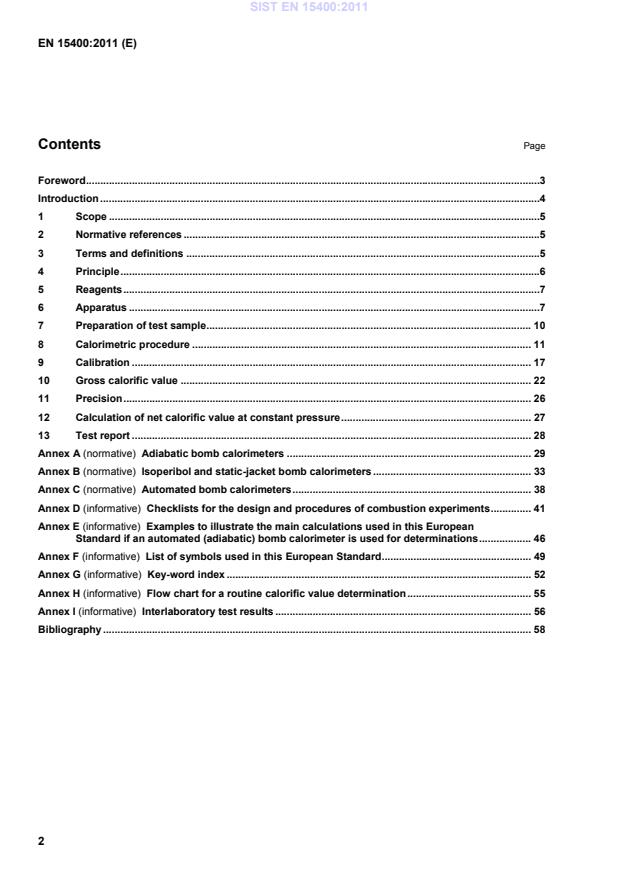
Adiabatic bomb calorimeters . 29Annex B (normative)
Isoperibol and static-jacket bomb calorimeters . 33Annex C (normative)
Automated bomb calorimeters . 38Annex D (informative)
Checklists for the design and procedures of combustion experiments . 41Annex E (informative)
Examples to illustrate the main calculations used in this European Standard if an automated (adiabatic) bomb calorimeter is used for determinations . 46Annex F (informative)
List of symbols used in this European Standard . 49Annex G (informative)
Key-word index . 52Annex H (informative)
Flow chart for a routine calorific value determination . 55Annex I (informative)
Interlaboratory test results . 56Bibliography . 58 SIST EN 15400:2011
Part 1: Determination of bromide, chloride, fluoride, nitrate, nitrite, phosphate and sulfate (ISO 10304-1:2007) 3 Terms and definitions For the purposes of this document, the terms and definitions given in EN 15357:2011 and the following apply. 3.1 gross calorific value at constant volume absolute value of the specific energy of combustion, in Joules, for unit mass of a solid recovered fuel burned in oxygen in a calorimetric bomb under the conditions specified NOTE The products of combustion are assumed to consist of gaseous oxygen, nitrogen, carbon dioxide and sulphur dioxide, of liquid water (in equilibrium with its vapour) saturated with carbon dioxide under the conditions of the bomb reaction, and of solid ash, all at the reference temperature. 3.2 net calorific value at constant volume absolute value of the specific energy of combustion, in Joules, for unit mass of a solid recovered fuel burned in oxygen under conditions of constant volume and such that all the water of the reaction products remains as water vapour (in a hypothetical state at 0,1 MPa), the other products being, as for the gross calorific value, all at the reference temperature 3.3 net calorific value at constant pressure absolute value of the specific heat (enthalpy) of combustion, in Joules, for unit mass of a solid recovered fuel burned in oxygen at constant pressure under such conditions that all the water of the reaction products remains as water vapour (at 0,1 MPa), the other products being as for the gross calorific value, all at the reference temperature SIST EN 15400:2011
Key 1 stirrer (6.2.3) 4 thermometer 2 thermostat lid 5 calorimeter can (6.2.2) 3 ignition leads 6 thermostat (6.2.4) Figure 1 — Classical-type bomb combustion calorimeter with thermostat In aneroid systems (systems without a fluid) the calorimeter can, stirrer and water are replaced by a metal block. The combustion bomb itself constitutes the calorimeter in some aneroid systems. In combustion calorimetric instruments with a high degree of automation, especially in the evaluation of the results, the calorimeter is in a few cases not as well-defined as the traditional, classical-type calorimeter. Using such an automated calorimeter is, however, within the scope of this European Standard as long as the basic requirements are met with respect to calibration conditions, comparability between calibration and fuel experiments, ratio of sample mass to bomb volume, oxygen pressure, bomb liquid, reference temperature of the measurements and repeatability of the results. A print-out of some specified parameters from the individual measurements is essential. Details are given in Annex C. As the room conditions (temperature fluctuation, ventilation etc.) can have an influence on the precision of the determination, the manufacturers instructions for the placing of the instrument shall always be followed. Equipment, adequate for determinations of calorific value in accordance with this European Standard, is specified in 6.2 to 6.8. 6.2 Calorimeter with thermostat 6.2.1 Combustion bomb, capable of withstanding safely the pressures developed during combustion. The design shall permit complete recovery of all liquid products. The material of construction shall resist corrosion by the acids produced in the combustion of solid recovered fuels. A suitable internal volume of the bomb would be from 250 ml to 350 ml. SIST EN 15400:2011
EN 15414-3. 8 Calorimetric procedure 8.1 General The calorimetric determination consists of two separate experiments, combustion of the calibration reference (benzoic acid) and combustion of the solid recovered fuels, both under same specified conditions. The calorimetric procedure for the two types of experiment is essentially the same. In fact, the overall similarity is a requirement for proper cancellation of systematic deviations caused, for example, by uncontrolled heat leaks not accounted for in the evaluation of the corrected temperature rise θ. The experiment consists of quantitatively carrying out a combustion reaction (in high-pressure oxygen in the bomb) to defined products of combustion and of measuring the change in temperature caused by the total bomb process. The temperature measurements required for the evaluation of the corrected temperature rise θ are made during a fore period, a main (= reaction) period, and an after period as outlined in Figure 2. For the adiabatic type calorimeter, the fore and after periods need, in principle, be only as long as required to establish the initial (firing) and final temperatures, respectively (see Annex A). For the isoperibol (isothermal jacket) and the static-jacket type calorimeters, the fore and after periods serve to establish the heat exchange properties of the calorimeter required to allow proper correction for heat exchange between calorimeter and thermostat during the main period if combustion takes place. The fore and after periods then have to be longer (see Annex B). The power of stirring shall be maintained constant throughout an experiment which calls for a constant rate of stirring. An excessive rate of stirring results in an undesirable increase in the power of stirring with ensuing difficulties in keeping it constant. A wobbling stirrer is likely to cause significant short-term variations in stirring power. SIST EN 15400:2011
Key 1 fore period 2 main period 3 after period 4 ignition temperature, Ti Figure 2 — Time-temperature curve (isoperibol calorimeter) During combustion, the bomb head will become appreciably hotter than other parts of the bomb, and it is important to have enough well-stirred water above it to maintain reasonably small temperature gradients in the calorimeter water during the rapid part of the rise in temperature. For aneroid systems, the particular design determines to what extent hot spots can develop (see Annex C). Certain solid recovered fuels can persistently burn incompletely; “exploding” and/or leaving residues that contain significant amounts of unburned sample or soot. By adding known amounts of an auxiliary material
(e.g. benzoic acid, n-dodecane or paraffin oil), by using bags or capsules or cotton fuse, or by omitting the distilled water from the bomb, or by using a lower oxygen filling pressure, clean combustion can in most instances be achieved. The auxiliary material shall be chemically stable, have known composition and purity, a low vapour pressure and a well-established energy of combustion; the energy should be known to within 0,10 % for the particular material used. The amount used should be limited to the minimum amount required to achieve complete combustion of the sample. It should not exceed an amount that contributes half of the total energy in an experiment. The optimum proportion of the sample to auxiliary material depends on the properties of the fuel, and needs to be determined by experiment. The mass of the auxiliary material shall be determined as accurately as possible so that its contribution can be correctly accounted for; this is particularly important if a hydrocarbon oil is used as its specific energy of combustion is considerably higher than that of the solid recovered fuel. 8.2 Preparing the bomb for measurement 8.2.1 General procedure Weigh the sample pellet, or the filled combustion bag or capsule, in the crucible (6.3), with a weighing resolution of 0,01 % or better. For 1 g samples (see 9.2 and 10.2), this means weighing to the nearest 0,1 mg. Weigh the combustible fuse and/or ignition wire either with a precision comparable with that for weighing the sample, or keep its mass constant, within specified limits, for all experiments (see 9.4 and 9.6.1). SIST EN 15400:2011
Tf – Ti = θ + ∆Tex (1) and hence SIST EN 15400:2011
= (Tf – Ti) – ∆Tex (2) There are various ways of evaluating the term ∆Tex, The most comm
...