

CEN/TS 15400:2006
(Main)Solid recovered fuels - Methods for the determination of calorific value
- Abstract
This Technical Specification specifies a method for the determination of gross calorific value of solid recovered fuels at constant volume and at the reference temperature 25 °C in a bomb calorimeter calibrated by combustion of certified benzoic acid.
- Status
- Withdrawn
- Publication Date
- 17-Oct-2006
- Withdrawal Date
- 08-Mar-2011
- Technical Committee
- CEN/TC 343 - Solid Recovered Fuels
- Drafting Committee
- CEN/TC 343/WG 4 - Physical/Mechanical tests
- Current Stage
- 9960 - Withdrawal effective - Withdrawal
- Start Date
- 09-Mar-2011
- Completion Date
- 09-Mar-2011



Relations
- Effective Date
- 12-Mar-2011
Get Certified
Connect with accredited certification bodies for this standard

Element Materials Technology
Materials testing and product certification.

ABS Group Brazil
ABS Group certification services in Brazil.

ABS Quality Evaluations Inc.
American Bureau of Shipping quality certification.
Sponsored listings
Frequently Asked Questions
CEN/TS 15400:2006 is a technical specification published by the European Committee for Standardization (CEN). Its full title is "Solid recovered fuels - Methods for the determination of calorific value". This standard covers: This Technical Specification specifies a method for the determination of gross calorific value of solid recovered fuels at constant volume and at the reference temperature 25 °C in a bomb calorimeter calibrated by combustion of certified benzoic acid.
This Technical Specification specifies a method for the determination of gross calorific value of solid recovered fuels at constant volume and at the reference temperature 25 °C in a bomb calorimeter calibrated by combustion of certified benzoic acid.
CEN/TS 15400:2006 is classified under the following ICS (International Classification for Standards) categories: 75.160.10 - Solid fuels; 75.160.40 - Biofuels. The ICS classification helps identify the subject area and facilitates finding related standards.
CEN/TS 15400:2006 has the following relationships with other standards: It is inter standard links to EN 15400:2011. Understanding these relationships helps ensure you are using the most current and applicable version of the standard.
CEN/TS 15400:2006 is associated with the following European legislation: Standardization Mandates: M/325. When a standard is cited in the Official Journal of the European Union, products manufactured in conformity with it benefit from a presumption of conformity with the essential requirements of the corresponding EU directive or regulation.
CEN/TS 15400:2006 is available in PDF format for immediate download after purchase. The document can be added to your cart and obtained through the secure checkout process. Digital delivery ensures instant access to the complete standard document.
Standards Content (Sample)
SLOVENSKI STANDARD
01-marec-2007
Trdno alternativno gorivo - Metode za ugotavljanje kurilne vrednosti
Solid recovered fuels - Methods for the determination of calorific value
Feste Sekundärbrennstoffe - Verfahren zur Bestimmung des Brennwertes
Combustibles solides de récupération - Méthodes pour la détermination du pouvoir
calorifique
Ta slovenski standard je istoveten z: CEN/TS 15400:2006
ICS:
75.160.10 Trda goriva Solid fuels
2003-01.Slovenski inštitut za standardizacijo. Razmnoževanje celote ali delov tega standarda ni dovoljeno.
TECHNICAL SPECIFICATION
CEN/TS 15400
SPÉCIFICATION TECHNIQUE
TECHNISCHE SPEZIFIKATION
October 2006
ICS 75.160.10
English Version
Solid recovered fuels - Methods for the determination of calorific
value
Combustibles solides de récupération - Méthodes pour la Feste Sekundärbrennstoffe - Verfahren zur Bestimmung
détermination du pouvoir calorifique des Brennwertes
This Technical Specification (CEN/TS) was approved by CEN on 25 March 2006 for provisional application.
The period of validity of this CEN/TS is limited initially to three years. After two years the members of CEN will be requested to submit their
comments, particularly on the question whether the CEN/TS can be converted into a European Standard.
CEN members are required to announce the existence of this CEN/TS in the same way as for an EN and to make the CEN/TS available
promptly at national level in an appropriate form. It is permissible to keep conflicting national standards in force (in parallel to the CEN/TS)
until the final decision about the possible conversion of the CEN/TS into an EN is reached.
CEN members are the national standards bodies of Austria, Belgium, Cyprus, Czech Republic, Denmark, Estonia, Finland, France,
Germany, Greece, Hungary, Iceland, Ireland, Italy, Latvia, Lithuania, Luxembourg, Malta, Netherlands, Norway, Poland, Portugal, Romania,
Slovakia, Slovenia, Spain, Sweden, Switzerland and United Kingdom.
EUROPEAN COMMITTEE FOR STANDARDIZATION
COMITÉ EUROPÉEN DE NORMALISATION
EUROPÄISCHES KOMITEE FÜR NORMUNG
Management Centre: rue de Stassart, 36 B-1050 Brussels
© 2006 CEN All rights of exploitation in any form and by any means reserved Ref. No. CEN/TS 15400:2006: E
worldwide for CEN national Members.
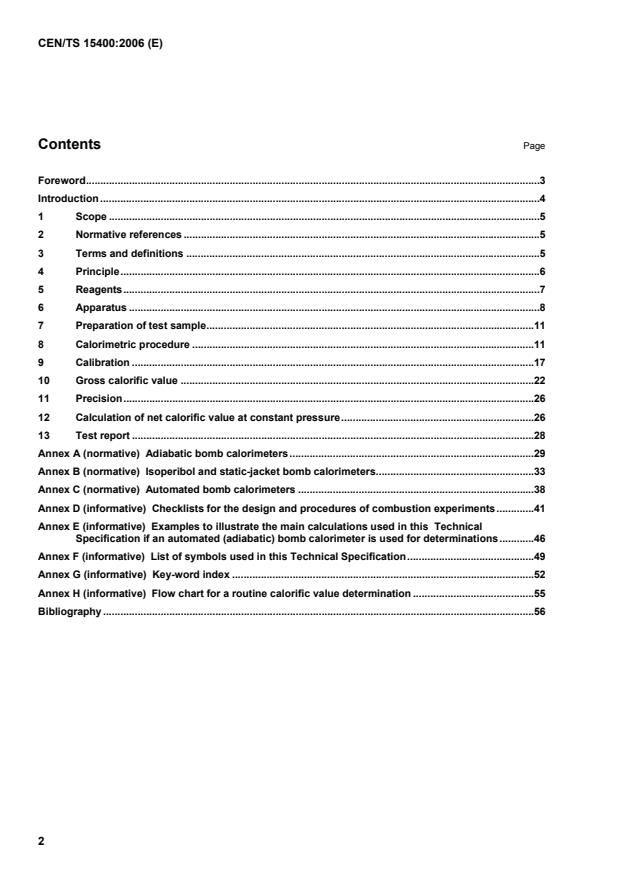
Contents Page
Foreword.3
Introduction .4
1 Scope .5
2 Normative references .5
3 Terms and definitions .5
4 Principle.6
5 Reagents.7
6 Apparatus .8
7 Preparation of test sample.11
8 Calorimetric procedure .11
9 Calibration .17
10 Gross calorific value .22
11 Precision.26
12 Calculation of net calorific value at constant pressure.26
13 Test report .28
Annex A (normative) Adiabatic bomb calorimeters.29
Annex B (normative) Isoperibol and static-jacket bomb calorimeters.33
Annex C (normative) Automated bomb calorimeters .38
Annex D (informative) Checklists for the design and procedures of combustion experiments.41
Annex E (informative) Examples to illustrate the main calculations used in this Technical
Specification if an automated (adiabatic) bomb calorimeter is used for determinations.46
Annex F (informative) List of symbols used in this Technical Specification.49
Annex G (informative) Key-word index .52
Annex H (informative) Flow chart for a routine calorific value determination .55
Bibliography .56
Foreword
This document (CEN/TS 15400:2006) has been prepared by Technical Committee CEN/TC 343 “Solid
recovered fuels”, the secretariat of which is held by SFS.
According to the CEN/CENELEC Internal Regulations, the national standards organizations of the following
countries are bound to announce this Technical Specification: Austria, Belgium, Cyprus, Czech Republic,
Denmark, Estonia, Finland, France, Germany, Greece, Hungary, Iceland, Ireland, Italy, Latvia, Lithuania,
Luxembourg, Malta, Netherlands, Norway, Poland, Portugal, Romania, Slovakia, Slovenia, Spain, Sweden,
Switzerland and the United Kingdom.
Introduction
WARNING — Strict adherence to all of the provisions specified in this Technical Specification should
ensure against explosive rupture of the bomb, or a blow-out, provided that the bomb is of proper
design and construction and in good mechanical condition.
This Technical Specification is based on ISO 1928:1995 and CEN/TS 14918 and modified to solid recovered
fuels with some additions and alterations specific to solid recovered fuels properties.
The result obtained is the gross calorific value of the sample analysed at constant volume with all the water of
the combustion products as liquid water. In practice, solid recovered fuels are burned at a constant
(atmospheric) pressure and the water is either not condensed (removed as vapour with the flue gases) or
condensed. Under both conditions, the operative heat of combustion to be used is the net calorific value of the
fuel at constant pressure. The net calorific value at constant volume can also be used; equations are given for
calculating both values.
General principles and procedures for the calibrations and the solid recovered fuels experiments are
presented in the normative text, whereas those pertaining to the use of a particular type of calorimetric
instrument are specified in Annexes A to C. Annex D contains checklists for performing calibration and fuel
experiments using specified types of calorimeters. Annex E gives examples to illustrate some of the
calculations.
1 Scope
This Technical Specification specifies a method for the determination of gross calorific value of solid
recovered fuels at constant volume and at the reference temperature 25 °C in a bomb calorimeter calibrated
by combustion of certified benzoic acid.
2 Normative references
The following referenced documents are indispensable for the application of this Technical Specification. For
dated references, only the edition cited applies. For undated references, the latest edition of the referenced
document (including any amendments) applies.
CEN/TS 15296, Solid biofuels — Calculation of analyses to different bases
CEN/TS 15357:2006, Solid recovered fuels — Terminology, definitions and descriptions
CEN/TS 15358, Solid recovered fuels — Quality management systems — Particular requirements for their
application to the production of solid recovered fuels
prCEN/TS 15443, Solid recovered fuels — Methods for laboratory sample preparation
CEN/TS 15414-3, Solid recovered fuels — Determination of moisture content using the oven dry method —
Part 3: Moisture in general analysis sample
prCEN/TS 15440, Solid recovered fuels – Method for the determination of biomass content
EN ISO 10304-1, Water quality — Determination of dissolved fluoride, chloride, nitrite, orthophosphate,
bromide, nitrate and sulfate ions, using liquid chromatography of ions — Part 1: Method for water with low
contamination (ISO 10304-1:1992)
3 Terms and definitions
For the purposes of this Technical Specification, the terms and definitions given in CEN/TS 15357:2006 and
the following apply.
3.1
gross calorific value at constant volume
absolute value of the specific energy of combustion, in Joules, for unit mass of a solid recovered fuel burned
in oxygen in a calorimetric bomb under the conditions specified. The products of combustion are assumed to
consist of gaseous oxygen, nitrogen, carbon dioxide and sulphur dioxide, of liquid water (in equilibrium with its
vapour) saturated with carbon dioxide under the conditions of the bomb reaction, and of solid ash, all at the
reference temperature
3.2
net calorific value at constant volume
absolute value of the specific energy of combustion, in Joules, for unit mass of a solid recovered fuel burned
in oxygen under conditions of constant volume and such that all the water of the reaction products remains as
water vapour (in a hypothetical state at 0,1 MPa), the other products being, as for the gross calorific value, all
at the reference temperature
3.3
net calorific value at constant pressure
absolute value of the specific heat (enthalpy) of combustion, in Joules, for unit mass of a solid recovered fuel
burned in oxygen at constant pressure under such conditions that all the water of the reaction products
remains as water vapour (at 0,1 MPa), the other products being as for the gross calorific value, all at the
reference temperature
3.4
reference temperature
international reference temperature for thermo-chemistry of 25 °C is adopted as the reference temperature for
calorific values (see 8.7)
NOTE The temperature dependence of the calorific value of solid recovered fuels is small [less than 1 J/(g × K)].
3.5
effective heat capacity of the calorimeter
amount of energy required to cause unit change in temperature of the calorimeter
3.6
corrected temperature rise
change in calorimeter temperature caused solely by the processes taking place within the combustion bomb.
It is the total observed temperature rise corrected for heat exchange, stirring power etc. (see 8.6).
NOTE The change in temperature can be expressed in terms of other units: resistance of a platinum or thermistor
thermometer, frequency of a quartz crystal resonator etc., provided that a functional relationship is established between
this quantity and a change in temperature. The effective heat capacity of the calorimeter can be expressed in units of
energy per such an arbitrary unit. Criteria for the required linearity and closeness in conditions between calibrations and
fuel experiments are given in 9.3.
A list of the symbols used and their definitions is given in Annex F.
4 Principle
4.1 Gross calorific value
A weighed portion of the analysis sample of a solid recovered fuel is burned in high-pressure oxygen in a
bomb calorimeter under specified conditions. The effective heat capacity of the calorimeter is determined in
calibration experiments by the combustion of certified benzoic acid under similar conditions, accounted for in
the certificate. The corrected temperature rise is established from observations of temperature before, during
and after the combustion reaction takes place. The duration and frequency of the temperature observations
depend on the type of calorimeter used. Water is added to the bomb initially to give a saturated vapour phase
prior to combustion (see 8.2.1 and 9.2.2), thereby allowing all the water formed, from the hydrogen and
moisture in the sample, to be regarded as liquid water.
The gross calorific value is calculated from the corrected temperature rise and the effective heat capacity of
the calorimeter, with allowances made for contributions from ignition energy, combustion of the fuse(s) and for
thermal effects from side reactions such as the formation of nitric acid. Furthermore, a correction is applied to
account for the difference in energy between the aqueous sulphuric acid formed in the bomb reaction and
gaseous sulphur dioxide, i.e. the required reaction product of sulphur in the solid recovered fuel. The
corresponding energy effect between aqueous and gaseous hydrochloric acid is neglected for solid recovered
fuels.
NOTE The corresponding energy effect between aqueous and gaseous hydrochloric acid depends on the sample
characteristics, e.g. the content of inorganic and organic chlorine, mineral composition and the actual pH-value in bomb
liquid. At the present time no values are available for this chlorine correction. Attention should be paid to the extremely
high chlorine content in the test sample because e.g. PVC fractions can affect the calorific value significantly.
4.2 Net calorific value
The net calorific value at constant volume and the net calorific value at constant pressure of the solid
recovered fuel are obtained by calculation from the gross calorific value at constant volume determined on the
analysis sample. The calculation of the net calorific value at constant volume requires information about the
moisture and hydrogen contents of the analysis sample. In principle, the calculation of the net calorific value at
constant pressure also requires information about the oxygen and nitrogen contents of the sample.
5 Reagents
5.1 Oxygen, at a pressure high enough to fill the bomb to 3 MPa, pure with an assay of at least
99,5 % volume fraction, and free from combustible matter.
NOTE Oxygen made by the electrolytic process can contain up to 4 % volume fraction of hydrogen.
5.2 Fuse
5.2.1 Ignition wire, of nickel-chromium 0,16 mm to 0,20 mm in diameter, platinum 0,05 mm to 0,10 mm in
diameter, or another suitable conducting wire with well-characterized thermal behaviour during combustion.
5.2.2 Cotton fuse, of white cellulose cotton, or equivalent, if required (see NOTE 1 of 8.2.1).
5.3 Combustion aids, of known gross calorific value, composition and purity, e.g. benzoic acid,
n-dodecane, paraffin oil, combustion bags or capsules.
5.4 Standard volumetric solutions and indicators, only for use if analysis of final bomb solutions is
required.
5.4.1 Barium hydroxide solution, c[Ba(OH) ] = 0,05 mol/l.
5.4.2 Sodium carbonate solution, c(Na C0 ) = 0,05 mol/I.
2 3
5.4.3 Sodium hydroxide solution, c(NaOH) = 0,1 mol/I.
5.4.4 Hydrochloric acid solution, c(HCI) = 0,1 mol/I.
5.4.5 Screened methyl orange indicator, 1 g/I solution: Dissolve 0,25 g of methyl orange and 0,15 g of
xylene cyanole FF in 50 ml of ethanol with a volume fraction of 95 % and dilute to 250 ml with water.
5.4.6 Phenolphthalein, 10 g/I solution: Dissolve 2,5 g of phenolphthalein in 250 ml ethanol with a volume
fraction of 95 %.
5.5 Benzoic acid, of calorimetric-standard quality, certified by (or with certification unambiguously traceable
to) a recognized standardizing authority.
NOTE 1 Benzoic acid is the sole substance recommended for calibration of an oxygen-bomb calorimeter. For the
purpose of checking the overall reliability of the calorimetric measurements, test substances, e.g. n-dodecane, are used.
Test substances are mainly used to prove that certain characteristics of a sample, e.g. burning rate or chemical
composition, do not introduce bias in the results.
NOTE 2 The benzoic acid is burned in the form of pellets. It is usually used without drying or any treatment other than
pelletizing; the sample certificate provides information. It does not absorb moisture from the atmosphere at relative
humidities below 90 %.
The benzoic acid shall be used as close to certification conditions as is feasible; significant departures from
these conditions shall be accounted for in accordance with the directions in the certificate. The energy of
combustion of the benzoic acid, as defined by the certificate for the conditions utilized, shall be adopted in
calculating the effective heat capacity of the calorimeter (see 9.2).
6 Apparatus
6.1 General
The calorimeter (see Figure 1), consists of the assembled combustion bomb (6.2.1), the calorimeter
can (6.2.2) (with or without a lid), the calorimeter stirrer (6.2.3), water, temperature sensor, and leads with
connectors inside the calorimeter can required for ignition of the sample or as part of temperature
measurement or control circuits. During measurements the calorimeter is enclosed in a thermostat (6.2.4).
The manner in which the thermostat temperature is controlled defines the working principle of the instrument
and hence the strategy for evaluation of the corrected temperature rise.
Key
1 stirrer (6.2.3) 4 thermometer
2 thermostat lid 5 calorimeter can (6.2.2)
3 ignition leads 6 thermostat (6.2.4)
Figure 1 — Classical-type bomb combustion calorimeter with thermostat
In aneroid systems (systems without a fluid) the calorimeter can, stirrer and water are replaced by a metal
block. The combustion bomb itself constitutes the calorimeter in some aneroid systems.
In combustion calorimetric instruments with a high degree of automation, especially in the evaluation of the
results, the calorimeter is in a few cases not as well-defined as the traditional, classical-type calorimeter.
Using such an automated calorimeter is, however, within the scope of this Technical Specification as long as
the basic requirements are met with respect to calibration conditions, comparability between calibration and
fuel experiments, ratio of sample mass to bomb volume, oxygen pressure, bomb liquid, reference temperature
of the measurements and repeatability of the results. A print-out of some specified parameters from the
individual measurements is essential. Details are given in Annex C.
As the room conditions (temperature fluctuation, ventilation etc.) can have an influence on the precision of the
determination, the manufacturers instructions for the placing of the instrument shall always be followed.
Equipment, adequate for determinations of calorific value in accordance with this Technical Specification, is
specified in 6.2 to 6.8.
6.2 Calorimeter with thermostat
6.2.1 Combustion bomb, capable of withstanding safely the pressures developed during combustion. The
design shall permit complete recovery of all liquid products. The material of construction shall resist corrosion
by the acids produced in the combustion of solid recovered fuels. A suitable internal volume of the bomb
would be from 250 ml to 350 ml.
WARNING — Bomb parts shall be inspected regularly for wear and corrosion; particular attention
shall be paid to the condition of the threads of the main closure. Manufacturers' instructions and any
local regulations regarding the safe handling and use of the bomb shall be observed. If more than one
bomb of the same design is used, it is imperative to use each bomb as a complete unit. Swapping of
parts can lead to a serious accident.
6.2.2 Calorimeter can, made of metal, highly polished on the outside and capable of holding an amount of
water sufficient to completely cover the flat upper surface of the bomb while the water is being stirred. A lid
generally helps reduce evaporation of calorimeter water, but unless it is in good thermal contact with the can it
lags behind in temperature during combustion, giving rise to undefined heat exchange with the thermostat and
a prolonged main period.
6.2.3 Stirrer, working at constant speed. The stirrer shaft should have a low-heat-conduction and/or a
low-mass section below the cover of the surrounding thermostat (6.2.4) to minimise transmission of heat to or
from the system; this is of particular importance if the stirrer shaft is in direct contact with the stirrer motor. If a
lid is used for the calorimeter can (6.2.2), this section of the shaft should be above the lid.
NOTE The rate of stirring for a stirred-water type calorimeter should be large enough to make sure that hot spots do
not develop during the rapid part of the change in temperature of the calorimeter. A rate of stirring such that the length of
the main period can be limited to 10 min or less is usually adequate (see Annexes A and B).
6.2.4 Thermostat (water jacket), completely surrounding the calorimeter, with an air gap of approximately
10 mm separating calorimeter and thermostat.
The mass of water of a thermostat intended for isothermal operation shall be sufficiently large to outbalance
thermal disturbances from the outside. The temperature should be controlled to within ± 0,1 K or better
throughout the experiment. A passive constant temperature (“static”) thermostat shall have a heat capacity
large enough to restrict the change in temperature of its water. Criteria for satisfactory behaviour of this type of
water jacket are given in Annex B.
NOTE 1 For an insulated metal static jacket, satisfactory properties are usually ensured by making a wide annular
jacket with a capacity for water of at least 12,5 I.
NOTE 2 Calorimeters surrounded by insulating material, creating a thermal barrier, are regarded as static-jacket
calorimeters.
If the thermostat (water jacket) is required to follow closely the temperature of the calorimeter, it should be of
low mass and preferably have immersion heaters. Energy shall be supplied at a rate sufficient to maintain the
temperature of the water in the thermostat to within 0,1 K of that of the calorimeter water after the charge has
been fired. If in a steady state at 25 °C, the calculated mean drift in temperature of the calorimeter shall not
exceed 0,000 5 K/min (see A.3.2).
6.2.5 Temperature measuring instrument, capable of indicating temperature with a resolution of at least
0,001 K so that temperature intervals of 2 K to 3 K can be determined with a resolution of 0,002 K or better.
The absolute temperature shall be known to the nearest 0,1 K at the reference temperature of the calorimetric
measurements. The temperature measuring device should be linear, or linearized, in its response to changes
in temperature over the interval it is used.
As alternatives to the traditional mercury-in-glass thermometers, suitable temperature sensors are platinum
resistance thermometers, thermistors, quartz crystal resonators etc. which together with a suitable resistance
bridge, null detector, frequency counter or other electronic equipment provide the required resolution. The
short-term repeatability of this type of device shall be 0,001 K or better. Long-term drift shall not exceed the
equivalent of 0,05 K for a period of six months. For sensors with linear response (in terms of temperature),
drift is less likely to cause bias in the calorimetric measurements than are non-linear sensors.
Mercury-in-glass thermometers which conform to ISO 651, ISO 652, ISO 1770 or ISO 1771 satisfy the
requirements. A viewer with magnification about 5× is needed for reading the temperature with the resolution
required.
A mechanical vibrator to tap the thermometer is suitable for preventing the mercury column from sticking (see
8.4). If this is not available, the thermometer shall be tapped manually before reading the temperature.
6.2.6 Ignition circuit
The electrical supply shall be 6 V to 12 V alternating current from a step-down transformer or direct current
from batteries. It is desirable to include a pilot light in the circuit to indicate if current is flowing.
Where the firing is done manually, the firing switch shall be of the spring-loaded, usually open type, located in
such a manner that any undue risk to the operator is avoided (see warning in 8.4).
6.3 Crucible, of silica, nickel-chromium, platinum or similar unreactive material.
The crucible should be 15 mm to 25 mm in diameter, flat based and about 20 mm deep. Silica crucibles
should be about 1,5 mm thick and metal crucibles about 0,5 mm thick.
If smears of unburned carbon occur, a small low-mass platinum or nickel-chromium crucible, for example
0,25 mm thick, 15 mm in diameter and 7 mm deep, may be used.
6.4 Ancillary pressure equipment
6.4.1 Pressure regulator, to control the filling of the bomb with oxygen.
6.4.2 Pressure gauge (e.g. 0 MPa to 5 MPa), to indicate the pressure in the bomb with a resolution of
0,05 MPa.
6.4.3 Relief valve or bursting disk, operating at 3,5 MPa, and installed in the filling line, to prevent
overfilling the bomb.
CAUTION — Equipment for high-pressure oxygen shall be kept free from oil and grease (high vacuum
grease recommended by the manufacturer may be used according to the operating manual of the
instrument). Do not test or calibrate the pressure gauge with hydrocarbon fluid.
6.5 Timer, indicating minutes and seconds.
6.6 Balances
6.6.1 Balance for weighing the sample, fuse, with a resolution of at least 0,1 mg; 0,01 mg is preferable
and is recommended if the sample mass is of the order of 0,5 g or less (see 8.2.1).
6.6.2 Balance for weighing the calorimeter water, with a resolution of 0,5 g (unless water can be
dispensed into the calorimeter by volume with the required accuracy, see 8.3).
6.7 Thermostat (optional), for equilibrating the calorimeter water before each experiment to a
predetermined initial temperature, within about ± 0,3 K.
6.8 Pellet press, capable of applying a pressure resulting from a mass of about 10 kg, either hydraulically
or mechanically, and having a die suitable to press a pellet having a diameter of about 13 mm and a mass of
(1 ± 0,1) g.
7 Preparation of test sample
The solid recovered fuel sample used for the determination of calorific value shall be the general analysis
sample (ground to pass a test sieve with an aperture of 1,0 mm) prepared according to the procedure given in
prCEN/TS 15443.
The preparation of test sample for determining calorific value of biomass/non-biomass part of SRF shall be
carried out in accordance with prCEN/TS 15440.
Due to the low density of solid recovered fuels they shall be tested in a pellet form. Press a pellet with a mass
of (1 ± 0,1) g with a suitable force to produce a compact test piece. Alternatively, the test may be carried out in
powder form, closed in a combustion bag or capsule.
NOTE 1 For sample materials containing high content of plastics or rubber, the mass of the sample should be reduced
to a mass in the range from 0,4 g to 0,8 g.
NOTE 2 For sample materials containing a mass fraction of ash ≥ 30 % on dry basis, it is recommended to use a
combustion aid (see 8.2.2).
The sample shall be well-mixed and in reasonable moisture equilibrium with the laboratory atmosphere. The
moisture content shall either be determined simultaneously with the weighing of the samples for the
determination of calorific value or the sample shall be kept in a small, effectively closed container until
moisture analyses are performed, to allow appropriate corrections for moisture in the analysis sample.
The moisture content of the analysis sample shall be determined in accordance with
CEN/TS 15414-3.
8 Calorimetric procedure
8.1 General
The calorimetric determination consists of two separate experiments, combustion of the calibration reference
(benzoic acid) and combustion of the solid recovered fuels, both under same specified conditions. The
calorimetric procedure for the two types of experiment is essentially the same. In fact, the overall similarity is a
requirement for proper cancellation of systematic deviations caused, for example, by uncontrolled heat leaks
not accounted for in the evaluation of the corrected temperature rise θ.
The experiment consists of quantitatively carrying out a combustion reaction (in high-pressure oxygen in the
bomb) to defined products of combustion and of measuring the change in temperature caused by the total
bomb process.
The temperature measurements required for the evaluation of the corrected temperature rise θ are made
during a fore period, a main (= reaction) period, and an after period as outlined in Figure 2. For the adiabatic
type calorimeter, the fore and after periods need, in principle, be only as long as required to establish the
initial (firing) and final temperatures, respectively (see Annex A). For the isoperibol (isothermal jacket) and the
static-jacket type calorimeters, the fore and after periods serve to establish the heat exchange properties of
the calorimeter required to allow proper correction for heat exchange between calorimeter and thermostat
during the main period if combustion takes place. The fore and after periods then have to be longer (see
Annex B).
The power of stirring shall be maintained constant throughout an experiment which calls for a constant rate of
stirring. An excessive rate of stirring results in an undesirable increase in the power of stirring with ensuing
difficulties in keeping it constant. A wobbling stirrer is likely to cause significant short-term variations in stirring
power.
Key
1 fore period
2 main period
3 after period
4 ignition temperature, T
i
Figure 2 — Time-temperature curve (isoperibol calorimeter)
During combustion, the bomb head will become appreciably hotter than other parts of the bomb, and it is
important to have enough well-stirred water above it to maintain reasonably small temperature gradients in the
calorimeter water during the rapid part of the rise in temperature. For aneroid systems, the particular design
determines to what extent hot spots can develop (see Annex C).
Certain solid recovered fuels can persistently burn incompletely; “exploding” and/or leaving residues that
contain significant amounts of unburned sample or soot. By adding known amounts of an auxiliary material
(e.g. benzoic acid, n-dodecane or paraffin oil), by using bags or capsules or cotton fuse, or by omitting the
distilled water from the bomb, or by using a lower oxygen filling pressure, clean combustion can in most
instances be achieved.
The auxiliary material shall be chemically stable, have known composition and purity, a low vapour pressure
and a well-established energy of combustion; the energy should be known to within 0,10 % for the particular
material used. The amount used should be limited to the minimum amount required to achieve complete
combustion of the sample. It should not exceed an amount that contributes half of the total energy in an
experiment. The optimum proportion of the sample to auxiliary material depends on the properties of the fuel,
and needs to be determined by experiment.
The mass of the auxiliary material shall be determined as accurately as possible so that its contribution can be
correctly accounted for; this is particularly important if a hydrocarbon oil is used as its specific energy of
combustion is considerably higher than that of the solid recovered fuel.
8.2 Preparing the bomb for measurement
8.2.1 General procedure
Weigh the sample pellet, or the filled combustion bag or capsule, in the crucible (6.3), with a weighing
resolution of 0,01 % or better. For 1 g samples (see 9.2 and 10.2), this means weighing to the nearest 0,1 mg.
Weigh the combustible fuse and/or ignition wire either with a precision comparable with that for weighing the
sample, or keep its mass constant, within specified limits, for all experiments (see 9.4 and 9.6.1).
Fasten the ignition wire securely between the electrodes in the combustion bomb (6.2.1) (see also NOTE 1).
Check the resistance of the ignition circuit of the bomb; for most bombs it shall not exceed 10 Ω, measured
between the outside connectors of the bomb head, or between the connector for the insulated electrode and
the bomb head.
Tie, or attach firmly, the fuse (if needed, see NOTE 1) to the ignition wire, place the crucible in its support and
bring the fuse into contact with the sample pellet or capsule. Make sure that the position of the crucible in the
assembled bomb is symmetrical with respect to the surrounding bomb wall.
If the ignition wire is combustible as well as electrically conducting, an alternative procedure may be adopted.
A longer piece of wire, enough to make an open loop, may be connected to the electrodes. After mounting of
the crucible, the loop shall be brought in contact with the sample pellet or capsule. For some types of
calorimeters the ignition process is better checked if the wire is kept at a small distance above the sample
pellet.
NOTE 1 Care should be taken to prevent any contact between ignition wire and crucible, in particular if a metal crucible
is used since this would result in shorting the ignition circuit. A special fuse is superfluous under these conditions. The
resistance of the ignition circuit of the bomb will be increased by a small amount only. For closer details of preparing the
bomb refer also to manufacturers instructions.
Add a defined amount of distilled water to the combustion bomb (6.2.1). The amount shall always be exactly
the same in both calibration and in determinations (see 9.2.1 and 9.2.2).
NOTE 2 As a main principle for solid recovered fuels, (1,0 ± 0,1) ml distilled water is added into the bomb. With some
solid recovered fuels (and some calorimeters) the complete combustion can be achieved by omitting the distilled water
from the bomb or by using a combustion aid. In some cases, the total absorption of the gaseous combustion products can
provide the use of a larger amount of distilled water (e.g. 5 ml).
Assemble the combustion bomb (6.2.1) and charge it slowly with oxygen to a pressure of (3,0 ± 0,2) MPa
without displacing the original air or, flush the bomb (with the outlet valve open, see manufacturers
instructions) with oxygen for about 30 s, close the valve slowly and charge the bomb to the pressure of
(3,0 ± 0,2) MPa. The same procedure shall be used both in calibration and in determinations. If the bomb is
inadvertently charged with oxygen above 3,3 MPa, discard the test and begin again.
WARNING — Do not reach over the combustion bomb during charging.
The combustion bomb (6.2.1) is now ready for mounting in the calorimeter can (6.2.2).
8.2.2 Using combustion aids
The following combustion aids may be used:
a) Liquid combustion aid: After the mass of the sample pellet has been determined, the auxiliary liquid
material shall be added drop by drop on the pellet placed in the crucible, allowing the liquid to be
absorbed; and determined precisely by weighing;
b) Solid combustion aid: Solid combustion aids (benzoic acid recommended) should not be used without
combustion bags or capsules.
NOTE It can be difficult to achieve a homogenous mixture of sample and combustion aid before pressing the test pellet.
c) Combustion bags or capsules: Combustion capsules or bags, or combustible crucibles with precisely
known calorific value (gelatine, aceto butyrate or polyethylene) may be used as combustion aids (as such or
with e.g. benzoic acid) according to the manufacturers instructions. They shall be weighed precisely before
filling (see also 8.1). The sample and the combustion aid like benzoic acid shall be mixed cautiously in the bag
or capsule before testing.
8.3 Assembling the calorimeter
Bring the calorimeter water to within ± 0,3 K of the selected initial temperature and fill the calorimeter
can (6.2.2) with the required amount. The quantity of water in the calorimeter shall be the same to within 0,5 g
or better, in all experiments (see 9.6.1). Make sure that the outer surface of the can is dry and clean before
the latter is placed in the thermostat (6.2.4). Mount the combustion bomb (6.2.1) in the calorimeter can
containing the correct amount of water after the can has been placed in the thermostat.
Alternatively, the system may be operated on a constant total-calorimeter-mass basis (see 9.6.2). The
combustion bomb (6.2.1) is then mounted in the calorimeter can (6.2.2) before this is weighed with the water.
The total mass of the calorimeter can, with the assembled bomb and the calorimeter water, shall be within the
limiting deviation of 0,5 g or better in all experiments.
The assembled calorimeter shall contain enough water to cover completely the flat upper surface of the bomb
head and cap.
Weigh the water to within 0,5 g if the effective heat capacity is in the order of 10 kJ/K.
Check the combustion bomb (6.2.1) for gas leaks as soon as its top becomes covered with water. If the gas
valves are not fully submerged, check for leaks with a drop of water across the exposed opening. Connect the
leads for the ignition circuit (6.2.6) and mount the thermometer.
WARNING — If gas escapes from the bomb, discard the test, eliminate the cause of leakage and begin
again. Apart from being a hazard, leaks will inevitably lead to erroneous results.
Cooling water, temperature controls, stirrers etc. are turned on and adjusted, as outlined in the instrument
manual. Make sure that the calorimeter stirrer (6.2.3) works properly. A period of about 5 min is usually
required for the assembled calorimeter to reach a steady state in the thermostat or jacket, irrespective of the
type of calorimeter. The criteria for when steady state has been attained depend on the working principle of
the calorimeter (see Annexes A and B).
8.4 Combustion reaction and temperature measurements
Start taking temperature readings, to the nearest 0,001 K or better, as soon as the calorimeter has reached
steady-state conditions. Readings at 1 min intervals usually suffices to establish the drift rate of the fore period
or check the proper functioning of an adiabatic system. If a mercury-in-glass thermometer is used for the
temperature measurements, tap the thermometer lightly for about 10 s before each reading and take care to
avoid parallax deviations.
At the end of the fore period, if the initial temperature T has been established, the combustion is initiated by
i
firing the fuse. Hold the switch closed only for as long as it takes to ignite the fuse. Usually, the current is
automatically interrupted as the conducting wire starts burning or partially melts. As long as the resistance of
the ignition circuit of the combustion bomb is kept at its usual low value, the electrical energy required to
initiate the reaction is so small that there is no need to measure and account for it separately.
WARNING — Do not extend any part of the body over the calorimeter during firing, nor for 20 s
thereafter.
Continue taking temperature readings at 1 min intervals. The time corresponding to T marks the beginning of
i
the main period. During the first few minutes after the charge has been fired, if the temperature is rising rapidly,
readings to the nearest 0,02 K are adequate. Resume reading temperatures to the nearest 0,001 K or better
as soon as is practicable, but no later than 5 min after the beginning of the main period. Criteria for the length
of the fore, main and after periods, and hence the total number of temperature readings required, are given in
Annexes A and B.
8.5 Analysis of products of combustion
At the end of the after period, if all the required temperature readings have been completed, remove the
combustion bomb (6.2.1) from the calorimeter, release the pressure slowly (following manufacturers manual)
and dismantle the bomb. Examine the interior of the bomb, the crucible (6.3) and any solid residue carefully
for signs of incomplete combustion. Discard the test if unburned sample or any soot deposit is visible. Remove
and measure any pieces of combustible ignition wire which have not reacted during the combustion process.
NOTE Another symptom of incomplete combustion is the presence of carbon monoxide in the bomb gas. Slow
release of the gas through a suitable detector tube reveals any presence of carbon monoxide and indicates the
concentration level. 0,1 ml/l of carbon monoxide in the combustion gas from a 300 ml bomb corresponds to a deviation of
about 10 J.
Wash the contents of the bomb into a beaker with distilled water. Make sure that the underside of the bomb
head, the electrodes and the outside of the crucible are also washed.
In the case of calibration experiments, determine the formed nitric acid from the combined bomb washings
either by ion-chromatography (as nitrate) as specified in EN ISO 10304-1 or dilute the combined washings to
about 50 ml and analyse for nitric acid, e.g. by titration with the sodium hydroxide solution (5.4.3) to a pH
value of about 5,5 or by using the screened methyl orange solution (5.4.5) as an indicator.
If the “sulphur” and/or or nitric acid corrections are based on the actual amounts formed in the bomb process,
the bomb washings from fuel combustions shall be analysed by the procedure specified in a) to c) of this
subclause or by an equivalent method. If the sulphur content of the solid recovered fuels and the nitric acid
correction are known, analysis of the final bomb liquid may be omitted (see 10.1).
a) Determine the amounts of nitric and sulphuric acid formed (as nitrate and as sulphate, respectively) by
ion-chromatography as specified in EN ISO 10304-1;
b) Dilute the combined bomb washings to about 100 ml. Boil the washings to expel carbon dioxide and
titrate the solution with barium hydroxide solution (5.4.1) while it is still hot using the phenolphthalein
solution (5.4.6) as an indicator. Add 20,0 ml of the sodium carbonate solution (5.4.2), filter the warm
solution and wash the precipitate with distilled water. If cold, titrate the filtrate with the hydrochloric acid
solution (5.4.4), using the screened methyl orange solution (5.4.5) as an indicator, ignoring the
phenolphthalein colour change;
c) If the sulphur content of the solid recovered fuel is known, the boiled bomb washings may be titrated,
while still hot, with a simplified method using sodium hydroxide solution (5.4.3) and phenolphthalein as an
indicator (5.4.6).
8.6 Corrected temperature rise θ
8.6.1 Observed temperature rise
The temperature at the end of the main period T gives, together with the initial or firing temperature T, the
f i
observed temperature rise T – T .
f i
8.6.2 Isoperibol and static-jacket calorimeters
In addition to the rise in temperature caused by the processes in the combustion bomb, the observed
temperature rise contains contributions from heat exchange between calorimeter and thermostat an
...