

CEN/TR 17439:2020
(Main)Guidance on how to implement EN ISO 19650-1 and -2 in Europe
- Abstract
The scope of this guidance is deliberately restricted only to refer to EN ISO 19650-1 and -2, highlighting and describing the manner in which to use it -and not extending or contradicting the scope and content of the standard The document aims simply to provide minimum supporting text to achieve a basic understanding and ability to implement EN ISO 19650-1 and -2. In each country, each client, each team can use this guidance to provide the best response to information management in each project.
This document explains the terms and definitions, explains the concepts and principles and how to use them, and gives typical examples with clear explanations.
It should be noted that in this guidance, Information Management is considered as a part of the Project Management.
This guidance is intended to demonstrate how the standard works at European level, which is neutral, agnostic, and applicable to any of the following circumstances:
- the nature of contracts: e. g. public; private, alliances, global, partnership,
- the actors' functions: e. g. through the programming, design, construction phases, from small agencies, SMEs to large firms, large companies,
- the types of works: e. g. simple, complex, new, rehabilitated, housing, infrastructure.
- Status
- Published
- Publication Date
- 09-Jun-2020
- Technical Committee
- CEN/TC 442 - Building Information Modelling (BIM)
- Drafting Committee
- CEN/TC 442/WG 3 - Information Delivery Specification
- Current Stage
- 6060 - Definitive text made available (DAV) - Publishing
- Start Date
- 10-Jun-2020
- Due Date
- 07-Mar-2020
- Completion Date
- 10-Jun-2020



Overview
CEN/TR 17439:2020 - "Guidance on how to implement EN ISO 19650‑1 and ‑2 in Europe" is a CEN technical report that explains how to apply the EN ISO 19650 series for information management using Building Information Modelling (BIM). It is a supporting, non‑normative document intended to help practitioners across Europe achieve a consistent, pragmatic implementation of EN ISO 19650‑1 (concepts and principles) and EN ISO 19650‑2 (delivery phase). The guidance is intentionally neutral and does not extend or contradict the standards; it provides explanatory text, examples and implementation scenarios for projects of any scale, contract type or asset type.
Key topics and requirements
- Terms and definitions: Clarifies EN ISO 19650 vocabulary (appointment, appointing/appointed parties, information requirement).
- Information requirements: Explains Exchange Information Requirements (EIR), Task Information Requirements (TIR) and overall Information Requirement concepts.
- Planning and delivery: Discusses BIM Execution Plans (BEP), Master Information Delivery Plans (MIDP) and Task Information Delivery Plans (TIDP).
- Common Data Environment (CDE): Describes CDE concepts, information containers, federation strategies and collaborative production of information.
- Information management processes: Illustrates the EN ISO 19650‑2 delivery process, information delivery cycles, information checking and the information management role as part of project management.
- Scalability and scenarios: Provides examples and practical scenarios for small, mid‑size and complex projects, and how to implement with or without client knowledge of EN ISO 19650.
- Level of Information Need: Explains how to define and apply levels of information throughout delivery and handover phases.
Practical applications
CEN/TR 17439:2020 is designed for practical use in:
- Project delivery and digital collaboration workflows (design, construction, handover)
- Establishing CDE and information exchange rules across multidisciplinary teams
- Preparing tender/EIR documents and contractual information responsibilities
- Defining MIDP/TIDP schedules for coordinated model and data delivery
- Handover to operations and asset management, aligning BIM outputs with O&M needs
Who should use it
- Clients and appointing parties seeking consistent information management
- Project managers, BIM managers and information managers integrating EN ISO 19650
- Architects, engineers, contractors, asset managers and SMEs scaling BIM practices
- Public authorities and private owners implementing European BIM requirements
Related standards
- EN ISO 19650‑1:2018 (Concepts & principles)
- EN ISO 19650‑2:2018 (Delivery phase)
- EN ISO 12006‑2 and EN ISO 12006‑3 (information classification and object frameworks)
CEN/TR 17439:2020 is a practical, Europe‑focused companion to EN ISO 19650 that helps teams turn standard principles into repeatable BIM workflows and coordinated information delivery.
Relations
- Effective Date
- 28-Jan-2026
- Effective Date
- 28-Jan-2026
- Effective Date
- 28-Jan-2026
- Effective Date
- 28-Jan-2026
Get Certified
Connect with accredited certification bodies for this standard

BSI Group
BSI (British Standards Institution) is the business standards company that helps organizations make excellence a habit.

DIBt (Deutsches Institut für Bautechnik)
German Institute for Building Technology.
DIN CERTCO
DIN Group product certification.
Sponsored listings
Frequently Asked Questions
CEN/TR 17439:2020 is a technical report published by the European Committee for Standardization (CEN). Its full title is "Guidance on how to implement EN ISO 19650-1 and -2 in Europe". This standard covers: The scope of this guidance is deliberately restricted only to refer to EN ISO 19650-1 and -2, highlighting and describing the manner in which to use it -and not extending or contradicting the scope and content of the standard The document aims simply to provide minimum supporting text to achieve a basic understanding and ability to implement EN ISO 19650-1 and -2. In each country, each client, each team can use this guidance to provide the best response to information management in each project. This document explains the terms and definitions, explains the concepts and principles and how to use them, and gives typical examples with clear explanations. It should be noted that in this guidance, Information Management is considered as a part of the Project Management. This guidance is intended to demonstrate how the standard works at European level, which is neutral, agnostic, and applicable to any of the following circumstances: - the nature of contracts: e. g. public; private, alliances, global, partnership, - the actors' functions: e. g. through the programming, design, construction phases, from small agencies, SMEs to large firms, large companies, - the types of works: e. g. simple, complex, new, rehabilitated, housing, infrastructure.
The scope of this guidance is deliberately restricted only to refer to EN ISO 19650-1 and -2, highlighting and describing the manner in which to use it -and not extending or contradicting the scope and content of the standard The document aims simply to provide minimum supporting text to achieve a basic understanding and ability to implement EN ISO 19650-1 and -2. In each country, each client, each team can use this guidance to provide the best response to information management in each project. This document explains the terms and definitions, explains the concepts and principles and how to use them, and gives typical examples with clear explanations. It should be noted that in this guidance, Information Management is considered as a part of the Project Management. This guidance is intended to demonstrate how the standard works at European level, which is neutral, agnostic, and applicable to any of the following circumstances: - the nature of contracts: e. g. public; private, alliances, global, partnership, - the actors' functions: e. g. through the programming, design, construction phases, from small agencies, SMEs to large firms, large companies, - the types of works: e. g. simple, complex, new, rehabilitated, housing, infrastructure.
CEN/TR 17439:2020 is classified under the following ICS (International Classification for Standards) categories: 35.240.67 - IT applications in building and construction industry; 91.010.01 - Construction industry in general. The ICS classification helps identify the subject area and facilitates finding related standards.
CEN/TR 17439:2020 has the following relationships with other standards: It is inter standard links to EN ISO 19650-2:2018, EN ISO 12006-2:2020, EN ISO 12006-3:2022, EN ISO 19650-1:2018. Understanding these relationships helps ensure you are using the most current and applicable version of the standard.
CEN/TR 17439:2020 is available in PDF format for immediate download after purchase. The document can be added to your cart and obtained through the secure checkout process. Digital delivery ensures instant access to the complete standard document.
Standards Content (Sample)
SLOVENSKI STANDARD
01-oktober-2020
Navodila za izvajanje EN ISO 19650-1 in EN ISO 19650-2 v Evropi
Guidance on how to implement EN ISO 19650-1 and -2 in Europe
Anleitung zur Umsetzung der EN ISO 19650-1 und -2 in Europa
Conseils sur la mise en oeuvre des normes EN ISO 19650-1 et -2 en Europe
Ta slovenski standard je istoveten z: CEN/TR 17439:2020
ICS:
35.240.67 Uporabniške rešitve IT v IT applications in building
gradbeništvu and construction industry
91.010.01 Gradbeništvo na splošno Construction industry in
general
2003-01.Slovenski inštitut za standardizacijo. Razmnoževanje celote ali delov tega standarda ni dovoljeno.
CEN/TR 17439
TECHNICAL REPORT
RAPPORT TECHNIQUE
June 2020
TECHNISCHER BERICHT
ICS 35.240.67; 91.010.01
English Version
Guidance on how to implement EN ISO 19650-1 and -2 in
Europe
Document d'orientation pour la mise en oeuvre des Anleitung zur Umsetzung der EN ISO 19650-1 und -2 in
normes EN ISO 19650-1 et -2 en Europe Europa
This Technical Report was approved by CEN on 8 December 2019. It has been drawn up by the Technical Committee CEN/TC
442.
CEN members are the national standards bodies of Austria, Belgium, Bulgaria, Croatia, Cyprus, Czech Republic, Denmark, Estonia,
Finland, France, Germany, Greece, Hungary, Iceland, Ireland, Italy, Latvia, Lithuania, Luxembourg, Malta, Netherlands, Norway,
Poland, Portugal, Republic of North Macedonia, Romania, Serbia, Slovakia, Slovenia, Spain, Sweden, Switzerland, Turkey and
United Kingdom.
EUROPEAN COMMITTEE FOR STANDARDIZATION
COMITÉ EUROPÉEN DE NORMALISATION
EUROPÄISCHES KOMITEE FÜR NORMUNG
CEN-CENELEC Management Centre: Rue de la Science 23, B-1040 Brussels
© 2020 CEN All rights of exploitation in any form and by any means reserved Ref. No. CEN/TR 17439:2020 E
worldwide for CEN national Members.
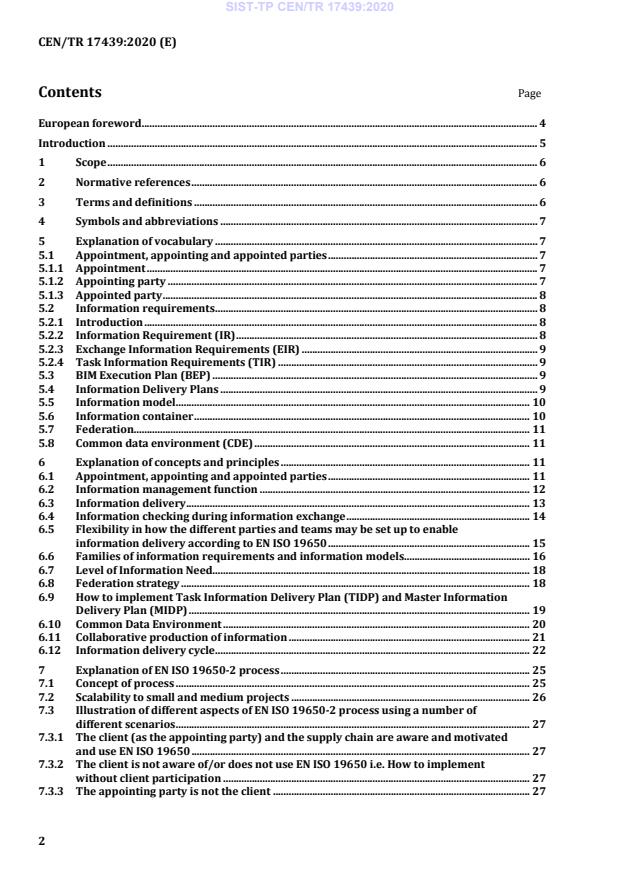
Contents Page
European foreword . 4
Introduction . 5
1 Scope . 6
2 Normative references . 6
3 Terms and definitions . 6
4 Symbols and abbreviations . 7
5 Explanation of vocabulary . 7
5.1 Appointment, appointing and appointed parties . 7
5.1.1 Appointment . 7
5.1.2 Appointing party . 7
5.1.3 Appointed party . 8
5.2 Information requirements . 8
5.2.1 Introduction . 8
5.2.2 Information Requirement (IR) . 8
5.2.3 Exchange Information Requirements (EIR) . 9
5.2.4 Task Information Requirements (TIR) . 9
5.3 BIM Execution Plan (BEP) . 9
5.4 Information Delivery Plans . 9
5.5 Information model . 10
5.6 Information container . 10
5.7 Federation. 11
5.8 Common data environment (CDE) . 11
6 Explanation of concepts and principles . 11
6.1 Appointment, appointing and appointed parties . 11
6.2 Information management function . 12
6.3 Information delivery . 13
6.4 Information checking during information exchange . 14
6.5 Flexibility in how the different parties and teams may be set up to enable
information delivery according to EN ISO 19650 . 15
6.6 Families of information requirements and information models. 16
6.7 Level of Information Need. 18
6.8 Federation strategy . 18
6.9 How to implement Task Information Delivery Plan (TIDP) and Master Information
Delivery Plan (MIDP) . 19
6.10 Common Data Environment . 20
6.11 Collaborative production of information . 21
6.12 Information delivery cycle . 22
7 Explanation of EN ISO 19650-2 process . 25
7.1 Concept of process . 25
7.2 Scalability to small and medium projects . 26
7.3 Illustration of different aspects of EN ISO 19650-2 process using a number of
different scenarios . 27
7.3.1 The client (as the appointing party) and the supply chain are aware and motivated
and use EN ISO 19650 . 27
7.3.2 The client is not aware of/or does not use EN ISO 19650 i.e. How to implement
without client participation . 27
7.3.3 The appointing party is not the client . 27
7.3.4 The delivery team is either a small and simple structure or a large and complex
structure but is delivering a similar project . 28
7.3.5 Explanation of the EN ISO 19650-2 process: The delivery team will continue through
to operation and maintenance . 31
7.4 The project is mid - size and EN ISO 19650 is used for optimizing costs and the
delivery phase . 33
8 Examples of implementing the EN ISO 19650-2 process . 34
8.1 Introduction. 34
8.2 The supply chain is not aware of/or does not use EN ISO 19650 . 34
8.2.1 Introduction. 34
8.2.2 The collaboration with Building Information Models . 35
8.2.3 Appointing the parties in the digital collaboration . 37
8.2.4 Planning the digital collaboration . 39
8.2.5 Collaborative production of information and construction . 41
8.2.6 Project close-out and handover . 42
8.3 The project is complex with a range of different stakeholders and demanding
schedules with a multiple delivery teams . 43
8.3.1 Introduction. 43
8.3.2 The digital capability and capacity. 44
8.3.3 Description of project to design a public access building for the appointing party’s
overall rail improvement programme, following the Information management
process during the delivery phase of assets from EN ISO 19650-2 . 44
8.3.4 Summary . 50
8.4 The project is small and straight forward and EN ISO 19650 seems too much effort . 50
8.4.1 First example of Implementing the EN ISO 19650-2 process: The project is small and
straight forward and EN ISO 19650 seems too much effort . 50
8.4.2 Second example of Implementing the EN ISO 19650-2 process: The project is small
and straight forward and EN ISO 19650 seems too much effort. 55
8.5 Example of Implementing the EN ISO 19650-2 process: CDE-scenario demonstrating
the spatial coordination of information models with other information models
existing within the infrastructure Project’s Common Data Environment (CDE) . 60
8.5.1 Introduction. 60
8.5.2 The collaborative production of Information Models in the Common Data
Environment (CDE) . 60
8.5.3 Collaborative production of information and construction . 62
8.5.4 Project close-out and handover . 63
European foreword
This document (CEN/TR 17439:2020) has been prepared by Technical Committee CEN/TC 442 “Building
Information Modelling (BIM)”, the secretariat of which is held by SN.
Attention is drawn to the possibility that some of the elements of this document may be the subject of
patent rights. CEN shall not be held responsible for identifying any or all such patent rights.
This document is intended to be a supporting document to the EN ISO 19650-1 and EN ISO 19650−2. It
is the CEN guidance on how to implement the EN ISO 19650-1 and EN ISO 19650−2. The aim is to create
a common understanding in digital collaboration according to EN ISO 19650-1 and EN ISO 19650−2
within the industry across Europe by fulfilling the following objectives:
— having a framework appropriate and adaptable across Europe for implementation according to
EN ISO 19650-1 and EN ISO 19650−2,
— delivering interpretation of EN ISO 19650-1 and EN ISO 19650−2 commonly applied and consistent
across Europe.
Introduction
It is important that this guidance is used as a supporting document to the original EN ISO 19650-1 and
EN ISO 19650−2 documents when implementing the standards. However, this guidance has been
prepared so that it can be read also as a standalone document to understand the principles of
EN ISO 19650−1 and EN ISO 19650−2.
This guidance does not seek to duplicate, contradict or extend the meaning of EN ISO 19650-1 and
EN ISO 19650−2.
This guidance helps to describe the journey to a good digital collaboration based on the EN ISO 19650-1
and EN ISO 19650−2 standards, which are targeted at the whole of the built environment included
infrastructure as well as buildings. It describes some of the key parts of the journey to establish a common
understanding of the digital collaboration. The detailed description of how to achieve this is described in
the EN ISO 19650-1 and EN ISO 19650−2 standards.
The principle of EN ISO 19650-1 and EN ISO 19650−2 standards is a pragmatic approach to allow all
involved parties to collaborate on information management using building information modelling for
projects and built assets as efficiently as possible. There should also be benefits relating to quality from
applying the principle of EN ISO 19650-1 and EN ISO 19650−2.
The first section (Clause 5 and Clause 6) of the guidance provides a description of what the key elements
of the EN ISO 19650−1 and EN ISO 19650−2 standards are. The second section (Clause 7) explains the
EN ISO 19650−2 process, and the examples of Clause 8 are available for European market.
1 Scope
The scope of this guidance is deliberately restricted only to refer to EN ISO 19650-1 and EN ISO 19650−2,
highlighting and describing the manner in which to use it – and not extending or contradicting the scope
and content of the standard. The document aims simply to provide minimum supporting text to achieve
a basic understanding and ability to implement EN ISO 19650-1 and EN ISO 19650−2. In each country,
each client, each team can use this guidance to provide the best response to information management in
each project.
This document explains the terms and definitions, explains the concepts and principles and how to use
them, and gives typical examples with clear explanations.
It should be noted that in this guidance, Information Management is considered as a part of the Project
Management.
This guidance is intended to demonstrate how the standard works at European level, which is neutral,
agnostic, and applicable to any of the following circumstances:
— the nature of contracts: e.g. public; private, alliances, global, partnership,
— the actors' functions: e.g. through the programming, design, construction phases, from small
agencies, SMEs to large firms, large companies,
— the types of works: e.g. simple, complex, new, rehabilitated, housing, infrastructure.
2 Normative references
The following documents are referred to in the text in such a way that some or all of their content
constitutes requirements of this document. For dated references, only the edition cited applies. For
undated references, the latest edition of the referenced document (including any amendments) applies.
EN ISO 12006−2, Building construction — Organization of information about construction works — Part
2: Framework for classification (ISO 12006-2)
EN ISO 12006−3, Building construction — Organization of information about construction works — Part
3: Framework for object-oriented information (ISO 12006-3)
EN ISO 19650-1:2018, Organization and digitization of information about buildings and civil engineering
works, including building information modelling (BIM) — Information management using building
information modelling — Part 1: Concepts and principles (ISO 19650-1:2018)
EN ISO 19650-2:2018, Organization and digitization of information about buildings and civil engineering
works, including building information modelling (BIM) — Information management using building
information modelling — Part 2: Delivery phase of the assets (ISO 19650-2:2018)
3 Terms and definitions
For the purposes of this document, the terms and definitions given in EN ISO 19650-1 and
EN ISO 19650-2 and the following apply.
ISO and IEC maintain terminological databases for use in standardization at the following addresses:
— IEC Electropedia: available at http://www.electropedia.org/
— ISO Online browsing platform: available at http://www.iso.org/obp
NOTE Only necessary supplement terms for this guidance are listed below.
3.1
task information requirement
TIR
information requirement in relation to task team
4 Symbols and abbreviations
No symbols and abbreviations are listed in this document.
5 Explanation of vocabulary
5.1 Appointment, appointing and appointed parties
5.1.1 Appointment
EN ISO 19650-1:2018, 3.2.2:
appointment: “agreed instruction for the provision of information concerning works, goods or services
Note 1 to entry: This term is used whether or not there is a formal appointment between the parties.”
Proper understanding of these terms requires consideration of them as a group and also collectively with
the terms “BIM Execution Plan (BEP)” and “Exchange Information Requirements (EIR)”. Fuller
understanding will be achieved through review of Clause 6, Explanation of Concepts and Principles.
Within the context of EN ISO 19650, appointment is used at the level of the appointing party with the lead
appointed party and its delivery team, wherein Exchange Information Requirements (EIR) are provided
and a BIM Execution Plan (BEP) is provided in response. The agreed instruction will be cascaded to the
appointed parties by the lead appointed party.
For a fuller explanation of what is an appointment, refer to 6.1 of this document and
EN ISO 19650-1:2018, 5.1.
5.1.2 Appointing party
EN ISO 19650-1:2018, 3.2.4:
appointing party: “receiver of information concerning works, goods or services from a lead appointed
party
Note 1 to entry: In some countries the appointing party might be termed client, owner or employer but the
appointing party is not limited to these functions.
Note 2 to entry: This term is used whether or not there is a formal appointment between the parties.”
In the context of EN ISO 19650, an appointing party has specific information requirements which the
party seeks to fulfil by providing clear requests via appointments of appropriate suppliers which set out
what, how and when information should be provided.
For a fuller explanation of what is an appointing party, refer to 6.1 of this document and
EN ISO 19650-1:2018, 5.1.
5.1.3 Appointed party
EN ISO 19650-1:2018, 3.2.3:
appointed party: “provider of information concerning works, goods or services
Note 1 to entry: A lead appointed party should be identified for each delivery team, but this might be the same
organization as one of the task teams.
Note 2 to entry: This term is used whether or not there is a formal written appointment in place."
An appointed party is part of a delivery team which is collectively responding to and delivering specific
information requirements allocated to that delivery team by an appointing party. This delivery team may
be comprised of a number of appointed parties, with a lead appointed party assigned to achieve overall
coordination of information production and delivery and will work to an agreed delivery plan (see 5.3,
BIM Execution Plan).
For a fuller explanation of what is an appointed party and lead appointed party, refer to 6.1 of this
document and EN ISO 19650-1:2018, 5.1.
5.2 Information requirements
5.2.1 Introduction
Information requirements exist throughout the life cycle and shall be specified to ensure that all decisions
are well supported and well informed, at the right times and to the right people to allow efficient delivery
and running of individual facilities, and ultimately integrated, smart infrastructure, cities and
communities. The information requirements specify what information the organization requires (e.g.
how many customers a particular facility is required to support to meet its business objectives) – the
Organizational Information Requirements (OIR); what information is required during the running of the
asset (e.g. how many spare parts are required at what time to keep the facility running) – the Asset
Information Requirements (AIR); what information is required to deliver the overall project (e.g. when
will all parts of the facility/infrastructure be ready for commissioning, and go live, at what cost) – the
Project Information Requirements (PIR); and what information is needed from each delivery
team/appointed party (e.g. what parts are required to construct this particular element of the facility) –
the Exchange Information Requirements (EIR).
The appointed party responds to the Exchange Information Requirements (EIR) through development
and implementation of the BIM Execution Plan (BEP) (see 5.3) which enables delivery of the required
information as set out in a Master Information Delivery Plan (MIDP) (see 5.4) which brings together the
contributions of each task team as set out in the Task Information Delivery Plans (TIDP) (see 5.4).
5.2.2 Information Requirement (IR)
The umbrella term “Information Requirement (IR)” indicates a clear description of the information
required to support a decision. An Information Requirement is usually related to a specific question(s)
concerning organizational objectives, operation of an asset, delivery of an asset, or in relation to a specific
appointment. The nature of the question helps to inform what information is needed, who will need to
understand it, when it will be needed, and how it should be provided. It should also help to inform the
framework for the level of information need.
5.2.3 Exchange Information Requirements (EIR)
The Exchange Information Requirements (EIR) bring together all the information required from a specific
appointment to support decision which may be at an organization asset or project level as explained in
5.2.1 above. Exchange Information Requirements (EIR) are set out in such a way that the appointed party
can respond through the BIM Execution Plan (BEP) in a clear and direct manner allowing for robust
acceptance criteria to be developed, and in accordance with the plan of information exchange as Master
Information Delivery Plan (MIDP).
5.2.4 Task Information Requirements (TIR)
It should be noted that it is most likely that appointed parties within a delivery team will have their own
information requirements to fulfil their task – and this is recognized within EN ISO 19650. This may be
described as Task Information Requirements (TIR) for convenience, although not specifically referenced
as such in EN ISO 19650.
5.3 BIM Execution Plan (BEP)
EN ISO 19650-2:2018, 3.1.3.1:
BIM execution plan (BEP): “plan that explains how the information management aspects of the
appointment will be carried out by the delivery team
Note 1 to entry: The pre-appointment BIM execution plan focuses on the delivery team’s proposed approach to
information management, and their capability and capacity to manage information.”
A BIM Execution Plan (BEP) is the response of a delivery team to the Exchange Information Requirements
(EIR) of an appointment. It provides the framework that sets out how the appointed parties will work
together as a delivery team, to enable delivery of the information in response to the Exchange Information
Requirements (EIR).
This captures what, when and how exchange of information is organized between task teams within a
delivery team to enable them to develop the information required by the Exchange Information
Requirements (EIR). The Master Information Delivery Plan (MIDP) can then be directly compared with
the Exchange Information Requirements (EIR) to ensure complete matching of deliverables with the
information required.
The BIM Execution Plan (BEP) is developed in two steps, first before the appointment, the second to
confirm and to update if necessary after the appointment. During the second step associated to the BEP,
a Master Information Delivery Plan (MIDP) is developed.
Within this guidance the requirements for information by a task team as described here is referred to as
Task Information Requirements (TIR). The content of BIM Execution Plans (BEP) is described in
EN ISO 19650-2:2018, 5.3.2.
For a fuller explanation of what is an appointed party and lead appointed party, refer to 6.1 of this
document and EN ISO 19650-1:2018, 5.1
5.4 Information Delivery Plans
Task Information Delivery Plan (TIDP), Master Information Delivery Plan (MIDP)
EN ISO 19650-2:2018, 3.1.3.3:
master information delivery plan (MIDP): “plan incorporating all relevant task information delivery
plans”
EN ISO 19650-2:2018, 3.1.3.4:
task information delivery plan (TIDP): “schedule of information containers and delivery dates, for a
specific task team”
A Task Information Delivery Plan (TIDP) is prepared by each task team to identify each of the information
deliverables it is responsible for and how they will be managed within their delivery team. A Master
Information Delivery Plan (MIDP) is prepared by each lead appointed party bringing together all of the
Task Information Delivery Plans (TIDP) within their delivery team and resolving any conflicts, or
omissions. The Master Information Delivery Plan (MIDP) could be considered as a part of the BIM
Execution Plan (BEP) and should fulfil delivery of the complete information to the appointing party as
required by the Exchange Information Requirements (EIR). Therefore, the Master Information Delivery
Plan (MIDP) can be used to check that there is a complete match of the information delivered with that
specified in the Exchange Information Requirements (EIR).
NOTE 1 Where the delivery team is small and there is only a single task team, the process of developing a Master
Information Delivery Plan (MIDP) will be more straightforward than described by the standard as it will not require
the compilation of a number of Task Information Delivery Plans (TIDP).
NOTE 2 It can become apparent, when the lead appointed party reviews the Task Information Delivery Plans
(TIDP), that specific Task Information Requirements (TIR) can only be fulfilled by the appointing party, or by
another delivery team. In this case, the lead appointed party is expected to have a dialogue with the appointing party
to establish how this can be accomplished.
5.5 Information model
EN ISO 19650-1:2018, 3.3.8:
information model: “set of structured and unstructured information containers”
An information model within the context of EN ISO 19650 will be comprised of a planned and managed
set of structured and unstructured information containers which are produced in response to specific
Exchange Information Requirements (EIR).
It is likely that a number of information models, coming from different appointments, will contribute to
the overall Project Information Model (PIM). As a whole, the Project Information Model (PIM) should
collectively, as a result of each appointment following EN ISO 19650-2, contain all the relevant
information identified through the organizational, asset and project information requirements (OIR, AIR,
PIR), which need to be sourced through that project.
In the same way, the Asset Information Model (AIM) will comprise an amalgam of information models,
some derived from Project Information Models (PIM) developed during the delivery phase, but some
during the operational phase. It shall be remembered that – in general - the Asset Information Model
(AIM) exists through the larger part of the asset life cycle and will through the correct management of
appointments through EN ISO 19650 contain all the relevant information identified through the overall
Organizational Information Requirements (OIR), Asset Information Requirements (AIR) and Project
Information Requirements (PIR).
5.6 Information container
EN ISO 19650-1:2018, 3.3.12:
information container: “named persistent set of information retrievable from within a file, system or
application storage hierarchy; example including sub-directory, information file (including model,
document, table, schedule), or distinct sub-set of an information file such as a chapter or section, layer or
symbol
Note 1 to entry: Structured information containers include geometrical models, schedules, databases.
Unstructured information containers include documentation, video clips, sound recordings.
Note 2 to entry: Persistent information exists over a timescale long enough for it to have to be managed, i.e. this
excludes transient information such as internet search results.
Note 3 to entry: Naming of an information container should be according to an agreed naming convention.”
An information model within the context of EN ISO 19650-1 will be comprised of a planned and managed
set of structured and unstructured information containers which are produced in response to specific
Exchange Information Requirements (EIR).
The definition of information container recognizes that management of information using EN ISO 19650
goes a step beyond management of documents and files and encompasses other forms and scale of
information such as objects, models and databases.
5.7 Federation
EN ISO 19650-1:2018, 3.3.11:
federation: “creation of a composite information model from separate information containers
Note 1 to entry: The separate information containers used during federation might come from different task
teams.”
Federation is an aggregation of information models to describe the whole project and/or asset or a part
of it.
5.8 Common data environment (CDE)
EN ISO 19650-1:2018, 3.3.15:
common data environment (CDE): "agreed source of information for any given project or asset, for
collecting, managing and disseminating each information container through a managed process
Note 1 to entry: A CDE workflow describes the processes to be used and a CDE solution might provide the
technology to support those processes."
It is important to understand that the definition of Common Data Environment (CDE) covers both the
process for collecting, managing and distributing information, and the technology which supports this
process.
From the technological perspective, this means that there could be a number of technological solutions,
distributed across organizations. These solutions are serving the Common Data Environment (CDE) and
collectively provide a consistent managed information process. This allows for unambiguous, logical and
robust control of information production and exchange.
The process information management perspective relies on these technological solutions. The workflow
shall be embedded consistently across all the above technological solutions.
6 Explanation of concepts and principles
6.1 Appointment, appointing and appointed parties
An appointing party prepares Exchange Information Requirements (EIR) informed by the Organizational
Information Requirements (OIR), Asset Information Requirements (AIR) and Project Information
Requirements (PIR). The appointing party provides the Exchange Information Requirements (EIR) for
that appointment to the lead appointed party of that delivery team, reviews and agrees the BIM Execution
Plan (BEP) provided by that lead appointed party and is then the receiver of information concerning
works, goods or services from that lead appointed party defined by the Exchange Information
Requirements (EIR).
NOTE 1 An appointing party can be instigating multiple appointments, and will be expected to ensure that in
aggregate, the Exchange Information Requirements (EIRs) for each of those appointments, addresses as a whole the
Organizational Information Requirements (OIR), Asset Information Requirements (AIR) and Project Information
Requirements (PIR).
NOTE 2 For a full explanation of what an appointing party is, refer to EN ISO 19650-1:2018, 5.1.
The lead appointed party receives Exchange Information Requirements (EIR) from the appointing party.
It develops a BIM Execution Plan (BEP) in response to this Exchange Information Requirements (EIR) in
collaboration with the appointed parties which make up this delivery team. The BIM Execution Plan
(BEP) includes the Master Information Delivery Plan (MIDP) which brings together all of the Task
Information Delivery Plans (TIDP) for each task team which describe the information flows needed to
enable delivery of the overall Exchange Information Requirements (EIR). This will include Task
Information Requirements (TIR), which can be managed through the Master Information Delivery Plan
(MIDP). There may be cases where those requirements can only be provided from outside of this delivery
team. The lead appointed party will need to establish how these are provided for through discussion with
the appointing party.
NOTE 3 There could be cases where the lead appointed party receives a number of Exchange Information
Requirements (EIR) from the appointing party to support different service deliveries. In this case, the lead
appointed party could find it more efficient to combine the responding BIM Execution Plan (BEP). It is important in
this instance that the delivery of information in response to each Exchange Information Requirements (EIR)
remains clear.
The appointed party is a part of the delivery team led by a lead appointed party who collectively respond
to and deliver to the specific Exchange Information Requirements (EIR) for that delivery team. Managed
by the lead appointed party, each appointed party prepares a task information delivery plan which may
incorporate its own Task Information Requirements (TIR) which is then combined to form the delivery
team’s Master Information Delivery Plan (MIDP). Once the delivery team has agreed the MIDP, and the
BIM Execution Plan (BEP) overall has been agreed with the appointing party, the lead appointed party
then instructs the appointed party proceeds to deliver information according to the agreed BIM Execution
Plan (BEP) in collaboration with the rest of the delivery team.
6.2 Information management functions
Different functions are involved in steering the management of information for the project, they are
necessary and shall be described and defined by the appointment, a special sheet matrix could be used.
They depend on it and are distinct from conventional professions. These functions of information
management can be assigned in parallel to the project conventional actors.
Depending on the project, the same party or actor may perform one or more functions or conversely a
specific facilitation function to support the project teams may be necessary.
Each function of information management has tasks and responsibilities are associated, which should not
be confused with design tasks and responsibilities.
In this sense, we are talking about:
— Asset information management functions:
The function of asset information management is designed earliest and continues throughout the
asset life cycle. As the asset life cycle is a long time, these functions are covered by a succession of
organizations or individuals;
— Project information management functions:
The function of project information exists during all the project time and relies on the appropriate
cascade of appointments for information management for the function to be realized properly;
— Task information management functions:
Each task team includes a function for management of information which needs to be coordinated
with the other task teams.
6.3 Information delivery
Figure 1 shows the information delivery process from lead appointed parties and their delivery teams to
the appointing party to help make key decisions.
Key
asset owner or project client key decision points
information exchange within delivery team, into PIM or AIM
lead appointed parties and appointed parties (task teams and delivery teams)
information verification and validation
flow of information deliverables
Figure 1 — Information delivery details using EN ISO 19650
[SOURCE: EN ISO 19650−1:2018, Figure 9]
Information is delivered from within delivery teams, each led by a lead appointed party and consisting of
one or more appointed parties - the figure shows three complex delivery teams, across delivery phase
and operational phase, delivering information to a single appointing party (for example, a building owner,
infrastructure owner, who is developing a new building/infrastructure and will occupy it after handover).
However, a delivery team can be much simpler than this, and can just consist of a single organization –
see 6.5, 7.2, 7.3.4 and 7.4.
Information is also delivered at predetermined points during the project through information exchange.
Some of the information exchange is between a delivery team and the appointing party (dark green solid
circles), while other information exchange is only within the delivery team (light green solid circles).
Information exchange within a delivery team is defined by the lead appointed party through the
additional Exchange Information Requirements (EIR) that the lead appointed party adds in to the
appointing party’s Exchange Information Requirements (EIR) when considering how to cascade the
Exchange Information Requirements (EIR) to the different appointed parties in their delivery team.
At each information exchange with the appointing party, there is a formal review by the appointing party
of the information delivered against their Exchange Information Requirements (EIR). If the information
deliverables satisfy all the Exchange Information Requirements (EIR) then the information is accepted,
but if there are errors or some information is missing, then the delivery team shall make some corrections
and submit a revised information exchange.
When there is a change of lead appointed party from one project stage to the next, then it is important
that the second lead appointed party is given the time to review the information being provided to it by
the appointing party (this is termed reference information in EN ISO 19650-2). This is especially
important where this information has come from a previous lead appointed party. This is illustrated by
the two sets of circular arrows either side of a dark green information exchange in Figure 1.
6.4 Information checking during information exchange
Figure 2 (see below) shows information deliverables being exchanged from lead appointed party to
appointing party at the end of a project stage. The deliverables are in response to the information
requirements, which have been provided at the beginning of the appointed party’s appointment. The
requirements and the deliverables are represented by the vertical arrows in the figure.
The information exchange happens in two parts. The detail within part two depends on the circumstances
in the project. These are described separately below:
— Part one: At the date agreed in the Master Information Delivery Plan (MIDP), the deliverables are
received by the appointing party and checked against the requirements. If the deliverables are OK,
then this part of the exchange is complete. If the deliverables are not OK, then they are returned to
the lead appointed party to be revised and then re-submitted to the appointing party. This part of the
information exchange is represented by the circular arrows to the left of the vertical arrows.
— Part two: This takes place after part one is complete and when the next stage of the project is starting.
The appointing party provides the deliverables received from the previous stage to the lead
appointed party, along with any other reference and shared information
(see EN ISO 19650:2018, 5.2.2). The lead appointed party can be the same as for the previous stage
(see part one above) or can be different. If the lead appointed party is different, then this part two of
the information exchange is especially important. The lead appointed party reviews the deliverables
and shared information against what they need to start their work. If the deliverables and shared
information are OK, then the second part of the information exchange is complete. If the deliverables
and shared information are not OK, then the appointing party is asked to provide additional
information. This part of the information exchange is represented by the circular arrows to the right
of the vertical arrows.
Figure 2 — Information checking during information exchange
[SOURCE: EN ISO 19650−1:2018 Figure 7]
6.5 Flexibility in how the different parties and teams may be set up to enable
information delivery according to EN ISO 19650
Figure 3 appears in the Introduction to EN ISO 19650-2. It illustrates the relationships between different
organizations involved in a project
...