

FprEN 15767-2:2026
(Main)Portable equipment for projecting extinguishing agents and firefighting support operations - Portable monitors - Part 2: Water nozzles
- Abstract
In addition to the requirements given in EN 15767-1, this document is applicable to manual water nozzles, including water with fire extinguishing additives. It specifies requirements for safety, performance, classification and designation, as well as test methods, instructions for use and maintenance and marking.
This document is not applicable to water nozzles that are manufactured before its date of publication.
- Status
- Not Published
- Publication Date
- 19-Jul-2026
- Technical Committee
- CEN/TC 192 - Fire service equipment
- Drafting Committee
- CEN/TC 192/WG 8 - Hand-held branchpipes for fire service use
- Current Stage
- 6055 - CEN Ratification completed (DOR) - Publishing
- Start Date
- 22-Jun-2026
- Due Date
- 15-Dec-2026
- Completion Date
- 22-Jun-2026

FprEN 15767-2:2026 is a draft European Standard from CEN for portable equipment for projecting extinguishing agents, focused on manual water nozzles for portable monitors, including water with fire extinguishing additives. It specifies safety and performance requirements, classification and designation, test methods, instructions for use and maintenance, and marking for manufacturers, testers, buyers and users in fire-fighting.
What does FprEN 15767-2:2026 specify?
FprEN 15767-2:2026 applies in addition to EN 15767-1 and covers manual water nozzles for portable monitors. It sets the requirements for the nozzle itself and shows how to check them in type tests, along with the user information and marking that must travel with the product.
The document is organized into six clauses and four annexes:
| Part | What it covers |
|---|---|
| Clause 1 | Scope |
| Clause 2 | Normative references |
| Clause 3 | Terms and definitions |
| Clause 4 | Classification |
| Clause 5 | Requirements and verification |
| Clause 6 | Information for use |
| Annex A | Classification of water nozzles for fire service use |
| Annex B | Guidance for acceptance test on delivery |
| Annex C | Datasheet for water nozzles |
| Annex D | Example of a completed datasheet for water nozzles |
FprEN 15767-2:2026 is not applicable to water nozzles manufactured before its date of publication.
What are the key requirements of FprEN 15767-2:2026?
FprEN 15767-2:2026 is built around type testing: the nozzle is checked as a product type, not as a one-off sample for normal use. In practice, this means manufacturers and test houses need to verify the nozzle’s handling, hydraulic performance, durability and information before placing it on the market.
Design, handling and classification
- Clause 4 requires water nozzles to be classified in accordance with Annex A. This gives a common product breakdown, so buyers and users can specify the nozzle type they need.
- Clause 5.1 says all tests are type tests, normally carried out with water only, at the reference pressure and within a defined water temperature range. That matters because results must be repeatable and comparable between tests.
- Clause 5.1 also requires ergonomic design for use with firefighter’s gloves complying with EN 659. In practice, the controls have to work in the conditions where the nozzle is actually handled.
- Clauses 5.2.1 to 5.2.4 cover mass, operating and handling elements, selectable flow positions and adjustable jet positions. The practical point is that the nozzle must stay light enough, operable by hand, and clearly identified when the user changes flow or spray settings.
Hydraulic performance and durability
- Clause 5.4 requires the nozzle to pass debris of a specified size without shutting off, either through a full-open position or a dedicated flush feature. If a flush feature is present, the user must have a mechanical and/or visual indication that flush is engaged.
- Clause 5.5.1 defines the pressures used for the hydraulic checks, including reference pressure, nominal pressure and the median pressure for automatic water nozzles. This keeps performance testing tied to the pressures the nozzle is meant to work at.
- Clause 5.5.2 requires flowrates marked on the nozzle to be measured at straight jet and at maximum spray angle, with limited deviation from the stated setting. For the reader, this means the published flow setting has to match real delivery closely enough to be trusted.
- Clauses 5.5.3 and 5.5.4 cover effective throw and spray jet. The nozzle must reach the required throw at higher flowrates, and the spray jet must have at least the stated spray angle. These checks matter because they determine reach and coverage on the fireground.
- Clauses 5.5.5 to 5.5.7 cover automatic water nozzles, heat resistance and frost resistance. Automatic water nozzles must stay within their stated regulation range, and the nozzle must still be usable after heat and frost exposure.
- Clause 5.6 requires leak-tightness during normal operation. In practice, this means no visible leakage at reference pressure and maximum flow.
Instructions and marking
- Clause 6.1 requires every nozzle to be delivered with an instruction and maintenance handbook, on paper and, if required, in a downloadable digital form. The instruction handbook must include the manufacturer’s details, the Annex C datasheet, product warnings and general use information, while the maintenance handbook must include maintenance instructions, a diagram and a spare-parts list.
- Clause 6.2 requires permanent marking with the standard reference, manufacturer identification, traceability details, nozzle type, spray type, maximum stated flowrate, nominal pressure and, where applicable, median pressure and position markings. This helps with identification, setup and traceability in service.
What terms does FprEN 15767-2:2026 define?
- Water nozzle - a component fitted to the monitor outlet that controls the water stream shape and quantity, with or without a shut-off function.
- Smooth bore water nozzle - a nozzle that produces a solid water stream.
- Combination water nozzle - a nozzle with an adjustable pattern; the document splits this into several types depending on whether flow changes with the pattern and whether pressure control is built in.
- Automatic water nozzle - a combination water nozzle with an integrated pressure control device.
- Median pressure (p_m) - for an automatic water nozzle, the average pressure of its control range.
- Flush - a position that lets the nozzle clear debris.
- Maximum stated flowrate (Q) - the flow at which the nozzle can be operated safely and efficiently.
- Straight jet and spray jet - the straight jet gives maximum throw and mechanical effect, while spray jet covers all other jet forms.
Who uses FprEN 15767-2:2026?
FprEN 15767-2:2026 is used by manufacturers of fire service equipment, test laboratories, certification bodies, and technical buyers. It is also relevant to fire brigades, procurement teams and maintenance staff who need to specify nozzle type, check delivery, read markings and keep the product serviceable.
For manufacturers, it sets the design, test and documentation framework. For buyers and quality managers, it provides a common basis for comparing nozzle classes, checking test records and confirming that the delivered product matches the required flow, jet and durability features.
What changed in FprEN 15767-2:2026 from the previous edition?
FprEN 15767-2:2026 will supersede EN 15767-2:2009. The changes stated in the document include:
- the title has been amended;
- the definition of water nozzle has been amended;
- the term flat spray water nozzle has been deleted;
- “manufacturer’s stated maximum flow” has been replaced by “maximum stated flowrate” to align with Part 1;
- test pressure has been deleted;
- notes using “should”, “may” and “recommended” were turned into normative text;
- classification was added in Clause 4 and Annex A;
- general requirements were reorganized into a new 5.1;
- the ergonomic design requirement was added as a shall statement;
- verification has been placed under the related requirement;
- missing requirements and verifications were added for heat, frost and several mechanical checks;
- Table 1 for maximum mass was amended;
- the flush requirements were updated;
- the spray jet verification was completed;
- wording and editorial changes were made.
Which standards are used with FprEN 15767-2:2026?
- EN 15767-1 - provides the general requirements for portable monitor assemblies and supplies the shared definitions used in this part.
- EN 659 - is the firefighter glove standard used to judge whether the nozzle controls can be operated safely with gloves.
- EN ISO 228-1 and EN ISO 228-2 - are used in the example datasheet for the fitting thread dimensions and their verification.
- EN 15182-1:2019 - is the source of the straight jet and spray jet definitions used in Clause 3.
What does the FprEN 15767-2:2026 document contain?
FprEN 15767-2:2026 contains the testable requirements, the conditions under which they are checked, and the information that must accompany the nozzle. Clause 5 uses tables for mass, torque and debris-passage size, and it sets the pressure conditions and measurement approach for flowrate, throw, spray angle, heat, frost and leak-tightness.
Annex A gives the classification structure, while Annex B explains how acceptance testing on delivery may be carried out and recorded. Annex C provides a datasheet template with flow-pressure charts and required product data, and Annex D shows a completed example for filling in that datasheet.
Relations
- Effective Date
- 02-Oct-2024
Get Certified
Connect with accredited certification bodies for this standard

CIS Institut d.o.o.
Personal Protective Equipment (PPE) certification body. Notified Body NB-2890 for EU Regulation 2016/425 PPE.

Kiwa BDA Testing
Building and construction product certification.
Kmetijski inštitut Slovenije
Agricultural Institute of Slovenia. Soil testing, plant health, agricultural product analysis.
Sponsored listings
Frequently Asked Questions
FprEN 15767-2:2026 is a draft published by the European Committee for Standardization (CEN). Its full title is "Portable equipment for projecting extinguishing agents and firefighting support operations - Portable monitors - Part 2: Water nozzles". This standard covers: In addition to the requirements given in EN 15767-1, this document is applicable to manual water nozzles, including water with fire extinguishing additives. It specifies requirements for safety, performance, classification and designation, as well as test methods, instructions for use and maintenance and marking. This document is not applicable to water nozzles that are manufactured before its date of publication.
In addition to the requirements given in EN 15767-1, this document is applicable to manual water nozzles, including water with fire extinguishing additives. It specifies requirements for safety, performance, classification and designation, as well as test methods, instructions for use and maintenance and marking. This document is not applicable to water nozzles that are manufactured before its date of publication.
FprEN 15767-2:2026 is classified under the following ICS (International Classification for Standards) categories: 13.220.10 - Fire-fighting. The ICS classification helps identify the subject area and facilitates finding related standards.
FprEN 15767-2:2026 has the following relationships with other standards: It is inter standard links to EN 15767-2:2009. Understanding these relationships helps ensure you are using the most current and applicable version of the standard.
FprEN 15767-2:2026 is available in PDF format for immediate download after purchase. The document can be added to your cart and obtained through the secure checkout process. Digital delivery ensures instant access to the complete standard document.
Standards Content (Sample)
SLOVENSKI STANDARD
oSIST prEN 15767-2:2025
01-september-2025
Prenosna oprema za črpanje in uporabo gasilnega sredstva in podporne gasilske
operacije - Prenosni monitorji - 2. del: Gasilno sredstvo - voda
Portable equipment for projecting extinguishing agents and firefighting support
operations - Portable monitors - Part 2: Water nozzles
Tragbare Geräte zum Ausbringen von Löschmitteln und zur Unterstützung der
Brandbekämpfung - Tragbare Wasserwerfer - Teil 2: Wasserdüsen
Equipement portable pour la projection d'agents d'extinction et les opérations de soutien
à la lutte contre les incendies – Lances--canon portables – Partie 2: Diffuseurs à eau
Ta slovenski standard je istoveten z: prEN 15767-2
ICS:
13.220.10 Gašenje požara Fire-fighting
oSIST prEN 15767-2:2025 en,fr,de
2003-01.Slovenski inštitut za standardizacijo. Razmnoževanje celote ali delov tega standarda ni dovoljeno.
oSIST prEN 15767-2:2025
oSIST prEN 15767-2:2025
DRAFT
EUROPEAN STANDARD
prEN 15767-2
NORME EUROPÉENNE
EUROPÄISCHE NORM
June 2025
ICS 13.220.10 Will supersede EN 15767-2:2009
English Version
Portable equipment for projecting extinguishing agents
and firefighting support operations - Portable monitors -
Part 2: Water nozzles
Equipement portable pour la projection d'agents Tragbare Geräte zum Ausbringen von Löschmitteln
d'extinction et les opérations de soutien à la lutte und zur Unterstützung der Brandbekämpfung -
contre les incendies - Lances--canon portables - Partie Tragbare Wasserwerfer - Teil 2: Wasserdüsen
2: Diffuseurs à eau
This draft European Standard is submitted to CEN members for enquiry. It has been drawn up by the Technical Committee
CEN/TC 192.
If this draft becomes a European Standard, CEN members are bound to comply with the CEN/CENELEC Internal Regulations
which stipulate the conditions for giving this European Standard the status of a national standard without any alteration.
This draft European Standard was established by CEN in three official versions (English, French, German). A version in any other
language made by translation under the responsibility of a CEN member into its own language and notified to the CEN-CENELEC
Management Centre has the same status as the official versions.
CEN members are the national standards bodies of Austria, Belgium, Bulgaria, Croatia, Cyprus, Czech Republic, Denmark, Estonia,
Finland, France, Germany, Greece, Hungary, Iceland, Ireland, Italy, Latvia, Lithuania, Luxembourg, Malta, Netherlands, Norway,
Poland, Portugal, Republic of North Macedonia, Romania, Serbia, Slovakia, Slovenia, Spain, Sweden, Switzerland, Türkiye and
United Kingdom.
Recipients of this draft are invited to submit, with their comments, notification of any relevant patent rights of which they are
aware and to provide supporting documentation.
Warning : This document is not a European Standard. It is distributed for review and comments. It is subject to change without
notice and shall not be referred to as a European Standard.
EUROPEAN COMMITTEE FOR STANDARDIZATION
COMITÉ EUROPÉEN DE NORMALISATION
EUROPÄISCHES KOMITEE FÜR NORMUNG
CEN-CENELEC Management Centre: Rue de la Science 23, B-1040 Brussels
© 2025 CEN All rights of exploitation in any form and by any means reserved Ref. No. prEN 15767-2:2025 E
worldwide for CEN national Members.
oSIST prEN 15767-2:2025
prEN 15767-2:2025 (E)
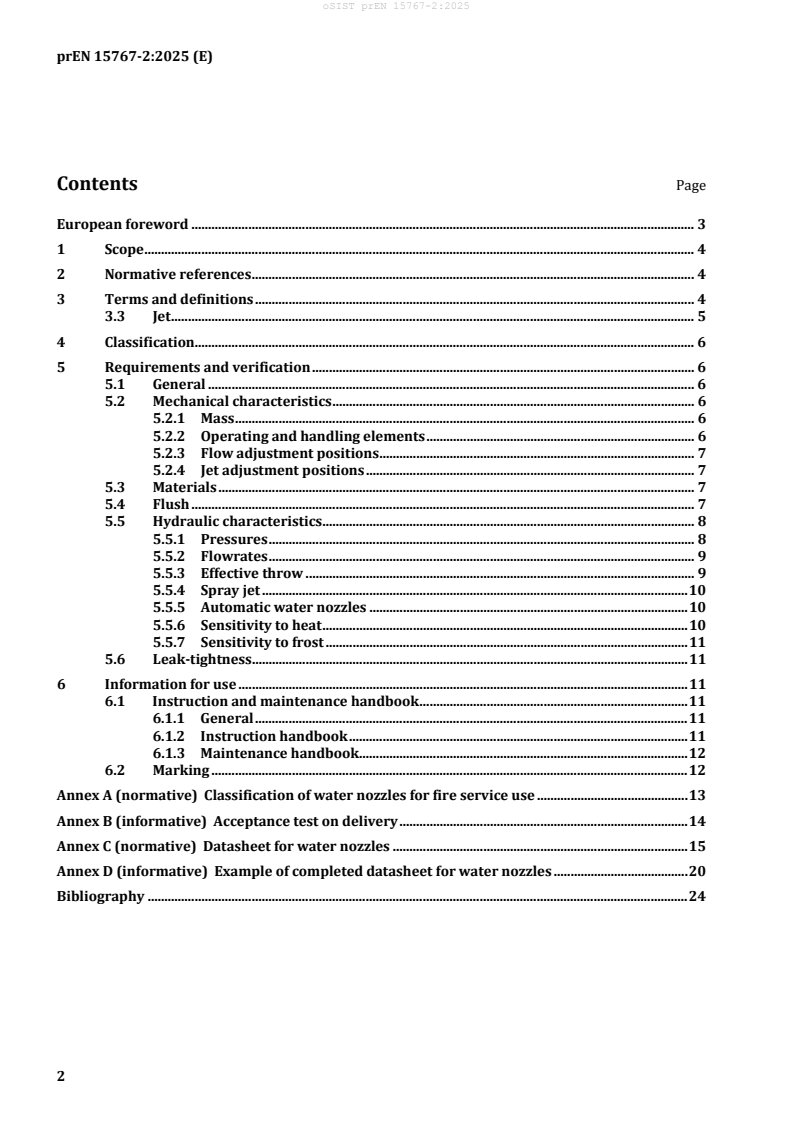
Contents Page
European foreword . 3
1 Scope . 4
2 Normative references . 4
3 Terms and definitions . 4
3.3 Jet . 5
4 Classification. 6
5 Requirements and verification . 6
5.1 General . 6
5.2 Mechanical characteristics . 6
5.2.1 Mass . 6
5.2.2 Operating and handling elements . 6
5.2.3 Flow adjustment positions . 7
5.2.4 Jet adjustment positions . 7
5.3 Materials . 7
5.4 Flush . 7
5.5 Hydraulic characteristics . 8
5.5.1 Pressures . 8
5.5.2 Flowrates . 9
5.5.3 Effective throw . 9
5.5.4 Spray jet . 10
5.5.5 Automatic water nozzles . 10
5.5.6 Sensitivity to heat . 10
5.5.7 Sensitivity to frost . 11
5.6 Leak-tightness. 11
6 Information for use . 11
6.1 Instruction and maintenance handbook . 11
6.1.1 General . 11
6.1.2 Instruction handbook . 11
6.1.3 Maintenance handbook . 12
6.2 Marking . 12
Annex A (normative) Classification of water nozzles for fire service use . 13
Annex B (informative) Acceptance test on delivery . 14
Annex C (normative) Datasheet for water nozzles . 15
Annex D (informative) Example of completed datasheet for water nozzles . 20
Bibliography . 24
oSIST prEN 15767-2:2025
prEN 15767-2:2025 (E)
European foreword
This document (prEN 15767-2:2025) has been prepared by Technical Committee CEN/TC 192 “Fire
service equipment”, the secretariat of which is held by BSI.
This document is currently submitted to the CEN Enquiry.
This document will supersede EN 15767-2:2009.
prEN 15767-2:2024 includes the following significant changes with respect to EN 15767-2:2009:
— the title has been amended;
— the definition of water nozzle (3.1) has been amended;
— the definition of flat spray water nozzle has been deleted (term not used in the document);
— to be consistent with part 1, “manufacturer's stated maximum flow” has been replaced by “maximum
stated flowrate”;
— test pressure has been deleted;
— according to current rules for drafting standard, notes containing the words “should”, “may” and
“recommended” have been transformed into normative text;
— addition of the classification (see Clause 4 and Annex A);
— all general requirements have been placed in a new 5.1 “General”;
— water nozzles shall be ergonomically designed (see 5.1 – should replaced by shall);
— each verification has been placed under the corresponding requirement (see Clause 5);
— missing requirements have been added in: 5.5.6 and 5.5.7;
— missing verification have been added in 5.2.1, 5.2.2, 5.2.3, 5.2.4, 5.3 and 5.6;
— Table 1 “Maximum mass” has been amended;
— 5.4 (flush): the requirements have been updated and the corresponding verification has been added;
— 5.5.4 (spray jet): the verification has been completed;
— improvement of the wording/editorial changes.
oSIST prEN 15767-2:2025
prEN 15767-2:2025 (E)
1 Scope
In addition to the requirements given in EN 15767-1, this document is applicable to manual water
nozzles, including water with fire extinguishing additives. It specifies requirements for safety,
performance, classification and designation, as well as test methods, instructions for use and
maintenance and marking.
This document is not applicable to water nozzles that are manufactured before its date of publication.
2 Normative references
The following documents are referred to in the text in such a way that some or all of their content
constitutes requirements of this document. For dated references, only the edition cited applies. For
undated references, the latest edition of the referenced document (including any amendments) applies.
1)
EN 15767-1, , Portable equipment for projecting extinguishing agents and firefighting support
operations — Portable monitors — Part 1: General requirements for portable monitor assemblies
3 Terms and definitions
For the purposes of this document, the definitions given in EN 15767-1 and the following apply.
ISO and IEC maintain terminology databases for use in standardization at the following addresses:
— ISO Online browsing platform: available at https://www.iso.org/obp/
— IEC Electropedia: available at https://www.electropedia.org/
3.1
water nozzle
component, with or without shut-off function, connected to the outlet of the monitor that controls the
water stream (shape and quantity)
Note 1 to entry: Several types of water nozzles are described in 3.1.1, 3.1.2.
3.1.1
smooth bore water nozzle
nozzle providing a solid water stream
3.1.2
combination water nozzle
nozzle with an adjustable pattern, corresponding to the following definitions
3.1.2.1
combination water nozzle – type 1
nozzle with adjustable pattern at variable flow
Note 1 to entry: Changing the pattern changes the flow.
3.1.2.2
combination water nozzle – type 2
nozzle with adjustable pattern at constant flow
Under revision.
oSIST prEN 15767-2:2025
prEN 15767-2:2025 (E)
Note 1 to entry: Changing the pattern does not change the flow.
3.1.2.3
combination water nozzle – type 3
nozzle with adjustable pattern at selectable, constant flow
Note 1 to entry: Changing the pattern does not change the flow.
3.1.2.4
combination water nozzle – type 4
automatic water nozzle
nozzle with integrated pressure control device
Note 1 to entry: Changing the pattern does not change the flow.
3.1.2.4.1
combination water nozzle – type 4.1
nozzle with adjustable pattern at constant pressure
3.1.2.4.2
combination water nozzle – type 4.2
nozzle with adjustable pattern and selectable flow at constant pressure
3.2
median pressure
p
m
for automatic water nozzle, average pressure of the pressure control range
3.3 Jet
3.3.1
straight jet
jet having the maximum throw and mechanical effect
[SOURCE: EN 15182-1:2019, definition 3.7]
3.3.2
spray jet
any jet different to the straight jet
[SOURCE: EN 15182-1:2019, definition 3.8]
3.4
flush
position allowing the water nozzle to clear debris
3.5
maximum stated flowrate
Q
max
flow under which the water nozzle can be operated safely and efficiently
oSIST prEN 15767-2:2025
prEN 15767-2:2025 (E)
4 Classification
Water nozzles shall be classified in accordance with Annex A.
5 Requirements and verification
5.1 General
The portable monitor can be equipped with smooth bore water nozzles or combination water nozzles.
All the tests defined in this document are type tests.
Unless otherwise specified, tests shall be carried out at the reference pressure p , at a water temperature
R
between 10 °C and 25 °C.
All tests shall be done with water only.
Actual test results can be entered on the data sheet when these results exceed the minimum requirements
given in this document.
NOTE Guidance for acceptance tests on delivery is given in Annex B.
Water nozzles shall be ergonomically designed so that they can be easily operated without risk of injury
when wearing firefighter's gloves complying with EN 659.
5.2 Mechanical characteristics
5.2.1 Mass
The water nozzle shall have a maximum mass as defined in Table 1.
Table 1 — Maximum mass
Maximum stated flowrate, Q Maximum mass of the water nozzle
max
l/min kg
< 2 000 4
2 000 - 4 000 8
> 4 000 12
NOTE The maximum mass does not apply to seawater-resistant water nozzles.
Verification
The mass shall be measured in accordance with Table 1.
5.2.2 Operating and handling elements
The torques needed to move the
...