


EN 15307:2014
(Main)Adhesives for leather and footwear materials - Sole-upper bonds - Minimum strength requirements
Adhesives for leather and footwear materials - Sole-upper bonds - Minimum strength requirements
This European Standard defines for four main types of footwear minimum strength requirements for their sole-upper bonds produced with solvent-based or dispersion adhesives under specified conditions.
Klebstoffe für Leder und Schuhwerkstoffe - Sohlen-Obermaterial-Klebungen - Mindestanforderungen an die Festigkeit
Diese Europäische Norm legt für vier Hauptklassen von Schuhen Mindestanforderungen an die Festigkeit von Sohlen Obermaterial Klebungen fest, die unter festgelegten Bedingungen mit Lösemittel oder Dispersions-klebstoffen hergestellt wurden.
Colles pour cuir et matériaux de la chaussure - Collages tige-semelle - Exigences minimales en matière de résistance
La présente Norme européenne définit quatre types principaux d’exigences minimales en matière de résistance des collages tige-semelle de chaussures obtenus, dans les conditions spécifiées, à l’aide de colles solvantées ou en dispersion.
Lepila za usnjene in obutvene materiale - Vrhnji spoji podplata - Minimalne zahteve za trdnost
Ta evropski standard za štiri glavne vrste obutve določa minimalne zahteve za trdnost vrhnjih spojev podplata, izdelanih z uporabo lepil na osnovi topil ali disperzijskih lepil pod določenimi pogoji.
General Information
- Status
- Published
- Publication Date
- 16-Dec-2014
- Withdrawal Date
- 29-Jun-2015
- Technical Committee
- CEN/TC 193 - Adhesives
- Drafting Committee
- CEN/TC 193 - Adhesives
- Current Stage
- 9020 - Submission to 2 Year Review Enquiry - Review Enquiry
- Start Date
- 15-Oct-2025
- Completion Date
- 15-Oct-2025
Relations
- Effective Date
- 24-Dec-2014
Overview
EN 15307:2014 (CEN) specifies minimum strength requirements for sole–upper bonds in footwear made using solvent‑based or dispersion adhesives. It covers four footwear stress classes (A–D) and defines test conditions, evaluation criteria and reporting requirements to ensure reliable bonding between uppers and soles under specified laboratory conditions.
Key SEO terms: EN 15307:2014, adhesives for leather, sole‑upper bonds, footwear adhesives, peel resistance, creep resistance, ageing test.
Key topics
- Scope and classification
- Applies to four classes of footwear by stress on the sole–upper bond:
- Class A – Low stress (infants, indoor, fashion)
- Class B – Medium stress (town, casual)
- Class C – High stress (children, general sports)
- Class D – Very high stress (mountain footwear)
- Applies to four classes of footwear by stress on the sole–upper bond:
- Minimum strength requirements
- Peel resistance after 4 days at (23 ± 2) °C:
- Class A ≥ 2.5 N/mm
- Class B ≥ 3.0 N/mm or ≥ 2.5 N/mm with material failure
- Class C ≥ 4.0 N/mm or ≥ 3.0 N/mm with material failure
- Class D ≥ 5.0 N/mm or ≥ 3.5 N/mm with material failure
- Initial peel resistance: ≥ 1.0 N/mm measured 2 minutes after assembly at (23 ± 2) °C.
- Creep resistance: Under 1.5 kg load at (50 ± 2) °C for 10 minutes, separation < 10 mm.
- Ageing: According to EN 15062; aged and reconditioned bonds must retain ≥ 80% of initial strength and still meet the minimums above.
- Peel resistance after 4 days at (23 ± 2) °C:
- Test methods and conditioning
- Peel and creep tests referenced to EN 1392.
- Conditioning in standard atmosphere 23/50 per ISO 554 (storage times specified for each test).
- Failure modes identified per EN ISO 10365.
- Documentation
- Test report must include adhesive and material identification, bonding procedure, storage conditions, test results, failure mode, and factors affecting results.
Applications
- Ensures consistent bond performance in footwear manufacturing, repair and product development.
- Used by:
- Adhesive manufacturers (formulation and quality control)
- Footwear manufacturers and OEMs (incoming material acceptance, process validation)
- Test laboratories and certification bodies (quality certification, compliance testing)
- R&D teams (material pairing, adhesive selection, durability testing)
Related standards
- EN 1392 - Testing of bond strength under specified conditions
- EN 15062 - Ageing of bonds under specified conditions
- EN 923, EN ISO 10365, EN ISO 868, ISO 554 - terms, failure patterns, Shore hardness, conditioning
EN 15307:2014 is a practical, test‑based standard for anyone responsible for specifying or verifying sole‑upper adhesive performance in leather and footwear production.



Frequently Asked Questions
EN 15307:2014 is a standard published by the European Committee for Standardization (CEN). Its full title is "Adhesives for leather and footwear materials - Sole-upper bonds - Minimum strength requirements". This standard covers: This European Standard defines for four main types of footwear minimum strength requirements for their sole-upper bonds produced with solvent-based or dispersion adhesives under specified conditions.
This European Standard defines for four main types of footwear minimum strength requirements for their sole-upper bonds produced with solvent-based or dispersion adhesives under specified conditions.
EN 15307:2014 is classified under the following ICS (International Classification for Standards) categories: 83.180 - Adhesives. The ICS classification helps identify the subject area and facilitates finding related standards.
EN 15307:2014 has the following relationships with other standards: It is inter standard links to EN 15307:2007. Understanding these relationships helps ensure you are using the most current and applicable version of the standard.
You can purchase EN 15307:2014 directly from iTeh Standards. The document is available in PDF format and is delivered instantly after payment. Add the standard to your cart and complete the secure checkout process. iTeh Standards is an authorized distributor of CEN standards.
Standards Content (Sample)
2003-01.Slovenski inštitut za standardizacijo. Razmnoževanje celote ali delov tega standarda ni dovoljeno.Lepila za usnjene in obutvene materiale - Vrhnji spoji podplata - Minimalne zahteve za trdnostKlebstoffe fúr Leder und Schuhwerkstoffe - Sohlen-Obermaterial-Klebungen - MindestanforderungenAdhésifs pour cuir et materiaux de la chausure - Collages de semelles et matériaux de dessus - Prescriptions minimalesAdhesives for leather and footwear materials - Sole-upper bonds - Minimum strength requirements83.180LepilaAdhesives61.060ObuvalaFootwearICS:Ta slovenski standard je istoveten z:EN 15307:2014SIST EN 15307:2015en,fr,de01-marec-2015SIST EN 15307:2015SLOVENSKI
STANDARDSIST EN 15307:20091DGRPHãþD
EUROPEAN STANDARD NORME EUROPÉENNE EUROPÄISCHE NORM
EN 15307
December 2014 ICS 83.180 Supersedes EN 15307:2007English Version
Adhesives for leather and footwear materials - Sole-upper bonds - Minimum strength requirements
Colles pour cuir et matériaux de la chaussure - Collages tige-semelle - Exigences minimales en matière de résistance
Klebstoffe für Leder und Schuhwerkstoffe - Sohlen-Obermaterial-Klebungen - Mindestanforderungen This European Standard was approved by CEN on 23 November 2014.
CEN members are bound to comply with the CEN/CENELEC Internal Regulations which stipulate the conditions for giving this European Standard the status of a national standard without any alteration. Up-to-date lists and bibliographical references concerning such national standards may be obtained on application to the CEN-CENELEC Management Centre or to any CEN member.
This European Standard exists in three official versions (English, French, German). A version in any other language made by translation under the responsibility of a CEN member into its own language and notified to the CEN-CENELEC Management Centre has the same status as the official versions.
CEN members are the national standards bodies of Austria, Belgium, Bulgaria, Croatia, Cyprus, Czech Republic, Denmark, Estonia, Finland, Former Yugoslav Republic of Macedonia, France, Germany, Greece, Hungary, Iceland, Ireland, Italy, Latvia, Lithuania, Luxembourg, Malta, Netherlands, Norway, Poland, Portugal, Romania, Slovakia, Slovenia, Spain, Sweden, Switzerland, Turkey and United Kingdom.
EUROPEAN COMMITTEE FOR STANDARDIZATION
COMITÉ EUROPÉEN DE NORMALISATION EUROPÄISCHES KOMITEE FÜR NORMUNG
CEN-CENELEC Management Centre:
Avenue Marnix 17,
B-1000 Brussels © 2014 CEN All rights of exploitation in any form and by any means reserved worldwide for CEN national Members. Ref. No. EN 15307:2014 ESIST EN 15307:2015
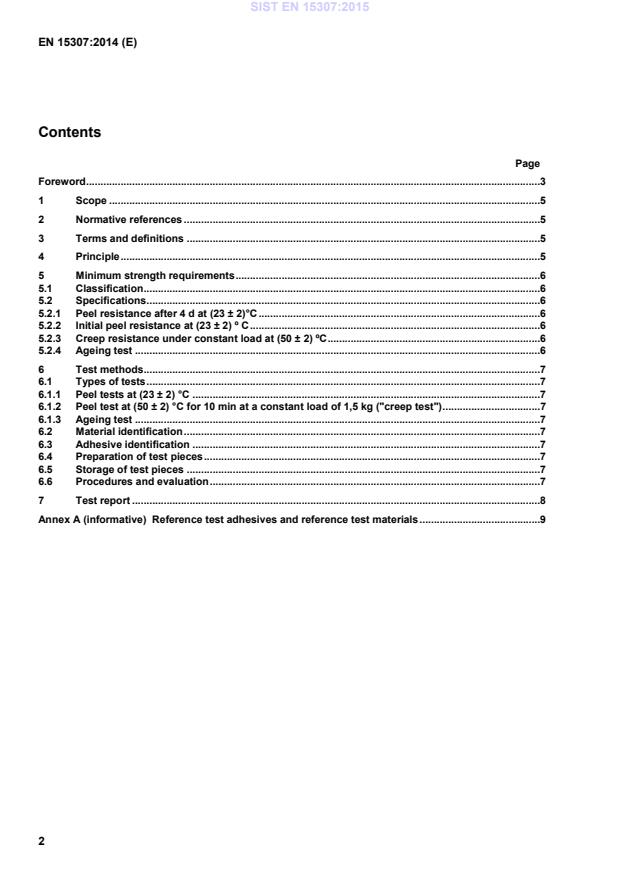
Foreword .3 1 Scope .5 2 Normative references .5 3 Terms and definitions .5 4 Principle .5 5 Minimum strength requirements .6 5.1 Classification .6 5.2 Specifications .6 5.2.1 Peel resistance after 4 d at (23 ± 2)°C .6 5.2.2 Initial peel resistance at (23 ± 2) º C .6 5.2.3 Creep resistance under constant load at (50 ± 2) ºC .6 5.2.4 Ageing test .6 6 Test methods .7 6.1 Types of tests .7 6.1.1 Peel tests at (23 ± 2) °C .7 6.1.2 Peel test at (50 ± 2) °C for 10 min at a constant load of 1,5 kg ("creep test") .7 6.1.3 Ageing test .7 6.2 Material identification .7 6.3 Adhesive identification .7 6.4 Preparation of test pieces .7 6.5 Storage of test pieces .7 6.6 Procedures and evaluation .7 7 Test report .8 Annex A (informative)
Reference test adhesives and reference test materials .9
...
Questions, Comments and Discussion
Ask us and Technical Secretary will try to provide an answer. You can facilitate discussion about the standard in here.
Loading comments...