

EN 12201-3:2011
(Main)Plastics piping systems for water supply, and for drainage and sewerage under pressure - Polyethylene (PE) - Part 3: Fittings
- Abstract
This European Standard specifies the characteristics of fittings made from polyethylene (PE 100 and PE 80) intended for the conveyance of water for human consumption, raw water prior to treatment, drainage and sewerage under pressure, vacuum sewer systems, and water for other purposes.
NOTE 1 For PE components intended for the conveyance of water for human consumption and raw water prior to treatment, attention is drawn to 5.6 of this part of EN 12201. Components manufactured for water for other purposes, drainage and sewerage may not be suitable for water supply for human consumption.
It also specifies the test parameters for the test methods referred to in this standard.
In conjunction with Parts 1, 2 ,4 and 5 of EN 12201, it is applicable to PE fittings, their joints and to joints with components of PE and other materials intended to be used under the following conditions:
a) allowable operating pressure, PFA, up to 25 bar );
b) an operating temperature of 20 °C as a reference temperature;
c) buried in the ground;
d) sea outfalls;
e) laid in water;
f) above ground, including pipes suspended below bridges.
NOTE 2 For applications operating at constant temperature greater than 20 °C and up to 40 °C, see Annex A of EN 12201-1:2011.
EN 12201 (all parts) covers a range of allowable operating pressures and gives requirements concerning colours and additives.
NOTE 3 It is the responsibility of the purchaser or specifier to make the appropriate selections from these aspects, taking into account their particular requirements and any relevant national guidance or regulations and installation practices or codes.
These fittings can be of the following types:
a) fusion fittings;
1) butt fusion fittings;
2) socket fusion fittings (see Annex A);
3) electrofusion fittings;
b) mechanical fittings;
1) compression fittings;
2) flanged fittings;
c) fabricated fittings (see Annex B).
- Status
- Withdrawn
- Publication Date
- 06-Sep-2011
- Withdrawal Date
- 06-Nov-2012
- Technical Committee
- CEN/TC 155 - Plastics piping systems and ducting systems
- Current Stage
- 9960 - Withdrawal effective - Withdrawal
- Start Date
- 07-Nov-2012
- Completion Date
- 07-Nov-2012

Relations
- Replaces
EN 12201-3:2003 - Plastics piping systems for water supply - Polyethylene (PE) - Part 3: Fittings - Effective Date
- 01-Apr-2009
- Effective Date
- 01-Apr-2009
- Effective Date
- 19-Jan-2023
- Effective Date
- 28-Jan-2026
- Effective Date
- 08-Feb-2012
Get Certified
Connect with accredited certification bodies for this standard

DIBt (Deutsches Institut für Bautechnik)
German Institute for Building Technology.
DIN CERTCO
DIN Group product certification.
Zavod za gradbeništvo Slovenije (ZAG) - Inšpekcija
ZAG inspection body for construction products, structures, and materials.
Sponsored listings
Frequently Asked Questions
EN 12201-3:2011 is a standard published by the European Committee for Standardization (CEN). Its full title is "Plastics piping systems for water supply, and for drainage and sewerage under pressure - Polyethylene (PE) - Part 3: Fittings". This standard covers: This European Standard specifies the characteristics of fittings made from polyethylene (PE 100 and PE 80) intended for the conveyance of water for human consumption, raw water prior to treatment, drainage and sewerage under pressure, vacuum sewer systems, and water for other purposes. NOTE 1 For PE components intended for the conveyance of water for human consumption and raw water prior to treatment, attention is drawn to 5.6 of this part of EN 12201. Components manufactured for water for other purposes, drainage and sewerage may not be suitable for water supply for human consumption. It also specifies the test parameters for the test methods referred to in this standard. In conjunction with Parts 1, 2 ,4 and 5 of EN 12201, it is applicable to PE fittings, their joints and to joints with components of PE and other materials intended to be used under the following conditions: a) allowable operating pressure, PFA, up to 25 bar ); b) an operating temperature of 20 °C as a reference temperature; c) buried in the ground; d) sea outfalls; e) laid in water; f) above ground, including pipes suspended below bridges. NOTE 2 For applications operating at constant temperature greater than 20 °C and up to 40 °C, see Annex A of EN 12201-1:2011. EN 12201 (all parts) covers a range of allowable operating pressures and gives requirements concerning colours and additives. NOTE 3 It is the responsibility of the purchaser or specifier to make the appropriate selections from these aspects, taking into account their particular requirements and any relevant national guidance or regulations and installation practices or codes. These fittings can be of the following types: a) fusion fittings; 1) butt fusion fittings; 2) socket fusion fittings (see Annex A); 3) electrofusion fittings; b) mechanical fittings; 1) compression fittings; 2) flanged fittings; c) fabricated fittings (see Annex B).
This European Standard specifies the characteristics of fittings made from polyethylene (PE 100 and PE 80) intended for the conveyance of water for human consumption, raw water prior to treatment, drainage and sewerage under pressure, vacuum sewer systems, and water for other purposes. NOTE 1 For PE components intended for the conveyance of water for human consumption and raw water prior to treatment, attention is drawn to 5.6 of this part of EN 12201. Components manufactured for water for other purposes, drainage and sewerage may not be suitable for water supply for human consumption. It also specifies the test parameters for the test methods referred to in this standard. In conjunction with Parts 1, 2 ,4 and 5 of EN 12201, it is applicable to PE fittings, their joints and to joints with components of PE and other materials intended to be used under the following conditions: a) allowable operating pressure, PFA, up to 25 bar ); b) an operating temperature of 20 °C as a reference temperature; c) buried in the ground; d) sea outfalls; e) laid in water; f) above ground, including pipes suspended below bridges. NOTE 2 For applications operating at constant temperature greater than 20 °C and up to 40 °C, see Annex A of EN 12201-1:2011. EN 12201 (all parts) covers a range of allowable operating pressures and gives requirements concerning colours and additives. NOTE 3 It is the responsibility of the purchaser or specifier to make the appropriate selections from these aspects, taking into account their particular requirements and any relevant national guidance or regulations and installation practices or codes. These fittings can be of the following types: a) fusion fittings; 1) butt fusion fittings; 2) socket fusion fittings (see Annex A); 3) electrofusion fittings; b) mechanical fittings; 1) compression fittings; 2) flanged fittings; c) fabricated fittings (see Annex B).
EN 12201-3:2011 is classified under the following ICS (International Classification for Standards) categories: 23.040.05 - Pipeline and its parts for external sewage systems; 23.040.45 - Plastics fittings; 91.140.60 - Water supply systems; 93.030 - External sewage systems. The ICS classification helps identify the subject area and facilitates finding related standards.
EN 12201-3:2011 has the following relationships with other standards: It is inter standard links to EN 12201-3:2003, EN 13244-3:2002, EN 12201-3:2011+A1:2012, EN 12201-4:2012, EN 12201-3:2011/FprA1. Understanding these relationships helps ensure you are using the most current and applicable version of the standard.
EN 12201-3:2011 is associated with the following European legislation: EU Directives/Regulations: 305/2011, 89/106/EEC. When a standard is cited in the Official Journal of the European Union, products manufactured in conformity with it benefit from a presumption of conformity with the essential requirements of the corresponding EU directive or regulation.
EN 12201-3:2011 is available in PDF format for immediate download after purchase. The document can be added to your cart and obtained through the secure checkout process. Digital delivery ensures instant access to the complete standard document.
Standards Content (Sample)
2003-01.Slovenski inštitut za standardizacijo. Razmnoževanje celote ali delov tega standarda ni dovoljeno.Cevni sistemi iz polimernih materialov za oskrbo z vodo in za odvodnjavanje in kanalizacijo pod tlakom - Polietilen (PE) - 3. del: FitingiKunststoff-Rohrleitungssysteme für die Wasserversorgung und für Entwässerungs- und Abwasserdruckleitungen - Polyethylen (PE) - Teil 3: FormstückeSystèmes de canalisations en plastique pour l'alimentation en eau et pour les branchements et les collecteurs d'assainissement avec pression - Polyéthylène (PE) - Partie 3 : RaccordsPlastics piping systems for water supply, and for drainage and sewerage under pressure - Polyethylene (PE) - Part 3: Fittings93.030Zunanji sistemi za odpadno vodoExternal sewage systems91.140.60Sistemi za oskrbo z vodoWater supply systems23.040.45Fitingi iz polimernih materialovPlastics fittingsICS:Ta slovenski standard je istoveten z:EN 12201-3:2011SIST EN 12201-3:2011en,fr,de01-december-2011SIST EN 12201-3:2011SLOVENSKI
STANDARDSIST EN 13244-3:2003SIST EN 12201-3:20031DGRPHãþD
EUROPEAN STANDARD NORME EUROPÉENNE EUROPÄISCHE NORM
EN 12201-3
September 2011 ICS 23.040.45 Supersedes EN 12201-3:2003, EN 13244-3:2002English Version
Plastics piping systems for water supply, and for drainage and sewerage under pressure - Polyethylene (PE) - Part 3: Fittings Systèmes de canalisations en plastique pour l'alimentation en eau et pour les branchements et les collecteurs d'assainissement avec pression - Polyéthylène (PE) - Partie 3 : Raccords
Kunststoff-Rohrleitungssysteme für die Wasserversorgung und für Entwässerungs- und Abwasserdruckleitungen - Polyethylen (PE) - Teil 3: Formstücke This European Standard was approved by CEN on 8 July 2011.
CEN members are bound to comply with the CEN/CENELEC Internal Regulations which stipulate the conditions for giving this European Standard the status of a national standard without any alteration. Up-to-date lists and bibliographical references concerning such national standards may be obtained on application to the CEN-CENELEC Management Centre or to any CEN member.
This European Standard exists in three official versions (English, French, German). A version in any other language made by translation under the responsibility of a CEN member into its own language and notified to the CEN-CENELEC Management Centre has the same status as the official versions.
CEN members are the national standards bodies of Austria, Belgium, Bulgaria, Croatia, Cyprus, Czech Republic, Denmark, Estonia, Finland, France, Germany, Greece, Hungary, Iceland, Ireland, Italy, Latvia, Lithuania, Luxembourg, Malta, Netherlands, Norway, Poland, Portugal, Romania, Slovakia, Slovenia, Spain, Sweden, Switzerland and United Kingdom.
EUROPEAN COMMITTEE FOR STANDARDIZATION
COMITÉ EUROPÉEN DE NORMALISATION EUROPÄISCHES KOMITEE FÜR NORMUNG
Management Centre:
Avenue Marnix 17,
B-1000 Brussels © 2011 CEN All rights of exploitation in any form and by any means reserved worldwide for CEN national Members. Ref. No. EN 12201-3:2011: ESIST EN 12201-3:2011
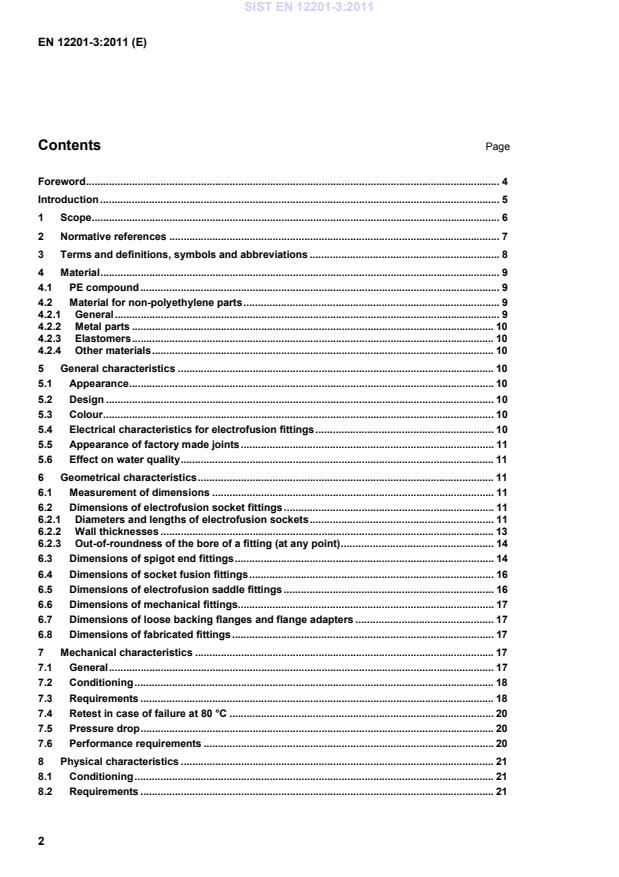
Socket fusion fittings . 24Annex B (normative)
Fabricated fittings . 26B.1General . 26B.2Dimensions . 27B.3Segmented bends . 28B.4Swept bends . 30B.5Segmented tees . 31Annex C (informative)
Examples of typical terminal connection for electrofusion fittings . 33Annex D (normative)
Short-term pressure test method . 36D.1Principle . 36D.2Apparatus . 36D.3Test piece . 36D.4Procedure . 36D.5Test report . 37Annex E (normative)
Tensile test for fitting/pipe assemblies . 38E.1Principle . 38E.2Apparatus . 38E.3Test piece . 38E.4Procedure . 38E.5Test report . 38Bibliography . 40 SIST EN 12201-3:2011
The System Standards are consistent with general standards on functional requirements and on recommended practice for installation.
EN 12201 consists of the following Parts:
EN 12201-1, Plastics piping systems for water supply, and for drainage and sewerage under pressure — Polyethylene (PE) — Part 1: General; EN 12201-2, Plastics piping systems for water supply, and for drainage and sewerage under pressure — Polyethylene (PE) — Part 2: Pipes; EN 12201-3, Plastics piping systems for water supply, and for drainage and sewerage under pressure — Polyethylene (PE) — Part 3: Fittings (this standard); EN 12201-4, Plastics piping systems for water supply, and for drainage and sewerage under pressure — Polyethylene (PE) — Part 4: Valves for water supply systems; EN 12201-5, Plastics piping systems for water supply, and for drainage and sewerage under pressure — Polyethylene (PE) — Part 5: Fitness for purpose of the system; CEN/TS 12201-7, Plastics piping systems for water supply — Polyethylene (PE) — Part 7: Guidance for the assessment of conformity. In this revision the test methods have been updated as appropriate and in accordance with other parts of this standard. According to the CEN/CENELEC Internal Regulations, the national standards organizations of the following countries are bound to implement this European Standard: Austria, Belgium, Bulgaria, Croatia, Cyprus, Czech Republic, Denmark, Estonia, Finland, France, Germany, Greece, Hungary, Iceland, Ireland, Italy, Latvia, Lithuania, Luxembourg, Malta, Netherlands, Norway, Poland, Portugal, Romania, Slovakia, Slovenia, Spain, Sweden, Switzerland and the United Kingdom. SIST EN 12201-3:2011
In respect of potential adverse effects on the quality of water intended for human consumption, caused by the product covered by EN 12201 (all parts): a) this European Standard provides no information as to whether the products may be used without restriction in any of the Member States of the EU or EFTA; b) products intended for use in water supply systems must comply, when existing, with national regulations and testing arrangements that ensure fitness for contact with drinking water. NOTE On April 2006, EC Commission set up a revised mandate (M/136) asking CEN to propose harmonised product standards and support standards for test methods which could be used for assessing the fitness for contact with drinking water. In parallel, EC Commission has launched processes for a regulation of construction products (CPR) to be substituted to CP directive (89/106/EEC) and for the revision of drinking water directive (98/83/EC). If relevant, when the ouputs of these processes will be known, European Product Standards will be amended by the addition of an Annex Z under Mandate M136 which will contain formal references to the applicable requirements. Until such amendments, the current national regulations remain applicable. Requirements and test methods for material and components, other than fittings, are specified in EN 12201-1, EN 12201-2 and prEN 12201-4:2011. Characteristics for fitness of purpose are covered in EN 12201-5. CEN/TS 12201-7 [2] gives guidance for the assessment of conformity. This Part of EN 12201 covers the characteristics of fittings. SIST EN 12201-3:2011
1) 1 bar = 0,1 MPa = 105 Pa; 1 MPa = 1 N/mm2. SIST EN 12201-3:2011
Automatic recognition systems for electrofusion joints SIST EN 12201-3:2011
Test method for the resistance of polyolefin pipe/pipe or pipe/fitting assemblies to tensile loading ISO 13953, Polyethylene (PE) pipes and fittings — Determination of the tensile strength and failure mode of test pieces from a butt-fused joint ISO 13954, Plastics pipes and fittings — Peel decohesion test for polyethylene (PE) electrofusion assemblies of nominal outside diameter greater than or equal to 90 mm ISO 13955, Plastics pipes and fittings — Crushing decohesion test for polyethylene (PE) electrofusion assemblies ISO 13956, Plastics pipes and fittings — Decohesion test of polyethylene (PE) saddle fusion joints — Evaluation of ductility of fusion joint interface by tear test ISO 14236, Plastics pipes and fittings
Mechanical-joint compression fittings for use with polyethylene pressure pipes in water supply systems 3 Terms and definitions, symbols and abbreviations For the purposes of this document, the terms and definitions, symbols and abbreviations given in EN 12201-1 and the following apply. 3.1 electrofusion socket fitting polyethylene (PE) fitting which contains one or more integral heating elements that are capable of transforming electrical energy into heat to produce a fusion joint with a spigot end or pipe 3.2 electrofusion saddle fitting polyethylene (PE) fitting which contains one or more integral heating elements that are capable of transforming electrical energy into heat to produce a fusion joint with the pipe
3.2.1 tapping tee electrofusion saddle fitting (top-loading or wraparound) which contains an integral cutter used for cutting through the wall of the main pipe, which remains in the body of the tapping tee after installation 3.2.2 branch saddle electrofusion saddle fitting (top loading or wrap round) which requires an ancillary cutting tool for drilling the hole in the adjoining main pipe 3.3 spigot end fitting polyethylene (PE) fitting where the outside diameter of the spigot end is equal to the nominal outside diameter, dn, of the corresponding pipe 3.4 mechanical fitting fitting, that generally includes a compression part to provide pressure integrity, leaktightness and resistance to end loads, for assembling polyethylene (PE) pipe to another PE pipe or any other element of the piping system NOTE 1 A pipe-supporting sleeve providing a permanent support for a polyethylene (PE) pipe to prevent creep in the pipe wall under radial compressive forces, may be applicable. The metallic parts of the fitting can be assembled to metallic pipes by screw-threads, compression joints, welded or flanged connections, including PE flanges. In some cases, the supporting sleeve at the same time constitutes a grip ring. SIST EN 12201-3:2011
The stress bearing parts shall only be made from virgin material conforming to EN 12201-1. 4.2 Material for non-polyethylene parts 4.2.1 General All components shall conform to the relevant European Standard(s). Alternative standards may be utilised in cases where suitable European Standards do not exist provided that the fitness for purpose can be demonstrated. The materials and constituent elements used in making the fitting (including elastomers, greases, and any metal parts) shall be as resistant to the external and internal environments as the other elements of the piping system and shall have a life expectancy under the following conditions at least equal to that of the PE pipe conforming to EN 12201-2 with which they are intended to be used: a) during storage; b) under the effect of the fluids being conveyed; c) taking account of the service environment and operating conditions. The requirements for the level of material performance for non-polyethylene parts shall be at least as stringent as that of the PE compound for the piping system. Other materials used in fittings in contact with the PE pipe shall not adversely affect the pipe performance or initiate stress cracking. NOTE Subclause 4.2 does not apply to non-stress bearing fitting parts. SIST EN 12201-3:2011
is the assumed value of the contact resistance. The surface finish of the terminal pins shall allow a minimum contact resistance in order to satisfy the resistance tolerance requirements. 5.5 Appearance of factory made joints The internal and external surfaces of the pipe and fitting after fusion jointing, examined visually without magnification, shall be free from melt exudation outside the confines of the fitting, apart from that which may be declared acceptable by the fitting manufacturer or used as a fusion marker. Any melt exudation shall not cause wire movement in electrofusion fittings such that it leads to short-circuiting, when jointed in accordance with the manufacturer’s instructions. There shall be no excessive creasing of the internal surfaces of the adjoining pipes. 5.6 Effect on water quality For fittings intended for the conveyance of water for human consumption attention is drawn to the requirements of national regulations (see Introduction). 6 Geometrical characteristics 6.1 Measurement of dimensions The dimensions of the fittings shall be measured in accordance with EN ISO 3126. In the case of dispute the measurement of dimensions shall not be made less than 24 h after manufacture after being conditioned for at least 4 h at (23 ± 2) °C. NOTE Indirect measurement at the stage of production is allowed at shorter time periods providing evidence is shown of correlation. 6.2 Dimensions of electrofusion socket fittings 6.2.1 Diameters and lengths of electrofusion sockets When measured in accordance with 6.1, the diameters and lengths of electrofusion sockets (see Figure 1) shall conform to Table 1. SIST EN 12201-3:2011
Key D1 is the "mean inside diameter in the fusion zone" measured in a plane parallel to the plane of the mouth at a distance of L3 + 0,5L2; D2 is the bore which is the minimum diameter of the flow channel through the body of the fitting where D2 ≥ (dn − 2emin); L1 is the "design penetration depth" of the pipe or male end of a spigot fitting; in the case of a coupling without a stop, it is not greater than half the total length of the fitting; L2 is the heated length within a socket as declared by the manufacturer to be the nominal length of the fusion zone; L3 is the distance between the mouth of the fitting and the start of the fusion zone as declared by the manufacturer to be the nominal unheated entrance length of the fitting L3 shall be ≥ 5 mm. Figure 1 — Dimensions of electrofusion sockets
Intensity regulation Voltage regulation
20 25 32 40 50 63 75 90 110 125 140 160 180 200 225 250 280 315 355 400 450 500 560 630 710 800 20 20 20 20 20 23 25 28 32 35 38 42 46 50 55 73 81 89 99 110 122 135 147 161 177 193 25 25 25 25 28 31 35 40 53 58 62 68 74 80 88 95 104 115 127 140 155 170 188 209 220 230 41 41 44 49 55 63 70 79 82 87 92 98 105 112 120 129 139 150 164 179 195 212 235 255 280 300 10 10 10 10 10 11 12 13 15 16 18 20 21 23 26 33 35 39 42 47 51 56 61 67 74 82
The mean inside diameter of the fitting in the middle of the fusion zone, Dl, shall not be less than dn. The manufacturer shall declare maximum and minimum values of Dl to allow end user to determine their suitability for clamping and joint assembly and fitness for purpose testing in accordance with EN 12201-5. In the case of a fitting having sockets of differing sizes, each one shall conform to the requirements for the corresponding nominal diameter. 6.2.2 Wall thicknesses In order to prevent stress concentrations, any changes in wall thickness of the fitting body shall be gradual. a) The wall thickness of the body of the fitting at any point, E, shall be greater than or equal to emin for the corresponding pipe at any part of the fitting located at a distance beyond a maximum of 2L1/3 from all SIST EN 12201-3:2011
Table 2 — Relationship between pipe and fitting wall thicknesses Material Relationship between fitting wall thickness, E, and pipe wall thickness, emin Pipe Fitting PE 80 PE 100 E ≥ 0,8 emin PE 100 PE 80 E ≥ 1,25 emin
b) In the case of a wall thickness design different from that according to a), fittings and associated fusion joints shall additionally meet the performance requirements given in 7.6. 6.2.3 Out-of-roundness of the bore of a fitting (at any point) When a fitting leaves the site of the manufacturer, the out-of-roundness of the bore of a fitting at any point shall not exceed 0,015 dn. 6.3 Dimensions of spigot end fittings When measured in accordance with 6.1, the spigot dimensions shall conform to the requirements given in Table 3 (see Figure 2). SIST EN 12201-3:2011
Key D1 mean outside diameter of fusion end piece a D2 minimum bore which comprises the minimum diameter of the flow channel through the body of the fitting E body wall thickness of fitting c E1 fusion face wall thickness d L1 cut-back length of fusion end piece e L2 tubular length of fusion end piece f
a D1 is measured in any plane parallel to the plane of the entrance face at a distance not greater than L2 (tubular length) from the plane of the entrance face. b This diameter does not include the fusion bead, if any. c It comprises the thickness measured at any point of the wall of the fitting. d It is measured at any point at a maximum distance of L1 (cut back length) from the entrance face and shall be equal to the pipe wall thickness and tolerance to which it is intended to be butt fused, as specified in EN 12201-2:2011, Table 2. E1 for small dimensions is at least 3 mm. e It comprises the initial depth of the spigot end necessary for butt fusion or re-weld and may be obtained by joining a length of pipe to the spigot end of the fitting provided the wall thickness of the pipe is equal to E1 for its entire length. f It comprises the initial length of the fusion end piece and shall allow the following (in any combination): the use of clamps required in the case of butt fusion; assembly with an electrofusion fitting; assembly with a socket fusion fitting; the use of a mechanical scraper. Figure 2 — Dimensions of spigot end fittings The wall thickness of the fusion end, E1, shall be at least equal to the minimum wall thickness of the pipe, except between the plane of the entrance face and a plane parallel to it, located at a distance not greater than (0,01de + 1 mm), where a thickness reduction for e.g. a chamfered edge is permitted.
Grade A Grade B Out-of-roundness Min. bore Cut back length Tubular length b Tubular length Out-of-roundnessCut back length Tubular length Normal c Tubular length Special d dn D1,min D1,max D1,max max. D2 L1,min L2,min L2,min max. L1,min L2,min L2,min 20 25 32 40
50 63 75 90
110 125 140 160
180 200 225 250
280 315 355 400
450 500 560 630
710 800 20,0 25,0 32,0 40,0
50,0 63,0 75,0 90,0
110,0 125,0 140,0 160,0
180,0 200,0 225,0 250,0
280,0 315,0 355,0 400,0
450,0 500,0 560,0 630,0
710,0 800,0 — — — —
— — — —
— — — —
— — — —
282,6 317,9 358,2 403,6
454,1 504,5 565,0 635,7
716,4 807,2 20,3 25,3 32,3 40,4
50,4 63,4 75,5 90,6
110,7 125,8 140,9 161,0
181,1 201,2 226,4 251,5
281,7 316,9 357,2 402,4
452,7 503,0 563,4 633,8
714,9 805,0 0,3 0,4 0,5 0,6
0,8 0,9 1,2 1,4
1,7 1,9 2,1 2,4
2,7 3,0 3,4 3,8
4,2 4,8 5,4 6,0
6,8 7,5 8,4 9,5
10,6 12,0 13 18 25 31
39 49 59 71
87 99 111 127
143 159 179 199
223 251 283 319
359 399 447 503
567 639 25 25 25 25
25 25 25 28
32 35 38 42
46 50 55 60
75 75 75 75
100 100 100 100
125 125 41 41 44 49
55 63 70 79
82 87 92 98
105 112 120 129
139 150 164 179
195 212 235 255
280 280 11 12,514,617
20 24 25 28
32 35 — —
— — — —
— — — —
— — — —
— — — — — —
— 1,5 1,6 1,8
2,2 2,5 2,8 3,2
3,6 4,0 4,5 5,0
9,8 11,1 12,5 14,0
15,6 17,5 19,6 22,1
24,8 28,0 — — — —
— 5 6 6
8 8 8 8
8 8 10 10
10 10 10 10
15 20 20 20
20 20 — — — —
— 16 19 22
28 32 35 40
45 50 55 60
70 80 90 95
60 60 60 60
60 60 — — — —
— 5 6 6
8 8 8 8
8 8 10 10
10 10 12 12
15 15 15 20
20 20 a Tolerance grades A and B are in accordance with ISO 11922-1:1997 [8]. b The values of L2 (electrofusion) are based on the following equations:
for dn ≤ 90, L2 = 0,6dn + 25 mm;
for dn ≥ 110, L2 = dn/3 + 45 mm. c Used by preference. d Used for fittings fabricated in the factory.
6.4 Dimensions of socket fusion fittings For the description and dimensions of these types of fittings, see Annex A. 6.5 Dimensions of electrofusion saddle fittings Outlets from tapping tees and branch saddles shall have spigots in accordance with 6.3 or an electrofusion socket in accordance with 6.2. The manufacturer shall specify the overall characteristic dimension of the fitting in the technical file. These dimensions shall include the maximum height of the saddle, H, and the height of the service pipe measured from the top of the main, h, as shown in Figure 3. NOTE For technical and design reasons the minimum bore diameter D2 may be different from the one of spigot fittings as given in 6.3. SIST EN 12201-3:2011
Key H is the height of the saddle, i.e. the distance from the top of the main to the top of the tapping tee; h is the "height of service pipe", i.e. the distance between the top of the main pipe and the axis of the service pipe; L is the "width of the tapping tee", i.e. the distance between the axis of the pipe and the plane of the mouth of the service tee. Figure 3 — Dimensions of electrofusion saddle fittings 6.6 Dimensions of mechanical fittings Mechanical fittings manufactured substantially from PE and intended for part fusion to PE pipe and part mechanical jointing to other pipe components, e.g. adapters, shall in at least one joint conform to the geometrical characteristics of the PE jointing system to be used. NOTE Mechanical fittings not manufactured substantially from PE should conform to the requirements specified in the relevant standard(s). 6.7 Dimensions of loose backing flanges and flange adapters Dimensions of loose backing flanges and flange adapters shall be in accordance with ISO 9624. 6.8 Dimensions of fabricated fittings When the description and dimensions of fittings of this type are required, Annex B applies. 7 Mechanical characteristics 7.1 General A fitting shall be tested and assembled with pipe or as a part of an assembly of more than one fitting fused to pipe conforming to EN 12201-2. Each assembly shall be prepared from components (pipes and fittings) of the same pressure class and material classification. SIST EN 12201-3:2011
Number of test pieces b Type of test Test temperature Test period Circumferential (hoop) stressc for:
PE 80
PE 100 Type A a EN ISO 1167-1 Shall conform to
EN ISO 1167-1 3 Water- in- water 20 °C 100 h
10,0 MPa 12,0 MPa EN ISO 1167-1 and EN ISO 1167-4
Hydrostatic strength at 80 °C No failure during test period of any test pieces End caps
Conditioning period
Number of test pieces b Type of test Test temperature Test period Circumferential (hoop) stress c for: PE 80
PE 100 Type A a Shall conform to
EN ISO 1167-1 3 Water-in-water 80 °C 165 h d
4,5 MPa 5,4 MPa EN ISO 1167-1 and EN ISO 1167-4 Hydrostatic strength at 80 °C No failure during test period of any test pieces End caps Conditioning period
Type of test Test temperature Number of test pieces b Test period Circumferential (hoop) stress c for: PE 80
PE 100 Type A a Shall conform to
EN ISO 1167-1 Water-in-water 80 °C 3 1000 h
4,0 MPa 5,0 MPa EN ISO 1167-1 and EN ISO 1167-4 Decohesive resistance for electrofusion socket fittings Length of initiation rupture ≤ L2/3 in brittle failure Test temperature Number of test pieces b 23 °C Shall conform to ISO 13954
or ISO 13955 ISO 13954 ISO 13955 Cohesive strength of electrofusion saddle fittings Ld < 50% and Ad ≤ 25 %, brittle failure Test temperature Number of test pieces b 23 °C Shall conform to
ISO 13956 ISO 13956 Tensile strength for butt fusion fittings - spigoted fittings Test to failure: − ductile: pass − brittle: fail Test temperature Number of test pieces b 23 °C Shall conform to ISO 13953 ISO 13953 Impact resistance of tapping tees No failure, no leaks Test temperature Mass of striker Height Conditioning period:
in air
in liquid (0 ± 2) °C (2 500 ± 20) g (2 000 ± 10) mm
4 h 2 h EN 1716 a Type B end caps may be used for batch release tests for diameters ≥ 500 mm. b The number of test pieces given indicate the quantity required to establish a value for the characteristic described in the table. The number of test pieces required for factory production control and process control should be listed in the manufacturer’s quality plan (for guidance see CEN/TS 12201-7 [2]). c The stress shall be calculated using the nominal dimensions of the pipe used in the test assembly. d Premature ductile failures are not taken into account. For retest procedure see 7.4.
7.5 Pressur
...