

EN 15377-2:2008
(Main)Heating systems in buildings - Design of embedded water based surface heating and cooling systems - Part 2: Design, dimensioning and installation
- Abstract
This European Standard is applicable to water based surface heating and cooling systems in buildings as defined in EN 15377-1.
Physiological limitations are taken into account when specifying the maximum and minimum surface temperature. The design is based on performance characteristic curves and limit curves calculated in accordance with EN 15377-1 and EN 1264.
Design considerations for heating and cooling systems are specified.
- Status
- Withdrawn
- Publication Date
- 24-Jun-2008
- Withdrawal Date
- 01-Sep-2009
- Technical Committee
- CEN/TC 228 - Heating systems in buildings
- Drafting Committee
- CEN/TC 228/WG 5 - Heating Systems in Buildings
- Current Stage
- 9960 - Withdrawal effective - Withdrawal
- Start Date
- 02-Sep-2009
- Completion Date
- 02-Sep-2009

Relations
- Replaced By
EN 1264-3:2009 - Water based surface embedded heating and cooling systems - Part 3: Dimensioning - Effective Date
- 08-Jun-2022
- Replaced By
EN 1264-4:2009 - Water based surface embedded heating and cooling systems - Part 4: Installation - Effective Date
- 08-Jun-2022
Get Certified
Connect with accredited certification bodies for this standard

DIBt (Deutsches Institut für Bautechnik)
German Institute for Building Technology.
DIN CERTCO
DIN Group product certification.

Aboma Certification B.V.
Specialized in construction, metal, and transport sectors.
Sponsored listings
Frequently Asked Questions
EN 15377-2:2008 is a standard published by the European Committee for Standardization (CEN). Its full title is "Heating systems in buildings - Design of embedded water based surface heating and cooling systems - Part 2: Design, dimensioning and installation". This standard covers: This European Standard is applicable to water based surface heating and cooling systems in buildings as defined in EN 15377-1. Physiological limitations are taken into account when specifying the maximum and minimum surface temperature. The design is based on performance characteristic curves and limit curves calculated in accordance with EN 15377-1 and EN 1264. Design considerations for heating and cooling systems are specified.
This European Standard is applicable to water based surface heating and cooling systems in buildings as defined in EN 15377-1. Physiological limitations are taken into account when specifying the maximum and minimum surface temperature. The design is based on performance characteristic curves and limit curves calculated in accordance with EN 15377-1 and EN 1264. Design considerations for heating and cooling systems are specified.
EN 15377-2:2008 is classified under the following ICS (International Classification for Standards) categories: 91.140.10 - Central heating systems; 91.140.30 - Ventilation and air-conditioning systems. The ICS classification helps identify the subject area and facilitates finding related standards.
EN 15377-2:2008 has the following relationships with other standards: It is inter standard links to EN 1264-3:2009, EN 1264-4:2009. Understanding these relationships helps ensure you are using the most current and applicable version of the standard.
EN 15377-2:2008 is available in PDF format for immediate download after purchase. The document can be added to your cart and obtained through the secure checkout process. Digital delivery ensures instant access to the complete standard document.
Standards Content (Sample)
2003-01.Slovenski inštitut za standardizacijo. Razmnoževanje celote ali delov tega standarda ni dovoljeno.Heizungssysteme in Gebäuden - Planung von eingebetteten Flächenheiz-und -kühlsystemen mit Wasser als Arbeitsmedium - Teil 2 : Planung, Auslegung und InstallationConception des systemes de chauffage et refroidissement par le sol, le mur et le plafond - Partie 2 : Conception, dimensionnement et InstallationHeating systems in buildings - Design of embedded water based surface heating and cooling systems - Part 2: Design, dimensioning and installation91.140.10Sistemi centralnega ogrevanjaCentral heating systemsICS:Ta slovenski standard je istoveten z:EN 15377-2SIST EN 15377-2:2008en,de01-december-2008SIST EN 15377-2:2008SLOVENSKI
STANDARD
EUROPEAN STANDARDNORME EUROPÉENNEEUROPÄISCHE NORMEN 15377-2June 2008ICS 91.140.10; 91.140.30 English VersionHeating systems in buildings - Design of embedded water basedsurface heating and cooling systems - Part 2: Design,dimensioning and installationSystèmes de chauffage dans les bâtiments - Conceptiondes systèmes de chauffage et refroidissement par le sol, lemur et le plafond - Design, dimensionnement et installationHeizungsanlagen in Gebäuden - Planung von eingebettetenFlächenheiz- und -kühlsystemen mit Wasser alsArbeitsmedium - Teil 2: Planung, Auslegung undInstallationThis European Standard was approved by CEN on 22 May 2008.CEN members are bound to comply with the CEN/CENELEC Internal Regulations which stipulate the conditions for giving this EuropeanStandard the status of a national standard without any alteration. Up-to-date lists and bibliographical references concerning such nationalstandards may be obtained on application to the CEN Management Centre or to any CEN member.This European Standard exists in three official versions (English, French, German). A version in any other language made by translationunder the responsibility of a CEN member into its own language and notified to the CEN Management Centre has the same status as theofficial versions.CEN members are the national standards bodies of Austria, Belgium, Bulgaria, Cyprus, Czech Republic, Denmark, Estonia, Finland,France, Germany, Greece, Hungary, Iceland, Ireland, Italy, Latvia, Lithuania, Luxembourg, Malta, Netherlands, Norway, Poland, Portugal,Romania, Slovakia, Slovenia, Spain, Sweden, Switzerland and United Kingdom.EUROPEAN COMMITTEE FOR STANDARDIZATIONCOMITÉ EUROPÉEN DE NORMALISATIONEUROPÄISCHES KOMITEE FÜR NORMUNGManagement Centre: rue de Stassart, 36
B-1050 Brussels© 2008 CENAll rights of exploitation in any form and by any means reservedworldwide for CEN national Members.Ref. No. EN 15377-2: ESIST EN 15377-2:2008
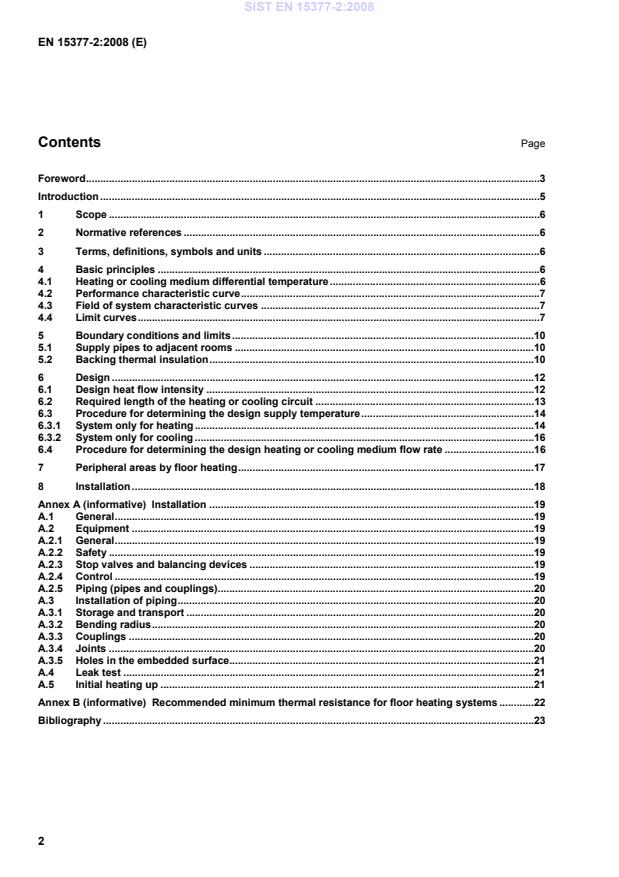
Installation.19 A.1 General.19 A.2 Equipment.19 A.2.1 General.19 A.2.2 Safety.19 A.2.3 Stop valves and balancing devices.19 A.2.4 Control.19 A.2.5 Piping (pipes and couplings).20 A.3 Installation of piping.20 A.3.1 Storage and transport.20 A.3.2 Bending radius.20 A.3.3 Couplings.20 A.3.4 Joints.20 A.3.5 Holes in the embedded surface.21 A.4 Leak test.21 A.5 Initial heating up.21 Annex B (informative)
Recommended minimum thermal resistance for floor heating systems.22 Bibliography.23
1 Scope This European Standard is applicable to water based surface heating and cooling systems in buildings as defined in EN 15377-1. Physiological limitations are taken into account when specifying the maximum and minimum surface temperature. The design is based on performance characteristic curves and limit curves calculated in accordance with EN 15377-1 and EN 1264. Design considerations for heating and cooling systems are specified. 2 Normative references The following referenced documents are indispensable for the application of this document. For dated references, only the edition cited applies. For undated references, the latest edition of the referenced document (including any amendments) applies. EN 1057, Copper and copper alloys — Seamless, round copper tubes for water and gas in sanitary and heating applications EN 1254 (all parts), Copper and copper alloys — Plumbing fittings EN 1264-2, Water based surface embedded heating and cooling systems — Part 2: Floor heating: Prove methods for the determination of the thermal output of floor heating systems using calculation and test methods EN 12828, Heating systems in buildings — Design for water-based heating systems EN 12831, Heating systems in buildings — Method for calculation of the design heat load EN 15377-1:2008, Heating systems in buildings — Design of embedded water based surface heating and cooling systems — Part 1: Determination of the design heating and cooling capacity EN ISO 13370, Thermal performance of buildings — Heat transfer via the ground — Calculation methods (ISO 13370:2007) ISO 17455, Plastics piping systems — Multilayer pipes — Determination of the oxygen permeability of the barrier pipe 3 Terms, definitions, symbols and units For the purposes of this document, the terms, definitions, symbols and units given in EN 15377-1:2008 apply. 4 Basic principles 4.1 Heating or cooling medium differential temperature The heating or cooling medium differential temperature Hθ∆ is calculated as follows (refer to EN 15377-1): SIST EN 15377-2:2008
(K) (1)where Vθ
is the supply temperature of heating/cooling medium in K; Rθ
is the return temperature of heating/cooling medium in K; iθ
is the design indoor temperature in K. In this way, the effect of the temperature drop is taken into account. 4.2 Performance characteristic curve The performance characteristic curve describes the relationship between the heat flow intensity q of a system and the required heating or cooling medium differential temperature. As a simplification, the heat flow intensity is taken to be proportional to the differential temperature of the heating or cooling medium: q = KH .Hθ∆
( W /m²) (2) where KH is the equivalent heat transmission coefficient determined by one of the following equations depending on the type of system:
∏⋅=imiiaB)(
(W/m²K) in accordance with EN 1264-2;
= 1/(Rw + Rr + Rx + Ri ) (W/m²K) in accordance with Annex B of EN 15377-1:2008;
= 1/(RHC + Ri )
(W/m²K) in accordance with Annex C of EN 15377-1:2008. KH may also be determined by Finite Element Method or Finite Difference Method calculations according to Annex D of EN 15377-1:2008. 4.3 Field of system characteristic curves The field of characteristic curves of a surface heating or cooling system with a specific pipe spacing, T, shall at least contain performance characteristic curves for no surface covering, Rλ,B = 0, and additionally it is recommended, if applicable (floor systems), for three different values of heat conduction resistance of the surface covering, in accordance with EN 15377-1 or EN 1264-2. Further, the limit curves shall be included for floor systems (see Figure 1). If the field of characteristic curves for floor heating is based on experimental testing (EN 1264-2), it is acceptable to provide performance characteristic curves by testing for no covering, Rλ,Β = 0, and for heat conduction resistance of the covering, Rλ,Β = 0,15 m² K/W, and establish the remaining performance characteristic curves by linear interpolation. 4.4 Limit curves The limit curves in the field of system characteristic curves describe the relationship between the heating or cooling medium differential temperature and the heat flow intensity for the limit case, with a temperature drop between supply and return water, waterθ∆, and the specified maximum or minimum surface temperature, SIST EN 15377-2:2008
1) National regulations may limit the temperature to a lower or higher value. SIST EN 15377-2:2008
Key 1 heating medium differential temperature Hθ∆ in K 2 heat flow intensity q in W/m2 3 limit curves 4 peripheral areas )(max,Siθθ− = 15 K 5 occupied areas and bathrooms )(max,Siθθ− = 9 K 6 performance characteristic curves
Figure 1 — Field of system characteristic curves including limit curves for floor heating, for constant pipe spacing. Thi
...